Chapter 2
My attorney, Daniel Reeves, did not make promises.
That was why I trusted him.
“No case is won because one side is angrier,” he told me. “We preserve records. We establish facts. We let facts survive longer than anybody’s excuses.”
He helped me request a no-contact order and worked with Detective Morales while CareGrid’s lawyer preserved every communication involving my family and Meridian.
My relatives reacted as though boundaries were some new form of cruelty.
An aunt called Naomi because I stopped answering family calls. A cousin texted that Ryan had made “one terrible mistake” and I was destroying him over it.
Dad left seven voicemails.
In the final one, he said, “You are not the only person who got hurt here.”
I listened twice.
Then I sent it to Daniel.
Mom came to my apartment two days after I was discharged.
Naomi was there sorting groceries and helping me organize medication. When Mom saw her, disappointment crossed her face.
“Could we have five minutes as a family?”
“Naomi stays.”
Mom flinched.
That reaction told me how new my boundaries were.
She sat across from me at the kitchen table.
“Your father thinks lawyers are making everything worse.”
“Ryan made everything worse.”
“I know you’re angry.”
“I was unconscious for days.”
She looked away.
“I know.”
“You left.”
“We thought you were stable.”
“That isn’t the same as staying.”
Her eyes filled.
Immediately, I felt the old reflex—the need to comfort her.
That disturbed me more than the tears.
Even after waking in a hospital and discovering my family had protected the person who put me there, part of me still believed my mother’s pain was mine to manage.
“Your father was terrified,” she said. “Ryan was panicking. Nobody knew what would happen.”
“And somehow the person in the hospital became the least important person in the emergency.”
“That’s not fair.”
“It’s exactly what happened.”
Mom left without asking me to change my statement.
An hour later Dad texted that I had humiliated her.
The next morning Aunt Laura called.
“I’m not taking sides,” she began.
People usually said that before choosing one.
She told me Ryan had always looked up to me. My success made him feel small. Prison could ruin his life.
“What do you think falling down a staircase did to mine?” I asked.
Silence.
Then she said, “But you survived.”
I closed my eyes.
There it was again.
Survival being offered as proof that the harm mattered less.
“That cannot be our family standard.”
“What standard?”
“The one where whoever survives has to protect whoever caused the damage.”
She had no answer.
After that, I stopped arguing with relatives.
My recovery was slower than I wanted.
The wrist healed steadily, but headaches came without warning. My ribs hurt when I coughed, laughed, or turned too quickly in bed. Some afternoons I could work forty minutes before exhaustion swallowed the rest of the day.
The worst part was stairs.
My physical therapist used three shallow practice steps with metal rails on both sides.
The first time she told me to climb them, my hands began shaking.
I hated my body for that.
I had built a company from nothing. I had negotiated with hospital executives who could end a meeting with one bored glance. I had survived months when making payroll depended on deals closing before Friday.
Yet three carpeted steps made my knees weak.
My therapist did not tell me to be brave.
She only said, “Put your hand on the rail.”
I did.
One step.
Then another.
Then I stopped.
That was all I could manage.
Back home, Naomi found me staring at my laptop without typing.
“You know recovery isn’t a performance review, right?”
I gave her a look.
“That look,” she said, putting groceries on the counter, “is exactly why I said it.”
I laughed, then grabbed my ribs.
“Don’t make me laugh.”
“Then stop being ridiculous.”
Naomi never called me strong.
That helped.
She acted as if needing help did not erase my authority.
CareGrid kept moving because the company was more stable than I had let myself believe. Naomi handled operations. Meridian adjusted the implementation timeline without threatening the contract.
During my first project call from home, I apologized afterward for missing so much work.
Naomi stared at me through the screen.
“Claire, nobody here is measuring your value by how quickly you recover.”
I said nothing.
At home, usefulness had always been my safest role. Perform well. Need little. Recover quickly. Then everyone could call me capable while expecting me to absorb more.
CareGrid did not need that version of me.
So I began saying, “I’m done for today,” before my body forced me to stop.
At first it felt like failure.
Eventually, it felt like judgment.
Then Meridian’s legal department produced Ryan’s contact records.
Naomi’s summary had been gentle.
Ryan had asked whether the contract contained personal guarantees. Whether revenue could be assigned. Whether an incapacitated founder’s family might gain a role in company decisions.
He had no legal authority over CareGrid.
What mattered was that, after I was injured, those were the questions occupying him.
Daniel slid the printed records across his desk.
“This does not prove what happened on the staircase by itself,” he said. “But it supports motive and shows what he was focused on afterward.”
I looked at Ryan’s name on the log.
For years, my parents had insisted I misunderstood him because I was too judgmental.
Now strangers had documented his own words.
Several weeks later, the hearing for the no-contact order arrived.
By then I could walk normally on flat ground. My wrist was still in a brace, but the headaches were less frequent.
Naomi came with me to the courthouse.
Daniel was waiting outside the courtroom with another man.
I recognized him immediately.
Elliot Mercer, Meridian’s chief executive.
I had met him four times during contract negotiations. He was formal, precise, and almost aggressively uninterested in small talk.
I stopped.
“What are you doing here?”
“Meridian received a subpoena concerning communications after your hospitalization,” he said. “Counsel asked me to be available to establish business context if necessary.”
It sounded exactly like him.
No speech. No heroics.
Just relevance.
“Thank you.”
He nodded.
Then added, “Your team is performing well.”
That nearly made me cry.
Not because it was affectionate.
Because it was normal.
My company was still being judged by its work.
We entered the courthouse together.
My family stood near a row of benches.
Dad and Mom were side by side. Ryan was with them. Aunt Laura and two cousins had come too.
Dad saw the brace on my wrist and tightened his mouth.
Ryan gave a small, disbelieving laugh.
“This is what she wanted,” Dad said loudly enough for me to hear. “An audience.”
I kept walking.
Then his eyes shifted past me.
He saw Elliot.
Every trace of color left my father’s face.
His shoulders dropped.
Mom looked from him to Elliot.
“Richard?”
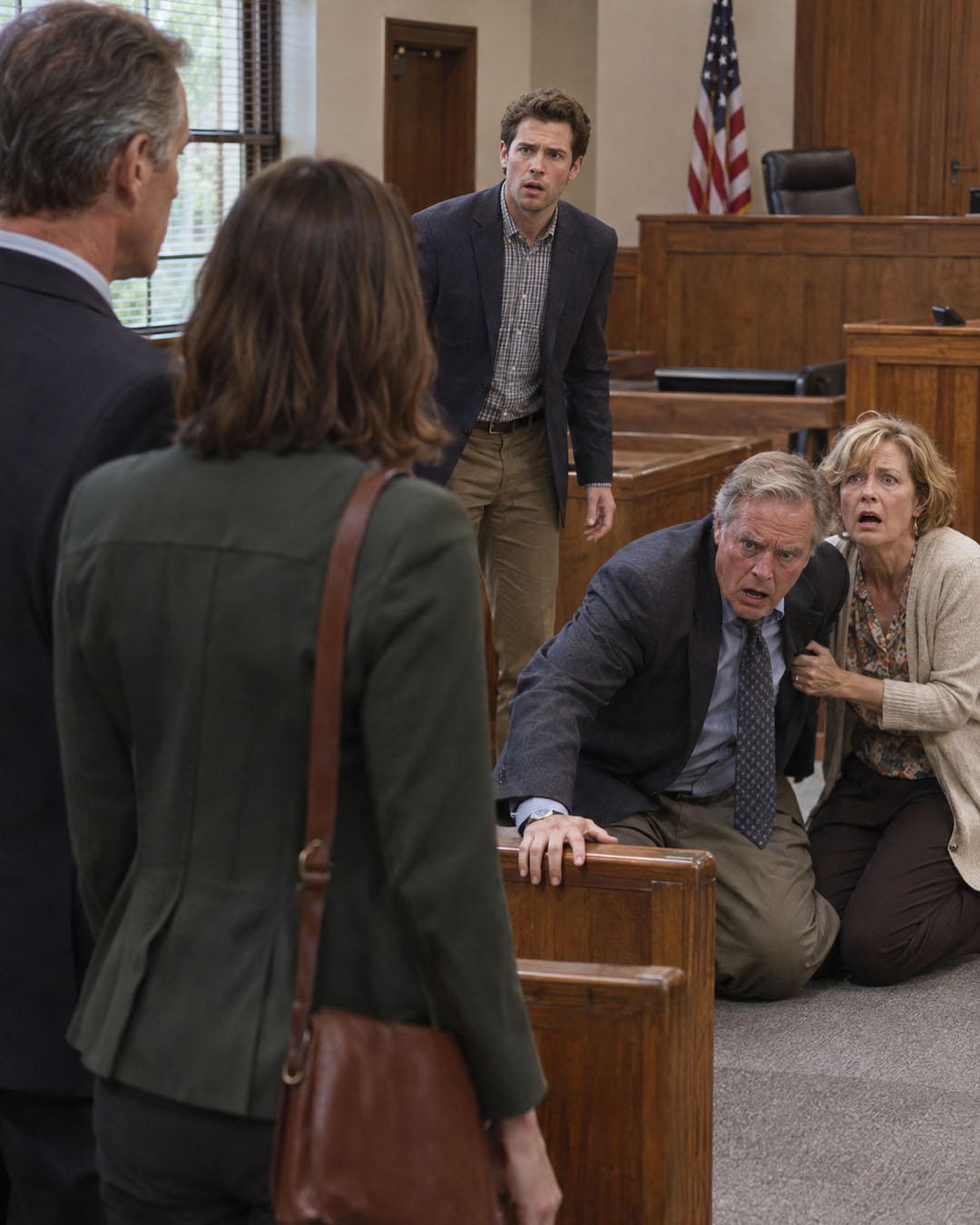
Dad reached behind him for the bench.
“Oh, God.”
His knees buckled.
Mom grabbed his sleeve and went down beside him.
Even Ryan looked startled.
Elliot simply watched my father.
“Richard Bennett,” he said.
Dad stared at him.
I looked between them.
“You know each other?”
“No,” Dad said too quickly.
Elliot turned toward me.
“Yes.”
One word.
And suddenly the hearing about my brother was no longer the only reason my father looked terrified.
Chapter 3
The courtroom did not turn into the kind of dramatic confrontation people see on television.
Daniel would not permit it, and neither would the judge.
The hearing remained focused on the immediate question: whether there was a reasonable basis to continue restrictions on Ryan contacting me.
Meridian’s records mattered.
Ryan’s attorney argued that he had merely tried to help the family understand my affairs while I was incapacitated.
Daniel asked why “helping” required questions about assigning corporate revenue.
Ryan had no good answer.
The temporary order remained in place.
That should have been enough for one day.
It wasn’t.
Outside the courtroom, Mom caught me near the elevator.
“What did Mr. Mercer mean?”
Dad came up behind her.
“Diane, not here.”
She turned on him.
“I asked Claire.”
“I don’t know,” I said. “I was about to ask you.”
Dad glanced across the hall.
Elliot stood speaking with Meridian’s attorney.
My father looked at him the way a person watches smoke rising from a house he hoped had stopped burning years ago.
Later that afternoon, Elliot agreed to meet with Daniel and me.
He did not tell stories.
He gave facts.
Fourteen years earlier, my father had worked in procurement at Meridian. An internal investigation found that he had altered vendor evaluation documents to benefit a business owned by someone he knew.
Elliot had been among the executives reviewing the findings.
He approved my father’s termination.
I sat motionless.
“My father told us his department was restructured.”
Elliot’s expression barely changed.
“I cannot speak to what he told his family. I can tell you why Meridian ended his employment.”
I thought about every lecture Dad had given me about accountability.
Every time he said Ryan needed compassion while I needed discipline.
Every time his version of events became family truth simply because he delivered it confidently.
When I told Mom, she refused to believe me.
Then Daniel showed her the employment records Meridian was legally able to provide.
She read them twice.
“He told me they eliminated his position.”
“I know.”
“Fourteen years.”
I did not answer.
Her face seemed to collapse inward.
For most of my life, Mom had allowed Dad to define reality whenever things became uncomfortable. He said Ryan was under pressure, so Ryan was under pressure. He said I was too rigid, so I was too rigid. He said an argument caused my fall, so an argument caused my fall.
Now she had proof that he had once rewritten his own disgrace in exactly the same way.
She sat silently for a long time.
Then she looked at me.
“I saw him push you.”
I stopped breathing.
“What?”
Her hand covered her mouth.
“I saw Ryan put his hands on you. I saw you go backward.”
The room seemed to shrink.
“Then why did you tell the police I fell?”
“I was scared.”
“For who?”
She began crying.
“Ryan.”
The answer hurt more because she did not hide behind another excuse.
Dad had convinced her Ryan’s future would be destroyed. She imagined prison, financial ruin, disgrace, every nightmare a mother could imagine for a son.
So she had moved the danger away from him.
Onto me.
She had decided I could survive one more thing.
I stood.
“Claire, please. You need to understand—”
“Telling the truth now does not erase what you did then.”
“I know.”
“No. I don’t think you do.”
She nodded slowly.
“You’re right.”
I stared at her.
It may have been the first time anyone in my family had said those words to me without adding a defense.
Three days later, Diane Bennett returned to investigators and corrected her statement.
She admitted she had witnessed Ryan intentionally shove me.
Dad called her decision an unforgivable betrayal.
Mom moved into Aunt Laura’s guest room that weekend.
The criminal case did not end with one dramatic revelation. Evidence accumulated piece by piece.
My statement stayed consistent.
Mom changed hers to match what she had actually witnessed.
My injuries matched the fall.
Ryan’s financial problems were documented.
His calls to Meridian showed what he had been focused on while I was unconscious.
And the original family story no longer held together.
Eventually, Ryan accepted a plea agreement on a serious assault charge.
There was time in custody. There was restitution. The no-contact restrictions continued.
His business collapsed under debt, missed work, and problems that had existed long before the day he pushed me.
I did not celebrate.
When Daniel called me with the final outcome, I sat alone in my office after everyone else had gone home.
I thought I would feel vindicated.
Instead, I grieved.
Ryan was my little brother.
I remembered teaching him to ride a bike in our driveway. I remembered dividing Halloween candy with him at the kitchen table. I remembered stepping between him and two older boys in middle school when they mocked him for struggling in class.
Those memories were real.
So was the staircase.
That was one of the hardest truths I had to accept.
Someone does not have to be cruel in every memory to become unsafe in your life.
Months later, Mom asked to see me.
I chose a coffee shop.
Not my apartment.
Not her house.
Neutral ground.
She looked older when she walked in.
“I’m not asking you to forgive me,” she said.
“Good.”
A sad smile touched her mouth.
“I deserved that.”
She was still living apart from Dad. He insisted she had destroyed the family by correcting her statement. Ryan barely spoke to her.
“I understand if you want nothing from me,” she said.
I looked at the woman who had held cool washcloths against my forehead when I was sick as a child, then left my hospital bedside when I needed her most as an adult.
“I don’t know what our relationship becomes.”
She nodded.
“But if there is one, it cannot be built around pretending.”
“I understand.”
“I need distance.”
“I understand that too.”
For once, I believed she might.
Dad never reached that point.
His messages alternated between anger and wounded disbelief until I blocked his number.
He never admitted that protecting Ryan had required sacrificing me.
He never apologized for asking me to doubt my own memory.
And he never explained why he had lied about Meridian for fourteen years.
Eventually, I stopped needing him to.
Chapter 4
Seven months after the fall, CareGrid’s first major Meridian deployment went live.
I attended in person.
Naomi stood beside a conference-room screen while hospital staff reviewed the first inventory forecasts produced through our system.
There were problems.
Of course there were.
One data feed had to be corrected. A hospital department had mapped several supply categories incorrectly. Our support team stayed late fixing discrepancies.
It was perfect.
Not because nothing went wrong.
Because it was real.
We had built something capable of working through mistakes without pretending they had never happened.
Near the end of the day, Naomi closed her laptop.
“Elevator?”
I looked down the hallway.
Twenty feet away was the stairwell door.
My ribs had healed. My wrist was strong again. The headaches were rare.
The fear had not disappeared completely.
I had stopped expecting it to.
Maybe some experiences do not vanish because we understand them. Maybe healing is simply reaching the point where fear no longer gets to make every decision.
“I’ll take the stairs,” I said.
Naomi looked at me once.
She understood enough not to turn it into a ceremony.
“See you downstairs.”
I pushed open the door.
The stairwell smelled faintly of concrete and disinfectant.
My hand found the rail.
For half a second, I was back in my parents’ house, Ryan standing in front of me and empty space behind me.
I stopped.
Breathed.
Then I looked down.
One step.
Another.
Nobody was watching.
There was no courtroom. No family argument. No detective. No one asking me to prove that what happened had happened.
Halfway down, I noticed my hand had loosened around the rail.
By the next landing, I was barely touching it.
I opened the door to the lower floor and heard my team laughing somewhere down the hall.
I stood there listening for a moment.
My company had survived.
I had survived.
But survival no longer meant what my family had tried to make it mean.
For most of my life, I thought strength meant being able to absorb whatever other people needed to unload—their disappointment, their debts, their anger, their mistakes, their consequences.
I believed love meant making room for people until there was almost none left for me.
Ryan taught me otherwise.
So did Mom.
So did Dad.
Strength was not how much damage I could carry without complaining.
It was telling the truth when silence would have been easier.
It was accepting that compassion did not require surrendering my safety.
It was understanding that consequences were not revenge simply because someone I loved did not want to face them.
And it was allowing myself to grieve people who were still alive without reopening the door to what they had done.
I walked toward the sound of my team.
Naomi saw me first.
She did not ask about the stairs.
She simply handed me a folder and said, “We have one more issue with the inventory mapping.”
I smiled.
“Of course we do.”
We returned to the conference room together.
Nothing in my life had become magically easy. My relationship with Mom remained careful and limited. Some months were better than others. Dad remained blocked. Ryan had to live with consequences I had once been expected to absorb for him.
And I had days when grief returned without invitation.
But grief was not the same thing as regret.
I did not regret telling Detective Morales the truth.
I did not regret refusing to change my statement.
I did not regret the no-contact order.
I did not regret walking into court while my family watched.
The strange thing was that the courthouse moment I remembered most was not Dad collapsing when he recognized Elliot Mercer.
It was what happened afterward.
For years, Dad had controlled our family through certainty. He could explain away almost anything if he spoke firmly enough. Ryan’s failures became bad luck. Mom’s silence became peacekeeping. My boundaries became selfishness. Dad’s own firing became a corporate restructuring.
Then he saw one man who knew the truth.
And all that certainty disappeared from his face.
That image stayed with me because it reminded me of something simple.
The truth does not always arrive dramatically.
Sometimes it is a police report.
Sometimes it is a business record.
Sometimes it is a mother finally admitting what she saw.
Sometimes it is a woman standing beside a hospital bed and saying no.
And sometimes it is just a quiet decision made on a staircase:
One step.
Then another.
I used to think my family’s love was something I had to earn by being useful enough, forgiving enough, and strong enough to survive what they asked me to overlook.
I know better now.
What happened to me counted.
My fear counted.
My future counted.
And loving someone had never required me to become the hiding place for their consequences.
I turned back toward the conference room, where people were waiting for me not because I could absorb everything, but because they trusted my judgment.
For the first time in a long time, that difference felt like freedom.
THE END.
⚠️ All characters and events are fictional. Do not imitate or apply them in real life. 😌😌😌