Chapter 2
Sam introduced himself more fully. His name was Samuel Whittaker, and he worked with a philanthropic fund that supported adult education programs throughout Ohio.
He explained that he’d come to the reunion because Whitmore University was recognizing several alumni for their community contributions. He was participating in the recognition breakfast scheduled for the following morning.
“I read about Second Chapter several months ago,” he said. “Your approach to older learners caught my attention.”
I shrugged.
“We just try not to make people feel foolish.”
“That sounds simple.”
“It should be. But people have a way of making simple things complicated.”
He laughed.
We began talking about how the program started. I told him about the first four students, the borrowed folding tables, and the retired teachers who volunteered to help us.
“We had one coffee machine,” I explained. “It worked whenever it felt appreciated.”
“Did you appreciate it?”
“Every Thursday. It still broke.”
Sam laughed again.
For the first time that evening, I stopped thinking about Richard.
I was enjoying a conversation without worrying about whether my words sounded impressive enough.
Sam asked why so many older adults hesitated to enroll in literacy classes.
“Shame,” I answered.
He nodded thoughtfully.
“That’s what I suspected.”
I explained that some people had struggled in school because of learning difficulties nobody recognized. Others had left school to help their families or care for younger siblings. By the time they reached retirement, asking for reading assistance felt almost impossible.
“They’ve spent decades learning how to hide it,” I said. “Some of them are better actors than anybody in Hollywood.”
Sam smiled, then became thoughtful.
“My wife struggled with reading during the final years of her life.”
“I’m sorry.”
“She had a neurological condition. Before that, she could finish a novel in a weekend. Later, sometimes she couldn’t follow a paragraph.”
He looked down at his hands.
“She started telling people she wasn’t interested in books anymore.”
I understood immediately.
“She didn’t want anyone to know she was having trouble.”
“Exactly.”
He explained that his wife had been a schoolteacher. Losing confidence in something she’d done so naturally had been heartbreaking.
“She wasn’t embarrassed about needing glasses,” he said. “But needing help reading a letter? That was different.”
I thought about Margaret Ellis, one of our students.
Margaret was 68, a retired school kitchen worker who had joined Second Chapter three years earlier. She had spent most of her working life relying on familiar labels, memorized routines, and the kindness of coworkers when unfamiliar paperwork appeared.
After retirement, she wanted to read bedtime stories to her granddaughter.
The first time she walked into our classroom, she’d looked at me and said, “I think I’m too old for this.”
I told her she wasn’t.
She replied, “That’s easy for you to say. You already know where the commas go.”
I told Sam about Margaret’s determination and her battles with the English language. She once told me that silent letters had been invented by someone who didn’t like children.
Sam laughed.
After several months of practice, Margaret finished reading an entire children’s book.
She cried.
Then she laughed because she’d been so excited that she’d accidentally turned the book upside down while celebrating.
“She told me she finally felt smarter than her refrigerator,” I said.
Sam smiled.
“That’s a wonderful story.”
“It’s hers. She did the hard part.”
He studied me for a moment.
“You talk about six years of work as though it were something you did between grocery shopping and laundry.”
I felt my cheeks warm.
“Well, there was quite a bit of grocery shopping involved.”
“Claire, do you understand what you’ve accomplished?”
I didn’t know how to answer.
I could list our attendance numbers, volunteer hours, and learning goals. I knew how many people we’d served. I knew how much effort went into keeping the program running.
But saying I was proud of myself felt strangely uncomfortable.
“It’s a good team,” I finally said.
“I’m sure it is. But somebody had to start it.”
I looked down at my hands.
“Yes,” I said quietly. “Somebody did.”
Sam then asked whether my husband was Richard Bennett.
I nodded.
“Do you know him?”
“Not personally. I’ve seen his name in the reunion materials.”
That surprised me. Richard had graduated from Whitmore thirty years earlier, but he hadn’t been especially involved with the university until recently.
Sam asked another question.
“What do you enjoy most about your work?”
“The moment someone stops apologizing for needing help.”
I explained that many students apologized before they even sat down. They apologized for reading slowly, asking questions, or making mistakes.
“And what do you tell them?”
“That they don’t owe me an apology.”
Sam smiled.
“Good advice.”
Across the ballroom, I spotted Richard talking with Greg Hollis. He was laughing loudly, shaking hands, and leaning forward with the eager expression he reserved for people he considered important.
Sam followed my glance.
“Your husband?”
“Yes.”
“Would you like to join him?”
I hesitated.
“He asked me to stay here.”
Sam looked puzzled.
“Why?”
For a moment, I considered inventing an excuse. Then I realized I was tired of inventing things to protect my husband’s reputation.
“He said he was embarrassed to be seen with me.”
Sam didn’t respond immediately.
Then he said, “I’m sorry he said that.”
I shrugged.
“It’s been a long evening.”
We continued talking. He told me about his grandchildren and a vegetable garden he maintained despite being terrible at growing tomatoes. I told him about my disastrous attempt at growing basil, which had produced enough leaves to supply an Italian restaurant.
It was an ordinary conversation.
And somehow, that made it wonderful.
Nearly two hours after Richard had abandoned me, he finally returned.
I saw him approaching from across the ballroom. He looked annoyed at first, probably because he had noticed I wasn’t where he’d left me.
Then he recognized Sam.
His entire expression changed.
“Claire,” he said sharply. “What are you doing?”
I looked up.
“Talking.”
Richard turned toward Sam.
“Dr. Whittaker! I didn’t realize you were here.”
He laughed nervously and extended his hand.
Then he looked back at me.
“Do you even know who he is?”
I opened my mouth.
Richard interrupted.
“Who gave you permission to talk to him?”
His voice was louder than he’d intended. A couple standing nearby turned around.
Sam slowly stood.
Richard forced an awkward smile.
“I’m sorry. My wife doesn’t always understand these kinds of events.”
Sam looked at me, then at Richard.
“Actually, Mr. Bennett, your wife is the woman behind the program I came here to recognize.”
Richard stopped smiling.
“Second Chapter,” Sam continued. “I’ve been reading about it for months.”
For a moment, nobody spoke.
Then Richard recovered.
“Well, yes. It’s something our family has been involved with. We’ve both contributed quite a bit.”
Sam nodded.
“Indeed. Then perhaps you can help me clear something up.”
Richard straightened his jacket.
“Of course.”
Sam pulled out a chair.
“How did Second Chapter begin?”
Richard smiled.
“Well, that’s a long story.”
Sam sat down.
“I have time.”
And for the first time that evening, Richard looked as though he wished he were somewhere else.
Chapter 3
Richard had a particular smile he used when he didn’t know the answer to a question.
I’d seen it at dinner parties, neighborhood meetings, and once when our accountant asked why he’d forgotten to send an important tax document.
He smiled that way at Sam.
“Well, you know how these things start. You see a need in the community. You bring people together.”
Sam nodded.
“Certainly. Which library branch hosted the first sessions?”
Richard hesitated.
“The downtown branch, I believe.”
I looked at him.
Second Chapter hadn’t started downtown. Our first classes had been held at a small neighborhood library on Columbus’s West Side. The room was so cramped that one of our volunteers had to move a folding table whenever somebody needed to use the restroom.
Sam asked another question.
“How did you recruit the first tutors?”
“Professional connections, mostly,” Richard answered. “We reached out to people we knew.”
I stared at him.
Our first tutors were two retired teachers and Ellen Parker, my longtime friend. Ellen had joined because I’d asked for help after she retired from her school administration job.
The other teachers had responded to a handwritten notice I’d posted on the library bulletin board.
Richard hadn’t recruited anyone.
He hadn’t even visited the first classroom.
Sam turned toward me.
“Claire, is that how you remember it?”
I could feel Richard watching me.
“No,” I said.
My voice was quiet, but the word was clear.
“No, that isn’t how it happened.”
Richard laughed.
“Claire remembers all the little details.”
“I remember because I was there.”
Sam didn’t smile.
“I believe there’s something we should clarify.”
He reached inside his jacket and removed a folded booklet. It was the reunion program, containing short biographies of alumni being considered for community service recognition.
He opened it to a page bearing Richard’s name.
“Have you seen this, Claire?”
I shook my head.
He handed it to me.
Under Richard Bennett, Class of 1996, was a short biography.
I began reading.
“Founder and driving force behind Second Chapter, a Columbus-based adult literacy initiative helping older adults regain confidence through education.”
I read it twice.
Then I noticed the next paragraph.
It described volunteer recruitment, program development, and expansion into additional library locations.
I recognized the wording.
I’d written most of it myself.
A week earlier, Richard had asked me to send him the report. He’d said he wanted to show his classmates what I’d accomplished.
Instead, he’d put his own name on it.
I looked at him.
“Richard, did you write this?”
He glanced at Sam.
“It’s just a summary.”
“It says you founded Second Chapter.”
“Claire, don’t make a scene.”
I kept looking at him.
“I asked you a question.”
His jaw tightened.
“We’re married. It’s a family project.”
“No, Richard. It’s a library program.”
“Which I’ve supported.”
“You made a donation.”
“Exactly.”
I looked back at the booklet.
He had changed the founder’s name, but almost everything else was taken directly from my report.
The worst part wasn’t even the lie.
It was remembering how happy I’d been when he asked me for the document. I’d thought he was finally proud of me.
I felt foolish for believing it.
Sam spoke quietly.
“The original report I reviewed through the Whitaker Fund identifies Claire as the founding coordinator, working with the library staff.”
Richard cleared his throat.
“Well, that report was written from her perspective.”
“Was it inaccurate?” Sam asked.
Richard didn’t answer.
“Because this biography identifies you as the founder.”
Richard glanced toward the people nearby.
“Perhaps we should discuss this somewhere private.”
Sam agreed.
“Certainly.”
We moved into a smaller lounge beside the ballroom. Sam closed the door but left it slightly open. He wasn’t trying to trap Richard. He simply wanted to understand the discrepancy.
“Mr. Bennett,” he began, “the committee included your community service statement because you’re being considered for an alumni advisory position. If there’s an error, it needs to be corrected.”
Richard crossed his arms.
“I may have phrased things broadly.”
“Broadly is one thing. Incorrectly is another.”
Richard turned toward me.
“Claire, tell him I supported your work.”
“You did.”
He relaxed slightly.
Then I continued.
“You gave Second Chapter $200 at our first fundraiser. I thanked you for it.”
His expression tightened.
“You make it sound like that was nothing.”
“It wasn’t nothing. But it wasn’t six years of work.”
I remembered that fundraiser vividly. Richard had spent most of the evening complaining about the coffee and asking whether we really needed so many volunteers.
Now he was claiming he’d recruited those volunteers himself.
Sam explained that he would ask Diane Mercer, the reunion committee’s co-chair, to review the conflicting information before the following morning’s breakfast.
Then he turned to me.
“Would you be willing to confirm the program’s history?”
I looked at Richard.
He gave me the expression I knew so well. The one that meant I was about to make his life difficult.
For years, I’d changed my answers whenever I saw that look.
This time, I didn’t.
“Yes,” I said.
Sam thanked me.
He also made something clear.
“This isn’t about embarrassing anyone. The committee has an obligation to present accurate information.”
Richard forced a smile.
“Naturally.”
But he didn’t look at me again until we were back in our hotel room.
The moment the door closed, he turned around.
“Do you have any idea what you just did?”
I set my purse on the dresser.
“I told the truth.”
“You contradicted me in front of Samuel Whittaker.”
“You told him you founded my program.”
“Our program.”
“Richard, we’re married. Why does that make my work yours?”
He pulled off his jacket.
“Your accomplishments are our accomplishments.”
I looked at him.
“Then why do they only have your name on them?”
He opened his mouth, then closed it.
For a moment, I thought he might apologize.
Instead, he said, “You don’t understand how these things work.”
“Then explain it.”
He paced toward the window.
“I’m trying to get onto the alumni advisory committee. Do you know how valuable those connections could be?”
“So you put your name on my work.”
“I helped you build a stable life so you could afford to spend time at the library.”
That hurt more than I expected.
I had worked throughout our marriage, managed our household, adjusted my schedule around his career, and helped care for his father when he became ill.
Apparently, none of that counted.
“You gave us $200,” I said. “And spent most of that fundraiser complaining about the refreshments.”
“That was still support.”
“Support isn’t ownership.”
He shook his head.
“Nobody checks these things that closely.”
“Apparently, somebody did.”
He turned toward me.
“You’re being ridiculous.”
I took a breath.
“When was the last time you were proud of something I did?”
He stared at me.
“What kind of question is that?”
“A simple one.”
“Claire, I’m tired.”
“Then answer it tomorrow.”
He didn’t.
A few minutes later, my phone buzzed.
It was a message from Diane Mercer.
She introduced herself as the recognition committee co-chair and asked whether I could verify some details about Second Chapter before Saturday morning’s presentation.
The breakfast began at 9:00.
Richard saw the message on my screen.
“You’re not answering that.”
I looked at him.
Then I sat on the edge of the bed and began typing.
Chapter 4
I didn’t sleep much that night.
Richard fell asleep with the television on. I lay beside him listening to advertisements and thinking about the past 27 years.
I’d been happy once.
We had shared bills, holidays, family dinners, and worries about money. When Richard’s father became ill, I’d arranged appointments and driven him to medical visits. When Richard traveled for work, I kept everything running at home.
I had never considered those things sacrifices.
They were simply what married people did for each other.
Somewhere along the way, though, our arrangement had changed.
Richard’s work became important.
Mine became something I did because I had time to spare.
His problems were emergencies. Mine were inconveniences.
And I’d accepted it because arguing seemed harder.
Around 6:00 in the morning, I finally gave up trying to sleep.
I made coffee in the hotel room and sat by the window with my phone.
I had drafted a response to Diane the previous night, but I still needed to send the supporting documents.
I kept thinking about what would happen when we returned to Columbus.
Richard could sulk for days when he felt criticized. Sometimes he’d barely speak to me. Other times, he’d become overly cheerful, pretending the argument had never happened.
I’d usually accepted whichever version appeared because I wanted things to return to normal.
But I was beginning to understand that our normal wasn’t especially good.
At 7:00, I called Ellen Parker.
She answered on the fourth ring.
“Claire, somebody better be having a baby.”
“Nobody’s having a baby.”
“Then this had better be interesting.”
I told her everything: the corner, Sam, the booklet, and Richard’s claim that he’d founded Second Chapter.
Ellen was silent for several seconds.
“Richard couldn’t even find our first classroom.”
I laughed despite myself.
“He thought we started downtown.”
“Of course he did. He came to one fundraiser and complained about the coffee.”
I reminded her that he’d donated $200.
“Good for him. I hope he also remembers that the coffee machine was donated by a woman who didn’t ask to have her name engraved on it.”
I smiled.
Ellen had been one of our first volunteers. She knew exactly how much work had gone into the program.
Then her voice softened.
“Are you okay?”
I looked toward the closed bathroom door. Richard was taking a shower.
“I don’t know.”
“What are you worried about?”
“Going home with him.”
Ellen waited.
“And going home without him,” I added.
That was the truth.
I was 52 years old. I’d been married since I was 25. I knew how to run a classroom, organize volunteers, and stretch a library budget until it begged for mercy.
I didn’t know how to start my personal life over.
Ellen was quiet for a moment.
“You don’t have to decide the next twenty years today.”
“I know.”
“Just decide whether you’re willing to lie for him one more time.”
I stared at my phone.
“No.”
“Then there’s your answer.”
After we hung up, I sent Diane the original Second Chapter report.
I also included a link to the library’s public program history, which identified me as the founding coordinator. I explained Richard’s actual contribution. He had donated $200 and attended a fundraiser.
I didn’t leave that out.
I wasn’t trying to make him look worse. I simply wanted the record to be accurate.
Diane replied shortly afterward.
She thanked me and explained that the committee would verify the information with the library before making any changes.
No dramatic promises.
No threats.
Just a professional response.
At 8:00, Richard and I sat across from each other in the hotel café.
He had scrambled eggs and toast.
I had coffee and half a bagel.
Neither of us had much appetite.
“I sent Diane the original report,” I told him.
He put down his fork.
“You did what?”
“I answered her questions.”
“You should have talked to me first.”
“I did. Last night.”
He looked around the café.
“Keep your voice down.”
My voice hadn’t been raised.
That was another thing Richard did. He accused me of making a scene whenever he disliked what I was saying.
“You can still correct your statement yourself,” I said.
“There’s nothing to correct.”
“Then why does it say you founded Second Chapter?”
He sighed.
“I was trying to present our family in the best possible light.”
“By leaving me out?”
“You’re taking this personally.”
I looked at him.
“Richard, it’s my name you replaced.”
He pushed his plate away.
“You’re determined to ruin this weekend.”
I thought about arguing.
Instead, I asked one question.
“How would you feel if I told people I founded your company?”
He laughed.
“That’s ridiculous. You don’t know anything about my business.”
“Exactly.”
He stared at me.
I paid for my coffee and went upstairs.
I put on the same navy dress I’d worn the previous night. For a moment, I considered changing into something more impressive.
Then I stopped.
I liked the dress.
That was enough.
When I came downstairs, I found Sam sitting in the hotel courtyard with a paper cup of coffee.
“Good morning, Claire.”
“Morning.”
He motioned toward the chair beside him.
“You look like you’ve had a difficult night.”
“I have.”
I sat down.
“I’m afraid people are going to think I’m a wife trying to embarrass her husband,” I admitted.
Sam considered that.
“Are you?”
“No.”
“Then don’t try to embarrass him. Tell the truth.”
I looked toward the courtyard.
“That sounds easier than it feels.”
“It usually does.”
He explained that the committee was reviewing the information independently. He wouldn’t decide the outcome himself.
I appreciated that.
I didn’t want a powerful man punishing Richard on my behalf.
I simply wanted people to know who had actually done the work.
“Wanting accurate credit isn’t selfish, Claire,” Sam said.
I took a breath.
“I’m not trying to take anything from Richard.”
“I understand.”
“I’m just not going to hand him anything else.”
Sam nodded.
“That sounds reasonable.”
At 8:40, I entered the breakfast ballroom.
Richard was talking with Greg Hollis near the front.
As I approached, I heard my husband say, “Claire’s been a little emotional this weekend. She sometimes takes things the wrong way.”
Greg looked uncomfortable.
Richard noticed me and stopped talking.
I didn’t confront him.
I walked to an empty table.
A moment later, Diane approached and sat beside me.
“Claire, I wanted to speak with you before we begin.”
My stomach tightened.
“We verified the program history with the library,” she said. “Your report was accurate.”
I nodded.
“We offered Richard the opportunity to amend his statement or withdraw it.”
“What did he say?”
“He declined. He maintains that the language is appropriate.”
I looked toward Richard.
He was laughing at something Greg had said.
Diane continued.
“The committee has removed his community service recognition from this morning’s presentation. Consideration of his advisory application has also been postponed.”
I felt both relieved and sad.
I’d given Richard a chance to correct the information privately.
He had refused.
Diane touched the printed program.
“Dr. Whittaker would still like you to participate in the adult literacy discussion, if you’re comfortable.”
I looked toward the small podium.
Richard was watching us.
For a moment, I felt the familiar urge to make myself invisible.
Then I remembered Ellen’s question.
Was I willing to lie for him one more time?
I turned back to Diane.
“Yes,” I said. “I’d like to participate.”
Chapter 5
There were about 80 people at the recognition breakfast.
Round tables covered in white cloths filled the ballroom. A small stage stood at the front with a podium, two chairs, and a university banner.
I sat near the middle with Diane.
Richard was at a table closer to the front.
He hadn’t spoken to me since breakfast.
The event began with remarks from the university’s alumni director. There were introductions, announcements, and a short presentation about scholarship funds.
Richard kept glancing at the printed program.
I knew why.
His original community service profile was still listed, but when the director moved into the recognition portion, Richard’s name wasn’t called.
There was no announcement explaining the omission.
No one pointed at him.
The committee simply didn’t recognize work it couldn’t accurately attribute to him.
A few minutes later, Sam was introduced.
The room applauded as he walked toward the podium.
He thanked the university for recognizing his years of work in education. He spoke about teaching, community programs, and the importance of giving adults opportunities to learn throughout their lives.
Then he mentioned his late wife.
“She taught me that needing help doesn’t make a person less capable,” he said. “Sometimes it simply means life has handed them a problem they never expected.”
I thought about our conversation the previous evening.
Sam continued by describing several literacy initiatives his fund had been studying.
One was Second Chapter.
He explained that the program had begun with a small group of volunteers and had grown into a valuable resource for adult learners in Columbus.
Then he said my name.
“Claire Bennett is here with us this morning. She helped establish Second Chapter and continues to coordinate its work. Claire, would you join me?”
I stood.
My knees felt unreliable.
On my way toward the front, I bumped one against the corner of a chair. Not hard enough to hurt myself, but enough to remind me that I hadn’t suddenly become graceful.
When I reached the microphone, I looked at Sam.
“I’ve helped adults who were nervous about reading aloud. Apparently, I should have asked them for advice before coming up here.”
People laughed.
I relaxed a little.
Sam asked how Second Chapter had started.
I told the room about the woman who first made me realize how many adults were afraid to ask for reading assistance. She had come into our library looking for a children’s book. When I offered to help, she admitted she couldn’t read well enough to choose one.
She was embarrassed.
I remembered thinking how unfair it was that a person could spend decades believing they didn’t deserve help.
So I spoke with our library manager. We found a small room, borrowed tables, and asked for volunteers.
“The first coffee machine worked approximately 40 percent of the time,” I said. “Which made it our most unpredictable employee.”
There was another ripple of laughter.
I explained how the program grew. I credited Ellen, the retired teachers, and the library staff who helped us.
I talked about our learners without revealing private information they hadn’t agreed to share.
Then I told Margaret’s story.
I explained that Margaret had worked in a school kitchen for years. She had raised children, paid bills, managed a household, and helped her family through difficult times.
But reading unfamiliar material remained difficult for her.
After retirement, she wanted to read stories to her granddaughter.
It took months of practice.
Finally, she finished an entire children’s book.
“She told me she felt like the grandmother she’d always wanted to be,” I said.
Several people smiled.
A woman near the front dabbed her eyes with a napkin.
I looked around the room.
Nobody seemed bored.
Nobody was checking a watch.
Sam asked what advice I’d give someone starting a similar program.
I thought about that for a moment.
“Start small. Listen before you decide what people need. And don’t confuse being important with being useful.”
I paused.
“The two aren’t always the same.”
The room applauded.
It wasn’t thunderous, but it was warm and sincere.
I looked toward Richard.
He was sitting very still.
For a moment, I felt that old reflex.
Maybe I’d said too much.
Maybe I should have kept my answers shorter.
Maybe he would be angry.
Then I caught myself.
I was discussing a program I’d helped build. I was answering questions honestly.
There was nothing to apologize for.
After the presentation, several guests approached me.
A retired teacher asked about volunteering. Another woman wanted information about starting a similar program near Dayton.
Then Greg Hollis came over.
“Claire, that was interesting.”
“Thank you.”
“I have employees who might benefit from something like this. Do you ever work with businesses?”
“Sometimes. We have evening sessions, and we can help connect employers with appropriate adult education resources.”
He nodded.
“I’d like to learn more.”
We discussed volunteer training and ways companies could support literacy without making employees feel singled out.
Then Richard appeared.
“Greg, there you are.”
He turned toward me.
“Claire’s been telling you about our program.”
Greg looked at him.
“She has.”
Richard smiled.
“I can put you in touch with the right people.”
Greg glanced at me.
“I believe I’m already talking to the right person.”
It was a perfectly polite sentence.
But Richard’s smile stiffened.
“Well, naturally, Claire and I have both put quite a bit into Second Chapter.”
I looked at my husband.
He’d had an entire night to think about what he’d done.
He’d had an opportunity to correct his statement.
And he was still doing it.
“Richard made a donation when we started,” I said. “I appreciated that.”
He smiled slightly.
Then I added, “But he didn’t found the program.”
The little group went quiet.
Richard’s smile disappeared.
“Claire, not here.”
I looked at him.
“You brought my work here, Richard. I didn’t.”
He lowered his voice.
“I was just trying to make our family look good.”
“Then why didn’t you mention my name?”
He glanced toward Greg.
“Can we discuss this later?”
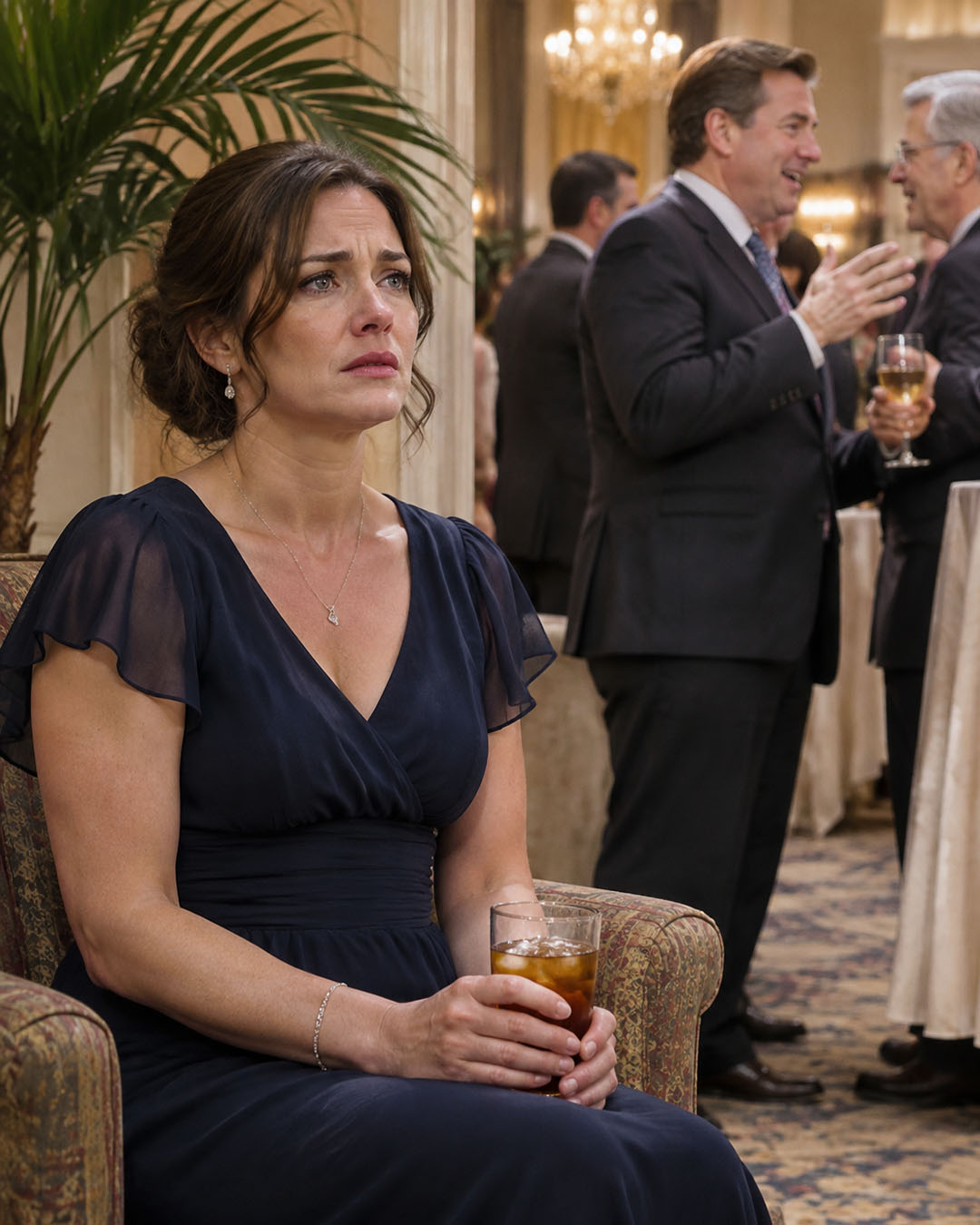
I thought about the night before, the chair beside the dusty artificial palm tree, and the way he’d walked away without looking back.
Then I asked the question that had been sitting in my chest for nearly two hours.
“Why were you so embarrassed to be seen with me last night?”
Richard went still.
Greg looked between us.
Diane, who had approached with another guest, stopped a few feet away.
Richard’s face reddened.
“That was private.”
“So was my work,” I replied. “Until you decided to put your name on it.”
Nobody applauded.
Nobody cheered.
Greg looked uncomfortable, as any decent person would.
He thanked me for the conversation and said he’d contact the library about arranging a visit.
Then he excused himself.
Diane approached Richard.
“Could I speak with you for a moment?”
He looked relieved to leave.
I watched them move toward the side of the room.
Later, Diane explained that Richard’s advisory application would not proceed during that selection cycle. The committee also required a written clarification before correcting the inaccurate alumni record.
Richard could acknowledge the actual program leadership or leave the original claim formally disputed in the committee’s records.
He eventually chose to correct it.
At the time, though, he was furious.
He caught up with me outside the ballroom.
“You enjoyed that, didn’t you?”
I stopped near the hotel entrance.
“Enjoyed what?”
“Watching everybody turn against me.”
“Nobody turned against you, Richard. They learned what happened.”
“You made me look like a fool.”
I considered that.
For 27 years, I’d spent a remarkable amount of energy helping Richard look good. I’d finished his sentences when he forgot names, covered for him when he was rude, and laughed at jokes that weren’t funny.
I’d even apologized to people after he offended them.
Somehow, he’d decided that was my responsibility.
“No,” I said. “I finally stopped helping you pretend.”
Richard stared at me.
“Do you know what that committee position meant?”
“Yes.”
“Then how could you do this?”
“Because I gave you the chance to correct it yourself.”
He looked away.
For a moment, neither of us spoke.
Then he said, “Get your coat. We’re leaving.”
I looked through the glass doors toward the parking lot.
“I’m not leaving with you.”
Richard frowned.
“Don’t be ridiculous. We’re married.”
“I know,” I replied. “I’ve spent 27 years remembering that. Maybe it’s time you did, too.”
I walked outside.
He didn’t follow me.
I found our car, the one we’d driven together, and sat behind the wheel. My hands were shaking.
I didn’t feel powerful.
I felt exhausted.
I had no idea what would happen when we returned to Columbus. But when I started the engine, I knew I couldn’t go back to being the woman who sat quietly in that corner.
Not anymore.
Chapter 6
I cried on the drive back to Columbus.
Not immediately.
For the first hour, I was almost numb. I stopped at a gas station outside Dayton, bought a bottle of water, and sat in the car staring at the receipt.
Then I remembered Richard bringing me flowers after I got my first library job.
I remembered our tiny kitchen, the chocolate cake, and the way he’d once listened to me talk about a student who had finally learned to read a newspaper.
I cried so hard I had to wait before driving again.
That’s the part people don’t always understand about ending an unhappy marriage.
You can know something needs to change and still miss what it used to be.
Richard hadn’t always been cruel. We had good years. We had holidays, family dinners, inside jokes, and evenings when we could make each other laugh without trying.
I’d loved that man for a long time.
I had kept believing he would come back to the person he used to be.
But somewhere along the way, I’d started living for his approval.
If Richard liked my dress, I felt pretty.
If he complimented dinner, I felt useful.
If he criticized something I’d said, I replayed the conversation for hours.
I’d become dependent on a man who rarely gave me the one thing I kept asking for.
Respect.
Richard returned home Sunday evening.
I was sitting at the kitchen table when he came in carrying his overnight bag.
“Have you calmed down?” he asked.
I looked up.
“I wasn’t the one who lost my temper.”
He sighed.
“Claire, I’m not doing this again.”
He put his bag down and opened the refrigerator. For a moment, I watched him search for something to eat as though we were having an ordinary Sunday evening.
Then he spoke.
“Greg hasn’t returned my message.”
I said nothing.
“The committee made a huge mistake.”
“Richard.”
He shut the refrigerator.
“What?”
“Do you understand why I corrected the record?”
He stared at me.
“Because you wanted to embarrass me.”
“No.”
“Then what?”
“Because you claimed something I spent six years building.”
He shook his head.
“You could have handled it privately.”
“I tried.”
“Not hard enough.”
I felt the familiar urge to explain myself again.
Then I stopped.
I’d already explained.
He understood the words. He simply didn’t like what they meant.
“Richard, this isn’t only about the reunion.”
He pulled out a chair.
“Then what is it about?”
I told him about the jokes, the interruptions, and the way he introduced me as though I were someone who needed to be excused.
I told him about the opportunities I’d declined because I worried he’d make me feel foolish.
I told him how many times I’d started a sentence at a dinner table only to watch him interrupt me before I finished.
He listened with an expression somewhere between impatience and disbelief.
“Those are small things,” he finally said.
I nodded.
“That’s how it happened. One small thing at a time.”
He leaned back.
“Are you going to throw away 27 years over a few comments?”
“No. I’m finally looking at what happened during those 27 years.”
He asked what I wanted.
I told him I needed space.
“I plan to stay with Ellen for a while.”
He stared at me.
“You’re leaving?”
“For now.”
“Where are you going to live?”
“What about money?”
Those were reasonable questions. They frightened me, too, but I didn’t let him turn them into reasons I had to stay.
“I’ll figure it out.”
He shook his head.
“You’re making a mistake.”
“Maybe,” I said. “But it’ll be mine.”
I packed a suitcase that evening.
Ellen opened her front door wearing slippers and an old Ohio State sweatshirt. She looked at my suitcase.
“Well,” she said, “I guess the guest room finally has a purpose besides storing Christmas decorations.”
I laughed.
Then I started crying again.
She hugged me without asking me to explain anything.
The next few weeks were harder than I’d expected.
I missed my own bed. I missed my kitchen. Sometimes I even missed hearing Richard complain about the evening news.
Ellen and I sat at her kitchen table one evening with a notebook, my pay statements, and a list of monthly expenses.
I was frightened.
My part-time income wasn’t enough to maintain the life Richard and I had shared. I worried about retirement, health insurance, and whether I’d ever feel comfortable living alone.
Ellen didn’t pretend everything would be easy.
“Talk to an attorney,” she said. “Find out what your options are.”
So I did.
I learned about marital property, shared savings, and what a separation might mean financially. I opened an individual bank account for my future earnings and made an appointment with a counselor.
None of those things felt particularly brave.
Mostly, they felt like paperwork.
There was a surprising amount of paperwork involved in reclaiming your independence.
At one point, I told Ellen, “I think divorce attorneys and accountants are the only people who can make marriage seem affordable.”
She nearly spilled her coffee.
Meanwhile, Second Chapter continued.
The library didn’t stop needing me because my personal life had become complicated. There were volunteer schedules to organize, books to sort, and learners who needed help.
That routine helped more than I expected.
A few weeks after the reunion, Greg Hollis contacted our library manager. He wanted to visit and learn about the program.
He came with two people from his company’s employee development team.
We arranged for them to attend a volunteer orientation and explained our privacy policies.
Greg asked practical questions.
How were tutors trained? How did we measure progress? Could local businesses support evening classes?
He didn’t offer me a job or hand me a large check.
He offered introductions to organizations interested in adult education.
That was useful.
Around the same time, the Whitaker Fund invited Second Chapter to apply for a small competitive grant.
Our library manager and I spent weeks preparing the application. We revised the budget twice and collected letters from community partners.
One afternoon, after I’d rewritten the same paragraph four times, Ellen looked over my shoulder.
“Are you writing a grant proposal or negotiating a peace treaty?”
“At this point, I’m not sure.”
We submitted it.
Then we waited.
I also accepted an invitation to speak at a regional library workshop.
I nearly declined.
The old fear returned immediately.
What if I sounded foolish? What if someone asked a question I couldn’t answer?
Then I remembered the reunion.
I went.
I spoke for twenty minutes.
Nobody laughed at me. A few librarians asked thoughtful questions, and one invited me to visit her program.
On the drive home, I realized I hadn’t once wondered what Richard would think.
That was new.
Chapter 7
Four months after the reunion, Richard asked me to meet him for coffee.
We chose a quiet place in Columbus.
He looked older than I remembered.
Maybe I did, too.
He told me he’d submitted a written correction to Whitmore’s alumni committee. The letter acknowledged that Second Chapter had been founded through the library, with me as its founding coordinator.
It also clarified that his involvement had been limited to personal support and a donation.
The committee accepted the correction for its records.
His advisory application wasn’t reinstated.
“I’m sorry,” he said.
I looked at him.
“For what?”
He sighed.
“For the application. And for what I said at the reunion.”
I believed he meant at least part of it.
“Thank you for saying that.”
He stirred his coffee.
“I’ve been thinking about us.”
“So have I.”
“I didn’t realize how unhappy you were.”
I believed that, too.
Richard had grown so accustomed to my silence that he’d mistaken it for contentment.
I asked him something I’d wanted to know since the reunion.
“Would you have apologized if Dr. Whittaker hadn’t been there?”
Richard looked down for a long time.
He said nothing.
Finally, he answered.
“I don’t know.”
It was the most honest thing he’d said to me in months.
I appreciated it.
But it didn’t change my decision.
“I don’t want to continue our marriage,” I told him.
He looked at me.
“Claire, we’ve been together almost 30 years.”
“I know.”
“I thought we’d grow old together.”
“So did I.”
He looked hurt, and seeing that hurt still affected me.
I wasn’t suddenly immune to loving him.
But I understood something I hadn’t understood before.
Loving someone wasn’t a reason to keep disappearing.
“I didn’t think growing old together meant I had to become smaller every year,” I said.
Richard didn’t argue.
We sat quietly for a while, then discussed practical matters: the house, the accounts, and the attorney appointments.
It wasn’t a dramatic ending.
It was two tired people discussing how to separate the life they’d built.
Six months after the reunion, the divorce was moving forward. We’d reached a provisional agreement on most of our finances, although the final paperwork wasn’t complete.
I rented a modest apartment not far from the library.
It had one bedroom, a small kitchen, and a living room that received beautiful afternoon sunlight.
I bought a bright yellow armchair.
Richard would have hated it.
I loved it.
I placed it beside the window with a reading lamp and a small table for my coffee.
Some evenings, I sat there and felt lonely.
Other evenings, I felt peaceful.
Sometimes both happened within ten minutes.
I didn’t suddenly become a different woman. I still worried about money. I still made mistakes. Once, I almost called Richard to ask where we’d bought a particular kitchen appliance.
Then I remembered I could simply look it up myself.
It took less than a minute.
I’d spent years asking his opinion about things that didn’t require it.
The grant application was approved that spring.
The funding allowed Second Chapter to add an evening tutoring session and expand our volunteer training. The library offered me additional paid coordination hours.
It wasn’t a fortune.
I still watched my budget carefully, but I was proud of the work.
And when people congratulated me, I finally learned to say, “Thank you,” instead of explaining why I didn’t deserve the compliment.
One Saturday afternoon, Margaret came into the library carrying a children’s book.
Her granddaughter had asked her to read at a school event.
Margaret looked nervous.
“What if I make a mistake in front of everybody?”
I smiled.
“Then you’ll correct yourself and keep reading.”
She studied me.
“You make it sound easy.”
“It isn’t,” I said. “But it’s worth doing.”
She laughed.
“Well, I suppose I can survive a room full of third graders.”
“Just don’t let them smell fear.”
She shook her head and went to practice with one of our volunteers.
A few minutes later, I noticed a new woman sitting alone near the back of the room.
She looked to be in her sixties. She was holding a registration form, but hadn’t written anything on it.
Her coat was still buttoned.
I recognized that expression.
The uncertainty. The embarrassment. The feeling that everyone else belonged somewhere you didn’t.
I thought about the reunion, about Richard leaving me in a corner, and about how certain I’d once been that something was wrong with me.
I walked toward her.
“Excuse me,” I said. “Is this seat taken?”
She looked up.
“No.”
I sat beside her.
“I’m Claire. I’m glad you’re here.”
She gave me a nervous smile.
“I almost didn’t come.”
I smiled back.
“I know the feeling.”
We talked for a while. I explained the program, and she told me what she hoped to learn.
Nobody interrupted us.
Nobody told either of us we were embarrassing.
And when she finally picked up her pencil, I felt something settle inside me.
For 27 years, I’d believed being a good wife meant keeping Richard comfortable, even when it meant making myself smaller.
I’d believed his opinion of me mattered more than my own.
That weekend changed something.
I didn’t need Richard to lose his job. I didn’t need him to beg. I didn’t even need him to agree with my decision.
I needed to stop protecting the lies that kept me quiet.
He had been embarrassed to be seen with me.
The saddest part was that somewhere along the way, I’d become embarrassed to be myself.
Not anymore.
I still have the navy-blue dress I wore to that reunion. I haven’t worn it since, but I haven’t thrown it away, either. Sometimes I see it hanging in my closet and remember the woman who sat beside that artificial palm tree, wondering what she’d done wrong.
I wish I could tell her something.
I’d tell her that she didn’t need a better dress, a more impressive job title, or a husband who introduced her properly to important people.
She needed to remember that she was already somebody worth knowing.
And that the work she’d done mattered, even when the person closest to her refused to acknowledge it.
Today, when someone asks me what I do, I don’t say I help out at the library.
I tell them I founded and coordinate an adult literacy program.
I tell them about Margaret.
I tell them about the woman who came into the classroom afraid to fill out a registration form and left with the confidence to read to her grandchildren.
And I tell them that learning to read is about more than recognizing words on a page.
Sometimes, it’s about learning to recognize the truth about your own life.
For years, I’d spent my energy making sure Richard felt important. I had made excuses for him, softened his comments, and hidden my accomplishments so he wouldn’t feel uncomfortable.
I thought that was what a good marriage required.
Now I understand that love should never require one person to disappear so the other can shine.
The morning after the reunion, Dr. Whittaker had recognized me for something I had spent six years building.
But his recognition wasn’t what made me valuable.
I had been valuable before he knew my name.
I had been valuable while sitting alone in that ballroom.
And I was valuable even when my own husband couldn’t see it.
If you’ve spent years making yourself smaller just to keep someone else comfortable, I hope you remember this:
You don’t have to wait for a room full of important people to recognize your worth.
You don’t need permission to be proud of what you’ve accomplished.
And it is never too late to begin living as someone whose voice deserves to be heard.
THE END.\
⚠️ All characters and events are fictional. Do not imitate or apply them in real life. 😌😌😌