
Chapter 2
For several seconds, I couldn’t move. Around me, guests laughed, servers cleared plates, and the jazz quartet played a soft arrangement of an old love song. Everything looked beautiful, which somehow made the danger feel even more unreal.
I wanted to believe there was another explanation. Perhaps Sutton had added something harmless, some ridiculous beauty supplement or flavoring she planned to promote online. But I’d seen the secrecy in her movements, and Adeline had seen enough to warn me immediately.
Sterling noticed my expression. He leaned closer and asked whether I was feeling all right, his thumb gently brushing the back of my hand. I wanted to tell him everything, but Sutton was sitting close enough to hear us whisper.
“I’m fine,” I said quietly. “Just overwhelmed.”
I slid my phone toward Sterling beneath the edge of the table. He read Adeline’s messages, and the warmth disappeared from his expression. His eyes moved briefly toward my glass, then toward Sutton.
He didn’t panic. Years of medical training had taught him to remain calm when something serious was happening. He gently pushed my champagne farther away and murmured that nobody should drink from either glass until we understood what was going on.
Before we could decide what to do next, his mother approached our table.
Eleanor Ashford was a gracious woman in her sixties, elegant without being showy. She had welcomed me into her family from the beginning, often inviting me to lunch without Sterling because, as she liked to say, she wanted to know the woman her son had fallen in love with.
To Sutton, however, Eleanor represented something else entirely.
Opportunity.
The moment Sutton spotted her, she jumped from her chair and hurried around the table.
“Mrs. Ashford! You look absolutely magnificent tonight,” she exclaimed. “I’ve been hoping we’d have another chance to talk about your work with the children’s hospital.”
Eleanor smiled politely, although I could tell she’d been caught off guard. Sutton launched into a stream of compliments about her dress, jewelry, and charitable contributions. She was so absorbed in impressing my new mother-in-law that she forgot about the champagne.
I glanced at Sterling.
He was looking toward David, his best friend and best man, who was approaching the head table. In the confusion, with Sutton’s chair empty and her attention elsewhere, I made a reckless decision that I would later wish I’d handled differently.
I switched the positions of our champagne flutes.
It took only a moment. The glasses were identical, and Sutton had barely touched hers since dinner. I moved the one she’d tampered with to her place and brought hers toward mine, intending to keep both untouched while we figured out what to do.
Adeline saw the movement from across the room. Her expression changed immediately, and she shook her head as if warning me not to go any further. I understood her concern, but before I could move the glasses away entirely, Sutton returned.
“Oh, Pamela,” she said brightly, sitting down. “Eleanor is such an extraordinary woman. I think she and I really connected.”
Sterling reached for my hand again. “Pamela and I need a moment,” he said. “Could you excuse us?”
Sutton ignored him.
Instead, she lifted the champagne flute now sitting in front of her and turned toward me with a strange, expectant smile.
“Come on, Pam. One little toast between sisters.”
I hesitated.
Sterling immediately said, “Maybe we should wait.”
But Sutton was already speaking.
“To my wonderful sister,” she announced, raising her glass. “May tonight be the beginning of everything you’ve ever wanted.”
She drank deeply before either of us could stop her.
My stomach turned.
“Sutton, put that down,” Sterling said sharply.
She lowered the glass and stared at him in surprise.
“Good grief, Sterling. It’s champagne, not gasoline,” she replied. “Can’t we enjoy ourselves for five minutes?”
Adeline was already making her way toward us.
I couldn’t explain what I’d done without revealing that I’d knowingly moved a potentially dangerous drink into my sister’s place. Shame and panic rose together in my throat. Whatever Sutton had intended, I should never have allowed her to swallow something that might hurt her.
Adeline arrived beside my chair and bent close.
“We need to tell the hotel manager,” she whispered. “Right now.”
I nodded. Sterling had already signaled to David, who came over looking concerned. My husband quietly explained that there might have been an incident involving a drink and asked him to find the manager and preserve whatever security footage the ballroom cameras had captured.
Sutton watched the exchange with growing irritation.
“What is everybody being so secretive about?” she demanded. “It’s a wedding, not a board meeting.”
Before anyone answered, the master of ceremonies announced that it was time for the speeches.
David glanced at Sterling, who gave him a small nod. We needed a few minutes to arrange help without creating unnecessary panic among the guests. David walked toward the microphone, and the ballroom quieted.
Sutton settled back into her chair, looking intensely pleased with herself.
As David told stories about Sterling’s disastrous cooking during medical school, I noticed Sutton rubbing her forehead. She blinked several times and shifted uncomfortably in her seat. At first, I wondered whether I was imagining it because I knew what she’d swallowed.
Then she reached for the edge of the table.
“Are you all right?” I asked.
She gave me an irritated look. “Of course I’m all right. Why wouldn’t I be?”
But her voice sounded different.
Sterling noticed it too.
He leaned forward and asked whether she felt dizzy or unusually tired. Sutton dismissed him with a wave of her hand, although the movement seemed less controlled than before. She insisted she’d had a long day and wanted to get through her speech.
I looked toward Adeline. She had her phone in her hand and was speaking quietly with the hotel manager near the ballroom entrance. When our eyes met, I saw something I’d never seen on her face before.
Fear.
David finished his speech to warm applause. He embraced Sterling, then stepped aside as the master of ceremonies invited the maid of honor forward.
Sutton stood immediately.
Or tried to.
Her knees seemed to weaken, and she steadied herself against the table. For one frightening moment, I thought she might fall right there.
Sterling rose.
“Sutton, sit down,” he told her firmly. “You don’t look well.”
She pulled her arm away.
“I’m giving my speech,” she snapped. “You don’t get to tell me what to do.”
Then she walked toward the microphone.
The enormous wedding cake stood beside the small presentation area, glowing beneath carefully positioned lights. Sutton moved toward it, apparently determined to have the expensive creation in the background of her photographs.
She accepted the microphone and smiled at the guests.
“Good evening, everybody,” she began. “For those who don’t know me, I’m Pamela’s younger sister, Sutton.”
Her words were clear enough, but something about her posture alarmed me. She gripped the microphone tightly and shifted her weight from one foot to the other.
“Pamela has always been the perfect one,” she continued. “Perfect grades, perfect job, perfect plans. And now, wouldn’t you know it, she’s managed to find the perfect husband.”
A few guests laughed politely.
Sutton looked directly at me.
“Some people just seem to get everything, don’t they?”
The bitterness in her voice made the ballroom uncomfortable.
I stood.
“Sutton, that’s enough,” I said.
She blinked at me.
Then her expression changed.
“Why is the room moving?” she whispered.
The microphone carried her words through every speaker in the ballroom.
Sterling was already rushing toward her when her legs gave way.
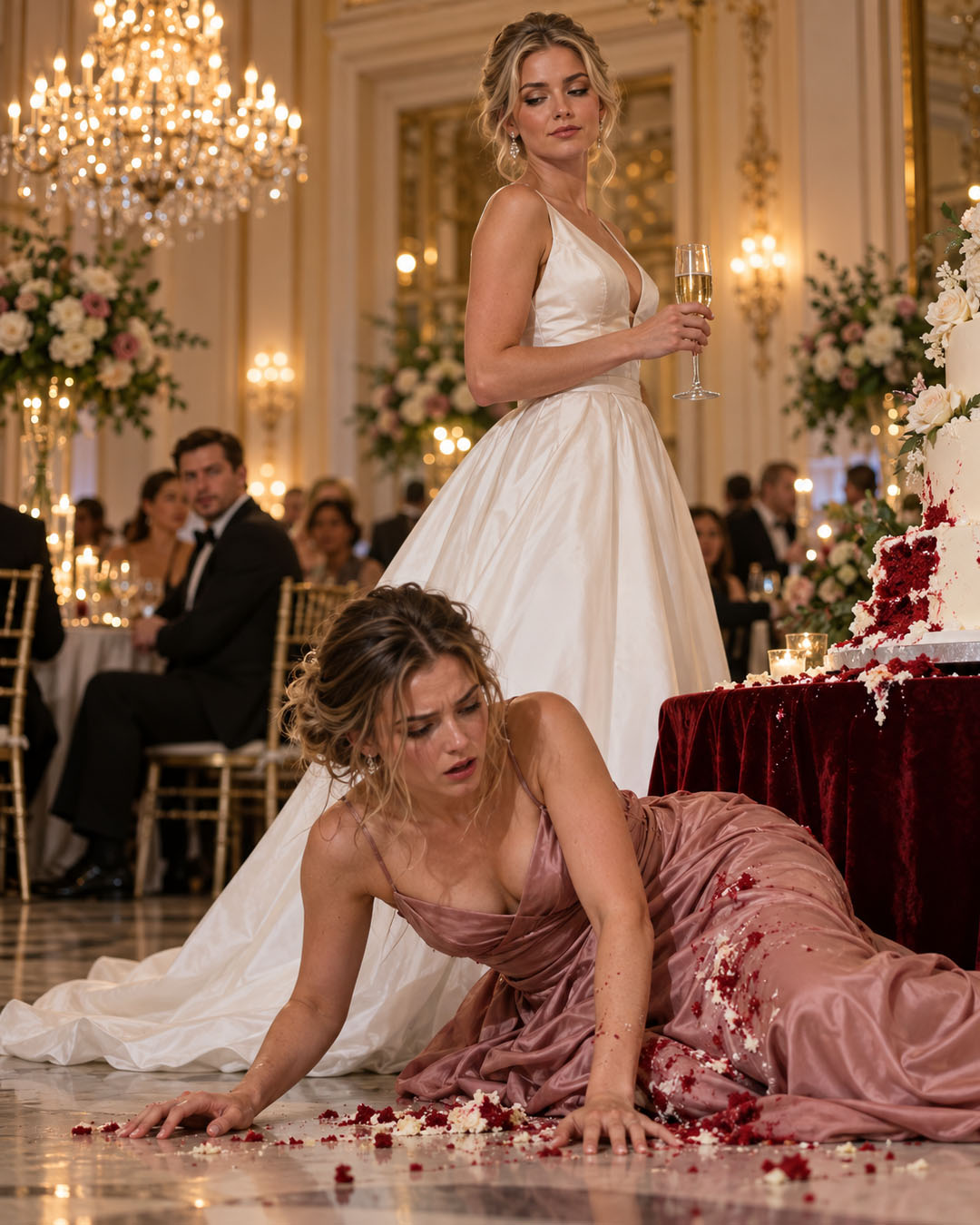
She stumbled backward, reached desperately for the nearest table, and caught the edge of our towering wedding cake.
The entire six-tier masterpiece toppled.
There was a terrible crash, followed by the sound of breaking serving dishes and frightened screams.
And beneath a mountain of red velvet cake and white frosting lay my sister, motionless.
Chapter 3
For one awful second, nobody moved. The music stopped, and the ballroom fell silent except for my mother’s horrified screaming. Sutton lay among broken cake layers and scattered sugar flowers, her expensive dress covered in crimson crumbs.
Then Sterling reached her.
He knelt beside her, called for someone to summon an ambulance, and carefully checked whether she was breathing normally. David joined him immediately, while hotel staff moved the surrounding guests back to give them room. Sterling’s voice remained steady, but I could see the worry in his eyes.
“Pamela,” he called, “tell the paramedics we suspect she swallowed an unknown substance.”
Those words struck me harder than the crash.
An unknown substance.
I didn’t know what Sutton had put into my drink. I didn’t know how much she’d used or what it might do when combined with alcohol. My foolish decision to switch the glasses had placed her in danger, and no amount of anger toward her could make that acceptable.
I went to Sterling and told him exactly what had happened.
He looked at me, stunned.
“You switched them?”
“Yes,” I whispered. “I saw what she did, and I panicked.”
For a moment, pain crossed his face. Then he turned back to Sutton, because keeping her safe mattered more than anything else at that instant.
My mother pushed through the crowd.
“What happened to her?” she cried. “What did you do to my daughter?”
Sterling told her to step back so Sutton could receive care. My father appeared behind her, his face pale and his hands trembling. Neither seemed to notice me until Sutton stirred and made a faint sound.
Her eyes fluttered open.
The wireless microphone had fallen beside her shoulder, still switched on. David reached to move it away, but Sutton began mumbling, and her voice echoed unexpectedly through the speakers.
“No,” she whispered. “That’s not right.”
Sterling leaned closer.
“Sutton, can you hear me?”
She looked past him toward the head table.
“Wrong glass,” she murmured. “She was supposed to drink it.”
The room seemed to lose all its air.
My mother stopped crying. My father froze where he stood, and the guests nearest the stage exchanged bewildered looks.
Sutton struggled to focus.
“Pamela was supposed to drink it,” she repeated.
Then her eyes closed again.
David switched off the microphone.
Nobody said a word.
I had spent my childhood listening to excuses for Sutton’s behavior, but this was different. She had spoken about my safety as though it were an inconvenience to her plans. And although her confused words alone couldn’t establish every detail of what she’d done, they confirmed the terrible possibility Adeline had warned me about.
The paramedics arrived soon afterward. They assessed Sutton, asked about her medical history and what she might have consumed, and prepared to take her to the hospital. Sterling gave them the information we had, including the suspected drink tampering and her sudden collapse.
Adeline stepped forward.
“I witnessed her put something into Pamela’s glass,” she said. “I also took a photograph of the small vial before she concealed it. The hotel manager has been told about the cameras.”
My father looked at her sharply.
“That’s a very serious accusation.”
“Yes,” Adeline replied. “It is.”
He turned toward me.
“Pamela, surely you don’t believe your sister would intentionally hurt you.”
I stared at him.
For twenty-nine years, I’d waited for my father to defend me without being forced. I’d imagined that someday he would see how differently he treated his daughters and regret the hurt he’d caused. Standing amid the remains of my wedding cake, I finally understood that he could see the truth and still choose not to acknowledge it.
“Dad,” I said quietly, “she put something in my drink.”
He opened his mouth, but I kept speaking.
“And the first thing you want to know is whether I’m accusing her unfairly.”
He looked away.
My mother found her voice.
“Sutton has been under terrible pressure lately,” she said. “She’s had financial problems, and she’s been feeling left behind. You have everything going for you, Pamela. Sometimes you don’t realize how hard that is for her.”
I couldn’t believe what I was hearing.
“She could have seriously hurt me, Mom.”
“She’s your sister.”
“And I’m your daughter.”
My mother stared at me, seemingly surprised that I would challenge her.
I looked from one parent to the other.
“Why has protecting Sutton always mattered more than protecting me?”
Neither answered.
The paramedics moved Sutton onto a stretcher. My mother hurried after them, still crying, while my father remained behind long enough to give me a final, disapproving look.
“We’ll discuss this when everyone has calmed down,” he said.
For the first time in my life, I didn’t accept his terms.
“No, Dad,” I answered. “We’ll discuss it when you’re ready to admit what happened.”
He left without another word.
As the ambulance doors closed outside, Adeline approached and put her arm around my shoulders. She told me the hotel had agreed to preserve the relevant security footage and that the police would need to know what had occurred. She also told me something I needed to hear, even though it hurt.
“Pam, switching those glasses was dangerous,” she said gently. “You know that, don’t you?”
I nodded, tears filling my eyes.
“I do.”
“Then be completely honest about it. Every part.”
I promised I would.
The evening had exposed something ugly in Sutton, but it had also shown me how easily anger could push a frightened person into making a terrible choice. I couldn’t change what I’d done. I could only take responsibility for it and make certain the truth wasn’t buried beneath another round of family excuses.
Sterling returned after speaking with the paramedics. His tuxedo was stained with frosting, and there was a small streak of red velvet cake on his sleeve. He looked exhausted.
“I’m going to the hospital for a while,” he said. “I want to know she’s safe.”
“I’ll come with you.”
He took my hands.
“Are you sure?”
I looked around the ballroom.
The flowers were still beautiful. Candles flickered on the tables, and our guests waited uncertainly, unsure whether they should leave or stay. At the far end, the beautiful cake I’d spent weeks choosing lay destroyed across the floor.
I thought about all the times I’d stayed quiet to keep the peace.
“I’m sure,” I said. “But before we go, there’s something I need to do.”
I turned to the hotel manager.
“Please don’t cancel the reception,” I told him. “Ask the guests to enjoy dessert, keep the music playing, and let them know we’ll return if we can.”
He nodded, looking relieved to have clear instructions.
Then I took Sterling’s hand and left the ballroom with him.
Our wedding night wasn’t going to be what we’d planned.
But for once, I wasn’t going to pretend everything was fine just to make my family comfortable.
Chapter 4
By the time we reached the hospital, Sutton was receiving treatment and being closely monitored. The medical team couldn’t immediately tell us exactly what she’d swallowed, but they were concerned about the effects of an unknown sedating substance combined with alcohol. We were told she was stable, which was the only news I truly cared about at that moment.
My mother sat in the waiting room with a tissue pressed against her face. My father paced beside a vending machine, looking as though he were preparing a speech. When he saw me, he stopped walking.
“Pamela, this has gone far enough,” he announced. “Your mother and I think the whole thing should remain a private family matter.”
Sterling’s jaw tightened.
“Conrad, your daughter was nearly given an unknown substance without her knowledge,” he said. “That’s not something you simply dismiss.”
My father looked offended.
“I’m trying to protect this family.”
“Which daughter?” I asked.
He stared at me.
“Excuse me?”
“Which daughter are you trying to protect?”
He didn’t answer.
I sat across from my parents and told them everything, beginning with the messages from Adeline and ending with my decision to switch the glasses. I admitted the truth without defending that decision. My father listened with his arms folded, while my mother alternated between crying and insisting that Sutton must not have understood what she was doing.
Then my father said something I’ll never forget.
“Well, Pamela, you must understand that you contributed to this situation.”
I looked at him in disbelief.
“Yes,” I answered. “I made a dangerous decision, and I’ve acknowledged it. But Sutton came to my wedding with a substance she intended to put into my drink. Are you going to acknowledge that?”
He rubbed his forehead.
“Your sister isn’t a criminal.”
“I hope she gets the help she needs,” I replied. “But you don’t get to make this disappear because the truth embarrasses you.”
My mother began sobbing again.
“You’re going to tear this family apart.”
I looked at her for a long moment.
“Mom, Sutton did that when she decided hurting me was worth whatever she hoped to gain.”
A police officer later spoke with us about what had happened. Adeline provided her observations, and I gave a complete account, including the glass switch. The officer explained that the investigation would depend on evidence, medical findings, and the accounts of those involved.
For once, I didn’t ask anyone to protect me from the consequences of telling the truth.
Sterling and I returned to the hotel later that evening. Most of the guests had gone home, but a smaller group of close friends and relatives remained. The ballroom had been cleaned, the damaged cake removed, and trays of chocolate mousse and lemon tarts arranged along the dessert table.
Adeline met us near the entrance.
“Sutton’s stable?” she asked.
I nodded.
“Thank goodness,” she said, pulling me into a hug.
Eleanor approached next. She looked at my stained wedding gown, then at Sterling’s exhausted face, and gently touched my shoulder.
“Come sit down, sweetheart,” she said. “You’ve both had quite enough excitement for one lifetime.”
I expected questions or judgment. Instead, she brought us cups of tea and sat beside us while the musicians played softly. After a while, she told me something that changed how I thought about family.
“Love doesn’t require pretending that someone hasn’t hurt you,” she said. “And family loyalty doesn’t mean allowing people to behave without consequences.”
I looked down at my hands.
“I should have handled it differently.”
“Yes,” she answered kindly. “You should have. But you can learn from that without accepting responsibility for your sister’s intentions.”
Those words stayed with me.
When the quartet began playing the song Sterling and I had chosen for our first dance, he stood and offered me his hand. My gown was wrinkled, my makeup had faded, and neither of us looked remotely like the elegant couple in our wedding photographs.
But I took his hand anyway.
We danced beneath the chandeliers while our friends watched quietly. Sterling held me close, and for the first time that day, I allowed myself to cry.
“I’m sorry,” I whispered against his shoulder.
He knew what I meant.
“We’ll work through it,” he said. “But promise me something.”
“Anything.”
“When you’re scared, tell me. Don’t try to solve everything alone.”
I nodded.
“I promise.”
We stayed only long enough to thank the people who had remained. There were no elaborate speeches, no cutting of the cake, and no grand departure beneath a shower of rose petals. Yet the quiet kindness of the people around us meant more than any detail I’d spent months arranging.
The next morning, my phone filled with messages.
Some were from concerned friends. Others came from distant relatives who’d already heard competing versions of the story. My mother sent a long message saying Sutton had been frightened, overwhelmed, and terribly jealous of my new life.
She insisted that Sutton had made a mistake.
Then she asked me to forgive her.
I read those words several times. There was no apology for what I’d almost experienced, no acknowledgment of the years I’d spent accommodating my sister, and no suggestion that Sutton should take responsibility for her actions.
Only another request that I make everyone comfortable.
I wrote back a short reply.
“I’m glad Sutton is recovering. I hope she gets the help she needs. I will be honest about what happened, and I need distance from all of you. Please respect that.”
My mother responded almost immediately.
“After everything we’ve done for you, this is how you repay us?”
I turned off my phone.
For years, I’d confused guilt with responsibility. I’d believed being a good daughter meant answering every demand, solving every problem, and swallowing every disappointment. But I was finally beginning to understand that love offered under constant conditions isn’t the kind of love anyone should have to earn.
Over the following weeks, Sutton recovered physically. The investigation continued, and our family became consumed by arguments about blame, appearances, and what should happen next. I cooperated when asked and refused to participate in efforts to minimize what had occurred.
Sutton eventually sent me a message.
She admitted she’d wanted me to become disoriented and embarrass myself in front of Sterling’s family. She said she believed that if I looked foolish enough, the Ashfords might question whether I belonged among them. She also said she hadn’t expected anyone to become seriously ill.
I stared at the message for a long time.
My own sister had wanted my wedding day to become a humiliation I’d never forget.
She had seen my happiness as something taken away from her.
And I finally understood why nothing I’d ever given Sutton had been enough.
She didn’t want my help.
She wanted my life.
Chapter 5
The months following our wedding were difficult in ways I hadn’t anticipated. I grieved the family I’d always wished I had, even though those people had never quite existed outside my hopes. Sometimes I reached for my phone automatically, intending to tell my mother something good that had happened, before remembering that every happy announcement had once become another opportunity for Sutton to compare our lives.
Sterling never pushed me to reconcile or encouraged me to remain angry. He simply reminded me that decisions about my family belonged to me. When I struggled with guilt, he listened without trying to solve everything.
I eventually started speaking with a counselor. It helped me understand why I’d spent so many years accepting behavior that made me miserable. More importantly, I began learning that refusing unreasonable demands wasn’t selfish, and that protecting my peace didn’t mean I’d stopped caring about other people.
There were moments when I missed Sutton.
I remembered the little girl who used to crawl into my bed during thunderstorms because she was frightened of the dark. I remembered teaching her to ride a bicycle and helping her prepare for school dances. Those memories were real, and I didn’t need to erase them to acknowledge the adult she’d become.
But missing someone isn’t the same as trusting them.
Our relationship remained distant.
My parents continued to send occasional messages through relatives, usually asking me to consider Sutton’s feelings. None of those messages suggested they understood why I’d stepped away. Eventually, I asked our extended family not to carry messages between us.
To my surprise, most respected that boundary.
A year after the wedding, Sterling and I were expecting our first child.
The pregnancy had brought ordinary discomforts, sleepless nights, and moments of joyful disbelief. But it also forced me to think about the kind of mother I wanted to become, and what I would do differently from the parents who had raised me.
One warm Charleston afternoon, Sterling accompanied me to a prenatal appointment. The doctor reviewed the examination and told us our baby was developing well. Then we heard the steady rhythm of her heartbeat, and Sterling squeezed my hand so tightly that I laughed through my tears.
A daughter.
We were having a little girl.
Later, as we drove beneath the live oaks draped in Spanish moss, I watched sunlight move across the dashboard. Sterling reached over and rested his hand against mine.
“What are you thinking about?” he asked.
I hesitated.
“My childhood.”
He waited.
“I used to think that if I accomplished enough, my parents would finally be proud of me,” I admitted. “Then Sutton would do something irresponsible, and they’d rush to help her while telling me I ought to understand.”
Sterling nodded.
“I remember.”
“I don’t want our daughter growing up thinking she has to earn our love.”
He pulled into our driveway and turned toward me.
“Then she won’t.”
We sat there for a while, listening to the quiet ticking of the engine as it cooled.
“I don’t know if we’ll have more children,” I said. “But if we do, I want them to know they’re equally loved. I don’t want one child constantly celebrated while another is expected to sacrifice.”
Sterling smiled gently.
“Then that’s the family we’ll build.”
That evening, I sat on our back porch with a glass of lemonade while Sterling prepared dinner. The air smelled of jasmine, and the cicadas were beginning their familiar summer chorus. Inside, our kitchen glowed with warm light.
My daughter kicked beneath my ribs.
I pressed my hand against the spot and smiled.
A few days earlier, my mother had sent a letter through a relative. She said Sutton was trying to rebuild her life and that she hoped we could all sit down together someday. She also mentioned hearing about the pregnancy and expressed her wish to become part of her granddaughter’s life.
I didn’t respond.
Perhaps someday genuine accountability would make a different conversation possible. Perhaps it wouldn’t. I no longer believed I had to make that decision on anyone else’s timetable.
What mattered was that my daughter would grow up surrounded by people who understood the difference between love and control.
I thought about the wedding cake, the ruined dress, and the ballroom full of shocked faces. For a long time, I’d remembered those images with anger and embarrassment. Now I saw them as reminders of how quickly resentment could become destructive and how important it was to respond to danger with care rather than revenge.
I wasn’t proud of switching the glasses. I was grateful Sutton had survived, and I’d learned never to mistake retaliation for protection. But I was proud that I’d finally stopped pretending her behavior was harmless, and that I’d found the courage to tell the truth even when it meant admitting my own mistakes.
Sterling appeared at the kitchen doorway.
“Dinner’s ready,” he said. “And before you ask, yes, I remembered the extra lemon.”
I laughed.
He crossed the porch and helped me to my feet, then placed a gentle hand against my stomach.
Our daughter kicked again.
“There she is,” he whispered, smiling.
I looked at my husband, at the home we’d created together, and at the future waiting for us. Our wedding hadn’t been the flawless celebration I’d imagined, and my family hadn’t become the loving, supportive people I’d spent years hoping they would be.
But the marriage was real.
The love was real.
And for the first time in my life, I knew I didn’t have to lose myself to keep either one.
THE END.
⚠️ All characters and events are fictional. Do not imitate or apply them in real life. 😌😌😌


