
Chapter 2
Mom had always been careful with money.
She grew up in a family where the electric bill sometimes waited until payday and new shoes were purchased only after the old pair became impossible to repair. By the time I was born, she and Dad had built a stable life, but she never forgot what uncertainty felt like. She saved receipts, read every contract twice, paid her mortgage early, and could stretch a dollar without ever appearing cheap.
When Dad died, the house was fully paid for.
Mom had investments too, nothing extravagant, but enough that she never needed help from me. She had also quietly updated her estate plan after her diagnosis.
I was her only child.
Everything would come to me.
The house alone had recently been appraised at a little over four hundred thousand dollars. The neighborhood had changed dramatically, and property values had climbed far beyond what Mom ever expected when she and Dad bought the place.
Craig knew none of that.
Not because I had hidden it.
Because he had never cared enough to ask.
Three weeks before Mom died, she called me into the kitchen and pushed a folder across the table.
“I need you to promise me you won’t get emotional and confront him tonight.”
I stared at her. “Confront who?”
“Craig.”
My stomach tightened.
She opened the folder.
Inside were printed screenshots of messages between my husband and a woman named Vanessa Blake.
At first, my brain refused to understand what I was seeing.
I read one message.
Then another.
And another.
Four years.
They had been involved for almost four years.
Vanessa worked in the same office complex as one of my cousins. Eventually, careless conversations and familiar photographs had connected the dots. Mom learned about it six months earlier.
She had said nothing because she knew how much I was already carrying.
“I hated keeping this from you,” she whispered. “But you were taking care of me, working, raising Paige. I couldn’t put one more thing on your shoulders until I knew for certain.”
I looked at my dying mother and realized she had spent some of her final months worrying about protecting me from my own husband.
“Why didn’t you tell me sooner?”
“I was afraid you’d go home angry and he’d talk you out of believing what was in front of you.”
That sounded painfully possible.
Mom squeezed my hand.
“Cecily, I have watched that man let you do all the carrying for years. He likes you competent because your competence makes his life easy.”
Tears filled her eyes.
“I don’t think he ever understood what he had.”
I hugged her for a long time.
Then I took the folder home.
And I said nothing.
That silence became the first secret I had ever successfully kept from Craig.
By the night he told me to find an apartment, I had already called Gerald Morgan, my mother’s estate attorney. I had also spoken with a divorce attorney named Elena Martinez, whose voice over the phone was so calm that I trusted her before I ever saw her face.
The next morning, while Craig ate breakfast downstairs with his mother, I dressed for work.
He looked surprised.
“You’re going in?”
“No. I have appointments.”
“What kind?”
“Estate matters.”
He nodded, uninterested.
Joanna poured herself coffee from my machine.
“Don’t let those lawyers confuse you,” she said. “They can make simple things complicated.”
I looked at her.
“I’ll keep that in mind.”
Gerald’s office was downtown, six floors above a bank. He was seventy, silver-haired, and had known my mother for more than twenty years.
When I walked in, he came around his desk and hugged me.
“I’m sorry, Cecily.”
That was all he said.
No empty speech. No suggestion that Mom was “in a better place.” Just acknowledgment.
He showed me the will, the property records, account information, and the instructions Mom had left. Everything was organized. Everything was legal. Everything was clear.
“She wanted you protected,” Gerald said.
I ran my fingers over Mom’s signature.
“She always did.”
That afternoon, I met Elena.
She reviewed my documents, the screenshots, banking records I had copied after meeting with her previously, and the information surrounding Craig’s spending.
She asked precise questions.
“Does he know you know about Vanessa?”
“No.”
“Does he know about your inheritance?”
“No.”
“Does he believe you’ll leave voluntarily?”
“Yes.”
Elena leaned back.
“Then don’t educate him yet.”
That sentence almost made me smile.
Craig filed for divorce nine days later.
He seemed proud of being first.
Maybe he thought filing first meant winning first. Maybe Joanna told him it gave him leverage. Whatever the reason, he moved through the house with the satisfaction of someone who believed every piece was already in place.
Linda had filled half the hallway closet by then.
Joanna rearranged my kitchen.
I came home one evening and discovered my coffee mugs had been moved because, according to her, “the whole layout was inefficient.”
I put them back.
She stared at me.
“Why would you do that?”
“Because they’re my mugs.”
“You won’t be here much longer.”
I held her gaze.
“That remains to be seen.”
The confidence left her face for half a second.
Two days later, Craig’s attorney sent Elena a proposed settlement.
Craig assumed I possessed no significant assets.
He wanted the marital home. He offered me a modest share of our joint savings, expected me to accept shared custody on a schedule primarily convenient to him, and suggested that we each keep property titled individually.
That final part was particularly interesting.
Elena read the proposal twice.
Then she looked at me.
“Do you want to know what I think?”
“Yes.”
“He wrote this believing he was the only person in the marriage with information.”
She prepared a response.
It listed my mother’s estate.
The inherited house.
The accounts.
The estimated value.
The evidence of marital funds Craig had spent on Vanessa.
The secondary credit card he had kept from me.
The income discrepancies.
The documentation showing that while he repeatedly told me money was tight, thousands of dollars had moved through accounts I had never been told existed.
Craig called that evening.
For the first time in days, he didn’t sound confident.
“What is this?”
“What is what?”
“Don’t play games, Cecily.”
“I’m making dinner.”
“This letter from your lawyer. Your mother’s house is worth four hundred thousand dollars?”
“Approximately.”
“You never told me.”
“You never asked.”
“That’s ridiculous. We were married.”
“Yes.”
“You hid an asset from me.”
“It was my mother’s property until she died.”
Silence.
Then his voice sharpened.
“You’re inheriting all of it?”
“Yes.”
“This isn’t fair.”
I almost laughed.
Instead, I turned down the burner under the pasta sauce.
“You told me to find an apartment, Craig.”
“That has nothing to do with this.”
“It has everything to do with this.”
“You know what I meant.”
“I do.”
He lowered his voice.
“You need to stop listening to that lawyer and talk to me.”
“Why?”
“Because we can work this out ourselves.”
“We had nine years to work things out ourselves.”
“Cecily—”
“I’m keeping communication about the divorce through our attorneys unless it concerns Paige.”
Then I hung up.
For a long time, I stood in the kitchen staring at the phone.
My hands were shaking.
People imagine strength feels powerful.
Sometimes it doesn’t.
Sometimes strength is just terror that has decided to keep moving.
Two days later, Joanna appeared at the front door.
I saw her through the glass and let her wait.
Not to punish her.
Because for once, I didn’t feel obligated to hurry for someone else’s convenience.
When I finally opened the door, she forced a smile.
“We should talk.”
“No, we shouldn’t.”
Her smile vanished.
“Craig is my son.”
“I’m aware.”
“He made a mistake.”
“He made the same mistake for four years.”
She looked startled.
So Craig had not told her everything.
Interesting.
“He loves you,” she said.
“Then his definition of love requires work.”
“Cecily, you’re being very cold.”
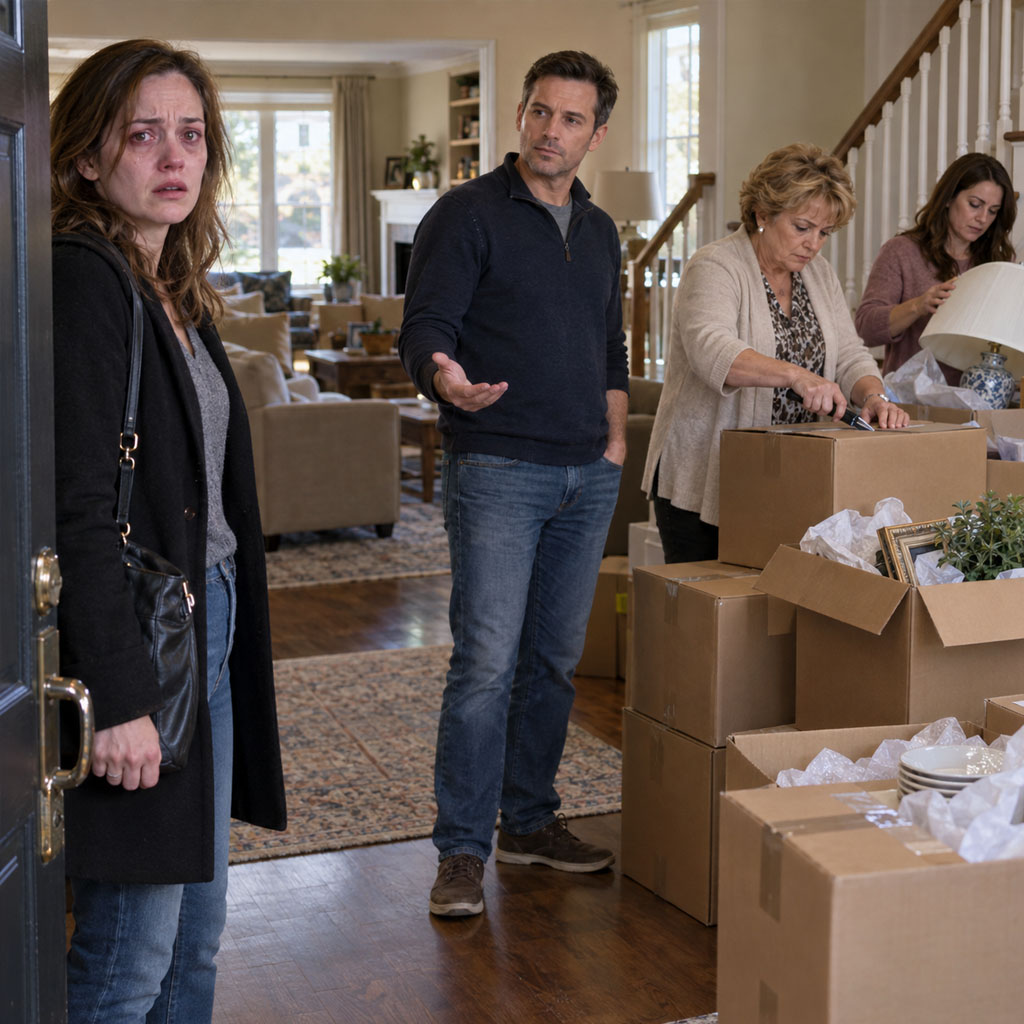
I thought of the lamp being unpacked before I had taken off my hospital clothes.
“No,” I said. “I’m being clear.”
She tried Paige next.
“You don’t want to tear apart her family.”
That one almost worked.
Almost.
Then I remembered my daughter touching my face and telling me I always looked tired.
“My relationship with Craig is separate from Paige’s relationship with her father and grandmother. I won’t interfere with appropriate contact.”
Joanna’s eyes narrowed at the word appropriate.
She was used to setting terms.
Now she was hearing mine.
“The lawyers will handle the rest,” I said.
I closed the door.
Then I walked into the kitchen, made coffee, and sat down at the table.
Something strange happened.
For the first time since Mom died, I could breathe all the way to the bottom of my lungs.
Chapter 3
The divorce lasted eight months.
There was no single courtroom moment where Craig’s entire life collapsed. Real divorces are usually less theatrical and more exhausting. They come in emails, financial disclosures, scheduling disputes, property valuations, mediation sessions, and legal phrases nobody should have to learn while also packing school lunches.
Craig fought almost everything at first.
Then the evidence accumulated.
His affair with Vanessa had lasted nearly four years. The relationship included hotel stays, gifts, restaurant charges, and transfers of money from funds that should have benefited our household.
The hidden credit card led to additional questions.
His claims about income didn’t always match tax documents and deposits.
Elena never promised miracles.
“That’s television,” she told me when I asked whether his affair meant I would automatically receive everything I wanted. “Law is slower and much less emotionally satisfying.”
I appreciated her honesty.
Mom’s inheritance remained mine.
That was the part Craig seemed least able to accept.
He called once after mediation.
“You’re going to sell that house, aren’t you?”
“Probably.”
“That money could’ve helped us.”
I nearly reminded him there was no us.
Instead, I said, “It helped my mother know I would be okay.”
He was silent.
Then he said, “She never liked me.”
“No. She stopped trusting you.”
“That’s because you complained about me.”
I closed my eyes.
Even then, he needed another person to be responsible for what he had done.
“I have to go, Craig.”
“Cecily—”
“Good night.”
Vanessa ended their relationship before the divorce was final.
I learned that from Craig himself, although I never asked.
Apparently, he had led her to believe he was far more financially secure than he actually was. She thought the marital home was effectively his. She thought he had substantial investments. She thought his future after divorce would look much different.
There was a pattern to Craig.
He didn’t exactly invent a new personality for every woman.
He simply told each of us the version of the truth most useful to him.
Once Vanessa learned the numbers, she left.
I didn’t celebrate.
By then, I was too tired to enjoy his disappointment.
Linda moved out before the final settlement. One afternoon I came home and discovered the hallway closet empty.
She was in the living room carrying a box.
“I’m staying with Mom for a while.”
“Okay.”
She hesitated.
“I guess things didn’t go the way Craig thought.”
“No.”
Another pause.
“I didn’t know about the affair.”
I believed her.
That didn’t excuse moving into my home before I had buried my mother emotionally, but I believed she had been given a cleaner version of events.
“I’m sorry about how this happened,” she said.
I nodded.
“Thank you.”
That was enough.
Joanna left a week later.
She did not apologize.
She packed her things with the wounded dignity of someone convinced she had been unfairly inconvenienced.
When she reached the front door, she turned.
“I hope you understand how difficult this has been for Craig.”
I looked around the living room.
For months, I had imagined hundreds of things I might say to her.
None of them seemed necessary anymore.
“I understand that choices have consequences.”
Her mouth tightened.
Then she left.
Paige had the hardest transition.
Craig saw her regularly, and I never spoke badly about him in front of her. I had to learn the difference between honesty and recruitment. My daughter deserved the truth appropriate for her age, but she did not need to become my ally against her father.
One evening, she crawled into bed beside me.
“Are you and Dad ever getting back together?”
“No, sweetheart.”
“Did he do something bad?”
I considered my answer carefully.
“He made choices that hurt our marriage.”
“Did you?”
“Probably some. But the decision to end the marriage is something the adults are handling.”
She studied me.
“Do you still love him?”
Children never ask easy questions when you’re prepared.
“I love some of the memories we made. And he’ll always be your dad. But I don’t want to be married to him anymore.”
Paige nodded.
Then she whispered, “The house feels less scary now.”
I looked at her.
“What do you mean?”
She pulled the blanket up to her chin.
“Before, everybody was always pretending they weren’t mad.”
That hurt more than anything Craig had said.
I had believed my silence protected her.
Instead, she had been living inside it.
I gathered her into my arms.
“I’m sorry.”
“For what?”
“For making you think pretending was normal.”
She hugged me tighter.
The divorce became final in early spring.
I kept primary residential custody, with a regular schedule for Craig. He remained part of Paige’s life. He was not cruel to her. He showed up for most school events, took her every other weekend, and remembered her birthday.
For a while, I felt guilty for admitting that was not impressive.
Then I realized showing up for your child is not heroism.
It is parenting.
After the divorce, Craig moved into a rental across town. Linda stayed with him temporarily, and Joanna rented a small apartment nearby. A mutual acquaintance told me they were splitting expenses.
I didn’t ask for updates.
Every new piece of information about Craig felt like furniture from a house I no longer lived in.
Mom’s house was different.
I went there alone several weeks after the divorce became final.
The garden was overgrown.
A few stubborn rosemary plants were still alive. The porch still needed paint. Her coffee mug remained in the cabinet because I had not yet found the courage to remove it.
I stood in the kitchen where she had handed me the folder.
For a long time, I thought inheriting that house was the great twist Craig never saw coming.
Standing there, I realized the money wasn’t the real inheritance.
Mom had given me proof.
Not just proof of Craig’s affair.
Proof that someone had seen what I was enduring, even when I had spent years convincing myself it wasn’t so bad.
I sold the house.
Gerald asked me twice whether I was sure.
“Yes.”
“You don’t have to rush.”
“I’m not running from it.”
He waited.
“I just don’t want to turn my mother’s home into a museum for my grief.”
He nodded.
“I think she’d understand.”
I used part of the proceeds to buy a condo for Paige and me.
Not enormous.
Not impressive.
Perfect.
Two bedrooms. Two bathrooms. A bright kitchen. A small balcony that caught the afternoon sun.
Paige chose a loft bed.
She also claimed one kitchen drawer entirely for snacks, which she labeled PAIGE’S IMPORTANT SUPPLIES in purple marker.
The first Saturday morning after we moved in, I woke before she did.
I made coffee and carried it onto the balcony.
The neighborhood was quiet.
For several minutes, I sat without doing anything.
No one criticized the way I had arranged the kitchen.
No one asked me to fix something.
No one needed me to stay calm so they could remain comfortable.
The quiet was not lonely.
It was mine.
Chapter 4
Three months after the divorce, Linda sent me a text.
I’m sorry for the way I came into your house after your mom died. I was following Craig and Mom’s lead, but I should have known better.
I read it several times.
Part of me wanted to leave it unanswered.
Another part remembered how easy it was for families to create systems where nobody questioned the loudest person.
Finally, I wrote, I appreciate you saying that.
Nothing more.
Joanna continued sending Paige birthday cards and Christmas presents. We remained civil because civility made my daughter’s life easier. But I stopped confusing civility with closeness.
Craig and I became parents who communicated mostly through brief texts.
Paige has soccer at 10.
I’ll pick her up Friday at 5.
She needs her inhaler in her backpack.
No arguments about our marriage.
No postmortems.
No attempts to become friends.
That was healthier than the marriage had been.
One afternoon, nearly a year after Mom died, Paige sat at the kitchen counter eating cereal after school.
“Mom?”
“Yes?”
“Do you miss Dad?”
I put down the mail in my hand.
I wanted to give her the kind of answer adults often give children—safe, vague, technically true.
Instead, I gave her the truth she could handle.
“I miss who I thought he was.”
She watched me.
“But I don’t miss the way I felt when we were together.”
Paige nodded slowly.
“I don’t miss it either.”
“Why?”
She pushed a cereal loop around her bowl.
“It always felt like everybody was pretending.”
There it was again.
The truth children see while adults are busy maintaining appearances.
I moved around the counter and hugged her.
She let me hold her longer than usual.
Later that night, after she went to bed, I sat on the balcony with a cup of tea.
I thought about the nine years I had spent trying to be easy to love.
All the criticism I swallowed.
All the tea I made for Joanna while she inspected my kitchen.
All the nights I returned from caring for Mom and convinced myself that Craig’s indifference was simply his personality.
All the times I thought patience was the same thing as wisdom.
I had been proud of my ability to endure.
That was the mistake.
Endurance is valuable when you are climbing a mountain, recovering from illness, raising a child through a difficult season, or caring for someone you love.
Endurance is not always a virtue inside a relationship that keeps asking you to disappear.
Mom understood that before I did.
Near the end, when she was weak enough that conversation exhausted her, she spent precious energy gathering information, calling Gerald, and making sure her affairs were in order.
She knew she wouldn’t be there to protect me forever.
So she gave me what she could.
Facts.
Documents.
A warning.
And a way forward.
Gerald sent me a handwritten card after the estate closed.
Your mother was one of the most thoughtful clients I ever represented. She planned carefully because she loved deeply. I suspect you inherited more than property from her.
I keep that card on my desk.
Craig once believed the inheritance was the part that defeated him.
He was wrong about that too.
The money helped, certainly. The house gave Paige and me options. The savings gave me breathing room. Financial security matters, especially when someone has spent years trying to convince you that you have none.
But the most valuable thing my mother left me could not be appraised.
She left me permission to believe my own eyes.
She reminded me that love without respect becomes obligation. That keeping peace is not the same as having peace. That a person who benefits from your silence may call you cruel the moment you finally speak.
And she taught me that protecting yourself is not revenge.
Months after everything was settled, I ran into Craig at Paige’s school concert.
He was standing near the auditorium doors in a navy jacket I had bought him years earlier.
“You look good,” he said.
“So do you.”
He gave an awkward laugh.
Then he looked toward Paige, who was laughing with friends near the stage.
“She seems happy.”
“She is.”
He nodded.
“I made a lot of mistakes.”
I waited.
For once, he did not follow the sentence with an excuse.
“I know.”
He looked at me.
“I thought you’d fall apart.”
There was no cruelty in his voice.
That almost made it sadder.
“You thought I needed you more than I did.”
“Yes.”
I considered correcting him.
Then I realized he was close enough.
“What happened to Vanessa?” I asked.
He gave me a tired smile.
“You know what happened.”
“I heard.”
“She thought I was somebody I wasn’t.”
“So did I.”
He looked down.
For a few seconds, we stood together in the hallway like two people who had once shared a home and now barely shared a conversation.
Then Paige called, “Mom!”
I turned immediately.
Craig noticed.
“You always did that.”
“Did what?”
“Answered her right away.”
I looked at him.
“She’s my daughter.”
“I know.”
Maybe he finally did.
I walked away before either of us could turn the moment into more than it was.
That evening, Paige and I stopped for ice cream on the way home.
She talked the entire drive.
A friend had forgotten a line during the concert. Her music teacher had worn mismatched socks. Someone named Dylan apparently thought whispering meant speaking at normal volume while covering his mouth.
I listened.
Every word.
At home, she disappeared into her room, and I carried my coffee onto the balcony.
The afternoon light turned the neighboring windows gold.
My condo was smaller than the house Craig had once ordered me to leave. The furniture was less expensive. The balcony could barely fit two chairs and a small table.
Yet I had never felt so wealthy.
Not because of the inheritance.
Because everything surrounding me had been chosen without fear.
The pictures on the walls.
The mugs in the cabinet.
The snack drawer Paige treated like sacred property.
The silence.
Especially the silence.
For years, quiet had meant holding my tongue.
Now quiet meant nobody was asking me to.
I sometimes wonder what Craig thought would happen that day I came home from the hospital.
Maybe he imagined I would cry.
Maybe he expected me to beg him to reconsider.
Maybe he thought I would pack a suitcase, rent a little apartment, and quietly hand him the house, the marriage, and the dignity he had already decided belonged to him.
Instead, I said okay.
It may have been the most powerful word I ever spoke.
Not because I agreed that he had the right to discard me.
Because I finally agreed to stop fighting for a place in a life where I was valued mainly for how much I could carry.
My mother died believing I deserved better.
For a long time, I wished she had lived long enough to see that she was right.
Then one morning, sitting on my balcony while Paige slept inside, I understood something.
Mom had already known.
That was why she prepared me.
That was why she made me promise to call Gerald.
That was why, with so little time remaining, she spent some of it making sure her daughter would not mistake abandonment for defeat.
Craig told me to find an apartment.
I found a home.
He expected me to leave with nothing.
I left with my daughter, my future, my self-respect, and the final gift my mother ever gave me: the courage to stop making myself smaller so other people could feel bigger.
And every morning when sunlight reaches that little balcony, I lift my coffee toward the empty chair across from me.
“See, Mom?” I whisper.
“I landed on my feet.”
THE END.
⚠️ All characters and events are fictional. Do not imitate or apply them in real life. 😌😌😌


