
Chapter 2
Sandra recovered first. She pushed back her chair, pressed a hand to her chest, and began explaining that Owen had been sent outside as a consequence for misbehaving.
“He threw a tantrum this morning,” she said. “He deliberately broke my sister’s Christmas ornament, and I needed him to calm down. Sometimes children need a little sensory reset.”
She used the word therapeutic three times in less than a minute. She claimed she’d been watching him through the window the entire time and that I had misunderstood the situation.
I listened without interrupting. Then I looked at Philip, waiting for him to tell me that his wife was mistaken, that there was some terrible misunderstanding, that he had never knowingly allowed his little boy to stand in the snow.
My son stared at the tablecloth.
That single gesture told me more than Sandra’s entire explanation.
“Philip,” I said quietly, “do you know what prolonged exposure to this temperature can do to a child?”
He rubbed his forehead. “Dad, you’re making this into something it isn’t.”
I glanced at Sandra. She was still standing beside her chair, looking offended rather than concerned.
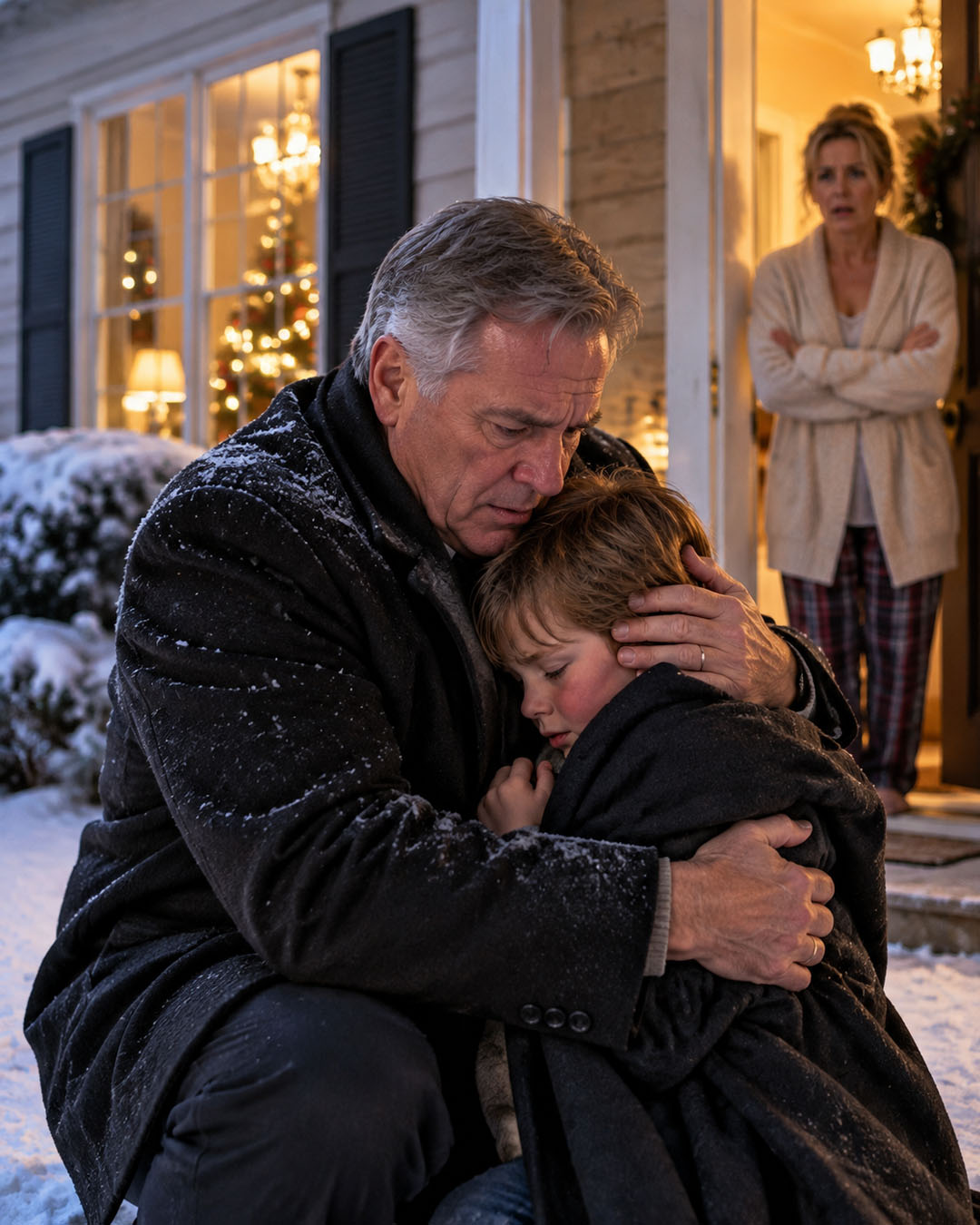
“Owen’s lips were blue when I found him,” I said. “I’m taking him to the hospital.”
Sandra stepped toward the door. “You cannot simply remove a child from his home. I’m his legal stepmother, and if you take him without permission, I’ll call the police.”
I took out my phone and dialed 911.
I reported that I’d found a seven-year-old child outside in freezing weather without adequate clothing, showing signs of dangerous cold exposure. I gave the dispatcher our location, Owen’s full name, and his age, then explained that I was taking him for medical attention.
Sandra’s expression changed when she realized I wasn’t bluffing. Philip finally moved toward me.
“Dad, stop. You’re embarrassing everyone.”
I stared at him for a long moment. I wanted to ask where the little boy had gone who once sat beside me on construction sites, eager to learn how things worked. I wanted to know when my son had begun caring more about avoiding an argument with his wife than protecting his own child.
Instead, I walked out.
The drive to the emergency room took twenty-two minutes. Owen leaned against me during the journey, exhausted and quiet, while I kept the truck warm and followed the dispatcher’s instructions. At the hospital, the medical team moved quickly, checking his temperature, monitoring his circulation, and wrapping him in heated blankets.
The attending physician told me we had brought him in time and that he was expected to recover. She asked what had happened, and I described exactly what I’d seen.
Her expression grew serious.
“Because of the circumstances, I’m required to report this to Vermont’s Department for Children and Families,” she said.
“Please do,” I replied.
I sat beside Owen’s hospital bed, holding his small hand while he slept. The room was warm, and the quiet beeping of the monitor reminded me that, for the moment, he was where he needed to be.
My phone vibrated repeatedly. Philip called twice, then again, and Sandra sent a message accusing me of destroying their Christmas. I didn’t respond.
An hour later, a detective from the Montpelier Police Department arrived. His name was Daniel Reyes, and he had the calm, observant manner of someone accustomed to hearing difficult stories without rushing to judgment.
He asked me to explain what I’d witnessed, how long Owen had been outside, and whether I’d noticed anything unusual during previous visits. I described the unanswered calls, Sandra’s increasingly strict control over access to my grandson, and the way Owen had grown quieter over the preceding months.
Detective Reyes wrote everything down.
“When was the last time you saw him before today?” he asked.
“About six weeks ago. He seemed withdrawn. He didn’t want to work on our model ship, and he barely spoke unless I asked him a question.”
I remembered something else. When I’d walked Owen to his father’s car that afternoon, he’d gripped my sleeve tightly and held on for several seconds. I’d assumed he was reluctant to say goodbye.
Now I wondered whether he’d been trying to tell me something without knowing how.
After the detective left, Owen woke up. He blinked at the ceiling, then turned his head and saw me beside him. His face relaxed in a way that nearly broke my heart.
“Grandpa?”
“I’m right here, sweetheart.”
He studied my face for a moment. Then he whispered, “I didn’t break the ornament on purpose.”
I squeezed his hand. “Tell me what happened, if you feel ready.”
He explained that he’d woken early and gone downstairs to look at the stockings. While reaching for one, he’d accidentally knocked an ornament from the tree. It shattered on the floor, and he’d immediately started crying and apologizing.
Sandra had come into the room, looked at the broken ornament, and ordered him to put on his slippers and go outside. She told him to stay there until she decided he had learned his lesson.
“How long were you outside?” I asked gently.
Owen thought for a moment.
“I counted the church bells,” he said. “They rang twice.”
The church near their subdivision rang on the hour.
He had been outside for roughly two hours.
I sat very still, trying to absorb what he’d told me. This hadn’t been a brief, misguided attempt to calm a child down. Owen had accidentally broken something, apologized, and then been left in dangerous cold for hours while the adults in his home ate breakfast.
I called my attorney, Patricia King, that evening. She had handled my estate planning for eleven years, and she was practical, thorough, and unimpressed by anyone who believed money or social standing placed them above accountability.
I explained what had happened and answered her questions about the house, the mortgage, and my financial contributions. I still had records of the down payment I’d provided, as well as messages from Sandra limiting my visits.
“Save everything,” Patricia advised. “The calls, the texts, the financial documents. Write down exactly what Owen told you, including when and where he said it. Don’t embellish anything, and don’t coach him. Let the investigators do their work.”
Then she said something that stayed with me all night.
“Arthur, this investigation may uncover a pattern. What you witnessed on Christmas morning may not be the first time Owen has been treated this way. It may simply be the first time you’ve seen it yourself.”
I looked through the hospital window at the snow falling beneath the parking lot lights. I had spent my career identifying weaknesses before they became catastrophic failures, yet I’d overlooked the warning signs in my own family.
I wasn’t going to make that mistake again.
Chapter 3
The following two weeks were difficult. Investigators from the Department for Children and Families assessed Owen’s situation, spoke with school personnel, and reviewed the information I’d provided. I cooperated fully, answering questions and sharing records without making assumptions about what the evidence would eventually show.
His second-grade teacher, Mrs. Abernathy, submitted a statement describing changes she’d noticed during the fall. Owen had become unusually quiet, struggled to concentrate, and seemed tired during class. His weight had also dropped by approximately eight pounds compared with the previous year’s measurements.
She had already raised concerns in November. Until the investigation began, those concerns had not developed into a formal assessment of his home situation.
Now they were being examined.
During the first week, Philip called me four times. I answered twice, and both conversations were painful. He insisted that Sandra had been trying her best, that Owen had become difficult to manage, and that I was making a private family problem into a public crisis.
I recognized the tone of his voice. He sounded like a man repeating arguments he’d been given rather than expressing thoughts of his own.
Then, near the end of our second conversation, his voice changed.
“Dad, I just need to know he’s okay.”
For the first time since Christmas morning, I heard something that sounded like my son.
“He’s safe,” I told him. “He’s warm, he’s eating, and the doctors say he’ll recover.”
Philip was silent. I heard Sandra call his name from somewhere nearby, and almost immediately his voice hardened again.
“You need to stop interfering,” he said before hanging up.
I sat with the phone in my hand for a long time. I couldn’t rescue my son from every mistake he’d made, but I could make sure Owen wasn’t left to suffer while the adults argued about who was responsible.
The initial assessment resulted in Owen being placed temporarily in my care while the investigation continued. He arrived at my home in Vermont with a duffel bag, his school backpack, and the model lighthouse I’d brought for him on Christmas morning.
He carried the lighthouse into the guest room and placed it carefully on the windowsill.
“Can we build something else?” he asked.
“Anything you like.”
He thought about it, then said, “Can we build a bridge?”
For a moment, I couldn’t answer. Bridges had been the language my son and I once shared, and now his little boy was asking me to teach him how to build one.
“Of course,” I finally said. “Bridges are what Grandpa knows best.”
We began sketching plans that weekend in my heated garage. Owen sat across the workbench from me, asking questions about cables, towers, and how a bridge could hold so much weight without collapsing. His curiosity returned in small, tentative bursts, and each question felt like a little piece of him coming back.
But healing doesn’t happen all at once.
One Tuesday evening, Owen was doing homework at the kitchen table while I prepared dinner. Without looking up from his worksheet, he said, “Grandpa, Sandra used to lock the pantry.”
I turned off the burner.
“What do you mean, sweetheart?”
“She put a lock on the door. She said food was a privilege, and I had to earn it by behaving.”
He said it matter-of-factly, as though he were describing a rule at school. That was what frightened me most. He had become accustomed to explaining things no child should have to accept as normal.
I sat beside him and asked when it had started. He told me that after Thanksgiving, Sandra began restricting access to the pantry. When his father worked late, there were evenings when nobody prepared him dinner.
“Sometimes I was hungry,” he said. “But I didn’t want to make Sandra mad.”
I took a slow breath, keeping my voice gentle. I asked whether he’d told his father, and Owen shook his head.
“Daddy was always tired. Sandra said I shouldn’t bother him with little things.”
I didn’t ask more questions. I told him he could always talk to me, and that he was never responsible for an adult’s decision to withhold food or leave him in the cold.
After he went to bed, I called Patricia and reported exactly what Owen had said. She instructed me to write a dated statement using his own words and to pass it to the investigator.
I spent the next morning documenting the details, keeping my account factual and avoiding conclusions. In engineering, I had learned that a report was strongest when it separated what you had observed from what you suspected. I applied the same discipline here because Owen deserved an investigation built on facts, not my anger.
The case expanded.
Sandra’s explanation for the pantry lock changed several times. At first, she claimed it was intended to prevent Owen from taking snacks before dinner. Later, she said it was a temporary measure recommended to establish household routines. Her account of Christmas morning also conflicted with the timeline established by the family’s own photographs and messages.
One photograph, posted by Sandra’s sister, showed the family gathered around the breakfast table at 7:45 that morning. The timestamp supported the evidence that Owen had been outside for a prolonged period while the adults were eating indoors.
As investigators continued their work, Philip finally began to reconsider what he’d allowed to happen. He hired his own attorney and cooperated separately with the authorities. In his statement, he acknowledged that Sandra had taken control of many household decisions and that he had repeatedly told himself she knew better.
Reading his words was painful. I recognized the shame of a man who had allowed his fear of confrontation to overrule his responsibility to his child.
Philip wasn’t innocent of the choices he’d made, but for the first time, he stopped pretending that those choices had never happened.
Chapter 4
The investigation continued through the winter, with Owen remaining in my care while the appropriate professionals evaluated the circumstances and determined what arrangements would best protect him. I didn’t discuss the details with neighbors or relatives, and I didn’t use the situation to humiliate my son or his wife.
This wasn’t about winning a family argument. It was about making sure a little boy could sleep through the night without worrying about whether he would be punished for an accident.
Sandra no longer lived in the colonial house by the time the immediate proceedings had concluded. The legal arrangements surrounding Owen’s care remained structured and supervised, and Philip had to demonstrate that he could provide a safe, stable environment before decisions about greater responsibility could be made.
I won’t pretend that everything was resolved neatly. Family court matters rarely work that way, and Owen’s needs were too important to be reduced to a simple ending in which everyone suddenly understood their mistakes.
What mattered was that he was safe.
Within several weeks, he began sleeping better. His appetite improved, and the doctor was pleased with his recovery. By the time his teacher sent me a note saying he had volunteered to read aloud in class for the first time that school year, he’d regained six of the eight pounds he’d lost.
I read that note at my kitchen table three times.
Then I put it in a drawer beside a photograph of Carol holding Owen as a baby. She had been such a gentle mother, always making him feel that he mattered, even when the world around her was difficult. I wondered what she would have thought of everything that had happened after she was gone.
I couldn’t change the past, and I couldn’t answer that question for her. But I could honor the trust she’d placed in Philip by making sure her son had a chance to grow up feeling loved and protected.
One afternoon, Philip came to my house without Sandra. He looked older than he had on Christmas morning, with tired eyes and a face that seemed to have lost its practiced expressions.
Owen was in the garage working on our bridge project when Philip approached the workbench. He watched his son for a moment before speaking.
“That’s coming along nicely,” he said.
Owen nodded but didn’t look up.
Philip swallowed. “I’m sorry I wasn’t there for you when you needed me.”
The room went quiet. Owen held a small wooden piece between his fingers, turning it over and over as though he were trying to decide whether it was safe to answer.
Finally, he said, “I need you to listen when I tell you things.”
Philip’s eyes filled with tears. “I will, buddy. I promise I’ll work on that.”
I didn’t interrupt them. An apology could be a beginning, but it couldn’t be the end of the work. Trust would have to be rebuilt through consistent actions, and Owen deserved the time and space to decide what he was ready for.
Philip began attending counseling and following the arrangements set by the professionals involved in the case. He learned that being a father wasn’t simply providing a house, paying bills, or assuming that another adult knew what was best. It meant paying attention, asking questions, and acting when a child’s safety depended on him.
He and I spoke more honestly than we had in years. I told him I loved him, but I wouldn’t pretend his choices hadn’t hurt Owen. He listened without arguing, and slowly our conversations became less about defending the past and more about deciding how to do better in the future.
Owen and I continued working on the bridge.
It took eleven weeks to complete. The model was four feet long, with a wooden deck, maple-dowel towers, and hand-twisted cables that stretched between the two ends. We measured every piece carefully, tested the joints, and adjusted the tension until the entire structure held together exactly as it should.
When we finished, we suspended it from the ceiling of my garage using thin wires. It hung above the workbench, spanning the space between its two anchor points, steady and strong.
Owen stood beneath it with his hands in his pockets, studying the structure with the seriousness of a much older boy.
“So the cables pull one way, and the towers push the other way,” he said. “They have to balance each other.”
“That’s right,” I told him. “A bridge works because every part does its share of the work.”
He tilted his head, thinking.
“Then it doesn’t work if one part has to hold everything by itself.”
I looked at my grandson, and for a moment I couldn’t speak. He had understood something that many adults spend their entire lives avoiding: a structure cannot remain strong if all the weight rests on one part while the others refuse to help.
“You’re exactly right, Owen,” I said. “Everything has to be in balance.”
He smiled, a real smile this time, the kind that reached his eyes. Then he looked back at the bridge and asked, “Grandpa, do you think we could build another one?”
I rested my hand on his shoulder.
“Yes, son,” I told him. “I think we can.”
That Christmas had begun with my grandson standing alone in the snow, believing that the adults in his own home had decided he didn’t deserve warmth, food, or comfort. It ended not with a miracle, and not with every wound healed, but with Owen learning that he had a safe place to turn and adults who were willing to listen.
I still think about those first few seconds in the driveway, when I saw his little figure against the white snow. I think about the warm lights in the windows and the breakfast table inside, and about how easy it would have been to tell myself that I didn’t know the whole story and should leave the matter to his parents.
But love sometimes requires us to look directly at something painful and refuse to pretend it isn’t happening.
I spent forty years designing bridges, believing that strength came from careful planning, solid foundations, and the knowledge that every connection mattered. Raising Owen through that difficult season taught me that families are built the same way. Children need adults who notice when something is wrong, who don’t confuse silence with peace, and who understand that protecting a child matters more than protecting an adult’s pride.
I couldn’t undo what Owen had endured. I couldn’t give Carol back to him or make Philip’s choices disappear. But I could make sure that the next chapter of his life was built on something stronger than fear.
The bridge above my workbench remains there today. Whenever Owen visits, he checks the cables and towers, looking for anything that needs adjusting. Sometimes we build together, and sometimes he simply sits beside me while I work on another project.
He knows now that mistakes can be corrected, that asking for help isn’t wrong, and that he never has to earn the right to be treated with kindness.
And every Christmas morning, before we open presents, he comes downstairs in warm pajamas and thick socks, carrying the little wooden lighthouse I made for him. He sets it on the windowsill, looks outside at the snow, and asks if we can build something new after breakfast.
I always tell him yes.
Because some of the most important things we build aren’t made of steel or concrete. They’re made of trust, patience, and the promise that when someone we love is standing alone in the cold, we won’t leave them there.
THE END.
⚠️ All characters and events are fictional. Do not imitate or apply them in real life. 😌😌😌


