
Chapter 2
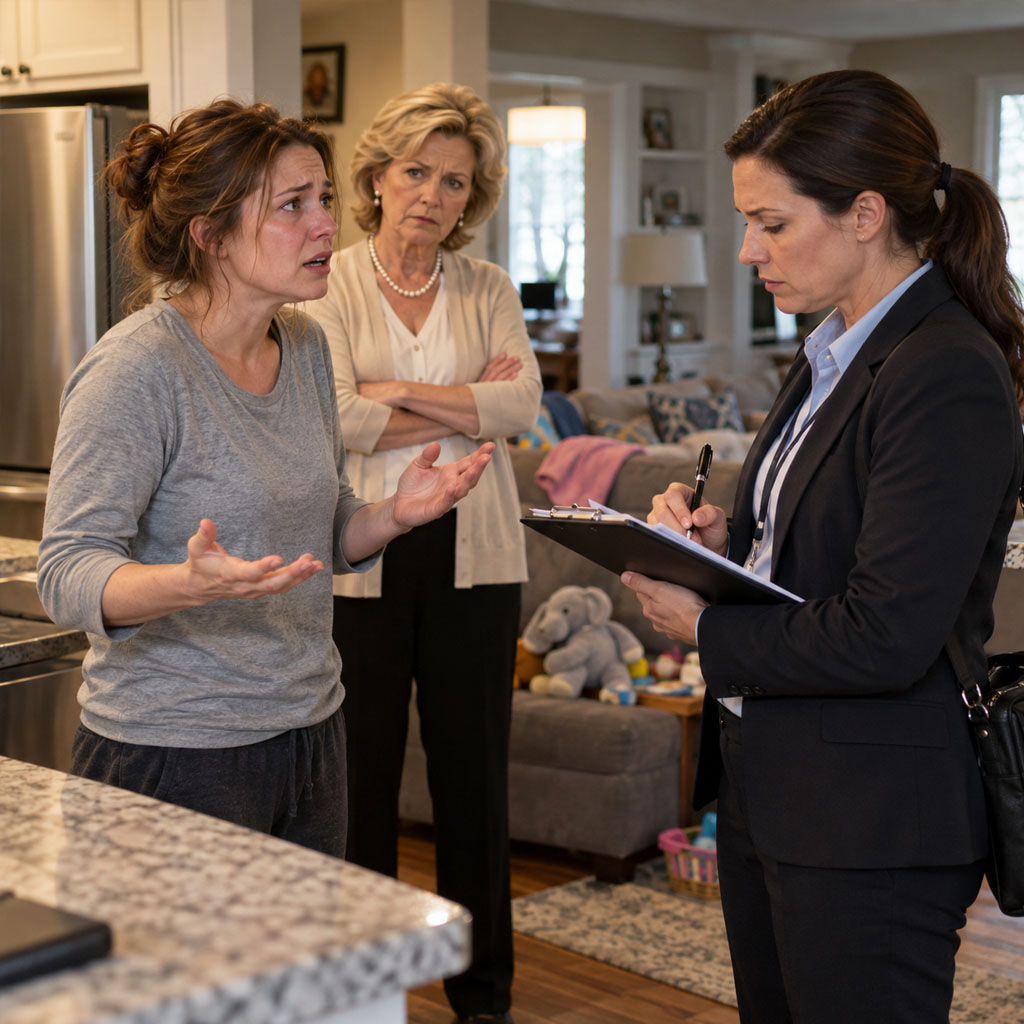
Three weeks after Andrea Frost first entered our home, the state officially closed the investigation.
Unfounded.
No evidence of abuse or neglect.
Healthy children. Stable home. Appropriate parenting.
I read the letter twice, then pressed it to my chest while David wrapped his arms around me.
For several minutes, neither of us spoke.
We had won something we never should have been forced to fight for.
Yet the damage remained.
Sophie had begun asking, “Is the lady coming back to watch us?”
Oliver woke crying one night and asked whether strangers could take him away.
Every bruise still made my pulse jump.
Every fall made me reach for my phone to take a photograph before reaching for a Band-Aid.
Patricia had changed the atmosphere of our home without living in it.
David called his parents after the case was closed.
He put the phone on speaker.
His father, Richard, answered.
“Dad, I’m telling you this once,” David said. “The investigation is over. There was no abuse.”
“I’m glad to hear it.”
“Mom will not see Sophie or Oliver.”
A pause.
“David—”
“Not unless she admits she made a false accusation and apologizes.”
Patricia apparently heard him from somewhere nearby, because her voice suddenly came through the phone.
“I will not apologize for protecting my grandchildren.”
I felt my jaw tighten.
David remained remarkably calm.
“You weren’t protecting them.”
“You don’t know what I saw.”
“The doctor does. CPS does. The investigation is over.”
“I acted on what I believed.”
“And what you believed nearly destroyed my family.”
Patricia began crying.
Richard took the phone.
“Son, emotions are running high.”
“No, Dad. This is a boundary.”
“Your mother loves those children.”
“So do I. That’s why she won’t be seeing them.”
He hung up.
Two weeks later, a large box arrived.
Expensive toys. Designer clothes. Books. A handwritten card.
Grandma misses you more than you know.
David repacked everything, carried the box to the shipping store, and sent it back.
No anger. No argument.
Just return to sender.
Patricia called him that night.
“You sent back their gifts?”
“Yes.”
“How can you be this cruel?”
“Gifts aren’t accountability.”
“I have nothing to apologize for.”
“Then we have nothing else to discuss.”
He ended the call.
For the first time in our marriage, David stopped trying to repair the relationship between his mother and everyone she hurt.
I watched something painful happen inside him over those weeks. He wasn’t simply angry at Patricia. He was grieving the mother he had believed he had.
Five weeks later, grief became war.
A certified letter arrived from a Hartford law firm.
Patricia was seeking court-ordered grandparent visitation.
I stood at the kitchen counter reading the words until they stopped making sense.
“She’s suing us?” I finally asked.
David took the letter from my hand.
His expression hardened with every paragraph.
Patricia claimed she had enjoyed a loving, established relationship with Sophie and Oliver. She claimed removing her from their lives was emotionally harmful. She claimed we were acting out of hostility instead of concern for our children.
Her attorney demanded that we agree to a visitation schedule.
Otherwise, they would file in court.
David called the law firm immediately.
The attorney listened to him describe the false accusation, the investigation, and the medical evidence.
Then the man said, “My client believes maintaining contact is in the children’s best interests.”
“My mother tried to have my wife investigated for abusing our kids.”
“She exercised her legal right to report a concern.”
“It was false.”
“The investigation found insufficient evidence. That doesn’t necessarily establish malicious intent.”
David’s voice became quiet.
“File your petition.”
He hung up.
The next morning we hired Rebecca Chen, a family attorney recommended by one of my coworkers.
Rebecca was compact, calm, and frighteningly attentive. She listened for nearly two hours without interrupting except to ask dates.
When we finished, she folded her hands.
“You have a strong position.”
I exhaled.
“But?”
“But this could be expensive and ugly.”
“How ugly?” David asked.
“Your family history becomes evidence. Her relationship with the children becomes evidence. Your decision-making becomes evidence. A judge may have to decide whether cutting her off is reasonable.”
“She made a false abuse claim.”
“That helps you. But her lawyer will say it was a good-faith mistake.”
“What do you think?”
Rebecca met my eyes.
“I think someone who sincerely believed children were being harmed would normally show relief when professionals determined they were safe.”
That sentence stayed with me.
Patricia hadn’t shown relief.
She had shown resentment.
The petition was filed two weeks later.
The court appointed Thomas Brennan, a child-welfare specialist, to evaluate the family and make a recommendation.
When Thomas arrived at our house, the dread came flooding back.
Another stranger with authority.
Another person studying us.
Another person who might someday write a sentence deciding where my children went and whom they had to see.
Thomas was gentler than Andrea had been. He was in his fifties, soft-spoken, with the patient manner of someone who had spent decades sitting in tense living rooms.
He asked why we had ended contact.
David answered first.
“Because my mother used access to our children to create a false narrative that my wife was abusing them.”
“Do you believe she knew it was false?”
“Yes.”
Thomas looked at me.
“And you?”
“I believe she wanted control. When she stopped being able to influence our decisions directly, she found a system that could.”
Thomas wrote something down.
Later, he spoke with Sophie.
“Do you miss Grandma Patricia?” he asked.
Sophie shrugged.
“Sometimes.”
“What do you miss?”
“She used to bring cupcakes.”
Thomas smiled slightly.
“Anything else?”
“She had a pool.”
I almost laughed, but didn’t.
Oliver was too young to say much. He played with toy trucks while Thomas watched him.
At the end of the visit, Thomas said the children appeared secure and happy.
Then he added, “I’ll also need to evaluate your mother-in-law and observe the history of her relationship with the children.”
Several weeks later, his preliminary recommendation arrived.
Supervised visitation.
I read the sentence and felt as if Patricia had found another key to our front door.
Thomas acknowledged that the abuse complaint had been unfounded. He acknowledged our concerns. But he also believed the children had positive memories of their grandmother and might benefit from preserving that relationship under supervision.
“He doesn’t understand,” I told Rebecca.
“He understands more than you think.”
“Then why is he recommending contact?”
“Because he’s looking at the children’s past relationship, not just Patricia’s behavior toward you.”
“That behavior endangered them too.”
“I know.”
Rebecca filed an objection.
The preliminary hearing came in August.
Patricia sat across the courtroom wearing pearls.
Of course she wore pearls.
Her attorney described her as a devoted grandmother whose excessive concern had been misinterpreted as malice.
Rebecca described the medical-record call, the photographs, the pattern of interference, and Patricia’s refusal to apologize.
Then Judge Christina Wallace asked a question that changed the room.
She looked directly at Patricia.
“Mrs. Whitmore, if rebuilding this relationship required you to acknowledge that your report caused serious harm and participate in family therapy, would you be willing to do so?”
Patricia hesitated.
I saw her attorney glance toward her.
Then she lifted her chin.
“I cannot apologize for trying to protect my grandchildren.”
Judge Wallace studied her for several seconds.
“Even knowing the investigation found no abuse?”
“I acted on what I believed was happening.”
“And you see no error in your actions?”
“No, Your Honor.”
For the first time, Patricia’s certainty did not look powerful.
It looked dangerous.
Judge Wallace ordered a comprehensive psychological evaluation before trial.
As we left the courthouse, Patricia passed within several feet of me.
She didn’t speak.
Neither did I.
But for once, I wasn’t afraid of her.
I was beginning to understand that Patricia’s greatest weakness was the one thing she considered her greatest strength.
She could never admit she was wrong.
Chapter 3
Dr. Vivian Torres was appointed to evaluate all of us.
She specialized in child development and high-conflict family relationships, and unlike everyone else who had entered our lives that year, she did not carry a clipboard visibly.
Her office had bookshelves, puzzles, stuffed animals, crayons, and a miniature wooden kitchen in one corner.
Sophie liked her immediately.
After her session, she emerged holding a picture she had drawn of our family.
Four figures.
Me. David. Sophie. Oliver.
No grandmother.
I tried not to attach meaning to it.
Dr. Torres interviewed me separately the following week.
She asked me to describe Patricia from the beginning.
So I did.
The wedding.
The criticism.
The parenting advice.
The way every offer came with a hidden expectation.
The way David’s promotion intensified Patricia’s belief that she should shape our family.
Then I described the morning Andrea Frost came to our house.
My voice remained steady until I reached the part about Oliver’s nightmares.
That was when I broke.
“I could handle her hating me,” I said. “I could handle being judged. But she made my children afraid someone might take them away.”
Dr. Torres waited.
“What would Patricia have to do for you to consider allowing contact again?”
“Change.”
“What would that look like?”
“Not words. Behavior. Therapy. Accountability. Time.”
“So you’re not saying never?”
I thought carefully.
“I’m saying not while she still believes she did nothing wrong.”
Dr. Torres interviewed David, Patricia, and Richard separately.
We knew nothing about their sessions until the report arrived three days before trial.
Rebecca called us to her office.
She had a printed copy waiting on the conference table.
“You need to read this.”
The report concluded that contact with Patricia was not currently in Sophie and Oliver’s best interests.
I stared at the sentence.
Rebecca continued.
“Dr. Torres found a pattern of escalating boundary violations. She’s especially concerned by Patricia’s refusal to recognize the consequences of the abuse report.”
David leaned forward.
“What does she say about supervised visits?”
“She recommends against them.”
I looked up.
“Completely?”
“For now.”
Rebecca turned several pages.
“Her concern is that court-ordered visitation would reinforce Patricia’s belief that she can bypass you whenever she disagrees with your parenting.”
I felt something inside me loosen.
Dr. Torres also found that Sophie and Oliver had adjusted well to the separation. They were not showing emotional distress from Patricia’s absence.
Most importantly, she recommended that any future reconciliation depend on Patricia engaging in meaningful therapy and demonstrating sustained behavioral change.
For months, Patricia had framed us as vindictive parents.
Now a neutral professional was saying what we had been saying all along.
Boundaries were not revenge.
Sometimes boundaries were protection.
Trial began the following Monday.
Patricia testified first.
She spoke lovingly about birthday parties, holidays, swimming lessons, Christmas mornings, and afternoon visits.
She cried while describing how much she missed the children.
For a moment, I almost felt sorry for her.
Then her lawyer asked whether she regretted reporting me.
“No,” Patricia said.
Rebecca looked down at her notes.
Patricia continued.
“When a child may be in danger, responsible adults must act.”
Her attorney nodded.
Rebecca’s cross-examination began quietly.
“Mrs. Whitmore, before reporting your daughter-in-law, did you attempt to obtain Sophie’s medical information?”
Patricia shifted.
“I called the pediatrician with questions.”
“Did you have parental authorization?”
“No.”
“Did the pediatrician’s office refuse to provide the information?”
“Yes.”
“Did you then report suspected abuse?”
“I reported my concerns.”
“After trying to investigate privately first?”
“I was gathering information.”
Rebecca walked closer.
“So your report was not an impulsive act triggered by seeing one alarming injury.”
“No.”
“You had been collecting information for some time.”
Patricia hesitated.
“I had been paying attention.”
“To bruises?”
“Yes.”
“To scratches?”
“Yes.”
“To conversations with the children?”
“I’m their grandmother.”
“To photographs of their arms and legs?”
Patricia looked toward her attorney.
“Yes.”
Rebecca paused.
“Did you ever ask David to take Sophie to a doctor because you feared she was being injured?”
“No.”
“Did you ever tell Mrs. Miller that you believed Sophie was unsafe?”
“No.”
“Did you ever tell your husband?”
“I may have expressed concerns.”
Richard later testified that she had not.
Rebecca asked the question I had been waiting months to hear.
“Mrs. Whitmore, after the investigation cleared these parents, were you relieved to learn your grandchildren were safe?”
Patricia opened her mouth.
Nothing came out.
Rebecca waited.
Finally Patricia said, “I was relieved they found no evidence.”
“That wasn’t my question.”
Her attorney objected.
The judge allowed it.
Rebecca repeated herself.
“Were you relieved to learn your grandchildren were safe?”
Patricia stared at her.
“I still believed there were reasons for concern.”
There it was.
Even innocence could not satisfy her because innocence meant she had been wrong.
Richard’s testimony came next.
He tried to portray me as difficult, emotional, and controlling.
Rebecca asked him whether he had ever witnessed me strike my children.
“No.”
Threaten them?
“No.”
Use inappropriate discipline?
“No.”
Witness any injury that personally alarmed him?
“No.”
By the time he left the stand, his testimony had become what it truly was: loyalty to his wife, not evidence.
Dr. Yun testified after lunch.
She was calm and precise.
She explained Sophie’s bruising tendency, her active temperament, her medical history, and her physical examinations.
“As a mandated reporter,” Rebecca asked, “have you ever observed signs that caused you to suspect abuse in this family?”
“No.”
“Not once?”
“Not once.”
“And had you observed signs of abuse, what would you have done?”
“Reported them immediately.”
Dr. Yun then described Patricia’s attempt to obtain confidential medical information.
That visibly interested Judge Wallace.
Finally, I testified.
Rebecca asked how Patricia’s accusation had affected our household.
I told the truth.
“I started photographing every bruise my children got.”
“Why?”
“Because I was afraid normal childhood injuries would be used against me again.”
“What effect did the investigation have on the children?”
“Sophie asked whether she was being watched because she had done something wrong. Oliver had nightmares about being taken away.”
My voice shook.
I stopped for a moment.
Rebecca waited.
I looked at Patricia.
She was watching me with the same controlled expression she had worn at our wedding.
I turned back to Rebecca.
“I didn’t cut her off because I wanted to punish her. I cut her off because she demonstrated that if she disliked our decisions enough, she was willing to use the children as leverage.”
Patricia’s lawyer stood for cross-examination.
“Mrs. Miller, isn’t it true that you never liked your mother-in-law?”
“No.”
He blinked, apparently surprised.
“I liked her at times. I tried very hard to have a relationship with her.”
“But there was tension.”
“Yes.”
“And after this report, you decided to exclude her permanently.”
“I decided to exclude her until she could be trusted.”
“Isn’t that effectively the same thing?”
“No.”
“What would make her trustworthy?”
“Taking responsibility.”
He paced slowly.
“Would you agree that good people can make mistakes?”
“Yes.”
“And should mistakes always cost someone their family?”
“No.”
That was clearly not the answer he wanted.
I continued.
“But refusing to admit the mistake means it can happen again.”
He stopped.
“Are you saying Mrs. Whitmore might file another report?”
“I’m saying she still believes the first one was justified.”
That ended the exchange.
Judge Wallace said she would issue a written ruling within two weeks.
Twelve days later, Rebecca called.
“We have the decision.”
David and I drove to her office without speaking.
Rebecca waited until we sat down.
Then she smiled.
“You won.”
David bowed his head.
I covered my mouth.
The judge denied Patricia’s petition.
No supervised visitation.
No scheduled contact.
No court-ordered access.
Judge Wallace found that we had legitimate reasons for ending contact. She gave substantial weight to Dr. Torres’s findings and emphasized that parents possess fundamental rights to decide who has access to their children unless extraordinary circumstances justify intervention.
Patricia had failed to prove that losing contact with her was harming Sophie or Oliver.
The judge also addressed the abuse report.
Patricia’s refusal to acknowledge the consequences of her actions, Judge Wallace wrote, raised legitimate concerns about future boundary violations.
The court would not force children into a relationship that their parents reasonably believed could destabilize their family.
I read those words again and again.
For months, strangers had examined whether I was safe enough for my own children.
Now a judge had recognized that the real danger was not a mother protecting her children.
It was someone who believed love entitled her to control them.
Chapter 4
The ruling cost us almost $28,000 in legal fees.
I would have paid twice that.
For the first few months afterward, I kept expecting another letter.
An appeal.
A complaint.
A surprise visit.
Nothing came.
Patricia disappeared from our lives.
At first, the silence felt unnatural. Then it became peaceful.
Sophie started kindergarten and immediately found three best friends whose names changed depending on the day. Oliver became obsessed with dinosaurs and asked approximately one thousand questions before breakfast.
David received another promotion.
We bought a modestly larger house twenty minutes away, mostly because the school district was good and the backyard had enough room for Sophie to run without treating the furniture as gym equipment.
Gradually, I stopped photographing every scrape.
Not completely.
But enough.
One afternoon, Sophie came inside with mud on her shirt and a bruise forming on her elbow.
“Mom!” she yelled. “You should’ve seen my jump!”
My heart still reacted before my brain did.
“What jump?”
“Off the big rock.”
I looked toward the backyard.
“The rock I told you not to jump from?”
She gave me the guilty smile of a child who knew the answer.
For a second, that old panic returned.
Then I took a breath.
“Wash your hands. I’ll get some ice.”
No photograph.
No notebook.
No witness statement.
Just a mother taking care of her daughter.
Six months after the court ruling, I realized I had gone an entire week without thinking about Patricia.
That felt like freedom.
Then February arrived.
The envelope was in our mailbox on a cold Saturday morning.
I recognized Patricia’s handwriting immediately.
My body reacted before I opened it.
David was making pancakes when I carried the letter into the kitchen.
“What is it?”
I held up the envelope.
He turned off the burner.
Neither of us spoke while I opened it.
The letter was only one page.
Patricia wrote that she had been in therapy for several months.
She said she had begun to understand that what she had called protection had often been fear disguised as control.
She wrote that she had spent years believing she knew what was best for David, then transferred that belief to our children.
She admitted she had gathered information about Sophie’s injuries because she had become convinced that my parenting was unsafe, not because she had evidence, but because she already distrusted me.
Then came the words I had once believed she was incapable of writing.
I was wrong.
I stopped reading.
David looked at me.
“Keep going.”
I did.
Patricia apologized for the investigation.
For trying to access medical records.
For forcing us into court.
For frightening the children.
For treating David’s independence as betrayal.
She did not ask to see Sophie or Oliver.
She did not demand forgiveness.
She did not propose a holiday visit.
She wrote that she understood trust could not be restored because she wanted it restored. If there was ever contact again, she said, it would have to come after sustained change, on our terms, with professional guidance.
The letter ended simply.
I understand now that being their grandmother did not give me authority over their parents. I hope someday my behavior will show you that I finally understand the difference.
David sat down.
For a long time, neither of us said anything.
“Do you believe her?” he asked.
“I believe she wrote the letter.”
“That’s not what I asked.”
I folded the page.
“I don’t know.”
He nodded.
“Me neither.”
There was sadness in his face, but not the desperate sadness I had seen before.
He no longer needed his mother to become the person he wished she had been.
That mattered.
“What do we do?” he asked.
“Nothing.”
He looked at me.
“Nothing?”
“Not yet.”
I placed the letter back in its envelope.
“If she’s really changing, she’ll still be changing six months from now. A year from now. Real change doesn’t need an immediate reward.”
David smiled faintly.
“That sounds like something Rebecca would say.”
“No. Rebecca would bill us $400 to say it.”
He laughed.
It was the first time Patricia’s name had been connected to laughter in nearly a year.
We put the letter in a drawer.
Then we finished breakfast.
Chapter 5
Another year passed.
Patricia did not push.
She sent one birthday card to David, not the children, and wrote nothing about visitation.
At Christmas, she mailed no gifts.
Richard sent David a short message saying they loved him and hoped he was well. David answered politely.
That was all.
The absence of pressure affected me more than any apology could have.
For years, Patricia had treated every boundary like the beginning of a negotiation.
Now she was finally allowing silence to mean silence.
One evening, after the children were asleep, David sat beside me on the back porch.
“Mom’s therapist contacted me.”
I looked at him.
“She asked?”
“No. Apparently Mom gave written permission for the therapist to reach out if we were ever open to hearing about her progress. The therapist didn’t ask for a visit. Just said Mom has continued treatment.”
“How long?”
“Almost two years.”
I leaned back.
The yard was dark except for the porch light.
“And what do you want?”
David thought before answering.
“I want my kids safe.”
“So do I.”
“I also want to believe people can change.”
“That doesn’t mean we have to gamble the children to find out.”
“I know.”
That was the difference between us now and us before.
David no longer confused forgiveness with access.
Neither did I.
Several months later, we agreed to speak with Patricia’s therapist without Patricia present.
We made no promises.
The therapist explained that Patricia had worked on control, anxiety, family boundaries, and what she called “entitlement disguised as caretaking.”
That phrase sounded painfully accurate.
Patricia, according to the therapist, had stopped focusing on how much she had lost and started focusing on what her actions had cost other people.
I listened carefully.
Then I asked the question that mattered most.
“Does she still believe reporting me was justified?”
The therapist paused.
“No.”
My hands tightened in my lap.
“She understands now that she interpreted ordinary events through a belief she had already formed about you. She recognizes that she collected information to confirm that belief rather than objectively evaluating what she saw.”
David looked down.
I felt something inside me shift.
Not forgiveness.
Not trust.
But movement.
We eventually agreed to one meeting.
No children.
Just Patricia, David, me, and the therapist.
Patricia entered the office without pearls.
I noticed that immediately and hated myself slightly for noticing.
She looked older.
Not dramatically. Just human.
For years I had experienced her as an immovable force. Sitting across from me now, she looked like a woman in her late sixties who had made terrible choices and finally understood she could not command her way out of the consequences.
She spoke first.
“I owe you both an apology that doesn’t contain an explanation.”
David said nothing.
Neither did I.
Patricia continued.
“I accused you of hurting your children because I had convinced myself that my distrust of you was evidence. It wasn’t. I frightened your family. I invaded your privacy. I forced you to defend yourselves to strangers. Then, when you protected yourselves from me, I tried to use the court to override you.”
Her voice shook.
“I was wrong.”
I had imagined hearing those words hundreds of times.
In my imagination, they always brought satisfaction.
They didn’t.
They brought grief.
Because admitting the truth did not erase what the lie had cost.
“Why now?” I asked.
Patricia nodded slightly, as if she had expected the question.
“Because for a long time I went to therapy hoping someone would help me prove you were cruel. When that didn’t happen, I nearly quit.”
David’s mouth tightened.
“What changed?”
“My therapist asked me why everyone else had to be wrong for me to remain right.”
Patricia wiped one eye.
“I didn’t have an answer.”
The room went quiet.
“I began looking at my behavior instead of my intentions,” she continued. “I kept saying I meant well. But meaning well did not make the consequences disappear.”
I looked at her.
“Sophie was afraid someone would take her away.”
Patricia closed her eyes briefly.
“I know.”
“Oliver had nightmares.”
“I know.”
“I was afraid to let my children play outside without documenting every bruise.”
“I know.”
My voice sharpened.
“No. You know now. We lived it.”
Patricia nodded.
“You’re right.”
There was no defense.
No tears designed to stop the conversation.
No “but.”
That mattered too.
We did not bring the children to the next meeting.
Or the one after that.
Six months passed before Patricia saw them again.
The reunion happened in a therapist’s office.
Sophie was 7 by then. Oliver was 5.
We had explained that Grandma Patricia had made serious mistakes, had been working on them, and wanted to apologize.
We told the children they did not have to hug her.
They did not have to sit beside her.
They did not have to forgive anything they did not understand.
Patricia was already seated when we entered.
Sophie stopped near the doorway.
Patricia’s face crumpled.
But she stayed in her chair.
“Hi, sweetheart.”
Sophie looked at me.
I nodded.
“Hi.”
Oliver hid behind David’s leg.
Patricia didn’t move toward him.
That restraint told me more than words could have.
The therapist helped everyone settle.
Patricia apologized in simple language.
“I made some bad choices because I thought I knew better than your mom and dad. I was wrong. I’m sorry I scared your family.”
Sophie frowned.
“Are you going to call the lady again?”
Patricia’s eyes filled with tears.
“No.”
“Promise?”
Patricia looked at us before answering.
“I promise I will respect your mom and dad.”
That was a better promise.
The children saw her for thirty minutes.
No gifts.
No dramatic reunion.
No pretending the past had disappeared.
When it was time to leave, Oliver gave Patricia a drawing he had made during the session.
She accepted it carefully.
“Thank you.”
He nodded.
On the drive home, Sophie asked, “Is Grandma coming to Christmas?”
David looked at me.
“No,” I said. “Not this year.”
Sophie accepted that easily.
Children sometimes understand gradual trust better than adults.
Over the next two years, Patricia earned limited supervised contact.
Then occasional family lunches.
Then birthdays.
She never returned to the role she once believed she deserved.
She became something different.
A grandmother who asked before visiting.
A grandmother who did not undermine us.
A grandmother who understood that love was not ownership.
Richard changed too, though more slowly. He eventually admitted that defending Patricia had allowed her behavior to continue.
The strangest part was that our family did not heal by returning to what it had been.
It healed by becoming something it had never been before.
Honest.
Boundaried.
Careful.
Imperfect.
One summer afternoon, years after the investigation, I watched Sophie race across our backyard chasing Oliver with a garden hose.
She slipped.
She landed hard.
She came up laughing with grass stains on her knees and a fresh bruise already forming on her shin.
Patricia was sitting several feet away on the patio.
For one second, our eyes met.
Years earlier, she would have inspected the bruise.
Asked questions.
Built a theory.
That afternoon, she simply called, “You okay, Soph?”
Sophie laughed.
“I’m fine!”
Patricia nodded.
“Then maybe stop running on wet grass.”
“You sound like Mom!”
“That’s because your mom is usually right about things like that.”
I looked at her.
She gave me a small smile.
No performance.
No hidden challenge.
Just acknowledgment.
I smiled back.
I had once believed cutting Patricia off meant I was destroying a family relationship.
I know better now.
Sometimes ending contact is not the destruction of a relationship.
Sometimes it is the only thing that gives a damaged relationship any chance of becoming healthy.
We had not protected our children by teaching them that family must always be forgiven immediately.
We protected them by teaching them that love requires responsibility.
That apologies require change.
That boundaries are not cruelty.
And that no title—mother, father, grandmother, grandfather—gives anyone permission to hurt a family and demand access to it afterward.
Patricia eventually became part of our lives again.
But she did not return because a court forced us to open the door.
She returned because, after years of refusing to change, she finally learned to knock.
THE END.
⚠️ All characters and events are fictional. Do not imitate or apply them in real life. 😌😌😌


