Chapter 2
At 9:10 that night, after Wesley went into the shower, I carried the sealed bag from the freezer to the side gate.
A plainclothes officer named Kofi Mensah was waiting outside in a hooded sweatshirt. He looked like a man taking an evening walk, except that he wore gloves and carried an evidence bag, a clipboard, and a small camera.
He recorded the time, photographed the sealed package, and asked me to sign a receipt.
“Detective Briggs says you did the right thing,” he told me.
I nodded, unable to speak.
Then I went back inside and sat on the hallway floor outside Poppy’s room.
I listened to her breathe.
At 11:15, Wesley came out of our bedroom to get water. When he saw me sitting there, he stopped.
“What’s wrong?”
“Headache,” I said. “The hallway’s cooler.”
He studied me, then looked at Poppy’s door.
For a moment, I thought he might ask why I wasn’t in bed. Instead, he went downstairs without getting his water.
At 1:50 in the morning, he returned.
“Can I check on her?”
“Of course.”
I still remember how easily the words came out.
He entered the room and stood beside her bed for nearly a minute without touching her. I watched through the narrow opening in the door, trying not to breathe too loudly.
When he came out, his expression was difficult to describe. He looked confused, almost offended, as though something he had carefully calculated had refused to work.
At 4:20, he went in again.
This time, he touched two fingers to the side of Poppy’s neck.
She rolled away, swatted at his hand, and mumbled, “Stop it, Daddy. I’m dreaming.”
He backed away.
When he emerged into the hallway, his face had gone pale.
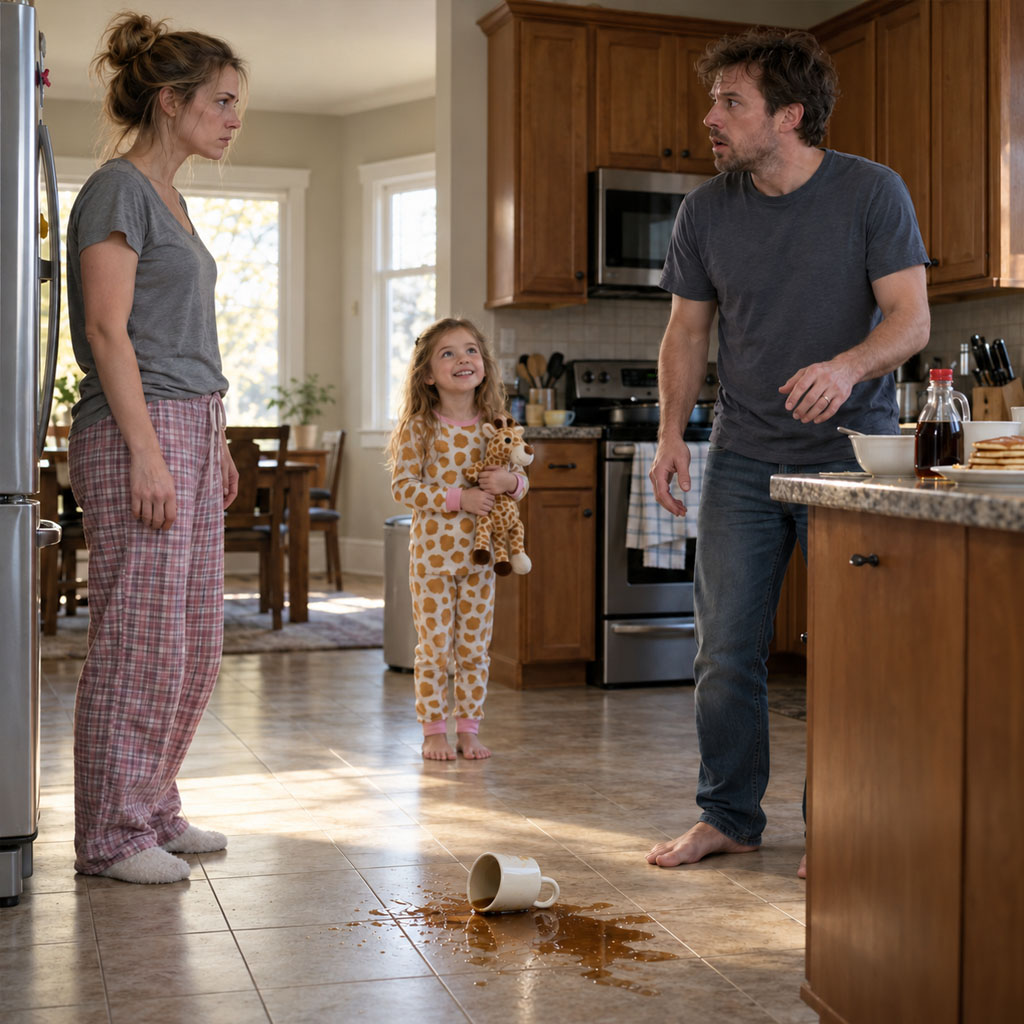
At 6:45, Poppy came thumping down the stairs in her giraffe pajamas and asked for chocolate-chip pancakes. Wesley dropped his coffee mug. It hit the tile without breaking and spun between us until it finally stopped.
We stood there, looking at each other.
Neither of us pretended to be confused anymore.
At 7:07, someone knocked on our front door.
I opened it expecting Lorna, perhaps with officers ready to take Wesley away. Instead, two uniformed officers stood behind her, and before she could speak, Wesley burst into tears.
“Oh, thank God,” he said. “Thank God you’re here.”
Lorna looked startled.
“My wife,” Wesley continued, his voice breaking. “Something happened last night. I didn’t know what to do.”
He pointed toward my purse, hanging on the hook beside the door.
“I found something. I was scared to confront her, so I stayed awake all night watching Poppy. Please. Look in the front pocket. The one with the zipper.”
My stomach turned cold.
I hadn’t touched that purse since Sunday.
I knew exactly what the officers would find because I’d heard Karen tell Wesley where to put it.
Lorna’s jaw tightened, but she couldn’t simply dismiss a direct accusation made in front of uniformed officers with their body cameras running. An officer put on gloves and opened my purse.
He removed a small brown bottle with a dropper top.
No label.
Wesley covered his mouth and sobbed.
“I think I stopped her,” he said. “I think I saved my little girl.”
The bottle was the prop he’d needed. He had taken a plan intended to kill our daughter and turned her survival into evidence that he was the hero.
“Lorna, he’s lying,” I said. “The recording—”
“Mrs. Hail,” Lorna interrupted quietly. “Please stop talking.”
She was right. Every word I said was being recorded, and Lorna knew she could no longer handle the case herself. She’d spoken to me the previous night and arranged the collection of evidence. That made her a witness.
The officers didn’t arrest me, but they took me in for questioning.
At the station, Sergeant Hugo Sana interviewed me. He was a veteran officer with a gray mustache, a gravelly voice, and the habit of listening without interrupting.
He played Wesley’s version of events back to me.
My husband claimed he’d found the bottle while looking for his car keys. He said he had been worried about my anxiety for months. He told police I had become unpredictable, that I had been acting strangely, and that he had spent the night watching Poppy because he feared I might hurt her.
“Your husband says you’ve been seeing a therapist,” Sana said.
“I see someone once a month,” I replied. “I spent eight years answering emergency calls. Some of them stay with you.”
He wrote that down.
“He also says you downloaded an application that can imitate someone’s voice.”
I almost laughed. “Sergeant, I can barely work our television remote.”
Then I played him the recording.
He listened without moving. When Wesley said, “I know how to cry,” the sergeant’s mustache twitched.
Afterward, he leaned back.
“I believe you heard what you say you heard,” he said. “But an audio recording can be challenged. Your husband says it’s fake. And you say you saw him prepare the cup.”
“I saw him put his hand in his pocket.”
“Did you see what he put in the milk?”
“No.”
“Did you see him touch the bottle?”
“No.”
He wasn’t accusing me. That somehow made it worse.
“His attorney will argue that you prepared the cup yourself and froze it to create evidence. He’ll say you planted the bottle in your own purse.”
“Why would I do that?”
“Your husband says you found out he wanted a divorce.”
The words hit me harder than I expected.
A divorce?
I had known our marriage wasn’t perfect. Wesley had become distant over the previous year, spending more time on business trips and less time talking to me. But I had never heard him say he wanted to leave.
Sana continued, “We need to establish what happened, not just what each of you believes happened.”
I was released at 2:40 that afternoon without charges.
Outside the station, a county social worker named Mona Reyes waited beside a white sedan. She wore a lanyard and had the exhausted expression of someone who had delivered too many difficult messages.
“Mrs. Hail, I’m sorry,” she said. “Both parents have made allegations against each other, and there’s a possible dangerous substance involved. Until we know more, Poppy can’t stay with either parent.”
“Where is she?”
“In the back seat. We need to arrange a temporary kinship placement.”
I looked through the window and saw my daughter buckled into a borrowed car seat.
“Who is taking her?”
Mona glanced at her paperwork.
“Your husband’s sister has offered. Karen has a clean background check and works in a pharmacy.”
“No.”
The word came out so loudly that a man across the parking lot turned around.
“Karen is part of the recording. She’s the one who helped him. You can’t send my daughter to her.”
Mona looked at me carefully.
“Do you have another relative who could be considered?”
I called my cousin Tessa, a kindergarten teacher in Sand Springs. She didn’t ask me to explain everything over the phone.
“I’m leaving now,” she said. “That’s family.”
Mona approved Tessa as a temporary placement that afternoon.
Then came the part I still struggle to describe without feeling that same helplessness all over again.
I had to open the car door and tell Poppy she was going to stay with Tessa for a few days.
“Mommy’s coming soon,” I promised.
She shook her head and grabbed my shirt with both fists.
“No, Mommy. Don’t go. I didn’t do anything!”
“I know, sweetheart. I know.”
She kicked so hard that one of her pink sneakers flew off and landed on the asphalt. Mona had to gently loosen Poppy’s fingers from my shirt, one at a time.
I picked up the little sneaker and slipped it into my purse.
Then I watched the white sedan pull away, the red light in Poppy’s remaining shoe blinking through the back window until the car reached the stop sign.
That evening, I hired Ruth Kimell, a family and criminal defense attorney in her sixties who worked from a converted bungalow in Midtown. She had short silver hair, reading glasses on a cord around her neck, and a cat that slept on her fax machine.
She listened to my recording twice.
When it ended, she removed her glasses.
“Well,” she said. “Your husband is a monster. That’s not going to be the hard part.”
“What is?”
“The fact that he’s had a head start.”
She took out a yellow legal pad and began listing what Wesley had assembled against me: a bottle found in my purse, a tearful accusation, a sister with a pharmacy job, and a mother with a documented history of anxiety.
Then she told me something else.
Wesley had filed for divorce that morning, while I was being questioned at the police station. He had also requested emergency sole custody of Poppy, claiming I was experiencing a mental health crisis and had attempted to harm our daughter.
I stared at Ruth.
“He filed while I was at the station?”
“That’s right.”
“How long has he been planning this?”
“That’s what we’re going to find out.”
Ruth checked the records for our house, which my father had left me. Wesley had taken out $40,000 against the home’s equity the day before the phone call.
He needed money. He wanted the house. And he wanted me removed from the picture.
When I finally returned home, the silence was unbearable.
Poppy’s drawings still hung on the refrigerator. Her little shoes sat beside the front door, one missing its mate. Wesley’s tulips were beginning to droop in the vase.
I went upstairs, closed the door to my daughter’s bedroom, and sat on the floor with her pink sneaker in my lap.
I had to get her back.
And I had to do it before Wesley got what he wanted.
Chapter 3
The laboratory called Sergeant Sana on Thursday morning.
He asked me to come to the station, and when I arrived, a pediatric emergency physician named Dr. Abel Mercer was waiting with him.
Dr. Mercer was a quiet man in his fifties who consulted with the state on suspected child poisoning cases. He spoke gently, as if he understood that the words he was about to use would stay with me long after I left the room.
“Mrs. Hail, the laboratory identified a substance in the milk that should never be given to a child,” he said. “I won’t get into unnecessary technical details. What matters is that the amount found could have caused a life-threatening medical emergency in a child of your daughter’s size.”
I stared at him.
“She could have died?”
“Yes.”
The room seemed to lose its air.
He continued, “The findings are consistent with deliberate exposure, not an accidental mix-up. Whoever prepared it knew they were creating a serious danger.”
I put my head down on the table.
I had known since Tuesday afternoon what Wesley intended to do. But hearing a doctor confirm that the cup contained something capable of killing Poppy made the truth feel newly real.
“This helps your case,” Sana said. “It establishes that the threat was real. But we still need evidence showing who put it there.”
“And the bottle?”
“Clean. No usable fingerprints.”
I looked up.
“Who wipes a bottle and then leaves it in her own purse?”
“That’s the question your attorney will raise,” he replied. “Unfortunately, your husband’s attorney will say you did it because you know how evidence works.”
That afternoon, Karen appeared on the local six o’clock news.
She wore a white blouse and a small gold cross. In her hands, she held a framed photograph of Poppy at the zoo, smiling beside the giraffe cup.
“My brother saved that baby’s life,” Karen said, her voice trembling. “He sat up all night watching her breathe. And now his wife is trying to accuse him of something terrible.”
She paused to wipe her eyes.
“We just want Poppy safe. That’s all we’ve ever wanted.”
Then she looked directly into the camera.
“Ivy, honey, if you’re watching, please get help.”
Ruth switched off the television.
“Well,” she said, “that’s the first mistake.”
“How is that a mistake? Everyone will believe her.”
“Maybe. But she’s just made herself part of the public story. Every word she says can be examined against the evidence. If she knows more than she’s admitting, that interview may become very important.”
I wanted to believe her.
But by Friday morning, I understood what Wesley’s money had bought him. His attorney, Vincent Shaw, was polished, confident, and practiced at turning uncertainty into suspicion. He had already begun portraying me as a troubled mother who had become desperate when her husband sought a divorce.
The emergency custody hearing was scheduled for two o’clock that afternoon.
Wesley wanted sole legal and physical custody of Poppy, with Karen approved as a backup caregiver.
Ruth was honest with me.
“Based on what’s currently in the file, the judge could order supervised visitation for you while Wesley retains custody,” she said. “I’m not saying that’s what will happen. I’m saying we have to prepare for it.”
I couldn’t stop picturing Poppy in Wesley’s house, drinking from her yellow cup while he watched her with that fixed, patient expression.
“What if he gets her?” I asked.
Ruth looked at me for a long moment.
“Then we keep fighting.”
She didn’t promise me everything would be fine. I trusted her more for that.
I spent Thursday night at home, alone with my laptop and the little pink sneaker in my lap. I listened to the recording again and again, trying to find something we had missed.
Wesley and Karen had spoken clearly about the bottle, the cup, and the story they intended to tell. But nothing in the audio directly identified the substance, and nothing showed whose hand had placed it in the milk.
At 1:30 Friday morning, I stopped listening to their words.
That was an old habit from my dispatch days. When a caller’s story didn’t make sense, I’d listen to the background. Sometimes the most important evidence wasn’t in what someone said, but in the sounds they didn’t notice.
I listened to the turn signal.
Click. Click. Click.
I listened to the tires passing over a rough patch of road near 71st Street. I heard the faint clinking of Karen’s bracelets whenever she moved her hands.
Then came the soft chime.
A mechanical voice warned Wesley to keep his eyes on the road.
“This stupid thing yells at me every time I look at my phone,” he complained.
Karen told him to stop looking at it.
I played that part again.
The chime.
The warning.
His irritation.
Suddenly, I remembered a dinner party two years earlier. Wesley had spent half the evening complaining about a new safety system his employer had installed in every company vehicle after one of the sales representatives had been involved in a serious collision.
A small black unit sat beside the rearview mirror. One lens faced the road. Another faced the driver. The system monitored driver attention and recorded certain events for the company’s safety department.
Wesley had joked that it was like having his mother in the passenger seat.
“Records everything, too,” he’d told me. “Sound, video, all of it. Big Brother with a corporate logo.”
I’d forgotten that conversation.
He had forgotten it, too.
I sat straight up in bed.
The recording wasn’t merely a conversation between my husband and his sister. It was a conversation inside a company vehicle equipped with a camera.
And if that camera had captured their meeting, there might be proof of what they’d done before he called me.
I called Lorna at 1:41 a.m.
She answered on the first ring.
“I’m not on the case anymore, Ivy,” she said after I explained. “But I’ll get Sana the information.”
At 2:05, Sana called me back.
“What company does Wesley work for?”
I told him.
“Do you know who manages the fleet system?”
I gave him the company’s name and the general details of the equipment. He told me not to contact Wesley, Karen, or anyone at the company.
“If that footage exists, we need to preserve it legally,” he said. “Don’t give him a reason to delete anything.”
By seven that morning, Sana had reached a fleet safety manager named Ray Dunore at the company’s Kansas City headquarters.
Ray confirmed that the system retained flagged clips for longer periods, but the complete cabin recordings were automatically deleted after seventy-two hours unless a legal hold was placed on them.
The trip we needed had begun at 4:31 p.m. Tuesday.
The scheduled deletion was midnight Friday, Central Time.
That gave us less than seventeen hours.
A preservation request could stop the deletion, but obtaining the footage for a criminal investigation required a warrant. Sana was working on it, but the timing was tight, and there was no guarantee a judge would sign in time.
I sat in Ruth’s office that morning, watching the clock while she prepared for the custody hearing.
“If the footage is there,” I said, “it could prove everything.”
“If it’s there, and if it shows what you think it shows,” Ruth replied. “We cannot build our argument around something we don’t have.”
At two o’clock, Wesley walked into Tulsa County Family Court wearing a navy suit I’d bought him for our anniversary.
Karen sat behind him with a tissue balled in her hand.
Vincent Shaw stood and spoke for twenty-one minutes. He described me as unstable, anxious, and increasingly unpredictable. He mentioned my therapist repeatedly and presented the bottle found in my purse as a troubling piece of physical evidence.
Wesley took the witness stand and cried.
Not too much.
Just enough.
He said he loved me. He said he wanted me to recover. He said he’d stayed awake all night watching our daughter because he feared for her safety.
He never once mentioned the conversation in his car.
When Ruth played my recording, Shaw objected that it was unauthenticated and might have been fabricated. The judge allowed it to be heard for what it was worth.
Wesley shook his head sadly throughout the playback, looking like a man listening to the worst accusations imaginable against someone he loved.
At 3:41, Ruth’s phone vibrated on the table.
She glanced at it, then slid it toward me.
The message was from Sergeant Sana.
Warrant signed. Footage retrieved. We’re coming.
I gripped the edge of the table.
For the first time in three days, I felt something other than fear.
But when the courtroom door opened three minutes later, I still had no idea whether the footage would save my daughter or simply give Wesley another way to hurt us.
Chapter 4
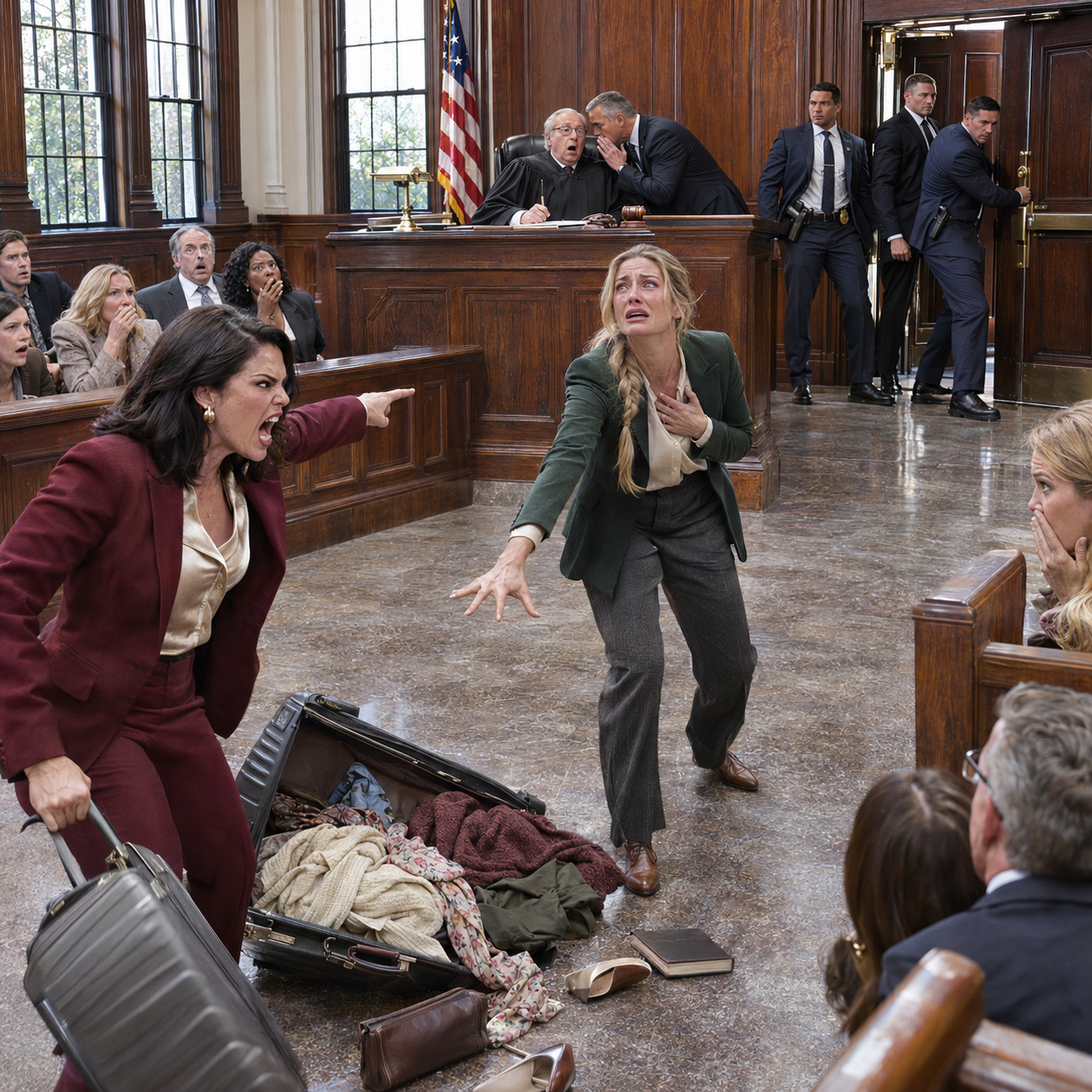
Sergeant Sana entered the courtroom carrying a laptop. Behind him walked Assistant District Attorney Simone Bell, a tall woman in a gray suit whose expression suggested she hadn’t come to observe.
“Your Honor,” she said, “I apologize for the interruption. The state has obtained evidence that bears directly on the safety of this child. We respectfully request that the court review it before issuing a custody ruling.”
Vincent Shaw immediately stood.
“This is an ambush. We haven’t had an opportunity to examine the material.”
Judge Theodore Larkin looked over his glasses.
“Then I suggest you pay attention while it’s being presented, Mr. Shaw. Play it.”
The courtroom screen flickered.
A black-and-white image appeared, slightly distorted around the edges. A timestamp sat in the corner.
Tuesday. 4:44 p.m.
Wesley was behind the wheel of his company SUV. Karen sat beside him, her bracelets catching the sunlight as she reached into her purse.
She removed a small brown bottle and handed it to him.
My hands began to shake.
There it was. The bottle he’d later claimed to have found in my purse.
On the recording, Wesley held it up briefly, examining it.
“Remember what we discussed,” Karen said. “Don’t get careless.”
She reached into her bag again and tossed something onto his lap. The camera captured the movement clearly enough to show that she was giving him protective gloves.
“Use those when you handle it,” she added.
Wesley laughed.
The sound was the same one I’d heard through my kitchen speaker, except now I could see his face as he made it.
At 4:51, he picked up his phone and called me.
The screen showed him making the call. The audio recorded our conversation, including my voice answering his question about milk.
“Two percent,” I heard myself say.
“Got it. Love you.”
Then he placed the phone face down in the cup holder.
The conversation that followed matched my recording word for word.
Karen asked whether I’d hung up. Wesley said I was cutting fruit. They discussed Poppy’s bedtime routine, the bottle, and the story they intended to tell emergency responders.
Then came the sentence that had changed everything.
“She’ll go to sleep and won’t wake up. That’s the point.”
A woman in the back row covered her mouth.
The footage continued. The safety system chimed, and Wesley glanced upward in irritation. For a moment, his face filled the screen as he looked directly toward the camera he’d forgotten was there.
Nobody in the courtroom moved.
I looked at Wesley.
He wasn’t crying anymore.
His expression was the same one I’d seen through the crack in Poppy’s bedroom door at 1:50 in the morning. The look of a man whose carefully arranged world had suddenly stopped obeying him.
Behind him, Karen had half risen from her seat.
Simone Bell turned toward her.
“Karen Hail, please remain where you are.”
Two deputies entered through a side door.
Karen looked at her brother.
“Wes? Wes, tell them.”
He didn’t answer.
Her face changed as she realized he wasn’t going to rescue her.
“You said it was your idea!” she shouted. “You said you needed the house! You said she was standing between you and everything you wanted!”
The deputies took hold of her arms.
Karen struggled against them, shouting that Wesley had planned it, that he’d needed money, and that he’d wanted me out of the house.
Her voice grew louder as they escorted her from the courtroom.
Then the door closed.
Wesley sat completely still.
Sergeant Sana approached the petitioner’s table.
“Wesley Hail, please stand.”
For the first time since I’d known him, my husband appeared to have nothing prepared to say.
Judge Larkin cleared his throat.
“The emergency petition is denied. Temporary sole legal and physical custody is awarded to the mother, effective immediately. The father and paternal aunt are to have no contact with the child pending further proceedings.”
He looked directly at me.
“Mrs. Hail, I believe your daughter is waiting for you.”
I couldn’t stand up immediately.
Ruth put a hand on my arm, and I realized I was crying. Not the kind of crying Wesley had rehearsed, not tears chosen to persuade anyone, but the helpless release of a mother who had spent three days wondering whether she’d ever be allowed to hold her child again.
Outside the courtroom, Simone Bell explained what would happen next. The footage had been obtained under warrant, and the state now had direct evidence connecting Wesley and Karen to the plan. The bottle, the recording, and the laboratory results would be included in the criminal investigation.
There would still be legal proceedings. There would still be difficult questions. But the evidence was no longer simply my word against his.
For the first time, someone could see what I had heard.
And someone could see what Wesley had done.
I drove to Tessa’s house that evening.
Poppy was playing in the yard when I pulled into the driveway. She was wearing her giraffe pajamas, and she had only one pink sneaker on.
She saw me and ran.
“Mommy!”
I dropped to my knees and caught her in my arms. She wrapped herself around me so tightly that I could barely breathe.
“I told Tessa you were coming,” she said. “She said you had grown-up things to do.”
“I did, sweetheart.”
“Are you staying?”
“Yes.”
She studied my face, searching for something she could understand.
“Can I have milk?”
I laughed through my tears.
“Of course you can.”
Then she looked down at her feet.
“I lost my shoe.”
I reached into my purse and took out the little pink sneaker I’d carried with me since the parking lot.
Her eyes widened.
“You found it!”
“You left it with Mommy.”
She sat on the grass, slipped it on, and stomped her foot until the heel flashed red. Then she looked up at me with a smile so ordinary and bright that I had to turn away for a moment.
That night, I made her favorite dinner. She told me about Tessa’s dog, a butterfly she’d seen in the yard, and a picture she’d drawn of our house.
Wesley was nowhere in her world for those few hours. There was only her plate, her crayons, and the comfort of knowing that when she called for me, I was there.
After dinner, she asked for her giraffe cup.
I took the spare from my bag. The original remained sealed in a state laboratory, preserved as evidence in the case against her father.
Poppy held the cup out to me.
“Mommy, you drink first.”
She’d begun asking me to take the first sip after the night everything changed. She couldn’t explain why, and I didn’t ask her to.
I drank.
Then I handed it back.
She took a sip, smiled, and began telling me about a giraffe she’d seen in a picture book.
I listened to every word.
Chapter 5
The criminal case moved forward over the following months.
Wesley and Karen were charged in connection with the plan against Poppy, along with evidence tampering. Their attorneys tried to challenge the recording, the vehicle footage, and the laboratory findings, but the evidence fit together too well.
The footage showed Karen giving Wesley the bottle. My recording captured their discussion afterward. The preserved cup established that something dangerous had been added to Poppy’s milk, and the bottle in my purse tied their plan to the false accusation against me.
The state’s case no longer depended on whether a jury found me believable.
It depended on what the evidence showed.
Eight months after the night of the milk, Wesley pleaded guilty to attempted first-degree murder, conspiracy, and evidence tampering. The prosecutor had made it clear that if he refused, the state was prepared to show the vehicle footage to a jury.
He was sentenced to twenty-eight years in prison.
Karen chose to go to trial. She maintained that she had only been trying to help her brother, but the footage contradicted her account. The jury returned its verdict in less than three hours.
She received eighteen years.
I didn’t attend every hearing. Ruth advised me to protect my peace where I could, and I began learning that I didn’t have to witness every detail of the case to be certain of what had happened.
The divorce was finalized. The house remained mine, and Wesley’s claims against it were resolved through the legal process. The $40,000 he’d borrowed could not undo the fact that he had tried to use my home, my reputation, and my daughter as pieces in a plan to get what he wanted.
There were still difficult days.
Some mornings, I’d wake before dawn and listen for Poppy’s footsteps. Other nights, I’d find myself staring at a glass of milk on the kitchen counter, remembering the way Wesley had watched our daughter drink.
I had to learn how to live in a house where so many ordinary things had become reminders.
I changed the locks. I rearranged the kitchen. I donated the clothes he’d left behind. I put away the tulips from the grocery store because I couldn’t bear to look at them, and I replaced the vase with one Poppy had painted at school.
None of those things erased what had happened.
But slowly, the house began to feel like ours again.
Poppy went back to kindergarten. She learned to read simple books and lost another tooth. She became fascinated with weather reports and insisted on telling me whether the next day would be sunny or cloudy.
I returned to work in a different capacity, helping train emergency dispatchers. I taught them to listen carefully, to ask clear questions, and to remember that a frightened person’s story might not make sense at first.
I also taught them something I’d learned the hardest way possible.
Evidence matters. Details matter. And the person who sounds the most convincing isn’t necessarily the person telling the truth.
I didn’t tell them the story of Poppy’s cup. Some things were too personal to turn into lessons for a room full of strangers.
But I remembered it whenever I heard a new dispatcher hesitate over a call that sounded impossible.
I remembered how close I’d come to doubting my own ears.
And I remembered that the truth doesn’t always arrive with flashing lights and a confession. Sometimes it begins with a phone that doesn’t disconnect, a sound in the background, and a mother who knows something is wrong even when the world hasn’t caught up yet.
Poppy is older now, though still young enough to believe that every giraffe in every picture book is a friend she hasn’t met.
She still likes milk before bed. For a long time, she insisted on watching me pour it. Sometimes she’d ask me to take the first sip, and I’d do it without hesitation.
I never told her that I had kept her other cup in my thoughts long after the laboratory finished with it. I didn’t tell her how many times I’d sat on the floor outside her bedroom listening to her breathe.
She deserved a childhood that wasn’t built around her father’s worst decision.
So we made new routines.
We read stories. We talked about school. We baked pancakes on Saturday mornings, and she learned that she could stir the batter as long as she didn’t eat too many chocolate chips before they went into the pan.
When she asked why her father didn’t live with us anymore, I told her the truth in words she could understand.
“Your dad made choices that weren’t safe,” I said. “The grown-ups had to make sure you were protected.”
She thought about that for a while.
“Was it my fault?”
“No, sweetheart.”
I took her hands in mine.
“Nothing that happened was your fault. You were a little girl who deserved to be safe. That’s all you ever needed to be.”
She nodded, then asked if we could go to the zoo.
We went the following weekend.
Poppy spent nearly twenty minutes watching the giraffes. She laughed when one stretched its long neck toward a branch and pulled leaves into its mouth. Then she turned to me, eyes shining.
“Mommy, their tongues really are purple!”
“They really are.”
She slipped her hand into mine, and we walked toward the next exhibit.
I don’t know whether forgiveness will ever be part of my story. I no longer believe it is something a person owes simply because time has passed. What I know is that I can love my daughter without letting the man who endangered her define the rest of our lives.
I can remember what happened without making every day afterward about him.
And I can be grateful for the quiet things: a little girl laughing in the back seat, pancakes on a Saturday morning, a pink sneaker lighting up against the kitchen floor.
Sometimes people ask me what saved Poppy.
They expect me to say the recording, the detective, the laboratory, or the footage from Wesley’s company vehicle. All of those things mattered. Without them, the truth might have been buried beneath a story my husband had prepared far more carefully than I ever imagined.
But before there was evidence, there was a moment when I heard something I could not accept and chose to listen instead of explaining it away.
I didn’t know how the night would end. I didn’t know whether the police would believe me, whether a judge would give my daughter back, or whether the evidence would survive long enough to reach a courtroom.
I only knew that Poppy was five years old, that she trusted the adults around her, and that she deserved someone willing to protect her even when doing so meant risking everything else.
That was the decision I made in the kitchen, with strawberry juice on my fingers and a phone resting beside a bowl of fruit.
Everything after that was a fight to make the truth visible.
And every night, when Poppy asks me for her giraffe cup, I pour her milk, take the first sip when she asks, and watch her carry it safely to the table.
Then I sit beside her while she tells me about her day.
I listen.
I always listen.
THE END.
⚠️ All characters and events are fictional. Do not imitate or apply them in real life. 😌😌😌