
Chapter 2
There was a time when Diane would have crossed a playground at a dead run to bring me an inhaler.
I was six when my breathing problems became serious enough that the school nurse insisted medication stay close to me. Mom was worried I would lose it, so she gave the responsibility to Diane, who was ten.
“Your sister is depending on you,” Mom told her.
Diane took that responsibility as seriously as any child could.
For nearly three years, my inhaler lived in the front pocket of her backpack. Twice I had trouble breathing during recess, and both times Diane noticed before any teacher did. She ran across the blacktop, shoved the medicine into my hands, and sat beside me against the brick school wall until my breathing eased.
“You are so annoying,” she would say afterward.
“I know.”
Then we would walk back inside together.
That was the sister I remembered while watching a deputy stand behind her in court.
And that was what made everything harder.
People like simple stories. They want cruelty to have always been cruelty and kindness to have always been kindness. Families are rarely that convenient.
Six years before the kitchen incident, our father suffered a major stroke.
I was nearly 2,000 miles away on the Gulf Coast, working for a commercial diving company. I wasn’t a diver myself. I tended air lines, managed equipment, hauled wet hoses, and spent long days on barges smelling of diesel and river water.
I flew home when Dad had the stroke.
I stayed a week.
Then I left.
Diane stayed.
She moved into Dad’s house and rearranged her entire life around him. She drove him to physical therapy. She learned how to help him into the shower safely. She handled prescriptions, insurance calls, doctor visits, meals, laundry, and emergencies.
For five years, she did most of it alone.
I sent birthday cards.
I called on Sundays.
I mailed checks when she asked.
None of that was the same as being there.
Last spring, Dad’s memory had declined enough that home care was no longer safe. Diane found a good memory-care facility, filled out the paperwork, moved his belongings, labeled his clothes, and visited him three days a week.
That was when I moved back.
Guilt was part of the reason.
So was exhaustion. I had grown tired of living out of work bags and temporary rentals. I wanted to come home while my father could still recognize me.
The painful part was that he did.
Sometimes.
Within weeks, Dad began lighting up when I entered his room.
“Laura!”
His entire face would brighten.
Meanwhile, Diane might have been there an hour earlier and he wouldn’t remember.
She had given him five years.
I got the smile.
I saw what it did to her.
At first, I tried to make up for it by thanking her. Then I started defending myself when her resentment sharpened.
“You left,” she would say.
“I worked.”
“I worked too.”
“I know.”
“No, you don’t.”
Those conversations became more frequent until we could turn almost any subject into an argument about Dad.
The week before she came to my apartment, she called four times.
I answered only once.
“You don’t get to come back now and act like the devoted daughter,” she told me.
“I’m not trying to replace you.”
“He barely knows who I am anymore.”
“That isn’t my fault.”
“No. Nothing is ever your fault.”
I hung up.
Then she used her key that Saturday.
In court, her defense attorney began talking about all those years of caregiving.
Diane had no criminal record, he explained. She was a lifelong resident of the county, active in her church, known by neighbors, and deeply involved in her father’s care.
Everything he said was true.
Then he moved to what happened in my kitchen.
According to him, it had been a misunderstanding.
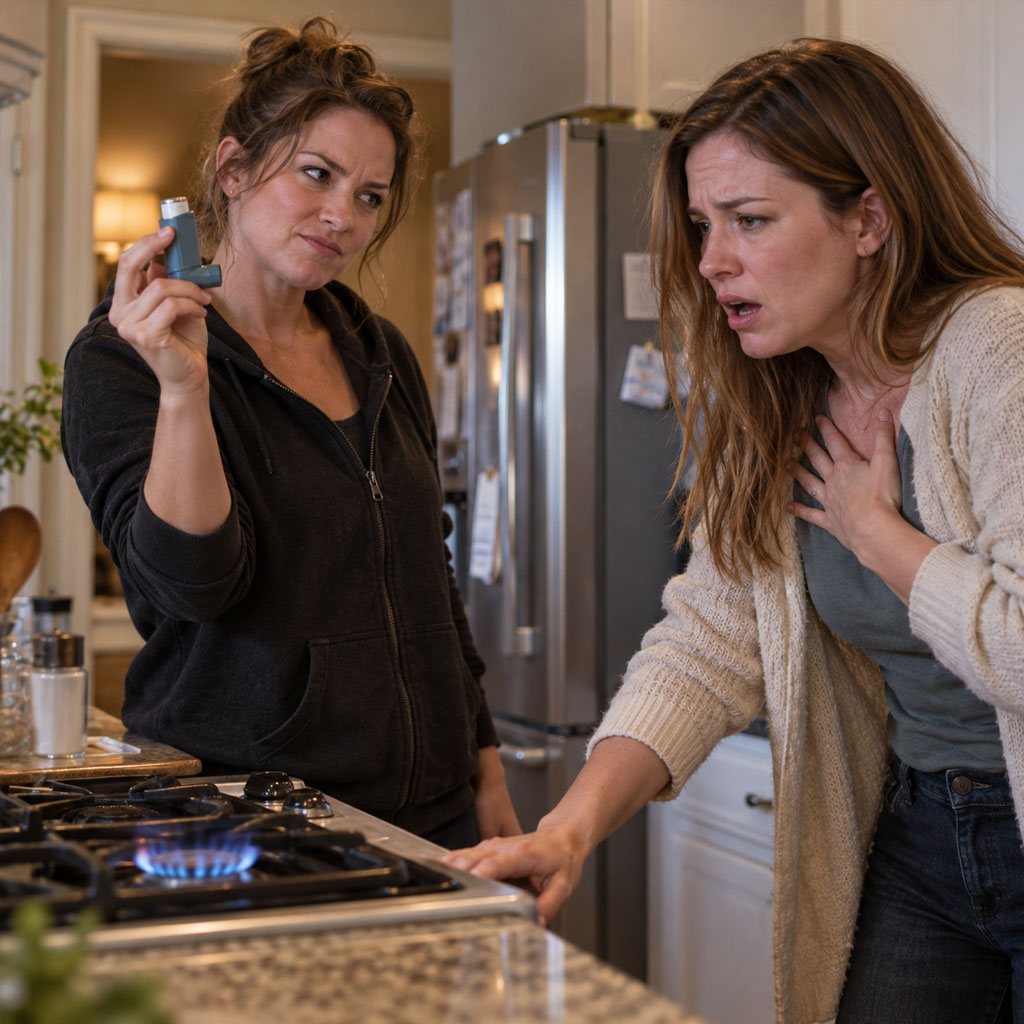
“The inhaler was old and empty,” he told the judge. “It had been sitting near the stove for months.”
I leaned closer to my laptop.
What?
He continued. Diane had picked up the old inhaler during an argument about clutter. She had behaved foolishly and regretted damaging it, but she had no reason to believe I was in danger.
Then came the part that made my hands cold.
“My client believed her sister was experiencing anxiety or a panic episode.”
I stared at Diane’s square on the screen.
The story was almost elegant.
I was emotional.
She was frustrated.
An old, useless inhaler had been destroyed.
Then I panicked.
Nothing intentional had happened.
The prosecutor asked permission to respond.
Before he could, Diane leaned toward her attorney and whispered something. The judge noticed.
“Ms. Mercer, you are not required to speak. If you choose to do so, anything you say may be used against you. Do you understand?”
“Yes.”
“Do you still want to speak?”
Diane wiped her cheeks.
“Yes, Your Honor.”
Her attorney looked like a man watching a car roll slowly toward a cliff.
Diane faced the camera.
“I would never hurt my sister.”
Her voice shook, but the conviction in it was pure Diane.
“I’ve taken care of Laura my whole life. When we were children, I carried her medicine everywhere. Anybody in our family can tell you that.”
That part was true.
Then she kept going.
“The inhaler was empty. I had seen it by her stove for months. It was the old blue one. She always leaves things lying around. I picked it up because I was angry, and yes, I did something stupid with it.”
She swallowed.
“But Laura started doing that breathing thing she does when she wants people to pay attention. I thought she was being dramatic.”
My stomach turned.
Diane shook her head.
“I never told her to choke. I never said I wanted her to suffer. She twists things. She always has.”
Then she sat back.
For a few seconds, nobody spoke.
The prosecutor glanced at his notes.
“Your Honor, the state has three pieces of information relevant to what the defendant just told this court.”
His tone was so plain that it was almost unsettling.
He began with the burned inhaler.
Police had recovered it from my stove.
Part of the pharmacy label had survived.
“The prescription was filled three days before the incident.”
Diane stopped crying.
“The pharmacy confirms it was new.”
I put my hand over my mouth.
I knew I had picked up a new prescription. Of course I knew that.
But until that moment, I hadn’t understood what else the pharmacy records proved.
The prosecutor continued.
“The defendant repeatedly described this as the old blue inhaler she claims she had seen for months.”
He paused.
“For the previous four years, the victim’s pharmacy dispensed this medication in orange devices from a different manufacturer.”
I felt something inside me go still.
“This was the first blue inhaler issued to the victim. It had been inside her apartment for three days.”
Diane’s attorney moved toward his microphone.
“My client may have misspoken—”
“Counsel,” the judge said.
He stopped.
The prosecutor looked directly at his camera.
“There is another issue, Your Honor. The defendant has denied making the statements attributed to her.”
I knew what was coming before he said it.
“The 911 call was recorded.”
And for the first time since the hearing began, Diane looked frightened.
Chapter 3
I had never listened to the emergency call.
My attorney had offered to let me hear it once, and I refused. I remembered enough.
The prosecutor asked the judge for permission to play the recording because Diane had directly denied saying the words described in the police report.
Her attorney objected.
He called it unnecessary and prejudicial for a first appearance. He argued that there would be a proper time to challenge evidence later.
The judge listened.
Then she said, “The defendant voluntarily made factual representations to this court about what she did and did not say. The court will hear the recording for purposes of determining release conditions.”
My hand moved toward the trackpad.
I could leave.
Nobody would know.
I stayed.
The prosecutor shared an audio file, and suddenly I heard my own frightened voice coming through the small speakers of my laptop.
I stood up.
I could not sit there and watch myself in the dark screen reflection while hearing it.
I walked to the window above the kitchen sink—the same window Diane had opened that afternoon—and wrapped my arms around myself.
The dispatcher’s voice remained calm.
Mine did not.
I heard myself trying to give my address. I heard drawers opening. I heard the room in a way I had never experienced it while I was inside it.
Then, faintly in the background, came Diane’s voice.
“Can’t breathe?”
There was no confusion in it.
No concern.
No belief that I was merely having a panic attack.
She sounded almost amused.
My eyes closed.
A little later, the dispatcher asked whether anyone else was in the apartment.
Before I could answer on the recording, Diane’s voice came again.
“Tell them your big sister’s here.”
Then, closer:
“I’m watching.”
I heard someone sob through my laptop.
For a moment, I thought the sound was part of the recording.
Then I realized it was Diane in the courtroom.
She had covered her face.
The judge spoke firmly.
“Ms. Mercer, lower your hands.”
Diane didn’t move.
“You chose to address the court. You will remain attentive while the recording is played.”
Slowly, Diane lowered her hands.
She had to listen.
So did I.
What struck me wasn’t the crying.
It was the look on her face.
She seemed shocked by herself.
Maybe that was my imagination. Maybe she had spent nine days building another version of the afternoon so carefully that hearing her own voice cracked something open.
People do that.
They repeat I didn’t mean it.
Then it becomes I didn’t know.
Then I barely did anything.
Eventually, the lie can feel kinder than the memory.
But recordings do not care which version helps you sleep.
When the audio ended, the courtroom remained silent.
The judge wrote something on a sheet of paper.
Then she looked up.
“The court finds the weight of the evidence substantial for purposes of today’s determination.”
Diane’s breathing changed.
“Bail is denied.”
Her attorney looked down.
“The defendant will remain in county custody pending further proceedings. The existing no-contact order with the victim remains in place.”
The judge paused.
“It will also be expanded to include the victim’s residence, workplace, and the care facility where the parties’ father resides.”
Diane jerked forward.
“My dad?”
The judge’s expression didn’t change.
“Your Honor, I’m the one who takes care of him. He needs me.”
Her attorney touched her arm, trying to stop her.
Diane pulled away.
“I’m the only one who knows everything. His appointments, his clothes, what he eats. Laura doesn’t—”
“Ms. Mercer.”
Diane went quiet.
The judge looked directly into the camera.
“You told this court that you have taken care of your sister throughout her life.”
Diane’s lips trembled.
“The court has now heard evidence of how you treated her on the day in question.”
There was no dramatic speech after that.
No lecture.
The judge simply said, “We are adjourned.”
One by one, the squares disappeared from my screen.
The prosecutor.
The clerk.
The attorneys.
Diane’s remained for a few seconds longer.
She looked straight toward the camera again.
Then her square went black.
I stood alone in my kitchen.
My microphone had been muted the entire hearing.
I had never said a word.
And I realized I didn’t need to.
For years, Diane had been the louder sister. The one with the faster answer, the stronger opinion, the longer list of sacrifices.
That morning, evidence had spoken more clearly than either of us could.
Chapter 4
Five weeks later, my attorney called while I was standing in line at the post office with a cardboard box full of old county records.
Since moving home, I had joined the local genealogy society. Once a month, I helped retired teachers and amateur historians scan marriage certificates, cemetery indexes, and census pages.
There was something comforting about old records.
Names.
Dates.
Facts.
Ink that didn’t change because somebody remembered an event differently.
My attorney told me Diane had accepted a plea agreement.
The attempted-murder charge would be dismissed in exchange for a guilty plea to a serious assault charge. Several related counts would be resolved as part of the agreement.
The sentence was seven years.
The no-contact order would remain during that time and continue for five years afterward.
“Did she say anything?” I asked.
“Only what the judge asked her.”
“What did she say?”
“Guilty. And yes, Your Honor.”
That was all.
I looked down at the box in my arms.
Five years caring for Dad.
Three years carrying my inhaler when we were children.
An entire lifetime of being my older sister.
Reduced in court to two words.
Guilty.
Yes.
“Do you want me to tell you anything else?” my attorney asked.
“No.”
I thanked her, mailed the package, and drove home.
I didn’t celebrate.
Some people assumed I would.
A neighbor once said, “You must feel vindicated.”
That wasn’t the word.
Vindication suggests winning.
There was no version of this in which I had won.
I still had the sister who ran across a playground for me when she was ten. I also had the sister who stood in my kitchen decades later and watched me struggle.
Both were real.
Understanding why someone became bitter does not require pretending bitterness excuses what they do.
Diane had lost years of her life caring for Dad.
She had watched him forget her.
Then she watched him remember me.
That was cruel in a way no one intended.
But it was not something I had done to her.
Her resentment explained the road.
It did not excuse where she chose to drive.
I eventually replaced my gas stove with an electric one. The installer asked whether I was remodeling.
“Something like that,” I said.
He didn’t ask more.
I returned to work, although not on the Gulf. I found a position with a diving contractor working river and bridge inspections closer to home. The work was cold, damp, repetitive, and wonderfully ordinary.
I also started visiting Dad more often.
Monday.
Wednesday.
Friday.
Those had been Diane’s days.
Her schedule had been taped behind the nurses’ station for nearly a year. After the court expanded the no-contact order, the facility director called me.
“We understand Diane won’t be able to visit for the foreseeable future,” she said carefully. “Would you be willing to take over some of her routine?”
“Yes.”
The answer came before I had time to decide whether I resented being asked.
Maybe that was appropriate.
For years, Diane had been the one who stayed.
Now I would.
I learned which sweater Dad preferred when the common room was chilly. I brought his old crossword book even though he could no longer finish the puzzles. I trimmed his fingernails on Fridays after an aide showed me how to do it without nicking his skin.
Some days he knew me.
Some days he didn’t.
I stopped keeping score.
Chapter 5
One Wednesday afternoon, Dad was sitting beside the window with a crossword book open across his knees.
He had written the same letter into four different boxes.
I didn’t correct him.
Outside, October leaves dragged across the parking lot in the wind. Somewhere down the hall, a television game show was playing too loudly.
Dad held the pencil in one hand and my hand in the other.
After a while, he looked up at me.
His eyes were still the same pale blue they had been when I was a child.
“Where’s the other one?”
I knew immediately who he meant.
“What other one?”
“The girl.”
He frowned, searching.
“The one who comes on Mondays.”
My chest tightened.
For an instant, I saw Diane as she had been at ten years old, her backpack bouncing against her shoulders while she ran across the playground toward me.
“She can’t come for a while, Dad.”
He studied my face.
“Is she sick?”
“No.”
“Working?”
I looked out the window.
There were a dozen answers I could have given him, none of which would survive in his memory for more than a few minutes.
“She has some things she has to deal with.”
Dad nodded slowly.
Then he looked down at his crossword again.
A minute later, he squeezed my hand.
“You’re a good girl, Laura.”
I nearly laughed.
I was sixty years old.
But I let him say it.
On Friday, I brought him a clean sweater and trimmed his nails. On Monday, I returned with coffee for myself and a cinnamon roll he was allowed to have in small pieces.
Life did not become easier simply because a judge had made a decision.
My father still forgot things.
My sister remained my sister.
Some nights I remembered the recording and wished I could erase her voice from my mind. Other nights I remembered her childhood backpack with my inhaler tucked safely inside it.
I stopped trying to decide which memory was the true Diane.
They both were.
That may be the hardest lesson adulthood gives us: the person who once protected you can later become someone you need protection from.
Love does not erase accountability.
Sacrifice does not purchase permission to harm another person.
And understanding someone’s pain does not mean volunteering to become the place where they put it.
Months after the hearing, I stood in my kitchen one morning and noticed a blue inhaler beside the salt.
For a second, my body went rigid.
Then I picked it up.
It was simply medicine.
Plastic.
Metal.
A prescription label with my name on it.
It no longer belonged to that afternoon.
I slipped it into my purse and placed another in the kitchen drawer.
Then I drove to the memory-care center.
Dad was awake when I arrived.
He smiled.
“Laura.”
“Hi, Dad.”
He pointed to the chair beside him.
“You staying awhile?”
That question reached somewhere deep.
For years, staying had belonged to Diane.
Leaving had belonged to me.
Maybe families make those roles too easily. One person becomes the dependable one. One becomes the difficult one. One becomes the successful one. One becomes the caretaker.
Then everyone starts believing those labels are permanent.
They aren’t.
People change.
Choices change them.
Consequences change them too.
I sat beside Dad and opened his crossword book.
“I’m staying.”
He nodded as though that settled everything.
Ten minutes later, he forgot I had just arrived.
But he kept holding my hand.
I thought about Diane sometimes when I sat there.
I hoped prison forced her to face the truth without destroying her. I hoped someday she understood that one terrible afternoon did not erase every good thing she had ever done—but neither could every good thing she had done erase that afternoon.
Both truths had to exist.
That was justice to me.
Not watching her suffer.
Not revenge.
Just refusing to lie about what happened.
Dad tapped a crossword clue with his pencil.
“Seven letters,” he said.
“What’s the clue?”
He squinted.
“Remain in one place.”
I looked at the empty boxes.
“Stay,” I said automatically, then counted. “No, that’s four.”
Dad smiled.
“See? You don’t know everything.”
“No, sir. I definitely don’t.”
He chuckled.
We sat by the window until lunchtime, trying answers and crossing them out.
And when I finally stood to leave, Dad caught my wrist.
“You’ll come back?”
“Yes.”
“When?”
“Friday.”
He nodded.
“Good.”
I bent down and kissed his forehead.
As I walked toward the door, I understood something I wish our family had learned years earlier.
Love is not measured by how much pain you endure for someone.
It is measured by what you choose to protect in them—and what you refuse to destroy.
THE END.
⚠️ All characters and events are fictional. Do not imitate or apply them in real life. 😌😌😌


