Chapter 2
Nobody answered.
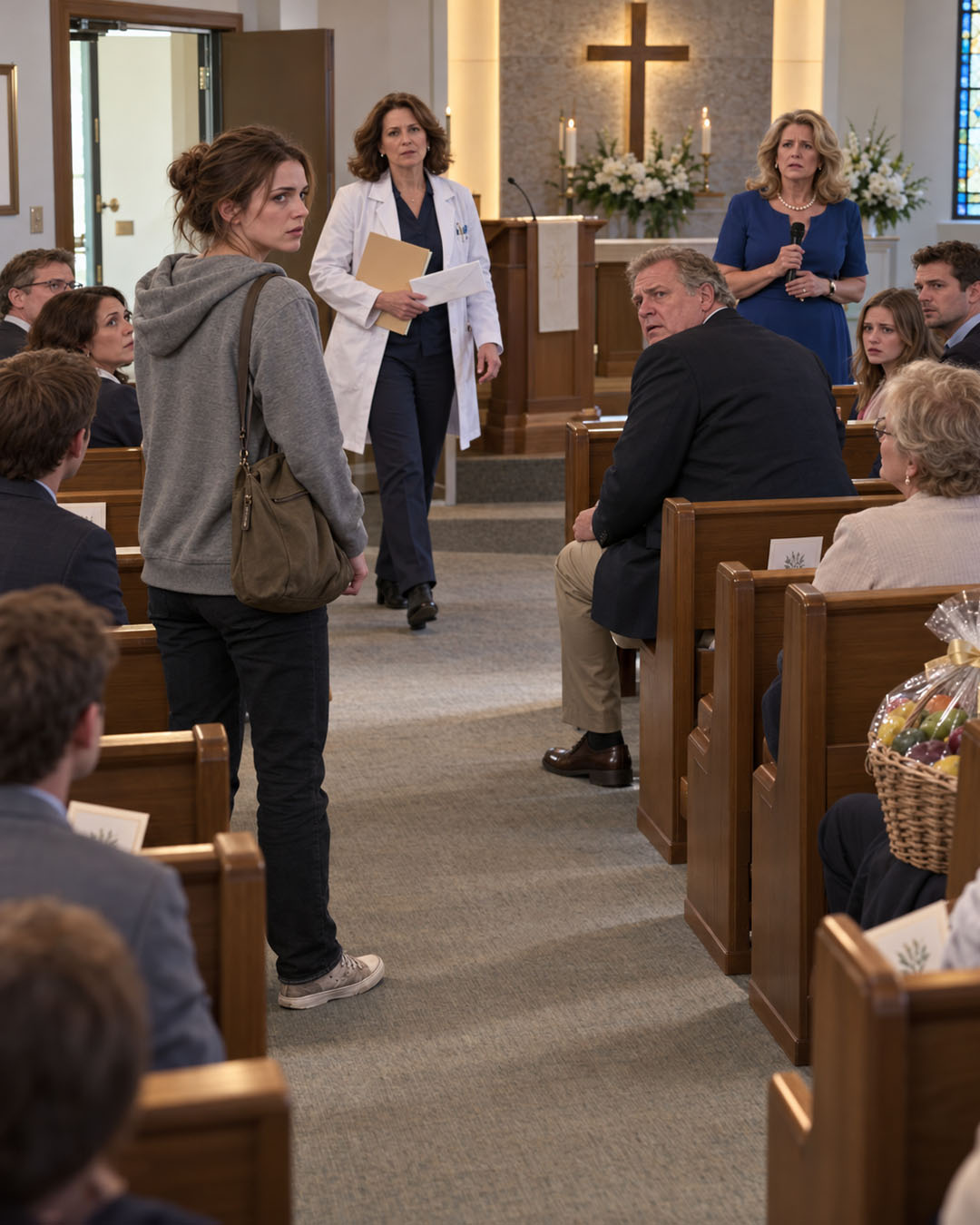
My father slowly lowered himself back onto the pew. The expression on his face was so unfamiliar that I almost failed to recognize him. Reed Preston had spent his life speaking with certainty, whether he was discussing home repairs, money, or the proper way to raise children. I had rarely seen him hesitate over a sentence.
Now he seemed unable to find one.
Dr. Feldman walked toward me first.
“Mia, would you come up here for a moment?”
I followed her to the front of the chapel. My mother stood motionless beside the microphone, while my aunt clutched her prayer cards against her chest.
Dr. Feldman placed the folder on the pew and turned toward the room.
“I’m Mia’s attending physician,” she explained. “My responsibility is to her as my patient. I’m here to discuss information relevant to her medical care, and I need everyone to understand that the decision to donate an organ belongs to the donor alone.”
My mother shifted impatiently.
“Doctor, we all understand that. We’re just here to encourage Mia to do the right thing.”
Dr. Feldman didn’t argue with her. Instead, she picked up the sealed envelope and handed it to me.
“Three days ago, your father came to my office privately,” she said. “He asked me to withhold some information from you until after your family had spoken with you. I explained that I couldn’t agree to that. You have a right to understand your own medical findings before making any decision about surgery.”
I looked at my father.
He was staring at his hands.
“Dr. Feldman,” I said, “what information?”
She nodded toward the envelope.
“Please read the report. I’ll explain anything that isn’t clear.”
My fingers felt strangely steady as I broke the seal. Inside was a printed page with my name at the top, followed by medical terminology I’d never seen before. I read the first few lines, then started again because the words didn’t seem to fit together.
Bilateral renal abnormality.
Structural irregularity.
Elevated risk associated with donation.
I looked up.
“What does this mean?”
Dr. Feldman stood beside me, speaking slowly enough that everyone could follow.
“During your preliminary screening, we discovered a structural difference in both of your kidneys. It’s something you were born with, and it doesn’t necessarily cause problems in ordinary life. Based on what we’ve found, you could continue living a normal life without ever developing symptoms from this condition.”
I glanced back at the page.
“Then why does it matter?”
“Because donating a kidney would carry a significantly higher risk for you than it would for someone without this finding. After reviewing your results, I documented that I would not recommend you as a donor under the current circumstances.”
For a moment, the chapel seemed to tilt.
I read the report again, searching for a different interpretation. I had come to the hospital expecting questions, tests, and difficult decisions. I had not expected to discover that the very procedure my family had been pressuring me to accept was one my own doctor had already decided was medically unsuitable for me.
I looked at Dr. Feldman.
“So I shouldn’t donate?”
“Based on your current evaluation, I would not recommend that you proceed as a living donor. Your individual care team can answer further questions, but you should not be pressured to accept a procedure that carries this risk.”
She paused before adding, “And you never needed to agree to it in order to prove that you love your brother.”
My mother sat down.
The microphone slipped from her hand onto the pew beside her. Aunt Sandra lowered her petition, which I hadn’t even noticed she was holding until that moment. Renee stopped dabbing her eyes.
I turned toward my father.
“You knew?”
He didn’t answer.
“How long have you known?”
Dr. Feldman spoke before he could.
“He came to see me three days ago. I told him I would give him an opportunity to share this information with you himself, but that I would not delay your access to it. That time has passed.”
Three days.
For three days, my father had known that my doctor did not recommend me as a donor. For three days, he had carried that knowledge while my mother arranged the gathering, my aunt printed her petition, and twenty-three relatives prepared to pressure me into agreeing.
I looked at my mother.
“You didn’t know?”
Her lips parted, but no words came out.
Then I looked at my father again.
“Did you know when you told me the family needed me to do this?”
He rubbed his palms against his trousers.
“I was trying to find the right time to tell you.”
“Then why did you let them gather here?”
He glanced at my mother, then at the relatives watching us.
“I thought if you agreed to the evaluation, we could discuss everything afterward.”
“Afterward?” I repeated. “After I said yes in front of all these people?”
His silence was answer enough.
I understood what he had hoped would happen. If I agreed publicly, the decision would become difficult to reverse. My family would celebrate my commitment, and withdrawing it would mean disappointing everyone at once. He had allowed the pressure to build while knowing that the medical facts gave me a legitimate reason not to proceed.
I wasn’t certain whether he had convinced himself he was helping Leo or simply decided that my wishes could wait.
Either way, he had withheld information that belonged to me.
And my mother had stood at the front of a chapel and praised me for making a decision I had never made.
I looked around the room.
Some relatives seemed embarrassed. Others stared at my father. Aunt Sandra quietly folded the petition in half, then in half again, as if the paper might somehow disappear if she made it small enough.
Renee approached me.
“Mia, sweetheart, we didn’t know.”
I believed her. I also knew that she had come prepared to persuade me, not listen to me.
“I understand,” I said.
She reached for my hand, but I stepped back gently.
Dr. Feldman closed the folder.
“I think Mia needs some privacy now,” she said. “If anyone has questions about her medical care, those questions need to be addressed with her permission. This meeting is over.”
Nobody argued with her.
My mother remained seated, her good blue dress gathered awkwardly around her knees. My father didn’t look at me as I picked up my handbag.
I walked out of the chapel carrying the envelope.
In the hallway, I stopped beside a window overlooking the hospital parking lot. Cars moved slowly between the rows, and a delivery truck was backing toward the service entrance.
Everything outside looked ordinary.
I had expected to feel relief. Instead, I felt a grief so deep and precise that I couldn’t immediately put a name to it.
I was grieving the family I’d believed I had. I was grieving the assumption that my parents would protect me when I was frightened, especially when a decision involved my health. And I was grieving the idea that being a good daughter had earned me the right to make my own choices without being shamed.
Dr. Feldman came to stand beside me.
“How are you doing?” she asked.
I almost laughed at the question. Twenty-three relatives had spent the morning discussing what I should do with my body, and this was the first time anyone had asked how I felt.
“I don’t know,” I admitted.
“That’s all right. You don’t have to decide anything else today.”
I folded the report carefully and placed it back inside the envelope.
For the first time since Leo’s diagnosis, the next step belonged to me.
Chapter 3
I didn’t go to Leo’s room that morning.
I loved him too much to walk in carrying the anger I felt toward everyone else. He was already frightened about his health, and I wasn’t going to make him responsible for a decision he might not even have known about.
Instead, I went home, took off my sneakers, and sat on the living room floor with my back against the couch. I left my phone on the coffee table while messages began arriving one after another.
Aunt Sandra wrote that the family was worried about Leo and that everyone had acted out of love. Renee said she was sorry the morning had become so upsetting. One of my uncles sent a long message about how difficult circumstances could make people behave badly.
My mother called six times.
My father didn’t call at all.
By late afternoon, I had received more than thirty messages, but not one person had asked what the doctor had found beyond the fact that I wouldn’t be donating.
I switched off my phone.
The next morning, I called Dr. Feldman’s office and arranged a follow-up appointment to discuss the report in private. I wanted to understand what the findings meant for my health, what monitoring might be appropriate, and whether there was anything else I needed to know.
She answered my questions carefully and explained the limits of what could be concluded from the screening. She also reassured me that the finding did not mean I should expect to become ill. It meant that the risks of donating were different for me, and those risks mattered.
“You don’t owe anyone a medical decision,” she told me. “Even if the results had been different, your consent would still have been entirely yours to give or withhold.”
I carried those words home with me.
For the first time, I began to understand how completely my family had blurred the line between love and obligation. They had treated my willingness to help as something they were entitled to, rather than something I could freely offer.
I had helped create that pattern by saying yes too often. Whenever someone needed something, I rearranged my life. When my mother wanted me to organize family birthdays, I did it. When my father needed help with paperwork, I drove across town. When Leo was struggling at work, I listened for hours and helped him prepare for interviews.
I didn’t regret those things. I loved my family, and I wanted to be there for them.
But I had mistaken being dependable for being available without limits.
Three days after the chapel gathering, Leo called me.
His voice was quieter than usual.
“Mia, can you talk?”
“Of course.”
“Mom says the donor screening didn’t work out.”
I closed my eyes.
“What exactly did she tell you?”
“That your doctor found something that made donation too risky. She said you didn’t know about it until the chapel meeting.”
I waited.
Then he asked, “Is that what happened?”
I could have told him everything immediately. I could have described the microphone, the applause, the petition, and our father’s silence. Instead, I took a breath and tried to separate my brother from the actions of the people around him.
“The doctor found an abnormality in both my kidneys. She doesn’t recommend me as a donor because the risk would be too high for me. Dad knew about it three days before the gathering.”
Leo went quiet.
“He knew?”
“Yes.”
“And they still did that to you?”
“Yes.”
I heard him exhale slowly.
“I didn’t know about the chapel. I swear I didn’t.”
“I believe you.”
He began to say something, stopped, and tried again.
“Mia, I’m sorry.”
I wanted those words to make everything better. I wanted my brother’s apology to reach the part of me that had been hurt by the others and make it possible to return to the family we had been before.
But an apology could not erase what had happened.
“Thank you,” I said. “I need some time to work through this.”
“I understand.”
We spoke for a few more minutes about his treatment and the next steps his doctors were considering. He sounded tired, and I knew he was carrying more fear than he wanted to admit.
Before we hung up, he said, “I love you, little sister.”
“I love you too.”
That part had never been in question.
Over the following weeks, I learned more about the transplant process from the medical team. My parents had initially talked as though I were the only possible solution, but the doctors had never promised that. They explained that the transplant team could continue evaluating potential donors and explore other appropriate options.
My family had narrowed the possibilities long before the medical process was finished.
My father eventually sent me a text saying he wanted to explain himself. I didn’t answer. I wasn’t ready to hear reasons, justifications, or another version of how everyone had acted with good intentions.
I wanted to understand what had happened without being asked to make the people responsible feel better about it.
At work, I struggled to concentrate for a while. I would open a spreadsheet, stare at the figures, and realize I had been thinking about my mother’s voice in the chapel instead of the task in front of me.
One afternoon, my supervisor asked whether everything was all right.
I told her I was dealing with a family matter. She offered me a day off, which I accepted.
I spent that day walking through a neighborhood park near my apartment. The trees had begun changing color, and fallen leaves gathered along the paths. I watched older couples walking arm in arm, parents pushing strollers, and people sitting on benches with paper cups of coffee.
I thought about how ordinary my life had been before Leo’s diagnosis. I had bills, work deadlines, a leaky kitchen faucet I kept meaning to fix, and a small list of books I wanted to read before the end of the year.
Then, in a matter of weeks, my family had turned my health into a public question of loyalty.
I didn’t want to become bitter. I didn’t want to stop loving people because they had hurt me. But I needed to learn that love could not require me to ignore my own safety.
For years, I had thought saying no meant closing a door forever.
Now I was beginning to see that sometimes saying no was the only way to stop a relationship from consuming the person inside it.
Chapter 4
Leo’s doctors continued searching for a suitable donor.
There were more evaluations, more waiting, and more conversations about treatment options. My family learned that transplant matching was a complicated process, and that a relative’s willingness to donate did not guarantee that donation would be medically appropriate.
Eventually, a suitable donor was identified through the national registry.
His name was Greg. He was forty-one, lived in Portland, Oregon, and had volunteered to be considered as a living donor. He wasn’t related to Leo. He had never met him and had no personal connection to our family.
He had simply chosen to help someone in need.
When Leo told me, his voice was full of disbelief.
“A stranger,” he said. “A man I’ve never met might give me a chance at getting better.”
I sat quietly, absorbing the news.
“That’s an extraordinary thing for him to do.”
“It is. I don’t even know how to thank someone like that.”
“Maybe you don’t have to find the perfect words. Maybe you just have to live well and honor what he’s giving you.”
Leo was silent for a moment.
Then he said, “I’ve been thinking about that chapel.”
I didn’t interrupt.
“I keep remembering how you must have felt standing there. I was in my room, worrying about my own life, and you were being made to feel like your life belonged to everybody else.”
My throat tightened.
“I didn’t want you to be put in that position,” I said.
“I know. And I should have asked more questions when Mom told me you were being evaluated. I was scared, Mia. I wanted to get better, and I let everyone else talk as if the answer was simple.”
I understood his fear. I had seen it in his face during the first hospital visits, when he tried to joke with the nurses and then went quiet after they left.
But fear didn’t excuse the way our family had treated me.
“I don’t blame you for being sick,” I told him. “I don’t blame you for wanting to live. I just need you to understand that helping you could never mean pretending my own health didn’t matter.”
“I understand that now.”
We began talking more regularly after that. Not every day, and not always for long, but our conversations became more honest. Sometimes we discussed his treatment. Sometimes we talked about childhood memories or the little things that had made us laugh before the diagnosis changed our lives.
We were rebuilding something carefully, without pretending that one apology could undo everything.
Leo eventually received his transplant. The recovery took patience, follow-up appointments, and a great deal of adjustment, but his health improved. He gradually returned to ordinary routines, although he remained under medical care and had to follow his doctors’ instructions.
When he called to tell me he was feeling stronger, I cried after we hung up.
I was relieved. I was grateful to Greg, whose generosity had given my brother another chance. And I was still hurt by my parents.
All those feelings existed together.
My mother tried to resume our usual pattern almost immediately. She began sending messages about family dinners and holidays, as though the chapel gathering had been an unfortunate misunderstanding that could be resolved by returning to our old routines.
I wasn’t ready.
When she called, I answered once.
“Mia, your brother is doing better. We should all get together.”
“I’m glad he’s doing better.”
“Your father and I have been through a lot too.”
I looked out my apartment window at the cars passing below.
“I know this has been frightening for everyone, Mom. But what happened at the chapel hurt me deeply.”
“We were scared for Leo.”
“So was I.”
“You have to understand that we weren’t thinking clearly.”
“I can understand that without pretending it was acceptable.”
She sighed.
“I don’t know what you want from us.”
I had asked myself that question many times.
I didn’t want my father to suffer. I didn’t want my mother to feel humiliated. I didn’t want my brother to believe I loved him less because I couldn’t donate a kidney.
What I wanted was for them to acknowledge that I had been frightened, that my consent mattered, and that they had no right to turn my medical decision into a public test of whether I was a good daughter.
“I want you to understand that my body belongs to me,” I said. “I need you to respect that, even when you don’t like my decision.”
She didn’t answer immediately.
Then she said she needed time to think.
For once, I didn’t rush to fill the silence or make her feel better.
“Take the time you need,” I told her.
After we hung up, I placed my phone on the desk and looked at the envelope from Dr. Feldman. I had kept it in the top drawer, underneath my passport and apartment lease.
Sometimes I forgot it was there. Other times, I opened the drawer and took it out, reading the report again—not because I doubted the medical findings, but because I needed to remind myself that I hadn’t imagined what happened.
The envelope was proof of something more than a diagnosis.
It was proof that the truth had existed before the gathering, that my father had known it, and that I had been entitled to know it too.
It reminded me that I had not been selfish for asking questions. I had not been cruel for feeling afraid. And I had not abandoned my brother by refusing to take a medical risk that his own treatment team did not recommend.
Those were simple truths.
Yet they had taken me nearly three decades to learn.
Chapter 5
Eight months after the chapel gathering, a letter arrived at my apartment.
I recognized my father’s handwriting before I opened the envelope. His name was written in the upper-left corner, the letters firm and slightly slanted, just as they had been on birthday cards and notes he’d left on the kitchen counter when I was a child.
I stood by the door for several minutes before carrying it to the table.
Then I opened it.
The letter was several pages long, written entirely by hand. My father had never been a man who enjoyed putting his feelings into words. He preferred practical gestures, fixing a broken cabinet or bringing home the right tool for a job, to sitting down and explaining what was happening inside him.
But this letter was different.
He wrote that he had been afraid for Leo and had allowed that fear to become the only thing he could see. He had convinced himself that if I agreed to donate, the family would have a solution, and he had treated the possibility as more important than my right to make an informed decision.
He admitted that he had known about my medical findings before the gathering. He had hoped to tell me privately, but instead of insisting that the family postpone the meeting, he had allowed the event to proceed.
He wrote that he had been wrong.
He apologized for allowing my mother to pressure me, for standing silently while relatives praised a decision I had not made, and for making me feel that I had to sacrifice my health to prove I loved my brother.
He didn’t ask me to forgive him.
He didn’t demand a phone call or a visit.
He wrote that he understood if I needed more time, and that he would respect my decision about when or whether to respond.
I read the letter once, then again.
On the third reading, I stopped halfway through and pressed my palm against the page.
I had spent months wondering whether my father understood what he had done. I had imagined explanations, arguments, and apologies that ended with a request for me to move on.
This letter contained none of that.
It didn’t undo the chapel gathering. It didn’t restore my trust or erase the memory of my mother’s voice through the microphone. But it was the first time my father had acknowledged the harm without asking me to make his guilt easier to bear.
I folded the pages and placed them beside the envelope from Dr. Feldman.
I still haven’t answered him.
Some days, I think I may write back. Other days, I think I need another month, or another year, before I know what I want to say. I no longer believe that taking time to decide is a failure of love.
Leo and I continue to speak. We are careful with one another, and there are subjects we approach slowly. He has never again suggested that I should have donated, and he has told me more than once that he is grateful I didn’t feel forced to risk my health.
Our relationship isn’t exactly what it was before his diagnosis. Perhaps it never will be. But there is room for honesty now, and I value that more than the appearance of a family that never has difficult conversations.
My mother and I speak occasionally. We haven’t returned to the old pattern of daily calls and automatic favors. When she asks me to do something, I consider it before answering. If I can help, I do. If I can’t, I say so.
The first few times, the words felt unfamiliar in my mouth.
“No, Mom. I can’t do that this weekend.”
“I need to think about it.”
“I’m not comfortable discussing that with the whole family.”
She doesn’t always respond well. Sometimes she goes quiet, and sometimes I can hear the disappointment in her voice. But I no longer rush to withdraw my answer simply because someone is unhappy with it.
I am learning that another person’s disappointment is not proof that I have done something wrong.
The experience has changed the way I understand generosity. I used to think that being a good daughter meant being willing to give whatever was needed, whenever it was needed, without making anyone uncomfortable by asking questions.
Now I know that generosity must be freely given to remain generosity.
A gift demanded under pressure is no longer simply a gift. A sacrifice made because someone has convinced you that your fear makes you selfish is not the same as a decision made with full understanding and an open heart.
And love, real love, must leave room for the person who gives it.
I still love my brother. I am grateful that he received a transplant and that a stranger named Greg chose to help him. I hope Greg knows that his decision has made an enormous difference to our family, even if I never have the opportunity to thank him personally.
I also love my parents, although loving them now requires a kind of distance I never expected to need.
I can hold both truths without forcing them to cancel each other out.
I can be grateful that Leo is recovering and still be hurt by what happened in the chapel. I can appreciate my father’s letter and still need time before responding. I can wish my mother peace without giving her permission to make decisions about my body.
For years, I believed the most important thing I could offer my family was my willingness to say yes.
At twenty-nine, I am finally learning that sometimes the most honest answer is no.
Not because I don’t care.
Because I do.
Because my life matters too, and because love should never require me to pretend otherwise.
The sealed envelope remains in the top drawer of my desk, underneath my passport and apartment lease. I keep it there beside the ordinary documents that prove where I live and who I am.
I don’t take it out every day. I don’t need to.
I know what it says, and I know what it represents.
It reminds me of the morning twenty-three people gathered to persuade me to surrender something precious. It reminds me of the doctor who insisted that my medical information belonged to me, even when someone I loved asked her to keep it from me.
Most of all, it reminds me of the moment I realized I could walk away from a room full of disapproval and still be a good sister, a good daughter, and a good person.
I cannot control whether my family understands every choice I make. I cannot guarantee that the people I love will always agree with me, or that they will never disappoint me again.
But I can decide what I will accept.
I can ask questions before making decisions that affect my future. I can seek independent medical advice when I need it. I can love someone deeply without promising to do anything they ask.
And I can take my time deciding what forgiveness should look like.
Sometimes, late at night, I think about the little girl I was at nine years old, the one who believed that being good meant keeping everyone happy. I wish someone had told her that she didn’t have to earn the right to be heard, that her fears mattered, and that she could love her family without surrendering every part of herself.
I would tell her that she was allowed to ask questions.
I would tell her that she was allowed to say no.
And I would tell her that the people who truly loved her would have to learn to respect those words, even when they were difficult to hear.
I cannot go back and teach that lesson to my younger self.
But I can live it now.
The envelope remains where I left it, and my father’s letter rests beside it. I haven’t decided what to do with either one, and for the first time in my life, I don’t feel pressured to decide today.
That, more than anything, feels like freedom.
My body belongs to me. My fear is not selfishness. My love is not measured by how much of myself I am willing to surrender.
And saying no to the people I love does not mean I have abandoned them.
Sometimes it means I have finally stopped abandoning myself.
THE END.
⚠️ All characters and events are fictional. Do not imitate or apply them in real life. 😌😌😌