
Chapter 2
Inside the box were my clothes, yearbooks, baseball glove, birth certificate, Social Security card and one framed Little League photograph.
Eighteen years of my life fit inside a cardboard box.
There was no letter.
Thelma read her name across the lid and sighed.
“Well,” she said, “at least your mother spelled it right.”
I wanted to throw the whole thing away.
Thelma wouldn’t let me.
“It’s yours,” she said. “Everything inside it is yours. So is that word on top. Keep it. Someday you’ll understand why.”
She made me put the box in the hall closet behind Earl’s railroad lantern.
It stayed there for twenty years.
Three weeks later, I graduated from high school. Thelma sat in the bleachers beside Howard and shouted, “That’s my boy!” when my name was called.
Howard took eleven photographs.
His thumb covered half of nine.
That summer, Thelma introduced me to one of Earl’s old railroad friends, who helped me get hired as a carman’s assistant in the rail yard. The job was dirty, loud and freezing in winter.
I loved it.
I showed up every day.
Years passed.
I worked my way up until I was supervising the shop crew.
Thelma eventually informed me that a twenty-two-year-old man had no business living with an elderly woman unless he intended to marry her, and she was not accepting proposals.
I rented an apartment two blocks away.
But every Sunday at six, that bell rang.
And I came for supper.
Years later, Thelma met Allison at a church fish fry and decided within ten minutes that I should marry her.
“She teaches second grade,” Thelma told me. “She reads books and doesn’t complain about coleslaw.”
Apparently those were her standards.
They turned out to be excellent ones.
Allison and I married two years later. We had Henry, then Maggie. Thelma adored them with an intensity that made me wonder whether she’d been saving up grandmotherly love for decades.
She let them ring Earl’s bell.
She’d never let me touch it.
When I complained, she said, “You never asked.”
I never heard from my parents.
Once, about ten years after they left, I searched online for Miranda. I found a woman with her name working as a nursing aide in Arizona.
I closed the page.
I assumed she had chosen them.
She probably assumed something about me too.
That is how families lose twenty years—not always through one great explosion, but through silence hardening around a lie.
Thelma grew slower.
Her hair thinned. Her hands shook. Her steps became careful.
But her rules never changed.
Wash your hands.
Napkin in your lap.
Tell me one thing about your day.
If you’re going to sulk, wait until after pie.
Thelma died peacefully at ninety-eight.
She left me her house.
Her will contained one instruction written in her plain, stubborn language:
Don’t sell it. Rent it to somebody who needs a place. Don’t get greedy. And if they’re hungry, feed them.
I spent two years fixing the house.
I replaced the roof, repaired the porch and refinished the kitchen floor. I kept her table. I kept Earl’s bell.
And I kept the box.
Then, in July, I finally put up a FOR RENT sign.
Four days later, my mother called.
Saturday morning, I arrived early.
At exactly ten, a silver Buick with Florida plates pulled to the curb.
Mom stepped out first.
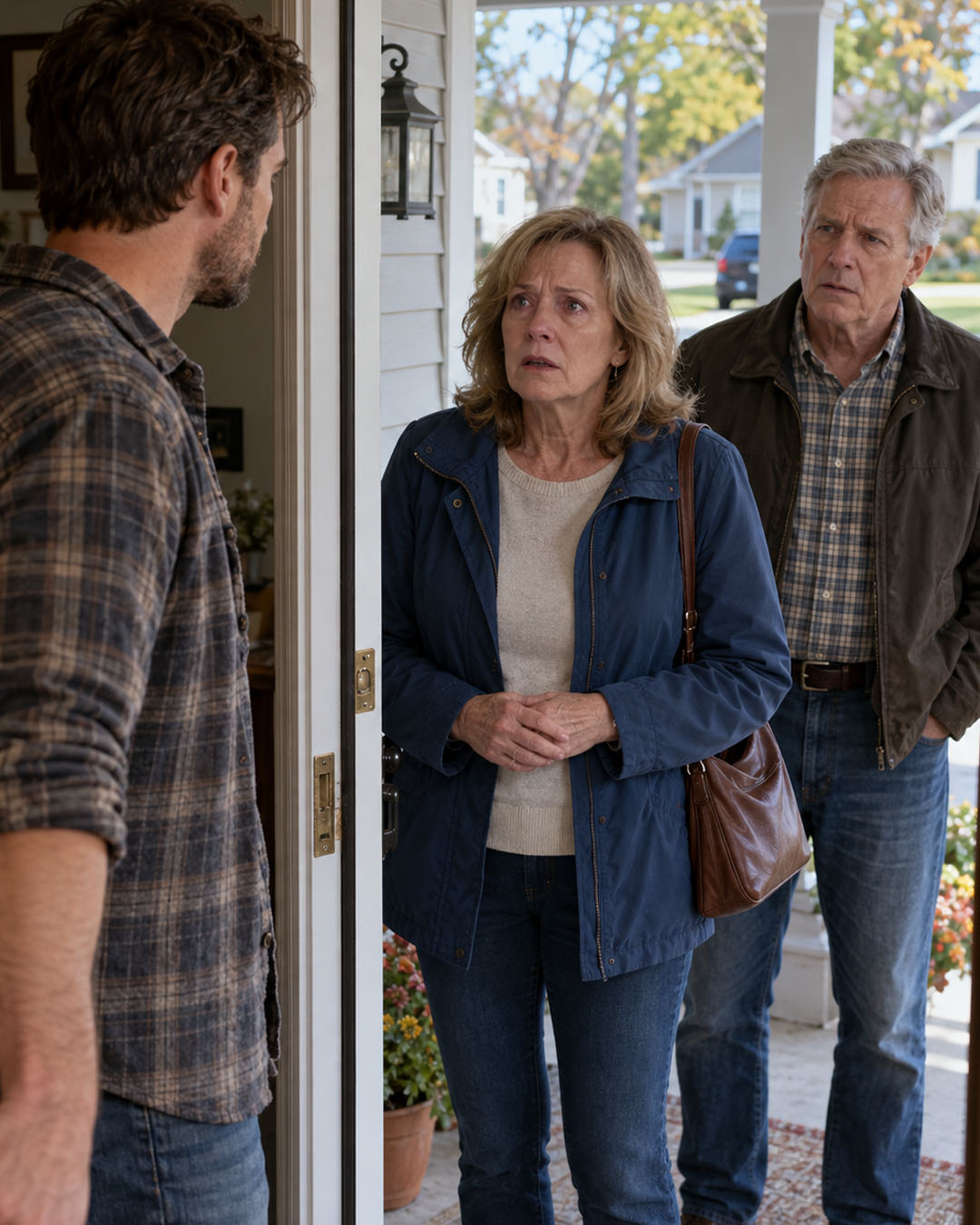
She was sixty, suntanned, with sunglasses pushed into her hair. She stood staring at the house we’d once lived in next door and pressed a hand to her chest.
Dad got out more slowly. His hair was gray, his belly heavier, his knees apparently disagreeing with every step.
He studied me.
Long enough that I wondered.
Mom marched up and extended her hand.
“Hi. I’m Colleen. We spoke on the phone.”
I shook my mother’s hand for the first time in twenty years.
“Aaron?” she didn’t say.
She simply smiled.
“This is my husband, Tom.”
Dad kept staring.
I wore a beard now. Glasses. A railroad cap. I was forty pounds heavier than the skinny eighteen-year-old they’d abandoned.
“Come inside,” I said.
Mom loved the kitchen.
“Oh, Tom, look! You can see our old house from here.”
Dad wasn’t looking through the window.
He was staring at Thelma’s table.
I took them through the house, then sat down with a rental application.
“Owner’s particular,” I said.
Mom smiled. “Of course.”
I asked for names.
Addresses.
Employment.
They were both effectively retired. They’d been living in an extended-stay motel for several weeks.
Then I reached the family section.
“Anyone else living here?”
“Just us.”
“Children?”
Mom answered immediately.
“We have a daughter. Miranda. She’s in Arizona.”
Dad muttered, “She’s a nursing aide.”
“Practically a nurse,” Mom corrected.
I looked down at the form.
“Just one child?”
There was a pause.
Barely two seconds.
Twenty years can fit inside two seconds.
Mom said, “Just the one.”
I wrote it down carefully.
“One child.”
Chapter 3
I kept asking questions because I wanted to know how far she’d go.
“Any grandchildren who might visit?”
“No,” Mom said. “No grandchildren.”
My children were ten and seven at the time.
She didn’t know they existed.
She wasn’t lying about them.
She truly had no idea.
I asked where they’d lived before Florida.
Mom pointed proudly out the window.
“Right there. We had that house twenty-one years.”
“Why’d you leave?”
“The factory closed. Work dried up. You know how things were.”
“Leave anybody behind?”
Her eyes narrowed slightly.
“What do you mean?”
“Family. Friends. People who’d remember you.”
Then Mom smiled.
“Oh, we knew everybody. The woman who lived in this house, Thelma Rusk? We were very close.”
Dad shut his eyes.
I almost admired Mom’s confidence.
“Very close?”
“Oh yes. Wonderful woman. She was practically family. Always feeding the neighborhood children.”
“Thelma left me this house,” I said.
Mom brightened.
“Oh! Are you related?”
“Something like that.”
Dad finally spoke.
“Colleen.”
She ignored him.
I stood, walked to the hall closet and reached behind Thelma’s winter coat.
The box was still there.
Same tape.
Same faded cardboard.
Same word.
THELMA’S.
I carried it into the kitchen and placed it in front of my mother.
She stared at the handwriting.
Confusion came first.
Then recognition.
Then fear.
I removed my railroad cap.
Then my glasses.
“You put down one child,” I said. “I’ll leave the application that way.”
Her mouth opened.
“Hi, Mom.”
A freight train moved somewhere beyond the neighborhood. The windows trembled faintly, just as they had when I was a boy.
Dad broke the silence.
“I told you it was him.”
Mom whipped around.
“You knew?”
“I said he looked familiar.”
“You said he looked like your cousin Howard.”
“Well, he does a little.”
I laughed.
I couldn’t help it.
After twenty years, my parents had found me, and within thirty seconds they were arguing about my resemblance to a cousin.
Mom recovered quickly.
She placed her palms on the table and gave me the polished smile she’d always used when she wanted reality to become negotiable.
“Aaron, sweetheart. Look at this. This has to mean something. We come back home, and you own Thelma’s house.”
“It means you called the number on my sign.”
“Thelma would want family here.”
“She had family here every night at six.”
Mom’s smile disappeared.
“Don’t be cruel.”
“The rent is eight hundred fifty a month. First month’s rent and deposit. I run credit and background checks on everyone.”
She stared at me.
“You’d charge your own mother rent?”
“I’d charge any tenant rent.”
Dad spoke quietly.
“Our credit’s not too good.”
Then Mom leaned forward.
“We can pay three hundred.”
The number almost made me laugh again.
“Three hundred?”
“Until we get settled. We’re family. That’s fair.”
I looked at her.
“No.”
Her face hardened.
“After everything we did for you?”
“What did you do, Mom?”
She looked genuinely offended.
“We raised you.”
“Until I was seven. After that, Thelma took the evening shift.”
Mom grabbed her purse.
“She’s the reason you’re like this.”
I shook my head.
“Thelma is the reason I’m not worse.”
She marched out.
Dad stopped at the door. For one moment, he looked like he might finally say something important.
Then Mom honked from the Buick.
He left.
I thought that would be the end.
I should have remembered my mother never accepted “no” as an answer.
She considered it an opening offer.
Within weeks, people around town started hearing her version.
Her selfish son had inherited a house and refused to help his aging parents.
Thelma had supposedly poisoned me against my family.
In some versions, I’d slammed the door in their faces.
In others, I had somehow been manipulated as a teenager into choosing a stranger over my own loving mother.
Allison wanted me to defend myself.
I didn’t.
“The people who knew Thelma already know,” I told her. “And anybody who wants Mom’s version badly enough won’t care about mine.”
That sounded wise.
It didn’t always feel wise.
One afternoon, even Rosalie—the grocery cashier who remembered me buying Thelma’s medicine—looked at me strangely.
That hurt.
Then Howard called.
He still lived next door, in my parents’ old house.
“Your mother was telling that story at the diner today,” he said. “She didn’t recognize me.”
He chuckled sadly.
“Guess twenty years works both ways.”
Then he said, “I’ve still got the papers.”
Howard kept everything.
Receipts. Contracts. Warranties. Tax records.
And the original purchase agreement for my parents’ house.
Signed by Tom and Colleen Mercer.
Dated March 4, twenty years earlier.
More than a month before they threw me out.
“Want me to say something?” Howard asked.
“Not yet.”
I didn’t know then that somebody else was about to start asking questions.
My sister called two weeks later.
Chapter 4
“Is this Aaron?”
The voice was older, but I knew it.
“Yes.”
“This is Miranda.”
I sat down at Thelma’s table.
She didn’t waste time.
“They’re sixty years old, Aaron. They’re living in a motel. I’ve been sending them money for months, and you’ve got an empty house.”
I said nothing.
“You chose that woman over us when we were kids,” she continued. “Fine. But what you’re doing now is cruel.”
I waited until she finished.
Then I asked one question.
“Miranda, when did Mom and Dad sell the house?”
“What?”
“The house we grew up in.”
“I don’t know. After you moved out.”
“No. They signed the sale papers March fourth.”
Silence.
“I moved in with Thelma in April.”
“That’s not true.”
“Call Dad. Ask him what date they signed the agreement with Howard Dobbs.”
“Who’s Howard Dobbs?”
“The man who answered our front door when I went home on Mother’s Day carrying a card for Mom.”
She hung up.
Two hours later, she called back.
Her voice had changed.
“Dad wouldn’t answer.”
I closed my eyes.
“What did he say?”
“He told me to ask Mom.”
There was another silence.
Then Miranda whispered, “They told me you refused to come with us.”
I stared at the old kitchen wall.
“They said you hated them. That you chose Thelma and said you never wanted to see us again. I was fourteen, Aaron. I believed them.”
“I thought you knew they’d left me.”
“I spent twenty years thinking you didn’t want me.”
“And I spent twenty years thinking you picked them.”
She started crying.
So did I, though I never told anybody except Allison.
Miranda and I talked for more than an hour.
She told me about her two children and her divorce. I told her about Allison, Henry and Maggie. We exchanged photographs like people trying to rebuild a bridge from opposite sides of a river.
Before we hung up, she said, “I’m not sending Mom and Dad money anymore.”
“That’s your decision.”
“I know.”
That mattered.
By September, I had chosen a tenant for Thelma’s house.
Howard.
His knees had gotten bad, and his doctor wanted him out of a two-story home.
Thelma had said to rent the place to somebody who needed it.
Howard had been the stranger who told an eighteen-year-old boy the truth when his own parents wouldn’t.
I offered him four hundred a month.
He argued that it was too low.
I reminded him whose kitchen we were sitting in.
He surrendered.
We were signing the lease one Saturday when the silver Buick pulled up.
Mom came through the screen door without knocking.
“You’re renting this house to the mailman?”
Howard looked up from the papers.
Mom pointed at him.
“A stranger? You’re giving a stranger this house instead of your own mother?”
“He’s not a stranger,” I said. “He bought your house.”
She stared at him.
Recognition arrived slowly.
Then completely.
Howard stood, reached into his shirt pocket and removed a folded piece of paper.
He had apparently been carrying it around for weeks.
“Colleen,” he said, “remember me now?”
She didn’t answer.
Howard unfolded the contract and put on his glasses.
“Residential purchase agreement. Sellers: Thomas and Colleen Mercer. Buyer: Howard Dobbs. Dated March fourth.”
He turned the page toward her.
“That’s Tom’s signature. That’s yours.”
Mom’s cheeks flushed.
“That’s none of your business.”
Howard raised an eyebrow.
“I bought the house. That made it pretty much my business.”
Then he asked the question nobody had asked in twenty years.
“If you’d already sold the house in March, Colleen, what was that three hundred dollars really about?”
Mom looked at me.
I didn’t rescue her.
“We were going to tell him.”
“When?” I asked.
No answer.
Then Dad spoke from the doorway.
“There was only one bedroom.”
We all turned.
He stood on the porch beneath Earl’s bell.
Mom’s face changed.
“Tom, don’t.”
But Dad continued.
“Your sister Patty had one room available in Florida. It was for Miranda.”
Mom stepped toward him.
“Stop talking.”
“I’ve been doing that for twenty years.”
He looked at me.
“We figured Aaron could stay with Thelma. He was always over here anyway.”
There it was.
Not an accident.
Not a misunderstanding.
A decision.
My mother looked at me, furious now because the truth had finally entered a room she couldn’t talk her way out of.
“You always loved her more.”
I thought about being seven years old on a cold porch.
About a brass bell at six.
About chicken and noodles.
About an old woman who had never once asked me to earn the right to come inside.
“She was home more,” I said.
Mom left.
Dad followed a minute later.
Howard sat down, picked up his pen and tapped the lease.
“So,” he said, “where was I supposed to sign?”
Chapter 5
The truth traveled through town faster than the lie had.
Howard told his coffee group. Somebody told Rosalie at the grocery store. Someone else remembered Thelma feeding half the children on Maple Avenue at one time or another.
Within a week, Mom stopped going to the diner.
Soon she stopped shopping at the grocery store too.
She and Dad eventually found a modest one-bedroom apartment near the interstate.
I didn’t celebrate.
There was nothing to celebrate.
Justice isn’t always a cheering crowd. Sometimes it’s simply the end of being expected to carry someone else’s lie.
Howard moved into Thelma’s house with one recliner, three boxes of old receipts and a radio he claimed sounded better than anything made after 1985.
He left Earl’s bell exactly where it was.
Then he sold my parents’ old house to a young single mother named Tessa.
She worked second shift as a hospital nurse.
Her son, Caleb, was seven.
One Sunday in November, Dad came by alone.
He parked an old Chevy at the curb and stopped halfway up the walk.
“I’m not here to ask for anything,” he said.
“Okay.”
Cold wind moved through the bare trees.
He looked older without Mom beside him.
“I should’ve thanked Thelma,” he said. “Years ago. I should’ve walked across this yard and thanked her for feeding you.”
I said nothing.
“And I should’ve told you about Florida. About the house. I went along with it, Aaron. That’s on me.”
“Thanks for saying it.”
Through the kitchen window, Allison was checking the noodles. Henry was setting forks on the table. Maggie stood on a chair near the back door, watching the clock because she had appointed herself official bell ringer.
Dad looked through the glass.
“Smells like Thelma’s cooking.”
“Allison learned her recipe.”
He nodded.
For a moment, I knew exactly what he wanted.
Come inside.
Pull up a chair.
There’s enough.
Maybe there was enough food.
That didn’t mean there was enough trust.
“Supper’s at six, Dad,” I said. “But tonight isn’t for you.”
His face tightened.
Then he nodded.
“No. I suppose it isn’t.”
He walked back to his car.
I didn’t feel proud.
I didn’t feel guilty either.
I felt a door finally closing all the way.
Miranda came for Christmas.
She brought her children and stayed at our house. She visited Mom one afternoon, returned three hours later and helped Allison make noodles.
For the first time since we were children, my sister and I sat at the same table without anybody else’s version of our lives between us.
The following spring, on a Sunday evening, we were all at Thelma’s table.
Howard sat at one end.
Allison sat beside me.
Henry was old enough to need two helpings before anyone else finished one.
Maggie waited by the back door, watching the clock.
At exactly six, she grabbed the rope and rang Earl’s old bell so hard the sound carried down the block.
Ten seconds later, somebody knocked.
I opened the door.
Caleb stood on the step in a sweatshirt, hands tucked into the front pocket.
“Mr. Howard said when I hear the bell, that means supper.”
Behind me, Howard suddenly found the ceiling fascinating.
“Where’s your mom?” I asked.
“Working until eleven.”
“Have you eaten?”
Caleb shrugged.
“Granola bar.”
Something moved inside me.
Not pain exactly.
Recognition.
I opened the door wider.
“That’s not supper. Come wash your hands.”
He stepped inside.
I pulled out a chair beside Henry.
“Nobody eats standing up in this kitchen, so don’t try it.”
Allison stopped stirring for just a second.
She looked at me.
She understood.
Caleb washed his hands and sat down. Maggie gave him the best dinner roll, an honor she had never once granted her own brother.
Allison put a plate in front of him.
He stared at the chicken and noodles as though he couldn’t quite believe they were meant for him.
I sat across from him.
“One rule before seconds.”
He looked worried.
“You have to tell us one thing that happened at school.”
Caleb thought carefully.
“Some kid threw up on the bus.”
Howard laughed so hard he had to put down his fork.
I looked toward the hall closet.
The old cardboard box was still on the top shelf.
For years, I’d wondered why Thelma insisted I keep it.
Now I understood.
The box wasn’t proof that my mother had abandoned me.
I didn’t need proof anymore.
It was proof that being left behind had not been the end of my story.
I had spent years believing family was decided by who drove away with you.
Thelma taught me differently.
Family was the person who noticed you sitting alone.
The person who made room.
The person who asked whether you’d eaten.
The person who kept the light on and a chair open without demanding that you first prove you deserved either one.
Caleb glanced toward the stove.
“Can I have seconds?”
I picked up the serving spoon.
“That story about the bus qualifies.”
Everyone laughed.
Outside, evening settled over Maple Avenue. Across the yard stood the house where I’d once waited for people who did not come home soon enough.
Inside, the table was crowded.
And the bell would ring again next Sunday.
THE END.
⚠️ All characters and events are fictional. Do not imitate or apply them in real life. 😌😌😌


