
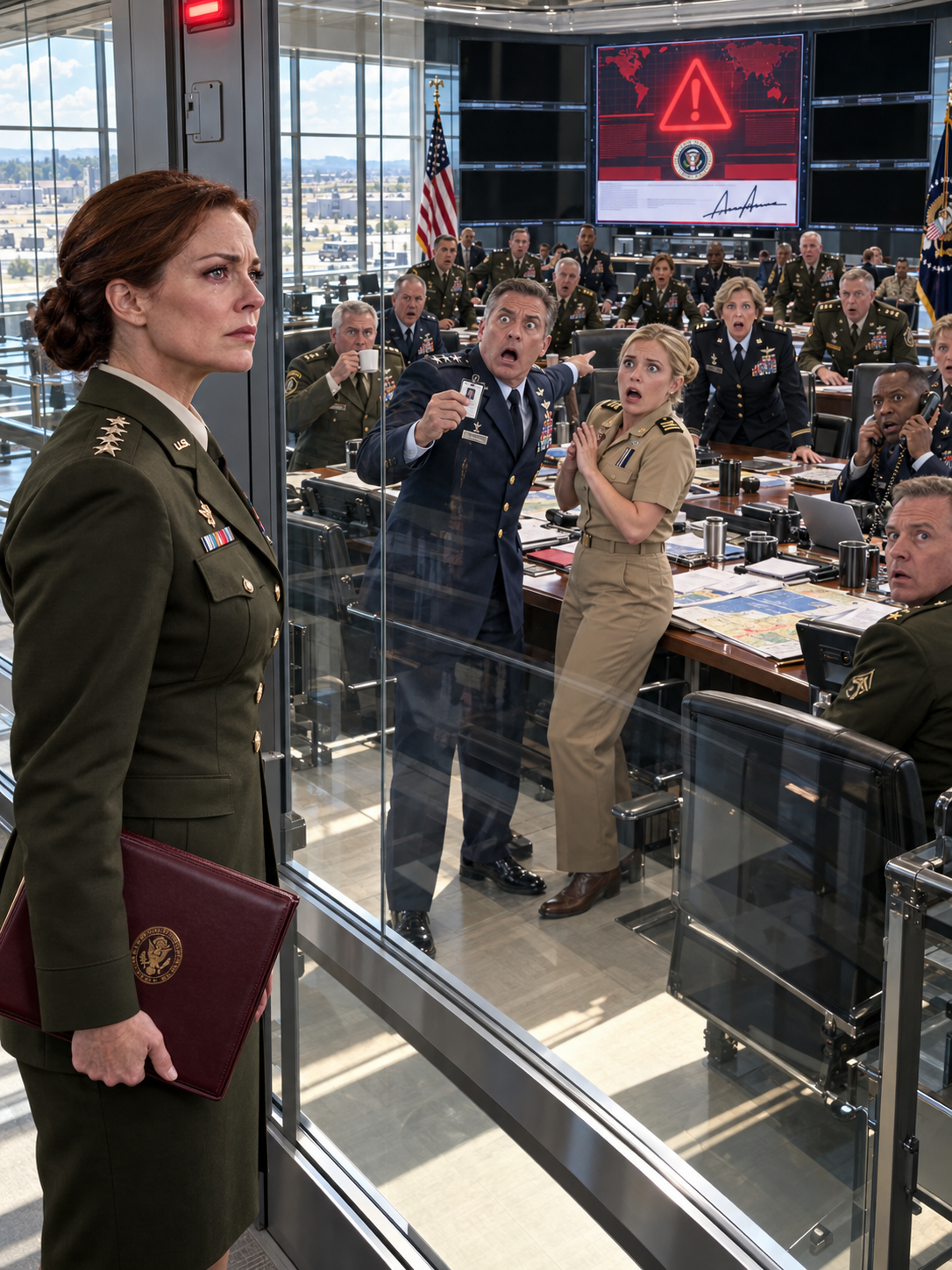
My husband humiliated me in front of twenty senior officers, stripped away my clearance, and announced that my military career was over because I challenged the dangerous plan created by the captain he had chosen to replace me in almost every part of his life. I handed him my badge without arguing and walked away while he smiled like he had finally broken me. 10 minutes later, every screen in his war room went black, the doors locked, and an emergency directive appeared bearing a signature he knew better than anyone—mine.
### Part 1
The first thing I remember was the sound of my husband’s palm hitting polished mahogany.
The crack rolled through War Room Bravo hard enough to make two water glasses jump against their coasters, and every conversation around the table stopped so abruptly that I could hear the ventilation system humming above us. Major General Grant Mercer stood at the head of the table with his jaw clenched, two silver stars gleaming beneath the white fluorescent lights, while Captain Natalie Shaw hovered behind his right shoulder with a tablet pressed against her chest. “You’re fired, Mara,” Grant said, loud enough for every officer, analyst, liaison, and technician in the room to hear. “Your career under this command ends today.”
Nobody moved.
Twenty people had been talking over one another thirty seconds earlier, trying to solve an operational emergency involving twelve American reconnaissance specialists stranded after a disastrous route change overseas. Now they stared at the table, at their screens, at folders that suddenly seemed fascinating, because no one wanted to make eye contact with the general’s wife while he destroyed her in public. I could smell burnt coffee from the pot near the communications station and the faint metallic scent of overheated electronics, ordinary details my mind noticed because the alternative was letting Grant see how deeply his words landed.
Natalie did look at me.
She tried to hide the smile, but she had never been as subtle as she believed. For six months I had watched her appear beside Grant at command dinners, on inspection flights, outside closed-door briefings, always polished, always eager, always laughing half a second too loudly at his jokes. That afternoon, standing behind him in a fitted service uniform while he ordered security to remove my access, she wore the expression of a woman watching a chair finally become vacant.
My mistake, according to Grant, had been speaking when he wanted silence.
The main display showed a mountain corridor glowing red across a digital operational map, the route Natalie had recommended for an emergency extraction attempt. I had pulled up telemetry she had omitted and found active electronic interference across the same corridor, strong enough that any aircraft relying on the proposed navigation package could lose communications within minutes. “That route is compromised,” I had said calmly. “Send an extraction flight through it and you may turn one endangered team into three.”
Natalie’s shoulders had tightened immediately. “With respect, Major Mercer, the route package was modeled against the data authorized for this briefing.”
“And the data authorized for this briefing is incomplete.”
Grant slowly turned toward me.
Ten years earlier, that look would have meant he was thinking. Five years earlier, it would have meant he was annoyed. Now I knew it meant something much simpler: I had contradicted him where other people could hear.
“You process logistics reports,” he said. “Captain Shaw built this operational profile.”
“I reviewed the same raw movement patterns your team received this morning.”
“You did not receive the same material.”
I almost smiled at that.
Grant caught the expression and mistook it for disrespect. “You think this is amusing?”
“No.”
“Then learn where your authority ends.”
My authority.
Of all the things he could have said, those two words came closest to breaking my composure.
I rested both hands against the closed folder in front of me and looked at the man I had followed through seven duty stations, three states, two foreign assignments, endless formal dinners, bad temporary housing, promotion boards, and lonely holidays. I remembered sewing a button onto his uniform at two in the morning before his first important inspection because his hands had been shaking too badly from exhaustion. I remembered him whispering against my forehead when he made lieutenant colonel that none of it would mean anything if we stopped being a team.
That man had disappeared gradually enough that I had spent years pretending not to notice.
“The numbers are wrong,” I said. “Whether you like hearing that from me or not does not change them.”
Grant’s nostrils flared.
Natalie lowered her eyes, but not before I saw satisfaction flash across her face.
“That is insubordination,” Grant said. “Security.”
Two military police officers near the rear door straightened.
His chief of staff, Colonel Daniel Hart, finally lifted his head. “General, perhaps we should finish reviewing—”
“I said security.”
Daniel stopped.
Grant came around the table until he stood opposite me, close enough that I could see the tiny pulse beating along his temple. “I have tolerated your attitude because you are my wife, Mara, and because I assumed eventually you would remember the difference between marriage and command authority. Apparently I was wrong.”
The humiliation in the room changed shape.
Before that sentence, people could pretend they were witnessing a professional dispute. Now everyone understood Grant wanted them to know he controlled me at home as completely as he believed he controlled me here.
I slowly unclipped the green identification card from my uniform.
Grant watched my hand.
Natalie watched even more closely.
I placed the card face down on the table.
“Understood, General.”
Something flickered in Grant’s expression, almost disappointment. He had expected tears, resistance, maybe an emotional argument that would justify everything he had just done. Instead, I gathered my folder, aligned the pen beside my terminal out of habit, and pushed back my chair.
“You will report to administrative processing,” he said. “You will clear your office before close of business. Any appeal can go through normal channels.”
“I won’t need an appeal.”
Natalie glanced up.
Grant laughed once. “Of course you will.”
I met his eyes for one second longer than necessary, then turned toward the door.
The officers moved aside as I crossed the room, my boots clicking against the pale tile. Nobody spoke, although Daniel Hart gave me a strange look as I passed him, a mixture of apology and concern that told me he had noticed far more than Grant realized. Behind me, Grant was already reclaiming the room.
“Now that the distraction is over, Captain Shaw, proceed.”
The heavy doors closed between us.
I stood alone in the corridor beneath harsh white lights, listening to the muffled rhythm of Grant’s voice through several inches of reinforced material. My hands were steady, which surprised me until I realized I had grieved our marriage long before he had publicly buried it. What remained inside me was not heartbreak.
It was clarity.
I walked past the elevators leading to the administrative floors.
A young lieutenant at the security desk saw my missing badge and started to rise. “Ma’am, do you need an escort?”
“No, Lieutenant.”
Instead of pressing the button marked Lobby, I inserted a plain metal key into the protected control panel beside the elevators. A section of buttons that did not appear on the public directory illuminated beneath my fingertips.
B1.
B2.
B3.
Then one unlabeled button below them.
I pressed it.
The lieutenant stared at the panel.
The elevator doors opened, and I stepped inside before he could form the question.
As the car descended beneath the public levels of the installation, I checked my watch.
Grant had eight minutes before Natalie’s extraction recommendation automatically entered the final authorization queue.
He had perhaps ten before his entire understanding of my life collapsed.
### Part 2
Most people on the installation believed they understood my marriage because they had watched it from the outside.
They saw Major General Grant Mercer, decorated officer, brilliant planner, commanding presence, the man whose name appeared in defense publications and whose speeches could make a room of junior officers sit straighter. Beside him they saw me, Major Mara Mercer, thirty-six years old, assigned to regional logistics coordination, usually carrying folders instead of giving speeches. Grant was the rising star; I was the dependable wife who had arranged our household around his career.
For a long time, that story had been true enough.
We met when Grant was still a major and I was finishing an advanced logistics assignment in Virginia. He drove an aging sedan with a broken air-conditioning vent, ate terrible vending-machine dinners, and called me after midnight because he wanted someone who would tell him when his ideas were stupid. He used to listen when I disagreed with him, and when we married two years later, he stood barefoot in our tiny apartment kitchen and promised that neither rank nor ambition would ever become more important than what we were building.
I believed him because Grant believed himself.
Ambition did not ruin him overnight.
It rewarded him slowly.
One promotion brought invitations, another brought aides, then came private dinners with executives who laughed at every story he told. People began stepping out of his way in hallways, and somewhere along the way Grant stopped seeing respect as something earned and began seeing obedience as something owed.
The biggest shift came after his first general officer promotion.
At home, questions became criticism in his mind. If I asked why a procurement meeting was taking place at a private resort instead of on base, he accused me of jealousy because I had not advanced as quickly. If I mentioned that he had missed three dinners we planned together, he explained that “real command responsibility” did not obey household calendars.
So I stopped asking certain questions aloud.
That was exactly what someone else wanted me to do.
Three years before Grant fired me, I had received an envelope delivered through a compartmented channel I had not used since an earlier assignment. Inside was a single page directing me to report to a restricted office in Washington wearing civilian clothes and telling no one except one designated security officer. Not Grant, not my command group, not friends.
The meeting lasted six hours.
When I emerged, my visible military career remained unchanged, but the purpose behind it had become something else entirely.
I had been selected for a small oversight cell created after several contracting scandals exposed weaknesses in the military’s ability to detect corruption inside operational logistics chains. My background was useful precisely because it looked boring: transportation schedules, fuel authorizations, warehouse allocations, contractor manifests, emergency routing, inventory reconciliation. A person searching for espionage watched secret files; a person searching for corruption watched where ordinary supplies moved and who got paid when they moved.
My cover assignment required me to remain exactly what Grant thought I was.
Unremarkable.
I reviewed routine logistics during the day and compartmented procurement data during restricted hours. I was not a spy hiding behind fake glasses, and I possessed no magical authority to ignore the chain of command. I was simply an Army officer serving under a special delegated oversight mandate whose existence was known to very few people outside Washington.
Then Grant’s name appeared in a transaction review.
The first irregularity was small.
A private transportation subcontractor called Northstar Strategic Transit had received an emergency modification worth far more than its original contract. The justification cited unexpected overseas requirements, but the equipment listed under the modification had never moved through the depot named in the paperwork. Someone had approved payment for services that seemed to exist only inside spreadsheets.
Grant’s digital authorization appeared near the end of the chain.
I told myself it meant nothing.
General officers signed hundreds of documents shaped by people beneath them, and Grant had never shown interest in financial details at home. I requested a broader sample, expecting to find a clerk’s mistake.
Instead I found six more contracts.
Then eleven.
Northstar had connections to an investment partnership whose ownership records disappeared behind layers of shell companies. One of those companies used a mailing address belonging to a law office in Delaware; another transferred consulting fees to an account controlled by the brother of someone newly assigned to Grant’s staff.
Captain Natalie Shaw.
I remember sitting alone in a windowless office at 1:17 in the morning, staring at her brother’s name on the monitor while the building’s ventilation clicked on and off behind me.
I wanted the data to be wrong.
Not because I cared about Natalie, but because if she was involved, Grant could not remain merely careless for long. He had personally accelerated her transfer, granted her unusual access, and defended her against objections from officers with far more operational experience.
The next morning he kissed my cheek before leaving for work.
“You look tired,” he said.
“Long night.”
“Still chasing truck schedules?”
“Something like that.”
He smirked while adjusting his cuff. “I keep telling you, Mara, you could have done more with yourself if you had been willing to take risks.”
I watched him walk out the door.
That sentence stayed with me all day.
For six months my oversight cell collected evidence while I continued playing the woman Grant had decided I was. We found inflated transport charges, suspicious consulting payments, contractor relationships that bypassed competitive review, and encrypted correspondence suggesting someone inside headquarters had been feeding privileged operational information to outside partners.
But one question remained unanswered.
Was Grant knowingly involved, or had Natalie been using his arrogance as camouflage?
Forty-eight hours before the war room confrontation, the answer began moving toward us.
An overseas reconnaissance element changed its planned support route after receiving an urgent amendment from Grant’s command group. The new path placed the team beyond its normal resupply network and created dependence on private air assets associated with Northstar. Within hours, hostile electronic interference disrupted communications in the region.
Twelve Americans became isolated.
The amendment carried Natalie Shaw’s planning identifier.
Grant had approved it.
I was still studying the routing history when my secure terminal displayed a message from Washington.
DO NOT INTERVENE UNLESS LIFE SAFETY THRESHOLD IS MET.
CONTINUE OBSERVATION.
I stared at those words until my eyes burned.
Somewhere overseas, twelve people were waiting for help.
At home that night, Grant drank expensive bourbon in our kitchen and complained about officers who lacked the courage to make bold decisions. Natalie sent him three messages during dinner; each time his phone lit up, he tilted the screen away from me.
“What happened today?” I asked.
“Operational issue.”
“Serious?”
He gave me the patient smile he used when explaining things to people he considered beneath him. “Nothing you need to worry about.”
My secure phone vibrated inside my pocket.
I excused myself, walked upstairs, and locked the bedroom door.
The message contained only eight words.
LIFE SAFETY THRESHOLD APPROACHING. PREPARE EMERGENCY AUTHORITY PACKAGE.
For the first time in three years, the investigation was no longer about following money.
It was about whether I could stop my husband before somebody died.
### Part 3
By five the next morning, our house smelled like coffee and rain.
Water tapped against the kitchen windows while Grant stood beneath the recessed white lights knotting his tie, irritated that his command driver was seven minutes late. He had barely slept, yet he looked energized in the way he always did during emergencies, as though crisis gave him a stage large enough for the version of himself he most admired. “There’s going to be a joint briefing,” he told me while scrolling through messages. “Do not come wandering into it unless your section is specifically called.”
I stirred my coffee once.
“Why would I wander into your briefing?”
His eyes lifted.
For a second, something uncertain passed over his face, but Natalie called before he could answer.
Grant stepped into the hallway.
His voice softened.
That hurt more than I expected.
Not because I wanted tenderness from him anymore, but because hearing him give another woman the patience he had spent years withholding from me confirmed that the cruelty between us was not exhaustion. It was choice.
My own phone vibrated.
Colonel Daniel Hart: LOGISTICS REQUESTED FOR 0900 BRIEF. COMMAND DIRECTION.
I almost laughed.
Grant had ordered me not to appear in a meeting his own staff had already summoned me to attend.
By 8:30 I was inside my public office reviewing supply manifests while a restricted feed ran silently on an encrypted device inside a locked drawer. Overnight satellite telemetry showed increased electronic activity near the proposed extraction zone. More troubling was a contractor dispatch notice indicating that two Northstar aircraft had been placed on alert before Grant’s headquarters officially requested private assistance.
Someone had known what solution Natalie intended to recommend hours before the meeting.
I forwarded the timestamp to my oversight team.
Three minutes later, my secure channel flashed.
AUTHORIZED TO PREVENT IMMINENT LOSS OF LIFE. DO NOT DISCLOSE STATUS UNLESS DIRECTIVE ALPHA IS TRIGGERED.
That gave me room to challenge the plan.
It did not yet give me permission to expose the investigation.
At 8:57 I entered War Room Bravo carrying the same dull manila folder everyone associated with my logistics work.
Natalie stood beside Grant wearing a confidence that seemed almost theatrical. She greeted a Pentagon liaison by first name, dismissed a junior analyst with a wave, and gave me a pleasant little nod when I sat near the far end of the table.
“Mara,” she said.
“Captain Shaw.”
“I wasn’t aware routine logistics would be joining us.”
Colonel Hart answered before I could. “Major Mercer’s section controls half the movement data relevant to the stranded team.”
Natalie smiled. “Of course.”
Grant said nothing.
That silence told me more than anger would have.
The doors sealed.
For the next twenty minutes, specialists reviewed communication failures, terrain limitations, weather windows, aviation availability, and the increasingly narrow period in which the stranded team could be moved safely. Every new fact made Natalie’s solution look more attractive if you ignored one particular layer of electronic telemetry.
She ignored it beautifully.
“Northstar can provide two aircraft within ninety minutes,” she announced, sending a route to the central display. “We move along the northern corridor, use commercial-style transponder masking, reconnect the team with our relay package, and extract before hostile systems adapt.”
Grant leaned back.
“Clean,” he said.
“It is.”
One colonel cleared his throat. “That corridor was rated unstable last quarter.”
Natalie barely glanced at him. “Last quarter is not this morning.”
Grant nodded. “Proceed.”
I opened my folder.
Inside was a single page printed from the restricted telemetry feed, stripped of identifying classification marks so I could reference the numbers without exposing the source.
“The corridor is saturated.”
Natalie stopped.
Grant slowly looked toward me.
I continued before he could speak. “Electronic activity increased forty-two percent overnight. The interference pattern is consistent with systems capable of degrading navigation and tactical communications. If those aircraft enter the valley under the profile Captain Shaw proposed, they may lose their situational picture before reaching the pickup point.”
Natalie tapped her tablet. “My modeling does not show that.”
“Your model excluded the overnight spectrum data.”
“That data was not part of the authorized package.”
“It should have been.”
Grant’s fingers curled against the table.
I watched his eyes move briefly toward Natalie.
There.
It lasted less than a second, but I saw it.
Not surprise.
Recognition.
He knew data had been excluded.
My stomach tightened.
Until that moment, a small irrational part of me had still hoped Grant was merely protecting Natalie because pride made admitting her mistake impossible. That look killed the hope.
“How did you obtain that information?” he asked.
“I reviewed regional telemetry.”
“You do not have access to that level.”
“I have access to what I need to do my job.”
Natalie’s face had gone pale.
She looked at Grant, and Grant looked at me.
Suddenly the room was no longer about twelve stranded Americans.
It was about what I knew.
Grant stood.
“Mara, step outside.”
“No.”
Several heads turned.
His voice dropped. “That was not a request.”
“And twelve people’s lives are not reputation-management tools.”
The silence that followed felt electric.
Grant walked around the table.
“You are dangerously close to ending your career.”
“Then end it after you choose a safe route.”
Natalie interrupted, too quickly. “General, we’re losing time.”
I looked at her. “You knew the contractor aircraft were on standby before this meeting.”
Her lips parted.
Grant snapped, “Enough.”
“I have the dispatch timestamp.”
“Mara.”
“Northstar activated two crews at 0314. Your request for contractor support was not entered until 0522. Explain that.”
Nobody breathed.
Natalie stared at me with naked panic.
Grant’s face became unreadable.
Then, as if a switch inside him had flipped, panic transformed into fury.
He slammed his hand onto the mahogany table.
“You’re fired.”
The words landed almost exactly as I knew they would.
What I had not known was whether his anger would cross the threshold Washington needed.
When he ordered my credentials stripped, he crossed it.
When he described me as dead weight and threatened my entire career to prevent further questions, he crossed it again.
And when he turned back toward Natalie after I left and told her to proceed with the same route despite the evidence I had presented, the final condition was satisfied.
My elevator descended into the restricted sublevel.
Bare concrete replaced polished walls.
A biometric reader glowed beside an unmarked steel door.
I pressed my palm against the glass.
A scanner moved across my eyes.
For three seconds nothing happened.
Then the light changed from red to green.
The door unlocked with a deep mechanical thud.
Three civilian specialists inside the secure operations cell stood as I entered.
One of them, Thomas Avery, removed his headset.
“Major Mercer?”
“Not in here.”
He understood immediately.
“Director Quinn.”
Hearing my maiden name spoken in that room felt like stepping into my own skin after years of wearing somebody else’s.
I placed the folder on his console.
“Grant authorized the route after receiving the warning.”
Thomas’s expression hardened. “Then we have threshold.”
“We do.”
“And Shaw?”
“Her contractor knew the recommendation before the command request existed.”
He exhaled slowly.
“Washington is holding.”
I looked at the countdown on the wall.
Natalie’s route would enter execution authority in six minutes.
“Open the black channel,” I said. “It’s time.”
### Part 4
There were only five permanent workstations in the restricted cell, but the room carried more authority than the entire polished command suite above it.
No plaques decorated the bare gray walls. There were no portraits, ceremonial flags, or trophy cases, only secure terminals, independent communications equipment, a wall clock, and a red telephone kept beneath a transparent cover. Everything about the place had been designed for people whose work mattered more if nobody knew their names.
Thomas opened an encrypted connection to Washington.
A woman appeared on the center screen.
Deputy Secretary Helen Ward looked exhausted, silver hair pulled back, reading glasses low on her nose. I had briefed her twice in person during the investigation, and both times she had reminded me that the objective was not to destroy Grant Mercer.
It was to determine whether he deserved to remain trusted with command.
“Mara,” she said.
“He proceeded after warning.”
“Recorded?”
“Fully.”
“Natalie Shaw’s contractor activation?”
“Confirmed two hours before formal tasking.”
Helen glanced toward someone outside the camera frame.
“What about the team?”
“Extraction window is shrinking.”
“Then protect them.”
The order sounded simple.
It was not.
The emergency authority package we had prepared did not make me Grant’s superior by rank, and it did not magically transfer the entire military into my hands. It activated a previously approved suspension mechanism signed by civilian defense leadership and delegated to the oversight investigation if Grant attempted to use command authority to obstruct a life-safety intervention.
My signature certified that the triggering conditions had been met.
The actual power behind the directive came from people far above both of us.
Thomas inserted a cryptographic token into the central console.
“Ready.”
I reviewed the text one final time.
SUSPEND LOCAL OPERATIONAL AUTHORITY PENDING IMMEDIATE REVIEW.
FREEZE CONTRACTOR TASKING.
TRANSFER CONTROL OF CURRENT EXTRACTION MISSION TO JOINT CRISIS CELL.
PRESERVE ALL COMMUNICATIONS AND PROCUREMENT RECORDS.
At the bottom was my legal certification.
MARA QUINN MERCER
SPECIAL INVESTIGATIVE DIRECTOR
COMPARTMENTED LOGISTICS OVERSIGHT CELL
For ten years Grant had told people I was lucky to be attached to his career.
For three years I had signed classified reports he would never have been cleared to read.
I pressed authorize.
Nothing dramatic happened downstairs.
A soft tone sounded.
Thomas said, “Directive transmitted.”
Upstairs, everything changed.
Our protected monitoring feed showed War Room Bravo’s main displays blank simultaneously as the local command network separated itself from operational control. Amber security lights began flashing across the room, and the automated access system sealed the doors while preservation protocols locked every terminal against deletion or external transfer.
Grant spun toward his communications chief.
“What happened?”
The officer typed rapidly. “We’ve been overridden.”
“By whom?”
“I’m checking.”
Natalie moved toward a secondary console.
It locked before her hand touched the keyboard.
“What the hell?” she whispered.
Grant snapped, “Restore my network.”
“Sir, I can’t.”
“You are the communications chief.”
“Yes, sir, and the command certificate has been suspended by external authority.”
Grant stared at him.
On the central screen, a plain message appeared.
PRIORITY DIRECTIVE RECEIVED.
LOCAL OPERATIONAL AUTHORITY SUSPENDED.
AWAIT SECURE HARD COPY.
I watched Grant’s face through the room camera.
He had spent years becoming skilled at hiding surprise, but that morning he failed.
A secure printer beside Colonel Hart began feeding out several pages.
Daniel tore them free.
He read the first page.
Then he read it again.
“General,” he said quietly.
Grant held out his hand.
Daniel did not move.
“Colonel.”
Daniel finally gave him the directive.
Grant scanned the header.
His eyes moved down the page.
For several seconds his expression remained blank.
Then he reached the certification line.
I saw the exact instant he recognized my signature.
Grant had watched me sign birthday cards, mortgage documents, tax returns, military forms, anniversary notes, hotel receipts, and letters to his mother. He knew the slight backward angle of my M and the way I crossed a capital Q as well as he knew his own handwriting.
“No.”
Natalie stepped toward him. “General?”
“No.”
He flipped the page as though another explanation might be printed behind it.
“What does it say?” she asked.
Grant did not answer.
Daniel Hart looked toward the cameras.
He knew.
Maybe not everything, but enough.
Grant’s voice suddenly exploded through the room. “Get Mara Mercer back in here.”
Nobody moved.
“I said find my wife.”
His communications officer swallowed. “Sir, the directive identifies Major Mercer as the certifying investigative official.”
Grant turned.
“What?”
“The authorization credential belongs to her.”
“That’s impossible.”
Natalie grabbed the document.
Grant should have stopped her.
Instead he let her read.
Her face drained so quickly that even through the camera feed I saw the change.
“This designation…” she said. “Special investigative director?”
Grant snatched the page back.
“This is fraudulent.”
Helen Ward, still watching from Washington, spoke behind me.
“Predictable.”
Thomas glanced over. “We have another problem.”
A red notification appeared on his side monitor.
Northstar’s two aircraft had started taxiing despite the contractor freeze.
“Who released them?”
Thomas typed.
His expression tightened.
“The launch code came from a contractor account authenticated through Captain Shaw’s authorization device.”
I stared at the screen.
“She issued it after the directive?”
“Thirty-eight seconds after.”
That meant Natalie had either panicked and tried to execute the mission before losing control, or someone outside the base had told her to move.
Either possibility was worse than what we had known ten minutes earlier.
“Block their theater clearance.”
“Working.”
Helen leaned toward her camera. “Mara, the stranded unit cannot remain where it is much longer.”
“I know.”
“Do you have an alternative?”
I had spent the previous night building one.
“Route Falcon Seven.”
Thomas looked at me.
“That was rejected last month because of refueling limits.”
“Only under the standard staging assumption. Move the relay package south, pair the aircraft with the airborne communications platform already on station, and use the eastern window.”
Thomas pulled up the map.
Numbers populated the screen.
A specialist beside him began calculating.
“Electronic exposure is significantly lower.”
“Exactly.”
“Pickup timing?”
“Twenty-two minutes slower than Shaw’s route.”
Helen asked, “Risk?”
“Manageable.”
“And Northstar?”
“Keep them grounded.”
A warning flashed.
One contractor aircraft had ignored the hold instruction.
It was moving toward takeoff.
Thomas swore under his breath.
Then something stranger happened.
Natalie’s tablet, sitting inside locked War Room Bravo, attempted to wipe itself remotely.
The preservation system stopped the deletion.
A folder appeared in the recovered queue.
Thomas opened the directory.
Dozens of encrypted communications populated the screen.
Payment schedules.
Routing recommendations.
Private messages.
And one conversation with a participant identified only by initials.
GM.
My husband’s initials.
For three years I had wondered whether Grant was careless, compromised, manipulated, or corrupt.
I was finally about to get my answer.
### Part 5
The recovered messages began eighteen months earlier.
At first they looked almost harmless: Natalie updating Grant on contractor capabilities, Grant complaining about slow procurement channels, both of them discussing how private suppliers could move faster than “career bureaucrats.” Gradually the language changed, professional shorthand giving way to discussions of consulting opportunities after retirement, investment introductions, and the value of controlling emergency contracts before competitors could react.
Then Thomas opened a message dated nine months earlier.
Natalie: NORTHSTAR CAN MAKE THIS WORTH EVERYONE’S TIME.
Grant: I DON’T WANT DETAILS IN WRITING.
I felt something inside me go very still.
There was no dramatic revelation, no shattered glass, no sudden music like the movies. Just the faint whisper of climate-control fans and the knowledge that the man who once spent twenty minutes returning a wallet because he believed keeping lost money would make him “the kind of person he hated” had eventually learned to discuss corruption by avoiding nouns.
Thomas looked at me.
“You okay?”
“Keep reading.”
The payments had been disguised.
Not direct transfers to Grant, but money routed into an investment vehicle managed by an old academy friend, then into a property partnership Grant had told me belonged to “some officers planning for retirement.” He had even discussed that investment with me at breakfast, complaining when I refused to contribute money from my own savings.
I had thought it was another vanity project.
Instead, it had been a laundering path.
Helen Ward’s voice came quietly through the speaker.
“Mara, you can step out.”
“No.”
“This is now evidence involving your spouse.”
“I know.”
“You are permitted to recuse.”
“I’ll recuse from the criminal review when the immediate mission is stable.”
She studied me.
“Understood.”
Upstairs, Grant had moved beyond denial.
He was demanding external communications, legal counsel, and access to the deputy commander. Every request was denied because the preservation order temporarily isolated the room until federal investigators arrived.
Natalie paced near the conference table.
For the first time since I had known her, she looked young.
Not ambitious, polished, or smug.
Young and terrified.
“General,” she whispered, “you said this couldn’t happen.”
Grant turned toward her.
I leaned closer to the monitoring feed.
“What couldn’t happen?” Daniel Hart asked.
Natalie realized she had spoken too loudly.
Grant snapped, “Nobody says another word.”
Daniel’s expression changed.
For years he had been one of Grant’s most loyal officers. That morning, I watched loyalty begin separating itself from obedience.
“Our people are still waiting for extraction,” Daniel said. “Whatever this investigation is, we need the mission transferred and moving.”
“It is my mission.”
“No, sir,” Daniel replied. “According to the order, it isn’t anymore.”
Grant stared at him as though betrayal had come from the wrong direction.
Meanwhile, Route Falcon Seven moved through emergency validation.
A communications aircraft already orbiting south of the danger zone could cover the gap we needed. Two military extraction aircraft at another installation had sufficient fuel if they staged through a closer forward location. The plan was not elegant, but it relied on existing assets rather than a contractor that appeared determined to force itself into the rescue.
“Falcon Seven valid,” Thomas said. “Joint Crisis Cell requests release.”
Helen looked toward me.
I checked the interference map again.
“Release.”
She transmitted approval.
Within minutes the rescue package began moving.
The Northstar aircraft that had attempted unauthorized departure was stopped before takeoff after airfield operations physically closed its departure lane. Its crew claimed they had received conflicting instructions.
Those instructions had come from Natalie.
Then the doors to War Room Bravo opened.
Three military investigators entered first, followed by two federal procurement agents and a senior officer from the Inspector General’s office. There was no theatrical storm of rifles or screaming arrest teams; just serious people carrying sealed evidence bags, credential cases, and the kind of calm that made Grant’s shouting seem increasingly small.
Brigadier General Laura Benton stepped forward.
“General Mercer, you are relieved of command pending investigation.”
Grant straightened.
“On whose authority?”
“The Secretary’s designated representative, pursuant to the directive already in your hand.”
“That directive was triggered by my wife.”
“It was certified by an authorized investigative officer.”
“My wife.”
Laura’s expression did not change.
“Yes.”
Grant laughed once.
It sounded almost desperate.
“This is some marital revenge fantasy.”
I chose that moment to leave the secure cell.
Thomas caught my arm lightly before I reached the door.
“Mara.”
“I know.”
“You don’t owe him an explanation.”
“No.”
The elevator ride upstairs felt longer than the descent.
I watched the floor numbers rise while my reflection floated faintly in the stainless-steel doors. I had changed nothing about my uniform except replacing the confiscated base badge with the compartmented credential I normally kept secured belowground.
That small black card contained no impressive title on the front.
It did not need one.
When I entered War Room Bravo, conversation stopped.
Daniel Hart stood first.
Then Laura Benton.
One by one, several officers followed, not because I suddenly outranked them, but because they understood I had entered in a different official capacity than the one Grant had mocked.
I did not ask them to salute.
I did not want theater.
Grant stared at me.
His face looked wrong without certainty.
“Mara.”
I walked to the empty workstation at the side of the table.
Natalie’s gaze followed me.
“You lied to me,” Grant said.
I logged into the crisis feed.
“No.”
“You hid this.”
“Yes.”
“From your husband.”
“My assignment was classified.”
“I was a general officer.”
“You were also a subject of the investigation.”
The room seemed to contract around him.
Grant’s mouth opened.
Nothing came out.
Natalie whispered, “You were investigating us?”
“For three years.”
She looked toward Grant.
He looked at her.
Something passed between them that made every rumor about their closeness suddenly seem less important than the financial partnership binding them together.
I turned to Laura Benton.
“Captain Shaw’s device contains messages indicating unauthorized contractor coordination and attempted destruction of records.”
Laura nodded.
“Natalie Shaw, step away from the table.”
Natalie did not move.
“Natalie.”
Her tablet slipped from her hand and struck the carpet.
“You don’t understand,” she said. “Northstar was supposed to solve the problem. That team getting cut off wasn’t supposed to happen.”
My head lifted.
Laura’s expression sharpened.
“What did you say?”
Natalie froze.
Grant closed his eyes.
And suddenly I understood the possibility we had not considered.
The disastrous route change that stranded twelve Americans might not have been a mistake at all.
### Part 6
Natalie asked for an attorney after that.
So did Grant.
Everything after those requests slowed into procedure, evidence preservation, recorded interviews, separate rooms, and careful questions from people trained not to confuse suspicion with proof. I stepped away from the criminal portion exactly as Helen Ward had instructed, but the rescue mission remained active, and until the twelve-person team was safe, I had no room in my mind for anything else.
Falcon Seven crossed the first staging point at 14:22.
The air inside the crisis center smelled of stale coffee and warm plastic from equipment that had been running all day. I stood behind Thomas watching small symbols crawl across a digital map while voices from three locations overlapped through secure headsets.
“Relay coverage stable.”
“Interference below predicted threshold.”
“Extraction flight approaching eastern window.”
I wrapped my fingers around the edge of the console.
For the first time that day, they trembled.
Grant had always accused me of lacking the temperament for command because I did not enjoy performance. He loved making decisions where everyone could see him making them; I preferred checking the assumption that could turn a confident decision into a funeral.
The difference had never bothered me until he began treating caution as weakness.
“Contact,” Thomas said.
A voice crackled through the secure channel.
The reconnaissance team had reestablished communication.
Nobody cheered.
Not yet.
We listened while coordinates were verified, landing conditions confirmed, and extraction aircraft moved into the pickup zone. Three minutes felt like thirty.
Then came the words I had been waiting for.
“Package aboard.”
Thomas closed his eyes briefly.
The specialist beside him exhaled.
I asked, “All twelve?”
A pause.
“All twelve confirmed.”
The room finally breathed.
I sat down because my knees suddenly felt unreliable.
Twelve people I had never met were alive and moving home.
Nothing else mattered for several seconds.
By evening, preliminary investigators had reconstructed enough of Natalie’s scheme to explain what had happened.
Northstar Strategic Transit belonged indirectly to Natalie’s older brother and two silent investors. The company had struggled to win major defense work because its equipment record was mediocre, so Natalie began engineering situations in which standard military options appeared too slow or restricted.
Grant helped.
Sometimes by pressuring procurement officers.
Sometimes by approving emergency waivers.
Sometimes by looking away.
The route change involving the reconnaissance team had been intended to create an urgent resupply problem, not strand anyone permanently. Natalie expected predictable communications disruptions that would make a private extraction request seem necessary, after which Northstar would receive a lucrative emergency tasking.
But the electronic warfare environment changed faster than she predicted.
A manufactured inconvenience became a genuine crisis.
“What happens to them?” I asked Helen during a late secure call.
“That will be determined through investigation and legal process.”
“And the evidence against Grant?”
“Significant.”
I stared at the empty coffee cup beside my hand.
“Did he take money?”
“We have evidence linking him to financial benefits through the investment vehicle. Investigators will determine what he knew about each transaction.”
That distinction mattered legally.
Emotionally, it changed nothing.
Grant had put careers, public money, and lives at risk because ambition had become an appetite no promotion could satisfy.
When I finally left the base after midnight, my house was dark.
Our house.
I stood in the entryway and listened to the refrigerator motor hum from the kitchen.
Grant’s shoes were lined neatly beside the bench. His coat hung on the hook where he had left it that morning. A coffee cup sat in the sink with a brown ring drying around the bottom.
Ordinary objects made the day feel more unreal than the classified screens had.
I walked upstairs.
His side of the closet contained rows of uniforms, tailored suits, shirts organized by color, the architecture of a life built around being seen.
I pulled a suitcase from the shelf.
Not his.
Mine.
For years Grant had made tiny comments suggesting I could not function without the life attached to his rank. He handled social invitations, chose where we lived when options existed, dismissed my friendships if they interfered with command events, and treated my quieter career as proof that I had nowhere more important to go.
The strangest part was that I had started believing pieces of it.
I packed until two in the morning.
At 2:18, the doorbell rang.
Colonel Daniel Hart stood outside.
He looked exhausted.
“I’m sorry to come this late.”
“What happened?”
“Grant asked me to bring you a message.”
I almost laughed.
“Of course he did.”
Daniel held out an envelope but did not cross the threshold.
“He has temporary access to counsel and limited personal communication. He wrote this before they moved him.”
I took the envelope.
“Did you read it?”
“No.”
“Do you think I should?”
Daniel considered the question.
“I think you should do whatever gives him the least control over your next decision.”
That was the smartest thing anyone had said to me all day.
I thanked him.
After he left, I carried the envelope into the kitchen and placed it beside the sink.
For ten minutes I did not touch it.
Then I opened it.
Mara,
Whatever you think you found, you do not understand the pressure I was under. Natalie manipulated access and contractor relationships. I made mistakes, but I never intended anyone to be hurt.
We have ten years together. Do not let outsiders turn one professional disaster into the destruction of our marriage.
I need you to remember who I was before all this.
Grant
I read the note twice.
Not because I was moved.
Because something was missing.
He did not apologize for humiliating me.
He did not mention the people endangered.
He did not ask what the investigators had discovered.
Most importantly, he wrote that Natalie had manipulated him, even though investigators had not publicly accused her of doing so.
Grant already knew the defense he intended to use.
I turned the page over.
There, pressed faintly into the paper from whatever sheet had been above it when he wrote, was another set of words.
I angled the page beneath the kitchen light.
Three partially visible lines emerged.
PROPERTY ACCOUNT—
CONTACT RICHARD—
MARA DOESN’T KNOW—
I stopped breathing.
Grant’s corruption might have begun inside his command.
But he had apparently carried part of it into our marriage.
### Part 7
The property account belonged to a condominium in Northern Virginia.
I learned that three days later from an attorney assigned to help separate my personal finances from assets under investigation. Grant had purchased the unit through a partnership eighteen months earlier using money traced partly to the same investment structure connected to Northstar, and although his name did not appear directly on the deed, financial records tied him to the payments.
I had never seen the condominium.
Natalie had.
Building access records placed her there fourteen times.
When my attorney told me, I surprised both of us by laughing.
Not because anything was funny.
Because after three years of following hidden contracts, coded transfers, shell companies, and compartmented evidence, the most predictable betrayal in the entire story turned out to be the one happening inside my marriage.
“Do you want a few minutes?” attorney Rachel Monroe asked.
“No.”
“Mara.”
“I’m done giving him extra minutes.”
I filed for divorce that afternoon.
Grant’s lawyer requested a private meeting before the preliminary military hearing.
I declined.
He asked again.
I declined again.
The third request claimed Grant possessed information relevant to our shared property that could “reduce unnecessary conflict.”
Rachel read the message aloud.
“What do you want me to say?”
“Tell them there is no unnecessary conflict. There is paperwork.”
She smiled.
“I like you.”
The investigation widened over the next two months.
Several people Grant had cultivated vanished from his social circle almost instantly. Others cooperated with investigators, suddenly remembering conversations they had once dismissed as aggressive career networking.
Colonel Daniel Hart testified that Grant repeatedly pressured staff to favor Natalie’s recommendations even after technical objections were raised. Procurement officials produced emails showing Grant asking why Northstar was not receiving more emergency work.
Natalie eventually agreed to cooperate.
Through her attorney, she acknowledged that the stranded reconnaissance team had been deliberately routed into a position where contractor assistance would appear necessary. She insisted Grant knew the route adjustment was designed to create urgency, although she claimed neither of them anticipated the level of hostile interference that followed.
Grant denied knowing the operational manipulation.
The messages complicated that defense.
One from the previous evening read:
GRANT: MAKE THEM NEED THE PRIVATE OPTION.
NATALIE: THEY WILL.
GRANT: NO CASUALTIES. I WON’T CARRY THAT.
NATALIE: RELAX. IT’S CONTROLLED.
I read those lines in a secure evidence review and felt colder than I had when he fired me.
“No casualties.”
Grant had known there was risk.
He had simply decided someone else could manage it.
His administrative removal became permanent while the legal process moved forward. I could not participate in charging decisions, and I did not want to; by then my job was finishing the systemic investigation that allowed someone like Grant to manipulate emergency contracting in the first place.
For the first time in years, I built something instead of watching him destroy things.
We changed review thresholds.
Separated contractor recommendations from operational planning.
Created automatic conflict checks for staff relationships.
Required independent verification when emergency procurement bypassed normal competition.
None of those reforms made headlines.
That was exactly how I liked it.
Six months after the war room incident, I walked into a plain conference room for the final divorce settlement.
Grant was already there.
I almost did not recognize him.
He had lost weight, and without the immaculate uniform his posture seemed less certain. He wore a dark civilian suit that hung slightly loose around the shoulders.
Rachel sat beside me.
Grant’s attorney sat beside him.
The documents took twenty-seven minutes.
No children.
No dispute over the house, which investigators had already confirmed was purchased from legitimate income.
Separate retirement considerations pending the military case.
Separate debts.
Separate futures.
When everything was signed, Rachel closed her folder.
Grant looked at me.
“Mara.”
I stood.
“Can I have five minutes?”
“No.”
“Please.”
His lawyer glanced away.
I almost left.
Then I realized I was not afraid of what he could say anymore.
“Two.”
Grant swallowed.
“I was horrible to you.”
I said nothing.
“I know that now.”
“You knew it then.”
His eyes dropped.
“I thought you would always be there.”
“That was part of the problem.”
“Natalie told me you hated my success.”
I nearly smiled.
“Did Natalie make you humiliate me?”
“No.”
“Did she make you hide money?”
“No.”
“Did she make you approve contracts?”
“No.”
His face tightened.
“I’m trying to tell you I was manipulated.”
“And I’m telling you that blaming another woman for decisions you made is not accountability.”
Silence filled the room.
Grant looked older than forty-six.
“What happened to us?” he whispered.
I had once asked myself that question every night.
Now I knew.
“You started believing love meant I would absorb whatever version of you came home.”
He looked at me.
“I loved you.”
“I believe you loved having me.”
The distinction landed hard.
He pressed his palms against the table.
“Could you ever forgive me?”
Rachel shifted slightly beside me.
I considered lying.
Instead I gave him the answer he had earned.
“Maybe someday I’ll stop feeling anything when I remember this.”
Hope flickered across his face.
I finished the sentence.
“That is not the same as wanting you back.”
The hope disappeared.
“I won’t rebuild a marriage with a man who needed to lose his command before he could see his wife as a person.”
Grant closed his eyes.
I walked out.
In the hallway, Rachel handed me a certified copy of the decree.
The name printed at the top read:
Mara Elise Quinn.
My name.
Not his.
For the first time in a decade, I carried only myself forward.
But Grant’s career had one final chapter left, and unlike our marriage, it would not end behind a closed conference-room door.
### Part 8
The final military proceedings concluded almost a year after the morning Grant fired me.
By then I had moved into a townhouse outside Washington with tall windows, a narrow balcony, and exactly one bedroom more than I needed because I had turned it into a reading room. The first piece of furniture I bought was an absurdly comfortable chair that Grant would have hated because it did not match anything else.
I loved it immediately.
My life became quieter.
I worked long days, but they were my days.
I stopped attending dinners where spouses were expected to arrange themselves according to rank. I reconnected with friends Grant had gradually pushed to the edges of our schedule.
On Saturday mornings I ran beside the river.
On Sunday nights I cooked whatever I wanted, sometimes badly.
No one inspected the table.
No one checked the clock.
No one explained how fortunate I was to be standing beside him.
Grant eventually entered an agreement resolving multiple military and federal allegations.
The legal findings confirmed that he had accepted improper financial benefits connected to contractor decisions, misused his authority, obstructed review processes, and approved actions that contributed to the dangerous overseas situation. He was dismissed from military service following the court process and lost the future he had spent decades assuming belonged to him.
Natalie received her own sentence after cooperating extensively.
Northstar collapsed under investigation.
Several contracting officials were removed or prosecuted.
The twelve reconnaissance specialists all returned home.
That last fact mattered more to me than every headline combined.
One of them, a staff sergeant named Owen Price, eventually sent a short letter through official channels.
Director Quinn,
You probably hear this from people who know more about what happened than I do, but my daughter turned seven last week, and I was there.
Thank you for helping make that possible.
I read that sentence four times.
Then I locked the letter in the drawer where I kept the few things I considered more important than awards.
A month later, I attended a closed defense review in the same installation where Grant had humiliated me.
War Room Bravo looked almost unchanged.
Same polished table.
Same fluorescent lights.
Same central screens.
But there was a different commander at the head of it now.
Brigadier General Laura Benton was reviewing reforms created after the Northstar investigation. Colonel Daniel Hart had become her deputy.
When I entered, Daniel smiled.
“Director Quinn.”
“Colonel.”
“You’re early.”
“I’m never early. Everyone else is late.”
He laughed.
I took a seat near the center of the table.
Not at the head.
I had learned that people who truly needed the best answer rarely cared which chair produced it.
During the briefing, a young captain disagreed with Laura about a readiness assumption.
The room became quiet.
I watched Laura study the numbers.
Then she said, “Show me where I’m wrong.”
The captain did.
Laura changed the plan.
It was such a small moment that nobody else seemed to notice.
I did.
That was the military I still believed in—not people who never made mistakes, but people strong enough to let truth survive rank.
Afterward, Daniel walked with me toward the elevators.
“Have you heard from him?”
I knew who he meant.
“No.”
Grant had written twice after the divorce.
I returned both letters unopened.
He sent one email through his attorney after his case concluded.
Rachel asked whether I wanted to read it.
I said no.
Maybe he had apologized.
Maybe he had blamed Natalie again.
Maybe he had finally understood everything.
It no longer mattered.
Forgiveness, I eventually learned, was not a door I had to open just because someone finally knocked politely.
Daniel pressed the elevator button.
“You know,” he said, “that morning he fired you, half the room thought you were finished.”
“Only half?”
He smiled.
“The other half knew something strange was happening when you didn’t argue.”
The elevator arrived.
I stepped inside.
Daniel held the door.
“What were you thinking when you put your badge on the table?”
I remembered Grant’s face.
Natalie’s smile.
The burnt coffee.
The nervous officers staring at their folders.
The sound of my boots crossing the floor.
“I was thinking he had finally given me permission to stop protecting him from the consequences of being himself.”
Daniel’s expression softened.
“Fair enough.”
The doors closed.
Later that afternoon I stood outside beneath a bright fall sky while transport aircraft moved across the distant runway.
The sound rolled across the field and faded.
For years, I had believed strength meant enduring quietly because endurance was what my marriage required. Then I learned silence could mean something very different.
Silence could be observation.
Preparation.
Discipline.
It could be the space between someone underestimating you and discovering what they had failed to notice.
Grant mistook my silence for weakness because he needed the people around him to be smaller than he was.
Natalie mistook rules for obstacles because she thought intelligence meant being clever enough to avoid consequences.
Both were wrong.
I never became famous.
I did not want interviews.
I did not build a public career out of the scandal.
My name appeared on a few internal commendations and then disappeared back into the kind of work most Americans would never hear about.
That suited me.
Two years after the war room incident, I was promoted into permanent leadership of the oversight program.
At the ceremony, Helen Ward handed me a small framed citation and whispered, “You know this means more meetings.”
“I was afraid of that.”
She laughed.
That evening, I returned home alone.
Not lonely.
Alone.
There is a difference I wish I had understood earlier.
I changed out of my uniform, opened the balcony door, and watched the city lights come on beneath a clear blue-black sky. On the kitchen counter sat a folder containing an offer for another demanding assignment, one that would require travel and terrible coffee and far too many hours spent arguing with people who hated being questioned.
I signed it.
Not because I needed to prove anything to Grant.
Not because I wanted revenge.
Because the work mattered.
Before going to bed, I passed the small shelf where I kept Sergeant Price’s letter.
“My daughter turned seven last week, and I was there.”
That was the only verdict I ever truly needed.
Grant once believed power was the ability to make an entire room go silent when he raised his voice.
I learned something different.
Real authority was knowing why the room had gone silent, listening to what everyone else had missed, and acting before pride turned somebody else’s mistake into a tragedy.
The morning my husband screamed, “You’re fired,” he thought he was ending my career.
Instead, he ended the last illusion I still carried about him.
Ten minutes later, the war room received orders bearing my signature.
A year later, his stars were gone.
And when I finally walked away from him, I did not feel victorious because his life had collapsed.
I felt free because mine no longer depended on holding his together.
THE END!
Disclaimer: Our stories are inspired by real-life events but are carefully rewritten for entertainment. Any resemblance to actual people or situations is purely coincidental.


