
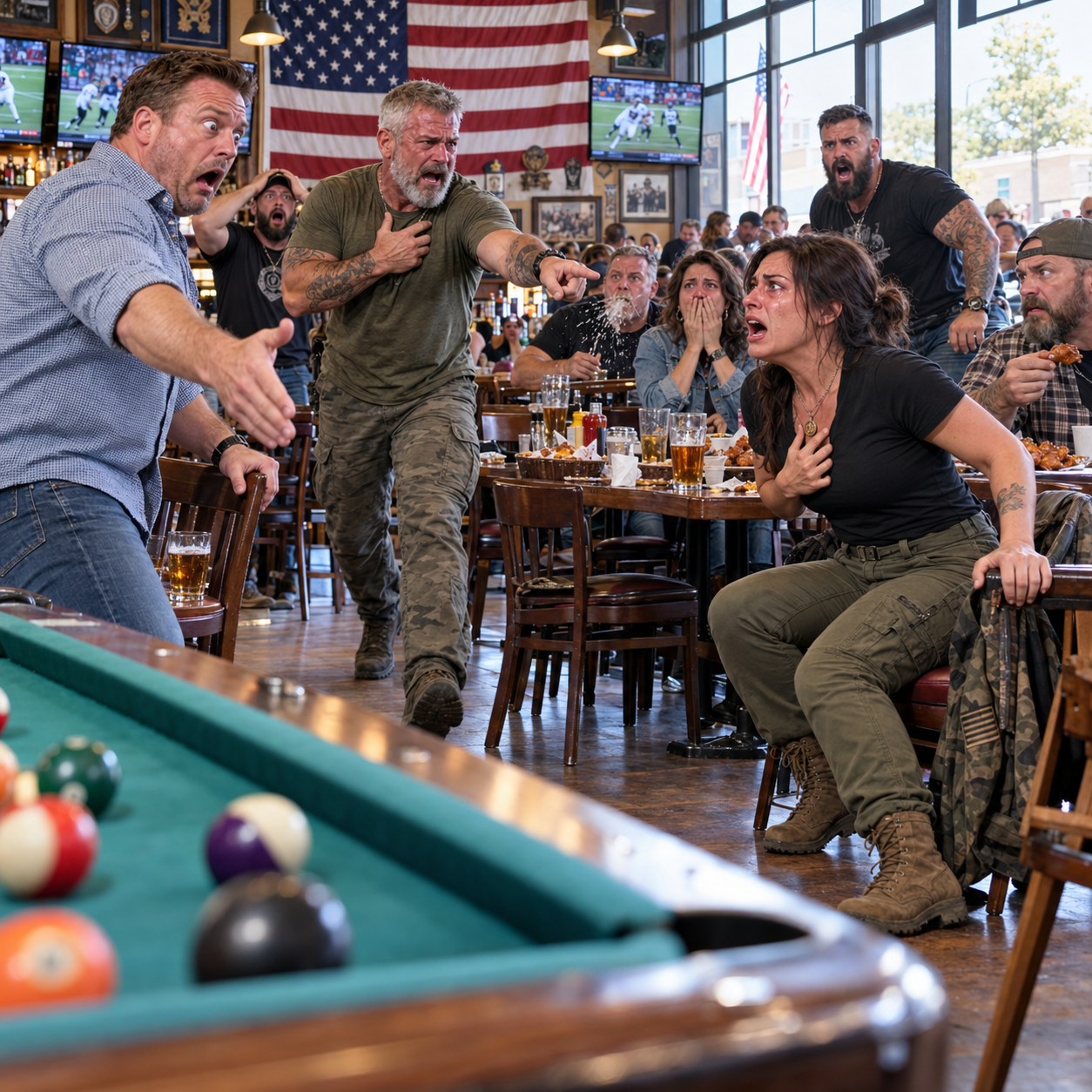
Wings Night. “To The Night I Carried Doc Out.” Cheers. I Asked, “How’d You Get Him Over The Wall?” The Storyteller Grinned. “You Had To Be There, Ma’am.” Laughter. Then A Man With A Cane Left The Pool Table And Walked Toward Us. The Storyteller Stuck Out His Hand. “Another Fan.” But The Man Walked Right Past Him, Stopped Beside Me, And Said, “Ma’am, Tell Him How We Got Over.”
For fifteen years, I never told anyone exactly what happened on the worst day of my life. Then I walked into a veterans’ post in Missouri and heard a stranger telling my story as if he had lived it. The room laughed when I questioned him, and even the post commander quietly asked me to let the man enjoy his moment. I almost left. Then a man with a cane stood up, crossed the room, looked straight at me, and asked one question that changed everything.
Part 1: The Stranger Who Knew Too Much About My Worst Day
On Friday nights, VFW Post 617 outside Fort Leonard Wood sold fifty-cent wings and cheap beer in plastic pitchers with a hairline crack near the handle. I learned that within ten minutes of walking through the door, along with the fact that regulars had assigned stools, nobody touched Earl Maddox’s red cap hanging behind the bar, and strangers were noticed even when everyone pretended not to look. I was forty years old, a master sergeant in the Army, and I had spent twenty-one years learning how to enter unfamiliar rooms without looking uncertain. None of that helped when I sat at the far end of the bar with an untouched club soda and a fourteen-year-old envelope inside my jacket.
The envelope had traveled through five duty stations and three states without being opened beyond the first sentence. The corners were soft, the handwriting faded, but I could still read the return name without taking it out: Noah Mercer. I had spent most of my adult life pretending that particular piece of paper was nothing more than an old letter I had forgotten to throw away. The truth was simpler and less flattering. I was afraid of what a wounded man might have written to the woman who carried him out of a vineyard while another soldier died behind her.
Around seven fifteen, a broad man in a black ball cap stood near the center of the bar and raised his beer. His name, I already knew, was Grant Halpern. I had seen his picture in the post newsletter beneath the headline OUR OWN HERO REMEMBERS KANDAHAR, but photographs had not prepared me for the confidence of the real man. He had a graying beard, a towing-company jacket draped over his stool, and the comfortable posture of someone who had been applauded in the same room many times.
“All right,” he said as the room quieted. “I said I wasn’t doing this tonight.”
“Tell it, Grant,” somebody called.
Earl Maddox, the seventy-seven-year-old post commander, lifted two fingers from his booth as if approving a motion. Grant smiled, waited until everyone was looking at him, and began. “To the night I carried Doc out.”
Glasses went up around the room. Mine stayed on the bar.
He knew the road. That was the first thing that bothered me. He knew the grape fields south of Kandahar, the walls thick enough to stop small-arms fire, the suffocating summer dust, and the way the vineyards were cut by irrigation trenches that could swallow a boot to the ankle. He knew there had been six vehicles in the convoy. He knew the second vehicle had taken the blast. He knew the turret gunner had been killed and the medic had left the third truck to reach him.
Then Grant told everyone he had been the one who ran through the fire.
He described carrying the medic three hundred yards to safety. He described the man’s weight, the incoming rounds, the exhaustion, the terrible determination to keep moving. People listened the way veterans sometimes listen to a story that confirms something they want to believe about themselves and each other. A man beside me whispered, “Hell of a thing,” and I stared at the condensation under my glass because if I looked at Grant, I was afraid my face might reveal too much.
The distance had been closer to three hundred forty meters. We had never reached a helicopter. The casualty collection point was behind a mud-walled drying compound. And Noah Mercer, our medic, had weighed close to one hundred ninety pounds in full gear and apologized almost the entire way because he thought being heavy was somehow his fault. Those were details Grant did not know.
When he finished, the room applauded. Someone ordered him another pitcher. The bartender, Renee Dalton, a gray-haired Navy retiree with an anchor tattoo on her wrist, filled it without smiling.
I had promised myself before walking in that I would listen and leave. Instead, while the applause faded, I heard my own voice.
“How did you get him over the wall?”
Grant looked toward me.
For half a second, his expression changed. It was small enough that nobody else seemed to catch it, but I had spent two decades reading soldiers in briefings, interrogations, classrooms, and bad situations. He did not look confused because he had forgotten a detail. He looked irritated because I had introduced a detail he did not own.
Then he smiled.
“You had to be there, ma’am.”
The room laughed.
Most of the laughter was not vicious. That almost made it worse. It was simply the sound of forty people deciding that the man they knew deserved their loyalty more than the woman they did not. Grant spread his hands as if he had been generous enough to answer me. Someone nearby tapped the bar twice in my direction, the way a person might calm an animal that had wandered somewhere it did not belong.
Grant leaned closer. “You want to tell it better?”
I said nothing.
“Where were you in June of 2011, ma’am?” He waited, enjoying the attention. “PX?”
That drew a louder laugh.
Renee stopped pouring beer in the middle of a pitcher.
Across the room, a man playing pool alone lowered his cue. He was in his late thirties, maybe forty, with close-cut hair graying at the temples and a cane hooked over the rail beside him. I had noticed him when I entered but had not looked twice. Now he stood motionless beneath the hanging beer lamp, staring at Grant.
Earl left his booth and came down the bar slowly, one hand touching chair backs for balance. He stopped beside me and lowered his voice.
“Ma’am, this post has had a rough couple years. Grant brings people in on Fridays. Folks hear that story, buy dinner, stay awhile. Whatever problem you have with the details, maybe tonight isn’t the night.”
He was not threatening me. He thought he was being kind.
“Let him have it,” he said.
I had heard some version of those words my whole life.
My father on our Illinois farm telling me that a decent woman did not need everyone to know what she had done. Officers who praised men for speaking confidently while calling women difficult for doing the same thing. Friends telling me there was no point reopening Afghanistan because nothing good lived there anymore. I had always believed silence was dignity.
“Yes, sir,” I told Earl.
I picked up my jacket.
My hand touched the envelope in the inside pocket, and for one strange second I was twenty-five again with one hundred ninety pounds across my shoulders and Noah’s voice in my ear telling me not to think about the destination. Just the next ten feet.
Behind me came the soft rubber knock of a cane against old linoleum.
Knock. Step. Knock.
The man from the pool table was walking toward us.
Grant saw him coming and grinned. “Another fan.”
He held out his hand.
The man with the cane walked past it.
He came straight to my stool, stopped beside me, and looked at my face as if fourteen years had collapsed into the space between us.
Then he said, “Sergeant Kincaid, tell him how we got over the wall.”
And suddenly I knew exactly who he was.
Part 2: Before the Wall, We Were Just Another Boring Convoy
In the spring of 2011, I was Sergeant Mara Kincaid, twenty-five years old, military police, and responsible for the second truck in a six-vehicle convoy running roads through southern Afghanistan. Back then I described things simply because simple words made dangerous work feel manageable. I did not say I commanded an armored vehicle in a hostile district. I said I had a truck. I had a driver, a turret gunner, a radio, too much gear, and responsibility for making sure everyone came home.
My gunner was Specialist Mateo Reyes, twenty years old, from a South Texas town called San Isidro that seemed to contain, according to Mateo, the best tacos, worst high-school football coach, prettiest sunsets, and most judgmental grandmothers in America. Every morning he played the same four songs from a tiny speaker balanced near the hood while we checked the vehicle. He sang badly enough that eventually the whole platoon knew the songs because suffering is also a form of repetition. Whenever I ordered him off the hood, he would say, “Sergeant, you can’t silence talent.”
“I’m not silencing talent, Reyes. I’m protecting government property.”
“Same thing.”
Mateo had a theory that being boring kept us alive. He said people attacked important people, reckless people, and people who looked like they were trying too hard. “Nobody wastes a good ambush on boring,” he told me once. For weeks, he appeared to be right. We ran the same roads, watched the same mud walls, passed farmers working the same rows, and returned to the same motor pool coated in dust.
Our medic was Specialist Noah Mercer, twenty-three, from Louisiana. Everyone called him Doc because every unit medic becomes Doc eventually, whether he likes the name or not. Noah had a soft Gulf Coast accent that became stronger when he was tired and nearly vanished whenever someone was hurt. He checked his aid bag every morning like a banker counting cash, touching each item and murmuring its purpose under his breath.
He believed every soldier should know how to save someone long enough for a medic to arrive. On Sundays he ran casualty classes behind the motor pool, making us practice drags, carries, bleeding control, airway work, and moving wounded people in full gear beneath an unforgiving sun. He made us repeat everything until our hands worked even when our brains were tired.
One afternoon he made me carry him.
Noah was much bigger than I was, and after eighty yards my thighs shook so badly I started stumbling. His weight dug across my shoulders while he spoke calmly beside my ear.
“Short steps, Sergeant.”
“I know how to walk, Mercer.”
“Apparently not with me attached to you.”
I nearly dropped him out of spite.
“Next ten feet,” he said. “Don’t look all the way down there. Just look at the next ten.”
When I finally reached the end of the lane and lowered him, I bent over with both hands on my knees.
“The last ten meters are the worst,” he said. “You can see safety, so your body decides the job’s finished before you’re actually there.”
“You practice these speeches?”
“Only for difficult students.”
The sixth vehicle in our convoy was a recovery wrecker from the support company. The driver changed every few weeks. That June, it was a large, quiet supply specialist whose name I never bothered learning. I remembered his face from the supply cage, his nervous laugh, and the way he stood a little outside every convoy briefing as though proximity might accidentally make him responsible for something.
Years later, that failure of attention would bother me.
Our platoon leader was Lieutenant Caleb Sloan, twenty-eight and smart enough to ask sergeants what they thought before pretending an idea was his. Staff Sergeant Warren Pike rode up front. Pike had already done two deployments and possessed the irritating calm of a man who seemed more relaxed while being shot at than while standing in line for coffee.
That was our convoy.
Six vehicles. A gunner who sang. A medic who overprepared. A lieutenant who listened. A staff sergeant who did not waste words.
And me.
People like dramatic stories because drama makes the past look organized. Something terrible happens, somebody becomes brave, somebody becomes afraid, and everyone learns who they really are. Real life is less considerate. Before June 9, we were not heroes or cowards or names in anybody’s speech.
We were boring.
Fourteen years later, after a transfer to Missouri, I found Noah’s letter while searching for a stapler.
I had become a master sergeant teaching senior NCOs at an academy. My life was controlled, useful, and mostly quiet. I had never married, though there had been relationships serious enough for people to ask why. I never gave them the real answer because the real answer was not that Afghanistan had ruined me. It was that I had become very good at leaving parts of myself packed in boxes.
The stapler should have been in a carton marked OFFICE. Instead I found a shoebox containing my Bronze Star with valor device and Noah’s unopened letter beneath it.
The medal had been awarded in October 2011 inside a gymnasium at Fort Riley. A colonel read a citation describing my actions while I stared at an empty folding chair reserved for Mateo’s mother, Elena Reyes. She had declined the invitation. I understood why.
Noah’s letter arrived months later.
I had read only the first line.
Sergeant Kincaid, I have been trying to write this for three months.
Then I folded it and put it away.
I told myself I could not handle being thanked.
The deeper truth was that I had made a choice that day. One soldier in my turret was already beyond help. Another lay wounded in the road. I chose the living man.
It was the correct decision.
I knew that intellectually.
But grief does not care much for correct decisions.
Two months after finding the letter again, one of my students, Staff Sergeant Evan Brody, brought a VFW newsletter into the break room. There was Grant Halpern’s photograph beneath that headline about Kandahar.
“Master Sergeant, you should hear this guy sometime,” Brody said. “He carried a medic through a vineyard under fire. Lives right here.”
I read the article.
Road. Grapes. June 2011. Second vehicle. Dead gunner. Medic.
My story.
Then I reached the medic’s surname.
Mercer.
Correctly spelled.
I looked up Noah online for the first time in fourteen years.
Noah Mercer, physician assistant, veterans outpatient clinic.
Eleven miles from my house.
I went to Wings Night three Fridays later.
And now, standing beside me in the VFW with a cane in one hand, Noah looked across the room at Grant and said, “Tell them the part about the wall.”
Part 3: The Detail He Could Never Have Heard on the Radio
Nobody moved.
The silence was not theatrical. It was confused, almost embarrassed, because the room had not yet figured out what kind of moment it was witnessing. Noah leaned against his cane beside me while Grant’s abandoned handshake remained suspended over the bar for a second before he slowly lowered it.
I had made myself one promise when I decided not to leave. If somebody asked me a direct question, I would answer plainly. Noah had done exactly that.
“The wall was about seven feet,” I said. “I couldn’t lift him anymore. I got down in the trench on my hands and knees, he put his good foot on my back, and I stood up until the men on the other side could pull him over.”
Three sentences.
That was all.
Noah nodded.
Then he faced the room.
“My name is Noah Mercer,” he said. “I was the medic.”
A few men recognized him from the clinic. Someone near the door murmured, “Doc?”
“That’s what they called me.” He shifted his weight against the cane. “June ninth, 2011, I left truck three because truck two got hit. I was trying to reach a gunner named Mateo Reyes. He was twenty years old.”
My hands tightened around the edge of the bar.
Noah did not look at me.
“I got about thirty meters before I got hit in the leg. Sergeant Kincaid came out of truck two, got me off the road, and carried me through the vineyard. She carried me about three hundred forty meters, not to a helicopter, but to a casualty collection point behind a drying compound.”
Grant’s face changed color.
Noah finally looked at him.
“You knew the road because you were there somewhere,” he said. “You knew the radio traffic. You knew my name. But you didn’t know the wall.”
Grant swallowed.
“No one who wasn’t with us behind that compound knew how we got over it.”
Someone turned off the television above the bar.
I remembered the real day then, not the cleaned-up version from the medal citation.
The blast had come through the floor of truck two at 1:40 in the afternoon.
There was no useful comparison for the sound. It was noise becoming pressure, dust becoming darkness, and time becoming a collection of disconnected objects. My driver shouting. A bent radio mount. The metallic smell inside the vehicle. Mateo not answering.
I called his name through the intercom.
“Reyes.”
Nothing.
“Mateo.”
Nothing.
I pushed up far enough to see the turret.
I will not describe what I saw.
For years I believed refusing to describe it was the same as refusing to exploit him. Maybe part of that was true. Another part was that once I described one thing, the rest of the day might come loose behind it.
Small-arms fire started from the grape rows north of us. Bullets slapped the armor like handfuls of thrown gravel. Pike began directing the convoy over the radio while Lieutenant Sloan called for support.
Then Noah’s voice came through.
“Moving to two.”
Pike answered immediately. “Negative, Doc. Hold at three.”
Noah moved anyway.
Medics are excellent at giving instructions and often terrible at following them.
Through the dust I saw him running bent low beside the road, aid bag bouncing against his hip. He made it most of the way.
Then he dropped.
His voice came through the radio.
“I’m good.”
A pause.
“I’m good.”
Another pause.
Then, “I’m not good.”
My turret was behind me.
Noah was ahead of me.
That was the choice I could never explain without feeling disloyal to someone.
Mateo was dead.
Noah was alive.
I opened the door.
Everything after that became physical and simple. Crawl. Reach him. Check the wound. Stay low. Move.
Noah already had his own tourniquet on.
“Sergeant,” he said when I reached him, “you’re supposed to be in your truck.”
“So are you.”
His eyes shifted toward truck two.
“Mateo?”
I shook my head once.
He closed his eyes.
Then the medic returned.
“Get me out of the road.”
The convoy could not move forward. Our damaged vehicle blocked the narrow lane, and the fire made the northern side unusable. Pike established the casualty collection point behind the drying compound south of us.
Three hundred forty meters through vines and irrigation trenches.
I got Noah across my shoulders the way he had taught me.
He weighed almost fifty pounds more than I did before equipment.
I stood anyway.
He talked beside my ear as we moved.
“Short steps.”
I hated him for repeating his own lesson.
“Next ten feet.”
I hated him for being right.
“I’m sorry I’m heavy.”
“Stop apologizing.”
“Okay. Sorry.”
Even now I sometimes laugh when I remember that.
We crossed row after row. Leaves struck my face. Grapes burst beneath my hands when I fell. Once I dropped into an irrigation trench hard enough that pain shot through my knee and Noah made a sound he tried to swallow.
“Sorry,” he whispered.
“Mercer, if you apologize one more time, I’m leaving you.”
“That seems medically inadvisable.”
We kept moving.
When we reached the compound, the wall was too high.
The gate stood around the corner along exposed ground.
I could not carry him there.
My arms no longer felt attached to me.
So I put him down.
“Use my back.”
He stared at me.
“You’ll collapse.”
“Then climb fast.”
He planted his good boot between my shoulder blades.
I pushed upward.
Hands reached over from the other side.
His weight disappeared.
Then somehow I got over too.
That was the detail Grant Halpern did not know.
Back in the VFW, nobody said anything for several seconds after Noah finished.
Grant lifted his beer and set it back down untouched.
He looked toward Earl.
Then Renee.
Then me.
I expected denial.
Instead he walked out.
His towing-company jacket remained draped over the stool.
Nobody followed him.
That bothered me more than anger would have.
The entire room had believed him minutes earlier, and now people sat in embarrassed silence, examining napkins, plates, floor tiles, anything except one another.
Noah lowered himself onto the stool beside mine.
“Anyone sitting here?”
“My jacket.”
“Your jacket talk much?”
“Less than you.”
He smiled.
Renee brought him water without asking.
Then she took my flat club soda.
“Fresh one, Master Sergeant?”
I stared at her.
“I didn’t tell you my rank.”
She tapped the Navy anchor tattoo.
“Twenty-two years. You sit like a first sergeant and watch doors like one too.”
“Why didn’t you say anything?”
Her expression tightened.
“I didn’t know what was true.”
That sentence would matter later.
People apologized slowly throughout the evening. One man admitted he had laughed at Grant’s PX joke. Another, the one who had tapped the bar, said, “I’m sorry about treating you like you wandered into the wrong yard.”
Earl came last.
He removed his red cap.
“I told you to let him have it.”
“You did.”
“I’m sorry.”
I believed him.
But apologies were not what interested me anymore.
Grant knew too much.
Noah seemed to understand the same thing because, as the room emptied, he leaned toward me.
“Mara, there’s something you need to know.”
I had not heard him say my first name since Afghanistan.
“He didn’t learn that story from the newsletter,” Noah said.
“How do you know?”
“Because I’m the one who first heard him tell it.”
Part 4: Grant Had Been in the Convoy All Along
Noah had started going to the VFW the previous April. He went for reasons that were ordinary enough: cheap dinner, people who understood bad knees without explanations, and a pool table that was usually free because most of the regulars preferred cards. The first time he heard Grant tell the Afghanistan story, he had been sitting near the back with his cane under the table.
“At first I thought coincidence,” Noah told me. “Bad convoy, wounded medic, vineyards. There were plenty of bad days.”
“Then he used your name.”
“No. Worse. He used Mateo’s.”
I looked at him.
Grant had stopped including Mateo’s name by the time the newsletter article was written. He referred only to “my gunner,” as if even the dead had become supporting characters in his version.
“The first time I heard it,” Noah said, “he said Mateo Reyes.”
“Why didn’t you confront him?”
Noah stared at his water.
That was when I realized I was not the only person in the room who had spent years building explanations around silence.
“Because I wasn’t sure of myself,” he said.
I almost laughed.
“You were there.”
“I was bleeding pretty badly.”
“You remember the wall.”
“I remember pieces. For years I dreamed things that didn’t happen and forgot things that did. Then I heard him sound so certain.”
He rubbed one hand along the cane handle.
“You never answered my letter, Mara. I couldn’t find you online. Your award citation wasn’t easy to locate. And here was this guy telling forty people he carried me. After the third Friday, I started wondering whether I had confused things.”
“That doesn’t make sense.”
“Trauma doesn’t care what makes sense.”
Fair.
“So you kept coming.”
“I wanted him to make a mistake I could prove.”
“The wall.”
“The wall.”
He smiled faintly.
“I knew if he ever got asked how we crossed it, he’d invent something.”
“And I happened to ask.”
“No. You asked because you were the only other person alive who knew that was the part that mattered.”
At ten, Noah wrote his address on a napkin.
“Come next Friday.”
“I’m supposed to work late.”
“You’ve ignored me for fourteen years. You can move one meeting.”
“You still annoying?”
“Three surgeries made it worse.”
I folded the napkin into the same pocket as his old letter.
Three days later, I learned Grant’s real connection to us.
I had gone to the post in daylight because there was a memorial wall outside I had avoided looking at. Mateo would not be listed there; he had been from Texas. Still, grief sometimes makes you search crowds for people you know cannot possibly be present.
Grant was standing alone in front of the granite.
He wore the work jacket he had left behind Friday. His towing company was called Halpern Recovery and Transport.
He heard me on the gravel.
“I figured you’d report me.”
“For what?”
He looked surprised.
“Stolen valor.”
“You claimed the story. Did you claim decorations?”
“No.”
“Benefits?”
“No.”
“Money?”
“Never.”
“Then this isn’t about what law I can use against you.”
He looked back at the memorial.
“I was there.”
I waited.
“Truck six.”
Something moved in my memory.
The support-company driver.
Supply specialist.
Large kid.
Nervous laugh.
“You drove the wrecker.”
“Yeah.”
For a few seconds, I could hear only the flag halyard tapping metal behind us.
“I was at the back,” he said. “I heard everything on the net.”
He described our briefing. The engineers. The vineyard road. Mateo singing from the motor pool while Grant worked inside the supply cage.
Then he described the blast.
Not because he had seen it clearly.
Because he had heard it.
“I heard you calling Reyes,” he said. “Over and over.”
I looked at him sharply.
“Our intercom got patched into the net after the blast. Somebody probably keyed something wrong. Your voice was everywhere.”
I had never known that.
“I heard Doc say he was moving forward. Heard Pike order him back. Heard him go down. Heard the call for the casualty point.”
Grant swallowed.
“And I stayed in my truck.”
“You were the recovery vehicle. Pike didn’t call you forward.”
“I know.”
“There wasn’t room to move.”
“I know that too.”
“You weren’t infantry support. You couldn’t have changed anything.”
“That’s what everyone told me afterward.”
His voice became angry, but not at me.
“At the time, I didn’t know any of that. I just knew people were outside and I was inside.”
There it was.
Not bravery stolen for profit.
Shame looking for somewhere else to live.
“When I got home, people asked about Afghanistan,” he continued. “I’d say nothing happened. Then one night at a bar somebody asked if I’d ever been in a firefight, and I told them about the convoy.”
“As a witness.”
“At first.”
He rubbed his palms together.
“People weren’t interested in the guy sitting in truck six listening. So I changed one thing. I said I moved forward. Later I said I helped at the casualty point. Then I said I helped carry Doc.”
“And eventually you carried him alone.”
“Eventually I couldn’t remember when I stopped telling what happened and started telling what I needed to have happened.”
I should have hated him.
Part of me did.
But another part recognized the mechanism too well.
He had filled the silence.
I had created it.
“Why my exact route?” I asked.
“I heard Pike calling directions. South vineyard. Drying house. Three hundred meters. Years later I looked at satellite maps. Found unit posts online. Found names.”
“You researched the lie.”
He winced.
“Yes.”
“What do you want from me?”
“Tell me what to do.”
It would have been satisfying to demand public humiliation. A resignation. A confession posted beside his newsletter photograph.
But punishment was not what the story needed.
“Mateo Reyes,” I said.
Grant looked at me.
“That was his name. He was twenty. He sang badly every morning.”
Grant nodded.
“I remember.”
“If you ever talk about that day again, tell his story. Then tell yours.”
“My story is that I sat in the truck.”
“Then tell that.”
He looked almost offended.
“Nobody wants that story.”
“That doesn’t make it less yours.”
I walked away.
Two days later, I went to Noah’s house carrying the fourteen-year-old letter.
His wife was visiting family. We sat on his front porch as the afternoon cooled.
“You still haven’t read it,” he said immediately.
“The first line.”
“That’s impressive avoidance.”
“I’ve had training.”
He laughed.
Then he handed the envelope back to me.
“Read it.”
My fingers shook when I opened the paper.
I had feared gratitude for fourteen years.
The letter was barely about me.
It was about Mateo.
Noah wrote that while lying wounded in the road, he had heard my voice through the radio system. He had heard me calling Mateo’s name after everyone else already understood the gunner was gone.
He wrote that I said Mateo’s name more than twenty times.
That I kept talking to him.
That from where Noah lay, it did not sound like anyone abandoning anybody.
I stopped reading.
For fourteen years, the worst belief I carried was that by going to Noah, I had left Mateo alone.
And the one man who could have told me otherwise had tried.
The letter had been sitting inside my own box the entire time.
Part 5: The Letter I Feared Said Something Completely Different
The porch blurred.
I read Noah’s letter again from the beginning, slower this time.
He had written it after his third surgery, when walking still required parallel bars and he was not sure whether he would ever return to military medicine. He remembered lying on the road with his radio still live. He remembered dirt against his cheek, the frightening calm that came after realizing his leg would not carry him, and my voice repeating Mateo’s name inside his earpiece.
He wrote that medics heard people at the edges of their lives more often than most people did. They heard bargaining, prayers, apologies, jokes, names. What stayed with him about me was not the carry through the vineyard.
It was that I would not stop talking to Mateo.
At the end was a single sentence of thanks.
Not for saving Noah.
For making sure, in the only way still available, that Mateo was not alone.
I folded the paper carefully.
“That’s all?” I asked.
Noah looked offended.
“It was three pages.”
“You know what I mean.”
“You expected some big thank-you.”
“Yes.”
“And you were afraid you’d have to say you chose me.”
“Yes.”
He nodded.
“You did choose me.”
The words landed hard.
“I know.”
“You chose the wounded man who could still be saved over the dead man who couldn’t. That isn’t betrayal, Mara.”
“It felt like it.”
“That’s because feelings are stupid.”
I laughed before I could stop myself.
He leaned back.
“I wanted you to know what the radio sounded like from my side.”
“I should’ve answered.”
“Absolutely.”
“I’m serious.”
“So am I.”
He was quiet for a moment.
“Be a little sorry. Then stop wasting time.”
Before I left, he gave me a phone number.
Elena Reyes.
Mateo’s mother.
Noah had found her through a unit association four years earlier. Every year on Mateo’s birthday, he called.
“She asks about you,” Noah said.
My stomach tightened.
“What does she say?”
“She asks if I ever found Sergeant Kincaid.”
“You told her about me?”
“Mateo did first.”
He explained that Mateo’s letters home had included stories from the platoon. Apparently I appeared often as “Sergeant K,” usually as the person ruining his fun, confiscating his speaker during briefings, or ordering him to get off government vehicles.
“She knows you cared about him.”
“She wasn’t at the award ceremony.”
“No.”
“Why?”
Noah hesitated.
“She told me later she couldn’t sit in a gym while strangers praised the day her son died.”
I understood.
I called Elena on Sunday afternoon from my kitchen.
I wrote notes on a legal pad beforehand: introduce yourself, ask if this is a good time, do not overwhelm her, answer what she asks.
When she picked up, I abandoned all of it.
“My name is Mara Kincaid. I was Mateo’s squad sergeant in Afghanistan.”
Silence.
Then a soft inhale.
“Sergeant K.”
My hand went flat on the table.
“Yes, ma’am.”
“I wondered if you were ever going to call me.”
No anger.
That was somehow harder.
“I should have called fourteen years ago.”
“Yes.”
There are moments when forgiveness would let you escape too easily.
Elena did not give me one.
Instead she asked, “What was he like that morning?”
I told her.
Mateo was on the hood before sunrise. He played the same songs. He argued that boredom was a combat strategy. He complained that Army coffee violated constitutional protections. He stole two packets of powdered drink mix from the chow hall and claimed he had liberated them.
Elena laughed.
Then cried.
Then laughed again.
“Nobody ever told me that.”
I looked toward the dark window above my sink.
“What did they tell you?”
“That he was brave. That he died serving his country. That his unit honored him.”
The sentences sounded familiar because institutions use them when the truth is too specific to fit on official letterhead.
“They never told me he was singing.”
“I’m sorry.”
“Did he suffer?”
There it was.
The question I had feared.
I answered carefully.
“No. It happened very fast.”
“Were you with him?”
“I was in the truck below him.”
“Did you talk to him?”
I closed my eyes.
“Yes.”
“What did you say?”
“His name. Mostly his name.”
“How long?”
“I don’t know.”
Noah knew.
More than twenty times.
Elena became quiet.
Then she said, “Thank you for that.”
This time I did not run from the words.
After the call, I stayed at the table until the room went dark.
I made myself list what my silence had cost.
It allowed Grant to step into an empty story and live there until even Noah questioned his own memory.
It left Noah’s letter unanswered for fourteen years.
It left Elena with a flag and official phrases instead of the simple knowledge that her son had spent his last morning singing terribly and irritating his sergeant.
I had always thought silence was humble.
My father had taught me that talking about yourself made people think you were seeking attention. The Army reinforced that lesson in subtler ways. Be competent. Do not complain. Do not make the team manage your emotions.
So I became excellent at disappearing from my own memories.
Grant had done the opposite.
He had made himself the center.
Neither of us had told the truth.
That Wednesday, Earl called me.
“We’re having a post meeting tonight.”
“I know.”
“Grant asked to speak.”
I sat upright.
“About what?”
“He wouldn’t tell me.”
“I’m not sure I should be there.”
“I think you should.”
At seven, Noah and I sat in the back row of the post hall. Sixty folding chairs faced a cheap wooden podium. Grant stood near the coffee urn, alone.
Earl finished announcements about a fish fry, roof repairs, and a teenager raising money for band camp.
Then he said, “Grant Halpern asked for five minutes.”
Grant walked to the front.
No beer.
No grin.
No practiced rhythm.
He placed both hands on the podium.
“I’ve been lying to you,” he said.
And for the first time since I had met him, I believed every word that followed.
Part 6: His Real Story Was Smaller, Uglier, and Finally True
Grant told the room he had been a supply specialist assigned temporarily to a recovery vehicle in June 2011. He had driven the sixth truck in our convoy. When truck two was hit, he heard the explosion through the radio before the sound reached him physically down the road.
He heard my voice.
He heard Noah leave truck three.
He heard Staff Sergeant Pike shouting instructions and Lieutenant Sloan trying to coordinate support.
Then he sat behind his steering wheel.
“I didn’t open the door,” Grant said.
Nobody interrupted.
“There wasn’t anything I was supposed to do. I know that now. The road was blocked. The wrecker couldn’t move. Nobody ordered me forward. But in that moment, I didn’t know any of that. I just knew somebody was out there and I was sitting inside armor.”
He stared down at the podium.
“When I came home, that became the part I couldn’t stand.”
Years passed.
Someone at a barbecue asked if he had seen combat.
Grant told them about the convoy.
At first, he stayed in truck six.
Then somebody asked what he did.
“I said I helped.”
That lie felt small enough to excuse.
Next time, he said he went forward after the shooting stopped.
Later, he said he helped move the wounded medic.
Eventually, he became the only man carrying Noah through the vineyard.
“I looked things up,” he admitted. “Unit pages. Maps. Old posts. Names. I told myself I was checking my memory. Really, I was making the lie harder to catch.”
Several men shifted uncomfortably.
Grant looked toward me.
“I’m sorry, Sergeant Kincaid.”
Then toward Noah.
“I’m sorry, Doc.”
Then the room.
“I’m sorry I let you thank me for something I didn’t do.”
He swallowed.
“The truth is I was scared. Maybe there was nothing I could’ve done. Maybe staying in that truck was exactly the right thing. But I never knew that until later, and I hated the version of myself who sat there.”
He paused.
“So I replaced him.”
The room remained silent.
Grant could have stopped there.
Instead he said, “Mateo Reyes played four songs almost every morning in the motor pool. Same four songs. Sang like hell.”
I felt Noah turn toward me.
“I could hear him from the supply cage,” Grant continued. “That part is mine. I remember it.”
His voice cracked.
“I wanted somebody to know.”
He left the podium.
Nobody applauded.
I was grateful.
Applause would have turned confession into another performance.
Earl walked over and shook Grant’s hand once. Then he returned to the microphone and started talking about volunteers needed for the fish fry.
That was the post’s way of accepting what had happened without pretending everything was repaired.
Grant and I did not become friends.
I would not have wanted that, and neither would he.
What he had done was cruel in a way he had not understood. He had borrowed the worst day of my life because he wanted a better role in his own. The fact that shame explained it did not erase the harm.
But he began telling the truth.
That mattered.
The deeper consequences came later.
Earl removed the framed newsletter from the lobby. Then he asked a question none of them had apparently considered before: how many stories had the post celebrated simply because a confident man told them well?
Renee told me several older veterans had stopped coming over the years after being interrupted, doubted, or corrected by louder regulars. One woman had served as a trauma nurse in Iraq and left after a man repeatedly called her “sweetheart” while explaining her own deployment to her.
“We built the room around whoever talked the loudest,” Renee said.
The post created no dramatic policy. Nobody formed a committee called Truth in War Stories.
They simply changed the culture in small ways.
People stopped demanding proof from quiet members while giving loud ones automatic belief.
Women were asked about their service instead of who they had married.
A Vietnam veteran who had never spoken during meetings gave a five-minute account of coming home through San Francisco and then immediately apologized for taking too much time.
Earl told him, “You’re allowed five minutes, Joe.”
The man came back the next month.
At the academy, I changed too.
For years, I had taught casualty movement from slides.
Fireman’s carry.
Two-person drag.
Litter teams.
Collection points.
The week after Grant’s confession, I stood in front of twenty-four staff sergeants and closed the slideshow.
“In 2011, my convoy was hit in Kandahar,” I said.
The room became still.
I told them about Mateo.
I told them about Noah.
I told them about the wall.
Four minutes.
No hero language.
No medal.
Then I made everyone practice carries across the training bay.
At the end, Staff Sergeant Brody lowered his partner onto the mat and bent over gasping.
“Master Sergeant,” he said, “you said the last ten meters are the worst. How do you know?”
“Someone smarter than me told me once.”
“Who?”
“A good medic.”
That evening I opened my desk drawer and placed the Bronze Star inside where I would see it when I reached for a pen.
Not on the wall.
Not hidden in a shoebox.
Somewhere in between.
A few weeks later, Elena Reyes called me.
“I found Mateo’s old music player.”
My chest tightened.
“What?”
“In a box the Army sent back.”
She had kept his possessions mostly untouched.
“I charged it.”
I could hear emotion pressing against her voice.
“The songs are still there.”
Four songs.
The same four.
“I thought maybe you’d want to hear them.”
I did not answer immediately.
Then Elena asked another question.
“Would you come to Texas?”
Part 7: Mateo’s Mother Had Waited Fifteen Years for the Truth
San Isidro was smaller than Mateo had described and exactly as important as he claimed.
I flew into San Antonio, rented a car, and drove south through long stretches of flat country under a pale November sky. Mateo had given me so many directions years earlier that landmarks felt familiar despite my never having seen them. The water tower painted with the high-school mascot. The feed store near the highway. The gas station he claimed sold breakfast tacos good enough to justify desertion.
Elena Reyes lived in a one-story tan house with a Virgin Mary statue in the front garden and a wind chime that sounded like silverware touching glasses.
She opened the door before I reached it.
She was sixty-eight, small, dark-haired except for a wide stripe of gray, and she looked enough like Mateo around the eyes that I stopped walking.
“You took your time, Sergeant K.”
“I did.”
She hugged me anyway.
Inside, there were photographs of Mateo everywhere.
Age five missing front teeth.
Age eleven holding a fish.
High-school graduation.
Basic training.
A formal Army portrait.
Then pictures I had never seen: Mateo asleep on a couch with a dog on his chest, Mateo dressed badly for a school dance, Mateo making tortillas beside his grandmother.
I had known only one version of him.
That realization hurt.
Elena made coffee and put a small black music player on the kitchen table.
“This came home in his things.”
I touched it with one finger.
“I remember that thing.”
“He wrote that you threatened to throw it under your truck.”
“Repeatedly.”
“He said you secretly liked his music.”
“He lied.”
She smiled.
Then she pressed play.
The first song began.
For a moment I smelled diesel, hot metal, dust, and the industrial soap from the motor pool wash station so clearly that I had to close my eyes.
Mateo was twenty again.
Standing on my hood.
Singing off-key.
Alive.
Elena let the song play.
“I used to be angry at you,” she said.
I opened my eyes.
“I understand.”
“No, you don’t.”
She folded both hands around her mug.
“I was angry because your name was in his letters all the time. Then he died, and suddenly nobody from the unit talked to me except officers whose voices sounded like they had been trained for funerals.”
I looked down.
“I thought maybe you knew something terrible and that was why you stayed away.”
“I did know terrible things.”
“Not the things I needed.”
She was right.
“I thought telling you about his last day would hurt you.”
“Parents are already hurt when their child dies, Mara. You don’t protect us by removing the child from the story.”
I could not defend myself.
So I did not.
“I was wrong.”
“Yes.”
Again, she did not rescue me.
Then she reached across the table.
“But you came.”
That afternoon we drove to Mateo’s grave.
The cemetery sat beyond town under broad live oaks. Elena brought fresh flowers and a tiny portable speaker.
“You’re not doing what I think you’re doing.”
“He liked these songs.”
“He tortured an entire platoon with these songs.”
“Then the cemetery can suffer too.”
We played one.
Quietly.
Elena stood with her hand on Mateo’s headstone.
I told him I was sorry.
Not because I had chosen Noah.
For years, I thought that was the apology I owed.
It was not.
I was sorry I had reduced Mateo’s life to the worst thirty seconds of it.
Sorry I had allowed the image in the turret to replace the boy on the hood.
Sorry I had let grief persuade me that remembering him required suffering.
On the drive back, Elena asked about Grant.
“Do you hate him?”
“Sometimes.”
“Good.”
I laughed.
She shrugged.
“Forgiveness is overrated when people use it to avoid consequences.”
“He confessed publicly.”
“That was a consequence.”
“He lost friends.”
“That was a consequence.”
“He tells the truth now.”
“That is his responsibility, not a gift to you.”
I glanced at her.
“You sure you weren’t a first sergeant?”
“Raised three boys.”
“Worse.”
Before I left Texas, Elena gave me a photograph.
Mateo was sitting on the hood of our armored truck in Afghanistan.
I had never seen the picture.
Someone had taken it from across the motor pool.
Mateo was grinning at the camera.
In the background, I was walking toward him with one hand raised, obviously yelling at him to get down.
On the back he had written:
SGT K about to protect government property again.
I laughed so hard in Elena’s driveway that I had to lean against the rental car.
When I returned to Missouri, I framed it.
Not the medal.
The photograph.
A month later, Grant approached me at the VFW.
He no longer stood at the center of the bar.
Most Fridays he sat near the far wall and listened.
“I called Mateo’s mother,” he said.
I stopped.
“You did what?”
His face tightened.
“No. Sorry. Wrong wording. I wrote her.”
“You wrote Elena?”
“I told her who I was. What I did. I didn’t ask her to answer.”
“Did she?”
“Yeah.”
He handed me a folded photocopy.
I did not take it.
“That’s between you and her.”
He nodded.
“She said the same thing.”
“What?”
“That I don’t get to use her forgiveness to feel better.”
I smiled despite myself.
“That sounds like Elena.”
Grant looked toward the bar.
“I’m going to keep telling my story at the post.”
I raised an eyebrow.
“The real one.”
“The guy in truck six.”
“Yeah.”
“People may not clap.”
“I’m starting to understand that’s not always bad.”
Across the room, Noah missed an easy pool shot.
“Leg,” he announced.
“Your leg didn’t touch the cue,” I said.
“Medical condition.”
I walked toward him.
Behind me, Grant called my name.
When I turned, he said, “For what it’s worth, I think your story is better.”
“No.”
He looked confused.
“It’s not better,” I said. “It’s just mine.”
Part 8: I Finally Learned That Silence Is Not the Same as Humility
By the following spring, Wings Night looked mostly the same as the first night I walked in.
Fifty-cent wings had become sixty cents because Renee said inflation respected neither patriotism nor poultry. The cracked pitcher had finally been thrown away after its handle came off in Earl’s hand. The plywood WINGS NIGHT sign still hung crooked because three separate men insisted they knew how to level it and none of them apparently owned a measuring tape.
I usually sat at the far end of the bar.
Not because I was hiding anymore.
I simply liked the stool.
Noah and I played pool most Fridays. He remained terrible. He blamed his leg, the table, the lighting, humidity, cue balance, and once the gravitational influence of Jupiter.
“Your problem is talent,” I told him.
“I had talent before the surgeries.”
“You were injured in the leg.”
“Everything is connected.”
Grant still came.
Some members never fully welcomed him back. A few men who had bought him drinks for years considered the lie personal. Others treated the confession as proof that everyone deserved another chance.
I did neither.
I did not forgive him in any grand ceremonial way.
Forgiveness, I learned, was not necessary for peace.
I stopped carrying his choices inside my body. That was enough.
Sometimes new members asked Grant about Afghanistan. He would say, “I drove recovery.”
If they wanted more, he told them the truth.
He described hearing the blast.
Hearing my voice.
Keeping both hands on his steering wheel.
Then he usually ended with Mateo singing badly in the motor pool.
It was not heroic.
It was his.
Earl started a monthly event called First Draft Night.
The name was Renee’s idea. Anyone could tell one story about service, and nobody was allowed to interrupt, correct, or improve it unless the speaker asked. Some stories were funny. Some were boring. One man talked for eight minutes about repairing generators in Germany and apologized twice because nothing exploded.
Nobody minded.
A former Army nurse named Beth Carter returned to the post after Renee invited her. She told a story about holding a young soldier’s hand during a flight out of Iraq while the aircraft rattled so hard she could not hear his words.
When she finished, the room was silent.
Then Earl said, “Thank you.”
That was enough.
At the academy, my classes changed permanently.
I still taught doctrine.
Doctrine matters.
But when we discussed leadership, casualty response, or decision-making under pressure, I also talked about memory. I told my students that after a crisis, the loudest account often becomes the official one even when it is incomplete.
“Write things down,” I told them. “Not because you’re important. Because other people are.”
One afternoon, Staff Sergeant Brody stayed after class.
“My dad was in Iraq,” he said. “Never talks about it.”
“Don’t push him.”
“He says there’s nothing worth telling.”
“That might be true.”
“You don’t think it is.”
“No.”
He waited.
“What should I ask?”
I thought about Noah’s letter.
Elena’s kitchen.
Grant’s steering wheel.
Mateo’s songs.
“Ask him what breakfast tasted like.”
Brody frowned.
“That’s it?”
“Ask something small. People hide big things behind locked doors. Sometimes the side entrance is coffee.”
Months later he told me his father had spent two hours describing a convoy cook who could make pancakes on a grill attached to a trailer.
That was enough too.
I retired from the Army the following year.
At the ceremony, I had the right to request who would speak.
I asked Noah.
He objected.
“I’m a medical provider, Mara. We avoid public speaking for patient safety.”
“You’ll survive.”
“You don’t know that.”
He kept his remarks short.
He did not mention the Bronze Star.
He did not mention Grant.
He talked about twenty-one years of service, students I had trained, soldiers I had led, and my habit of pretending coffee counted as food.
Then he looked down at the front row, where Elena sat beside Renee.
“I knew Master Sergeant Kincaid when we were young,” he said. “She thought strength meant carrying things alone.”
I glared at him.
He smiled.
“She got smarter.”
Afterward Elena handed me a small gift box.
Inside was Mateo’s old music player.
I stared at her.
“I can’t take this.”
“You can.”
“It’s his.”
“Yes.”
“It should stay with you.”
She shook her head.
“I’ve got my son.”
She touched her chest.
“You have the motor pool.”
The player still worked.
I keep it in my desk beside Noah’s letter.
The medal is there too.
None of them means what it meant before.
The medal is not proof that I was brave.
The letter is not proof that I was forgiven.
The music player is not proof that Mateo survived.
They are objects.
What matters is that I stopped asking objects to carry memories I refused to speak.
The last time I saw Grant before moving back to Illinois, he was repairing a broken chair near the VFW entrance.
“You leaving tomorrow?”
“Morning.”
He nodded.
“Take care, Sergeant.”
“You too.”
That could have been the end.
Instead he said, “I still think about the door.”
“What door?”
“The truck door. That day.”
I understood.
“You think you should’ve opened it.”
“Sometimes.”
“Would it have helped?”
“Probably not.”
“Then what are you trying to punish yourself for?”
He looked down at the screwdriver in his hand.
“Being afraid.”
I leaned against the wall.
“Grant, everybody was afraid.”
“You got out.”
“Yes.”
“Noah got out.”
“Yes.”
“And I didn’t.”
“That’s true.”
His face tightened.
I did not soften the truth.
“But being afraid inside a truck doesn’t mean you need to spend the rest of your life inventing a man who wasn’t.”
He nodded slowly.
I left him there.
No reconciliation.
No friendship.
Just the truth placed where it belonged.
These days, when I tell the story, I rarely begin with the explosion.
I begin with Mateo standing on the hood.
That matters.
He is twenty.
The morning is already hot.
Some terrible song is playing through a cheap speaker.
I am inspecting the truck when his boot appears above me.
“Reyes, get off the hood.”
He keeps singing.
“Government property, Sergeant.”
“What?”
“I’m protecting it with morale.”
“Get down.”
He grins.
“Boring day today.”
“I hope so.”
“Boring is a strategy.”
For many years, I thought the story ended later that afternoon.
I was wrong.
The story continued in a letter I would not read, in a mother’s unanswered questions, in a frightened young supply specialist who stole another person’s courage because he could not live with his own fear, in a medic playing pool badly in Missouri, and in a room full of veterans learning that confidence and truth are not the same thing.
I used to believe silence was humble.
Sometimes it is.
Sometimes silence is mercy.
Sometimes it is respect.
But silence can also create an empty space, and empty spaces do not stay empty forever. Somebody fills them with assumptions, guilt, fantasy, or a story that hurts less than the truth.
You do not have to tell everyone everything.
I still believe that.
Some memories belong in private rooms.
Some names should be spoken only by people who loved them.
Some days should never become entertainment.
But if there is a person who needs the truth from you, do not make them wait fourteen years because you are afraid speaking will make you seem proud.
Tell one person.
Tell the mother her son was singing.
Tell the wounded friend you read his letter.
Tell the frightened man that his real story may be uncomfortable, but at least it belongs to him.
And if somebody looks you in the face one day and asks how you got over the wall, answer them.
Tell them there was no helicopter waiting.
Tell them your arms were finished.
Tell them you got down in the dirt.
Tell them a wounded man put his boot on your back.
Tell them you stood anyway.
Then tell them that was never the whole story.
THE END!
Disclaimer: Our stories are inspired by real-life events but are carefully rewritten for entertainment. Any resemblance to actual people or situations is purely coincidental.

