
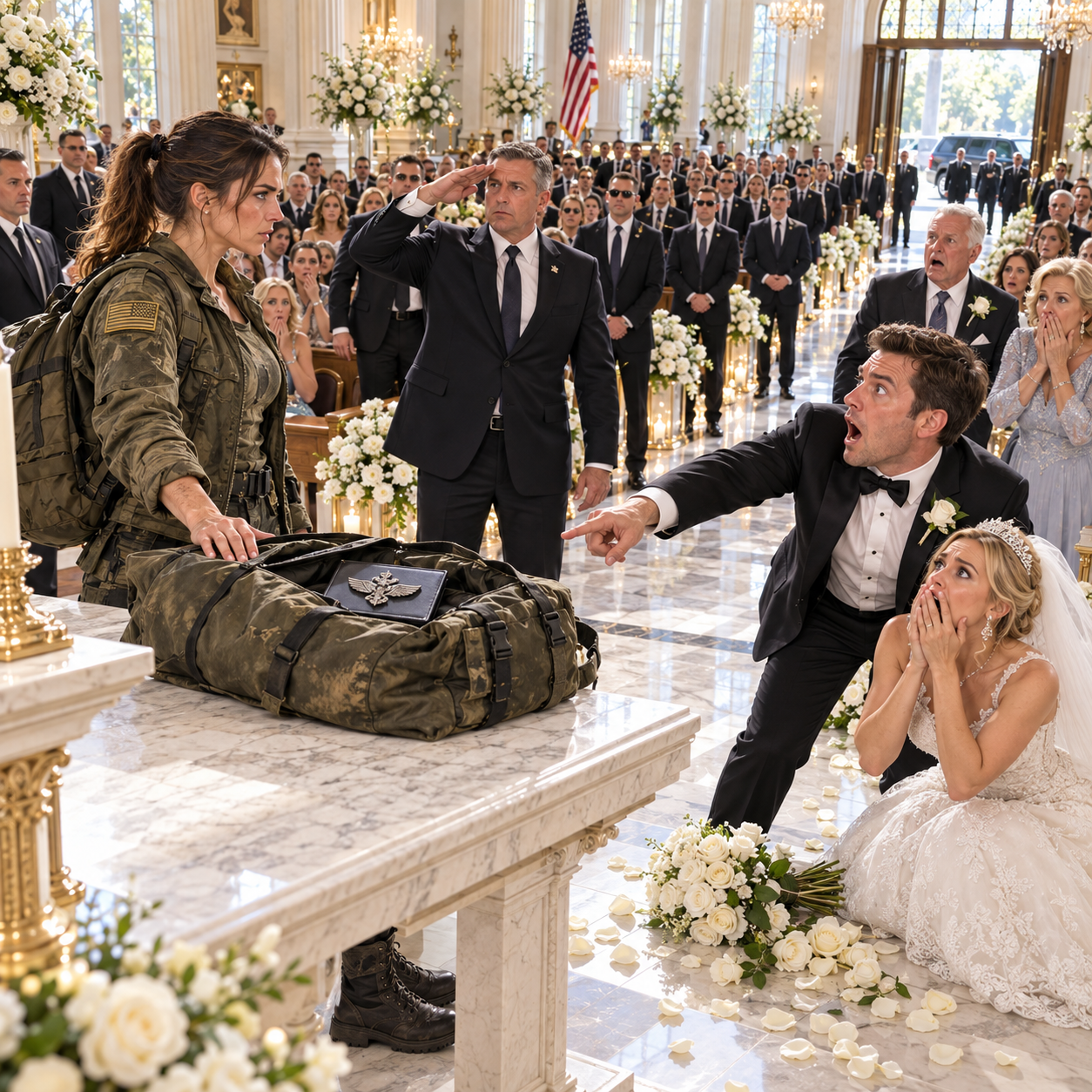
The Groom Sneered, “Kick This Dirty Soldier Out!” I Said Nothing, Tossing My Bloodstained Duffel Onto The Altar. Seeing The Titanium Black Code Badge, 40 Secret Service Agents Drew Their Weapons, Sealing Every Exit: “Commander Valkyrie Is On Site. Lock Down The Perimeter!” The Bride Fell To Her Knees.
Two hundred wedding guests watched my older sister tell security to throw me out because my military uniform embarrassed her. Her fiancé called me a dirty soldier, and the relatives who had known me since childhood looked away. I didn’t argue. I only told the guard to release my government-issued bag. Minutes later, the Secret Service was evacuating the cathedral. I thought my sister’s cruelty was the worst betrayal that day. Three days later, a photograph of my dead mother’s handwriting arrived in the mail.
## Part 1: The Promise I Almost Broke
The first thing I noticed when I walked into St. Anselm’s Chapel was the smell of white roses. Hundreds of them lined the center aisle, their perfume mixing with expensive cologne and the faint dampness of a Virginia rainstorm. Then the string quartet stopped playing, and two hundred people turned toward the doors. I stood there in a faded Army combat uniform, my boots still stained with dust from an overseas deployment, watching my older sister’s face change from bridal happiness to absolute disgust.
“Are you serious?” Adelaide whispered from the altar, although her microphone carried the words through the chapel. Beside her, Beckett Rourke lowered the sheet of vows he had been reading and stared at me as though someone had dumped garbage in the aisle. His expression shifted into something uglier when he recognized my face. “Security,” he snapped, reaching for the microphone. “Get that woman out of here. You disgrace our wedding in fatigues!”
For a moment, I couldn’t move. Not because of Beckett’s shouting or the attention of two hundred strangers, but because Adelaide did nothing to stop him. My sister, who used to climb into my bed during thunderstorms, stood beneath a ceiling painted with angels and let her future husband humiliate me. Our Aunt Meredith sat in the second pew, staring at her folded hands. Nobody spoke up.
Forty-eight hours earlier, I had been standing on a military airfield outside Warsaw, Poland, watching ground crews unload equipment from an American transport aircraft. My name is Major Rowan Mercer, and for eleven years I had worked in Army logistics and operational systems evaluation. Most people imagined my job involved counting supplies and scheduling trucks. Sometimes it did, but much of my recent assignment involved determining whether communications equipment could survive the conditions American service members actually encountered.
I had spent the previous six weeks helping coordinate field evaluations of equipment intended for emergency communications during difficult deployments. A series of technical failures had complicated the assignment, and my return to the United States had been delayed twice. By the time my aircraft landed at Joint Base Andrews, I had barely slept. I completed the required evidence handoff, collected a separate sealed courier package for delivery to a regional oversight office, and checked my phone.
Adelaide had sent exactly one message.
Wedding starts at four. Please don’t make a scene.
There was no question about whether I had arrived safely, no acknowledgment that I had crossed an ocean to be there. I answered that I was on my way, then rented a car and drove south through heavy rain. My dress uniform was at my apartment, and the pale blue bridesmaid dress Adelaide had chosen remained in her bridal suite. I had planned to change there, assuming I arrived with enough time.
My mother had made me promise I would attend this wedding.
She died nineteen months earlier after an illness that left her thin, exhausted, and still remarkably interested in everyone else’s problems. During one of her final evenings at home, she asked me to sit beside her on the couch. Adelaide had recently started dating Beckett, and Mom worried that the differences between our lives would eventually become permanent distances. “Your sister cares too much about what people think,” she told me, rubbing her thumb against my knuckles. “Don’t let her push you so far away that you forget how to find each other.”
I promised I wouldn’t.
That promise had survived missed birthdays, canceled holidays, and Adelaide’s increasingly uncomfortable comments about my career. She had married prestige long before she met Beckett, collecting invitations and acquaintances with recognizable last names. I had learned to tolerate the little insults because our mother loved us both. Standing in that chapel, however, I began wondering whether keeping a promise required allowing someone to treat me without dignity.
Beckett descended the altar steps, followed by two guards wearing black suits and gold security pins. He was forty-one, handsome in the deliberate way of men who spent more time choosing cuff links than listening to other people. As chief executive of Rourke Signal Systems, he had inherited a company that manufactured tactical communications equipment for military and government customers. I knew his business by reputation, although Adelaide had always dismissed my interest whenever I asked about his work.
“You’re not walking down that aisle looking like that,” he said, stopping a few feet from me. “Do you have any idea who’s sitting in this room?”
I glanced toward the front pews. A few faces were familiar from public briefings and congressional hearings, including senior federal officials whose responsibilities touched defense procurement. A woman in a dark blue suit sat near the aisle, surrounded by several people who looked conspicuously uninterested in the ceremony. I recognized her a moment later as Vice President Celia Whitcomb, whose Secret Service detail had apparently been accommodated among the wedding guests.
It was an extraordinary guest list for a wedding, even one costing more than a million dollars.
“I came for Adelaide,” I said. “I drove straight from Andrews.”
“Then you should have stopped somewhere and changed,” Beckett replied.
Adelaide gathered her elaborate silk skirt and walked toward us. Her makeup was flawless, her diamonds glittering beneath the chandeliers, but her expression reminded me of the afternoon she accused me of ruining her high school graduation because I arrived late from a military academy interview. She looked at my uniform, then at the guests watching from their seats. “Rowan, I specifically told you this wedding mattered to us. How could you embarrass me like this?”
“I tried to get here before the ceremony,” I answered. “The weather delayed my flight. I thought you’d rather have me here than not.”
“You thought wrong.”
She said it quietly enough that the microphone missed it, but I heard every syllable.
Beckett motioned toward the guards. “Escort her outside. She can wait in the parking lot until we’re finished.”
The taller guard approached my left shoulder and reached for the strap of the government-issued bag hanging across my chest. Inside was the sealed courier package I was responsible for delivering, along with transit documentation and my identification. I had kept it with me because leaving it unattended in a rental car was not an option. I shifted the bag away from his hand.
“Please don’t touch that,” I said.
He reached again.
“Ma’am, you’re being asked to leave.”
“I understand. But you cannot handle that package.”
Beckett laughed, loud enough for the nearest guests to hear. “Listen to her. She’s pretending her luggage is classified. Rowan, you’re a glorified supply clerk, not the president.”
The guard caught the strap and tugged.
I took one controlled step backward, opened the exterior document pocket, and placed my military identification and transit authorization on the nearby guest-book table. I asked the guard to release the strap and told him the package needed to remain in my custody. Nothing in my voice was threatening, but the movement attracted the attention of one of the plainclothes agents near the front pews.
He looked at the documents, then at the guard’s hand.
“Release the bag,” he ordered.
The guard hesitated. The agent was already speaking into his wrist microphone, his eyes moving between the sealed package, Beckett, and the vice president’s location. Two other agents started toward us while the quartet members quietly lowered their instruments.
“Protectee movement. South exit,” the agent said. “Clear the hall.”
Behind him, Secret Service personnel rose from their seats.
And for the first time since I entered the chapel, Beckett Rourke stopped smiling.
## Part 2: The Wedding Nobody Was Supposed to See
The evacuation happened with a speed that made the entire confrontation seem suddenly childish. One agent moved between Beckett and me while another escorted Vice President Whitcomb toward a side entrance with the rest of her protective team. Guests were instructed to leave through designated exits, and uniformed personnel appeared in the vestibule to keep the corridors clear. Nobody screamed, but the sound of chairs scraping against marble and expensive shoes striking the floor filled the chapel.
“What’s happening?” Adelaide demanded, grabbing my arm. “Rowan, what did you do?”
I gently removed her hand. “Your security guard grabbed a sealed government package inside a protected event. The Secret Service is responding to a security incident.”
“Tell them it’s a misunderstanding.”
“That’s not my decision.”
The lead agent introduced himself as Special Agent Elias Greer and asked me to remain near the guest-book table until his team completed its initial assessment. I showed him my credentials and explained the transport authorization without opening the sealed package. He verified what he needed through official channels while another agent interviewed the guard. Beckett kept insisting that I had threatened his guests, although the guard eventually admitted I had repeatedly warned him not to touch the bag.
Greer listened without visible irritation. “Mr. Rourke, this is a protective-security matter. Please step away and allow us to finish.”
“This is my wedding.”
“And the vice president’s safety is my responsibility.”
The two men stared at each other, and Beckett was the first to look away.
Adelaide stood beside him, still holding her bouquet. I expected her to be frightened by what had happened, but her first concern was the ceremony. She complained that the photographer had missed their vows, that the florist charged extra for the imported roses, and that the vice president leaving early would become a social embarrassment. She never asked whether the guard had hurt me.
As guests moved out, I noticed a cream-colored folder lying open on a small table near the front of the chapel. It contained personalized seating arrangements for the reception, with certain names marked in gold. There were several senior acquisition officials and members of Congress positioned beside Rourke Signal Systems executives. A separate itinerary listed a private conversation scheduled for six-thirty under the harmless heading Industry Innovation and National Readiness.
I recognized one of the names.
Deputy Assistant Secretary Martin Havel had participated in discussions concerning a major military communications modernization program. His name also appeared in the bidder-contact restrictions distributed to evaluation personnel earlier that year. Although attending a wedding wasn’t itself improper, arranging private procurement discussions during an active competition could create serious ethical and legal problems. The careful placement of the guests suddenly seemed less innocent.
Beckett noticed me looking at the folder. He crossed the room and shut it before I could see anything else.
“That’s private,” he said.
“Then you should keep it somewhere private.”
His jaw tightened. “You’ve already ruined enough today.”
“I haven’t done anything to your wedding except show up.”
“Don’t pretend you don’t understand.”
There was something revealing about the way he said it. Beckett wasn’t speaking to a sister-in-law who had embarrassed him with muddy boots. He was speaking to someone he believed had the power to damage something much more important than a wedding.
I studied his expression. “What exactly am I supposed to understand?”
He glanced at the agent standing nearby and immediately changed his tone. “Nothing. You’re exhausted. You’ve clearly had a difficult trip.”
Adelaide pulled him away before I could press further.
Within twenty minutes, most guests had left the chapel, and the protective team had confirmed there was no immediate danger to the vice president. The government package remained secure, but the venue’s private-security confrontation had been recorded by several guests. Greer collected statements from people who had witnessed the guard’s actions and informed Beckett that his staff would be contacted about the incident. He did not treat me like someone important; he treated me like a person involved in a security event, which was exactly what I was.
When he finished, he handed back my identification.
“Major Mercer, you’re free to proceed with your authorized transport,” he said. “I suggest you don’t make any more unscheduled stops.”
“Understood.”
He glanced toward Adelaide, who stood beneath an enormous floral arch with her veil twisted around one wrist. “For what it’s worth, I’m sorry your day turned out like this.”
I thanked him, although I wasn’t sure which day he meant.
My military transport contact met me outside beneath the covered entrance. The rain had softened into mist, leaving the stone steps slick and dark. After completing the required checks, I transferred the package and signed the custody record. My duty was finished, but the exhaustion I’d been outrunning finally caught up with me.
I had just turned toward the rental car when Adelaide appeared behind me.
She had removed her veil, revealing the intricate pins holding her blond hair in place. Her wedding gown dragged over the wet pavement as she approached. “Beckett says you knew there would be federal officials inside. He says you came here on purpose.”
I looked at her. “Did you believe him?”
She folded her arms. “You never tell us anything about your assignments. How am I supposed to know?”
“Because I’m your sister.”
“That doesn’t mean you’re incapable of being vindictive.”
The words landed harder than Beckett’s insults. Adelaide had known me all my life, yet her first instinct was to accept her fiancé’s accusation because it protected the explanation she preferred. I thought about the handwritten birthday cards I’d mailed from deployment, the money I’d sent when Mom became ill, and the dozens of times I’d apologized for circumstances beyond my control.
“Did you know I was still coming today?” I asked.
“Of course.”
“Then why was my name removed from the bridal party?”
She looked startled.
Earlier, while waiting for Greer, I had seen the printed ceremony program. There were five bridesmaids listed, not six. The dress Adelaide insisted I wear was never mentioned, and my assigned seat had been replaced with a place card bearing the name of one of Beckett’s business associates.
“That was a last-minute adjustment,” she said.
“When?”
“I don’t remember.”
“Adelaide.”
She stared at the rain running along the driveway. “Beckett thought your work could make things awkward with some of his guests. He suggested we avoid putting you in photographs.”
I waited.
“He also asked me to tell him exactly when you landed.”
My stomach tightened. “Why?”
“He said he wanted to make sure someone was available to meet you.”
The two guards who had confronted me were wearing private event-security uniforms, yet neither had tried to direct me toward a dressing room or a family entrance. They had moved immediately to remove me from the property. Someone had prepared them to treat my arrival as a problem.
“Was he expecting me in uniform?” I asked.
Adelaide’s silence answered before she did.
I walked toward my car, but she followed. “Rowan, please. He has been under enormous pressure with this government contract. You can’t imagine how much is riding on it.”
I stopped beneath the awning. “Then why did he invite half the people involved in deciding who gets it?”
She looked genuinely alarmed.
I had not mentioned my field assignment, and nothing about my role in operational testing had appeared in the wedding invitations. Yet Beckett knew enough to worry about my presence before I’d ever walked through the doors. As I started the engine, one question kept returning.
How had he known I was connected to the very equipment his company desperately needed the government to approve?
## Part 3: The Photograph My Mother Left Behind
By the following morning, a video of Beckett ordering me out of the chapel had appeared online. Someone had recorded the confrontation from the fourth pew, capturing his insults, the guard grabbing my bag, and the Secret Service moving through the room. The clip spread quickly because of the vice president’s presence, and reporters began asking questions about how an ordinary wedding had become a federal security incident. I refused every interview request and went home to an apartment that smelled faintly of stale coffee and unopened mail.
My commanding officer called that afternoon. Colonel Reese Calder had already reviewed the incident report, and he wanted to make sure the package had reached its destination without compromise. After confirming the custody record, he asked whether I had known Rourke Signal Systems executives would be attending the wedding. I told him my sister was marrying the company’s chief executive, but I had not participated in any business conversations. He was quiet for a moment before explaining that our legal office would need to review the potential conflict.
I understood why. Rourke Signal Systems was among several contractors seeking approval for a communications modernization program, and our recent field evaluations concerned equipment related to that competition. Although I had never been responsible for selecting a vendor, my reports could influence technical assessments. I agreed to cooperate with the review and avoid discussing the matter outside authorized channels.
Three days after the wedding, a padded envelope arrived without a return address.
Inside was a photograph of a laboratory notebook, its yellowed pages covered in my mother’s unmistakable handwriting. Mom had been a reliability engineer at Briarstone Laboratories before becoming ill, and I recognized the way she drew small boxes around measurements she considered important. The photograph showed a series of environmental tests performed on a communications unit. Near the bottom, beneath several temperature and humidity readings, she had written a sentence in red ink.
Intermittent transmission loss under moisture exposure. Not suitable for operational deployment without corrective verification.
I read it twice before noticing the date.
The entry had been written six weeks before Mom’s final hospitalization.
A smaller note was attached to the photograph: Ask Adelaide why the Mercer archive was closed on March 12.
I sat at my kitchen table until the afternoon light moved across the floor. My mother had rarely discussed confidential projects, but I remembered her becoming unusually withdrawn during her last year at Briarstone. She had once told me that a manufacturer was pressuring the laboratory to accept test results that didn’t match the equipment’s actual performance. When I asked whether she had reported it, she said she was handling the matter through the proper channels.
I hadn’t thought about that conversation in years.
March 12 was ten days after her death.
I called the attorney who had handled her estate, a patient older woman named Judith Fenwick. She confirmed that Adelaide, as executor, had authorized the transfer of several boxes of Mom’s professional papers to a company called Hawthorne Technical Holdings. Judith hadn’t examined the documents because Adelaide represented them as obsolete personal records. When I asked who owned Hawthorne, she hesitated before telling me the company had been acquired by Rourke Signal Systems.
That afternoon, I drove to Judith’s office.
She placed a copy of the estate inventory on her desk and pointed to a handwritten amendment. The original inventory included twenty-three engineering notebooks, correspondence from Briarstone, and an external storage drive. The amendment, signed by Adelaide, described the materials as having no outstanding contractual or regulatory significance. Beneath it was a declaration stating that all technical concerns associated with the records had been resolved before my mother’s death.
“Was there supporting documentation?” I asked.
“None in the estate file.”
My chest tightened. “Mom would never have signed off on a safety problem without evidence.”
Judith looked uncomfortable. “Rowan, I can’t tell you whether the declaration was accurate. But your sister received compensation for the transfer.”
“How much?”
“One hundred and eighty thousand dollars.”
I stared at the number.
During Mom’s final illness, Adelaide had repeatedly told relatives that she was struggling with expenses. I had paid hospital bills, covered repairs on Mom’s house, and taken unpaid leave when the family needed help. Adelaide had accepted every dollar without mentioning that she’d received a six-figure payment connected to our mother’s work.
I left Judith’s office with copies of documents I was legally entitled to review and sent them to the appropriate independent legal and oversight personnel. I did not contact Beckett or try to investigate his company’s protected technical information myself. Whatever was happening involved a potential conflict with my professional responsibilities, and I knew that handling it carelessly could destroy the credibility of anything I discovered.
That evening, an unfamiliar woman called.
“My name is Nora Bell,” she said. “I worked with your mother at Briarstone. I’m the person who sent the photograph.”
I gripped the phone. “Why now?”
“Because I saw the wedding video. I didn’t know her daughter was the Army officer whose name appears in the latest validation paperwork.”
I felt the room grow strangely quiet.
“What paperwork?”
Nora hesitated. “Rourke’s technical certification package. It claims you independently confirmed that the communications system passed operational evaluation.”
“I never signed anything like that.”
“I was afraid you would say that.”
She explained that she had been a records technician at Briarstone, responsible for maintaining original laboratory reports and revision histories. After Mom died, several reports were reclassified as preliminary, and updated versions appeared without the original warnings. Nora had kept copies of certain records because she believed the changes violated the laboratory’s document-retention obligations. Seeing the wedding confrontation made her realize that the Mercer family connection might explain why the records had disappeared.
Before we ended the call, she offered to provide everything she knew directly to investigators.
Then she sent me one additional page from a certification summary that had circulated among authorized technical reviewers. At the bottom was a statement confirming satisfactory operational performance, followed by an electronic image of a signature.
My signature.
I was looking at a document that claimed I had approved equipment I’d spent weeks documenting problems with.
And somebody had put my name on it.
## Part 4: The Signature That Nearly Cost Me Everything
The following Monday, Colonel Calder asked me to report to his office at eight. I arrived early, carrying a notebook and a terrible feeling that the next conversation would change my career. Two people from the legal office were already seated across from his desk. Calder offered me coffee, which frightened me more than if he had immediately started shouting.
He explained that an independent review had been opened into the disputed technical certification. Until investigators determined how my name had appeared on a contractor’s submission, I would be temporarily removed from work involving that procurement. My access to certain evaluation materials would be restricted, and I would need to preserve relevant communications. Nobody accused me of wrongdoing, but I understood how serious the situation had become.
For eleven years, I had built my professional reputation on accuracy. Equipment either functioned under specified conditions or it didn’t, and my reports reflected what happened during testing rather than what manufacturers wanted to hear. Now a company was using my name to support conclusions I had never reached. Even if investigators eventually cleared me, the uncertainty could follow me into every future assignment.
“Sir, I never approved that system,” I told Calder.
“I believe you,” he said. “But belief isn’t the same as documented proof. Let the investigators establish what happened.”
I returned to my office and packed the personal things I wouldn’t need during reassignment. There were three framed photographs on my desk: my commissioning ceremony, a group picture from an overseas deployment, and Mom standing beside me at my first promotion. In the last photograph, she was smiling so broadly that her eyes had nearly disappeared. I turned it facedown before leaving because I couldn’t bear looking at her while wondering whether her own daughter had helped falsify my professional judgment.
The investigation moved faster than I expected, largely because Beckett had created witnesses during his wedding confrontation. Several guests had recorded his behavior, and venue staff confirmed that his private-security team had received instructions to prevent me from entering the ceremony. The reception coordinator also preserved the seating arrangements and private meeting itinerary as part of the venue’s ordinary records. Those materials did not prove corruption by themselves, but they provided investigators with a documented reason to examine his planned contacts with procurement officials.
Meanwhile, Nora Bell contacted the proper authorities and provided the laboratory’s original revision history. Investigators found discrepancies between the reports Mom had prepared and later documents submitted under Rourke Signal Systems’ name. The original data identified failures during moisture exposure, while the revised summaries described those same tests as successful after adjustments that lacked supporting records. The dates of some revisions also conflicted with the recorded availability of the testing equipment.
I learned only the information investigators were permitted to share with me. I had been removed from the evaluation process for a reason, and I refused to risk compromising it by demanding access to material I was no longer authorized to handle. Instead, I concentrated on establishing where I had been when the disputed certification was created. Travel records, assignment logs, and my original report history made it clear that I had not participated in the contractor’s final approval process.
Then Beckett’s attorney sent me a letter.
It claimed that I had made damaging statements about Rourke Signal Systems and warned against interfering with the company’s commercial relationships. The letter also suggested that my personal hostility toward Beckett had influenced my professional conduct. My attorney, a former military legal officer named Claire Voss, read it while sitting across from me in a small conference room.
“He wants you distracted,” she said.
“By what?”
“By the fear that defending yourself will cost more than staying quiet.”
I looked at the letter again. “He’s already used my name on a false document.”
“Which is why we respond through the appropriate channels and don’t give him anything else to work with.”
Two days later, Adelaide called.
I hadn’t spoken to her since the wedding. Her first words were not an apology, but a question about whether I had contacted federal investigators. When I told her the matter was being reviewed independently, she began crying. She said Beckett’s company was facing questions from its board and that their honeymoon had been canceled.
“Do you understand how humiliating this has been?” she asked.
I closed my eyes. “Adelaide, someone used my signature to certify equipment that may not be safe.”
“Beckett says it’s an administrative misunderstanding.”
“Then the records should clear it up.”
“You make everything sound so simple.”
“Safety records shouldn’t depend on who someone is married to.”
She went silent.
I thought the call was ending when she suddenly asked whether I had spoken to Judith Fenwick. When I said yes, her breathing changed. She wanted to know which estate documents I’d seen, whether Judith had shown me the compensation agreement, and if I planned to challenge the transfer of Mom’s notebooks.
“Why are you worried about those papers?” I asked.
“Because Beckett’s attorneys are making everything sound worse than it was.”
“What was it, Adelaide?”
She began talking about Mom’s illness, the cost of maintaining the house, and how overwhelmed she’d felt after the funeral. I listened until she ran out of explanations. Then I asked one question.
“Did you know Mom had documented problems with Rourke’s equipment?”
For several seconds, the only sound was Adelaide crying.
“She was being unreasonable,” my sister finally whispered. “Beckett said the laboratory was going to fix the reports.”
My hand tightened around the phone.
“Adelaide, what did you give him?”
She took a shaky breath.
“Everything Mom left in those boxes,” she said. “Including the report she told me never to let anyone change.”
## Part 5: The Price of My Mother’s Silence
I met Adelaide at Judith Fenwick’s office the following Thursday. Claire attended with me, and Adelaide brought her own attorney, a nervous-looking man who kept checking his phone. My sister arrived wearing an expensive camel-colored coat, but the woman beneath it looked exhausted. There were shadows beneath her eyes, and her engagement ring was missing.
For several minutes, nobody spoke beyond the necessary introductions. Then Adelaide placed a tissue on the conference table and began explaining how Beckett had approached her after Mom’s death. He had described her engineering records as valuable research that could help his company improve its products. Adelaide said she initially believed selling the archive would honor Mom’s career while helping settle family expenses.
But Beckett hadn’t simply purchased old notebooks.
According to Adelaide, he wanted the original test records, correspondence, and every version of the safety objections Mom had raised. He promised that his engineers would correct the problems before the equipment reached anyone in the field. When Adelaide questioned whether the records should remain with Briarstone, Beckett told her that the purchase agreement gave his company the right to control its proprietary material.
“Did Mom ever agree to that?” I asked.
Adelaide stared at the table. “No.”
“Then why did you sign a declaration saying her concerns had been resolved?”
“Because Beckett said it was standard paperwork.”
Claire leaned forward. “Your signature appears on an amendment specifically stating that the technical objections had been withdrawn. Are you saying you didn’t understand what you signed?”
Adelaide’s attorney interrupted, warning her not to speculate about the meaning of the documents. She ignored him. Tears ran down her cheeks as she admitted that she knew Mom hadn’t withdrawn the report. Beckett had told her the wording was necessary to prevent delays that could threaten the company’s bid.
I thought about the field evaluations in Poland, the unreliable transmissions, and the people depending on that equipment. There was nothing abstract about a radio failing during a storm when a team needed help. I had seen experienced personnel waste precious minutes trying to restore communications that should never have failed under the conditions they were designed to withstand.
“Did you ever think about who might use those radios?” I asked.
Adelaide pressed the tissue against her eyes. “I thought they were going to fix them.”
“You knew Mom believed something was wrong.”
“Yes.”
“And you helped make her warning disappear.”
She didn’t answer.
The conversation turned to the payment. Adelaide admitted that the one hundred and eighty thousand dollars hadn’t gone toward Mom’s outstanding medical expenses. Most had been used to cover personal debts and fund a renovation of the house she shared with Beckett. She said he had encouraged her to view the money as compensation for handling the estate, and she had convinced herself that Mom would have wanted her to be financially secure.
I remembered checking my bank account before sending another hospital payment, calculating whether I could afford new tires that month. Adelaide had thanked me warmly every time I contributed. She had never offered to reimburse me after receiving the money.
“Why didn’t you tell me?” I asked.
“Because you would’ve made everything difficult.”
“By asking what happened to Mom’s work?”
“By refusing to understand what was at stake.”
I looked at her for a long moment. “You keep saying that, but you never explain why Beckett’s contract mattered more than the truth.”
Adelaide’s face crumpled.
She confessed that Beckett had been courting her while negotiating to acquire Mom’s records. At first, she hadn’t connected his interest in her family to his company’s technical problems. Eventually she realized that their relationship gave him an opportunity to obtain documents through the estate rather than through the laboratory’s normal review process. By then she was engaged, financially entangled with him, and unwilling to face what her decisions meant.
“He said your mother was trying to destroy years of work over one technical disagreement,” Adelaide whispered. “He said you were just like her.”
I felt something inside me settle.
“That’s why you didn’t want me at the wedding.”
She nodded.
Beckett knew I had been involved in evaluating equipment connected to his company. He feared I might recognize the guests involved in the procurement process or ask questions about the technical claims behind the bid. Adelaide agreed to remove me from the wedding party and tell security to keep me away if I arrived unexpectedly. The uniform became a convenient excuse when their plan failed.
“You let him call me a disgrace,” I said.
“I was scared.”
“You stood there while a stranger grabbed my bag.”
“I didn’t know it would turn into a federal incident.”
I looked at my sister. “Would it have been acceptable if those agents hadn’t been there?”
She couldn’t answer.
The room stayed quiet until Adelaide reached into her handbag and removed a small envelope. Its edges were worn, and my name was written across the front in Mom’s careful handwriting.
“She asked me to give you this before she died,” Adelaide said.
I reached for it, but my sister held on a moment longer.
“I was afraid you’d ask about the laboratory,” she whispered. “So I kept it.”
I took the envelope without touching her hand.
Inside was a two-page letter describing how Mom had documented her concerns, submitted them through the laboratory’s formal reporting process, and asked that her original findings be preserved. She wrote that engineers had an obligation to tell the truth even when it made powerful people uncomfortable. Near the bottom of the second page, her handwriting had become shaky.
Rowan, if you ever have to choose between keeping the peace and protecting someone who depends on your work, choose the person who depends on you. Peace built on silence is never as safe as it looks.
I read the sentence three times.
Attached to the letter was a photocopy of an earlier safety complaint. It carried a dated receipt stamp from a federal oversight office, confirming that Mom had submitted a separate copy before her death.
She hadn’t trusted the records to survive only in one place.
When I looked up, Adelaide was reaching across the table toward me.
“Can you forgive me?” she asked.
I folded Mom’s letter and placed it carefully in my bag.
“No,” I said. “I can’t.”
## Part 6: What Remained After the Wedding
Nine months after the wedding, Rourke Signal Systems was removed from consideration for the communications modernization contract. The government’s technical review had identified material discrepancies between the company’s submitted performance claims and the underlying testing records. Additional concerns about altered certifications and undisclosed procurement contacts were referred for further investigation. The company faced potential suspension from future federal contracting, while its board removed Beckett from day-to-day executive authority pending the outcome of separate proceedings.
There was no dramatic television-style arrest at the chapel, and nobody went to prison simply because the Secret Service had cleared a wedding. The consequences came through interviews, recovered documents, technical testing, and people willing to put their names beside the truth. Nora Bell’s preserved laboratory records helped investigators reconstruct the changes made after Mom’s death. The unauthorized use of my signature became part of the evidence supporting the broader review.
The company’s collapse was not immediate, and it affected people who hadn’t participated in Beckett’s decisions. Engineers lost jobs, suppliers waited for payments, and several honest employees spent months helping independent reviewers separate legitimate research from altered results. I found no satisfaction in their hardship. What mattered was that equipment with unresolved safety problems would not be approved based on documents that concealed those failures.
Eventually, investigators confirmed that my supposed certification had been assembled using a copied image of my signature and information from earlier correspondence. I was formally cleared of involvement in the false submission and permitted to return to my regular duties. Colonel Calder delivered the news in his office on a cold February morning, then asked whether I needed time before resuming field assignments.
“I’d rather get back to work,” I told him.
He nodded. “Your mother would’ve been proud.”
For a moment, I couldn’t speak.
Adelaide’s situation unfolded more slowly. Her legal representatives negotiated the return of money associated with the disputed estate transaction, and the false declaration she had signed became the subject of separate legal proceedings. She cooperated with investigators and provided documents showing how Beckett had obtained the archive. Her cooperation mattered, but it did not erase the fact that she had knowingly concealed Mom’s unresolved objections.
She and Beckett separated before their first wedding anniversary. Their marriage had been legally completed in a private ceremony after the disrupted event, but the partnership deteriorated as their finances and legal problems became impossible to ignore. Beckett moved out of their house, and Adelaide eventually sold it to meet obligations she could no longer afford. The society pages that once celebrated their engagement treated the separation as another item of gossip.
My sister wrote to me eleven times.
The first letters were filled with explanations. She talked about how controlling Beckett had become, how frightened she was of losing everything, and how much pressure she’d felt to maintain their lifestyle. Later letters were different. She admitted that she had wanted the money, admired the attention, and enjoyed being treated as someone important. She acknowledged that Beckett hadn’t forced her to lie about Mom’s records or remain silent at the wedding.
I believed parts of what she wrote.
But believing someone regrets a decision is not the same as inviting that person back into your life.
Aunt Meredith called, too. She apologized for watching Beckett humiliate me and saying nothing, explaining that she’d been afraid of creating an even bigger scene. I thanked her for acknowledging it, but I didn’t reassure her that everything was fine. I had spent too many years making other people comfortable after they hurt me.
The hardest thing wasn’t losing Adelaide. It was accepting that the sister I remembered and the woman she had become were not the same person. We had shared a childhood full of ordinary happiness: riding bicycles behind our house, eating cereal directly from the box, and hiding under blankets during summer storms. Those memories were real, but they could not make her recent choices harmless.
I also came to understand that Mom’s promise had never meant what I had forced it to mean.
She asked me not to forget how to find my sister. She hadn’t asked me to let Adelaide repeatedly hurt me or to surrender my judgment whenever keeping the family together became inconvenient. I had attended the wedding despite every obstacle, and I had given my sister an opportunity to treat me with basic kindness. What happened afterward was not a failure to keep my promise.
That spring, I used some of my savings to establish a small scholarship at a community college near our hometown. It supported students pursuing electronics, reliability testing, and technical maintenance, particularly those entering the profession through military service or midcareer training. I named it after Mom, who had always believed that careful, honest engineering was one of the quiet ways people protected one another. The first recipient was a thirty-two-year-old single mother who worked nights repairing industrial equipment.
At the scholarship ceremony, she told me that she wanted her daughter to see her finish something difficult.
I thought Mom would have liked her.
Afterward, I drove past our old family house. The maple tree in the front yard had grown enormous, its branches stretching over the sidewalk where Adelaide and I used to draw chalk pictures. I parked for a few minutes but didn’t get out. The house belonged to another family now, and the windows glowed with the unfamiliar warmth of somebody else’s evening.
For years, I had associated that place with everything I had lost. Sitting there, I realized I no longer wanted to recover the life we once had. I wanted to carry forward the parts of it that deserved to survive.
I kept Mom’s letter in a wooden box beside my bed, along with the little brass compass she gave me when I received my first assignment overseas. I read the letter occasionally, especially after a difficult day at work. It reminded me that integrity wasn’t always rewarded immediately and that choosing the right thing could sometimes mean disappointing people you loved.
On the anniversary of the wedding, Adelaide sent one final message.
I know you don’t owe me anything. I miss you. I wish I had been brave enough to be your sister when you needed me.
I read it in my kitchen while waiting for the coffee maker to finish. Outside, the sun was rising over the neighboring rooftops, and someone was walking a dog along the sidewalk. It was an ordinary morning, which somehow made the message feel less powerful than it might have a year earlier.
I didn’t answer.
Not because I wanted to punish her, but because I no longer needed her to understand my pain before I could move beyond it.
Later that day, I drove to the small military cemetery where Mom was buried. The grass was freshly cut, and a light breeze carried the smell of rain from the trees. I placed a bunch of white daisies beside her headstone and sat on the nearby bench for a while. I told her about the scholarship, the investigation finally ending, and my plans to take a long-overdue vacation.
Then I told her about Adelaide.
“I went to her wedding, Mom,” I said softly. “I kept my promise.”
I looked down at my boots, clean now but still marked with the scratches of years of service. They weren’t beautiful, and they would never belong in the kind of wedding Adelaide had wanted. But they had carried me through difficult places, across long distances, and into rooms where telling the truth mattered more than being welcomed.
For a long time, I had believed family meant staying, no matter what someone did to you.
Now I understood something different.
Love could be genuine without being unconditional access to my life. Forgiveness could remain unoffered without turning into hatred. And walking away from someone who had betrayed me did not mean I had become cruel.
I stood, brushed the grass from my uniform, and touched Mom’s headstone one last time.
“I didn’t turn my back on her,” I whispered. “I just stopped turning my back on myself.”
Then I walked to my car, started the engine, and drove toward a life that finally belonged to me.
THE END!
Disclaimer: Our stories are inspired by real-life events but are carefully rewritten for entertainment. Any resemblance to actual people or situations is purely coincidental.


