I had spent 15 years running toward other people’s worst days, but Chief Grant Rourke needed less than a month to decide I was dead weight. He announced it in front of an entire motor pool, laughing about my clean hands and easy paycheck while everyone watched. I could have defended myself. I didn’t. I only reached for a pen and rolled back my sleeve. Then the young mechanic standing beside him whispered my name like he had just seen a dead woman walk into the room.
### Part 1
The gloves were the first thing I put on every morning and the last thing I took off.
Gray mechanic’s gloves, suede worn dark across the palms, buttoned snugly at my wrists over the cuffs of my uniform.
I didn’t turn wrenches.
I didn’t rebuild transmissions.
I didn’t need gloves for my job at all.
I wore them because a buttoned cuff stopped at the wrist, and a rolled sleeve did not.
That Thursday morning, the motor pool was cold enough that every steel surface seemed to hold winter inside it. The bay doors were still down when I arrived a little before six. Diesel hung in the air with the bitter smell of burned coffee. Somewhere near Bay Four, a radio played quietly beneath the metallic clank of tools being laid out for the day.
I had been assigned to the maintenance company for three weeks.
Long enough to learn which coffee pot leaked.
Long enough to know the dispatch window stuck halfway open.
Long enough to understand that Chief Warrant Officer Grant Rourke believed everyone who didn’t repair vehicles was taking up oxygen that properly belonged to a mechanic.
I had been warned.
Staff Sergeant Naomi Vega, another medic who had helped me in-process, had walked me through the company on my first morning.
When we reached the little aid station tucked behind the maintenance bays, she lowered her voice.
“Rourke knows machines,” she said. “I’ll give him that. But if you don’t hold a wrench, he thinks you’re furniture.”
“I’ve been called worse.”
“I’m serious, Mara.”
“So am I.”
She had studied me for another second.
“Keep your head down. Do your work. Don’t feed him a reaction.”
That part sounded easy.
I had been keeping things down for years.
My sleeves.
My memories.
The small private inventory of nights I woke with my heart pounding because some sound outside had brought back a place thousands of miles away.
People sometimes mistake silence for emptiness.
That was Chief Rourke’s first mistake.
I joined the Army at eighteen, in 2011, because running toward trouble had always made more sense to me than running away.
When I was nine, a car slid off an icy road near our house and went down an embankment. Our neighbors stood on their porches staring while I scrambled down in socks because I had forgotten my boots.
The driver had blood running from a cut above his eyebrow.
At nine, blood on a face looks like death.
I pressed my mitten against the cut until an ambulance arrived.
Years later, I learned scalp wounds bleed dramatically. That man had needed only a few stitches.
But something happened to me on that frozen slope.
I understood that distance mattered.
There was a hurt person.
There was help.
And the distance between them would not close itself.
So when a recruiter mentioned the combat medic specialty, I chose it before he finished explaining.
At medic training, an old sergeant first class told us, “A medic is the calm somebody borrows on the worst day of their life. Don’t run out of it.”
I wrote those words in a notebook.
For years, I believed being strong meant never keeping track of how much calm everyone borrowed.
I checked soldiers after patrols when I wanted sleep.
I listened when young troops came to the aid station because they needed somewhere to fall apart without becoming a story in the barracks.
I filled aid bags after midnight.
I learned how fear looked on different faces.
Some people talked too much.
Some laughed.
Some became very polite.
Some went completely quiet.
My platoons trusted me, and the strange thing about trust in the Army is that nobody announces it.
You discover it in small ways.
A squad leader glances at you before stepping off.
A private finds an excuse to stay near your vehicle.
A soldier asks whether you packed something he knows you packed because what he really wants to hear is your voice saying, “Yes.”
For fifteen years, people leaned on me without calling it leaning.
Then I arrived at Rourke’s shop.
To him, I was thirty-three, female, medical, assigned to a maintenance company, and apparently therefore suspicious.
He never asked about my background.
He didn’t need to.
He had already invented one.
At first, the disrespect came in small pieces.
“Must be nice having a climate-controlled office.”
“Wish I could get paid to count bandages.”
“You medical people sure know how to avoid grease.”
Each time, I let it pass.
Not because I was afraid of him.
Because I had survived enough loud men to know that some of them feed on resistance.
Then Thursday came.
The shop was losing a fight with the schedule.
A deadlined truck had received the wrong replacement part in the correct box. Another vehicle had missed dispatch. Someone at battalion was calling every twenty minutes.
Rourke stood near the dispatch window with a clipboard in his hand, irritated at a world he could not force into compliance.
I walked up carrying the medical readiness log.
He spotted me.
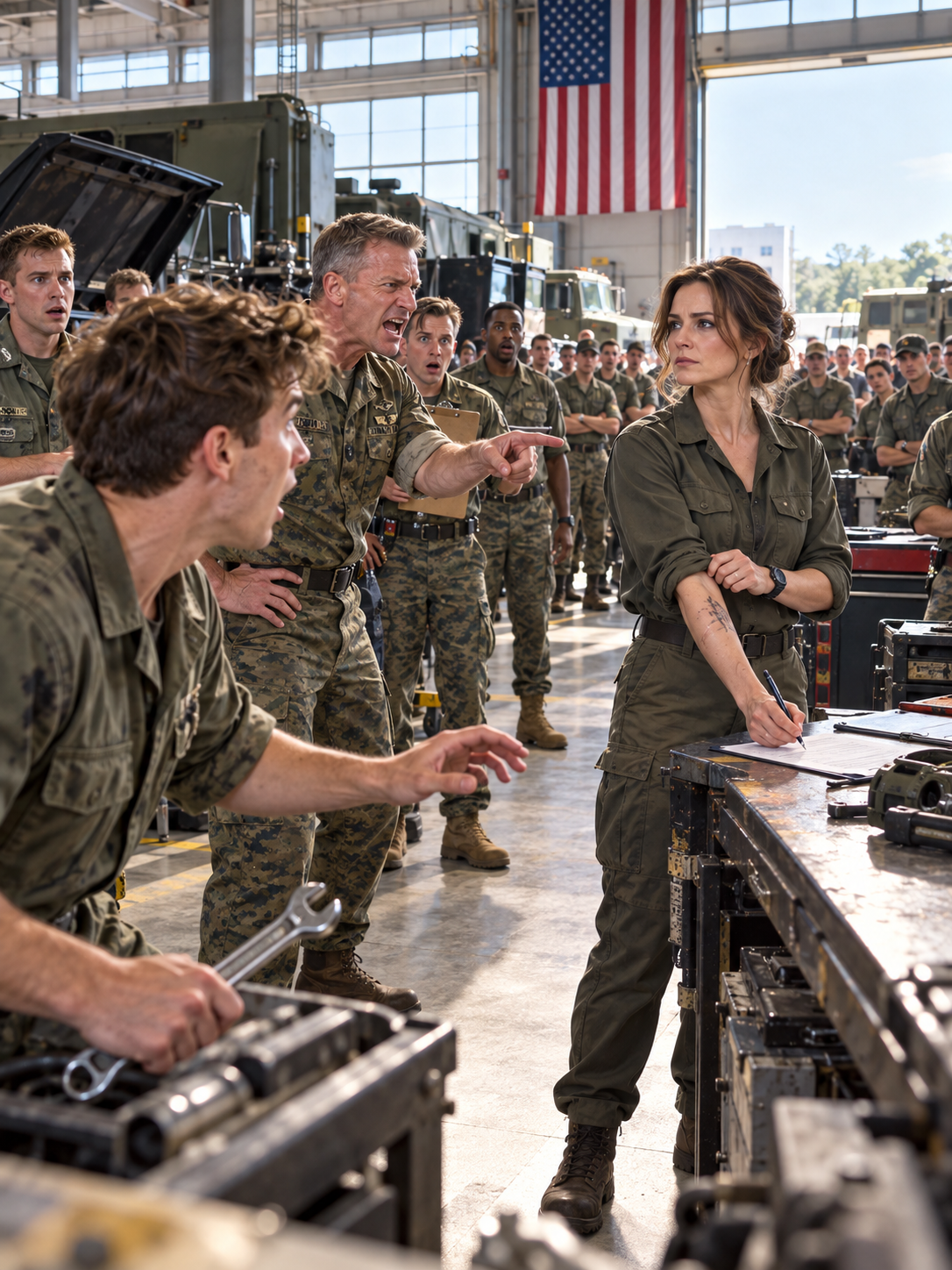
“There she is.”
His voice carried across the bay.
A few mechanics looked up.
I kept walking.
Rourke smiled.
“You want to know where readiness disappears in this company?”
Now more people were watching.
He pointed at me.
“This is the one who coasts on the uniform.”
The bay quieted.
“Never earned a callus in her life. We carry her.”
A couple of soldiers looked down at their tools.
One young mechanic near Rourke shifted uncomfortably.
I placed my clipboard on the steel ledge beneath the window.
Slowly.
“That isn’t true, Chief.”
He grinned as though I had just volunteered for entertainment.
“No?”
“No.”
“Then enlighten me.”
He spread his arms toward the shop.
“Tell everybody what you fixed this week. One truck. One transmission. One dispatch you saved.”
“That isn’t my job.”
“Exactly.”
His smile widened.
“We’re out here killing ourselves to meet timelines, and you’re sitting in your little closet with Band-Aids and a blood-pressure cuff. Same uniform. Same paycheck. Same benefits.”
Nobody laughed.
That seemed to irritate him more.
“So go ahead, Sergeant Ellison. What exactly do you do?”
There were several answers I could have given.
I could have told him about fifteen years.
About the soldiers whose blood had dried beneath my fingernails.
About hospital rooms.
About letters I still received at Christmas.
About a road in 2018 that I tried very hard not to visit unless sleep dragged me there.
Instead, I picked up the chained pen.
The sleeve of my uniform was tight around my wrist, so without thinking much about it, I unbuttoned the cuff and rolled it toward my elbow.
The young mechanic beside Rourke stopped moving.
My forearm showed beneath the white fluorescent lights.
Pale grafted skin ran from wrist to elbow in an uneven map of ridges.
I barely noticed anymore unless someone else did.
The mechanic noticed.
His face lost its color.
The wrench in his hand lowered slowly.
“Sergeant Ellison?”
His voice was barely audible.
I looked at him.
He was young. Early twenties. Familiar in a way I could not place.
Then I saw his eyes.
Not his face.
His eyes.
Something moved inside my memory.
A burning vehicle.
Smoke.
A boot heel sliding in my hands.
Rourke glanced between us.
“You two know each other?”
The mechanic ignored him.
His mouth opened, but nothing came out.
Then he whispered, “You’re alive.”
The pen stopped between my fingers.
And suddenly I understood why his face had been bothering me.
I had never really seen him before.
Not standing.
Not clean.
Not grown.
The last time I had seen those eyes, he had been nineteen years old and trapped inside a vehicle that was burning around him.
### Part 2
His name was Specialist Eli Mercer.
He found me behind the maintenance bays during lunch, where the smokers usually gathered beside a concrete wall stained dark beneath an exhaust vent.
He carried a sandwich he never touched.
For several seconds, neither of us spoke.
Then he said, “They told me you died.”
There are sentences that hit the body before the mind.
That was one of them.
I felt it beneath my ribs.
“What?”
“At the hospital.”
He stared at the gravel.
“I kept asking who pulled me out. Somebody said the medic got hit bad afterward and didn’t make it.”
He swallowed.
“I was nineteen. I didn’t know who to ask. I didn’t know how anything worked. I thought…”
His voice broke.
“I thought you were dead for eight years.”
My right arm suddenly felt too exposed even though my sleeve was down again.
The road from 2018 returned in pieces.
That was the only way it ever returned.
Never the entire day.
Heat first.
Then noise.
Then the smell.
Then my hands around a boot heel.
We had been escorting a movement when a vehicle ahead of mine was hit and caught fire.
There are moments when training takes over so completely that your own body becomes background information.
I remember realizing my arm was burning before I understood that the burning belonged to me.
I reached into the vehicle anyway.
Eli was first.
I didn’t know his name then.
He was simply the young soldier whose boot I could reach.
I pulled until he came loose.
Then I went back.
A second soldier.
Then a third.
I will not describe more than that.
Some memories should be owned by the people who lived them, not consumed by strangers.
All three survived.
That sentence mattered more to me than anything else.
The fire damaged most of my right forearm.
The pain came later.
Hours later.
The doctors repaired what they could.
Skin grafts.
Therapy.
Procedures.
Months in which bending my wrist another degree felt like conquering a mountain nobody else could see.
A surgeon once sat at the foot of my bed and said, “You could medically retire. Nobody would question it. You’ve done enough.”
“I’m not done being useful,” I told him.
I came back.
Eventually.
The Army awarded me a Silver Star for that day.
I kept it in a box.
Not because I was ashamed.
Because medals are clean.
That day was not.
A medal has straight edges and polished metal and a citation typed in neat lines.
Memory does not.
Eli rubbed both palms against his pants.
“I have a bracelet.”
“A bracelet?”
“A memorial bracelet.”
His laugh came out wrong.
“I put your name on it. Spelled it wrong, too.”
Despite myself, I smiled.
“How?”
“Ellison with one L.”
“That’s not terrible.”
“I’ve been mourning Sergeant Alison for eight years.”
That made me laugh.
Then he laughed.
Then both of us stopped because laughter had opened the wrong door and there were tears behind it.
Soldiers aren’t always good at hugging.
Sometimes we stand beside each other and look in the same direction.
That was what we did.
After a while, Eli said, “You went back.”
“Yes.”
“For Mason and Rivera.”
Hearing the names hurt.
I nodded.
“Why?”
The answer had been inside me since I was nine years old.
“Because the distance wasn’t going to close itself.”
Eli wiped his face quickly.
He told me Mason had two children now.
Rivera had gotten married.
He had found them online but never contacted them.
“I don’t know what I’d say.”
“You don’t need the perfect words.”
“What would you say?”
“That you’re glad they’re still here.”
He nodded.
Then he looked toward the bays.
“What are you going to do about Chief Rourke?”
“Nothing today.”
His head snapped toward me.
“Nothing?”
“What happened on that road has nothing to do with whether Rourke knows how to lead this shop.”
“He humiliated you.”
“Yes.”
“In front of everyone.”
“Yes.”
“And you’re just letting him?”
“No.”
That was the difference.
Doing nothing and refusing revenge are not the same decision.
After work, Naomi Vega sat across from me in the aid station while I turned a pen between my fingers.
The tiny room smelled of alcohol wipes and coffee.
“I would rather they still thought I was furniture,” I admitted.
She frowned.
“Why?”
“Because now everyone will know.”
“You earned that medal.”
“That isn’t the problem.”
I looked at my sleeve.
“For eight years, I made that day small enough to carry. Private enough that I could decide when I touched it. Now it’s going to become shop gossip.”
Naomi leaned back.
“You can’t control which true things people see.”
“I can control what I tell them.”
“Usually.”
She folded her arms.
“But Eli saw you. He has his own truth, too. You saved his life. You don’t own his gratitude any more than he owns your scar.”
I hated that she was right.
“I don’t want to be a story.”
“Then don’t act like one.”
I looked at her.
She shrugged.
“Keep doing your job. Let everyone else have their feelings. Managing those feelings isn’t your responsibility.”
That night, I barely slept.
I imagined walking into Captain Daniel Hart’s office and placing my Silver Star on his desk.
I imagined Rourke being summoned.
I imagined his expression when he understood exactly who he had called dead weight.
The fantasy was satisfying.
That was precisely why I did not trust it.
I had seen leaders destroy people publicly in the name of correcting public cruelty.
It never taught the formation dignity.
It taught everyone to wait and see who held power before choosing a side.
I didn’t want Rourke humiliated.
I wanted the shop fixed.
The next morning, I asked Captain Hart for fifteen minutes.
I also requested First Sergeant Lena Brooks.
When they were seated, I said nothing about the scar.
Nothing about 2018.
Nothing about the Silver Star.
I talked about dispatch records.
I talked about mechanics afraid to report mistakes.
I talked about soldiers who hesitated before telling Rourke that a repair would miss deadline.
I gave examples.
Dates.
Patterns.
I explained that a shop ruled by contempt eventually creates dishonest readiness because frightened people learn to hide bad news.
Captain Hart listened without interrupting.
First Sergeant Brooks watched me with the unreadable expression of a senior NCO who had built an entire career around letting silence do work.
Finally Hart said, “Sergeant Ellison, I pulled your record this morning.”
I knew what came next.
He continued quietly.
“You could have walked in here and led with the Silver Star.”
“The medal is about one day, sir.”
“And this?”
“This is about every day.”
First Sergeant Brooks gave one small nod.
That was when I knew things were going to move.
The question was whether Chief Rourke would move with them—or make everyone drag him.
### Part 3
I found Rourke alone near Bay Two at the end of the day.
The big doors were halfway down, cutting the late afternoon light into bright rectangles on the concrete. Tools had been returned to their cages. The constant noise of the shop had faded to an occasional metallic click.
Rourke was studying a maintenance board.
“Chief.”
He turned.
His expression hardened immediately.
I understood why.
By then, he knew my record had been pulled.
He knew Eli recognized me.
He knew Captain Hart had started asking questions.
Men like Rourke can survive being wrong more easily than they can survive knowing other people have discovered it.
“If you came for an apology,” he said, “I don’t perform.”
“I didn’t.”
That surprised him.
I stopped several feet away.
“I raised a climate concern through the chain.”
His jaw tightened.
“Of course you did.”
“It wasn’t about what you said to me.”
He laughed once.
“Sure.”
“It was about the three weeks before that.”
That silenced him.
I continued.
“Your mechanics are afraid to give you bad news. They delay telling you when deadlines slip. They blame each other before you arrive because nobody wants to be standing closest when you find out something went wrong.”
“I run the highest-output shop in the battalion.”
“Maybe.”
“Not maybe.”
“Then imagine what it could be if your people trusted you.”
His face changed.
Not much.
But enough.
“I don’t need a medic telling me how to run maintenance.”
“You’re right.”
That stopped him again.
“You know more about vehicles than I ever will. You could probably diagnose half those trucks by sound.”
I pointed toward the bays.
“But machines and people fail differently.”
He stared at me.
“A vehicle doesn’t hide a cracked line because it’s afraid you’ll embarrass it. A soldier will.”
His eyes narrowed.
“So what do you want?”
“Fix it.”
“That simple?”
“No. That difficult.”
He folded his arms.
“And if I don’t?”
“Then the chain will handle what you choose not to.”
That was the boundary.
No threat.
No victory speech.
Just a door.
He could walk through it or slam it shut.
Two days later, I was summoned to battalion headquarters.
Lieutenant Colonel Adrian Cole had my personnel file open on his desk.
The moment I entered, I saw the citation.
My stomach tightened.
“Sit down, Sergeant.”
I sat.
He read silently for another few seconds.
Then he closed the folder.
“So let me understand something.”
“Yes, sir.”
“I have had a Silver Star recipient working in one of my companies for a month, and somebody decided she was excess weight because she didn’t turn a wrench.”
“I would rather not make this about the medal, sir.”
“I know.”
His answer came quickly.
“That is exactly what Captain Hart told me you would say.”
He stood and walked around the desk.
I expected a lecture.
Instead, he leaned against the edge of it so we were almost at eye level.
“I read your memo.”
I waited.
“You didn’t ask for punishment.”
“No, sir.”
“You didn’t ask for an apology.”
“No.”
“You asked for a climate review and changes to reporting procedures.”
“Yes, sir.”
“Why?”
Because the answer seemed obvious to me.
“Removing one man doesn’t automatically remove the habits he created.”
Colonel Cole watched me for a long second.
Then he nodded.
“We’ll address the standard.”
Relief loosened something in my shoulders.
“But there is one thing I am going to say about you.”
I almost protested.
He raised a hand.
“Off the record.”
I stopped.
His voice lowered.
“You were not carried.”
I didn’t move.
“Not in that motor pool. Not on that road. Not anywhere in this battalion.”
There it was.
A simple sentence.
No ceremony.
No formation.
No applause.
And somehow it went deeper than any public recognition could have.
He continued.
“I’m sorry it took us opening a file to understand what should have been obvious from watching you work.”
I looked down because I needed one second.
“Thank you, sir.”
On the drive home, I took the long road past the ranges.
The sun was dropping low behind the tree line.
“You were not carried.”
I said it once inside my truck.
Then again.
Not because I had believed Rourke.
Not exactly.
But when somebody names you wrongly in front of enough people, some small part of the insult follows you home.
I had spent fifteen years being useful.
Still, that accusation had found the one vulnerable place I rarely admitted existed.
The part of me that remembered the surgeon offering retirement.
The part that sometimes wondered whether staying had been selfish.
Whether my body had become an administrative burden.
Whether the Army looked at my scar and saw cost before it saw service.
Colonel Cole’s sentence didn’t erase those questions.
It simply refused to let Rourke answer them for me.
The climate review began quietly.
No dramatic investigation.
No one was marched from the shop.
The battalion looked at maintenance trends, delayed reporting, personnel complaints and inspection habits.
Captain Hart changed how certain readiness concerns were elevated.
First Sergeant Brooks started walking the bays more often without announcing herself.
Rourke became quieter.
Not kinder.
Not immediately.
But quieter.
People noticed.
So did I.
I made a point not to watch him too closely.
A man attempting to change under the stare of the person he wronged will often perform instead of grow.
I wanted to know which one Rourke would choose when he thought nobody important was looking.
The answer came one morning before first formation.
I was restocking gauze when his shadow appeared in my doorway.
He stood there awkwardly, hands at his sides.
“Sergeant.”
“Chief.”
He looked at the litter mounted on the wall.
Then at my trauma bags.
Then back at me.
“I know trucks.”
“Yes.”
“I don’t know this.”
I waited.
His jaw worked once before he forced the words out.
“If somebody goes down under a jack in my bay, I don’t know what my people are supposed to do before you get there.”
For the first time since I met him, he looked uncertain.
Not weak.
Human.
“Teach us.”
I could have made him apologize first.
Part of me wanted to.
But trust and apology were not the same thing, and a shop full of young soldiers should not have to wait for my personal satisfaction before learning how to keep one another alive.
“Monday,” I said.
“The whole shop.”
He nodded.
As he turned to leave, I added, “Chief.”
He looked back.
“This doesn’t erase what happened.”
His expression tightened.
“I know.”
That mattered.
Not enough to forgive him.
Enough to begin.
### Part 4
Our first medical drill was ugly.
I expected that.
A maintenance shop does not become an aid station because somebody rolls out a training mannequin and starts shouting.
Half the soldiers held tourniquets as if they were fragile museum pieces.
One private dropped his gloves three times.
Another kept asking permission before touching the training casualty.
Rourke stood near the wall with his arms crossed.
Old Rourke would have mocked them.
I watched closely.
When Private Noah Benson put a pressure dressing on backward, Rourke opened his mouth.
Then stopped.
I saw the correction happen inside him before it reached his face.
Instead of humiliating Benson, he said, “Reset. Do it again.”
Benson did.
The second attempt was better.
That small moment told me more than any apology could have.
We trained every Monday.
Bleeding control.
Litter carries.
Heat injury.
Eye injuries.
Crush injuries.
Radio reports.
What to do when the medic is not standing ten feet away.
The mechanics learned quickly.
Faster than I expected.
Then I realized why.
Mechanics spend their lives dealing with systems that fail under pressure.
They understand procedures.
They understand that panic does not make a broken thing less broken.
They know the value of putting your hands in the correct place and working the problem in order.
Once they stopped treating medicine like magic, they became good at it.
Eli Mercer was the best.
He trained with an intensity that sometimes made me uncomfortable.
Every repetition seemed personal.
One afternoon after everyone left, I said, “You don’t owe me anything.”
He pretended not to understand.
“I know.”
“No, you don’t.”
He stopped packing equipment.
“You survived that road. You don’t have to spend the rest of your life paying for surviving.”
His eyes dropped.
“I know.”
“Do you?”
He was quiet for a long moment.
Then he said, “I’m trying.”
That was enough.
Rourke changed differently.
Slowly.
Awkwardly.
He started using soldiers’ first names.
He stopped making people perform mistakes for an audience.
When something went wrong, he asked what happened before asking whose fault it was.
The first few times, everyone clearly assumed it was a trap.
Trust does not return because somebody announces a new policy.
It returns through repetition.
One morning.
Then another.
Then another.
I did not forgive him.
I want to be clear about that.
Forgiveness is sometimes treated like the final box that must be checked before growth becomes legitimate.
I don’t believe that.
Rourke had humiliated me deliberately.
He had done it because he believed my silence made me safe to target.
He had spent years teaching younger soldiers that contempt was leadership.
His improvement did not make those choices disappear.
What changed was that I stopped needing him punished for them.
There is a difference.
Weeks passed.
Readiness numbers improved.
More important to me, maintenance faults were being reported earlier.
A mechanic came to Rourke one afternoon and admitted he had damaged a component during installation.
I happened to be walking past.
The entire bay seemed to wait.
Rourke stared at the part.
Then at the young soldier.
“How’d it happen?”
The mechanic explained.
“All right.”
That was it.
No public execution.
No sarcasm.
No twenty-minute speech about competence.
Just the problem.
Later, Naomi found me smiling in the aid station.
“What?”
“Nothing.”
“That’s a suspicious nothing.”
“The shop told the truth today.”
She leaned against the door.
“And?”
“Nobody died.”
“That’s usually how truth works.”
I threw a roll of gauze at her.
She caught it.
“You leaving the sleeves down forever?”
I glanced at my right arm.
“Yes.”
“You know you don’t have to.”
“I know.”
That mattered.
Keeping it covered had never been shame.
Leaving it covered after everyone knew was something different.
It was choice again.
My fence belonged to me.
That was enough.
Then came the Tuesday training lane.
The company was practicing vehicle recovery beyond the ranges.
Nothing dramatic.
Nothing dangerous by military standards.
Dust, engines, shouted instructions, hydraulic equipment and soldiers moving between vehicles.
We were running a simulated casualty exercise when reality slipped inside the rehearsal.
I heard someone yell.
Not the theatrical yell people use during training.
A real one.
“Medic!”
My body moved before the thought finished.
I ran toward a cluster of soldiers near a ramp.
A young private was on the ground.
Blood covered one side of his face.
For half a second, I was nine again.
Ice beneath my socks.
A stranger bleeding above his eye.
Then I was thirty-three.
A medic.
Working.
The private had collapsed in the heat, fallen and caught the side of his head against the ramp.
Scalp wound.
Heavy bleeding.
Potential head injury.
Before I reached him, somebody was already kneeling with gloved hands and direct pressure.
Benson.
The same private who had put the first training dressing on backward.
“Good pressure,” I called.
Another soldier was already on the radio.
Clear voice.
Correct location.
Nature of injury.
No screaming.
No chaos.
The litter came off the vehicle.
Fast.
Eli moved toward the casualty, then stopped when he saw me arrive.
Rourke was across the scene.
Our eyes met.
A month earlier, he had built his entire identity around being the man who controlled his bay.
Now he did something harder.
He stepped back.
Half a step.
Just enough.
“Sergeant Ellison has medical.”
No hesitation.
No pride.
No argument.
Then he began clearing space.
“Everybody not working, move back. Give them room.”
I knelt beside the private.
“Hey, look at me.”
His eyes found mine.
“What’s your name?”
“Tyler.”
“Good. Tyler, stay with me.”
He tried to sit up.
I placed a hand on his shoulder.
“Not yet.”
Around me, the shop moved exactly the way we had practiced.
For years, people had borrowed my calm.
That afternoon, something changed.
The calm was no longer only mine.
I had taught it outward.
And now, for the first time, I was standing inside a circle of people who could lend some back.
### Part 5
Tyler needed four stitches, fluids and several hours of observation.
That was all.
By evening, he was already telling the story as though he had survived an event involving helicopters, explosions and possibly an enemy sniper.
I let him.
A private earns the right to exaggerate after frightening half his company.
What stayed with me was not his blood.
It was the response.
Nobody froze.
Nobody waited helplessly for me.
Nobody became useless because they were scared.
Benson, the young soldier who had struggled during our first drill, controlled the bleeding before I arrived.
Another mechanic transmitted the correct information without being prompted.
Eli prepared equipment.
Rourke surrendered authority the instant the situation left his expertise.
That last one mattered more than he probably understood.
Being technically competent had always been easy for him.
Admitting somebody else should lead had not.
I had known officers and NCOs who would rather make the wrong decision themselves than watch another person make the right one.
Rourke did not.
Not that day.
When we returned to the motor pool, I stayed behind after most of the company left.
The big bay door was open.
Evening air moved through the building, carrying the smell of dust and warm metal.
Eli came and stood beside me.
Neither of us looked at the other.
The soldier’s version of intimacy.
“Benson did good,” he said.
“He did.”
“Chief did too.”
“Yes.”
A long silence.
Then Eli said, “I messaged Mason.”
I turned toward him.
“And?”
“He answered.”
A smile pulled at one side of his mouth.
“He has two daughters. Sent me about forty pictures.”
“That sounds right.”
“He thought I died.”
I stared at him.
“Seriously?”
“Apparently that whole deployment was held together by terrible information.”
I laughed.
Eli did too.
Then his expression softened.
“He asked about you.”
I looked back through the open bay.
“What did you tell him?”
“The truth.”
“That’s dangerous.”
“I told him you were alive. Still serving. Still impossible.”
“Better.”
He rubbed his wrist.
The memorial bracelet was there.
He had shown it to me once.
My last name misspelled.
A dead woman who had never existed.
“You know,” he said, “you kept your sleeve down all those years.”
“Yes.”
“You don’t have to now.”
I looked at the glove on my right hand.
At the button fastened over my cuff.
For eight years, I had closed that button every morning.
Sometimes consciously.
Mostly not.
The habit had become so deep that my fingers moved before thought.
I unfastened it.
Not dramatically.
No speech.
No witness except Eli.
I left it open.
The next morning, I still wore my sleeve down.
That surprised me.
For a second, standing in front of my locker, I wondered if leaving the button open had meant nothing.
Then I understood.
Freedom is not doing the opposite of what you used to do.
Freedom is no longer being forced by fear to choose one way or the other.
Some days I rolled my sleeves.
Some days I didn’t.
The scar slowly became what I had wanted it to be all along.
My arm.
Not a legend.
Not evidence.
Not a story other people owned.
Just my arm.
The motor pool kept changing in boring ways.
Those were my favorite changes.
Trucks with faults were marked honestly.
Mechanics spoke sooner when parts were wrong.
Rourke started holding short after-action talks when repairs failed, focusing on process instead of humiliation.
Readiness numbers improved because reality was finally allowed into the building.
New soldiers arrived who knew nothing about what had happened at the dispatch window.
One morning, a private watched me roll my sleeve before taking his blood pressure.
His eyes passed over the scar without stopping.
I nearly laughed from relief.
He had no idea.
To him, I was simply Sergeant Ellison, the medic telling him his caffeine intake was ridiculous.
That was the life I wanted.
Not recognition.
Usefulness.
Naomi transferred several months later.
Before she left, she handed me her spare aid-bag key.
“You still wish you were furniture?”
“Some mornings.”
She hugged me.
I pretended to hate it.
Eli finally met Mason in person.
Rivera joined them by video.
I did not attend.
They invited me.
I thanked them.
Then I declined.
That road belonged to all of us, but our healing did not have to happen in the same room.
I had learned something important about boundaries.
A shared trauma does not create unlimited access to one another.
Love, gratitude and distance can exist together.
So can respect and refusal.
That was where Chief Rourke and I ended up.
We were never friends.
I did not invite him into my personal life.
I did not erase what he had done because he eventually behaved better.
When people asked whether I forgave him, I usually said the question was less important than they thought.
He no longer had the power to disturb my peace.
That was enough.
His soldiers trusted him more.
He became a better warrant officer.
That was enough too.
One cold morning months after the whole thing began, I walked to the dispatch window with the same kind of clipboard I had carried on the day he humiliated me.
The same chained pen hung beneath the ledge.
Rourke was on the other side reviewing paperwork.
I signed the log.
My sleeve happened to be rolled to mid-forearm.
The scar was visible.
He looked at it once.
Not with shock.
Not with pity.
Then he looked at me.
He gave one plain nod.
I returned it.
No apology.
No salute.
No emotional speech in front of the shop.
Just one professional recognizing another.
That was better.
Apologies can be performed.
Respect has to survive Monday morning.
As I walked back toward the aid station, I passed Benson arguing with another mechanic about a fault code. Someone laughed near Bay Five. A radio played underneath the sound of an impact wrench. The coffee smelled burned again.
Everything was ordinary.
That was the miracle.
Years earlier, on an icy hill, I had learned that the distance between someone hurt and someone who could help did not close itself.
On a burning road, I learned how much closing that distance could cost.
In the motor pool, I learned something harder.
Sometimes the distance is not physical.
Sometimes it exists between who you are and who somebody has decided you are.
You cannot always close that distance by explaining yourself.
Sometimes you keep working.
You tell the truth.
You protect the standard.
You let people reveal who they are when the easy version of you stops being available to them.
And if they change, you can acknowledge the change without pretending the wound never happened.
I do not believe every person who wrongs us deserves another place in our lives.
Sometimes late respect is simply late.
Sometimes an apology arrives after the door has already closed.
You can accept that someone finally sees you without inviting them closer.
That is not bitterness.
That is knowing the difference between peace and access.
Chief Rourke once stood in front of an entire motor pool and said the company carried me.
He was wrong.
But proving him wrong was never the victory.
The victory was realizing I did not need his verdict in the first place.
For fifteen years, soldiers had leaned on me quietly.
Some survived because my hands were there.
Some simply got through a bad night because I stayed beside them until morning.
Most of those moments never became citations.
Nobody photographed them.
Nobody pinned anything on my uniform.
That was fine.
Most of a useful life happens when nobody is looking.
The room did eventually catch up.
But my worth had not increased while it was catching up.
I had been the same woman before Rourke knew my record.
Before Eli recognized my scar.
Before Colonel Cole opened my file.
Before anyone understood why I kept my sleeve buttoned.
That was the lesson I carried forward.
If somebody calls you dead weight without asking what you have carried, their ignorance does not become your identity.
If somebody sees only the quiet part of you, that does not mean the rest disappeared.
And if you have a private wound, you are allowed to keep it private.
Nobody earns access to your pain just because they are curious.
Keep your sleeve down if you need to.
Roll it up if you want to.
The important thing is that the choice remains yours.
I still arrive early.
I still check the aid station before most of the shop is awake.
I still smell diesel and cold coffee every morning.
And sometimes, when I fasten my uniform, my fingers pause over that old cuff button.
Some mornings I close it.
Some mornings I leave it undone.
Either way, I know exactly who I am before I walk through the door.
And nobody in that motor pool gets to decide it for me.
THE END!
Disclaimer: Our stories are inspired by real-life events but are carefully rewritten for entertainment. Any resemblance to actual people or situations is purely coincidental.