
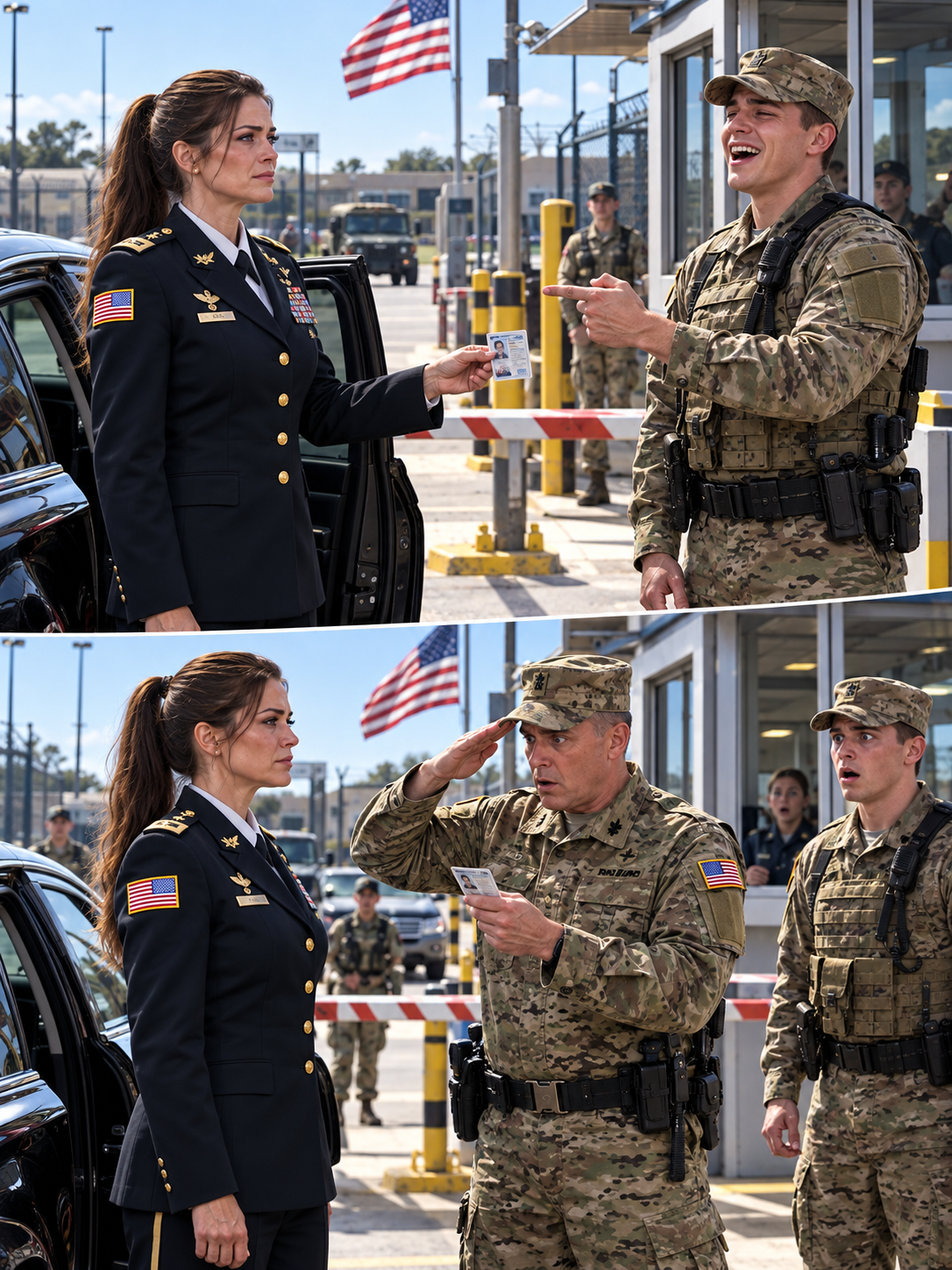
My nephew had spent 6 months guarding the front gate when I arrived in a plain government sedan, wearing the uniform my family had mocked for twenty years. He looked at the colonel’s eagles on my chest, laughed, called them part of my “costume,” and refused even to check my identification. Then his watch commander took the card, read one line, and snapped to attention. In four seconds, the family joke died—and something much harder began.
### Part 1
The note sat unopened on the corner of my desk for two days, folded once through the middle and written in handwriting I recognized immediately. Outside my headquarters window, four soldiers were forming up near the flagpole in the blue-gray light before sunrise, their boots striking the pavement with the quiet precision I had trusted for most of my adult life; inside, my nephew Cole’s apology waited beneath my coffee cup, and I still could not make myself read it.
My name is Colonel Mara Ellison, I was forty-four years old when this happened, and by then I had spent twenty years as an Army engineer officer doing the kind of work my family had always described as “playing soldier.” For six weeks, I had been commander of an entire Army installation, responsible for roads, housing, utilities, security, training areas, emergency services, thousands of soldiers and civilians, and more problems before breakfast than my sister Denise had ever imagined existed inside one military post.
The strange part was that commanding the installation was easier than opening that note.
People think being underestimated is the painful part, but it is not always. Sometimes the worst moment comes afterward, when the people who spent years laughing at you finally understand who you are and you have to decide whether their humiliation is going to change who you have become.
I learned early that competence did not buy much affection in the Ellison house. Denise was five years older, naturally charming, funny at exactly the right moment, and able to make adults forgive almost anything with a grin; I was the girl who noticed the kitchen faucet leaking, found the wrench, replaced the washer, and got told by my mother that I took everything too seriously.
When I was ten, I rewired a lamp that had flickered for months. When I was twelve, a storm knocked out power across our neighborhood, and while everyone complained about the utility company, I dragged our old generator manual onto the kitchen floor, cleaned the fouled plug, got it running, and then helped the widow next door do the same; my mother’s first reaction was not pride but worry that the neighbors would think I was showing off.
Denise got a party for making the cheerleading squad. I made honor roll three years straight and heard, “You don’t have to turn everything into a competition, Mara,” even though I had never competed with anyone but myself.
By fifteen, I stopped bringing achievements to the dinner table. There is a strange freedom in realizing an audience will never clap for you, because eventually you stop performing for them and begin working for the only reason that lasts: because the work matters.
Machines made sense to me. Structures made sense, terrain made sense, numbers made sense, and none of them ever accused me of being cold because I wanted an answer to be correct.
At eighteen, I told my family I wanted to become an Army engineer officer. Denise laughed into her iced tea and asked whether I planned to spend adulthood “digging holes in camouflage,” while my mother gave me the disappointed look usually reserved for someone announcing a terrible marriage.
I commissioned in 2004.
My family did not attend.
Three days later, Denise mailed me a card with a cartoon soldier on the front and one handwritten sentence inside: “Congratulations on the costume.”
She meant it as a joke, which was always Denise’s defense. She could cut you open and then act offended if you bled on the carpet.
I carried that sentence farther than she ever knew.
In 2006, I led soldiers on route-clearance missions in Iraq, moving ahead of convoys and studying roads for the tiny details that meant somebody had changed the landscape overnight. Fresh dirt, disturbed trash, wires where wires should not be, a roadside crowd suddenly missing from a place normally full of people—survival lived in details, and I became very good at noticing details.
We went first so other people could keep moving.
That was the simplest way to explain the job, although my family never asked.
I earned decorations I rarely discussed and buried friends whose names I still remember when I wake at three in the morning. I learned what hot metal smelled like after hours under desert sun, how silence inside an armored vehicle could become louder than shouting, and how thirty soldiers could look at a twenty-four-year-old lieutenant and expect her to know what came next.
I learned to know what came next.
When I returned from one deployment, Denise handed me lemonade in her kitchen and asked, “So are you finally done playing Army?”
I remember the refrigerator humming behind her and her youngest son, Cole, pushing a toy truck across the tile near my boots. He could not have been more than six, but he looked up when his mother said it, and I saw the sentence enter him before he was old enough to understand what it meant.
“No,” I said. “I’m not done.”
Denise smiled. “You push dirt around and blow things up. Don’t make it sound like brain surgery.”
I could have told her about the roads. I could have told her about the soldiers who came home because my platoon noticed what someone else would have missed, but experience had already taught me that explaining yourself to someone committed to misunderstanding you is just another way of volunteering to be exhausted.
So I drank the lemonade.
Years passed.
When Cole was eight or nine, he announced at Thanksgiving that Aunt Mara “pretended to be a soldier.” Everyone laughed, including my mother, while Denise ruffled his hair like he had delivered the best joke of the evening.
I said nothing.
That silence bothered me later, because children do not invent family myths. They inherit them.
In 2017, after being selected for a command I had worked years to earn, I made one last attempt with my sister. I called Denise and said plainly, “This one matters to me. I know military promotions don’t mean much to you, but this does, and I would like my sister to be proud of me.”
There was a pause.
Then she chuckled and said, “Must be nice having a job that hands out ribbons whenever somebody does what they’re supposed to do.”
After that, she started telling me about Cole’s soccer tournament.
I never asked again.
By 2020, I was a lieutenant colonel with hundreds of people under my responsibility. My father had died by then, a quiet man who had never joined Denise in mocking me but had never stopped her either; before he passed, I made peace with him, although I never forgot the lesson his silence had taught me.
Silence is not always neutrality.
Sometimes silence is the safest way to vote for whoever already has power.
Then, in 2024, Denise called with news.
Cole had enlisted.
I expected some kind of comparison, but when she told me, I only said, “Good for him. I’m proud of him.”
And I meant it.
My family had spent decades behaving as though my life were a competition with theirs, but I had never wanted to beat them. I had only wanted them to stop pretending my accomplishments were imaginary.
A few months later, orders arrived assigning me to command a garrison.
I read the message twice.
The job was significant, difficult, and exactly the kind of responsibility I had spent my career preparing to carry. What I did not notice until I reviewed personnel information later was one small detail buried among thousands of names.
Specialist Cole Mercer, security forces.
My nephew.
Assigned to my installation.
I did not tell Denise.
I did not call Cole.
And the day before my formal assumption-of-command ceremony, I decided to report early in a plain sedan so I could see the installation without staff officers polishing every surface for the new commander.
The afternoon sun was bright against the windshield when the main gate came into view.
I slowed toward the checkpoint.
A young soldier stepped from the guard booth.
Then he looked through my open window, recognized my face, and smiled.
Not warmly.
The old family smile.
The one that always arrived one second before the joke.
“Seriously?” Cole said, glancing at the colonel’s eagles on my uniform. “Nice costume, Aunt Mara.”
Twenty years vanished in one sentence.
And suddenly I knew exactly how much of his mother’s story he had brought to work with him that day.
### Part 2
For several seconds, I simply looked at him. Vehicles idled behind me, an air-conditioning unit rattled from the guard shack, and somewhere across the installation I could hear the faint mechanical pulse of heavy equipment, but the loudest thing in that moment was Denise’s voice coming out of her son’s mouth.
I held out my military identification. “Specialist Mercer, check my ID and render the appropriate courtesy.”
The instruction was simple, routine, and completely unrelated to the fact that I was his aunt. A soldier working an access-control point did not get to choose which regulations felt convenient based on whether he liked the person inside the vehicle.
Cole did not take the card.
Instead, he looked over his shoulder toward two other soldiers inside the shack, making sure they were paying attention. That small movement told me almost everything, because people who possess real authority rarely need witnesses to prove they have it.
“You can’t tell me what to do here,” he said, giving me a crooked grin. “This is my gate.”
My gate.
He was twenty-three years old, six months into duty at an access-control point, and standing on government pavement had somehow convinced him that authority belonged to whoever happened to be closest to the barrier.
I kept my voice even. “Take the identification, Specialist.”
He waved it away. “I know who you are.”
That was exactly the problem.
One of the soldiers inside the booth, a young woman whose name tape read PARKER, looked from my face to the eagles on my chest and suddenly stopped smiling. Her posture changed almost imperceptibly as she realized that whatever family comedy Cole believed he was performing might not be funny at all.
Cole kept going.
“You can’t just show up because we’re related and expect special treatment,” he said. “People have procedures here.”
I almost laughed at the irony. He had refused the procedure while accusing me of trying to bypass it.
“I am asking you to follow the procedure,” I said.
He shook his head and pointed toward the turn lane. “You’ll need to go around and contact whoever you’re supposed to meet.”
Behind him, Parker took half a step backward.
The other soldier studied the ground.
They knew.
Or at least they knew enough to understand that a specialist dismissing a colonel at the gate was already dangerous territory, regardless of my actual job.
I had been in enough ugly situations to know that raising my voice almost never improves a person’s ability to think. Anger can feel like action, but often it is only noise, and I had not spent twenty years learning command just to turn a family wound into a public tantrum.
So I put the ID back toward him one final time.
“Specialist, take the card.”
He folded his arms.
“No.”
That was when the watch commander stepped out.
Sergeant First Class Raymond Hale was in his late thirties, broad-shouldered, calm-faced, and wearing the expression of a man who expected to discover a scanner malfunction or some civilian complaining about an expired pass. He approached my vehicle, looked at Cole, then at the line of cars accumulating behind us.
“What’s the issue?”
Cole answered before I could. “Just a family thing, Sergeant.”
Hale’s eyes narrowed.
Family thing.
At an installation gate.
During duty hours.
With a colonel sitting in the lane.
Hale reached toward me. “Ma’am, may I see your identification?”
“Of course.”
He took the card.
Cole was still smiling when Hale looked down.
I watched the watch commander’s eyes move across the front of the identification, then return to my face.
The change in him was immediate.
His shoulders squared.
His jaw tightened.
He looked at the card again as if hoping he had misread something that absolutely could not be misread.
Then Sergeant First Class Hale snapped to attention.
“Colonel Ellison.”
The smile disappeared from Cole’s face.
Hale swallowed once. “Ma’am.”
Nobody spoke.
The barrier arm stayed down in front of my sedan, and for one strange second the entire gate seemed frozen around us.
Then a second government vehicle stopped behind mine.
The rear door opened.
Command Sergeant Major Elena Vasquez stepped out.
I had met her briefly by phone but not yet in person. She was the senior enlisted adviser for the garrison, a soldier with nearly three decades in uniform and the kind of controlled presence that makes rooms organize themselves before she says anything.
Vasquez walked toward my window.
She saw Hale at attention.
She saw the expression on Cole’s face.
Whatever questions formed in her mind, she saved them for later.
She stopped beside my sedan, came to attention, and said clearly, “Colonel Ellison, welcome to Fort Arden. Headquarters is ready for you, ma’am.”
That sentence changed everything.
Fort Arden.
Ready for you.
Cole’s eyes moved from Vasquez to Hale, then slowly back to me.
First he understood that the rank was real.
Then he understood that the appointment was real.
Finally, I watched him understand something much worse: the aunt he had just mocked was not visiting the installation.
I commanded it.
He had told the garrison commander, “You can’t tell me what to do here.”
The realization drained the color from his face.
For years, I had imagined what it might feel like if my family were ever forced to confront reality without a joke available to protect them. I thought there would be satisfaction, maybe even some sharp little flash of justice.
There was none.
Cole suddenly looked young.
Not innocent—he was responsible for his behavior—but young enough that I could still remember him running around Denise’s kitchen with a toy truck while she taught him the first version of the lie.
Sergeant Hale began, “Ma’am, I apologize for—”
I stopped him.
“No, Sergeant Hale. You took the identification your soldier refused to take, you verified it, and you corrected the situation. You have nothing to apologize for.”
His expression changed slightly, relief mixed with embarrassment.
Then I looked at Cole.
His mouth opened, but I held up one hand.
“Specialist Mercer, finish your shift.”
He blinked.
“Ma’am, I—”
“Finish your shift properly. We will discuss this later, off duty.”
I did not humiliate him in front of his peers.
That surprised everyone, including him.
Power used only because you finally have the chance to use it is insecurity wearing rank insignia, and I refused to become the person my family had spent twenty years pretending I was.
I looked toward Parker, the soldier who had recognized trouble before anyone explained it. I gave her a small nod.
She straightened slightly.
Then I told Hale, “Run your gate, Sergeant.”
“Yes, ma’am.”
Vasquez returned to her vehicle.
The barrier lifted.
As I drove through, I caught Cole in the mirror.
He was standing exactly where I had left him, but the swagger was gone.
At headquarters, people were waiting with binders, turnover briefings, maps, infrastructure reports, security updates, housing complaints, repair priorities, and enough paper to bury a desk. I spent the next six hours learning the problems I had inherited because that, not my nephew’s embarrassment, was why I was there.
But Denise called that night.
I knew from her first breath that Cole had already spoken to her.
“What did you do to my son?”
I sat alone in temporary quarters with my boots beside the couch and said, “Good evening to you too.”
“Don’t be cute, Mara. He says you showed up at his gate and pulled rank on him in front of everybody.”
I stared at the dark television screen.
“I didn’t pull rank on him, Denise.”
“You humiliated him.”
“No. He humiliated himself.”
“He didn’t know!”
That sentence finally made something in me shift.
“He knew I was his aunt. He knew I was an officer. He saw colonel’s rank on my uniform and called it a costume.”
Denise went quiet.
I continued before she could reshape the facts.
“I did not pull rank on your son. I have the rank. I earned it. I have had it for years.”
She inhaled sharply.
“This is exactly what I mean about you. You always needed everyone to know how important you are.”
I closed my eyes.
There it was.
When reality became impossible to deny, she attacked my character instead.
“Denise,” I said quietly, “I command the installation where your son works.”
Silence.
“You never knew because you never asked what I actually did.”
“That’s not fair.”
“It is completely fair.”
Her voice hardened. “So what now? You’re going to destroy his career to prove something?”
“No.”
That stopped her.
“He will be counseled by his leadership. He will be corrected. But I am not going to use your son to settle a score with you.”
Another silence.
Then I said what I should have said decades earlier.
“But you need to hear this clearly. I am finished being the family joke.”
Denise did not answer.
“I will not shrink myself to make you comfortable anymore. And I will not let Cole carry your contempt into a profession where arrogance can get people hurt.”
She hung up first.
Three days later, my office assistant said, “Ma’am, Specialist Mercer is outside asking if you’ll see him.”
I looked at the empty chair across from my desk.
“Send him in.”
Cole entered wearing jeans and a plain gray shirt instead of a uniform.
He looked terrified.
I pointed to the chair.
“Sit down.”
He sat.
And instead of chewing him out, I asked the one question nobody in our family had ever asked.
“Cole, what do you actually know about me?”
His face changed.
Because for the first time, he realized the answer was almost nothing.
### Part 3
Cole stared at the floor for several seconds before looking back at me. “You’re my aunt.”
“That is a relationship, not an answer.”
He rubbed his palms against his jeans. “You’re in the Army.”
“What do I do in the Army?”
His mouth opened.
Nothing came out.
I leaned back in my chair while the air vent whispered above us and traffic moved somewhere beyond the headquarters windows. On the wall behind him hung an installation map covered in colored markings—housing areas, training ranges, utility lines, emergency routes—the kind of thing Denise would have dismissed as me “playing with dirt.”
“What units have I commanded?” I asked.
“I don’t know.”
“Where have I deployed?”
“Iraq?”
“How many times?”
He shook his head.
“What kind of officer am I?”
“Engineer.”
“Do you know what an Army engineer officer does?”
Another shake of the head.
I let the silence sit.
“You have spent your whole life being certain about someone you have never actually taken the time to know.”
He flinched.
I did not say it to punish him.
That was why it landed.
“If I had called you in here and screamed at you, Cole, you could leave thinking I was angry because you embarrassed me. That is not the main problem.”
His brow tightened.
“You were standing a security post. Your job was to verify identification and follow procedure whether the driver was your aunt, a general, a civilian employee, or somebody you hated. Instead, you made your post about your ego.”
He swallowed.
“I thought you were messing with me.”
“You thought that because you wanted to think it.”
He looked down again.
“What happens at a gate if a soldier decides rules depend on who he respects personally?”
His voice was quieter. “The gate fails.”
“Exactly.”
I pointed toward the window.
“Authority is not getting to tell people what to do. Authority is responsibility for what happens when you are wrong.”
That sentence had taken me twenty years to learn.
I told Cole about my first platoon, not every detail and certainly nothing designed to impress him. I explained route clearance, the patience required to move slowly down a road when every instinct begged you to hurry, and how young soldiers learned to look for one detail that did not belong.
Then I told him about a morning in Iraq when my convoy stopped because a specialist noticed disturbed dirt that everyone else had passed the previous day.
“That soldier did not save people because he felt important,” I said. “He saved people because he respected the job more than his own assumptions.”
Cole’s eyes stayed on me.
“My mother always said you mostly built roads.”
“Sometimes I built roads.”
“She made it sound…”
“Small?”
He nodded.
“That was her choice.”
He looked miserable, and for a moment I saw the boy again.
Then he whispered, “Why didn’t you tell us?”
I nearly laughed, but there was nothing funny in the question.
“I tried.”
He looked up.
“Your mother did not want the answer.”
I did not attack Denise beyond that. Cole had to come to his own conclusions, because replacing one family narrative with another would have been the same mistake wearing different clothes.
Before he left, I told him exactly what would happen.
His chain of command would counsel him.
He would receive retraining.
His performance would be watched.
There would be no special punishment because he was my nephew, but there would also be no special protection.
“Do not apologize to me again today,” I said.
His eyes widened.
“Show me you are sorry by doing your job differently.”
He nodded.
I stopped him at the door.
“And Cole?”
“Yes, ma’am?”
“You called the uniform a costume because you thought disrespect made you look strong. It did the opposite.”
His face reddened.
“I know.”
“You know now. Make sure you still know when nobody important is watching.”
That was the end of the conversation.
The next morning, I took formal command of Fort Arden.
Then reality arrived at full speed.
An installation is less like a military base than a small city with uniforms. We had aging water lines, family housing, miles of roads, schools, fire stations, warehouses, training ranges, environmental restrictions, construction projects, security problems, budget fights, and one bridge that everybody assured me could “probably last another few years.”
Probably is not an engineering term I enjoy.
I spent an afternoon reading old inspection reports.
Hairline fractures had widened. Load restrictions were being interpreted generously. Repairs had become rituals instead of solutions.
I closed the bridge.
People complained immediately.
Closing it added nine minutes to one of the most commonly used routes on post. Nine minutes is enough to make hundreds of people furious when they do not understand that the alternative might eventually be several tons of vehicle dropping into a creek.
A month later, engineers opened part of the structure and discovered corrosion worse than our estimates.
Complaints stopped.
Cole heard about it.
Everyone did.
Two months after that, a heavy storm flooded one training area that had flooded almost every spring for years. Instead of accepting it as unavoidable, I walked the terrain in muddy boots, studied decades-old grading plans, and found a drainage decision made long before any of us arrived that was still forcing water exactly where nobody wanted it.
We corrected it.
The next major rain came.
The range stayed open.
That was the “playing in dirt” my family had laughed about.
Small decisions, carefully made, protecting people who might never know your name.
Cole watched from his corner of the installation.
Sergeant Hale placed him under closer supervision, and Command Sergeant Major Vasquez quietly recommended an experienced mentor from the gate section. I approved the plan but told both of them the same thing.
“Do not treat him as the commander’s nephew.”
Vasquez gave me a long look.
“I wasn’t planning to.”
“That is why you are good at your job.”
Cole struggled at first.
Not with tasks, but with pride.
I heard through normal reporting that he had become overly cautious, checking the same things twice and stiffening whenever senior officers approached. Shame can make people careless in a different direction, and I did not want him performing fear instead of learning discipline.
Sergeant Hale corrected that too.
Months passed.
Then winter hit Fort Arden harder than expected.
At 2:47 one morning, a major water line ruptured beneath a family housing area while temperatures sat well below freezing. Several buildings lost water, heating systems began failing, children were being moved into temporary shelters, and maintenance crews faced frozen ground hard enough to fight every shovel and machine.
My phone rang.
By 3:15, I was in the emergency operations center.
Nobody cared about my childhood there.
Nobody cared whether Denise respected me.
A map filled the wall screens while phones rang, radios hissed, engineers reported pressure readings, and housing personnel tracked families with infants or elderly dependents.
People wanted decisions.
So I made them.
We isolated the damaged section, rerouted what we could, deployed warming centers, moved equipment before roads iced over, prioritized the most vulnerable households, and brought in additional crews.
At one point, a young officer started talking faster as a second system fault appeared.
I said, “Slow down. Give me the problem once.”
He did.
We solved it.
By late morning, temporary service was restored to most of the affected area.
I finally stepped outside after sunrise.
My coffee had gone cold hours earlier.
Across the parking lot stood Cole.
His security detail had been redirected to support traffic control around the emergency zone.
He was watching me.
Not smiling.
Not ashamed.
Just watching.
Later, Sergeant Hale mentioned that Cole had volunteered to stay beyond his shift because another soldier had a sick child.
“He’s improving,” Hale said.
I nodded.
“That’s good.”
I did not allow myself more.
But inside, something loosened.
Denise, meanwhile, was telling relatives that the gate incident had been “a misunderstanding.”
Then a cousin called me unexpectedly.
“Mara, I didn’t know you commanded the whole base.”
“Installation,” I corrected automatically.
“You know what I mean.”
I smiled.
Then she asked, “Why didn’t Denise ever tell us?”
I looked out my office window.
“That would be a question for Denise.”
For the first time in decades, the family story was beginning to collapse without me arguing against it.
Reality was doing the work.
And reality is patient.
A week later, Cole left a handwritten envelope on my desk.
I recognized his handwriting immediately.
I did not open it.
Not yet.
Because his actions were beginning to matter more than anything he could put on paper, and I wanted to know whether the change would last after the embarrassment faded.
Then Sergeant Hale called me with news I had not expected.
“Ma’am, I thought you should know Specialist Mercer requested consideration for engineer training.”
I stared at the installation map.
My nephew, who had once laughed at the work that built my life, now wanted to learn how to do it.
And I had no idea yet whether that made me proud—or afraid for both of us.
### Part 4
I did not speak to Cole about engineer training for almost three weeks. If he wanted that path, it had to belong to him, not to me, and the quickest way to poison a young soldier’s ambition would have been to let everyone believe the garrison commander had reached down and arranged it for her nephew.
Instead, I watched what happened when nobody was applauding.
He started arriving early.
He studied access-control procedures until Sergeant Hale trusted him to help newer soldiers.
He stopped trying to sound authoritative and became quieter, which in my experience is often what happens when a person finally develops actual confidence.
One afternoon, Hale came into headquarters for an unrelated security brief.
At the end, he lingered near the conference table.
“Permission to say something outside the brief, ma’am?”
“Go ahead.”
“Mercer has changed.”
I kept my expression neutral.
“How?”
“He listens now.”
That was one of the best reports anyone could have given me.
Hale continued, “He had a civilian get angry at the gate last week. Old version of him probably would’ve made it personal. Instead, he stayed calm, followed procedure, got the issue resolved, and sent the driver on his way.”
I nodded once.
“Good.”
“He’s turning into a solid soldier.”
“Make sure he earns every inch of that reputation.”
Hale smiled faintly.
“I figured you’d say that.”
I still did not open the note.
Denise called less often after our confrontation.
When she did, our conversations stayed polite and shallow until one evening she surprised me by asking, “What does a garrison commander actually do all day?”
I almost asked whether somebody had dared her to say it.
Instead, I answered.
I explained infrastructure planning, emergency management, housing oversight, community services, physical security, construction, range support, and how every problem eventually became a human problem because pipes, roads, roofs, gates, and budgets affected actual families.
She remained quiet through the whole explanation.
When I finished, she said, “I thought you commanded soldiers.”
“I do. I also command systems.”
“I didn’t know that.”
The old Mara would have rushed to make the moment comfortable.
The new one did not.
“You never asked.”
Silence.
“I guess I didn’t.”
“No.”
For years, I had imagined receiving an apology from my sister and feeling restored by it.
Instead, when small pieces of accountability finally came, they felt almost ordinary.
That was when I understood something important.
I no longer needed Denise to validate my life.
And because I no longer needed it, I could evaluate whatever she offered without mistaking it for oxygen.
Several months into command, we held a large garrison community event.
Families would attend, local officials would tour parts of the installation, soldiers would receive recognition, and staff members began handing me guest lists almost two weeks beforehand.
I invited Denise.
Then I hated myself for caring whether she accepted.
You can command thousands of people and still become the twelve-year-old girl waiting for somebody to notice what she fixed.
I checked the final guest roster twice.
Denise’s name was there.
On the morning of the event, I arrived early.
She was already standing outside headquarters.
That alone startled me.
Denise was almost never early for anything.
She stood in front of the large sign near the entrance where my name and title were displayed, staring at it with both hands tucked into her coat pockets.
I approached quietly.
She turned.
“Hi.”
“Hi.”
Her eyes returned to the sign.
“So this is really yours?”
“The installation belongs to the Army. The responsibility is mine for now.”
She gave a small, uncomfortable smile.
“You always do that.”
“Do what?”
“Correct things.”
“I’m an engineer.”
For the first time in my memory, she laughed without turning me into the joke.
We stood there for a moment.
Then Denise said, “I didn’t understand how big this was.”
I looked at the headquarters building, the roads beyond it, the flags moving in the cold breeze.
“Most people don’t.”
“I mean all of it. Your career.”
I said nothing.
She took a breath.
“I treated it like something silly because I didn’t understand it.”
“No, Denise.”
Her face tightened.
“You treated it like something silly because that made it easier not to understand.”
She looked hurt.
But I did not take the words back.
There is a difference between cruelty and accuracy.
“I’m trying,” she said.
“I know.”
“Does that count for anything?”
“Yes.”
Her shoulders dropped slightly.
“But it does not erase twenty years.”
That was the boundary.
I could accept her attempt without pretending the history had disappeared.
She looked at me for a long moment.
“I’m sorry.”
“I believe you.”
“Do you forgive me?”
The question sat between us.
Years earlier, I would have said yes immediately because I had been trained to protect other people from the consequences of hurting me.
This time, I answered honestly.
“I’m not angry the way I used to be.”
“That isn’t what I asked.”
“No.”
Her face changed.
I continued.
“I accept that you’re sorry. I’m willing to build something better from here. But forgiveness does not mean we go back to being sisters the way you imagine we were, because we were never actually close. I spent most of my life grieving a relationship I wanted, not one I had.”
Denise looked toward the sign again.
Tears brightened her eyes.
I did not rush to rescue her from them.
“I understand,” she whispered.
I believed that she was beginning to.
Inside the event hall, Cole was receiving recognition for performance during the winter emergency.
I sat several rows back.
Denise sat beside me.
When his name was called, Cole walked forward in uniform with none of the swagger I remembered from the gate.
He shook hands, received the recognition, and stepped aside.
Then his eyes found mine.
He gave me one small nod.
Nothing more.
It meant everything.
Afterward, he found me near a side hallway.
“Can I talk to you?”
“Of course.”
He looked toward Denise, who was speaking with another relative across the room.
“I put in the engineer-school request.”
“I heard.”
His eyebrows rose. “From who?”
“I command the installation, Cole. Things occasionally reach me.”
That made him smile.
Then he became serious.
“I didn’t do it because of you.”
“I know.”
“I mean—I guess partly because of you. But not because I want favors.”
“I know that too.”
He exhaled.
“Do you think I can do it?”
That question reached somewhere deep.
Not because he was asking whether engineers were impressive.
Because he was asking whether I believed he could become one.
“It’s hard,” I said.
He waited.
Then I gave him the sentence an old mentor once gave me.
“You can do hard things.”
His eyes lowered for a second.
When he looked back up, they were wet.
“Thanks.”
I tapped his shoulder once.
“Earn it.”
“I will.”
Later that night, Denise and I stood outside near the headquarters steps.
She said, “He talks about you differently now.”
“How?”
“With respect.”
I looked toward the parking lot where Cole was laughing with two other soldiers.
“He learned respect is something you practice, not something you announce.”
Denise nodded.
Then, quietly, she said, “I think I taught him the opposite.”
I looked at my sister.
“Yes.”
She absorbed it without defending herself.
That mattered.
But it did not magically return the lost years.
Two weeks later, I finally opened Cole’s note.
The first line read:
“I’m glad you were the person at my gate that day, because somebody else might have only punished me.”
I stopped reading.
Not because I was angry.
Because suddenly I understood the choice I had made at that barrier more clearly than I had understood it while making it.
I had not spared him.
I had given him something harder than punishment.
I had given him the chance to change.
### Part 5
Cole’s note was only a page and a half long. He did not make excuses, did not blame his mother, and did not hide behind the fact that he had misunderstood my position; instead, he wrote that he had treated a military post like personal territory, dismissed an officer because family prejudice told him she could not possibly deserve the rank she wore, and embarrassed himself because arrogance had felt easier than curiosity.
The last sentence mattered most.
“I’m sorry I thought knowing your name meant I knew you.”
I folded the letter again and put it in my desk drawer.
Not beside my awards.
Not beside promotion orders.
Beside an old photograph of my first platoon.
Months continued moving.
Fort Arden demanded attention the way large institutions always do, one problem replacing another before you have time to celebrate solving the first. We replaced the unsafe bridge, repaired housing systems that had been neglected too long, redesigned drainage around the training area, improved response procedures after the winter failure, and changed several gate-training practices after an installation-wide review.
I never made Cole’s incident part of that review.
The goal was not to turn one young soldier into a cautionary legend.
The goal was to make the system better.
Cole eventually earned his opportunity to pursue engineer training.
Earned is the important word.
His performance supported it.
His supervisors recommended it.
His scores qualified him.
Nobody called my office asking for a favor, and if they had, the answer would have been no.
The first time he showed me his acceptance paperwork, we were standing near the same gate where everything had started.
Sergeant Hale was inside the shack.
Cole held the paper out almost shyly.
“Looks like I’m going.”
I read it.
“Looks like you are.”
He grinned.
Then his gaze moved toward the lane where my sedan had stopped months earlier.
“I still think about that day.”
“So do I.”
“I was such an idiot.”
“You were.”
He laughed.
The fact that he could laugh now without using laughter as a weapon told me more about his growth than any certificate could.
“I keep wondering why you didn’t destroy me.”
“Because destruction is easy.”
He looked at me.
“Building something takes longer.”
He shook his head.
“That is the most engineer answer possible.”
“I warned you what career field you were entering.”
He laughed again.
When Denise learned about his training slot, she called me.
“I know you didn’t arrange it.”
“I didn’t.”
“I used to think people like you got things because you were good at looking important.”
I said nothing.
She sighed.
“I know how awful that sounds.”
“It sounds honest.”
“I’m embarrassed.”
“You should be.”
Another pause.
The old Denise would have attacked back.
This version said, “Fair.”
That was progress.
But progress did not require me to hand her the place in my life she once assumed would always be waiting.
We became cordial.
We became more truthful.
We did not become inseparable sisters.
She invited me to holidays, and sometimes I went.
I called on birthdays.
We could sit across from each other without the old knives hidden inside jokes, but I never returned to chasing her approval.
That part of me was gone.
And I was grateful.
About a year after the gate incident, we attended an extended family gathering at a cousin’s house.
Folding chairs covered the backyard.
Smoke from a grill drifted across the patio.
Someone had made too much potato salad.
For once, nobody was discussing military work.
A neighbor wandered over and was introduced around.
Denise brought him toward me.
Habit made my body tighten before my mind caught up.
For decades, this was where the joke would come.
My little sister who plays soldier.
My little sister who loves uniforms.
My little sister who takes herself way too seriously.
Denise stopped beside me.
“This is my sister Mara,” she said. “She’s an Army colonel. She commands Fort Arden.”
No joke.
No qualifier.
No little laugh asking the room not to take me seriously.
Just the truth.
The neighbor shook my hand.
“That sounds like a huge responsibility.”
“It can be.”
Then the conversation moved on.
That was all.
Twenty years of pain reduced to an ordinary introduction I no longer needed.
And that was how I knew I had changed.
If Denise had said those words ten years earlier, I might have gone home and cried from relief.
Now they landed like weather.
True.
Welcome.
But no longer necessary for survival.
Cole found me near the back fence later that afternoon.
He was leaving for training soon.
He had become leaner, steadier, less interested in proving himself every second.
“Can I ask you something?”
“Sure.”
“Do you hate Mom?”
I looked across the yard.
Denise was helping carry plates inside.
“No.”
“Did you forgive her?”
I considered the question.
“Not in the way people usually mean it.”
He waited.
“I stopped needing her to become the sister I wanted. I believe she regrets what she did, and I hope she keeps changing, but I am not pretending the past didn’t happen just so everyone can feel comfortable.”
Cole nodded slowly.
“So you’re still angry?”
“No.”
That surprised him.
“Anger means somebody still gets to control your weather.”
I looked toward the house.
“She doesn’t anymore.”
That evening, Denise and I ended up on the porch while the sky faded from orange to gray.
She said, “I wish I could go back.”
“You can’t.”
“I know.”
We listened to people laughing inside.
“Sometimes I think if I apologize enough…”
“You will turn apologizing into another way of making this about you.”
She looked at me.
I smiled slightly.
“You asked for honesty.”
She nodded.
“I did.”
“You don’t need to keep telling me you’re sorry. Live differently.”
Her eyes filled.
“That sounds like something you told Cole.”
“It is.”
“Did it work?”
“So far.”
She laughed softly.
Then she asked, “Do you ever think about how different we might have been?”
“Sometimes.”
“And?”
“I stopped building houses in places I don’t live.”
She looked confused.
I explained.
“For years I built an imaginary relationship with you in my head. In that version, you eventually understood me, Dad defended me, Mom was proud, everybody realized the jokes had hurt. I kept renovating that imaginary house every time reality disappointed me.”
Denise was quiet.
“I don’t live there anymore.”
“Where do you live?”
“In what’s real.”
She wiped under one eye.
“And what’s real between us?”
I looked at her.
“You’re my sister. You hurt me for a long time. You’re trying to do better. I care about you. I don’t trust you the way I once wished I could, and I’m not going to force that trust because you finally understand why it mattered.”
She nodded.
Painful truth.
Honest ground.
It was enough.
A few days later, I returned to Fort Arden before sunrise.
The headquarters was almost silent.
I stood at the same window from the beginning of this story while the flag detail crossed the parade field below.
Four soldiers.
Precise movements.
Small things done correctly when almost nobody was watching.
That had always been the part of the Army my family failed to understand.
The uniform was never the achievement.
The rank was never the point.
The work underneath it was.
I opened my desk drawer and took out Cole’s note one final time.
Then I read the entire thing without stopping.
At the bottom, beneath his signature, he had added one handwritten sentence.
“Thank you for giving me a standard instead of giving me revenge.”
I sat there with the paper in my hands.
For twenty years, my family had called my career a costume because they had decided what I was before they bothered to look.
The gate changed that story for Cole in four seconds.
Changing the man underneath the story took months.
Changing my sister took longer.
Changing me took nearly forty years.
And that, I finally realized, was the only transformation I truly controlled.
People who refuse to see you do not get a vote in who you are.
They can laugh.
They can reduce your work to a joke.
They can call your uniform a costume, your ambition arrogance, your discipline coldness, and your success luck.
They can be wrong about you for decades.
Wrong does not become true because your family repeats it.
I had spent half my life waiting for the people who raised me to catch up to reality.
Eventually some of them did.
But by then, something better had happened.
I stopped waiting.
I stopped shrinking.
I stopped explaining myself to people committed to misunderstanding me.
And when the day finally came that my nephew stood at my gate and said, “You can’t tell me what to do here,” I discovered that the real victory was not watching his commander read my ID and snap to attention.
It was knowing I did not need to crush him afterward.
I already knew who I was.
The card only told everybody else.
And after twenty years of being treated like a woman wearing a costume, I finally understood that my life had never needed their permission to be real.
THE END!
Disclaimer: Our stories are inspired by real-life events but are carefully rewritten for entertainment. Any resemblance to actual people or situations is purely coincidental.


