
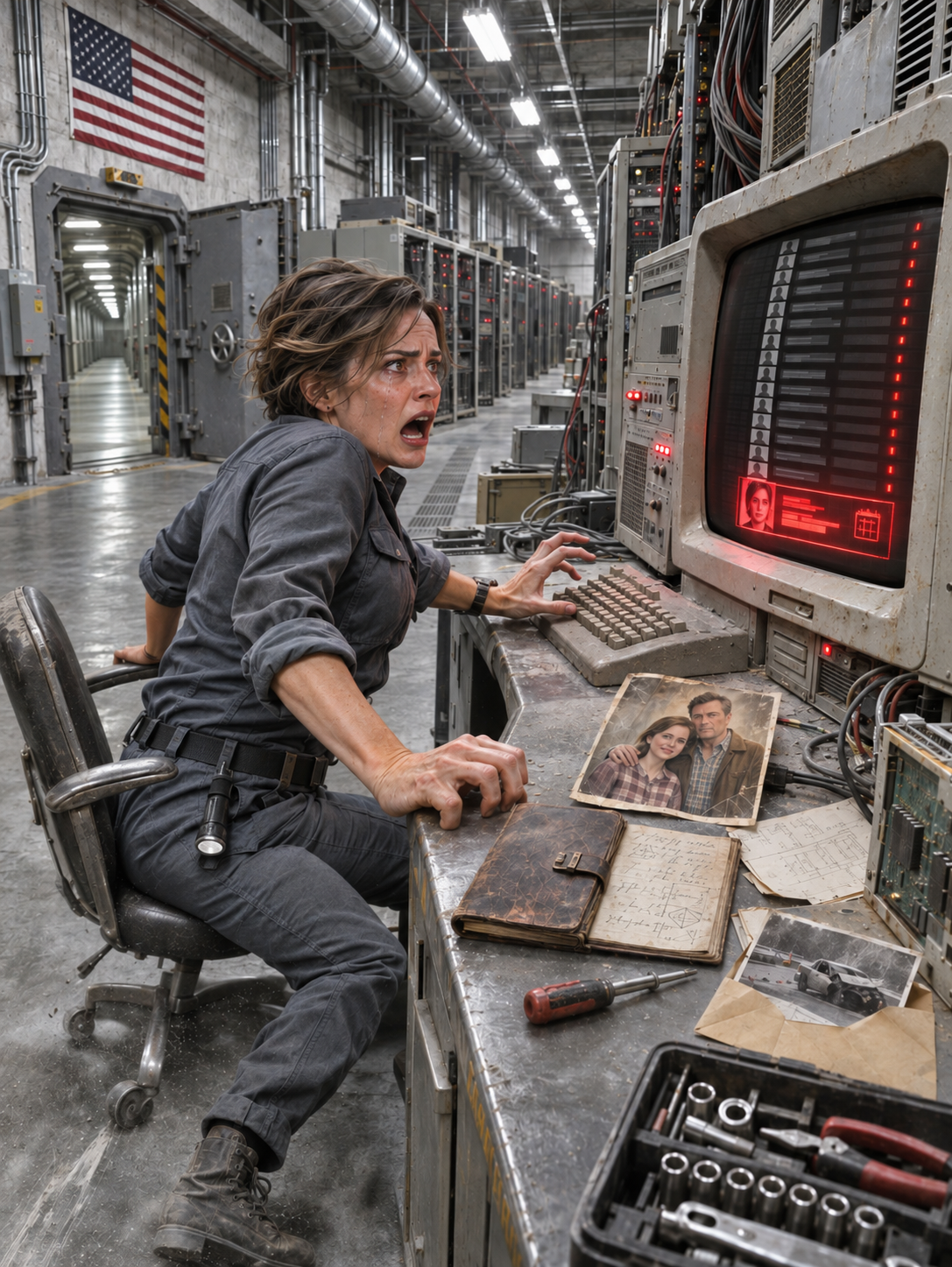
Twenty years after my father died in what everyone called a meaningless highway accident, I was sent underground to dismantle an obsolete military server nobody had touched since his death. I expected dust, dead circuitry, and eight boring hours with a screwdriver. Instead, I typed the strange number puzzle my father had forced me to memorize as a teenager, and the machine woke up with nineteen dead names on its screen. The twentieth name was mine—and beside it was tomorrow’s date.
### Part 1
The first thing that bothered me about Vault Four wasn’t the cold. Underground military facilities are always cold, especially the forgotten sections where old electronics sit humming beneath concrete thick enough to survive things nobody likes discussing over coffee. What bothered me was the dust, because there wasn’t enough of it.
I noticed that before I noticed anything else.
My name is Mara Ellison, I’m thirty-four years old, and for most of my adult life I’ve made a living dismantling secrets after the government decides they’re too old to remain useful. I’m a senior cryptographic systems contractor, which sounds impressive until you understand that most days involve inventory sheets, obsolete hardware, stripped screws, stale vending-machine coffee, and men with shiny badges reminding me which doors I’m allowed to open. I don’t design glamorous new defense systems. I take apart the ghosts left behind by people who did.
That Tuesday morning, my work order described the assignment as routine decommissioning of a legacy communications rack designated Sentinel Seven. The equipment had supposedly been disconnected from operational networks for nineteen years, eleven months, and several days, which was oddly specific for something everyone kept calling irrelevant. Three different clearance stamps said it was dormant, isolated, harmless, and scheduled for physical destruction by the end of the month.
Yet the floor directly in front of the rack had been cleaned recently.
I crouched beside the steel cabinet and dragged one gloved finger across the concrete. Gray dust coated the surrounding floor, but a narrow half-moon in front of the machine was almost spotless, as if somebody had stood there repeatedly. I glanced toward Major Cole Barrett, the intelligence officer assigned to supervise my work, but he was across the vault speaking quietly with two armed security specialists while checking something on a rugged tablet.
“Major,” I called. “Was anyone down here before us?”
Barrett looked over. He was in his early forties, broad-shouldered, exhausted-looking, with the restrained posture of somebody who considered every room a place where things might go wrong. “Not according to the access record.”
“Then somebody has very disciplined dust.”
One of the guards almost smiled. Barrett didn’t.
He crossed the raised metal floor and stopped beside me while I removed the front panel. The screws came loose too easily, another detail I filed away without knowing why. Inside, most of the wiring looked exactly like I expected: old fiber interfaces, obsolete switching boards, ceramic connectors, and cable tags printed in a format the military stopped using when I was in college.
Then I saw the auxiliary board mounted beneath the primary processor.
My screwdriver slipped from my fingers.
It hit the floor with a metallic crack that echoed through the chamber.
“You all right?” Barrett asked.
I didn’t answer immediately because I was staring at a handmade cryptographic bridge soldered directly onto the board. It wasn’t elegant. Whoever built it had routed thin copper paths around the standard logic like veins around a mechanical heart, creating two parallel key structures that folded into each other through a sixteen-position numerical matrix.
I had never seen that architecture in any technical manual.
I had seen it on diner napkins.
When I was fourteen, my father, Daniel Ellison, spent three weeks making me memorize sixteen numbers. At the time, I thought it was another one of his strange attempts to make mathematics fun. Dad was a defense cryptanalyst who could turn grocery receipts into puzzles and license plates into probability exercises, but that particular game had been different because he wouldn’t let me write the sequence down anywhere except disposable paper.
“Forward,” he would say while we sat in a booth at Lenny’s Diner.
I would recite the numbers.
“Backward.”
I would reverse them.
“Every other position.”
I would groan, and he would slide my milkshake away until I got it right.
Three weeks later, he died when his car left an icy mountain road.
For twenty years I had remembered those numbers for the same reason people remember the last voicemail from someone they loved. They were useless, painful, and impossible to throw away.
“Mara?”
Barrett’s voice pulled me back into the vault.
I pointed at the circuitry. “Who designed this?”
He leaned closer without touching anything. “Sentinel Seven predates my assignment.”
“I mean who specifically?”
“I can request archived engineering records.”
“You need to.”
His expression changed slightly. “Why?”
I almost told him.
Then something stopped me.
There are moments in life when fear doesn’t arrive like panic. It arrives like arithmetic, one small fact connecting to another until your body understands the answer before your mind accepts it. The clean floor, the loose screws, the strangely specific age of the system, and now a cryptographic layout that looked exactly like a childhood exercise my dead father had invented.
I stood slowly.
“Because this isn’t standard architecture.”
“That’s why you’re here.”
“No. I’m here because somebody requested me by name.”
That got his attention.
Barrett opened the work order on his tablet. I watched his thumb move through the authorization chain until he found what I had noticed upstairs while signing in but hadn’t thought important enough to question: the personnel field didn’t say approved contractor pool.
It said MARA ELLISON — REQUIRED.
Barrett looked from the tablet to me. “Did you know about this?”
“No.”
The vault suddenly felt ten degrees colder.
I should have stepped away then. I should have told him I was suspending the job until the authorization chain was reviewed. Instead, curiosity did what curiosity has always done to people in my profession: it convinced me that one more piece of information would make me safer.
I connected a maintenance keyboard.
The terminal remained dark for three seconds, then an amber cursor appeared.
SYSTEM LOCKED.
LEGACY OVERRIDE REQUIRED.
Barrett read over my shoulder. “Can you access it?”
“Not with any modern maintenance key.”
“Then stop.”
I stared at the cursor.
Somewhere in the back of my mind, I could hear my father tapping a spoon against a diner mug.
Forward.
Backward.
Every other position.
“Mara,” Barrett said again.
My fingers settled over the mechanical keys.
I typed sixteen digits from memory.
The terminal didn’t beep when I pressed Enter.
It shuddered.
Every dormant monitor in Vault Four flashed black at the exact same moment, and behind us the massive steel door slammed shut hard enough to shake dust from the ceiling. Cooling fans that had been silent for nearly twenty years screamed to life inside the rack.
Then amber letters began appearing across the largest screen.
One name.
Then another.
Then another.
Major Barrett stopped breathing loudly enough for me to notice.
By the time the twentieth line appeared, his hand was resting on his holster.
And I was still trying to understand why the seventh name belonged to my father.
### Part 2
Nobody spoke for several seconds. The cooling fans filled the silence with a deep mechanical roar while amber light washed across the vault, making Barrett’s face look almost colorless. The two security specialists moved closer, not quite aiming their rifles at me but no longer pretending I was simply a contractor with a screwdriver.
“Step away from the terminal,” Barrett said.
I did.
“Hands visible.”
I raised them. “Major, I don’t know what this is.”
“You entered an unauthorized command into a classified system.”
“I entered a sequence I learned when I was fourteen.”
His eyes narrowed. “From whom?”
I looked back at the screen.
Twenty names were arranged vertically beside dates and abbreviated status markers. Most of the codes meant nothing to me, but one column was labeled FINAL EVENT, and another carried words that made my stomach tighten.
AUTO.
MED.
FALL.
AIR.
Barrett ordered one of the guards, Staff Sergeant Nolan Price, to keep me away from the console while he pulled up the secure personnel registry. He began entering names from the screen, moving faster with each result. The other guard, Lieutenant Tessa Ward, watched the sealed vault door and repeatedly tried her radio, getting only static.
“What are you seeing?” I asked.
Barrett ignored me at first.
Then he stopped at the third name.
“Captain Andrew Keller. Signals intelligence.” His voice had lost its command sharpness. “Died at thirty-six. Reported cardiac event.”
He checked another.
“Dr. Miriam Saye. Systems cryptography. Fatal hiking fall.”
Another.
“Master Sergeant Paul Denning. Communications security. Single-vehicle collision.”
My skin went cold.
Barrett looked at the list on the wall screen, then at his tablet. “All three worked on Sentinel Seven.”
He checked the remaining entries one by one.
The pattern held.
Nineteen people.
Nineteen specialists.
Nineteen deaths across nearly two decades, all officially unrelated.
Some had drowned. Some had died driving home. One supposedly suffered a gas leak in a cabin. Another disappeared during a private fishing trip and was declared dead eight months later.
Every name carried a date within forty-eight hours of what Barrett called administrative closure.
I stepped closer despite Price’s warning gesture.
“Number seven.”
Barrett didn’t have to ask which one.
DANIEL ELLISON.
FINAL EVENT: 11/14/2006.
AUTO.
My knees weakened.
November 14 was the date two state troopers came to our house while my mother was washing dishes. I remembered the sponge dropping into the sink. I remembered one trooper taking off his hat before speaking. I remembered my mother making a sound I had never heard from a human being before and never wanted to hear again.
Dad’s car had supposedly crossed black ice on an isolated mountain pass.
There had been no witnesses.
I was fourteen years old.
Barrett turned toward me. “Your father worked on this system?”
“He worked in defense cryptography. That’s all I knew.”
“That code you entered?”
“He taught it to me.”
“When?”
“Three weeks before he died.”
Nobody moved.
The answer seemed to change the temperature of the room.
Barrett stared at me with a mixture of suspicion and something worse: belief.
“Tell me exactly how he taught it.”
I described the diner, the napkins, the repetitions, the way Dad demanded that I memorize the pattern backward as often as forward. I told him about the phrase he used whenever I complained.
If someone makes you open the door, build the mirror.
I hadn’t remembered that sentence in years.
Barrett did not react visibly, but his eyes shifted to the terminal.
“What does that mean?”
“I thought it meant nothing.”
The machine chimed.
We all turned.
A twentieth status field had activated.
MARA ELLISON.
The date beside my name was tomorrow.
For a second the rest of the information refused to make sense, like words in a language I almost understood.
Then the final column populated.
PENDING CONFIRMATION.
A countdown appeared beneath it.
23:59:59.
23:59:58.
23:59:57.
Price muttered something under his breath.
Ward stepped away from the door.
Barrett moved directly to the console and pulled an emergency power disconnect mounted beneath the desk. The red handle came loose in his hand with a heavy mechanical clunk.
Nothing happened.
The monitors remained alive.
The countdown continued.
“That should have killed the rack,” he said.
“It should have killed the entire cabinet.”
He triggered a second cutoff.
Still nothing.
I pushed past Price before anyone could stop me and leaned toward the diagnostic field in the top corner of the monitor. A thin line of hexadecimal traffic was pulsing through a bus interface that should have been physically disconnected.
“This thing is talking to someone.”
Barrett looked at me sharply. “Impossible.”
“Then impossible is sending packets every four seconds.”
Sentinel Seven had been officially air-gapped for almost twenty years, but the traffic monitor showed a live handshake through a buried relay path. Somebody outside Vault Four was issuing commands to a machine everyone thought was dead.
Barrett brought up the maintenance architecture.
The diagram showed no such connection.
“That line doesn’t exist,” he said.
“It exists enough to kill the power override.”
I traced the incoming packet source.
COMM-DIR RELAY.
My mouth went dry.
“Who authorized my assignment?”
Barrett opened the work order again.
This time he followed the signature chain higher.
The final approval came from Colonel Grant Holloway, deputy director of strategic communications.
I knew the name.
Everyone in our contracting division knew it.
Holloway had built a reputation as the man who modernized half the secure communications infrastructure in the mountain complex. He had also personally approved my elevated temporary clearance forty-eight hours earlier, something I had considered fortunate at the time.
Barrett’s jaw hardened.
“You think Holloway wanted you down here?”
“I think somebody did.”
“Why?”
I looked at my father’s name glowing on the screen.
“Because they had the machine.”
Then I looked at my own.
“But they didn’t have his key.”
The overhead lights went out.
Red emergency strobes began rotating across the vault.
A siren screamed through the ceiling.
Lieutenant Ward’s radio suddenly came alive, but instead of a human voice, a calm automated announcement filled the chamber.
“Environmental contamination detected. Sublevel Four suppression sequence initiated.”
Steel dampers slammed shut inside the ventilation ducts.
Barrett swore and reached for his radio.
Before he could transmit, a new command flashed across the terminal.
REMOTE AUTHORIZATION ACCEPTED.
ORIGIN: COMMUNICATIONS DIRECTORATE.
Three lines lower, a second message appeared.
ATMOSPHERIC PURGE COMMENCING.
I heard the first violent hiss of gas rushing into the ventilation system.
Then a timer appeared beside mine.
02:59.
02:58.
02:57.
Whatever Sentinel Seven had been built to hide, Colonel Holloway had just decided it was worth killing four people to keep buried.
### Part 3
The sound of the purge was louder than the alarm. Pressurized gas blasted through the ceiling vents in a steady white roar while Ward and Price ran to the vault door and tried the manual release wheel. It didn’t move.
Barrett grabbed a wall phone.
Dead.
His tactical radio produced only static.
“Mara,” he shouted over the noise. “Can you stop it?”
“I don’t know.”
“That’s not useful.”
“Neither is yelling at the contractor you locked in here.”
He stared at me for half a second, then nodded once. “Fair.”
That tiny moment of sanity helped more than it should have.
I dropped into the chair at the terminal and opened the system-control directory. The interface was older than anything I’d worked with professionally, but beneath the dated command structure I recognized my father’s habits: short labels, mirrored logic paths, redundant validation checks. He believed good cryptography should look ordinary until you knew where to turn it inside out.
The purge countdown reached two minutes.
I attempted a local environmental abort.
ACCESS REVOKED.
I tried a maintenance override.
REMOTE ROOT PRIORITY ACTIVE.
I opened the hardware control table.
Every subsystem had been locked through the same remote authority.
“Holloway?” Barrett asked.
“Or somebody using his credentials.”
“You think there’s a difference?”
“At this point, I’m hoping there is.”
My fingertips were starting to feel numb. Whether from fear or changing air composition, I couldn’t tell.
Barrett crouched beside me. “What did your father mean by the mirror?”
“I don’t know.”
“You remembered the key after twenty years.”
“Because he drilled it into me.”
“Then he drilled that phrase into you for a reason.”
The memory came unexpectedly.
Lenny’s Diner. Blue vinyl booth. Rain against the window. Dad drawing two identical houses on opposite sides of a paper napkin.
I had been irritated because my friends were at the movies.
“If someone makes you open the door,” he had said, “don’t fight them at the door.”
“Then what am I supposed to do?”
“Build the mirror.”
I had rolled my eyes.
He flipped the napkin over.
“The mirror turns the house inside out.”
At fourteen, I thought he was being weird.
At thirty-four, suffocating beneath a mountain, I finally understood.
“The key has two halves,” I said.
Barrett leaned closer. “Meaning?”
“Forward opens the architecture.”
The countdown hit 01:31.
I opened the root compiler.
“Backward changes who owns it.”
The machine rejected my first attempt.
Then my second.
My lungs began pulling harder for air.
Price slid down against the vault door, breathing rapidly.
Ward was still standing, but barely.
“Mara,” Barrett said.
“I know.”
The sequence Dad taught me had sixteen values, but he never made me simply reverse all sixteen. Sometimes he asked for odd positions first. Sometimes even. Sometimes mirrored pairs.
He hadn’t been testing memory.
He had been teaching transformations.
I entered the first eight values backward.
Nothing.
I entered mirrored pairs.
A hidden directory appeared.
MIRROR INSTANCE AVAILABLE.
My entire body went cold.
“Found something.”
Barrett put one hand on the back of my chair to steady himself.
Inside the hidden directory were only three commands.
OPEN.
REFLECT.
RELEASE.
The first had already been triggered by my original code.
I selected REFLECT.
The system asked for authentication.
I typed the sixteen digits backward.
The terminal paused.
AUTHENTICATION ACCEPTED.
For the first time since Sentinel Seven woke up, I had root access.
The countdown showed forty-three seconds.
“Shut down the purge,” Barrett said.
“I can do more than that.”
He looked at me.
The hidden control map showed the remote channel Holloway was using. But the system wasn’t merely receiving instructions through that connection.
It could send information back.
A lot of information.
I found an encrypted archive partition nearly six terabytes in size, enormous for the era when Sentinel Seven had been built. File names were meaningless strings, but metadata dated back to the year before my father died.
Barrett saw it too.
“What is that?”
“I think that’s why nineteen people died.”
The purge timer reached twenty-eight seconds.
I could shut down the environmental system immediately.
Or I could do what Dad had apparently designed the mirror for.
Turn the house inside out.
“Mara,” Barrett warned.
“If I close the purge first, Holloway may cut the relay before we expose anything.”
“And if you guess wrong?”
“We die with the cleanest archive in Colorado.”
He didn’t laugh.
I redirected the archive output through the remote command path, then searched for any authenticated emergency channel beyond Holloway’s control.
The system displayed several.
Inspector General.
Joint operations archive.
Federal investigative gateway.
Base command.
I selected all of them.
“Can this actually transmit?” Barrett asked.
“We’re about to find out.”
Fourteen seconds.
I entered RELEASE.
The machine requested final confirmation.
Nine seconds.
My vision narrowed.
Six.
I struck Enter.
Everything went black.
For one awful second, I thought I had erased the system.
Then every monitor exploded with white text.
The ventilation stopped hissing.
Emergency dampers opened overhead.
Cold air rushed into the room so fast loose papers lifted from the tables.
Price coughed.
Ward dropped to one knee.
Barrett gripped the edge of the console and dragged in a long breath.
I did the same.
Then the vault screens began filling with files.
Financial ledgers.
Personnel dossiers.
Audio logs.
Maintenance records.
Mission authorizations.
Accident reports.
Twenty years of encrypted data unspooled faster than we could read it.
Barrett pointed toward the transmission status.
“Where did you send this?”
“Everywhere the emergency architecture would let me.”
The vault door suddenly unlocked.
Ward raised her rifle.
Price forced himself upright.
The massive steel barrier began retracting.
Armed military police appeared in the corridor.
Behind them were three people in civilian clothes holding credentials.
For one frightening second, I assumed Holloway had sent them.
Then the oldest investigator entered, glanced at Barrett, looked directly at the terminal, and said something I never expected.
“Do not power down that system.”
She produced an Inspector General badge.
“We received an archive burst from this room ninety seconds ago.”
Barrett exhaled.
I almost did too.
Then she looked at me.
“Ms. Ellison, step away from the console.”
My relief vanished.
“Why?”
The investigator’s face tightened.
“Because Colonel Holloway says you are conducting a hostile breach of a classified defense network.”
Barrett stepped between us.
“She just kept four people alive.”
“I’m aware of that.”
“Then what’s the problem?”
The investigator held up a printed alert.
“The problem is that Holloway transmitted evidence thirty seconds before your archive burst claiming Ms. Ellison planted the entire database.”
I stared at her.
“He was ready for this.”
“Yes,” she said. “Which means whatever you just opened, somebody expected Daniel Ellison’s daughter to eventually find it.”
### Part 4
They separated us immediately.
I was moved upstairs under armed escort to a windowless conference room with gray carpet, a bolted table, and a coffee machine that smelled burned even before anyone touched it. Nobody handcuffed me, but two military police officers remained outside the door, which felt like handcuffs with better furniture.
For forty minutes, nobody explained anything.
I sat there thinking about my father.
Not the cryptanalyst.
Not the dead name on Sentinel Seven.
My father.
The man who burned pancakes every Sunday because he always turned the stove too high. The man who sang old jazz songs badly while fixing things. The man who once drove twenty miles back to a grocery store because the cashier had accidentally given him ten dollars too much change.
The idea that he had built something connected to nineteen deaths didn’t fit inside my memories of him.
That terrified me more than Holloway did.
The door finally opened and the Inspector General investigator entered with Barrett. Her name was Special Investigator Claire Danner, and she carried three folders plus the expression of someone who had slept less than I had.
“Holloway has been detained,” she said.
“Detained isn’t arrested.”
“No.”
“So he’s still talking.”
“Yes.”
“Which means he’s still lying.”
Barrett sat across from me.
Danner remained standing.
“Holloway’s version is that your father created Sentinel Seven as an unauthorized surveillance archive,” she said. “According to him, Daniel Ellison became unstable after being investigated for diverting classified material, and he embedded a personal access key before his death.”
I felt heat rise into my face.
“My father died before anybody told us he was under investigation.”
“That investigation was classified.”
“How convenient.”
Danner placed the first folder down.
Inside were copies of documents carrying Dad’s name.
Security violations.
Unauthorized data retention.
Possible financial irregularities.
One memorandum recommended suspension of his clearance.
I stared at his signature on the final page.
It looked real.
“Did he write this?”
“We don’t know yet.”
Barrett tapped the page.
“Look at the date.”
Three days after Dad died.
I looked again.
The memorandum claimed he had acknowledged receipt.
Three days after state police officers stood in our kitchen and told us he was dead.
The room went very still.
Danner opened the second folder.
“These are from the archive burst.”
Bank transfers had moved through shell consulting firms, procurement accounts, and classified budget channels. The numbers were difficult to follow, but even I understood the scale.
Millions.
Then tens of millions.
Then more.
“What was Holloway doing?”
“We don’t know the full structure yet,” Danner said. “But preliminary review suggests someone inside strategic communications had been diverting protected program funds for years.”
“And my father found it.”
“That is one possibility.”
“One possibility?”
Danner looked at me directly. “Another is that your father helped build it.”
The words hit harder than I expected.
Barrett leaned forward. “Claire.”
“She needs to know what we’re considering.”
I hated her for approximately three seconds.
Then I realized she was right.
“Show me.”
Danner slid over a personnel map.
Dad’s name appeared near the center of the original Sentinel Seven development group.
So did Grant Holloway’s.
They had worked together.
Not casually.
Closely.
Dad had been lead cryptographic architect.
Holloway had overseen communications infrastructure and procurement security.
Twenty years ago, they had shared an office division.
My mouth went dry.
“He never mentioned Holloway.”
“Holloway says they were friends.”
“I would have remembered that name.”
“Maybe your father wanted you not to.”
That possibility hurt.
The third folder contained something stranger.
A list of the nineteen dead specialists, arranged by year.
Beside each name was the date they were granted access to Sentinel Seven.
Most died within forty-eight hours.
But not all.
One survived eleven months.
Dr. Evelyn Cross.
Her official record showed a fatal boating accident in 2012.
“What makes her different?” I asked.
Barrett answered. “We don’t know.”
I studied the entry.
Evelyn Cross had accessed Sentinel Seven twice.
Every other person had accessed it only once.
“Maybe she learned enough the first time to come back.”
Danner nodded slowly.
“That was our thought.”
“Then find out what she did in between.”
“We are.”
I pushed the file back.
“What happens to me?”
“Holloway’s accusing you of fabricating evidence, sabotaging a secure facility, and attempting to distribute classified data.”
“He tried to suffocate us.”
“We have the purge command.”
“Then arrest him.”
“It was issued under his credentials. That is not automatically the same as proving he personally sent it.”
I laughed once because the alternative was shouting.
“So I’m trapped in a room while the man who scheduled my death gets lawyers.”
Danner didn’t answer.
Barrett looked angry enough for both of us.
Then Danner’s secure phone buzzed.
She checked the message.
Her expression changed.
“What?”
She turned the screen toward Barrett.
A security image showed an empty detention office.
“Holloway’s gone.”
I stood so quickly my chair struck the wall.
“How does a detained colonel disappear from a military complex?”
“He didn’t disappear,” Danner said.
She swiped to another image.
Holloway was walking through a security checkpoint beside two uniformed officers.
“They released him.”
“Who?”
“That authorization came from above this base.”
A cold realization settled over me.
Holloway wasn’t the top of anything.
Danner’s phone buzzed again.
This time she read the message twice.
“What now?”
She looked at me.
“Dr. Evelyn Cross wasn’t killed in 2012.”
I stared at her.
“Her death certificate is real,” Danner continued, “but the body recovered from that boat was never DNA-confirmed.”
Barrett stood.
“Where is she?”
Danner slowly lowered the phone.
“Twenty minutes ago, a woman using that name walked into a federal field office in Denver.”
My pulse jumped.
“What did she say?”
Danner looked at me with an expression I couldn’t read.
“She said Daniel Ellison told her this day would come.”
Part 5
That made it worse. I stared at the tabletop until the grain blurred. For twenty years I had imagined ice, darkness, twisted metal, and my father alone in a car. Now the image changed. Somebody had planned it.
Somebody had gone to work afterward. “Why nineteen others?” “Because Daniel hid proof.” “Inside Sentinel Seven.” “Yes.”
“Then why couldn’t Holloway erase it?” “Daniel built the archive so the incriminating material couldn’t be opened with administrative access. The evidence partition required his personal matrix.” “My sixteen numbers.” Evelyn nodded.
“Holloway searched his office, house, storage records, notebooks. He found nothing.” “Because Dad put the key in my head.” “Yes.” Anger rose through me so quickly I felt dizzy.
“He used a fourteen-year-old girl as a vault.” “He was trying to keep you alive.” “He taught me the code three weeks before he died.” Evelyn looked down. “He knew they were coming.”
I stood and walked to the opposite wall. For years I had treasured those evenings at Lenny’s Diner because they felt like the last normal memories I had with him. Now every milkshake, every napkin, every stupid number was part of a contingency plan created by a man preparing for his own murder. I wanted to be furious at him. Maybe part of me was.
But mostly I wanted five minutes with my father so I could ask whether he had been scared. Barrett broke the silence. “Why fake your death?” Evelyn gave a humorless smile. “Because I opened Sentinel Seven in 2012.”
My head turned. “What did you see?” “Almost nothing. Daniel had modified the archive after I last worked with him. I could access the outer shell but not the core evidence. Hollow
“Holloway discovered I had accessed the system,” Evelyn continued. “I staged my death because I knew he would kill me next.” She placed a small encrypted drive on the table and looked directly at Danner. “Daniel gave me this before he died. It contains the original financial records, evidence of the nineteen murders, and recordings identifying the people responsible.”
Danner immediately ordered a forensic examination of the drive. Within hours, investigators uncovered evidence connecting Holloway to my father’s staged car accident and millions of dollars in stolen government funds. More importantly, the recordings implicated Lieutenant General Robert Voss, the powerful official who had secretly authorized Holloway’s release. “They weren’t protecting national security,” Barrett said, staring at the evidence. “They were protecting themselves.”
The evidence was transferred to independent federal investigators before anyone could interfere. Holloway and Voss were subsequently arrested, and a months-long investigation exposed the conspiracy behind Sentinel Seven. The nineteen suspicious deaths were reopened, my father’s fabricated security violations were formally overturned, and his name was finally cleared. I was no longer considered a suspect. For the first time in twenty years, the truth about Daniel Ellison was part of the official record.
On the anniversary of his death, I visited my father’s grave with my mother. I placed a photograph from Lenny’s Diner beside the flowers, remembering the sixteen numbers he had taught me when I was fourteen. “You knew they were coming, Dad,” I whispered, tears running down my cheeks. “But you made sure the truth would survive.” My mother squeezed my hand as the morning sunlight fell across his headstone.
They had murdered nineteen people to bury their secrets and marked me as the twentieth. But they made one fatal mistake: they brought me to the machine my father had built. Twenty years earlier, he had taught me how to open the door and build the mirror. That day, I finally understood why. They had taken my father from me, but they could never erase what he left behind.
THE END!
Disclaimer: Our stories are inspired by real-life events but are carefully rewritten for entertainment. Any resemblance to actual people or situations is purely coincidental.


