
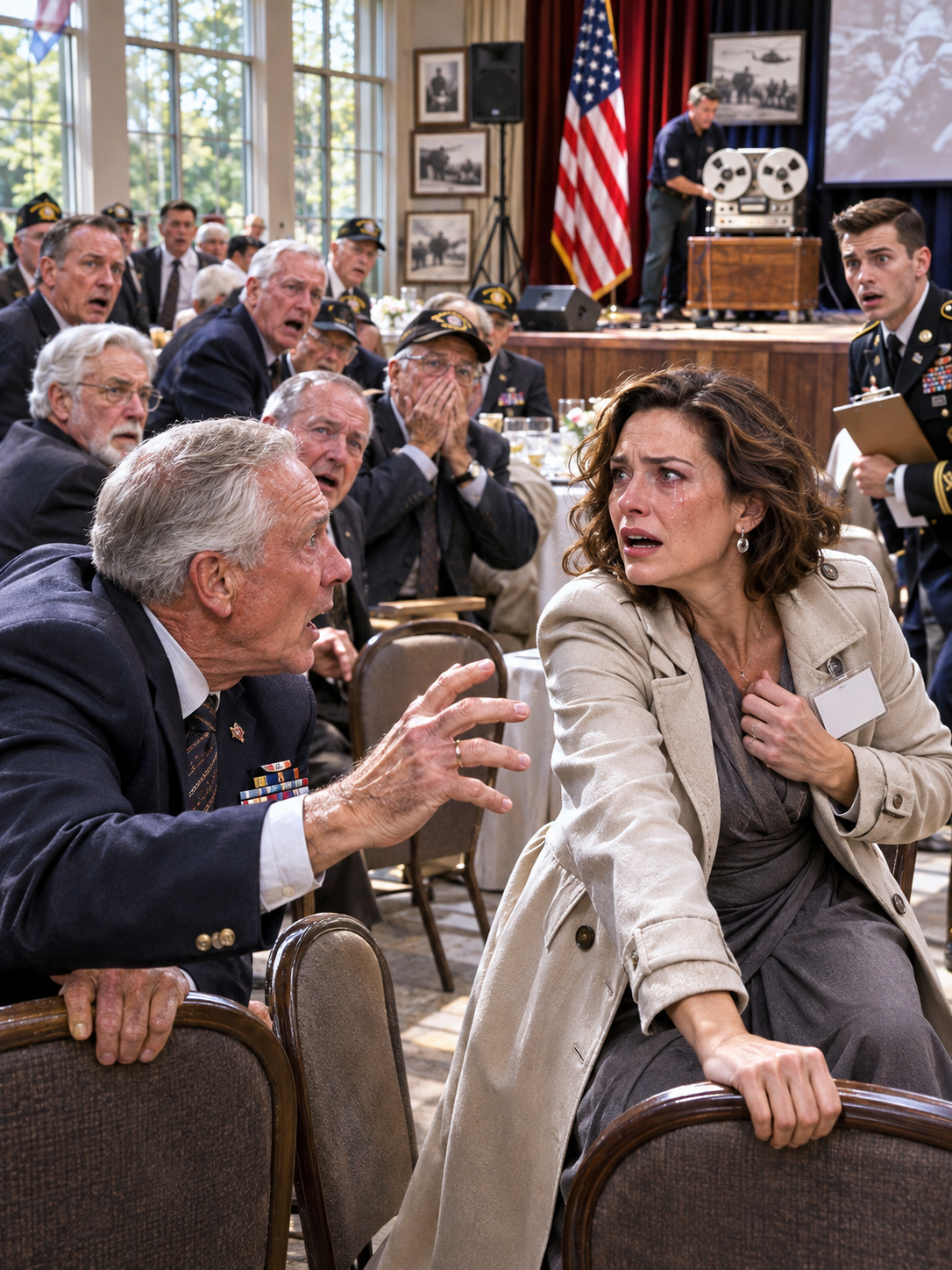
I flew eleven hundred miles to attend a reunion where nobody knew my face, only to be mistaken for somebody’s wife and quietly pushed toward the family section. I could have corrected the young sergeant in five seconds, but explaining who I really was would have opened a door I had kept locked for fifteen years. So I sat alone in the back wearing a blank name tag—until an old recording began playing, one veteran slowly turned toward me, and the room discovered why I had come.
### Part 1
The rain followed me from the airport all the way to the community center, a thin cold September rain that smeared the parking-lot lights across my windshield and made every painted line shine like wet bone. By the time I hurried beneath the awning, water had darkened the shoulders of my charcoal coat, curled the ends of my hair, and soaked through one shoe because I had stepped directly into a puddle while wrestling my suitcase out of the rental car. I stood outside the glass doors for several seconds, listening to laughter from inside, and almost turned around.
I had flown eleven hundred miles to attend the reunion, but arriving and entering were two different decisions. For fifteen years I had been very good at living in the space between those two things, close enough to remember, far enough away not to be recognized. That evening, with my hand wrapped around the brass door handle, I told myself I only needed to stay an hour.
Inside, two Air Force members had turned a folding table into a check-in station. A young staff sergeant with a polished haircut, crisp uniform, and the comfortable authority of a man trusted with logistics looked at me, then at the list on his clipboard. His name tape read PARK, and beside him an airman named Jensen was sorting handwritten badges into alphabetized rows.
“Last name, ma’am?” Sergeant Park asked.
“Rowan.”
He ran one finger down the sheet, frowned briefly, then looked at my wedding ring. It was not my wedding ring anymore, technically; it was only the ring I had never stopped wearing. His expression relaxed as though that small piece of gold had answered a question for him.
“Did you follow your husband here?” he asked with an easy smile. “The spouse tour is Thursday afternoon. Family events don’t officially start until tomorrow.”
For half a second I thought I had misheard him. Then something inside me almost laughed, although nothing about it was funny.
“I’m here for tonight’s program,” I said.
“Sure.” He nodded immediately, already solving the inconvenience. “No problem. We’ve got visitors every year. Just write your name here.”
He slid a blank adhesive badge toward me and pointed to the left side of his chest. “Name tag goes there. Tradition. Don’t ask me why. Coffee’s inside, restrooms are past the flags.”
He was not mocking me. That almost made it harder.
I could have told him my full name. I could have told him my rank before retirement, the units I had served with, the operations cell where I had spent thousands of hours staring at weather, coordinates, fuel states, and the blinking digital signatures of people whose lives depended on whether someone in a windowless room stayed calm. I could have said one sentence and watched his posture change.
Instead, I peeled the backing from the badge and stuck the blank white rectangle over my heart.
“Thank you, Sergeant.”
He smiled. “Enjoy the reunion, ma’am.”
The hall smelled exactly the way military community halls always smelled—coffee that had been cooking too long, floor wax, damp wool, folding tables, and the faint dusty heat of a building usually empty during the week. Thirty years of unit photographs covered one wall, crews standing beside aircraft in deserts, mountains, snowfields, and places where everybody looked twenty years younger than they felt.
I walked slowly along the back wall rather than between the tables. Retired rescue crews were gathering in clusters, gray-haired men clapping one another on the shoulders with the enthusiastic violence of people who had once trusted each other with their lives. Younger officers stood nearby listening to stories they had probably heard before and would happily hear again.
Several Army aviation veterans had been invited too. Rescue communities like to pretend branch lines matter until someone is bleeding on a mountain, and then suddenly nobody cares what color uniform brought the helicopter.
I recognized voices before faces.
That startled me.
A broad man near the flags laughed, and something cold moved across my back. Fifteen years earlier I had heard that same gravelly laugh through a headset after a pilot barely cleared a ridge with an engine coming apart underneath him. I had heard him laugh exactly once, for maybe two seconds, and apparently my brain had stored it forever.
Another man spoke near the coffee table, and I knew the cadence before I could place why. He had once reported a fuel number to me while trying very hard to make twenty-three minutes sound like thirty. A third man used his hands while telling a story, and I remembered those hands only as radio silence between transmissions.
None of them looked at me twice.
That was the agreement I had made with the world.
For most of my career, I had been a voice.
A controller does not get dramatic lighting. Nobody sees you leaning over a map at two in the morning with headphones cutting into your temples and cold coffee beside your elbow. The people on the other end know your call sign, your timing, your tone, and whether you can be trusted when everything outside their windshield has gone wrong.
Sometimes they know you better than people who have eaten dinner with you for years.
But they do not know your face.
I found a chair against the rear wall beneath a black speaker stand and sat with a paper cup of coffee I did not remember pouring. From there I could watch almost the entire room without being part of it. That had always been my favorite position: useful, invisible, near the exit.
A small memorial table stood beside the stage.
I tried not to look at it.
There were folded flags, framed photographs, unit patches, and a row of names beneath small electric candles. Even from the back of the room, I knew one photograph was there. I had checked the reunion program online before booking my flight and found the memorial list, then closed the browser so fast I nearly knocked over my water.
I did not need to read that particular name.
I carried it everywhere.
An older man passing my chair paused and gave me the kind smile strangers reserve for women sitting alone.
“You with one of the families?” he asked.
I looked up at him.
“Something like that.”
“Well, there’s fresh coffee up front. Or what they’re calling fresh.” He chuckled. “Cream’s gone already.”
“I’m fine. Thank you.”
He patted the back of my chair and continued toward his table.
He had once known me.
Not me exactly.
My voice.
That distinction was the architecture of my entire adult life.
At seven fifteen the lights dimmed slightly, and retired Colonel Martin Hale stepped behind the podium. I had served under him years earlier, when both of us still had dark hair and knees that did not complain on stairs.
He tapped the microphone twice.
“Find a seat if you’ve got one,” he said. “If you don’t, find somebody who looks lonely and ruin their evening.”
The room laughed.
I smiled despite myself.
The sound carried me backward so quickly that for one dangerous instant I could smell another room entirely: overheated electronics, burned coffee, canvas map cases, and the stale recycled air of an operations cell at 2:00 a.m.
I tightened my fingers around the cup.
Just one hour, I reminded myself.
Sit in the back.
Listen.
Leave.
It was a good plan.
Unfortunately, some of the worst nights of my life had also begun with good plans.
Colonel Hale welcomed old crews, surviving families, visiting units, and the younger generation now carrying the mission. Then he stopped shuffling his notes.
His voice changed.
Not much.
I noticed anyway.
“Before we start the heritage presentation,” he said, “we’re going to do something we do every year.”
My heart gave one hard beat.
I looked toward the exit.
Hale rested both hands on the podium.
“If this is your first reunion,” he continued, “nobody explained this part because explaining it ruins it. You just have to hear it.”
The room around me became very still.
Then he said two words I had spent fifteen years avoiding.
“Ridgeline Eleven.”
My coffee cup creased beneath my fingers.
And suddenly I knew exactly what recording they were about to play.
### Part 2
I should have stood up.
There were maybe twenty steps between my chair and the side exit, twenty ordinary steps across commercial carpet, through a steel door, under an awning, and into rain. I had walked much farther distances carrying much heavier things.
Instead, I sat perfectly still.
Colonel Hale glanced toward the sound booth. “Roll it.”
The speaker above my head hissed.
Static filled the room.
I closed my eyes.
There are sounds a body recognizes faster than a mind does. Your childhood front door closing. Your mother clearing her throat before delivering bad news. The specific engine note of a car belonging to someone you love. For me it was radio static from an old military frequency, compressed and scratchy from too many generations of copied audio.
Then a woman’s voice came through.
Calm.
Low.
Almost emotionless.
“Ridge team, this is Guardian Control. I have you. Give me your condition one at a time.”
Two hundred people disappeared.
The room vanished.
I was back inside a dark operations cell fifteen years earlier, twenty-eight years old, headset pressing against damp hair, three maps spread beneath my hands, weather moving in faster than the forecast had promised. A ground team was trapped near a ridgeline after dark, three injured, one critically, with visibility dropping and the first rescue aircraft already reporting conditions near minimums.
I opened my eyes.
Nobody was looking at me.
They were all listening.
The recording continued.
“Good. Keep talking to me. Tell me his breathing rate again.”
A younger male voice answered through static.
“Twenty-eight. Maybe thirty.”
“Count it out loud for me.”
“He can hear you.”
“I know. Count anyway.”
My stomach tightened.
I had forgotten that line.
Memory edits itself over time, removing little pieces around the edges. You retain what hurts and what matters, then convince yourself you remember everything because the center remains intact. The tape was returning details I had lost.
On the recording, the frightened young man began counting breaths.
The woman guiding him sounded as if she were ordering breakfast.
That woman was me.
I had not listened to this recording since the year it happened.
I knew copies existed. Someone had mentioned years ago that instructors used excerpts in rescue training, but I had never asked which sections and had immediately changed the subject. Eventually I stopped attending professional reunions entirely, which made avoiding the question much easier.
Listening now, I finally understood something I had never understood from inside my own head.
I sounded unafraid.
At the time, terror had filled every part of me.
The weather system had collapsed onto the mountain faster than predicted. A helicopter had already waved off once, and the wounded man’s condition was worsening. We had medical guidance, aircraft, experienced crews, maps, radios, and all the intelligence a modern operation could buy.
And none of those things changed the mountain.
The men on the ridge had one useful resource left that did not depend on weather.
My voice.
People misunderstand control-room work because the interesting parts happen somewhere else. Nobody makes movies about someone moving a grease pencil across acetate while asking fuel states. But sometimes the person on the ground has already used every skill he owns, and what he needs next is not another instruction.
He needs somewhere to put his fear.
Your job becomes making your voice sound like you are calling from tomorrow.
You speak as though morning has already arrived. You make home sound inevitable. You lend him confidence you do not possess because, for thirty seconds at a time, borrowed confidence works just as well as the real kind.
The tape crackled.
A pilot reported deteriorating visibility.
My recorded voice responded, “Understood. No shame in breaking away. Set up east and come again when you can.”
Someone near the front exhaled sharply.
I knew that voice too.
I opened my eyes and found a gray-haired pilot at the second table staring at the floor. His hands were clasped so tightly his knuckles had gone white.
He must have been the pilot.
I had never known his name.
That realization hit me harder than I expected.
We had spent hours together on one of the worst nights of his life, yet if he walked past me at a grocery store, we would have been strangers. I had probably walked past people like him dozens of times.
On the tape, the pilot answered, “Copy, Guardian.”
His voice sounded young.
Everyone’s voice on old recordings sounds young.
The room listened without moving.
At the memorial table near the stage, the electric candles flickered against polished frames. One photograph sat partly hidden behind a folded flag, and although I could not see the face clearly from my seat, my mind supplied it anyway.
Dark hair.
Crooked smile.
Eyes that always seemed one joke ahead of everyone else.
I forced myself to look elsewhere.
There had been another night before Ridgeline Eleven.
A night I was not ready to remember in this room.
I watched Colonel Hale instead.
He stood beside the podium with his head lowered, listening to the tape he had apparently heard many times. Several veterans nearby mouthed familiar pieces of the transmission.
That was when I realized this had become ritual.
My worst hours had become their tradition.
There was something both terrible and beautiful about that.
The tape jumped forward.
Four hours compressed into fragments.
“Stay with me.”
Static.
“Eastern approach is improving.”
More static.
“Keep pressure there. I know you’re tired.”
Then the wounded man’s voice.
“I don’t think I’m getting off this hill.”
My entire body went cold.
I remembered him.
Not his name.
His voice.
His breathing.
The pause before he spoke again.
“I need you to tell my mom—”
“No.”
The response came instantly.
My response.
A few people in the room smiled because they knew what came next.
On the recording, twenty-eight-year-old me said, “You can tell your mother yourself. I am not taking messages tonight.”
A small ripple of laughter moved through the room.
The wounded man laughed too.
Weakly.
But he laughed.
I remembered what happened after that. I asked him useless questions on purpose: what color the sky looked near the horizon, whether his gloves were wet, what his favorite breakfast was. He never understood that none of it mattered.
Talking mattered.
Breathing mattered.
Remaining attached to the next minute mattered.
He told me pancakes.
I told him that was an embarrassing answer.
He told me to go to hell.
I said, “After breakfast.”
The room laughed again.
My vision blurred slightly.
I looked down at my blank name tag.
The absurd little square had become damp at one corner from my coat. A woman without a name listening to her younger self hold strangers together.
It felt almost too perfectly cruel.
Then another memory surfaced.
Not Ridgeline.
A kitchen.
A cheap apartment off base.
A man leaning over the counter while testing a handheld radio we had absolutely no reason to be testing inside our home.
“Radio check,” he’d said.
“Loud and clear.”
“And what is today’s mission?”
I had rolled my eyes.
He grinned.
“Say it.”
“You are ridiculous.”
“Say it, Captain.”
I had not been a captain yet.
He knew that.
I laughed and finally gave him the line he had invented.
“Everybody comes home tonight.”
His grin softened.
“That’s right.”
The memory disappeared so violently I nearly gasped.
I had not realized the reunion recording contained the line.
I suddenly remembered that it did.
Near the end.
The room was moving toward it.
I considered leaving again, but now my legs felt unreliable.
The audio continued.
“Aircraft three, you are cleared for another approach.”
“Copy.”
“Ridge team, bird inbound.”
Then the chaos intensified, compressed rotor noise and clipped voices layered over static.
I knew every coming word.
Every pause.
Every breath.
Without realizing it, I began whispering along.
Not loudly.
Barely enough to move air.
“Come left three degrees.”
The recording said it half a second later.
“Hold that.”
Again, the voice above me followed.
“Easy.”
I stopped.
Two tables ahead, a large gray-haired man slowly turned his head.
At first I thought he was looking toward the speaker.
Then his eyes found me.
He stared.
I looked away.
The recording moved toward its final minute.
The gray-haired man did not turn back around.
Beside him, an Army veteran noticed his expression and followed his gaze.
My skin prickled.
I kept my eyes on the carpet.
Above me, the younger version of myself said, “All souls aboard?”
A crew member answered.
“All souls aboard.”
A sigh moved through the room like wind through grass.
Then came the final transmission.
The sentence I had carried for fifteen years.
My lips moved before I could stop them.
“Everybody comes home tonight.”
The gray-haired man stood up so fast his chair struck the table behind him.
A half second later, my recorded voice came through the speaker.
“Everybody comes home tonight.”
The man’s face drained of color.
He stared directly at me.
Then, in a voice cracked open by fifteen years of waiting, he whispered loud enough for three tables to hear:
“That’s her.”
### Part 3
People nearby turned toward him, but most of the room was still listening to the final static fade from the speakers. I sat frozen beneath the black stand, hoping absurdly that if I did not move, the moment might somehow misunderstand itself and pass over me. The gray-haired man kept staring.
Sergeant Park noticed first.
He had left the check-in desk and taken a position against the side wall once the program began. From where he stood, he saw an older veteran suddenly rise, saw several men turn toward the rear, and saw the woman he had admitted as a visitor sitting directly beneath the attention.
His interpretation was logical.
It was also entirely wrong.
He came down the side aisle quickly but discreetly, crouching beside my chair so he would not block anyone’s view.
“Ma’am?”
I looked at him.
He glanced toward the standing veteran and lowered his voice. “This part of the program can get pretty emotional for the old crews. We usually keep family and visitors closer to the side lounge during the memorial section.”
The irony was so complete that under different circumstances I might have smiled.
“I’m fine here.”
“I know.” His tone remained polite. “I just don’t want anyone getting uncomfortable. There’s another room through those doors, quieter, fresh coffee, some seating.”
The gray-haired man had begun moving toward us.
Park saw him coming.
He stood and shifted slightly between us.
“No problem, sir,” he said toward the approaching veteran. “I’m handling it.”
The veteran stopped.
His expression changed from disbelief to confusion.
“Handling what?”
Park glanced at me. “I was just going to help her find the family room.”
The veteran stared at him as though Park had begun speaking another language.
Then he looked past the sergeant toward me.
“Say it.”
Park blinked.
“Sir?”
“Not you.”
The veteran stepped around him.
Up close, he was larger than I expected, broad through the shoulders despite his age, with silver hair cut short and hands scarred in the unmistakable way of someone who had spent years around cables, tools, rotor wash, and bad terrain. His eyes were already wet.
He stopped three feet from me.
“Please,” he said. “Say it again.”
I stood.
Not because I wanted the room to see me.
I stood because I saw humiliation beginning to gather around Sergeant Park like a storm cloud, and I wanted to leave before it broke over him. He had made an ordinary mistake from ordinary assumptions, and I had no desire to turn a young man’s embarrassment into entertainment.
“I should probably go,” I said.
The veteran shook his head.
“No.”
His voice cracked.
He swallowed and tried again.
“Please. I need to know.”
The room was catching up now.
Colonel Hale had stopped speaking at the podium.
Several people had risen.
The Army pilot near the front had turned completely around.
Sergeant Park looked from the veteran to me and finally seemed to understand that something larger was happening.
The gray-haired man continued, “The last thing you said. On that hill. Say it.”
My throat closed.
For fifteen years I had kept two versions of myself in separate rooms.
There was Claire Rowan the woman, who bought groceries, forgot dentist appointments, read mystery novels before bed, kept too many plants on the kitchen windowsill, and lived in a small house where one side of the closet remained strangely empty.
Then there was Guardian Control.
The voice.
The voice belonged to night missions, aircraft crews, maps, wounded men, and strangers asking questions they were afraid to hear answered.
The voice did not cry.
The voice did not hesitate.
The voice knew what came next.
Claire Rowan rarely did.
Keeping those two women separate had saved me more than once.
Now a room full of people was forcing the walls down.
I looked at the veteran.
“What’s your name?” I asked.
His breath caught.
“Jonah Briggs.”
The name meant nothing.
Then he added, “Pararescue. Team Two. Ridgeline Eleven.”
Everything clicked.
I remembered his call sign.
I remembered his breathing.
I remembered him telling me once, during hour three, that he was considering attempting a movement I had specifically ordered him not to make.
“You were Atlas.”
He closed his eyes.
That was confirmation enough.
“Oh, God.”
He covered his mouth with one hand.
Sergeant Park took one step backward.
Jonah’s shoulders shook once.
“You remember?”
“I remember your radio discipline being terrible.”
He laughed and cried at the same time.
Someone behind him made a sound that might have been a laugh too.
I had not meant to make a joke, but the room needed somewhere for the pressure to go.
Jonah lowered his hand.
“Say it.”
I looked beyond him.
Every face had turned toward us.
The memorial table stood in my peripheral vision.
I could see the photograph now.
Not clearly enough to read the name beneath it.
Clearly enough to see the man.
I had spent fifteen years refusing to say certain words while looking at a human face.
Radio had protected me from that.
A headset gives you darkness.
No eyes.
No expression.
No physical evidence of what your voice is doing to another person.
Jonah stood in front of me without that mercy.
So did two hundred others.
I took one breath.
Then I let the woman and the voice occupy the same body.
“Everybody comes home tonight.”
I did not perform it.
I did not make it dramatic.
I spoke the words exactly the way I had spoken them fifteen years earlier—flat, quiet, certain.
The speaker above us had been replaying the last portion of the recording.
Half a second after I finished, my younger voice repeated the same sentence.
“Everybody comes home tonight.”
Past and present overlapped.
The effect on the room was physical.
Jonah bent slightly forward as if someone had struck the air from him.
The Army pilot stood.
Then another veteran.
Then the man beside him.
Chairs began sliding backward.
Nobody applauded.
I am grateful for that.
Applause would have made me want to disappear.
Instead they stood.
Table after table.
Some understood immediately.
Others only understood because the people beside them were rising.
Within seconds almost everyone in the hall was on their feet.
Colonel Hale remained behind the podium gripping the sides.
His face had gone pale.
“The voice on the recording,” he said into the microphone.
Then he stopped.
Apparently he had discovered that knowing what to say to squadrons and knowing what to say now were different skills.
He tried again.
“The woman who ran Ridgeline Eleven is here.”
Every head turned fully toward me.
For once there was nowhere left to hide.
My coat was still damp.
My hair was a mess from the rain.
The name tag over my heart was blank.
That detail seemed suddenly ridiculous.
Airman Jensen stood near the doors holding a stack of unused badges. He looked at my empty one, then at Sergeant Park, then back at me.
Park looked devastated.
I knew that expression.
I had worn versions of it.
The moment when your understanding of a room collapses and reconstructs itself around the fact that you have been confidently wrong.
I expected shame to hit me.
Or panic.
Maybe anger.
Instead I felt tired.
Not the exhaustion that comes from lacking sleep.
A deeper kind.
Like I had been holding something overhead for years and had finally been told I could lower my arms.
For fifteen years I had imagined being recognized as exposure.
A spotlight.
A violation.
Standing there, I discovered recognition could feel like rest.
Nobody needed Guardian Control from me now.
No helicopter was inbound.
No medic was counting breaths.
No frightened pilot needed to borrow my confidence.
They were simply looking at me.
And for the first time in a military room, I did not have to save anyone.
I could just be a woman who had once answered a radio.
Jonah crossed the last step between us and held out his hand.
I took it.
His grip was enormous.
“I’ve waited fifteen years to do that.”
I tried to answer.
Nothing came.
He squeezed once.
“My daughter is thirteen.”
I looked at him.
“She exists because I came off that mountain.”
His eyes filled again.
“And I came off that mountain because when I was ready to quit, you sounded like tomorrow had already happened.”
Something moved behind my ribs.
Not relief.
Not pride.
Something more dangerous.
Grief with a door opening beside it.
Jonah smiled through tears.
“I always wondered what the lighthouse looked like.”
My hand went cold in his.
“The what?”
He gave a rough little laugh.
“You don’t know?”
I shook my head.
Behind him, several veterans exchanged looks.
Jonah wiped his face.
“That’s what we called you.”
He looked around the silent hall.
“The Lighthouse.”
And from the way everyone else reacted, I realized the name had been following my voice for years without me ever knowing it existed.
### Part 4
Sergeant Park was still standing beside us.
I could practically hear every sentence he had said to me replaying inside his head.
Did you follow your husband here?
Spouse tour is Thursday.
The family room is quieter.
He looked twenty-six again instead of like the polished staff sergeant who had controlled the entrance.
“Ma’am,” he began.
I turned toward him.
“I’m sorry.”
“Sergeant—”
“I didn’t know.” He swallowed. “I checked you in as a visitor. I tried to move you out of the room. I thought you were—”
“Stop.”
He stopped.
I kept my voice low enough that most people could see us talking but could not hear every word.
“Look at me.”
He did.
His eyes were glassy.
There are moments when embarrassment becomes instruction if you handle it correctly, and damage if you do not. I had watched enough young officers and enlisted members fail publicly to know the difference often depended on what the senior person did next.
“You saw a woman you didn’t recognize,” I said. “You thought she was lost, and you tried to take care of the room.”
His jaw tightened.
“That doesn’t excuse—”
“I didn’t say it excused everything. I said your instinct was not cruel.”
He looked down.
I waited.
Then I said, “Here’s the lesson.”
He raised his eyes again.
“You almost never know who’s in the room.”
He was listening now.
“The woman in the wet coat. The old man sitting alone. The airman cleaning tables. The person who looks like somebody’s spouse. Any of them might have a history you cannot see. Treat people like their story matters before you know what the story is.”
Park nodded.
A tear escaped despite his attempt to stop it.
I pretended not to notice.
“And Sergeant?”
“Yes, ma’am?”
“Stand up straight.”
His shoulders came back automatically.
“This is your reunion too. You work here. Keep working.”
Something changed in his face.
Not relief exactly.
Permission to recover.
He drew a breath.
“Yes, ma’am.”
Then he did what competent people do when emotion becomes too large.
He found a task.
Within five minutes he was helping older veterans find chairs, directing traffic around the back aisle, and quietly telling Airman Jensen to bring water.
Jonah still had not gone far.
He led me toward a quieter corner near the memorial display, where the line of people beginning to approach could form without blocking the center aisle. I disliked the idea of a line immediately.
Apparently my opinion did not matter.
The Army pilot arrived first.
“Cole Navarro,” he said, extending his hand. “Retired chief warrant officer. Medevac.”
“I know the voice.”
He laughed.
“Of course you do.”
He had flown the east approach on Ridgeline Eleven.
Hearing him tell me that made the room tilt slightly.
“I thought you were older,” he said.
“I was twenty-eight.”
“That’s impossible.”
“It felt older at three in the morning.”
He studied me.
“We used to argue about you.”
“That sounds promising.”
“Somebody said you had to be a forty-year-old master sergeant. Somebody else was convinced you were a pilot. I always pictured this terrifying little grandmother who smoked three packs a day.”
I laughed.
The sound surprised me.
“I’ve never smoked.”
Navarro looked genuinely disappointed.
“There goes the legend.”
Then his expression softened.
“We called you the Lighthouse because you never moved. Everything else on bad nights moved—weather, fuel, plans, wounded counts, coordinates. You always sounded exactly the same.”
“I wasn’t exactly the same.”
“No.” His gaze held mine. “I know that now.”
That landed harder than the compliment.
One by one, other people approached.
Some had worked directly with me.
Some only knew the recordings.
One retired flight engineer said crews used to fight over which controller was working certain frequencies because hearing my call sign lowered everyone’s blood pressure.
A younger pararescueman told me instructors had played thirty seconds of Ridgeline Eleven during training.
“They tell us, ‘Listen to her pace. She never gives fear more bandwidth than information.’”
I almost objected.
Then I remembered being twenty-two and copying adults I believed understood everything.
“Your instructors exaggerated.”
“They usually do.”
He grinned and shook my hand.
A woman in her early forties waited until the line thinned.
Her name was Major Mara Quinn, the current operations officer.
“I restored that recording,” she said.
I stared at her.
“The copy we had was awful. Dropouts, tape noise, compression artifacts. Two years ago I spent about forty hours cleaning it.”
“Why?”
“Because we use it for training.”
She hesitated.
“And because I wanted to hear you.”
That sentence unsettled me.
Mara seemed to see it.
“Not in a strange way.”
“I didn’t think—”
“I talked to the recording.”
I blinked.
She laughed awkwardly.
“I’d be working at midnight, trying to recover some buried phrase, and I’d say, ‘Come on, ma’am. Give me one more word.’ Then I’d isolate another frequency band and there you’d be.”
I did not know what to do with that.
“Forty hours is a lot of time to spend with a dead version of someone.”
“You weren’t dead.”
“No.”
“But we didn’t know that.”
She looked toward the speaker.
“I used to wonder what happened to you.”
I folded my arms because suddenly I felt cold.
“Most people who disappear from these communities have a reason.”
“I figured.”
She paused.
“I’m not going to ask.”
I appreciated her immediately.
Mara continued, “But when I cleaned the tape, there was something I could hear that I don’t think people noticed before.”
“What?”
“Your breathing.”
My stomach tightened.
“In the pauses.”
She touched two fingers lightly against her own ribs.
“You sounded completely calm when you transmitted. But between transmissions, especially during the last hour, you were breathing like you’d run up stairs.”
I looked away.
Technology.
Always finding new ways to tell the truth you thought you had successfully hidden.
Mara said quietly, “That’s why I play it for new controllers.”
“So they can learn to hide panic?”
“So they understand calm isn’t the absence of panic.”
I looked back at her.
She held my gaze.
“It’s what you build on top of it.”
For fifteen years I had believed that because nobody heard fear in my voice, fear had somehow counted less. As if controlling its sound meant I had not suffered the feeling.
I was not ready to think about what Mara had just handed me.
So I nodded.
“That’s a better lesson.”
“I thought so.”
Someone called her name from the stage.
She squeezed my arm once.
“I’m glad you’re here, Claire.”
Hearing my first name in that room felt strangely intimate.
Most of those people had known me only as Guardian.
I watched her walk away.
Then my eyes drifted to the memorial table.
The photograph was no longer obscured.
Captain Daniel Rowan smiled at me from fifteen years ago.
Dark hair.
Crooked grin.
Flight suit.
A small line beneath the photograph listed his dates.
I had known it was there.
Seeing it was different.
Jonah noticed where I was looking.
“Friend of yours?”
I could have lied.
I had lied by omission thousands of times.
Instead I walked slowly toward the table.
The reunion noise softened behind me.
I stopped in front of Daniel’s photograph.
“He was my husband.”
Jonah froze.
I touched the edge of the frame with one finger.
“We were married eleven months.”
His expression shifted.
“When did he—”
“2009.”
Two years before Ridgeline Eleven.
Jonah’s face changed again.
He understood the timeline before he understood the story.
“You were already…”
“Yes.”
My throat tightened.
I stared at Daniel’s picture.
Then I said the sentence I had not spoken aloud to anyone in that community.
“I was controlling his mission the night he died.”
### Part 5
Jonah did not say, “I’m sorry.”
I loved him a little for that.
People reach for those words because silence feels rude, but sometimes silence is the more respectful thing. He simply stood beside me while the reunion continued around us, giving the truth room to exist without trying to soften it.
Daniel and I had met in 2007 during a training exercise where he disagreed loudly with a weather decision I had made and then spent twenty minutes proving I was right. He apologized by buying me terrible coffee, which I told him tasted like hydraulic fluid. He said that meant it was authentic Air Force coffee, and I decided I disliked him.
Three weeks later we were dating.
Daniel flew rescue helicopters and had the irritating emotional steadiness of someone who could sit in a vibrating aircraft during terrible weather and discuss breakfast. He left cabinet doors open, forgot to replace empty toilet-paper rolls, and believed every disagreement could be improved by making me laugh halfway through it.
I married him anyway.
Eleven months later his aircraft went down during a recovery mission.
I was on duty.
I was running the net.
That sentence contains almost everything and explains almost nothing.
His crew first reported an electrical problem.
Then worsening instrumentation.
Then weather trapped them between two bad options.
The operation cell became very quiet in the way professional rooms become quiet when everyone realizes there is no more normal left in the night.
Daniel came onto my frequency.
“Guardian, Falcon Two.”
I knew his voice immediately.
Nobody in the room knew that hearing it had just changed the chemistry of my blood.
“Falcon Two, Guardian. Go.”
“Need updated terrain clearance south corridor.”
I gave it.
My voice did not shake.
He acknowledged.
A minute later he requested another heading.
I gave him that too.
Then another problem.
Then a worse one.
For approximately ninety seconds, my husband was no longer Daniel.
He was Falcon Two.
I was not Claire.
I was Guardian.
That was what professionalism demanded and what love demanded too, because if I had let him hear my fear, I would have given him one more problem to manage.
So I gave him numbers.
Headings.
Altitude.
Options.
Calm.
The warm voice I had heard laughing in our kitchen became increasingly clipped.
Then it vanished.
We tried to raise him.
No response.
Other aircraft joined.
I coordinated the rescue for the rescuers.
My voice stayed level.
That was the detail that haunted me afterward.
Not that I failed.
The investigation made clear there had been no magic instruction I could have given to reverse physics.
What haunted me was that I sounded good.
Professional.
Controlled.
Exactly the way people later praised me for sounding on Ridgeline Eleven.
I had spent years secretly hating the very skill other people admired.
After Daniel died, they gave me leave.
I lasted three days at home.
The apartment felt like a museum arranged around evidence that somebody was expected back.
His running shoes.
An unfinished cereal box.
A half-read aviation magazine on the coffee table.
The cabinet above the sink standing open because he had left it that way before his last shift.
I could not close it.
Closing it felt like agreeing he was not coming home.
So I returned to work.
People thought I was strong.
The less flattering truth was that the operations room was the only place where Daniel still existed in present tense.
His call sign remained in logs.
His handwriting remained on old planning boards.
His voice existed on stored communications.
Home contained his absence.
Work contained traces.
I chose traces.
Two years later came Ridgeline Eleven.
By then I had become exceptionally good at controlling fear.
Jonah listened without interrupting.
When I finally stopped speaking, he looked toward Daniel’s photograph.
“Everybody comes home tonight.”
I closed my eyes.
“His line.”
Jonah looked at me.
“What?”
“He invented it.”
I told him about the handheld radios in our kitchen.
Daniel had loved unnecessary radio checks.
Every time he tested one, he demanded a mission statement.
Eventually the sentence became a private joke.
Everybody comes home tonight.
After he died, I kept saying it.
At first accidentally.
Then deliberately.
It became the promise I could no longer keep to him, redirected toward strangers.
Jonah sat slowly in an empty chair.
“You said his words to us.”
“Yes.”
“For four hours.”
“More or less.”
He stared at the floor.
Then he gave one quiet laugh with no humor in it.
“Claire, you have got to stop describing impossible things like scheduling meetings.”
“It’s an occupational defect.”
“No kidding.”
He rubbed both hands over his face.
“I spent fifteen years thinking that voice came from some person who had never been afraid of anything.”
“I was afraid of almost everything.”
“You didn’t sound like it.”
“That was the assignment.”
He looked up.
“Maybe. But I think we heard something else.”
“What?”
“Somebody who already knew what losing looked like and refused to let us go there.”
I had no answer.
He continued, “You weren’t calm because you thought nothing bad could happen.”
His eyes flicked toward Daniel’s photograph.
“You were calm because you knew exactly how bad it could get.”
That hurt.
Truth often does.
Colonel Hale approached quietly.
He stopped when he saw where we were sitting.
Then he looked at Daniel’s photograph.
Something passed over his face.
He remembered.
“Rowan.”
“Yes, sir.”
Hale lowered himself into the chair beside Jonah.
“I commanded you that year.”
“I know.”
“I never connected the names.”
“Daniel and I didn’t advertise the marriage professionally.”
“No.”
He studied me.
“You came back three days after the accident.”
“Four.”
His mouth tightened.
“I should not have let you.”
“I would have gone around you.”
“That sounds like you.”
We both almost smiled.
Then he asked, “Is that why you stopped coming to reunions?”
I stared at the electric candle beneath Daniel’s photograph.
“It was part of it.”
“What was the rest?”
“The Ridgeline recording became something people celebrated.”
Hale waited.
“It was the best night of my career,” I said. “Daniel’s mission was the worst. I didn’t know how to stand in a room and accept gratitude for one without feeling like I was betraying the other.”
Hale nodded slowly.
“Success and grief can occupy the same room.”
“I know that intellectually.”
“Intellect is usually the last part of us to be useful.”
Jonah snorted.
Hale ignored him.
“I want to ask you something.”
I looked at him.
“We’re rebuilding the heritage program.”
I immediately disliked the direction.
“No.”
“You don’t know the question.”
“I know your face.”
That made Jonah laugh.
Hale smiled briefly.
“Fair.”
Then he became serious again.
“We play that recording every year, and we use pieces of it in training. But the story has become mythology. Anonymous controller. Mysterious voice. Lighthouse.”
“I prefer anonymous.”
“I know.”
He glanced around the room.
“But these younger people are learning the wrong lesson if they think that kind of steadiness comes from being untouched.”
Mara’s words returned to me.
Calm isn’t the absence of panic.
It’s what you build on top of it.
Hale continued, “I want you to record the story properly.”
My stomach tightened.
“In your own name.”
“No.”
“Claire.”
“No.”
He nodded as though he had expected that.
Then he said, “What if Daniel’s mission is part of it?”
I looked at him sharply.
Hale gestured toward the memorial wall.
“No mythology.”
His voice softened.
“No miracle voice floating out of a speaker. The whole cost.”
For the first time all evening, I felt anger rise clean and hot.
“You want me to turn my husband’s death into training material?”
“No.”
He did not flinch.
“I want you to decide whether the people who inherit this work should know that the person they admire paid for that calm somewhere.”
The anger stalled.
Hale stood.
“You don’t owe us anything.”
He looked toward Daniel.
“But if you ever choose to tell it, we will tell it correctly.”
Then he walked away.
Jonah remained seated beside me.
After several seconds he said, “You know he’s right about one thing.”
“I don’t want your opinion.”
“I wasn’t going to give it.”
“Good.”
“I was going to say your name tag is still blank.”
I looked down.
It was.
Despite everything, I laughed.
Across the room Sergeant Park heard it.
He looked toward me.
For the first time all night, he smiled without embarrassment.
And I realized I had entered that building determined to leave without anyone knowing my name.
Now the only question was whether I was ready to put the name beside the voice.
### Part 6
The reunion gradually resumed the way people resume after weather passes—carefully at first, then all at once. Conversations restarted. Someone replaced a coffee urn. Airman Jensen began stacking abandoned cups while Sergeant Park redirected a group of retirees away from a doorway they were blocking without realizing it.
I stayed.
That was not the plan.
But by then I had learned what my plans were worth.
People continued approaching, although the initial line dissolved into smaller conversations. Some told me stories about missions I barely remembered. Others simply shook my hand and walked away.
One older loadmaster stood in front of me for ten seconds without speaking.
Then he nodded once.
I nodded back.
That was enough.
Near nine, Sergeant Park brought me a fresh coffee.
“No cream,” he said.
“Tragic.”
“I’ve failed again.”
I looked at him.
He was testing whether humor was allowed.
“It’s going in your evaluation.”
His shoulders loosened.
He handed me the cup.
“Thank you, ma’am.”
“For what?”
He thought about it.
“Not making me the villain in a story where I would’ve deserved it for at least ten minutes.”
“You didn’t deserve it.”
“I made assumptions.”
“Yes.”
“I was condescending.”
“A little.”
He winced.
I almost smiled.
“You want me to lie?”
“No, ma’am.”
“Then don’t ask questions you don’t want answered.”
He laughed quietly.
Then he became serious.
“I keep thinking about what you said. That you never know who’s in the room.”
“You won’t forget tonight.”
“No.”
“Good.”
He hesitated.
“Can I ask something?”
“You may regret that sentence.”
He glanced toward the memorial table.
“Was your husband why you let me think you were here with someone?”
The question was more perceptive than I expected.
I looked down at the ring on my finger.
“I suppose.”
“You still wear it.”
“Yes.”
Park nodded.
He did not ask anything else.
That earned him more respect from me than any apology could have.
Around ten the crowd had thinned significantly. The younger airmen folded unused tables while older veterans lingered with the stubbornness of people who knew leaving meant admitting another reunion was finished.
Mara found me again.
“I heard about Daniel.”
I expected discomfort.
Instead she said, “If you ever record the heritage piece, I’ll do the audio.”
“I haven’t agreed.”
“I know.”
“You’re already planning it.”
“Planning is not coercion.”
“That sounds like something operations officers say before coercion.”
She laughed.
Then she grew thoughtful.
“I’d include silence.”
“What?”
“Daniel’s mission.”
My body stiffened.
Mara spoke carefully.
“I don’t mean the actual recording unless you wanted it.”
“I don’t.”
“Then we don’t.”
She gestured vaguely toward the speakers.
“What I mean is that everybody celebrates the transmissions where the rescue works. But sometimes the lesson is in the fact that the same procedure, the same professionalism, the same skill doesn’t produce the same ending.”
I stared at her.
“You’re proposing a training segment about failure?”
“About limits.”
That word settled differently.
Mara continued, “Young people need to understand that doing everything right is not the same as controlling the outcome.”
I had known that.
I had taught versions of it.
I had written it in reports.
Yet hearing it applied to Daniel made me angry again.
“What if I had missed something?”
“Did you?”
“I don’t know.”
“Yes, you do.”
I looked at her sharply.
She did not retreat.
“You’ve read the investigation.”
“Hundreds of times.”
“Did it identify a controller error?”
“No.”
“Was there an alternate action available to you at the time that investigators concluded would have changed the outcome?”
“No.”
“Then the question you’re asking isn’t professional.”
My jaw tightened.
“No.”
“It’s personal.”
“Yes.”
She nodded.
“Those questions don’t answer to evidence.”
I looked toward Daniel’s photograph.
“I keep listening in my head for the place where my voice should have broken.”
Mara stayed silent.
“If it had broken,” I said, “I think part of me believes that would prove I loved him more than I loved the job.”
She inhaled slowly.
“That is a brutal standard.”
“I know.”
“Would Daniel have wanted your voice to break?”
“No.”
“Would he have felt safer if it did?”
“No.”
“Would it have changed anything?”
“No.”
She waited.
I hated her slightly for making me say it.
Then she said, “Maybe the fact that you loved him is exactly why it didn’t break.”
I turned away.
The room blurred.
For fifteen years I had arranged the story differently.
My calm had been evidence against me.
Proof that some professional part of me was too cold, too trained, too intact while my husband disappeared.
Mara was suggesting the opposite.
That love had not failed to enter my voice.
Love had held the voice steady.
I pressed my tongue against the back of my teeth.
The pressure behind them had lived there since 2009.
“That’s an irritating interpretation.”
“I get that a lot.”
I laughed once despite myself.
Colonel Hale appeared with a black marker and an adhesive badge.
“This has been bothering me all evening.”
He held out the badge.
It read:
CLAIRE ROWAN
Nothing else.
No rank.
No title.
No callsign.
Just my name.
I stared at it.
“You people have boundary issues.”
“Occupational tradition.”
He peeled my blank badge gently from my coat and replaced it.
The new one felt heavier.
Jonah approached carrying his jacket.
“My daughter’s waiting for me to call.”
“Go call her.”
“I told her for years about the Lighthouse.”
“You didn’t.”
“I did.”
I covered my face briefly.
“What did you tell her?”
“That when she thinks she can’t do one more minute of something hard, she only has to do thirty seconds. Then another thirty.”
I looked at him.
“You got that from me?”
“You said it on the hill.”
I did not remember.
Jonah smiled.
“That’s the strange part, Claire. The lines you forgot became parts of other people’s lives.”
He hugged me.
I am not naturally good at hugs.
I tolerated it for three seconds, then hugged him back.
When he released me, his eyes were bright.
“She’s going to lose her mind when I tell her I met you.”
“Please tell her I am extremely disappointing in person.”
“No chance.”
He left.
I stood near the doors watching rain streak the windows.
Sergeant Park was folding his check-in table.
The spot where he had first mistaken me for a spouse looked completely ordinary.
Maybe that was why the evening mattered.
Most life-changing moments take place in places that look ordinary afterward.
At eleven, Colonel Hale walked me to the memorial wall.
Daniel’s picture waited.
Hale held a small notepad.
“What do you want the new plaque to say?”
I looked at him.
“You’re serious.”
“Very.”
I read Daniel’s name.
Captain Daniel Rowan.
Rescue Pilot.
2009.
I swallowed.
“Put his mission on the wall.”
Hale nodded.
“Not just his name.”
“All right.”
“And don’t call it a failed rescue.”
He waited.
“Call it what it was.”
“What was it?”
I touched the frame.
“A mission where everyone did their job and we still lost people.”
Hale wrote it down.
Then I added, “If I record anything, his story goes with mine.”
Hale looked up.
“Is that a yes?”
“It’s a condition.”
His eyes softened.
“I’ll take it.”
As he turned away, I looked once more at Daniel’s photograph.
For fifteen years I had thought preserving him meant keeping certain doors closed.
Now, for the first time, I wondered whether preserving him might require opening one.
### Part 7
We recorded the heritage interview the next morning.
That surprised everyone, including me.
I had planned to fly home at noon, but rain delayed several flights and Colonel Hale mentioned they already had audio equipment stored in the building. Mara tried very hard not to look excited.
“I can leave,” I told her.
“You could.”
“I’m serious.”
“So am I.”
I stared at her.
She handed me coffee.
“Sit down, Claire.”
The interview setup was almost insulting in its simplicity.
One microphone.
One table.
No dramatic lights.
No audience.
Mara sat across from me with headphones while Hale remained outside the room so his presence would not affect what I chose to say.
“That microphone has heard worse,” Mara said when I stared at it too long.
“Not reassuring.”
“It wasn’t meant to be.”
We began with basic information.
Name.
Role.
Years of service.
The Ridgeline mission.
At first I answered like an officer giving testimony: accurate, compressed, emotionally useless.
Mara stopped me after five minutes.
“If you want this to sound like a report, I’ll read the report.”
“What do you want?”
“The room behind it.”
I knew immediately what she meant.
So I started again.
I told her the coffee had been cold before the mission started.
I told her the operations cell lights were dimmed because bright screens ruined night adaptation.
I described the grease pencil rolling off the desk during hour two and how irrationally angry that made me.
I described the wounded man’s breathing.
The pilot’s frustration.
The way weather cells looked green and yellow on the screen while human fear came through as static.
Then we reached Daniel.
My hands became cold.
Mara removed her headphones.
“We can stop.”
“No.”
“We don’t have to do this today.”
“If I leave, I won’t come back.”
She considered that.
Then she put the headphones on again.
“All right.”
I told Daniel’s story.
Not everything.
Some rooms remain locked because privacy is not dishonesty.
But enough.
I told her about the cheap apartment.
The open cabinets.
The handheld radios in the kitchen.
The sentence.
Everybody comes home tonight.
My voice remained steady through most of it.
Then I described his final transmission.
“Guardian, Falcon Two.”
The flatness cracked.
Barely.
One tiny fracture.
My eyes burned.
I stopped.
Mara did not move.
She did not offer tissues.
She did not say anything comforting.
She simply waited.
That was exactly right.
“I always thought,” I said slowly, “that because my voice stayed calm, some part of me had failed him.”
Mara listened.
“I know now that isn’t true.”
Saying it aloud felt dangerous.
I continued anyway.
“I stayed calm because he needed me to. That was the last useful thing I could give my husband.”
My voice broke completely on the word husband.
Fifteen years.
That was how long it took.
I covered my mouth.
One breath.
Then another.
For once there was no radio.
No aircraft.
No wounded team waiting for me to recover quickly.
So I let the silence stay.
Eventually I lowered my hand.
“I loved him enough not to make him carry my fear too.”
Mara’s eyes filled.
She kept recording.
“He didn’t come home,” I said. “That sentence didn’t save him. I kept using it anyway because I learned something ugly and useful that night. A promise can fail once and still be worth making again.”
I looked at the microphone.
“Ridgeline Eleven was not me correcting Daniel’s death. Nothing corrects that. Those men were not replacements for him, and rescuing them did not balance an equation.”
My throat tightened again.
“They were simply people who were still reachable.”
That became the center of the recording.
Not the famous transmission.
Not the mythology.
Reachable people.
When someone is still reachable, you reach.
When an outcome is no longer yours to control, you do the work anyway.
When a frightened person borrows your calm, you lend it without demanding they understand what it costs.
And when the mission ends badly, you do not confuse grief with proof of failure.
We finished after nearly two hours.
Mara stopped recording.
Neither of us spoke for a while.
Finally she said, “That’s what they needed.”
“I don’t know.”
“I do.”
“You are professionally overconfident.”
“Correct.”
I laughed.
Outside the room, Colonel Hale waited by the wall.
He had clearly heard some of it through the door despite trying not to.
“You all right?” he asked.
“No.”
He nodded.
“Good answer.”
I appreciated that.
Before leaving for the airport, we walked to the memorial wall.
A temporary card had already been placed beneath Daniel’s photograph until the permanent plaque could be made.
It did not call his mission a failed rescue.
It read:
Some missions end in loss even when everyone does the job correctly. We remember the crew, the rescuers who tried to reach them, and the people who remained on the net until silence became final.
I read it twice.
Then once more.
Beside Daniel’s display, Hale had left an empty space.
“For what?”
“The Ridgeline section.”
“No.”
He smiled.
“You agreed.”
“I agreed to audio.”
“Details.”
I pointed at him.
“You were always terrible with boundaries.”
“Command privilege.”
“You’ve been retired for years.”
“Old habits.”
Sergeant Park arrived carrying his cover.
He had apparently volunteered to drive me to the airport because the rain was still heavy.
Before we left, he stood in front of Daniel’s photograph.
“Captain Rowan?” he asked.
“Yes.”
“The husband I thought you’d followed here.”
The sentence could have hurt.
Instead, it felt strangely complete.
“Yes.”
Park nodded toward the rest of the hall.
“Guess I wasn’t entirely wrong.”
I looked around.
He was right.
I had followed Daniel into rescue.
Into the radios.
Into the belief that nobody should be left alone inside the worst minutes of their life.
And after he died, I had kept following the direction he had pointed me.
Maybe that was different from chasing a ghost.
At the door, Park opened a black umbrella.
I stepped beneath it.
He did not apologize again.
That was another sign he had learned.
We walked through the rain together toward my rental car.
Halfway across the parking lot, my phone buzzed.
A message from Jonah.
A photograph loaded.
A teenage girl with curly hair stood in a kitchen holding an index card.
On it she had written six words.
Everybody comes home tonight.
Under the photograph Jonah had typed:
She says the Lighthouse finally has a face.
I stood motionless in the rain.
Park glanced at me.
“Everything okay?”
I looked at the picture again.
Then toward the building behind us.
For the first time in fifteen years, the sentence did not feel like a promise I had broken.
It felt like something Daniel had started and none of us had finished carrying yet.
“Yes,” I said.
“I think it is.”
### Part 8
My flight home left six hours late.
Normally that would have made me furious.
Instead I sat by the terminal window watching aircraft crawl through rain and let myself do absolutely nothing.
No mission.
No reunion.
No voice anybody needed.
My new name tag sat in the front pocket of my carry-on.
I kept touching it absentmindedly.
Claire Rowan.
I had spent years thinking names made things heavier.
Maybe sometimes they distribute the weight.
When I reached home after midnight, the house smelled faintly of dust, basil from the plant near the kitchen window, and the cedar blocks I kept in the coat closet. I dropped my suitcase by the stairs and stood in the kitchen without turning on the overhead light.
One cabinet door was open.
I stared at it.
I had left it that way before the trip.
For years after Daniel died, I could not tolerate open cabinet doors because they reminded me of him.
Then at some point I began leaving one open deliberately.
Grief is ridiculous like that.
You spend years begging for a habit to stop hurting, then when it finally stops, you recreate it because losing the pain feels too much like losing the person.
I closed the cabinet.
Nothing terrible happened.
Daniel did not disappear more.
The room did not become emptier.
I stood there with my hand on the handle and understood that fifteen years of grief had taught me the wrong mathematics.
Keeping pain was not the same as keeping love.
My phone buzzed.
Sergeant Park had somehow gotten my number through Colonel Hale.
Ma’am, thank you again. Airman Jensen made new check-in cards for next year. They have a category that says “Guest / Veteran / Family / Other — Ask, Don’t Assume.”
I laughed aloud.
Then another message arrived.
He added:
Jensen wants credit.
I typed back:
Give him credit. Promote him immediately.
Park replied:
Not within my authority.
I wrote:
Coward.
That exchange would have been impossible twenty-four hours earlier.
People can change quickly when embarrassment is allowed to become instruction instead of punishment.
I had learned that too.
Over the following months, the heritage recording circulated through several rescue and controller training programs.
Mara sent me the final edit before anyone else heard it.
She had kept the silence.
That mattered.
No swelling music.
No heroic narration.
No attempt to turn Daniel’s death into inspirational material.
Just my voice explaining what it costs to sound calm when the person listening cannot afford to hear you afraid.
They paired a short section of Ridgeline Eleven with the interview.
The younger me said, “Breathe with me.”
The older me explained, “I was breathing too fast when I said that. He just couldn’t hear it.”
That became the piece instructors talked about most.
Not the rescue.
Not the dramatic ending.
The hidden breathing.
Apparently new controllers found that more useful than the legend.
Good.
Legends are terrible teachers.
Humans are better.
Colonel Hale kept his promise about Daniel’s plaque.
When he sent me a photograph, I sat at my kitchen table for a long time before opening it.
The final memorial display described the crew, the recovery effort, and the investigation without pretending there had been some secret lesson that would have saved everyone.
At the bottom were three words I had requested:
They were reachable.
So we reached.
That was enough.
I returned to the reunion the following year.
I almost did not.
Old habits defend themselves.
But Jonah called three times.
Mara sent a hotel reservation I had not requested.
Colonel Hale sent one message:
Your chair will be in the room whether you use it or not.
Sergeant Park sent another:
Spouse tour moved to Thursday. Please do not accidentally attend.
That made the decision.
The next September, I walked through the same glass doors in clear daylight.
No rain.
No wet coat.
No blank badge.
Airman Jensen was now Senior Airman Jensen, and when he saw me approaching the table, he immediately looked toward Park.
Park raised one hand.
“Don’t.”
Jensen grinned.
I stopped at the check-in station.
Park picked up a badge.
“Last name?”
I stared at him.
He kept a perfectly professional face.
“Rowan.”
He pretended to scan the list.
“Hmm.”
“Sergeant.”
“Just doing my job, ma’am.”
Jensen was struggling not to laugh.
Park finally slid the badge toward me.
CLAIRE ROWAN.
Underneath, in smaller letters:
LIGHTHOUSE.
I looked up.
“No.”
“Colonel Hale’s decision.”
“You printed it.”
“Following orders.”
“You’re lying.”
“Almost certainly.”
I removed the backing and placed it over my heart.
This time the name did not feel heavy.
Jonah saw me from across the hall and shouted loud enough to damage hearing he had apparently already lost.
Several heads turned.
I did not flinch.
I did not search for an exit.
I walked into the room.
Daniel’s photograph remained on the memorial wall.
I went there first.
I touched the edge of the frame.
“Made it back,” I whispered.
The words hurt.
They always would.
But pain was no longer proof that I needed to hide.
Behind me, people laughed, chairs scraped, coffee poured, and another generation of rescue crews traded stories with the old one.
Life had continued without asking permission.
I had finally decided to participate.
Later that evening they played part of Ridgeline Eleven.
This time I sat near the middle.
Not front row.
I am not a different person entirely.
But not against the back wall either.
When my younger voice came through the speakers, I listened.
Really listened.
I no longer heard a cold woman who had somehow failed to grieve correctly.
I heard a terrified twenty-eight-year-old officer doing exactly what frightened people needed from her.
I heard Daniel in the sentence she carried forward.
I heard the cost.
I heard the love too.
Near the end, the old recording reached the familiar transmission.
“Everybody comes home tonight.”
Nobody turned toward me this time.
They already knew where I was.
That difference meant more than I expected.
Jonah sat two seats away.
Sergeant Park stood near the wall.
Mara was beside the sound controls.
Colonel Hale had his eyes closed.
I looked at Daniel’s photograph across the room.
For years I believed he was the exception that made the promise a lie.
He had not come home.
Nothing could rewrite that.
But I finally understood the sentence had never been a guarantee against death.
It was a statement of intent.
We keep reaching.
We keep calling.
We keep flying toward the hill.
We keep answering radios.
We keep making room for people whose stories we cannot see.
Sometimes everybody comes home physically.
Sometimes someone comes home years later when a room finally lets her put down what she has been carrying.
When the recording ended, nobody applauded immediately.
There was simply silence.
Good silence.
Not the shaped silence of a frequency where a voice has vanished.
The silence of people allowing something to finish.
Then conversations gradually returned.
Jonah leaned toward me.
“You okay?”
I thought about the question.
“Yes.”
It was not the automatic yes I had used for fifteen years.
It was not code for functional.
It was not code for please stop asking.
It was simply true enough.
Across the room, a young woman stood near the doorway looking uncertain, holding a visitor badge and scanning the tables as though she was worried she had entered the wrong place.
Sergeant Park noticed her.
He started forward.
Then stopped.
I watched him remember.
He approached without assuming.
“Welcome,” he said. “Who are you here with?”
The woman answered something I could not hear.
Park listened.
Really listened.
Then he smiled and showed her where to go.
I sat back in my chair.
That small exchange may have been the most satisfying thing I saw all night.
Fifteen years earlier, I had believed rescue meant pulling somebody off a mountain.
Now I knew better.
Sometimes rescue was a pilot making one more approach.
Sometimes it was a voice staying level.
Sometimes it was an old man finally finding the woman he had carried in his memory.
Sometimes it was a young sergeant being given room to become wiser instead of merely ashamed.
And sometimes it was a widow standing in a reunion hall, hearing her own voice come back through a speaker and deciding she no longer needed to separate the strongest part of herself from the most broken one.
I had followed my husband there.
Sergeant Park had been right about that much.
Daniel had led me into rescue, into love, into loss, into fifteen years of telling strangers they were not abandoned.
But I was not following him anymore.
I was carrying forward what he had given me.
There is a difference.
At the end of the night I walked outside alone.
The sky was clear.
No rain.
No umbrella.
No one escorting me because they thought I was lost.
Behind me, the hall remained loud with people saying goodbye badly, promising to call, making plans for next year, and lingering because nobody wanted to be first to leave.
I stood beside my car and looked back through the glass doors.
For a long time I had believed belonging required people to know what I had done.
Now I understood something quieter.
I had belonged even when Sergeant Park thought I was somebody’s wife.
I had belonged when my name tag was blank.
I had belonged during every year I stayed away.
Recognition had not created my place in that room.
It had only allowed me to finally see it.
I touched Daniel’s ring once.
Then I got into the car.
For fifteen years, whenever I said his sentence, I imagined everyone except me.
Pilots.
Rescuers.
Wounded men.
Strangers on dark hills.
That night, for the first time, I included myself.
Everybody comes home tonight.
Even the lighthouse.
THE END!
Disclaimer: Our stories are inspired by real-life events but are carefully rewritten for entertainment. Any resemblance to actual people or situations is purely coincidental.


