
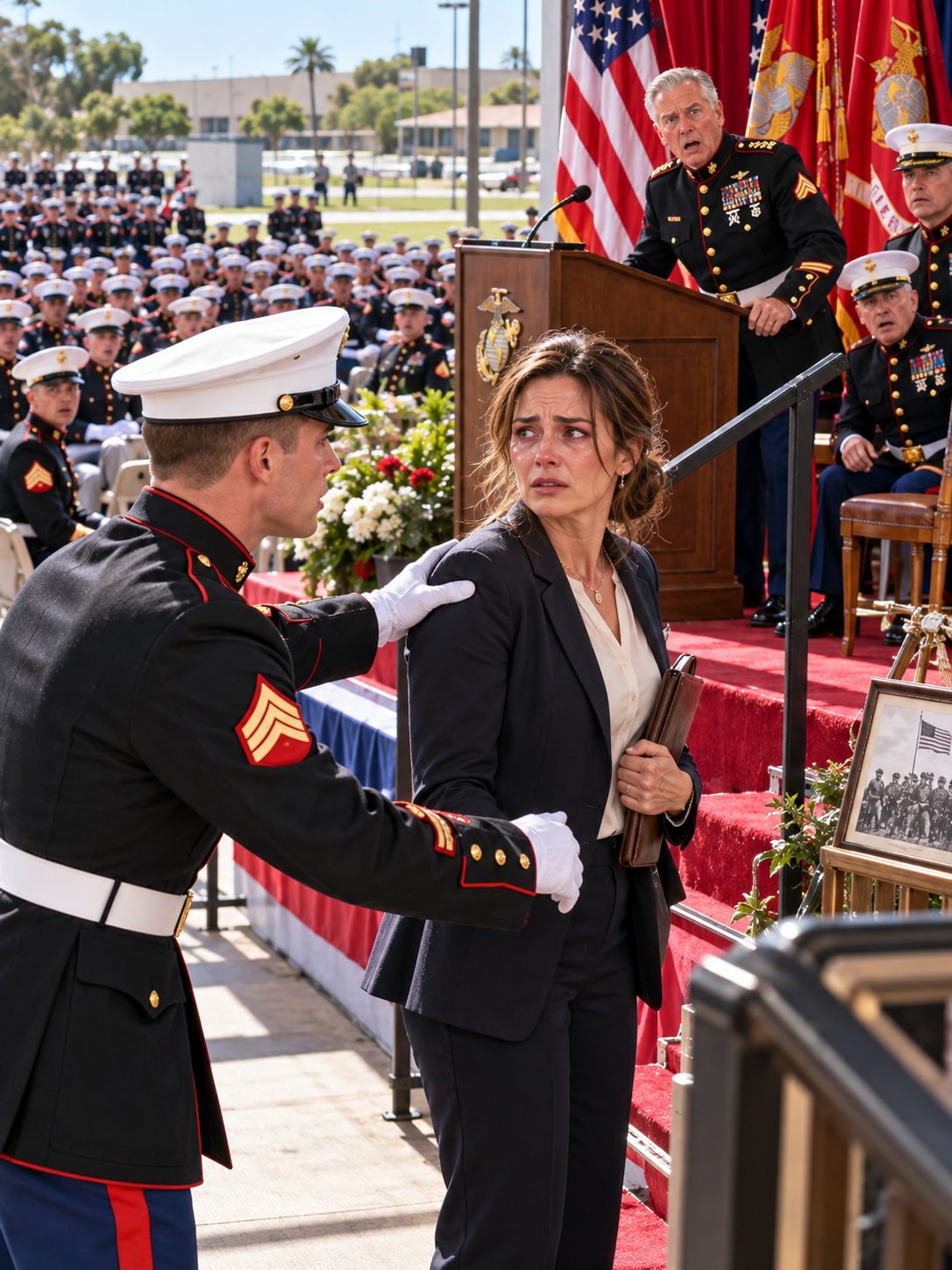
A young Marine put his hand on my shoulder in front of hundreds of people and calmly told me I was not allowed near the change-of-command stage. I could have ended his mistake with six words, but humiliating him would have taught the wrong lesson. What he couldn’t see was the history connecting me to that battalion—or why another Marine’s hand on my shoulder sixteen years earlier had changed every decision I made afterward.
### Part 1
The corporal’s palm landed flat against my shoulder just as my right foot touched the paved walkway leading toward the reviewing stand. “Ma’am, I’m going to need you to stop right there,” he said, already turning his body sideways to block me. Behind him, three hundred Marines, officers, family members, and guests filled the parade deck beneath a cloudless Carolina sky, and somewhere near the band I heard a trumpet being tested twice. The corporal looked about twenty-two, his uniform pressed so sharply it seemed capable of cutting paper, and his expression told me he believed he was handling a minor problem before the ceremony began.
“This area is restricted to the command party,” he continued, pointing toward the chairs behind a low ceremonial rope. “Family seating is over there, and the ceremony will begin shortly.” He wasn’t rude, which mattered to me then and matters even more when I tell the story now. He was patient in the particular way young Marines become patient with civilians who appear confused, and because he thought I was one of those civilians, he began guiding me backward.
I let him move me half a step. That surprises people whenever they hear what happened, because everyone imagines I should have snapped my rank at him immediately, watched his face collapse, and marched onto the stage while the crowd enjoyed his humiliation. Instead, I looked at the brass stanchions, the rows of folding chairs, and the battalion colors waiting beside the reviewing stand while his hand remained on my shoulder. Thirty yards away, Brigadier General Malcolm Reeves lowered the folder he had been reading and stared directly at us.
The general knew who I was. Corporal Jonah Pike did not.
My aide, First Lieutenant Owen Brooks, had disappeared ten minutes earlier to solve a problem involving a microphone that apparently refused to cooperate with anyone below the rank of major. We had arrived early because I had insisted on arriving early, a habit I had acquired long before anyone trusted me with command. Instead of waiting beside the parking area like a sensible incoming commander, I had looked across the field at the battalion assembling beneath its colors and decided I wanted to see them before they saw me. In less than an hour, every training decision, deployment recommendation, disciplinary problem, casualty notification, and late-night phone call connected to those Marines would ultimately belong to me.
I wanted five minutes when they were still strangers.
So I walked alone across the grass in my service uniform, without an escort, without a program, and without anyone announcing me. I knew exactly where I was going, but to Corporal Pike I looked like a woman drifting toward a stage reserved for senior officers. He had been posted there to prevent exactly that from happening. When he stepped in front of me, he wasn’t violating his orders; he was following them.
The mistake happened afterward.
“Corporal,” I said quietly, looking at the hand still resting against my shoulder, “take your hand off me.”
Something in my voice reached him before the words did. His hand dropped immediately, almost automatically, and for half a second the Marine replaced the twenty-two-year-old in his face. Then confusion returned. “Yes, ma’am, but you still need to move behind the rope.”
That was when I understood he genuinely had not looked at my collar.
It sounds impossible until you understand what certainty does to the human eye. He had seen a woman walking alone where civilians were not supposed to walk, decided who I must be, and from that moment forward everything he saw passed through that conclusion. My insignia had been visible the entire time. He simply had no reason, in his mind, to look for it.
I had spent more than twenty years watching that happen in different forms. Sometimes people saw a woman before they saw an officer; sometimes they saw an officer before they saw a human being. Sometimes I was the one making the wrong assumption, which is harder to admit but more important. The most dangerous judgment I ever made in uniform had begun with absolute certainty, and a twenty-one-year-old Marine had paid for it.
Sixteen years earlier, another hand had struck the same shoulder.
That hand belonged to Lance Corporal Caleb Ward.
Even after all those years, I could remember its weight more clearly than I remembered the sound that followed. Caleb had grabbed the back of my gear and pulled me down behind a broken wall on a morning when I had once again decided the front of the formation was the only acceptable place for a lieutenant trying to prove she belonged. He pushed me into cover, stepped where I had been standing, and never came home. I had lived every day since inside the distance his hand moved me.
On the parade deck, Corporal Pike glanced toward the people gathering nearby and raised his voice slightly. “Ma’am, I really need you to move now. You’re holding up the command party.”
I nearly smiled. Not because he was foolish, but because the sentence was so perfectly backward.
I wasn’t holding up the command party.
I was the person they were waiting for.
Still, I understood what the growing audience was doing to him. Families had stopped talking, several Marines near the chairs were watching openly, and a captain beside the reviewing stand had turned in our direction. Pike could feel every pair of eyes. Young people often become more certain when an audience makes uncertainty embarrassing.
“What’s your name, Corporal?” I asked.
His chin rose a fraction. “Corporal Jonah Pike, ma’am.”
He gave it the way a Marine gives his name when he assumes someone intends to report him. I could practically hear the thought forming behind his eyes: complaint, angry civilian, command investigation. I didn’t blame him. He still believed he understood the situation.
“Corporal Pike,” I said, keeping my voice low, “in about thirty seconds, several people are going to become embarrassed for you. Before that happens, I want you to know something.”
His expression changed.
Not much. Just enough.
“You haven’t done anything wrong yet.”
For the first time since he’d stopped me, his certainty cracked. His eyes moved briefly from my face to my collar, but before they reached the insignia, another sound cut across the parade deck: boots striking pavement quickly and hard. People near the aisle moved aside before the man crossing toward us said a single word.
I knew that walk.
Every Marine knows that walk.
A sergeant major was coming.
I turned toward him, expecting an irritated senior enlisted leader I had not yet met, someone prepared to rescue the ceremony from an awkward misunderstanding. Instead, the man crossing the deck looked directly at me and stopped so suddenly that for an instant the entire morning seemed to fold in half. I recognized his face at almost the exact moment he recognized mine.
Sixteen years disappeared between us.
And suddenly I was not looking at Sergeant Major Elias Navarro.
I was looking at a nineteen-year-old lance corporal standing ten feet away from Caleb Ward behind a broken wall.
### Part 2
Elias Navarro had been little more than a kid the last time I saw him. Back then his helmet always seemed slightly too large, his sleeves never stayed exactly where regulations wanted them, and he had the unnerving ability to remain silent while everyone else complained. He had been in my rifle platoon during a deployment that aged all of us more quickly than the calendar had any right to. On the worst morning of my life, he had watched Caleb Ward save me.
Caleb was different. He talked when the rest of us needed noise, especially during the long stretches when everyone was tired enough to become trapped inside his own thoughts. He could make Marines laugh while cleaning equipment, waiting for transport, or sitting through another briefing everyone already understood. When Caleb stopped joking, I learned to pay attention.
A week before the morning behind the wall, he had been cleaning his rifle when he spoke without looking up. “Ma’am, you know you don’t have to lead every movement from three feet in front of everybody else.”
I remember pretending not to understand him. “You questioning my tactical brilliance, Ward?”
“I’m questioning your addiction to proving things nobody asked you to prove.”
Navarro nearly choked trying not to laugh.
Caleb finally looked at me. His expression wasn’t disrespectful; if anything, that made his words harder to dismiss. “If something happens to you in the first minute, we’re the ones who have to figure out what comes next. Sometimes leadership means letting somebody else stand in front.”
I told him I appreciated his concern. What I meant was that I had no intention of listening.
At twenty-seven, I believed courage was measurable by proximity to danger. I had spent years knowing that some people considered me a curiosity before they considered me a Marine officer, and I responded by making myself impossible to question. If equipment needed carrying, I carried more. If weather was miserable, I volunteered for the worst position. If a route looked exposed, I somehow found myself at the front.
I called it leading by example.
Caleb understood before I did that sometimes it was simply pride dressed in a uniform.
The morning everything changed smelled like dust, sweat, and hot stone. We were moving through a narrow area where the walls were high enough to hide what waited beyond them, and the silence had become too complete. Caleb had gone quiet several minutes earlier. I noticed but failed to listen to what that silence meant.
I was standing where I had trained myself always to stand.
In front.
Then Caleb’s hand hit my shoulder.
He didn’t ask permission or explain. He jerked me downward with enough force to knock me off balance and pushed me behind the wall. For one brief instant I was angry because I didn’t understand what he had seen.
Then he stepped into the space I had occupied.
I will not describe what followed in detail. There are people who loved Caleb before the Marine Corps ever knew his name, and their memories do not need the sounds that live in mine. What matters is simple: I was alive because Caleb Ward had moved me, and Caleb Ward did not come home because he had taken the position I believed belonged to me.
The equation formed in my mind instantly.
He was there because I should have been there.
For sixteen years I tried to solve that equation, but grief does not become mathematics merely because an officer wants something orderly enough to understand. I could analyze every movement, decision, and warning sign, yet the answer always returned to that single unbearable truth. Caleb had seen danger before I did, and when the weight came, he carried it for me.
I didn’t get to collapse.
That is one of the cruelest facts about leadership in moments people later call heroic. There were Marines around me who had just watched Caleb fall, and they were looking at my face to learn how frightened they were allowed to become. My grief had to wait because their survival could not.
So I stood.
I gave orders.
I did the next necessary thing.
Navarro was ten feet away, staring at me with eyes I never forgot. He looked younger than nineteen, and for one second I could see that he wanted me to explain why the world had just done something so unfair. I had no explanation. All I could give him was direction.
“We carry him ourselves,” I said.
Nobody argued.
We took turns. Every Marine who could put a hand beneath the weight did so, because I understood instinctively that leaving Caleb to strangers would become another wound. Navarro took his turn with his jaw clenched and his eyes forward. I remember thinking, absurdly clearly, that he was going to become somebody.
The days afterward arrived in fragments. Reports. Calls. Inventories. Questions asked by people far from the place where answers had actually mattered. Then came the letter to Caleb’s mother.
Nothing prepared me for that blank page.
A report can hide behind phrases and official language. A letter to a mother cannot. I sat at a folding table with a pen in my hand and tried to explain why her twenty-one-year-old son was not coming home.
Eventually I wrote the only thing I believed she deserved.
I told her Caleb had recognized danger before I did. I told her he had moved me to safety and stepped forward when every instinct of self-preservation should have told him to step back. I told her that I would not turn him into a slogan because he had been more than the final seconds of his life.
Then I wrote a sentence I have never forgotten.
I am alive because of the man you raised, and I will spend my life trying to be worthy of what that cost him.
I kept a copy.
Sixteen years later, the paper was folded in the inside pocket of my uniform as Sergeant Major Elias Navarro crossed the parade deck toward me.
I hadn’t known he would be there. The Marine Corps is large enough for careers to travel thousands of miles apart and small enough for the past to step around a corner without warning. Somewhere between being that quiet lance corporal and the senior enlisted Marine of the battalion I was about to command, Navarro had lived an entire military life I knew nothing about.
Now his eyes were moving across my face.
I watched him recognize the young lieutenant beneath the older one.
I watched the wall return to him.
Then he saw Corporal Pike standing between me and the stage.
Navarro stopped three feet away and came to attention with a crack of his heels so sharp nearby conversations died instantly. Pike straightened, but he still did not understand. I saw him glance from the sergeant major to me as though waiting for someone to explain why the atmosphere had changed.
Navarro looked at him.
“Corporal Pike.”
“Sergeant Major.”
“Take one step back from the lieutenant colonel.”
The words landed harder than any shout could have.
Pike’s eyes snapped toward my collar.
This time he actually saw it.
The color left his face.
### Part 3
There is a particular expression people wear when the world they were certain about changes in one second. Corporal Pike’s face moved through confusion, calculation, disbelief, and finally horror while he stared at the rank insignia that had been visible from the beginning. He opened his mouth but nothing came out. Behind him, the crowd became so quiet I could hear the small metal clips striking the flagpole in the morning breeze.
Navarro turned to me.
For a moment he was Sergeant Major Elias Navarro, senior enlisted leader of the battalion, perfectly composed in front of hundreds of people. Then his eyes softened just enough for the nineteen-year-old behind the wall to appear. “Lieutenant Colonel Mara Ellison,” he said formally, and then much quieter, “It’s good to see you again, ma’am.”
I had prepared myself that morning for speeches, salutes, old photographs, and the weight of accepting command.
I had not prepared myself for a ghost to speak.
“Sergeant Major,” I said.
My voice almost held.
Almost.
His mouth shifted with the smallest hint of recognition, as if he understood exactly what it had cost me to say those two words normally. Then the formal mask returned. He faced Pike again.
The corporal had gone rigid.
A captain from the reviewing stand hurried toward us, followed by another officer from the ceremony staff. I could read the situation on their faces before either spoke. Somebody needed to pay for the spectacle everyone had just witnessed.
“Ma’am,” the captain said, keeping his voice low, “I’ll remove him immediately.”
Pike stared straight ahead.
The crowd waited.
This is the point where most retellings become satisfying in the wrong way. People want me to describe how good it felt watching the young Marine realize the woman he had been pushing behind a rope was the incoming commander. They expect a sharp sentence, public correction, maybe some punishment dramatic enough to match the humiliation.
I understood that desire because part of me felt it too.
Twenty years in uniform had not purified me into some endlessly patient symbol of wisdom. I was embarrassed. I was angry that he’d seen what he expected rather than what was standing directly in front of him. A tired part of me wanted the clean little victory of watching everyone decide I had been wronged.
The captain leaned closer. “Say the word, ma’am.”
I looked at Pike.
He was twenty-two.
Caleb had been twenty-one.
That fact changed the entire field.
“Nobody is removing him,” I said.
The captain blinked.
“Ma’am?”
“Stand down.”
“He put his hands on the incoming battalion commander.”
“He stopped an unidentified person attempting to enter a restricted area.”
“Colonel, he—”
I looked at him.
The captain stopped.
“We’re not starting my command by destroying a corporal for doing the job we posted him here to do.”
The captain’s jaw tightened. “Yes, ma’am.”
I turned toward Pike.
His eyes stayed fixed somewhere beyond my shoulder.
“Look at me, Corporal.”
He did.
Barely.
“You were assigned to hold this walkway?”
“Yes, ma’am.”
“You were told not to let unauthorized people onto the reviewing stand?”
“Yes, ma’am.”
“I approached alone with no escort.”
“Yes, ma’am.”
“Then stopping me was not your mistake.”
His eyes finally focused on mine.
I let the silence remain long enough for him to understand there was another sentence coming.
“Your mistake was deciding who I was before you finished looking.”
His face changed.
Not relieved.
Listening.
“You saw someone you didn’t recognize, and you decided that meant I could not belong here. Once you made that decision, you stopped gathering information. My rank was visible, Corporal. You didn’t see it because certainty had already told you not to look.”
“Ma’am, I—”
“I’m not asking for an explanation.”
“Yes, ma’am.”
“I’m giving you something cheaper than the way I learned this lesson.”
Navarro’s eyes moved toward me.
He knew exactly what I meant.
I continued. “You will spend your entire career making fast judgments about people. Sometimes you won’t have a choice. The first impression isn’t the problem. The problem comes when you become so attached to it that new information cannot reach you.”
Pike swallowed.
“Do you understand?”
“Yes, ma’am.”
This time the answer sounded real.
“Good. Now recognize me, Corporal.”
He came to attention.
“Lieutenant Colonel Mara Ellison, ma’am.”
“Then let me pass.”
His salute was not perfect. His hand trembled slightly, and anyone interested in parade-ground precision could have found something to criticize. But I have received thousands of salutes, and that one remains among the few I remember.
I returned it.
Then I walked past him.
The general still stood on the reviewing stand with the command orders in his hands. He had watched everything without interfering, which told me he understood something several people below him had not. The real ceremony had already started.
My first decision as commander had happened before the orders were read.
The official part merely needed to catch up.
As I reached the stairs, Navarro fell into step beside me. Neither of us spoke until we were halfway up. The sunlight caught the ribbons on his uniform, and I found myself thinking about how many years were represented in that small rectangle of color.
“You stayed,” I murmured.
“Yes, ma’am.”
“All these years.”
“So did you.”
That answer stopped something inside me.
I had never thought of it that way.
For sixteen years I had considered myself the person who survived Caleb Ward. I had never stopped to realize Navarro carried the same morning from a different angle. He had watched Caleb fall, watched me stand back up, and then spent his own career deciding what that memory required of him.
Two people had left that wall.
We had apparently both been trying to become worthy of the person who had not.
The outgoing commander, Lieutenant Colonel Aaron Vance, waited near the colors. He gave me a look that said he had witnessed the entire mess and was saving whatever comment he wanted to make for a much more private setting. The band settled. Chairs stopped moving. The ceremony began.
General Reeves opened the orders.
By then everyone knew.
But knowing and hearing were different things.
“From Headquarters, United States Marine Corps,” he began.
My name traveled through the loudspeakers across the parade deck.
Lieutenant Colonel Mara Ellison.
Assumption of command.
Effective this date.
The formal words were plain, almost dry, but each one removed another piece of the stranger Corporal Pike had imagined ten minutes earlier. I looked toward the formation instead of the crowd. Hundreds of Marines stood facing me, and somewhere near the rope line, one corporal was learning that the woman he had tried to send away was about to become responsible for every person standing on that field.
Then Aaron Vance stepped to the microphone.
He thanked families, praised the Marines, spoke about deployments and training, and did all the things an outgoing commander is supposed to do. Near the end, he paused and looked directly toward the battalion.
“Some of you believe you’re meeting your new commander today,” he said.
I felt Navarro glance at me.
Vance continued.
“You’re not.”
The field went still again.
“Lieutenant Colonel Ellison served in this battalion sixteen years ago.”
Something tightened beneath my ribs.
“She wore a different rank. Most of you were children. But she carried these colors before any of you knew her name.”
He paused.
Then he said the one sentence nobody had warned me about.
“Colonel Ellison isn’t arriving here today.”
His eyes met mine.
“She’s coming home.”
### Part 4
For one dangerous second, I stopped hearing the ceremony. The reviewing stand, band, chairs, and hundreds of people blurred into shapes while the word home settled somewhere I had spent sixteen years refusing to examine too closely. I had considered that battalion many things over the years: my first real test, my deepest loss, the place that taught me how dangerous pride could become. I had never allowed myself to call it home.
Then Navarro lifted the battalion colors.
Ceremonial flags are strange objects because they look lighter than what they represent. A wooden staff, fabric, streamers, metal fittings—nothing one healthy person cannot easily carry. But every streamer records a campaign, every ribbon points backward toward people who stood beneath that flag before you, and once you understand that, the object becomes almost impossibly heavy. Commanders are not given ownership of colors; they are given temporary custody of everything those colors remember.
Vance placed his hands on the staff.
Navarro received it from him.
Then the sergeant major turned toward me.
Three steps separated us.
I saw the young lance corporal inside the senior enlisted Marine again.
Not because he looked young anymore. His hair carried gray near the temples, his face had sharpened with age, and decades of responsibility had changed the way he held himself. But his hands were the same hands that had helped carry Caleb Ward away from the wall.
Now they were bringing me the battalion colors.
Navarro stopped in front of me.
For one second we looked at each other.
No microphone could hear what passed between us, because neither of us spoke.
I know what this weighs for you, his eyes said.
I know you do, mine answered.
Then he extended the colors.
I took them.
The staff settled into my palms.
Somewhere among the battalion’s recorded campaigns was the deployment that included the morning Caleb died. His name existed in the unit’s history, probably inside some folder, roster, or memorial list few of the Marines standing in formation had ever read. But I knew exactly where he belonged.
He belonged in the weight.
I spoke the required words.
The colors were mine to carry.
So was the battalion.
Afterward, people told me they noticed I paused before speaking. They assumed I was overwhelmed by the significance of command, and in the broadest sense they were correct. What they didn’t know was that I had a folded copy of Caleb’s mother’s letter inside my uniform, close enough that I could feel its outline whenever I breathed deeply.
My speech came last.
I had written three pages.
I used less than one.
Long change-of-command speeches are mostly remembered by Marines for how long they were forced to stand in the sun, and I had no desire to begin my relationship with the battalion by making them resent my microphone. I stepped forward and looked at the formation.
“Sixteen years ago,” I began, “I served under these colors as a young lieutenant.”
Heads shifted slightly.
“I knew less than I thought I knew.”
Navarro’s mouth almost moved.
“I suspect some of you know that feeling.”
A few smiles appeared.
“I’ve been given the privilege of returning with more experience and, I hope, slightly less certainty.”
That time the smiles spread.
I didn’t tell them about Caleb. Not yet. His story did not belong to my first speech merely because it could make the speech powerful. Grief should never become decoration.
So I told them something simpler.
“You will hear commanders say that Marines work for them. There is truth in that. But command runs in both directions.”
I looked across the companies.
“I work for you too.”
Nobody moved.
“I work to make sure your training is worthy of what we may ask you to do. I work to make sure your families receive you back whenever circumstances allow it. I work to make sure discipline is fair, standards matter, and nobody’s dignity becomes currency for somebody else’s ego.”
For the first time, my eyes moved toward the rope line.
Pike was staring straight ahead.
I did not name him.
I didn’t need to.
“You don’t have to believe me today.”
Several faces changed.
“Actually, I’d prefer you didn’t.”
That earned a few confused looks.
“Watch me instead.”
Now I had them.
“Watch what happens when somebody fails. Watch what happens when someone tells me something I don’t want to hear. Watch how this command treats the youngest Marine in the room when nobody important is watching.”
General Reeves folded his arms.
“Then decide.”
I stepped back.
That was the entire speech.
The ceremony ended twenty minutes later.
Families moved toward their Marines, cameras appeared, officers surrounded Vance, and people began doing what people always do after military ceremonies—congratulating the new commander as though command were a prize she had won. I accepted handshakes, remembered names, posed for photographs, and tried to keep my attention from drifting toward the rope line. Pike was still there.
General Reeves found me near the edge of the reviewing stand.
He had the careful face of a man who rarely said more than he intended. “Strong first ten minutes, Colonel.”
“Not the first ten minutes I planned, sir.”
“Those aren’t usually the useful ones.”
He shook my hand.
Then he kept holding it.
“You could have taken that corporal’s stripes this morning.”
I glanced toward Pike.
“Possibly.”
“Half the officers I know would have.”
“That’s unfortunate.”
One corner of Reeves’s mouth moved.
“A quarter would’ve enjoyed it.”
“That’s worse.”
He studied me for a moment.
“Why didn’t you?”
I knew the official answer. Leadership development. Proportional accountability. Good order and discipline. All the phrases officers use when talking about human beings from behind desks.
Instead, I gave him the truth.
“Stripes are easy to take, sir.”
He waited.
“They’re difficult to grow.”
The general said nothing.
I continued. “A whole battalion just watched what I do when a young Marine embarrasses me publicly and has absolutely nothing he can offer my career. I could have taught them that my pride costs more than one of their people.”
“And instead?”
“I’d rather they learn I’ll grow them before I grind them.”
Reeves finally released my hand.
“I’ve relieved commanders,” he said. “Good records. Good evaluations. Smart people.”
I waited.
“The failure was almost never one dramatic decision. It was dozens of small ones nobody bothered putting into a report.”
His eyes shifted toward the Marines moving across the grass.
“How a person treats someone who cannot help them tells me more than most fitness reports.”
I thought about Caleb.
“You had nothing to gain from protecting that corporal,” Reeves said.
“No, sir.”
“And something to gain from humiliating him.”
“Only for about thirty seconds.”
The general nodded slowly.
“Exactly.”
Then he stepped back.
“Carry on, Colonel.”
After he left, Navarro appeared beside me.
For several seconds neither of us spoke.
Then he looked toward the reviewing stand and said, “Ward would’ve thought this was hilarious.”
I turned.
“What?”
“You getting thrown off your own change of command.”
The laugh escaped before I could stop it.
A real laugh.
Not polite.
Not controlled.
Caleb would have told the story forever.
The lieutenant who always insisted on standing in front had finally been told to get behind the rope.
“He would’ve never let me forget it,” I said.
“No, ma’am.”
Navarro smiled.
“He absolutely would not.”
And for the first time in sixteen years, Caleb Ward’s name existed in my mouth beside laughter instead of only grief.
That might have been the greatest gift I received that day.
### Part 5
The battalion commander’s office was almost disappointingly ordinary. One desk, several chairs, a flag, shelves full of binders, a window overlooking part of the headquarters area, and a wall covered with framed photographs of previous commanders. By late afternoon everyone had finally stopped congratulating me long enough for the building to become quiet.
I walked toward the photographs.
Nearly every face was male.
Some I recognized from Marine Corps history, some from assignments where our paths had crossed, and several from nothing more than names I remembered seeing on old documents. Halfway down the wall I found the commander from my lieutenant years.
Colonel Henry Dalton.
He had seemed impossibly old to me back then.
Looking at the photograph now, I realized he had probably been younger than I was.
Dalton had been the man who called me into his temporary office after Caleb died. He didn’t offer me easy comfort, which I appreciated even then. He asked whether I could continue leading the platoon.
I had answered yes.
He looked at me for a long time.
Then he said, “That’s not what I asked, Lieutenant.”
I remember being angry.
“I asked whether you can lead them, not whether you can physically stay upright.”
At twenty-seven, I thought the distinction was insulting.
At forty-three, standing in his old battalion commander’s office, I finally understood it.
A person can remain standing and still be incapable of carrying anyone else.
There had been years when I came dangerously close to learning that too late.
My career after that deployment looked clean enough on paper. Promotions. Schools. Assignments. Instructor duty where I trained young officers and occasionally saw something in their faces that reminded me of the lieutenant I had once been.
I became particularly suspicious of the fearless ones.
Fearless young officers worried me.
Fear usually meant the person understood the price.
Certainty was more dangerous.
I spent three years teaching lieutenants that leadership did not require proving they could personally carry every burden in the organization. Some listened. Some smiled the way I had smiled at Caleb Ward.
Whenever that happened, I felt the old wall rise between us.
After the schoolhouse came staff assignments, planning jobs, exercises, and the strange institutional education that teaches an officer how much of war is prepared inside rooms where nobody looks heroic. Then came the year I rarely discussed. The year the box I had packed grief into finally opened.
People imagine trauma behaves according to calendars.
It doesn’t.
For years I functioned perfectly. Then one ordinary season, nothing dramatic happened, and suddenly sleeping became difficult. Certain sounds carried me places I did not want to go.
I eventually did the least glamorous and most useful thing of my career.
I admitted I needed help.
That year never appeared on a command photograph.
Neither did the conversations, the work, or the humiliating process of discovering I couldn’t order my own mind into obedience.
But that invisible year had shaped what happened with Corporal Pike as surely as any military school.
I understood the danger of making permanent judgments about people during their worst thirty seconds because I had once needed others not to judge me during my worst year.
I sat behind the desk.
The first folder waiting for me contained routine administrative matters.
The second concerned training.
The third involved a Marine with family problems serious enough to require command attention.
The work began immediately.
That was comforting.
Work had always been how I carried weight without pretending it had disappeared.
Before opening the first folder, I reached into my uniform and removed Caleb’s letter.
The paper had softened along the folds.
I read only the final paragraph.
I am alive because of the man you raised, and I will spend my life trying to be worthy of what that cost him.
Sixteen years had changed how I understood that promise.
At twenty-seven, worthy meant becoming tougher.
At thirty, it meant becoming more competent.
At thirty-five, it meant advancing far enough that Caleb’s sacrifice had produced something valuable.
By forty-three, I understood the promise differently.
Being worthy was not a rank.
It was not a command.
It was not a wall of photographs.
It was what happened in moments nobody planned.
The hand you did not slap away.
The corporal you did not destroy.
The frightened lieutenant you allowed to admit she was frightened.
The private whose mistake you corrected without turning him into entertainment.
I folded the letter and put it away.
Then I said his name aloud.
“Lance Corporal Caleb Ward.”
The empty office held it for me.
Three weeks later, I saw Corporal Pike again.
I had kept track of him without making it obvious. His platoon commander reported no disciplinary problems. His squad leader said Pike had become unusually quiet after the ceremony.
That bothered me more than anger would have.
Shame becomes heavy when people carry it alone.
I found him near one of the company spaces after a training meeting. He saw me and came to attention so quickly he nearly dropped the notebook in his hand.
“At ease, Corporal.”
“Yes, ma’am.”
He relaxed technically.
Nothing else about him relaxed.
I could see him waiting for the delayed punishment.
“How are you doing?”
“Good, ma’am.”
It was the least convincing answer I heard that week.
I nodded toward the notebook. “Walk with me.”
We crossed toward a row of buildings while Marines moved around us carrying equipment and complaining about the heat.
Pike remained silent until he couldn’t.
“Ma’am, I’ve thought about that morning every day.”
“Good.”
That surprised him.
“Good, ma’am?”
“Yes.”
He looked worried.
I stopped walking.
“Now stop thinking about what happened to you.”
His expression tightened.
“Think about what happens next.”
“I don’t understand.”
“You will meet thousands of people in this uniform. Marines younger than you. Officers you dislike. Civilians who frustrate you. People who look lost. People who look confident and are completely lost.”
He listened.
“You can’t control your first impression.”
I tapped the notebook lightly.
“But you can control whether your first impression becomes a prison.”
His eyes lowered for a second.
“I should have seen your rank.”
“Yes.”
“I’m sorry.”
“I know.”
He looked up.
“That apology isn’t the useful part anymore.”
“What is?”
“Whether the private who arrives tomorrow gets treated like he might someday become somebody.”
Something changed in his face.
I continued.
“Because sixteen years ago, there was a nineteen-year-old lance corporal in my platoon named Elias Navarro.”
Pike’s eyes widened slightly.
“Yes. Your sergeant major.”
He glanced toward headquarters instinctively.
“Nobody looking at him then would’ve seen what he became.”
I paused.
“And there was another lance corporal.”
I had not planned to say Caleb’s name.
But the morning seemed to ask for it.
“Caleb Ward.”
Pike waited.
“He taught me the same lesson you learned on that parade deck.”
I looked at him.
“Mine cost more.”
He understood enough not to ask how.
“Learn yours cheaper, Corporal.”
His shoulders straightened.
“Yes, ma’am.”
This time, when he said it, there was no fear inside the answer.
### Part 6
Command became real quickly. Ceremonies make responsibility look polished, but actual battalions are held together by things like broken vehicles, missed appointments, marriages under strain, training accidents narrowly avoided, and exhausted staff officers carrying coffee they forget to drink. Within a month, the parade deck felt less like the beginning of my command than something that had happened to another woman.
Navarro became my closest professional partner.
We rarely discussed Caleb.
We didn’t need to.
Sometimes I would enter the operations center late and find Navarro standing over a map with the same expression he wore behind the wall sixteen years earlier. In those moments, the shared history between us sat quietly in the room, neither hidden nor displayed.
He had built an extraordinary career.
I learned how slowly.
No miracle assignments.
No influential sponsor pulling him upward.
He had simply become dependable one difficult year at a time.
Platoon sergeant.
Company first sergeant.
Operations assignments.
Deployments.
Senior enlisted leadership.
The nineteen-year-old I once watched carry Caleb had turned into the Marine everyone else looked toward when things became uncertain.
One afternoon I asked him why he stayed.
We were alone after a meeting.
He considered pretending not to understand.
Then he sat back.
“Same reason you did, probably.”
“I don’t know if that’s healthy.”
“It wasn’t always.”
We both laughed quietly.
He rubbed a hand across his chin.
“After Ward, I kept thinking somebody had to make what happened mean something.”
“I know.”
“Then I got older.”
He looked toward the window.
“And I realized that’s too much pressure to put on a dead man.”
That sentence struck harder than I expected.
Navarro continued.
“Ward doesn’t need my career to justify his life. He had a life before that morning.”
I nodded slowly.
“He was funny.”
“He was annoying.”
“He was extremely annoying.”
“He cheated at cards.”
“I never proved that.”
“Ma’am, everybody proved that.”
I laughed again.
Navarro smiled.
“That’s what I mean. For years I turned him into the guy who saved you.”
His expression softened.
“He was also the guy who owed me forty dollars.”
“I didn’t know that.”
“He died owing me money.”
“That explains your career. You’ve been chasing the debt.”
“Exactly.”
The laughter faded naturally.
What remained felt lighter.
That conversation changed something in me.
For sixteen years, I had built Caleb’s memory around his final choice.
It was an understandable mistake.
The final moment was the reason I was alive.
But Caleb had been twenty-one years of life before he became one second of sacrifice.
Reducing him to what happened behind the wall was another way of failing to see the whole person.
The realization followed me into a training exercise two weeks later.
One company was running a complicated field problem designed to test small-unit leaders under uncertainty. I observed from a distance because battalion commanders who stand too close to training usually cause everyone to perform for the commander instead of learning. Pike’s platoon was participating.
Near midday, a young private made a mistake.
Nothing dangerous.
Nothing catastrophic.
He misunderstood an instruction, moved equipment to the wrong location, and caused enough confusion to irritate everyone already hot and tired.
I watched Pike approach him.
The old version of the moment was obvious.
A corporal with authority.
A private embarrassed in front of others.
The easy instinct would have been to make an example.
Pike opened his mouth.
Then stopped.
He looked at the private.
Actually looked.
“Tell me what you thought you heard.”
The private explained.
Pike listened.
Another Marine interrupted.
Pike raised a hand.
“Hold on. Let him finish.”
The private finished.
Pike discovered the instruction had passed through three people before reaching him and had changed somewhere along the way.
The mistake was still his.
But it wasn’t only his.
Pike corrected him.
Then he corrected the communication process.
Nobody was humiliated.
Training continued.
I stood beside Navarro fifty yards away.
“Did you see that?” he asked.
“Yes.”
“You going to tell him?”
“No.”
Navarro glanced at me.
“Why not?”
“Because eventually he needs to believe that’s who he is, not something he performs because he thinks I’m watching.”
The sergeant major smiled.
“You’re learning.”
“I outrank you.”
“Still learning.”
That evening, Pike’s platoon commander mentioned the incident without knowing I had seen it.
“Pike handled that private well.”
I kept my face neutral.
“Good.”
“He’s been different since the change of command.”
That interested me.
“Different how?”
“Less interested in being right immediately.”
I looked down at the report in front of me.
There it was.
The return on the decision people thought had been mercy.
Mercy had almost nothing to do with it.
If Pike had intentionally ignored my rank or treated me disrespectfully after recognizing it, discipline would have been appropriate.
But punishment is supposed to correct behavior.
Humiliation is something else.
Humiliation satisfies the person delivering it.
I had been offered the pleasure of making Pike feel as small as he had accidentally made me feel.
I declined.
A month later, a private benefited from that choice.
Maybe a year later another Marine would.
Maybe Pike would become a sergeant and carry the lesson forward.
Maybe he wouldn’t.
Leadership never gives guarantees.
You plant things you may never see grow.
That truth reminded me of Caleb again.
He had never known what his final decision would become.
He had not grabbed my shoulder because he imagined battalion command sixteen years later.
He saw danger.
He moved.
Everything afterward belonged to those of us who survived.
That night I opened the battalion history files.
I had been avoiding them.
Navarro found me two hours later sitting alone with an old deployment roster.
He didn’t need to ask what I had found.
Caleb Ward’s name was there.
One line among hundreds.
Lance Corporal Caleb M. Ward.
A service number.
A unit assignment.
Dates.
The bureaucracy of memory.
I touched the page.
“I used to hate how small this looked,” I said.
Navarro sat across from me.
“Yeah.”
“A whole person reduced to one line.”
“That’s why we remember the rest.”
I looked at him.
He continued.
“The paperwork doesn’t carry him.”
“We do.”
“Exactly.”
For the first time in sixteen years, that idea did not feel like a punishment.
It felt like permission.
### Part 7
Three months into command, the battalion held a memorial observance for Marines who had died while serving under its colors. It wasn’t built around Caleb, and I refused suggestions that my personal history should become the center of the event. Names were read from several periods, several conflicts, several generations. Every one belonged equally to the battalion.
Still, when Caleb Ward’s name was spoken, the air changed for me.
I stood beside Navarro.
Neither of us moved.
Across the formation, Corporal Pike stood with his company.
He knew enough by then to understand that something about Caleb connected the sergeant major and me, but he did not know the whole story.
I preferred it that way.
Not every lesson needs the entire legend behind it.
After the ceremony, Navarro and I walked toward headquarters.
“His mom is still alive,” he said.
I stopped.
“What?”
“Ward’s mother.”
“I know.”
“No, I mean I spoke with her.”
That surprised me.
“When?”
“Last year.”
I stared at him.
Navarro looked almost uncomfortable.
“She found me through another Marine from the platoon.”
“What did she want?”
“To know what he was like.”
I swallowed.
“And?”
“I told her he cheated at cards.”
I laughed despite myself.
Navarro continued.
“I told her he hated powdered drink mix. Told her he could imitate Staff Sergeant Bell so well we almost got him killed for it.”
“Bell wanted to kill all of us.”
“True.”
He glanced at me.
“Then she asked about you.”
My steps slowed.
“What did you say?”
“That you carried him too.”
The words entered quietly.
I looked away toward the trees.
Navarro continued, perhaps because he knew stopping would make it worse.
“She said something I figured you’d want to hear eventually.”
I waited.
“She said you didn’t owe her your life.”
For sixteen years, I had imagined conversations with Caleb’s mother.
None sounded like that.
Navarro kept his voice gentle.
“She said she read your letter until the folds started tearing.”
My hand moved unconsciously toward the inside pocket where my copy often remained.
“She remembers every word.”
I couldn’t speak.
“But she doesn’t want her son’s last decision to become a debt that keeps charging interest against you forever.”
I stared at the headquarters building.
“Those were her words?”
“Almost exactly.”
I breathed out slowly.
“What did you tell her?”
“That you’d probably ignore the advice.”
That made me laugh and almost cry at the same time.
“You’re becoming insubordinate, Sergeant Major.”
“Twenty-seven years of practice.”
We resumed walking.
For the rest of that day, I carried a sentence I had never allowed myself to consider.
You don’t owe her your life.
The promise in my letter had always felt like obligation.
Maybe it could become gratitude instead.
There is a difference.
Debt says you must keep paying because something remains unresolved.
Gratitude says you were given something and may use it fully.
That evening I removed Caleb’s letter from my pocket.
I did not throw it away.
I never will.
But for the first time, I put it in the top drawer of my desk instead of back inside my uniform.
Then I closed the drawer.
The next morning, Pike knocked on my office door.
Battalion commanders do not normally receive surprise visits from corporals, so my assistant looked alarmed enough that I almost enjoyed it.
“Let him in.”
Pike entered.
“Ma’am.”
“Corporal.”
He seemed nervous.
“Sergeant Major said I could request a minute.”
I looked through the open door toward Navarro’s office.
The sergeant major was nowhere visible.
Of course.
“Sit.”
Pike sat.
He looked older than he had on the parade deck, though only a few months had passed.
“I’m reenlisting.”
“Congratulations.”
“Thank you, ma’am.”
He hesitated.
“I wanted to tell you something.”
I waited.
“That morning, I thought the worst thing that could happen was getting punished.”
I leaned back.
“Then for a while I wished you had punished me.”
That surprised me.
“Why?”
“Because then it would’ve been over.”
I understood immediately.
“If you’d taken rank or put paperwork on me, I could’ve been angry about it.”
He rubbed his hands together.
“Instead I had to think.”
“Terrible punishment.”
He smiled.
“Yes, ma’am.”
Then he became serious again.
“I started noticing how often I decide things about Marines before they finish talking.”
I said nothing.
“Especially the new ones.”
He looked down.
“I didn’t like what I noticed.”
“Most useful things we notice about ourselves aren’t pleasant.”
“Yes, ma’am.”
He breathed slowly.
“I’ve been trying to change it.”
“I’ve heard.”
His eyes lifted.
“You have?”
“You’re in my battalion, Corporal.”
A little pride entered his expression before he could hide it.
Then he asked the question I knew eventually would come.
“Why did you really let it go?”
I could have repeated the lesson about certainty.
Instead, I gave him one more piece.
“Because somebody once made a decision about me faster than I could understand it.”
His face became still.
“A Marine?”
“Yes.”
“Caleb Ward?”
I looked at him.
So he had learned the name.
“Yes.”
“What did he do?”
“He saved my life.”
Pike’s eyes shifted toward the floor.
I continued.
“He taught me that the value of a Marine is not always visible in the moment you’re looking at him.”
I leaned forward.
“I wasn’t going to dishonor what he taught me by deciding everything about you from thirty bad seconds.”
Pike absorbed that.
Then he stood.
“Thank you, ma’am.”
“Don’t thank me.”
He looked confused.
“Use it.”
Understanding replaced confusion.
“Yes, ma’am.”
He saluted.
This time his hand was perfectly steady.
After he left, Navarro appeared in the doorway.
“Listening?”
“Sergeants major don’t listen.”
“What do you call it?”
“Maintaining situational awareness.”
I shook my head.
He smiled.
Then his eyes moved toward the closed desk drawer.
“You finally put the letter down?”
I looked at it.
“No.”
Navarro waited.
“I just stopped wearing it like armor.”
He nodded.
That was enough.
### Part 8
By the time my first year in command ended, almost nobody talked about the rope-line incident anymore. New Marines arrived who had not been there. Others transferred, deployed, promoted, or left the service. The morning that once felt enormous became what most events eventually become inside large organizations: a story remembered mainly by the people who had needed its lesson.
Pike made sergeant.
I did not interfere with that process.
He earned it.
At his promotion, I deliberately stood near the back.
His company leadership handled the ceremony.
When the new chevrons were pinned on, he looked across the room and found me.
I gave him one nod.
He returned it.
That was all.
Later, his platoon commander told me Sergeant Pike had developed a reputation for making new Marines explain what happened before he decided what punishment fit.
Sometimes punishment still fit.
That mattered.
Growth does not mean standards disappear.
It means judgment becomes more accurate.
I thought about the parade deck.
If I had humiliated Pike that morning, he might still have become a good Marine.
People survive unfairness every day.
But he might also have learned the wrong lesson—that authority exists to protect itself from embarrassment.
Instead, he had learned something harder.
Authority exists to protect the standard without forgetting the person.
Navarro and I never turned Caleb into a battalion myth.
I was determined about that.
There was no framed photograph placed in my office, no inspirational quotation attributed to him, no dramatic story repeated to every new Marine.
He deserved better than becoming a command slogan.
He remained what he had actually been.
A twenty-one-year-old lance corporal who talked too much, cheated at cards according to highly credible witnesses, owed Sergeant Major Navarro forty dollars, made frightened Marines laugh, challenged his lieutenant when she needed challenging, and once put his hand on her shoulder at exactly the right moment.
That was enough.
Near the end of my command tour, I finally wrote to his mother again.
Not another casualty letter.
Not an apology.
A letter from the woman I had become.
I told her I had returned to the battalion.
I told her Navarro was the sergeant major.
I told her we had said Caleb’s name beside laughter.
Then I wrote something that would have been impossible for me sixteen years earlier.
Your son did not leave me with a debt.
He left me with time.
I have tried to use it well.
I read the sentence several times.
Then I added one more.
I am finally learning that being alive is not something I need to apologize to him for.
I mailed the letter.
No ceremony.
No witness.
Just an envelope leaving my hands.
A week later, a small card arrived.
Her handwriting was different from what I remembered.
Older.
Shakier.
There were only two sentences.
Mara, he would have wanted you to use every minute.
Please keep doing exactly that.
I sat alone for a long time after reading it.
Then I put her card beside my old letter in the desk drawer.
Not inside my uniform.
Beside it.
That distinction mattered.
My final change-of-command ceremony arrived on another bright morning.
This time I was the outgoing commander.
The parade deck looked almost exactly the same.
Band.
Chairs.
Colors.
Families gathering.
Young Marines guarding walkways.
I arrived early again.
Old habits.
As I crossed the grass, I saw Sergeant Jonah Pike supervising several junior Marines assigned to ceremonial security.
He noticed me.
Then he smiled.
“Careful, ma’am.”
I stopped.
“Problem, Sergeant?”
“Restricted area.”
I stared at him.
He held the expression for approximately two seconds before both of us laughed.
One of the younger Marines looked horrified.
Pike immediately turned toward him.
“It’s fine.”
Then he looked back at me.
“She belongs here.”
The sentence reached somewhere deeper than he knew.
I continued toward the stage.
Halfway there I looked over my shoulder.
Pike was speaking to the young Marine.
I could not hear everything.
Only the final line.
“Hold the line, but make sure you actually look at who’s standing on the other side.”
I kept walking.
Nothing I said during my entire command meant more than hearing that sentence from him.
Navarro waited near the colors.
His retirement was approaching.
Mine eventually would too.
We were no longer the young people behind the wall.
That remained one of the strangest facts of my life.
“Ready?” he asked.
“No.”
“Good.”
I looked at him.
“Why good?”
“People who are ready to give up command probably should’ve done it earlier.”
“Very profound.”
“I’ve been saving that.”
The ceremony began.
Orders were read.
The colors passed again.
This time they moved from my hands into another commander’s.
For a moment, the weight left my palms and I felt almost physically lighter.
Then I understood something.
The colors had never contained the entire weight.
Neither had command.
Neither had Caleb’s letter.
The weight had always been people.
The people you misjudged.
The people who saved you.
The people you failed.
The people you grew.
The people who grew you.
The people whose lives touched yours for thirty seconds and changed the direction of everything afterward.
When it was my turn to speak, I looked at the battalion one last time.
I kept it short.
“I told many of you on my first day that command would be proved through small decisions.”
Several Marines who had been there smiled.
“I was wrong about one thing.”
That surprised them.
“The decisions are not always small.”
I looked toward Pike.
“They only look small when you make them.”
The wind moved the colors behind me.
“Sometimes choosing not to humiliate someone changes how that person leads years later.”
I glanced toward Navarro.
“Sometimes listening to a lance corporal changes whether you live long enough to command anything at all.”
The field became very still.
“And sometimes the person standing in front of you carries a life you cannot see.”
I paused.
“So hold your standards.”
I looked across the formation.
“Hold your line.”
Then I remembered two hands on the same shoulder sixteen years apart.
“But hold your certainty gently.”
That was the last lesson I gave them.
After the ceremony, I walked away from the reviewing stand without an escort.
Nobody stopped me.
I almost wished someone had.
The mistake on my first morning had become one of the best gifts of my command because it forced everyone—including me—to reveal something before the polished speeches began.
Corporal Jonah Pike had looked at me and seen the wrong person.
I had looked at him and almost made the same mistake.
Caleb Ward had taught me better.
Elias Navarro had reminded me.
And somewhere between the rope line and the colors, a battalion learned the lesson with us.
People will sometimes look at you for one second and decide they know everything worth knowing.
You may be tempted to prove them wrong loudly.
Sometimes you will need to correct them.
Sometimes you must defend your place.
But humiliation is rarely proof of strength.
And if you are ever the person guarding the rope, controlling the doorway, interviewing the stranger, supervising the new employee, correcting the young Marine, or deciding who belongs, remember the other side.
You cannot avoid every first impression.
You can avoid worshipping it.
Look again.
Ask one more question.
Leave room for information that threatens your certainty.
Because the person you are dismissing may be carrying history you cannot see.
The frightened private may become a sergeant major.
The annoying lance corporal may save your life.
The stranger crossing the grass may already belong beneath the colors you are guarding.
And the woman you are politely turning away from a change-of-command stage might be the person whose command you are standing in front of.
THE END!
Disclaimer: Our stories are inspired by real-life events but are carefully rewritten for entertainment. Any resemblance to actual people or situations is purely coincidental.


