
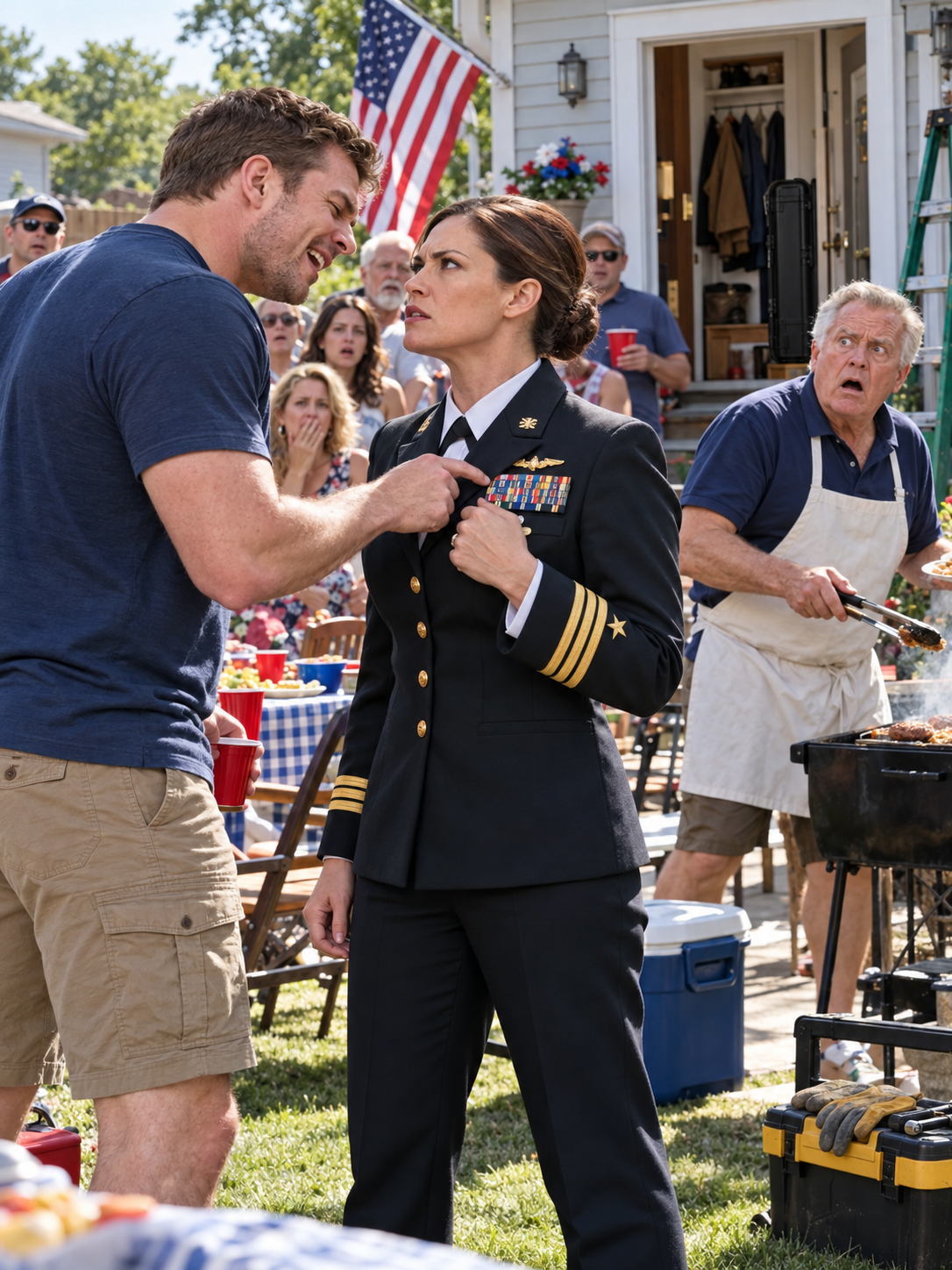
For years, I let my family believe my Navy career had amounted to almost nothing. They saw a forty-year-old woman sleeping in her mother’s spare room, fixing broken gutters, avoiding questions, and refusing to explain the black case hidden behind the winter coats. Then my cousin decided to humiliate me at his father’s retirement cookout. He touched one of my ribbons, laughed that women didn’t earn medals like mine, and called my uniform history a costume. That was when his father turned around.
### Part 1
My name is Mara Whitfield, and by the time I turned forty, my family had reduced eighteen years of my life to one sentence.
“Mara did some Navy stuff.”
That was how my mother said it when people asked.
Not because she was ashamed of me. Linda Whitfield loved me with the nervous, practical devotion of a woman who saved plastic grocery bags, checked the locks twice before bed, and still asked whether I had eaten whenever I walked through her door.
She simply did not know what I had done.
That was partly her fault.
Mostly, it was mine.
By early spring, I was living in the spare bedroom of her Virginia house while I finished the long administrative process of leaving active service behind. The room had once been mine. Same narrow closet. Same squeaking window. Same pale water stain on the ceiling that looked vaguely like some country erased from every map.
At forty, I was back beneath it.
To my relatives, that told them everything they needed to know.
No husband.
No children.
No civilian job they could brag about.
No expensive house.
No polished LinkedIn title.
Just Mara, home again.
“Figuring things out.”
That phrase followed me everywhere.
I heard my mother use it during phone calls.
“Mara’s home for a while. She’s figuring things out.”
At church.
“She’s taking some time.”
At family dinners.
“She had a long career, but now she’s deciding what comes next.”
Nobody ever asked what that career had actually been.
Except my cousin Evan Mercer, and he never asked because he wanted an answer.
He asked because he wanted an audience.
One Thursday afternoon, I was replacing the sagging latch on Mom’s back gate when his truck rolled into the driveway.
Evan climbed out carrying an energy drink and wearing mirrored sunglasses even though the clouds were thick enough to hide the sun.
He leaned against the fence while I worked.
“Still doing handyman duty?” he asked.
I tightened one screw, checked the hinge, then tightened another.
“Something like that.”
“Must be nice.”
I knew that tone.
“What’s nice?”
He grinned.
“Being forty and living rent-free with your mom.”
The screwdriver stopped for half a second in my hand.
Then I kept working.
Evan laughed through his nose.
“Some of us have jobs.”
“So I’ve heard.”
“That Navy pension must be sweet.”
I looked at him then.
He was thirty-two, broad through the shoulders, handsome in the hard way men sometimes become when they have spent too much time trying to look unimpressed. He had his father’s jaw and none of his father’s stillness.
His father, Grant Mercer, had spent thirty years in the Navy SEALs.
In our family, that fact entered rooms before Grant did.
Photos of him in uniform sat on my aunt Susan’s mantel. Stories about deployments surfaced at every holiday. Evan had grown up beneath those stories like a plant under a massive oak.
He had enlisted at twenty.
He had come home less than a year later.
Nobody discussed why.
Evan discussed everybody else instead.
“Just saying,” he continued. “A lot of people serve. Doesn’t mean they did anything.”
I went back to the hinge.
“That right?”
“Oh, yeah. You’d be amazed how many people exaggerate.”
He took a drink.
“Stolen valor is everywhere.”
There it was.
He never accused me directly.
That was Evan’s specialty.
He would place a knife on the table and let everyone pretend it was silverware.
At my cousin’s graduation the year before, he had spent nearly an hour talking about “desk sailors” who wore uniforms but never did anything dangerous.
At Thanksgiving, he had announced that “real operators don’t brag,” then glanced at me even though I had said nothing about my service all evening.
At Christmas, he told a story about people who bought military ribbons online.
Always near me.
Never technically about me.
If I objected, I would look defensive.
If I stayed quiet, his version grew.
So I stayed quiet.
Again.
After Evan left, my phone rang.
Tessa Brandt.
I answered with my shoulder while testing the repaired gate.
“You sound irritated,” she said.
“I’m holding a screwdriver.”
“That wasn’t my question.”
Tessa had served as an explosive ordnance disposal technician with me. She was one of the few people alive who knew exactly what my silence cost.
I told her about Evan.
She listened.
Then she said, “You’re still letting him do it.”
“Do what?”
“Write your biography.”
I sighed.
“Tess.”
“He calls you a fraud without using the word. Your family lets him. You keep saying nothing. Congratulations, now his version is the official version.”
“I don’t need to prove anything.”
“No,” she said. “But there’s a difference between not needing applause and volunteering to be misunderstood.”
I closed my eyes.
Behind me, through the kitchen window, I could see my mother wiping the same clean countertop she had wiped twice already.
“She doesn’t know either,” Tessa said quietly.
“No.”
“Still?”
“No.”
There was a pause.
Tessa knew about the black case.
It sat behind two winter coats in my closet.
Inside were ribbons, documents, photographs I rarely looked at, and one medal I had touched only a handful of times since the ceremony where it had been pinned to my uniform.
The Silver Star.
I did not hide it because I was ashamed.
I hid it because every object inside that case was attached to one particular night.
And that night had teeth.
Once people knew, they asked questions.
Once you answered questions, the event became a story.
Once it became a story, strangers decided what it meant.
Hero.
Bravery.
Sacrifice.
Words that sounded clean when the actual memory smelled like dust, hot metal, blood, burned insulation, and the inside of your own mouth when fear dried it completely.
I had survived that night.
I had no interest in performing it.
So I kept the case closed.
And because I kept it closed, my family filled the silence themselves.
Two weeks later, Aunt Susan called Mom about Grant’s retirement cookout.
“Thirty years,” Mom said after hanging up. “Can you believe it?”
I was tightening the loose handle on a kitchen cabinet.
“That’s a long time.”
“You know, it’s strange you two have never really met.”
That was true.
Grant and I had technically belonged to the same extended family for more than a decade, but deployments, assignments, holidays, and bad timing had kept us from ever standing in the same room.
I knew him from photographs.
He knew me from whatever my family had told him.
Probably that Mara had “done some Navy stuff.”
Mom hesitated.
Then she said, “Would you wear your ribbons to the cookout?”
I looked up.
“What?”
“Just the little bar. Not a uniform or anything.”
“Why?”
Her cheeks colored.
“It might be nice for Grant. You both served.”
I almost said no.
Then I saw something in her face that stopped me.
My mother wanted one visible thing she could understand.
Something she could point to.
Evidence that the daughter sleeping in her spare room had once belonged somewhere.
So I agreed.
The morning of the cookout, I opened the black case.
The hinges gave a soft click.
For a few seconds, I simply stared.
Then I removed the small ribbon bar, pinned it to my blouse, shut the case again, and pushed it behind the coats.
I thought I had taken out the least dangerous thing inside.
I had no idea one of those ribbons was about to detonate everything my family thought it knew about me.
### Part 2
Aunt Susan had transformed her backyard into a retirement postcard.
Three folding tables sat beneath a maple tree, covered with blue disposable tablecloths. Coolers sweated beside the deck. Someone had tied red, white, and blue streamers along the fence. Children ran through a sprinkler at the far end of the lawn while the smell of burgers, smoke, cut grass, sunscreen, and charcoal hung in the humid air.
Grant stood at the grill.
I recognized him immediately.
Big man.
Gray at the temples.
Weathered face.
The kind of posture you do not lose when retirement papers say you are allowed to.
He had his back to me when Mom and I arrived.
Susan rushed over and hugged us.
“Mara! Look at you.”
Her eyes fell to my ribbon bar.
“Oh. That’s nice.”
Nice.
I almost laughed.
Instead, I handed her the bowl Mom had brought.
For the first hour, I did what I usually did at family gatherings.
I made myself useful.
I carried trays.
Refilled ice.
Moved chairs.
Helped a toddler retrieve a plastic truck from beneath a table.
Utility had always been easier for me than visibility.
Then Evan arrived.
I heard him before I saw him.
His laugh cut across the yard.
He hugged his mother, slapped one cousin on the shoulder, grabbed a beer from a cooler, and immediately positioned himself where the largest number of people could hear him.
For twenty minutes, he ignored me.
That made me nervous.
There are people whose silence feels peaceful.
Evan’s silence felt like a door being locked.
I was setting out paper plates when he finally came over.
“Well, look at this.”
His eyes had landed on my ribbons.
I kept separating plates.
“What?”
“You dressed up for Dad?”
“I wore a blouse, Evan.”
He leaned closer.
“No. That.”
His finger hovered near my chest.
I stepped back.
“Don’t.”
He smiled.
Several relatives were already watching.
“I’m just curious.”
“No, you’re not.”
That got a laugh from one uncle.
Evan’s smile tightened.
He had been drinking.
Not falling-down drunk. Just enough that every bad instinct felt clever.
“What are these supposed to be?”
“You were in the Navy. You know what ribbons are.”
His jaw shifted.
There it was.
Something older than this afternoon.
Something I still did not understand.
He took another drink.
“Anybody can buy ribbons.”
My aunt Susan heard him from the drinks table.
“Evan.”
He ignored her.
“You know, there are whole websites.”
I picked up the stack of plates.
“Move.”
He stepped sideways and blocked me.
Around us, conversations were slowing.
“I’m serious. Forty bucks and you can make yourself look like Admiral Whoever.”
“Move, Evan.”
He looked at the relatives now instead of me.
That was when I knew he had been waiting for this.
“Those medals are bought,” he announced.
The yard changed.
You could feel it.
A dozen conversations collapsed at once.
Someone near the sprinkler turned down a portable speaker.
Even the scrape of a spatula against the grill suddenly seemed too loud.
Evan reached toward me.
His index finger flicked the upper ribbon on my bar.
A tiny physical motion.
Barely anything.
But something inside me went perfectly still.
“Girls don’t earn these,” he said.
A few relatives looked horrified.
Others stared at their plates.
My mother made a small sound behind me.
Evan kept smiling.
I could smell beer on his breath.
I looked directly into his eyes.
“Put your hand down.”
My voice was quiet.
That should have warned him.
Instead, it encouraged him.
“Come on, Mara. We all know you weren’t doing what my dad did.”
I did not answer.
“You were what? Logistics? Paperwork?”
“Evan.”
“What? Everybody’s thinking it.”
“No,” Mom said suddenly. “They aren’t.”
But he was committed now.
People like Evan confuse attention with permission.
He laughed and lifted his hand again.
Then a plate hit the grass.
It made a soft, ridiculous sound.
Not a crash.
A wet paper slap followed by the rattle of a plastic fork.
Everyone turned.
Grant was standing beside the grill.
Except he wasn’t grilling anymore.
His right hand hung empty.
A burger, potato salad, and corn lay scattered near his shoes.
He did not look down.
He was staring at me.
At first, I thought he was angry about Evan.
Then I saw his face.
All the color had drained from it.
His mouth opened slightly.
His eyes moved from mine to the ribbon bar and back.
I knew that expression.
Recognition arriving before the mind can accept it.
Grant took one step away from the grill.
Then another.
Aunt Susan stared at him.
“Grant?”
He did not answer.
Evan laughed uncertainly.
“Dad, relax. We’re messing around.”
Grant walked toward me.
The yard seemed to stretch around him.
Thirty years of service, retirement banners, laughing children, all of it fell away from his face.
He stopped about three feet in front of me.
For several seconds, he could not speak.
Then he said, “Whitfield?”
The sound of my last name in his voice struck me harder than Evan’s finger ever could.
I stared at him.
“Yes.”
His eyes filled.
Not dramatically.
Not instantly.
They simply became wet.
He looked toward the ribbon on my chest again.
“Oh, God.”
Something cold moved down my spine.
I had never met Grant Mercer.
Yet suddenly I knew that I had.
I just did not know where.
Evan looked between us.
“What is this?”
Grant did not even glance at him.
His voice dropped.
“Six years ago.”
My breath caught.
And suddenly the backyard was gone.
For one terrible second, I smelled hot dust instead of charcoal.
He said a location.
Only one word.
A place my family had never heard me mention.
My fingers went numb around the paper plates.
Grant swallowed.
“I was there.”
I knew.
Before he said anything else, I knew exactly who he was.
Not Grant Mercer.
Not Aunt Susan’s husband.
Not Evan’s father.
He had been the senior man attached to a team trapped on open ground six years earlier.
A team with one way out.
A team whose route had become something else entirely.
My family was watching.
Evan was still smiling, but his smile no longer fit his face.
“Dad,” he said, “seriously. It’s a costume.”
Grant finally looked at him.
I have never forgotten that look.
Not anger.
Not embarrassment.
Grief.
“You don’t know what you just touched.”
Nobody moved.
Grant turned back to me.
His voice broke on the next words.
“I served under her.”
The paper plates slipped from my hands.
Six years of silence had just ended in my aunt’s backyard.
And the man who ended it was the one stranger in my family who already knew the truth.
### Part 3
I could have destroyed Evan in that moment.
I knew that.
Everyone knew it.
Thirty relatives stood scattered across the yard, holding drinks and paper plates, waiting for Grant to explain why a retired SEAL looked as though he had just seen someone return from the dead.
Evan had spent years making me smaller.
One speech could have repaid all of it.
I could have opened the entire black case in public without touching the latches.
I didn’t.
Grant stood in front of me, visibly shaken.
So I reached out and touched his forearm.
“Not here.”
He blinked.
“Mara—”
“We’ll talk.”
His jaw tightened.
“You saved—”
“Grant.”
I held his gaze.
“Later.”
Something passed between us then.
Recognition.
Not of rank.
Not of history.
Of the fact that some truths survive only if you choose the right room for them.
Grant nodded.
I lowered my hand.
Then I turned to Evan.
His face had changed completely.
The swagger was gone, but I did not replace it with humiliation.
“Don’t touch me again,” I said.
He opened his mouth.
I walked past him.
For the next two hours, that cookout tried desperately to become a cookout again.
Children kept running through the sprinkler.
Someone put fresh burgers on the grill.
A cousin turned the music back up.
People spoke in low, careful voices and pretended they were not watching me.
I helped Mom pack leftovers.
She kept glancing at me.
Finally she whispered, “What did Grant mean?”
“Later.”
“But—”
“Please.”
She nodded.
The light began to soften near evening.
One family after another left.
Evan disappeared into the house.
Eventually only Aunt Susan, Grant, Mom, and I remained outside.
The tables were littered with crushed napkins, abandoned cups, and condiment bottles sticky with fingerprints.
Grant sat across from me.
Susan beside him.
Mom beside me.
For a long time nobody spoke.
Then Grant began.
Six years earlier, overseas, his team had been moving through an exposed area when the route ahead became blocked by an explosive threat.
He did not describe everything.
He did not need to.
I remembered each detail before he said it.
The wrong intelligence picture.
The order to hold.
The men stranded where they should not have been stranded.
The device between them and the only practical path out.
The radio traffic.
My own breathing.
Tessa beside me.
Fear turning my mouth dry.
Grant spoke about the EOD officer who came forward despite being told to wait for another option.
Mom slowly turned toward me.
Grant did not.
His eyes stayed fixed on the tabletop.
“She looked at the situation,” he said, “and knew the picture being used by command wasn’t the picture we were actually standing in.”
Susan covered her mouth.
“She came forward?”
Grant nodded.
“She came forward.”
My mother whispered, “Mara?”
I stared at my hands.
Grant continued.
He talked about me the way survivors talk about the person who was working while they were waiting.
Not heroically.
Specifically.
How I knelt.
How I kept stopping to check what I thought I knew.
How Tessa relayed information.
How rounds were impacting close enough to throw dirt.
How I refused to rush even when everything around me demanded speed.
The strange thing about hearing someone describe the hardest minutes of your life is how ordinary the details sound.
Hands.
Tools.
Distance.
Breathing.
Choices.
Grant looked at Mom.
“Your daughter gave us a way out.”
Mom began crying.
Quietly.
I hated that part.
Not because she cried.
Because I could see her rebuilding me in real time, and I did not want to become another exaggerated version of myself.
First the failure.
Now the hero.
Both were too simple.
Grant’s voice dropped.
“One of my men was nineteen. He’s got two daughters now.”
He looked at me.
“Another walked his daughter down the aisle last year.”
I had never known that.
That hit harder than anything else.
For years, I had kept that night frozen at the point where I left it.
I had never allowed myself to imagine the men afterward.
Birthdays.
Mortgages.
Graduations.
Broken water heaters.
School pickups.
Ordinary irritation.
Ordinary joy.
Life.
Grant swallowed.
“I spent years trying to find you.”
My head came up.
“What?”
“I got a name eventually. Commander Mara Whitfield.”
Susan looked stunned.
“You knew her name?”
“I knew a name. I never connected it to your niece.”
His laugh was short and broken.
“Why would I? Every time Mara came up, you people talked about her like she’d been filing forms in a basement somewhere.”
Susan flinched.
Mom closed her eyes.
Grant leaned back.
“Then today I heard Evan say medals. I turned around.”
His eyes moved toward my chest.
“And there was that ribbon.”
Silence.
From the house behind us came the faint creak of a floorboard.
Evan was listening.
I knew without looking.
Grant knew too.
He raised his voice only slightly.
“That Silver Star wasn’t bought.”
Another creak.
“She earned it because men like me came home.”
I stood.
“Enough.”
Grant looked up.
“He needs to hear it.”
“He heard it.”
I gathered empty cups from the table because my hands needed something to do.
Mom stared at me.
“You were wounded?”
I stopped.
Grant’s eyes closed briefly.
So much for controlling the story.
“In the leg,” I said.
Mom made a strangled sound.
“I recovered.”
“You never told me.”
“No.”
“Why?”
Because when I came home, you looked ten years older than when I left.
Because I heard you praying in the kitchen the night before my next deployment.
Because every time the phone rang late, your face changed.
Because I loved you.
Instead, I said, “I didn’t want that night living in this house.”
Mom wiped her eyes.
I carried the cups to the trash.
Inside, through the glass door, I saw Evan standing in the dark kitchen.
Our eyes met.
For the first time in my life, he did not have a joke.
Three days later, Aunt Susan insisted we all meet again.
I almost refused.
Then Grant called me himself.
“There’s something you don’t know about Evan,” he said.
“I know enough.”
“No,” he replied. “You know what he did. You don’t know why.”
That irritated me.
“I don’t need a tragic explanation for someone humiliating me.”
“I’m not asking you to excuse him.”
A pause.
“I’m asking you to hear something before you decide what comes next.”
So I went.
And by the end of that night, I understood that the ugliest thing Evan had ever done to me had begun years before he ever touched my ribbon.
### Part 4
We sat in Susan and Grant’s living room on a Wednesday evening.
No audience.
No grill.
No beer.
No relatives pretending not to listen.
Just six people and the soft hum of an air conditioner working against the late-summer heat.
Mom sat beside me.
Grant took an armchair.
Susan sat near the fireplace.
Evan chose the far end of the couch.
He looked smaller somehow.
Not physically.
His shoulders were still broad. His jaw was still square.
But without the performance, he looked exhausted.
Grant spoke first.
He explained the Silver Star in plain language.
He explained my former role.
He explained enough of the incident that no one could pretend the cookout had been a misunderstanding.
Then he stopped.
Evan stared at the floor.
I expected an apology.
Instead, he said, “Why didn’t you ever tell anybody?”
The old instinct rose in me.
Anger.
Fast and sharp.
But I held it.
“Because it was mine.”
“That doesn’t make sense.”
“It doesn’t have to make sense to you.”
“You let everyone think—”
I leaned forward.
“No. Be careful.”
He looked up.
“I stayed silent. You actively chose what story to tell about me. Those are not the same thing.”
He looked away.
Nobody rescued him.
That mattered.
For years, every ugly comment had been softened by someone.
“Evan’s joking.”
“He doesn’t mean it.”
“You know how he is.”
Not tonight.
He rubbed his hands together.
Then he said, “I washed out.”
Grant’s face changed.
Susan inhaled.
Apparently, even they had never heard him say the words that plainly.
Evan stared at his hands.
“When I enlisted, I thought I was going to do what Dad did.”
Grant started to speak.
Evan shook his head.
“Don’t.”
Grant stopped.
“I had spent my whole life hearing what Dad was. Everywhere we went, somebody knew. Guys at school. Coaches. People at church. Dad was the SEAL.”
His voice tightened.
“I thought that was what being a man looked like.”
Grant’s eyes lowered.
“I got there and couldn’t do it.”
No one moved.
“I didn’t make it through. I wasn’t even close.”
There was no self-pity in his voice now.
That made it harder to hear.
“I came home and everybody kept telling me it was fine. Dad said he was proud of me anyway. Mom said I was brave for trying.”
He laughed once.
“I hated both of them for it.”
Susan began crying.
Evan looked at me.
“And then there was you.”
I folded my arms.
“The cousin nobody talked about. No husband. No big house. Living quietly. Never telling anybody what you did.”
Understanding arrived slowly.
I did not like it.
“You needed me to be a failure.”
His eyes filled.
“Yes.”
There it was.
No excuse.
No euphemism.
Just yes.
“If you were pretending,” he said, “then maybe failing didn’t make me fake.”
His voice cracked.
“If your service didn’t count, maybe mine didn’t have to count either.”
I stared at him.
For years, I had interpreted his contempt as arrogance.
Some of it was.
But underneath it sat something more pathetic and more dangerous.
Shame.
He had been drowning.
And instead of learning to swim, he had tried to stand on me.
Understanding him did not erase what he did.
That was important.
People confuse understanding with forgiveness because forgiveness makes everybody else comfortable.
I was not interested in comfort anymore.
Evan wiped his face with one hand.
“I was awful to you.”
“Yes.”
He flinched.
I did not soften it.
“I humiliated you.”
“Yes.”
“I called you a fraud.”
“For years.”
He nodded.
“I don’t know how to fix that.”
“You don’t.”
He looked confused.
“You can’t go backward and make the cookout not happen. You can’t erase every joke everybody laughed at. You can’t give me back years of being treated like the sad cousin who failed at life.”
Mom began to cry beside me.
I continued.
“What you can do is stop.”
Evan swallowed.
“Stop using me to manage how you feel about yourself. Stop needing someone else to be smaller so you can breathe.”
He nodded.
“And don’t ask me to forgive you tonight.”
His face fell.
I let it.
“You apologized because the truth cornered you. I want to see who you are when there’s no room full of people watching.”
That was the boundary.
Not revenge.
Not reconciliation.
A door.
But one he would have to walk through himself.
Over the next several months, my family changed in small, awkward ways.
Mom apologized more than once.
I eventually had to tell her to stop apologizing every time she looked at me.
Aunt Susan admitted she had laughed at Evan’s jokes because confronting him was uncomfortable.
Grant and I met for coffee.
That was where he told me things I had never known.
The nineteen-year-old from his team had opened a hardware store.
One man had become a high school baseball coach.
Another had stood at his daughter’s wedding and raised a glass to an EOD officer whose face he had never known.
I stared at my coffee until the steam disappeared.
For six years, I had remembered only the terrible part.
Grant gave me the rest.
The lives after.
That changed something.
So did Mom asking one evening whether she could see the medal.
I stood in the spare room for several minutes before opening the closet.
The black case was exactly where it had always been.
Behind the coats.
Closed.
Safe.
I carried it to the kitchen table.
Mom sat silently while I opened it.
The Silver Star rested inside.
Under the ordinary kitchen light, it looked smaller than the weight I had assigned to it.
Mom did not touch it.
“Can I ask something?” she whispered.
“Yes.”
“Were you scared?”
That was the first question anyone in my family had ever asked that felt correct.
“Terrified.”
She looked surprised.
I smiled faintly.
“Courage is mostly people being scared and still having work left to do.”
Mom nodded.
Then she closed the case herself.
Evan sent me a message two weeks later.
No excuses.
No request to meet.
Just: I’m sorry. I’m trying to become someone who doesn’t need another person beneath him.
I read it twice.
Then I put my phone away.
I did not reply.
Not because I hated him.
Because an apology is not a reset button.
And for the first time in my life, I was letting other people sit with the consequences of what they had done instead of rushing in to make the room comfortable.
Then, on an ordinary Monday morning, my old commander called.
He offered me a teaching billet at the Navy’s EOD school.
I almost said no.
Instead, I found myself staring at the black case and wondering whether the life I had worked so hard to lock away might still have one useful thing left to give.
### Part 5
I took four days to answer.
For two years, anything that pointed me back toward my old world had produced the same reaction.
No.
Immediate.
Physical.
Like pulling your hand from heat.
This time, the reaction never came.
So I paid attention.
My former commander did not want me back for ceremony.
He did not need another decorated officer standing at the front of a classroom telling young technicians about courage.
He wanted me to teach decision-making.
That made sense to me.
Because the most important thing I had learned in eighteen years was not how to be fearless.
Fearless people are dangerous.
The skill was staying clear while afraid.
Knowing when the information in front of you no longer matched the plan built somewhere far away.
Knowing when obeying an order created more danger than questioning it.
Knowing that if you chose differently, the responsibility became yours.
That was what happened six years earlier.
That was what Grant remembered.
That was what the Silver Star represented.
Not a fearless woman.
A frightened woman who stayed clear long enough to make one decision.
I accepted.
My first morning at the school began before the heat rose.
The range was quiet beneath pale white sunlight. Dew clung to the grass near the barriers. Training equipment sat in orderly rows. Beyond them, the sand looked almost untouched.
I stood there holding coffee that went cold in my hand.
For years, I had imagined peace as distance.
Far from the Navy.
Far from that night.
Far from the black case.
I had been wrong.
Peace was being able to stand near the memory without belonging to it.
My students did not know my story at first.
I preferred it that way.
I watched them work.
Corrected habits.
Stopped them when they moved too fast.
Made them explain why they believed what they believed.
“What do you know?” I would ask.
Then, “What are you assuming?”
There is a world of difference between those questions.
One morning, a young technician named Rachel stayed after class.
She had the serious, controlled expression of someone accustomed to being underestimated.
“Commander Whitfield?”
“I’m retired. Mara is fine.”
She hesitated.
“I heard something.”
“That sounds dangerous already.”
She almost smiled.
“Is it true you have a Silver Star?”
I looked at her.
“Yes.”
Her eyes widened.
“Can I ask what happened?”
“You can.”
So I told her the useful version.
Not the legend.
Not the version that turns people into statues.
I told her the intelligence picture was wrong.
I told her people were exposed.
I told her I was afraid.
I told her the important moment was not whether I felt brave.
It was whether I could still think.
She listened.
When I finished, she asked, “How do you know if you’re ready to make that kind of call?”
“You don’t.”
She frowned.
“You train until you can tell the difference between fear and confusion.”
I tapped the notebook in her hand.
“Then, if the day ever comes, you hope you remain clear.”
“What about the medal?”
“Forget the medal.”
She blinked.
“Chase clarity. Let somebody else decide afterward whether they want to hang metal on you.”
That became the way I taught.
Whenever a student looked at me like a legend, I dragged the story back to the ground.
Legends are useless.
A legend tells young people, Look what this extraordinary person did.
A lesson tells them, A frightened human being made a decision. Someday you may have to make one too.
Months passed.
I moved out of Mom’s spare room and rented a small place near the school.
The black case came with me.
But it no longer lived behind coats.
It sat on a shelf in my study.
Closed most days.
Open when it needed to be.
Mom stopped describing me as “figuring things out.”
She also stopped introducing me by my medal, after I asked her to.
That may have been the greater accomplishment.
Grant settled into retirement better than he expected.
Sometimes we had coffee.
Sometimes neither of us mentioned the night at all.
We talked about leaking roofs, bad knees, overpriced groceries, his plans to teach his granddaughter to fish.
That meant more to me than gratitude.
It proved the night had finally become part of our lives instead of the whole definition of them.
Aunt Susan changed too.
At family gatherings, when someone made a joke at another person’s expense, she no longer gave the easy laugh.
She had learned what that laugh could build.
And Evan?
For a while, we barely spoke.
That was intentional.
He needed to learn that remorse did not entitle him to immediate closeness.
I needed to learn that setting a boundary did not make me cruel.
At gatherings, he was quieter.
Not theatrically quiet.
Simply less hungry for the center.
He stopped telling stories about fake veterans.
Stopped correcting people about military matters he barely understood.
Stopped using his father as proof of himself.
Eventually, almost a year after the cookout, he asked whether I would have coffee with him.
I agreed.
We sat in a diner near the highway.
He apologized again.
This time nobody had cornered him.
Nobody was listening.
He did not cry.
He did not explain his childhood.
He did not mention washing out.
He simply said, “I knew what I was doing to you. I didn’t know why, but I knew it hurt you, and I kept doing it because hurting you made me feel less ashamed of myself. That was wrong.”
That apology I believed.
I accepted it.
But I did not give him the relationship we had never actually possessed.
I told him we could be civil.
We could be family.
Maybe someday we could know each other differently.
But I was not going to pretend one honest conversation erased years of contempt.
He nodded.
“I understand.”
And, to his credit, he did not ask for more.
That was the beginning of something.
Not forgiveness in the sentimental sense.
Not a reunion.
Just reality.
Later that year, my family came to a visitor day at the school.
Mom arrived early.
Susan came with Grant.
Evan came alone.
They stood behind the designated barrier while my students worked through a training problem.
I barely noticed them until the session ended.
Then I walked over.
Mom hugged me.
Susan did too.
Grant stood with his hands behind his back, looking over the range.
Eventually he said, “Good place for you.”
“I think so.”
He held out his hand.
When I took it, he covered mine with his other hand and held it for one quiet second.
No speech.
None needed.
Evan stood a few feet away.
He looked toward the young technicians preparing another lane.
Then he looked at me.
“I’m proud to be related to you.”
A year earlier, those words might have satisfied something angry in me.
Now they simply landed.
“Thank you,” I said.
That was enough.
After they left, I stayed at the edge of the range.
The afternoon sun moved slowly across the sand.
Training shells sat in neat rows.
A breeze stirred the grass.
For the first time, I understood that my cousin’s humiliation had never been the center of the story.
Neither was Grant dropping the plate.
Neither was the medal.
The center was simpler.
For years, I had believed silence protected me.
Sometimes it did.
But sometimes silence gives other people an empty space where they can build whatever version of you they need.
Evan built a failure because he needed someone beneath him.
My family accepted that version because it was easy.
I allowed it because correcting them required opening a door I was afraid to open.
None of us were innocent.
But we were not equally responsible either.
That distinction mattered.
I never needed my family to worship me.
I needed them to stop defining me without my permission.
I never needed Evan destroyed.
I needed him to stop using me as a life raft for his shame.
And I never needed the Silver Star to become the most important thing about me.
I only needed to stop pretending it meant nothing.
The hardest lesson of my career had always been the same one.
Slow down.
Look at what is actually in front of you.
Separate fear from fact.
Decide what needs to be dismantled and what simply needs to be understood.
At forty, I finally realized that lesson worked on families too.
Some relationships can be repaired.
Some cannot.
Some apologies deserve acknowledgment without restored intimacy.
Some people may become better, and you are still allowed to remember who they were when they hurt you.
I did not forgive Evan in the way my family once wanted me to.
I did not announce that everything was okay.
Everything was not okay.
What I did was stop carrying him.
His shame belonged to him.
His growth belonged to him.
His relationship with his father belonged to him.
I wished him well from a distance that felt healthy.
And I walked into the second half of my life without making myself smaller so anyone else could feel taller.
That evening, after everyone had gone, I stood alone beside the range with another cup of coffee cooling between my hands.
Six years earlier, I had walked toward something everyone else needed to get away from.
At the cookout, I had done it again in a different way.
Not toward an explosive device.
Toward the truth.
For years, I thought the greatest thing I had ever done was bringing Grant’s men home.
I was wrong.
The greatest thing I learned was that surviving something does not mean you have to hide it forever.
Sometimes the final step is simply allowing the truth to stand in daylight without explaining itself.
The medal was never proof of my worth.
Grant’s recognition was never proof of my worth.
My family’s regret was never proof of my worth.
I already knew what I had done.
And once I finally understood that, nobody could ever make me small again.
THE END!
Disclaimer: Our stories are inspired by real-life events but are carefully rewritten for entertainment. Any resemblance to actual people or situations is purely coincidental.


