
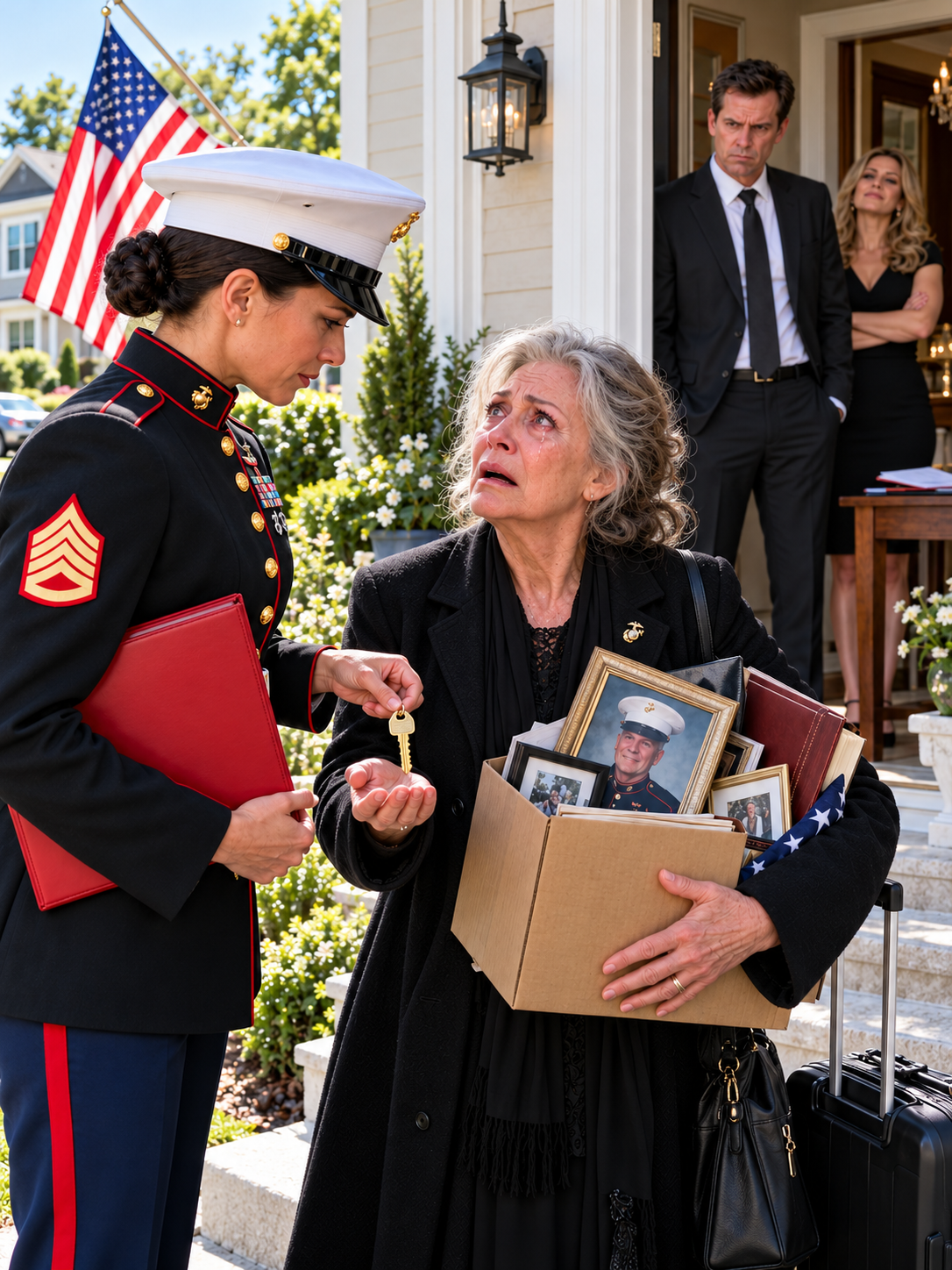
“Dad is gone, Mom. The house was never really yours,” my son said the morning after my husband’s funeral. His wife smiled as she pushed transfer papers across the kitchen table. I was sixty-six, a retired Marine, but my hands shook as I packed Doug’s photographs and walked out with nowhere to go. Hours later, a Marine pressed a brass key into my palm. “Doug knew Kyle might do this,” she whispered. “His lawyer has a red folder waiting for you.”
Part 1: My son evicted me before learning what Doug protected.
The morning after my husband’s funeral, my son stood beneath thirty years of family photographs and told me to leave. Kyle did not shout; he spoke with the flat certainty of a man announcing a business decision, while his wife Amanda stood behind him with folded arms and a satisfied smile. “Dad is gone, Mom. The house was never really yours.” I was sixty-six, a retired Marine Corps engineer, and I had spent my life believing structures failed because people ignored warning signs. In that moment I realized families could fail the same way. I packed one suitcase, took my wedding album, Doug’s retirement photograph, my service medals, and our deployment letters, then walked out without asking where I was supposed to go. I cried in the car until the steering wheel blurred, but I never turned around.
Only nineteen days earlier, Doug had been standing beside the kitchen window with coffee in his hand while I pointed out a young hawk on the fence. His mug slipped first, striking the sill and spilling across the floorboards; then his knees gave way. I called his name once like a wife and again like a Marine, as if command voice could bully death into retreat, but by the time the paramedics covered his chest with a blanket, I knew the life we had built had divided into before and after. Doug hated spectacle, so the funeral was small: wet grass, old roses, a pine casket, a folded flag, and a trumpet note that cracked in the cold air. Kyle wore a tailored charcoal suit and looked polished enough for a board meeting. Amanda kept dark glasses on until the burial ended. Neither of them cried, and I told myself grief took different forms because that was kinder than admitting how quickly they had begun looking past me toward what Doug had left behind.
The first warning came less than an hour after we returned from the cemetery. Our house filled with casseroles, damp coats, coffee, perfume, and the careful voices people use around a new widow, while Doug’s study remained half open at the end of the hall. I saw Amanda slip inside carrying a plate she never touched, and when I followed, she was standing beside Doug’s filing cabinet with one drawer open. She smiled as if I had caught her arranging flowers. “I was thinking we should get ahead of the paperwork before it becomes overwhelming.” Kyle appeared behind her and immediately defended the intrusion, telling me there were title questions, tax issues, and business matters that needed quick attention. That evening, after the last neighbor left, Amanda spread transfer forms across my kitchen table. My name appeared where ownership would be surrendered; Kyle and Amanda’s names were already typed where ownership would land. “It keeps everything in the family,” she said softly. I stared at her and answered, “I am the family.” They left irritated, not ashamed, and when I checked Doug’s filing cabinet later, one hanging folder was missing.
The next day they came back with a property assessor. Kyle walked into my mudroom carrying a tape measure as though he already had permission to measure my walls, while Amanda introduced the stranger as someone helping with “insurance updates.” I told them no. Kyle sighed as if grief had made me unreasonable, then finally said the thing he had been circling since the funeral: “Dad handled the deed, the company, the taxes, everything important. You lived here, but that doesn’t mean you built any of it.” Behind him, Amanda’s expression changed almost imperceptibly; she was not surprised by his cruelty, only relieved he had finally said it. I opened the front door and ordered all three of them out. Kyle laughed once, called me dramatic, and left with the confidence of a man certain the law would eventually correct his mother. That night, alone among Doug’s slippers, reading glasses, and unfinished life, I understood they were not waiting for me to finish grieving. They were waiting for me to become weak enough to sign.
At two forty-three in the morning, I drove to the bungalow of Sandra Pike, a woman who had served beside me for eight years and never wasted sympathy on things that required action. She opened the door before I reached the porch, put a wool blanket around my shoulders, poured coffee strong enough to strip paint, and listened without interrupting while I told her what Kyle had said. When I finished, she set her mug down and asked one question: “Did Doug’s lawyer call you yet?” I stared at her. Sandra disappeared into the hall, returned with an old brass key Doug had given her years earlier, and said he had left instructions for exactly one situation: if I ever arrived at her house in the middle of the night because Kyle had pushed me out, she was to send me to Walter Landon immediately. My husband, it seemed, had imagined the shape of my betrayal long before I had.
Walter’s office sat above a pharmacy in downtown Bend. On his desk lay a red folder reinforced with yellowing tape, and across the tab was Doug’s handwriting: For Evelyn. Walter explained that Doug had deposited it five years earlier and ordered its release only if I was displaced, coerced into signing estate papers, or threatened over ED Contracting. My hands shook when I opened the first letter. Doug told me to read everything before deciding anything, trust Walter, trust my instincts, and never let guilt persuade me to surrender what was mine. Beneath it were trust documents, property records, company agreements, notarized witness statements, and a second sealed envelope marked for release only if family litigation had begun. Walter slid Kyle’s newly filed court petition toward me, then placed a loan application on top of the folder carrying Amanda’s signature, my legal name, and my home listed as collateral. I had entered thinking my son wanted my house. I left knowing he and his wife intended to use my entire life to save themselves.
Part 2: A hidden red folder turned grief into a legal war.
Doug had not left me a sentimental insurance policy; he had built a defensive system with the precision of a man who trusted redundancy more than luck. Four years earlier, he had transferred the cedar house into a private family trust naming me as sole living beneficiary, while the six wooded acres behind it were separately protected. The anti-coercion clause allowed any transfer made while I was grieving, displaced, threatened, or pressured by family to be challenged automatically. ED Contracting was protected too: forty-nine percent of its beneficial control sat in my trust, while the remaining interest was guarded through two former Marines Doug trusted, so no major sale, debt conversion, or liquidation could occur without my written approval. Kyle had not inherited a kingdom. He had mistaken access for ownership.
Walter showed me the records Doug had begun collecting before his death. Fourteen transfers had moved from company accounts into accounts controlled by Kyle over two years, totaling more than one hundred twenty thousand dollars, with vague descriptions such as temporary advance, vendor bridge, and family reimbursement. Some entries aligned with Amanda’s failed consulting ventures, others with personal debt, a luxury vehicle, and what appeared to be a down payment on an investment property that never closed. Doug had suspected enough to preserve account logs, signature pages, and private notes, but he had died before he could finish confronting the pattern. One margin note in his handwriting said, Watch Amanda. Kyle follows pressure. Reading it hurt more than the financial numbers because I could hear the hope behind the warning; Doug had wanted to believe our son was weak rather than corrupt. I was no longer sure there was a meaningful difference.
The next morning I met Thomas Chandler at ED Contracting’s warehouse office. The company was smaller than during Doug’s busiest years, but stable, profitable, insured, and current on payroll. Tom showed me how the withdrawals had been disguised through secondary access credentials after Kyle began appearing more often during Doug’s decline, claiming his father wanted him trained on legacy accounts. Amanda supplied polished explanations that made improper withdrawals sound like temporary family structuring. Then Tom brought out a burgundy binder Doug had left in a locked cabinet. Inside were access logs, copies of original signatures, handwritten comparisons, and a federal loan application listing my name as a secondary beneficiary and the cedar house as secured residential backing. They had begun positioning my home before Doug was even gone.
Brenda agreed to meet me at an old diner off Third Street. She looked twenty years older than I remembered, sitting in a cracked vinyl booth with both hands around a mug she was not drinking from. I did not threaten her or promise protection; I simply told her Kyle and Amanda were trying to remove me from my home and that I had seen the unauthorized transfers. Silence did the rest. Brenda confessed that Kyle began with small requests, always claiming Doug had approved them, while Amanda supplied forms and vocabulary that made Brenda feel foolish for asking questions. Twice Brenda tried to verify directly with Doug, and twice she was told his health was too fragile for stress. Worse, Amanda repeatedly claimed I already knew what was happening and wanted discretion. When the wires grew larger, Brenda became frightened enough to save copies of emails, draft applications, and handwritten notes in a lockbox at home.
From her tote, she produced the page that turned my anger cold. In Amanda’s handwriting, beside a draft loan package, were the words: Use Evelyn as passive backing—she won’t contest if Kyle handles house first. Brenda also had a property valuation request submitted three days before Doug died, naming Kyle as the primary contact. They had measured my grief before I had even entered it. She told me she had overheard Amanda warning Kyle that if he could not “get the house moved over,” they were finished, and Kyle answering that I was stubborn and emotional. Then Brenda gave me one final record: the largest unauthorized transfer had been initiated by Kyle personally, without Amanda beside him, and when Brenda hesitated, he told her, “Family has earned it.” That sentence took away the last excuse I had been saving for my son.
Once Brenda agreed to testify, the case accelerated. Walter filed responses to Kyle’s petition, Tom authenticated the company records, and Doug’s two designated partners produced original trust documents. Kyle’s side responded by claiming I was an unstable bereaved veteran vulnerable to manipulation by outsiders, and they sought emergency control of the property on the theory that I could no longer manage complex assets. The cruelty of it was almost elegant: first they tried to make me dependent, then they intended to use dependency as proof that I should lose control. Amanda left short voicemails telling me we did not need to “make this public,” while Kyle cycled through anger, pleading, accusation, and wounded-son performances. I answered none of them.
The night before court, Sandra made pot roast and handed me one of Doug’s old challenge coins, worn smooth at the edges. He had given it to her years earlier with instructions to return it if I ever needed reminding who I was before walking into a bad room. At dawn I met Walter outside the courthouse with the red folder in one hand and Doug’s coin in my pocket. Tom arrived, then Brenda, Reyes, and Michaelson. Inside, Kyle sat beside Amanda looking composed until the back doors opened and twelve men and women who had served with Doug quietly filled the last two rows. Nobody saluted or made a speech. They simply sat down as witnesses to something my husband had prepared years before, and for the first time Kyle looked frightened.
Part 3: Doug’s witnesses exposed the fraud my son helped build.
Kyle’s attorney opened by describing me as emotionally compromised, financially inexperienced, and vulnerable to people who had inserted themselves into my grief. He suggested that my military history, age, and bereavement made me incapable of understanding the estate Doug had supposedly managed alone. Kyle testified first and called his attempt to take the house an act of protection. Amanda followed, insisting the transfer forms were merely nonbinding options for future stability. When Walter asked whether she had written use Evelyn as passive backing, she smiled faintly and claimed she could not recall the exact wording of informal notes. I watched her turn deceit into administrative fog and understood why Brenda had been intimidated by her certainty.
When it was my turn, Walter asked only simple questions at first: my name, age, marriage, military career, years in the cedar house, and whether I had ever authorized anyone to surrender my property or use my identity in loan documents. Then I placed Doug’s red folder on the rail. The judge read the trust declaration, the property transfer, the six-acre title protection, the anti-coercion clause, and the company-control provisions. She asked for the documents to be projected, and Kyle’s face changed when my name appeared on the screen as sole living beneficiary. His lawyer argued that secret planning should make the trust suspicious, but the judge cut him off with a sentence so plain it seemed to clear the room: practical dependency was not a legal basis for stripping a lawful beneficiary of her rights. The story Kyle had brought to court had depended on me being small. Doug’s paperwork made that impossible.
Then Brenda took the stand. Her voice trembled, but her testimony did not. She described the escalating transfers, Kyle’s direct instructions, Amanda’s claims that I had already approved the arrangements, and the federal loan package listing my home as backing. She authenticated the copies she had saved and identified Amanda’s handwriting. Amanda finally lost control and accused Brenda of lying to save herself, earning a sharp warning from the judge. Walter then called Reyes, who carried a sealed envelope Doug had instructed him to release only if family members ever challenged rights already secured for me. Inside were witness instructions and a memorandum documenting Doug’s suspicions that my identity was being positioned for fraudulent financial use. The twelve former service members in the back stood one by one and confirmed their presence during the trust execution and later reaffirmations. There was no theater in it, only a chain of people saying yes to facts my son had counted on being buried.
The judge requested that the federal investigators waiting outside be brought in. Their entrance was quiet enough to make it worse. One of them produced a warrant for Amanda tied to suspected wire fraud, false statements in federally backed loan materials, and identity-based financial misrepresentation. For the first time since I had known her, Amanda looked stripped of language. Then panic took over. She pointed at Kyle and said she had done nothing without him, that he knew they needed the house, that he knew they were running out of time. Kyle stood and tried to distance himself from the loan application, but the court had already seen his transfers, the valuation request, and his petition to displace me. The judge ruled that the trust was valid, the house and forest parcel were protected, my control rights in ED Contracting were established, and neither Kyle nor Amanda had authority to enter, market, assess, transfer, or encumber the property. She also ordered preservation of Kyle’s financial records for separate civil and criminal review.
After court, Kyle asked to speak with me privately. We sat across from each other in a beige consultation room where the fluorescent light made both of us look older. He began by saying he had not known Amanda used my name “that way,” as if fraud had acceptable and unacceptable styles. I made him start over. Eventually he admitted they were drowning in failed businesses, credit lines, penalties, private debt, and money he had moved from ED Contracting because he believed he could replace it before Doug discovered the damage. The house had been their escape plan: transfer it, refinance it, use the proceeds to cover the worst obligations, then explain later. He had not viewed my home as a home at all. He had viewed it as collateral with family photographs attached.
I asked whether he had known Amanda wanted me to feel dependent. He looked away. I asked whether he had authorized the final company transfer himself. He said yes. Then, because people cornered by truth often search for an older injury to justify a newer crime, he said Doug had never trusted him with the company and that I had always made him feel he had to prove himself. “You gave me standards,” he said bitterly. “Dad gave me a business I was never really allowed to own.” I told him he had confused inheritance with entitlement and age with readiness. What broke something final in me was not the money or even the lawsuit; it was remembering him in my kitchen, while his father was barely cold in the ground, telling me I had built nothing. That sentence had not come from panic. It had come from belief.
Finally he asked whether there was any way back. I looked at the man across from me and saw the boy I had raised layered over the adult who had measured his mother for weakness. Both were real, but only one could make decisions now. I told him no. I would not call betrayal a misunderstanding because it came from blood, and I would not spend the rest of my life teaching a forty-two-year-old man that his mother was not an asset line. He lowered his head and whispered, “Okay.” At the door I told him Doug had loved him, and that made what he had done uglier, not cleaner. Then I walked away.
Outside, Sandra waited beside my car. When she asked how it went, I told her I had buried my husband weeks earlier and had just buried the idea that my son was still the person I remembered.
Part 4: I sold the battlefield and rebuilt a life without them.
Winning the house did not make me want to live in it again. That surprised people, especially Walter, who assumed the court order would feel like restoration. It did not. When I returned, the porch ferns were dead, Amanda had replaced my wreath, and a new keypad hung beside the front door. Every room carried two versions of itself: the life Doug and I had built and the invasion that followed his death. I found a note from Doug tucked behind an old quarterly report in the company files: If this ends the way I fear, do not keep the cedar house just because we were happy there. Homes hold memory. They should not hold poison. That sentence made the decision for me. I spent the next month packing slowly, keeping his letters, drafting pencils, flannel jacket, photographs, the chipped mug he loved, our cast-iron skillet, and the ridiculous ceramic trout Kyle made in fifth grade. I kept the memory of the boy without confusing it with the character of the man.
Walter handled the sale privately. A wildlife biologist and her wife bought the property, and when they stood on the porch with mud on their boots, talking about the forest as if it were a gift instead of an asset, I felt something loosen in me. After the papers were signed, I walked through the empty rooms one last time. Pale rectangles marked where pictures had hung, the kitchen echoed, and the porch swing Doug built moved once in the wind. I placed my palm on the railing and thanked the house for holding us as long as it could. Then I left the key on the counter and walked out without turning around. I had been forced from that home once by betrayal; the second time I left by choice, and the difference was everything.
I kept my ownership interest in ED Contracting but gave Tom full operational authority. We cleaned the books, strengthened controls, cooperated with every investigation, and created a veterans’ housing and recovery fund that received twenty percent of annual net profit after payroll and essential reserves. I wanted the company to build stability for people who had lost theirs, because Doug had spent his life creating structures that could bear weight. Brenda testified in the later proceedings and accepted responsibility for the entries she had processed while helping investigators establish how she had been deceived. Amanda eventually pleaded guilty to charges connected to fraudulent financial applications and wire activity. Kyle faced repayment orders, asset review, and separate legal consequences for the money he had taken. I followed none of it closely. Accountability belonged to the courts. My life no longer belonged to the case.
By early fall, I bought a smaller house overlooking a narrow lake. The deed carried only my name. I planted tomatoes in a patch that received more sun than any sensible gardener needed, put peonies by the front steps, and adopted two rescue dogs, Bear and Scout. For the first time in months, silence stopped feeling like an ambush. Then a letter arrived in Kyle’s handwriting. It contained no excuses, only a brief apology and the hope that I might forgive him one day. I did not tear it up, and I did not answer. I placed it in a drawer because regret can be acknowledged without being granted access. Forgiveness, I had learned, was not the same thing as permission, and an apology was not a key.
Under that letter I found one final envelope from Doug that I had somehow missed during the move. This one contained no legal instructions. He wrote about meeting me when I was young and stubborn, about our first kitchen, about Kyle as a baby, and then about the future he hoped I would choose if his fears ever came true. “Do not make a saint of blood,” he wrote. “Some people are family because they stand with you. Some are only relatives with access.” He reminded me that I had never been secondary in our marriage, no matter whose name appeared first on a document, and enclosed a handwritten list titled WHEN YOU ARE READY: buy a place with morning light, get a dog, plant tomatoes, keep one good skillet, let Tom run the company, help people who do not ask prettily, do not answer apologies merely because they sound sincere, and find your laugh again.
I laughed before I finished the list, then cried, then laughed again. Months later, I spoke to a small recovery group where a younger woman asked how I had kept betrayal from making me bitter. I told her I had become bitter for a while; I simply refused to build a house there. That winter, the veterans’ fund helped a former Army medic move into an apartment, Sandra adopted a terrible little terrier, and my dogs learned exactly where to lie in the kitchen so I would trip over them while cooking. Life kept insisting on itself. Kyle eventually moved away. I never reopened the door between us, not because I stopped remembering the child he had been, but because memory was no longer allowed to overrule fact.
Tonight the lake outside my window is silver under the moon, Bear is asleep against my boot, Scout is snoring beside the stove, and Doug’s list rests inside my journal. I lost my husband, my old house, and the version of my son I had carried in my heart for forty-two years, but I did not lose myself. The house Kyle said was never mine became proof that ownership was the least important thing he had misunderstood. A home is not merely the property you can refinance, inherit, or seize. It is the place where your dignity is safe. I left the cedar house, kept what was truly mine, built something new, and never went back.
THE END!
Disclaimer: Our stories are inspired by real-life events but are carefully rewritten for entertainment. Any resemblance to actual people or situations is purely coincidental.


