
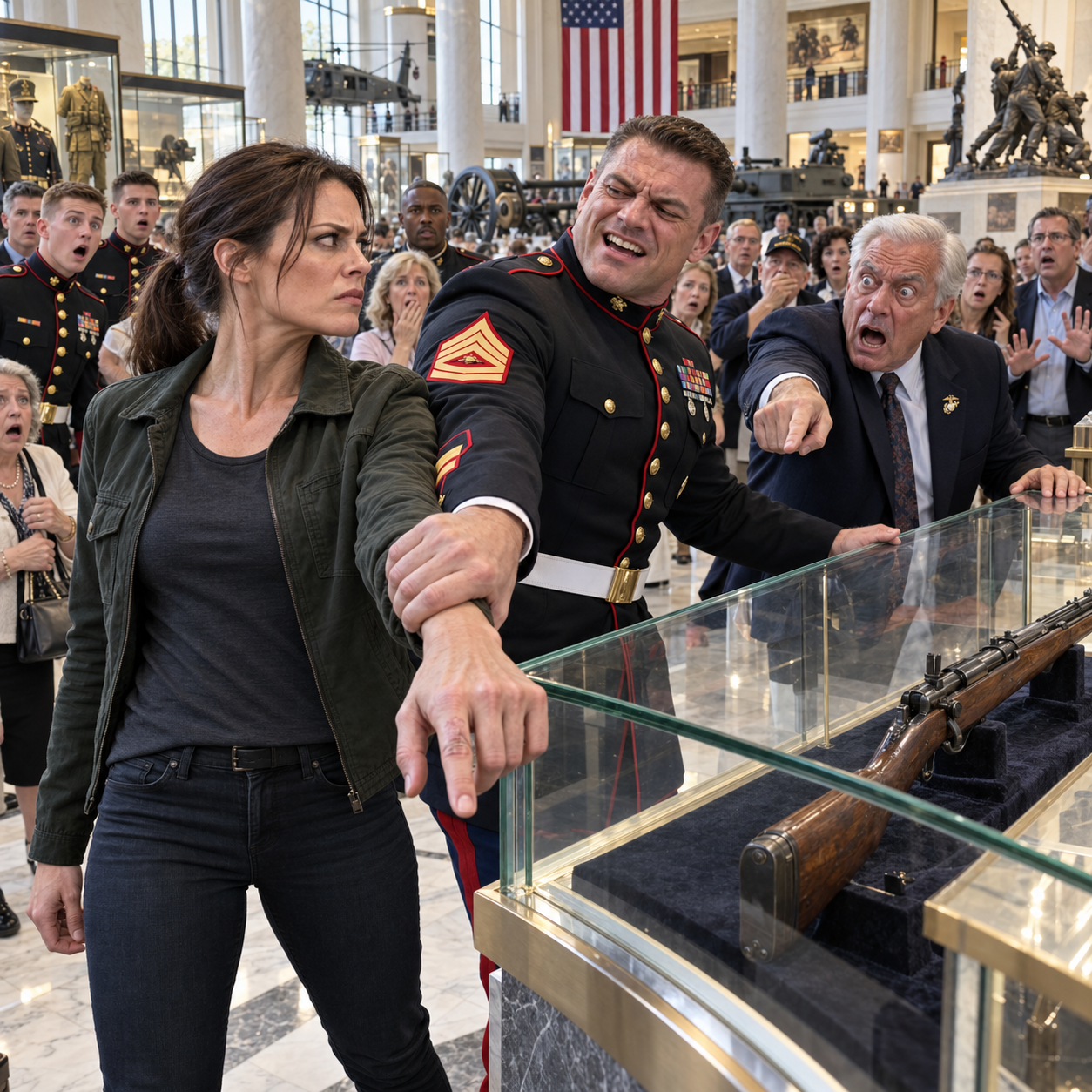
“Hands Off, Ma’am.” The Gunny Pulled My Hand From The Glass In Front Of His Whole Tour. “That Piece Cost More Than You Ever Earned.” A Retired Colonel In The Group Winced. I Said The Serial, Seven Digits, No Pause. The Gunny Laughed. “Nice Party Trick.” The Colonel Didn’t Laugh. He Was Staring At My Right Hand. “Gunny, Look At Her Trigger Finger.”
For nineteen years, I kept my damaged hand hidden and my military service mostly to myself. Then a young Marine described a museum exhibit about an unidentified hero who had defended a checkpoint in Iraq, and I recognized the rifle she was talking about. When I visited, the gunnery sergeant leading the tour mocked my disability benefits in front of his students. I answered with seven numbers, never expecting an elderly stranger to recognize the injury that had changed my life—or to uncover why two Marines had disappeared from the official story.
Part 1: A Wounded Veteran Hears Her Forgotten Rifle Has Become a Legend
The first thing Corporal Natalie Briggs said that Monday morning was that she wanted to quit. She said it without drama, sitting on a wooden bench behind the firing line at Quantico, Virginia, with her injured right hand resting inside a black brace and a rifle case between her boots. Rain drifted sideways across the gravel, collecting along the brim of her cap, while somewhere beyond the low hills another group of Marines practiced in the cold. I handed her a paper cup of coffee and said, “Then you can quit after you show me what you learned yesterday.”
She gave me the sort of look younger Marines reserve for civilians they suspect have forgotten what military service actually involves. I had been working as an adaptive marksmanship instructor for twelve years, helping service members whose injuries required them to learn unfamiliar ways of handling their weapons. Natalie had once qualified Expert without much effort, but an equipment accident had damaged several tendons in her shooting hand, and every attempt to shoot left-handed reminded her of what she could no longer do. “You make it sound easy,” she said, and I held up my own right hand, letting her see the shortened index finger and the uneven scar that crossed my knuckles. “I promise you,” I told her, “nobody here understands difficult better than I do.”
She stayed, although she complained through most of the first hour. By lunchtime, she had managed a respectable group at two hundred yards, and when the target came back, she stared at it as though somebody had changed the paper while she wasn’t looking. I watched her straighten her shoulders, the brace hanging uselessly against her chest, and remembered the first time I had discovered that losing the use of one finger didn’t necessarily mean losing everything that had once made me useful. “Again?” she asked, suddenly impatient, and I smiled because I knew that particular impatience very well.
My name is Rebecca Mercer, though most people at the range call me Beck. I was forty-three that fall, medically retired from the Marine Corps, unmarried, and the owner of a modest ranch-style house in Stafford County with a perpetually unreliable dishwasher and a backyard that needed attention. I had no children, no impressive collection of military memorabilia, and no interest in attending reunions where everyone eventually asked the same carefully worded questions. My closest friend was a retired Navy nurse named Denise, who lived three streets away and understood that when I said I didn’t want to discuss something, I generally meant it.
Natalie started talking while we cleaned up the equipment. Her corporal’s leadership course had visited the National Museum of the Marine Corps the previous Friday, and she had been especially impressed by a new exhibition about the fighting in Iraq. “There’s a rifle in this glass case,” she told me, folding a damp cleaning cloth into a neat square. “Looks like somebody dragged it behind a truck, but the guide says it’s one of the most important weapons they have.”
I was putting away a box of ear protection when she described the damage along the left side of the handguard. She mentioned a strip of faded tan tape around the grip and a front sight that appeared slightly crooked, and something unpleasant tightened beneath my ribs. Lots of old service rifles carried scratches and tape, I reminded myself, and there were countless ways for a front sight to get bent. Then Natalie added, “The gunnery sergeant says it came from an entry control point outside Fallujah in April 2007.”
I stopped moving.
“He says this unidentified Marine held off an attack for eleven minutes after a truck exploded near the checkpoint,” she continued. “Apparently nobody ever figured out who the guy was, but the battalion saved his rifle.”
I asked whether the display mentioned any other Marines. Natalie frowned, trying to remember, then shook her head. “I don’t think so. Why?”
“No reason,” I said, although there was a reason, and it had been sitting in the back of my mind for almost two decades.
She studied me for a moment before changing the subject, which was one of the things I liked about Natalie. Her injury had made her sensitive to the difference between questions people were ready to answer and questions they weren’t. We finished storing the equipment, and she drove back toward the barracks while I remained inside the small range office, looking at the rain crawling down the window. Eleven minutes was an awfully specific detail for a story whose central participant supposedly had no name.
On the drive home, I passed the museum entrance without turning in. Its enormous sloping structure rose above the trees, visible through the gray afternoon, and I wondered how many times I had driven that road while something belonging to me sat inside that building. At home, I reheated leftover chicken, fed the neighborhood cat that occasionally appeared on my porch, and sat at the kitchen table beneath a light that flickered whenever the washing machine ran. I tried reading a novel, but every time I turned a page, I saw tan tape peeling from a black pistol grip.
There was a steel biscuit tin in my laundry room filled with empty brass casings. I had collected one from the first successful session of nearly every injured shooter I’d coached, not because the casings were valuable, but because each represented a moment somebody had refused to give up. Under the tin was a cardboard box containing photographs from my first deployment, a few certificates, and a bundle of letters tied with blue thread. I carried the box into the kitchen, where I hadn’t opened it since moving into the house.
The first photograph showed three young Marines standing beside a battered concrete barrier under an impossibly bright sky. I was in the middle, twenty-four years old, wearing body armor that seemed built for somebody with much broader shoulders. To my left stood a woman named Carla Mendez, grinning beneath her helmet, and to my right was a lanky young man with a crooked smile and the kind of sunburn that never seemed to fade. His name was Lance Corporal Daniel Rowan, and he had been dead since April 19, 2007.
I touched the corner of the photograph with my left thumb. Daniel’s mother had received a letter about his death, and somewhere inside that letter was a reference to another Marine who had fought alongside him. That was all I had permitted the battalion to say about me, and at twenty-four I’d believed I was doing something honorable by refusing recognition. Now someone was telling Daniel’s final morning as the story of a nameless man, and I realized that my silence had protected neither of us.
I searched the museum website that evening, finding a small announcement about the new exhibition. The photograph accompanying it was too distant to reveal the rifle’s markings, but the description included a phrase that made my stomach tighten: “The unknown defender of Entry Control Point Two.” I was preparing to close the laptop when I noticed an acknowledgment beneath the article thanking a former battalion public affairs officer for supplying the historical account. I recognized his name, and for the first time, I wondered whether the missing identities were really an accident.
Part 2: The Marine I Lost Had a Name and a Mother
Nineteen years earlier, I’d arrived in Iraq believing that competence would eventually settle every argument about whether I belonged there. I had grown up outside Green Bay, Wisconsin, where my father repaired agricultural equipment and taught me to shoot on weekends, and I entered the Marine Corps shortly after my nineteenth birthday. The recruiters talked about challenge and discipline, which appealed to me, but what mattered most was the idea of being judged by something other than the small expectations people carried about girls from small towns. I learned quickly that military institutions could admire your abilities while remaining uncomfortable with what those abilities suggested.
I was assigned to military police and eventually selected for an attachment supporting infantry operations in Anbar Province. The unit needed female Marines to search women passing through checkpoints, a job that required patience, attention, and the ability to remain polite when everyone involved was exhausted. My supervisor explained the assignment with the usual mixture of practicality and condescension, telling me that my responsibility was to keep the civilian lanes moving rather than involve myself in infantry matters. I accepted the assignment because the work needed doing, not because I agreed with his assessment of what I was capable of.
Carla Mendez became my partner during that deployment. She was from Tucson, spoke Spanish with her grandmother every Sunday whenever she could get a connection, and possessed an almost supernatural ability to find edible food where everyone else found disappointment. She kept a little notebook of Arabic phrases, including several that weren’t especially useful in polite company, and taught me to recognize different kinds of frustration without taking every angry expression personally. During the first month, we spent more time helping frightened civilians understand checkpoint procedures than doing anything resembling the war we had imagined.
Daniel Rowan belonged to the infantry squad assigned to our checkpoint. He came from a river town in southern Ohio, talked endlessly about his mother’s cooking, and had promised his younger sister he would help repair her car when he returned home. He possessed an unfortunate singing voice and no awareness of its limitations, which made the long hours considerably less solemn. When he discovered that I couldn’t stand excessively sweet tea, he began bringing me a cup every morning from a nearby vendor, always adding enough sugar to make a dessert out of it.
“You know that’s terrible,” I told him one morning, taking the paper cup anyway. He watched me drink while leaning against a stack of sandbags, delighted by the contradiction. “Then why do you keep accepting it, Corporal Mercer?” he asked, and I told him I was performing a public service by preventing him from drinking the entire container himself. He laughed so hard that the corporal supervising his squad ordered him back to work.
Daniel was not the fearless giant people sometimes invent when somebody dies young. He worried about making mistakes, complained that his feet hurt, and wrote long letters home because his mother insisted she could tell when he was leaving something out. Once, after a frightening afternoon when an elderly man collapsed in the vehicle line, Daniel admitted that he’d been afraid the whole situation would turn violent before medical help arrived. I told him that fear was useful when it reminded you that every person in front of you was real, and he considered this with an unusually serious expression.
A week later, he brought me a photograph from his wallet. His mother, Margaret, stood beside a faded blue pickup outside a small white house, holding a ridiculous birthday cake with crooked lettering, and Daniel pointed proudly at the woman as though she had personally invented motherhood. “She’s going to want to meet you someday,” he said, because he’d apparently mentioned my name so often that Margaret had begun including me in her letters. I teased him about having a mother who investigated his friendships, but the thought of meeting her warmed me more than I admitted.
The last ordinary photograph of Daniel was taken two days before the attack. Carla had borrowed somebody’s camera, and the three of us posed beside the checkpoint while Daniel pretended to balance an empty tea cup on my helmet. He’d been reprimanded for doing something equally foolish during an inspection, and we were laughing about it when the picture was taken. Later, I would remember that laughter more clearly than almost anything else about the deployment, although the photograph itself disappeared somewhere during my evacuation.
On April 19, Carla was confined to her quarters with a high fever. Our checkpoint was already short-handed, and rather than pull another woman from a different position, the duty officer instructed me to cover our lane alone until a replacement became available. Daniel arrived just after sunrise carrying the usual tea, looking exhausted because he’d spent part of the night helping another squad move equipment. I asked why he hadn’t slept, and he said, “Somebody had to make sure you got breakfast.”
He handed me the cup, and I complained about the sugar. That conversation became the last ordinary exchange of our lives together, although I didn’t understand its importance until much later. At the time, the checkpoint was simply busy, with civilians waiting beneath the growing heat and Marines trying to manage traffic without making anyone more miserable than necessary. Daniel checked his watch, leaned toward the road, and said he thought the first vehicles were arriving unusually fast.
For years, I remembered the next several minutes in disconnected pieces. A raised voice, a sudden movement, the hard impact that damaged my hand, and Daniel’s body falling out of sight behind the concrete. I remembered trying to reach him and being forced to remain where I was, unable to tell whether he could hear me. Most clearly, I remembered being frightened that I would fail him twice: first by allowing him to die, and then by failing to prevent the checkpoint from being overrun.
Afterward, in a military hospital, someone asked me to provide a statement for an awards recommendation. I insisted that Daniel should receive the attention because he had died while defending the gate, and I was still alive to argue about paperwork. I didn’t understand that declining recognition was different from erasing myself from the historical record, or that a wounded twenty-four-year-old could make a decision whose consequences would last nineteen years. The officer collecting the account seemed relieved when I asked not to be named.
That Tuesday morning, before leaving for the museum, I looked up the former public affairs officer whose name appeared on its website. His name was Lieutenant Colonel Thomas Varden, retired, and his professional biography described a distinguished career in military communications followed by consulting work with historical organizations. I remembered him from a hospital telephone call in 2007, when he’d asked whether I would object to being identified only by my unit rather than my name. The strange thing was that Varden knew exactly who I was when he made that call.
Part 3: Seven Numbers Silence a Room Full of Laughing Marines
I had a medical appointment in Fredericksburg that Tuesday morning, the kind that involved answering familiar questions about nerve damage and being told that nothing significant had changed. By the time I finished, the rain had stopped, leaving the roads wet and the trees along Route 1 brilliant with autumn color. I drove toward Quantico with no clear intention beyond examining the exhibit and deciding whether the rifle was actually mine. I had rehearsed several possible conversations, none of which involved an audience.
The museum was busy with visitors, including schoolchildren shepherded past aircraft displays and retired service members studying photographs from wars that had aged them. I followed the signs toward the newer galleries, passing exhibits that made me feel both familiar and strangely displaced. The Iraq section contained uniforms, maps, photographs of damaged buildings, and personal objects displayed with the careful seriousness museums give to things removed from their original purposes. Then I heard a man’s voice projecting confidently from the far end of the room.
“That’s why we preserve these objects,” he was saying. “Not because metal matters more than people, but because sometimes metal survives long enough to tell us what people did.”
About twenty Marines stood in a loose semicircle around him, accompanied by their staff sergeant instructor and several civilian visitors. The speaker was Gunnery Sergeant Marcus Doran, a broad-shouldered man with silver beginning to show above his ears, whose uniform was immaculate and whose manner suggested years of being listened to without interruption. Behind him stood a glass case containing an M16A4 rifle mounted against a charcoal-colored background. I didn’t need to read the description to know what I was looking at.
The left handguard still bore the gouge I’d made when the weapon struck concrete during the attack. There was a faint scrape near the magazine well from a maintenance mishap months earlier, and the front sight leaned just enough to irritate an armorer who hadn’t known how to correct it. The tape around the pistol grip had faded from tan to a dirty gray, but I could still see the two tiny parallel cuts I’d made with a pocketknife so that I could distinguish my rifle from another in poor light. My knees weakened before I had time to tell myself that the reaction was unnecessary.
Doran explained that an unnamed infantry Marine had defended the checkpoint after an attempted vehicle bombing. According to the version he presented, the Marine continued fighting after being wounded and remained at his position until help arrived eleven minutes later. He emphasized that nobody had been able to identify the rifle’s owner, which made the weapon a symbol of anonymous courage. Several Marines leaned forward, visibly moved, and I understood why Natalie had remembered the story so vividly.
Then Doran said something that made me look away from the weapon. “The Marine who carried this rifle never asked anybody to remember his name.”
I knew he couldn’t possibly know that. More importantly, he had no reason to assume the Marine was a man, or that the only person worth mentioning was whoever had held that particular weapon. The description on the wall gave no indication that Daniel Rowan had died at the checkpoint or that other Marines had been wounded defending it. An entire morning of fear, noise, bravery, and loss had been reduced to one anonymous figure suitable for a speech.
I moved closer without realizing how far I’d stepped beyond the back of the group. Doran had turned to answer a question when I reached the display, and I placed my scarred right hand against the glass near the damaged handguard. The surface felt surprisingly cold, almost damp, and for a moment I was standing somewhere else with sunlight burning through the back of my uniform. Doran interrupted himself, approached, and took my wrist firmly enough to move it away from the case.
“We don’t touch the exhibits, ma’am,” he said, speaking loudly enough for everyone to hear. I apologized and lowered my hand, but he looked at my faded fleece jacket and shook his head with theatrical patience. “That rifle’s worth more than most folks make in a year, so let’s not test the security system.” A few of the younger Marines smiled, and I might have walked away if he’d stopped there.
His attention settled on the veterans’ identification card hanging from my jacket. He noticed the disability notation, glanced at my damaged hand, and gave a short amused breath. “Actually,” he added, “that rifle’s probably worth more than your entire pension.”
Several people laughed.
I recognized that kind of laughter immediately. It was the laughter people offer when somebody with authority decides that another person can safely be made into entertainment, and I had heard versions of it throughout my service. I looked at the rifle rather than Doran, remembering the young corporal who had once been told she was there to search bags and stay out of the way. Then I said, quietly and distinctly, “Seven. Three. One. Four. Six. Zero. Two.”
Doran frowned. “Excuse me?”
“That’s the serial number,” I said. “Check the left side of the receiver.”
He glanced toward the small museum placard and smiled as though I’d offered a clever but irrelevant guess. “Visitors come prepared with all kinds of trivia, ma’am,” he replied, and he began turning back toward the group. Before he could continue, a tall elderly man standing beside the rear wall moved toward us, his attention fixed on the scar across my right hand. His face had changed so completely that I wondered whether he was feeling ill.
“Gunny,” the man said, in a voice that cut through the room without rising. “I want you to look at her hand.”
Doran hesitated, recognizing something in the man’s bearing even before the older visitor introduced himself. The stranger ignored him and looked directly at me, studying my face as though searching for a person he had once met in terrible circumstances. “Were you at Entry Control Point Two on April nineteenth?” he asked. I nodded, and his expression collapsed into something between disbelief and grief.
“My name is Adrian Bellamy,” he whispered. “I was the major who helped carry you to the helicopter.”
Part 4: The Colonel Remembers a Young Woman the Records Forgot
The name came back to me slowly. Major Bellamy had been part of the reaction force that reached our checkpoint after the fighting, and I remembered his hands more clearly than his face. One had held my shoulder steady while a Navy corpsman worked on the injury, and the other had gripped my uninjured hand so firmly that I’d thought he was afraid I might disappear. He’d spoken to me while the medical team prepared the evacuation, although pain and exhaustion had reduced his words to fragments.
Now he stood in front of me, much older, wearing a gray jacket and carrying the same expression of concentrated concern. “I remember your eyes,” he said, looking at my face. “I remember asking your name, but somebody interrupted before you answered, and then they took you away.” I tried to respond, but the words caught somewhere below my throat. For nineteen years, I’d assumed nobody outside my immediate unit retained a clear memory of what happened.
Doran looked between us with growing discomfort. “Sir, are you saying you were present during this incident?”
“I led the response element,” Bellamy answered. “And unless my memory has failed me completely, the Marine who carried that weapon was a woman with a destroyed right hand.” He turned toward the display, studying it with an intensity that made the surrounding visitors fall quiet. “We brought the rifle away from the casualty collection area that morning, and I remember the tape around its grip because it was stuck to my gloves.”
The collection manager was called before anybody touched the case. While we waited, Staff Sergeant Lauren Pierce quietly moved her students toward the side wall, apparently sensing that what was happening was more important than their scheduled lesson. Doran stood beside the display with his hands clasped behind his back, no longer offering jokes or commentary. I wanted to leave, but Bellamy asked whether I could bear to answer a few questions, and something in the gentleness of his request made me remain.
He asked what I remembered about the morning, and I began with Daniel. I told him about the paper cup of over-sweetened tea, the civilian vehicles waiting in line, and Carla being absent because she was sick. The younger Marines were watching me now, their expressions unsettled, and I realized that until that moment they had probably imagined the unknown defender as somebody larger and stronger than ordinary people. I couldn’t bring myself to describe Daniel’s death immediately, so I talked instead about how ordinary the morning had felt before everything changed.
The first warning was shouting near the outer barriers. I remember looking up and seeing a truck moving much faster than the surrounding traffic, its movement so out of place that my mind recognized danger before I consciously understood it. Daniel was several feet away, turning toward the road, while another Marine shouted into a radio. Within seconds, the checkpoint was filled with noise, and everything we had learned about maintaining orderly procedures became irrelevant.
I remember raising my rifle and being struck hard enough that my right hand seemed to vanish from my awareness. When I looked down, my finger was badly injured, and for a second I was almost curious about the sight of it. Then I heard Daniel calling out, and the part of my mind that still understood the situation forced me to keep working with the weapon despite the injury. The truck exploded before reaching the main gate, throwing dust and debris across the position and leaving me unable to hear properly.
When I regained enough awareness to understand where I was, Daniel lay motionless near a concrete barrier. Two other Marines were wounded on the opposite side of the checkpoint, and gunfire continued from buildings beyond the road. I tried calling Daniel’s name, but he did not respond, and I could not reach him without abandoning the narrow area I was still helping defend. The helplessness of that choice stayed with me longer than the physical pain.
The fighting continued until the reaction force arrived. I could not have told anyone how long it lasted if the official logs hadn’t recorded the interval, because time had become a series of separate tasks and frightening sounds rather than something measurable. At some point, I realized I was using my middle finger to work the trigger, and at another I found myself counting the remaining ammunition while wondering whether reinforcements had heard our calls. I remember being certain I would never see Wisconsin again, but I don’t remember deciding to remain at my position.
Bellamy’s people reached us eleven minutes after the first emergency transmission. He approached through a cloud of dust, helped secure my rifle, and directed the corpsman toward my hand. I asked about Daniel, and although Bellamy didn’t answer immediately, his face told me what I needed to know. Later, on a stretcher near the evacuation area, I remember begging him to make sure somebody told Daniel’s mother what her son had done.
“I remember that,” Bellamy said softly in the museum. “You kept asking whether we’d gotten his name.”
“Daniel Rowan,” I answered. “Lance Corporal Daniel Rowan.”
Bellamy closed his eyes for a moment.
The collection manager arrived carrying keys and a tablet. Her name was Eleanor Shaw, and she listened without interrupting while Doran explained that a former participant in the incident appeared to recognize the displayed weapon. She asked me to repeat the seven numbers, entered them into her records, and went completely still when the corresponding accession file appeared. Then she looked at Bellamy and said, “Colonel, I think we need to open the supporting documentation before we do anything else.”
I assumed she wanted to protect the museum from an embarrassing misidentification. Instead, Eleanor turned the tablet toward us, showing an old scanned document that had accompanied the rifle when it was transferred from a battalion headquarters display. Most of the page was ordinary inventory information, but near the bottom sat a handwritten note referencing a damaged weapon authorization card recovered after the engagement. Beside the word “assigned,” someone had written my surname in faded ink.
Doran stared at the screen. “Then why does our narrative file say the owner was unidentified?”
Eleanor scrolled further, reading silently. I watched her expression change as she reached a document bearing Lieutenant Colonel Thomas Varden’s signature. It was dated nearly a decade after the attack, and a line in the margin instructed future custodians to preserve the account as an example of anonymous infantry courage. Bellamy looked at me, then at the document, and said the question nobody else had yet dared to ask.
“Why would anybody keep the identity unknown after it had already been recorded?”
Part 5: A Hidden Paper Trail Reveals Who Changed Our History
Eleanor invited us into a small conference room behind the gallery while another staff member temporarily closed the rifle display. I followed reluctantly, conscious of the visitors whispering beyond the doorway and wondering whether somebody had already taken a photograph of me. Bellamy sat opposite me at a narrow table, his hands folded over an old leather notebook, while Doran remained standing until Eleanor offered him a chair. The room smelled of fresh printer paper and stale coffee, an ordinary workplace atmosphere that seemed absurd beside the enormity of what we were discussing.
Eleanor explained that the rifle had spent years in a display at its former battalion headquarters before being transferred to the museum. During that time, several different descriptions of the incident had circulated, each derived from earlier summaries rather than the original operational records. When the museum prepared its new exhibition, an outside historical consultant had assembled a narrative package using the material provided by the battalion. That package identified the rifle’s owner as an unknown male Marine, although the older inventory documents appeared to contain enough information to challenge that conclusion.
I asked whether the authorization card was still available. Eleanor opened another file and showed me an image of a warped plastic card bearing my surname, an abbreviated unit designation, and the weapon number I’d repeated in the gallery. The card was damaged along one edge, but the identifying information was readable, which made the repeated claims of uncertainty harder to understand. Doran leaned toward the screen, his expression tightening when he realized that the answer had been sitting in the archive all along.
Bellamy examined the card, then asked to see the original after-action reports. Eleanor couldn’t provide them immediately because the museum possessed only a partial documentation set, but she promised to request the complete records through the appropriate channels. I told her I didn’t need a ceremony or an investigation, only a corrected description that named Daniel Rowan and acknowledged the other Marines who had defended the checkpoint. She listened carefully, then said something that made the situation more complicated.
“Ms. Mercer, correcting a public display is only one part of this. If a record was knowingly altered, we have to establish where that happened.”
I disliked the word “altered” because it suggested motives I wasn’t prepared to examine. For nineteen years, I’d understood the missing details as the natural consequence of my own decision to avoid recognition, and that explanation had been painful but manageable. Deliberate omission was different, particularly if it involved Daniel. He hadn’t requested anonymity, and nobody had any right to turn his death into material for a convenient inspirational speech.
Bellamy offered to help locate the original accounts. He had retired as a colonel several years earlier, but he still maintained relationships with Marines who’d served in our battalion and knew how complicated the records could become when personnel belonged to attached units. Before leaving, he wrote his phone number on the back of a business card and pressed it into my uninjured hand. “I searched for you after that deployment,” he said, and I looked at him in surprise.
He explained that he’d wanted to nominate the injured Marine he remembered for recognition, but the information he’d received identified me only through my temporary attachment. He made several inquiries and eventually learned that I had declined an award recommendation, which he’d interpreted as a request for privacy. He hadn’t known about my medical retirement or my later work at Quantico, and the years had passed without either of us discovering how close we lived. Hearing that someone had genuinely looked for me unsettled an assumption I’d carried for almost half my life.
Doran accompanied me toward the exit after Bellamy left. He tried to apologize beside the main staircase, beginning with a formal statement about unprofessional conduct and regrettable assumptions. I interrupted him because the language sounded rehearsed, even though I suspected he meant every word. “You didn’t just misunderstand an exhibit,” I told him. “You saw a civilian woman with a disability card and decided she was safe to ridicule in front of your Marines.”
He lowered his eyes. “You’re right.”
“I don’t need you to feel terrible for ten minutes,” I continued. “I need you to remember how quickly you made that decision, because those young people were watching you decide what kind of respect somebody like me deserved.”
He nodded without defending himself, which was more restraint than I’d expected. I left him standing by the stairs and drove home with the uncomfortable knowledge that the museum had offered me something I’d avoided for years: the possibility that people would examine what happened instead of accepting the version I’d helped create. On the drive, I nearly called Denise, but I couldn’t explain the day without beginning a conversation I’d spent nineteen years postponing.
The following morning, Denise appeared at my front door with blueberry muffins and an expression suggesting she’d already heard something unusual. Natalie had contacted her after seeing a brief discussion among Marines about an unidentified female veteran who challenged a museum presentation. I confessed what had happened while Denise made coffee, and when I finished, she sat quietly for a long time. “You kept saying the past wasn’t bothering you,” she finally said, “but you’ve arranged your whole life around keeping it outside the front door.”
I wanted to argue, but she was standing in a kitchen without a single photograph of my years in uniform. My awards remained packed in a closet, and I had never once introduced Denise to anyone who’d known me during the deployment. I told her that remembering Daniel was difficult, and she answered that remembering him privately wasn’t the same as allowing his mother to know the complete circumstances of his death. The distinction made me feel ashamed, although she hadn’t intended it that way.
That afternoon, Eleanor called with the results of a preliminary archive search. She had located correspondence from Daniel’s mother, Margaret Rowan, submitted years earlier when the rifle was still displayed at the battalion headquarters. Margaret had apparently asked that her son’s name be added to the description and had supplied copies of official documents proving he died defending that checkpoint. According to Eleanor, someone had answered her request with a letter explaining that the exhibit was dedicated to an unidentified service member and could not be changed without sufficient verification.
“Who signed that letter?” I asked.
Eleanor hesitated before answering. “Thomas Varden.”
Part 6: The Fallen Marine’s Mother Had Been Asking Questions for Years
I read the scanned letter three times before I understood how much it troubled me. Margaret Rowan hadn’t demanded special recognition or disputed the rifle’s ownership; she had simply asked the battalion to acknowledge that her son died during the engagement the display commemorated. Her request was accompanied by his casualty documentation and a copy of the award citation recognizing his actions that morning. Varden’s reply had been polite, official, and completely dismissive.
The letter stated that the exhibit represented all Marines who served at the checkpoint and that attaching additional names might distract from its broader symbolic purpose. Reading those words, I remembered Daniel describing the real woman behind his mother’s strict instructions about writing home. She was somebody who kept a folder for important papers, saved grocery receipts, and called her son every Sunday because routines made distance bearable. I imagined her opening that letter at the same kitchen table where she’d once checked Daniel’s homework, then putting it into the folder with everything else she’d been forced to preserve.
Bellamy contacted me that evening after speaking with two retired officers familiar with the battalion’s historical records. He had located an unabridged account identifying four Marines involved in the defense, including Daniel, the two wounded infantrymen, and an attached female military police corporal. My name appeared in a supplemental roster, even though the narrative summary circulated later omitted it. He also discovered that Varden had overseen preparation of a commemorative history used during fundraising for the battalion’s veterans’ programs.
I asked whether he thought the omission had been deliberate. Bellamy paused long enough that I could hear the clock ticking in my kitchen. “I think someone preferred a simpler story,” he said, “and once that story attracted attention, the people responsible became reluctant to correct it.” He refused to accuse Varden of inventing the entire account without further evidence, but he no longer believed the errors resulted solely from lost paperwork.
The next day, Eleanor sent a copy of an internal memorandum she’d discovered among the exhibit planning documents. The memorandum recommended retaining the anonymous-hero framing because it allowed visitors to imagine themselves in the defender’s place and avoided complications associated with incomplete personnel records. It also referred to the rifle as an infantry artifact, despite the authorization card establishing that it had been issued to an attached military police Marine. The author was a consultant working from material previously prepared under Varden’s supervision, and the museum had accepted the recommendation without independently resolving the contradictions.
The discovery made me angrier than Doran’s insult. A rude remark could be acknowledged, apologized for, and remembered as an individual’s failure, but the documents revealed a series of people choosing convenience over accuracy. Each had apparently assumed the next person would handle the uncertainty, while Margaret’s requests and Daniel’s name remained outside the story. My own silence had made the original omission easier, but it hadn’t authorized anyone to ignore the evidence that eventually arrived.
On Friday morning, I finally called Margaret Rowan. Bellamy had spoken with her first and asked whether she would welcome hearing from me, and she’d answered so quickly that he barely finished the question. I sat at my kitchen table with Daniel’s photograph beside the telephone, listening to the line ring, and nearly disconnected when a woman answered in a voice that reminded me of him. “Mrs. Rowan? This is Rebecca Mercer. I served with Daniel.”
For several seconds, she said nothing. Then she asked, “Were you the other Marine?”
“Yes, ma’am.”
She took a careful breath. “I’ve been wondering about you for nineteen years.”
Her voice was steady, but I could hear something moving beneath it. She explained that Daniel’s original casualty notification mentioned several Marines defending the position and that later accounts referred to an unnamed partner, but nobody had been able to answer her questions about who stood beside him. She had written letters, contacted veterans’ groups, and asked old friends of Daniel’s whether they remembered an attached female Marine. Eventually, she’d stopped expecting an answer, though she never stopped keeping the correspondence.
I told her about the tea. I described Daniel arriving with his exaggerated seriousness, presenting me with a cup he’d sweetened beyond reason, and pretending to be offended when I complained. Margaret laughed suddenly, a startled sound that dissolved into tears. “He did that to me,” she said. “Even when he was little, he used to put sugar in my tea because he thought everyone ought to like things the way he did.”
We talked for more than two hours. I told her how Daniel had helped a frightened child at the checkpoint, how he’d talked about repairing his sister’s car, and how he sang so badly that Carla threatened to confiscate his music player. Margaret listened to details she’d never heard, asking questions about his clothes, his expressions, and the ordinary hours between the photographs the family had received. When she asked about his final moments, I answered carefully, refusing to invent reassuring details I couldn’t honestly provide.
“He was doing his job,” I said. “He stayed with us when everything became frightening, and he helped stop the truck before it reached the people waiting inside.”
She was quiet. Then she asked whether he’d been alone.
“No,” I said. “I was there, and so were the other Marines.”
“Good,” she whispered. “I’m glad somebody was with him.”
I cried after we hung up, not because Margaret blamed me, but because she didn’t. She had been denied simple answers for nineteen years, and I had possessed several of them all along. I understood why I’d remained silent at twenty-four, when I believed any recognition of my survival diminished Daniel’s sacrifice. At forty-three, however, I could no longer pretend that my private reasoning had made the consequences harmless.
The following Monday, Bellamy forwarded a written statement he’d prepared for the museum and the Marine Corps records office. It described the incident from his perspective, identified the Marines he’d found, and explained that the original documentation should be reviewed for inaccuracies. He copied Margaret, Eleanor, and the appropriate administrative offices, but he did not request a medal or make claims about awards he couldn’t authorize. His closing sentence stated that the historical record should identify the people who had actually served, rather than the symbolic figures later substituted for them.
I thought that would be the end of the revelations. Then Eleanor called and told me that Varden had responded to a request for clarification and wanted to speak with me personally. He claimed that his decisions in 2007 had been based on instructions I gave after the attack, and he possessed a signed statement that supposedly proved I had asked to remain unidentified in every future account. I remembered signing a statement at the hospital, but I had never agreed to erase Daniel. Eleanor asked whether I’d be willing to examine the document before making any decisions, and for the first time, I became afraid of what my younger self might have written.
Part 7: The Statement I Signed Became an Excuse to Erase Others
Varden’s statement arrived in a password-protected file the following morning. The signature was mine, although my handwriting looked uneven because I’d been learning to use my left hand, and the date placed it shortly after my transfer to a hospital in Maryland. I remembered the exhausted captain who’d brought me the paperwork and explained that the battalion was preparing recommendations connected to the attack. He’d asked whether I wanted my actions considered for an individual award, and I’d told him I didn’t.
The document confirmed that decision. I had declined an individual recommendation and requested that official publicity not emphasize my personal involvement, explaining that Daniel’s death and the injuries suffered by the other Marines deserved recognition without competition. My handwritten note ended with a request that Daniel’s family receive an accurate account of his actions. Nothing in the original document authorized the suppression of his name, and it certainly didn’t turn me into a male infantry Marine whose identity could never be established.
Varden had appended a later cover memorandum presenting my refusal of publicity as the basis for an anonymous account. In that memorandum, he described the decision as consistent with the heroic defender’s wishes, despite knowing that the rifle belonged to an attached female Marine. The altered interpretation had then traveled through subsequent summaries until people reading it no longer recognized any difference between declining personal attention and possessing an unknown identity. Bellamy called the distinction important, and I thought it was the sort of distinction nobody would have made unless somebody insisted.
We met Varden at the museum on Thursday in Eleanor’s conference room. He was a neatly dressed man in his late sixties, with expensive glasses, a restrained manner, and the habit of folding his hands while other people spoke. Bellamy sat beside me, while Eleanor had invited a museum administrator to document the discussion. I was determined not to let the meeting become an argument about whether a woman who’d been seriously injured deserved the credit somebody else had assigned to an imaginary man.
Varden began by expressing regret for the distress caused by the exhibit. He explained that the battalion had been managing numerous casualties, personnel transfers, and complicated award recommendations, and that retaining an anonymous account had seemed respectful of my stated wishes. He acknowledged that details had been lost as documents passed between organizations, but maintained that he hadn’t intended to diminish anybody’s service. I listened until he described Daniel as a peripheral casualty whose story was already preserved elsewhere.
“Daniel wasn’t peripheral,” I said.
Varden stopped speaking.
“He was at the gate before the truck came. He helped defend it, and he died there, while I survived with an injury that changed my life.” I looked across the table at him, making sure he understood that I wasn’t asking for praise. “His mother wrote to you with documents identifying him, and you told her the story couldn’t be changed because it needed to remain universal.”
Varden glanced toward the administrator. “There were institutional considerations.”
“There was a mother,” I answered. “She wanted to know why her son’s name wasn’t attached to the story of the place where he died.”
For the first time, Varden appeared genuinely uncomfortable. He admitted that the anonymous account had become a prominent part of the battalion’s historical presentations and that changing it would have required reviewing materials already distributed to several organizations. He had worried that correcting one inconsistency might call the reliability of the broader history into question, creating work for people who were no longer available to reconstruct every detail. The explanation was plausible, which made it worse, because it revealed how easily preserving an institution’s appearance could become more important than correcting its mistakes.
Bellamy asked whether Varden had ever attempted to contact my original military police unit for clarification. Varden said he couldn’t remember, and Bellamy placed a copy of the roster on the table between them. My name, rank, assignment dates, and unit were visible beside those of the other personnel involved in the checkpoint defense. “You had access to this,” Bellamy said. “Whether you chose to use it is the question.”
Varden offered no clear answer. The museum administrator explained that the institution would conduct a formal review of its sources and publication process, including the consultant’s recommendation to preserve the anonymous framing. Eleanor had already removed the inaccurate description from public display and arranged for a temporary notice acknowledging that the earlier account was under correction. None of these actions could undo the years Margaret had spent asking for answers, but they established that the institution was no longer treating the omissions as harmless.
I declined Varden’s offer to continue our conversation privately. He seemed surprised, perhaps because he believed a direct apology would allow the meeting to end with everyone feeling better. I told him that Margaret would decide whether she wanted to receive his explanation, and that I wasn’t interested in negotiating forgiveness on her behalf. Then I left the room with Bellamy, who walked beside me through the museum without saying anything until we reached the atrium.
“You did more than I managed back then,” he said.
I shook my head. “I don’t know about that.”
“You were twenty-four, badly injured, and trying to protect your friend’s memory,” he replied. “I was a major with the resources to follow up, and I accepted the paperwork when somebody told me it had been handled.”
I told him that guilt had become an easy place for both of us to live. We could spend another nineteen years discussing what we should have done, or we could help make the surviving record accurate enough that the people who came afterward wouldn’t inherit the same confusion. Bellamy smiled faintly and admitted that he’d spent much of his retirement trying to become less argumentative. I said he was doing a terrible job, and for a moment we were simply two aging veterans laughing in a museum parking lot.
That weekend, I received a handwritten letter from Margaret. She thanked me for speaking with her and included a copy of a photograph taken at the checkpoint shortly before Daniel’s death, one I’d assumed had disappeared during my evacuation. Carla had apparently mailed a duplicate to Daniel’s family after returning from deployment, along with a note explaining how much his friendship had meant to us. Margaret had kept it with her son’s letters and wanted me to have it, because she believed a photograph belonged partly to the people inside it.
I studied the picture for a long time. Daniel stood between Carla and me with his shoulders thrown back, holding his empty tea cup as if he’d won a championship, while I looked impatient and Carla laughed at something outside the frame. There was no heroism visible, no hint of the loss approaching us, just three young people doing an exhausting job and finding something ridiculous to enjoy. On the back, Margaret had written a sentence that made me sit down: “You don’t have to disappear to prove you loved him.”
Part 8: The Truth Finally Returns to the Rifle and Its Owners
The museum’s corrected exhibition opened several weeks later, after the records review confirmed the identities and circumstances described in the surviving documents. Eleanor contacted me throughout the process, asking precise questions about dates, assignments, and the difference between what I remembered and what the reports established. The final account identified Daniel, me, and the two other Marines who helped defend the checkpoint, without presenting the incident as the achievement of one miraculous figure. It also acknowledged that earlier descriptions had incorrectly characterized the rifle’s owner and omitted known participants.
I learned that Varden had provided a written clarification admitting his cover memorandum had overstated the implications of my request for privacy. The museum revised its source notes, discontinued use of the unsupported anonymous-hero narrative, and began reviewing other exhibit materials supplied through the same historical package. The relevant Marine Corps administrative offices received the corrected documentation for consideration in their own records, a process Eleanor warned could take considerably longer than changing an exhibit. Nobody was dramatically stripped of a rank or arrested in a hallway, and I was relieved because the truth didn’t need another performance built around it.
Doran called me after the new label was approved. He said he’d been taken off public tours temporarily while his supervisors reviewed the incident and he’d completed additional training concerning visitor interactions and the handling of uncertain historical material. His tone was subdued, and I could hear the embarrassment beneath the professionalism. He asked whether I would attend the revised exhibition’s opening, not because he expected me to endorse him, but because he thought the people who’d heard the original account should have the opportunity to hear the truth.
I told him I wasn’t ready to decide. Then I asked whether he’d changed the way he spoke about disabled veterans, especially those whose experiences he couldn’t recognize from a glance. He said yes, and I answered that I hoped the change would last longer than his discomfort. We ended the call politely, but I didn’t offer forgiveness simply because he finally understood why his joke had been cruel. Respect had been available to him before he knew who I was.
Margaret traveled to Virginia with Daniel’s younger sister, Laura, for the exhibition’s small reopening. I met them outside the museum on a bright November morning, recognizing Margaret instantly from the old photograph Daniel used to carry in his wallet. She was shorter than I’d imagined, with silver hair tucked beneath a blue scarf and Daniel’s unmistakable brown eyes. When she saw me, she opened her arms without hesitation, and I stepped into an embrace I’d been afraid of for nineteen years.
She held me tightly, then moved back to look at my face. “You look older than the girl in the picture,” she said, almost sternly. I told her that nineteen years had been hard on my complexion, and she laughed, brushing away a tear before introducing Laura. Daniel’s sister was now a mother herself, with two teenagers who knew their uncle mostly through photographs and the stories their grandmother told at family dinners.
Inside the museum, Eleanor greeted us and led us toward the revised display. The rifle stood in its familiar position, still damaged, still wrapped with the tape I’d applied so long ago, but the card beside it had changed. Daniel’s name appeared first, identifying him as killed in action during the defense of Entry Control Point Two on April 19, 2007. Beneath it, my name and the names of the two wounded infantry Marines appeared with a concise account explaining that the checkpoint had been defended through their combined efforts until the reaction force arrived.
Margaret read the words without speaking. Her fingers moved toward the edge of the case, then stopped short of touching it, and I watched her lips form Daniel’s name before she looked at the photograph displayed nearby. Eleanor had included the picture of the three of us from the checkpoint, with Margaret’s permission, because it showed the people behind the military report. For once, the photograph didn’t need a dramatic interpretation to make its meaning clear.
Bellamy stood several feet away with Staff Sergeant Pierce and a small group of Marines who had attended the earlier tour. Doran was there too, not leading the presentation, but standing among the museum staff while Eleanor explained the corrected history. When she invited questions, a young corporal asked why the error had remained uncorrected for so long. Eleanor answered that historical records were not immune to assumptions, institutional habits, or incomplete research, and that the museum had failed to examine evidence that should have prompted further questions.
Another Marine asked whether I’d known about the exhibition before visiting. I told him I hadn’t, and that I’d intended to leave without speaking to anyone until I heard Daniel’s role omitted from the story. My hands shook slightly as I answered, which irritated me until I realized nobody seemed to care. They were listening to what I said rather than watching to see whether I behaved like the veteran they’d imagined.
After the brief presentation, Doran approached Margaret. He introduced himself, apologized for repeating an inaccurate account of Daniel’s service, and acknowledged that his behavior toward me had contributed to the situation. Margaret listened, thanked him for making the correction, and turned back toward the photograph. I respected her for that, because she didn’t mistake accepting an apology for agreeing that the harm had disappeared.
We had lunch afterward at a diner not far from the museum. Margaret ordered iced tea, opened three sugar packets, and poured them into her glass with such familiar concentration that Laura and I began laughing before she understood why. When I explained, Margaret shook her head and said, “Well, apparently he learned something from me after all.” We spent the afternoon talking about Daniel’s childhood, the terrible car he planned to repair for Laura, and all the small ordinary things that death had interrupted.
Before leaving, Margaret gave me a small envelope. Inside was a copy of a letter Daniel had written shortly before the attack, mentioning that he’d met a stubborn Marine named Mercer who could outshoot most of the men at the gate but complained endlessly about his tea. He’d written that he liked knowing she was nearby because she paid attention when other people became careless. I folded the letter slowly and asked Margaret whether she’d mind if I kept it with the photograph.
“It was written partly about you,” she said. “Of course you should have it.”
The following Monday, I returned to work at Quantico. Natalie was waiting near the firing line, no longer wearing her heavy brace, and she greeted me with the same impatient determination she’d shown after her first successful practice. She hadn’t asked many questions about the museum, but I knew she’d read the corrected account because she’d left a printed copy on my desk with the names carefully underlined. When I thanked her, she shrugged and said she thought every Marine deserved to know who had actually stood at that gate.
Her shooting had improved enough that we began discussing whether she could return to ordinary qualification requirements. She was nervous about making the transition, particularly because her right hand still tired easily, so we worked through the morning without treating either success or frustration as a verdict on her future. When she completed a good group at three hundred yards, she sat up and laughed with a mixture of surprise and relief. I found myself laughing with her, the cold air sharp against my cheeks.
At the end of the session, I picked up one of her spent casings and placed it in my jacket pocket. Natalie saw the movement and asked why I saved them, and for the first time I told another person about the biscuit tin in my laundry room. I explained that it contained reminders of the people who’d learned something difficult after believing they couldn’t, and that I’d been collecting them for years. She smiled, looked down at her injured hand, and asked whether hers had earned a place among them.
“It already did,” I said.
That evening, I carried the tin into my kitchen and set it beside the box of photographs I’d finally moved out of the closet. I added Natalie’s casing, took Daniel’s picture from its envelope, and placed it in a simple wooden frame on the shelf near the window. For the first time in nineteen years, I didn’t feel the need to hide the photograph whenever somebody came to visit. I could see his crooked smile while washing dishes, and I could remember his jokes without forcing myself to relive everything that followed.
I still have difficult days. Sometimes the smell of hot metal or a sudden sharp noise brings back the checkpoint with an intensity that makes my comfortable Virginia kitchen seem impossibly far away. My hand aches in cold weather, and there are mornings when I think about Daniel’s mother spending years trying to understand his final hours while the people who possessed the answers remained silent. The corrected exhibition didn’t restore his life, heal my injury, or remove the guilt that had followed me home.
But Margaret and I speak now. She sends photographs of her grandchildren, I tell her stories about the Marines I teach, and every few months we exchange some small detail about Daniel that neither of us has mentioned before. Bellamy occasionally stops by the range, usually pretending he has official business, and Denise enjoys reminding him that retired colonels aren’t automatically in charge of civilian coffee makers. My life hasn’t become extraordinary, which is exactly how I prefer it.
There is one thing that has changed, though. When somebody asks about the scar on my hand, I no longer give a vague answer and change the subject. I tell them that I was wounded in Iraq while serving beside other Marines, including a young man named Daniel Rowan who did not come home. I tell them that the history of an event belongs to everyone who lived through it, and also to the families of those who didn’t.
For nineteen years, I believed that keeping quiet was the most respectful thing I could do for Daniel. I understand now that silence can sometimes begin as kindness and eventually become permission for other people to replace the truth with whatever story is easiest to tell. The rifle still sits behind glass in a museum, but it no longer belongs to an imaginary hero with no name and no companions. It tells the story of four real Marines, one of whom died, and that is what should have been written there from the beginning.
On cold mornings, I still remember Daniel offering me that absurdly sweet tea, waiting for the complaint he knew would come. Sometimes I can almost hear him laughing before I even lift the cup. I used to push that memory away because I knew what happened afterward, but now I let it stay. Daniel deserved to be remembered for more than the moment he died, and I deserved to remember more than the moment I was wounded.
That is what finally came home with me from the museum: not a medal, not an apology, and not the satisfaction of embarrassing a man who underestimated me. It was the right to tell the truth without believing I had stolen something from the people I loved. And every time I see Daniel’s photograph beside my kitchen window, I am grateful that his mother no longer has to wonder who stood beside her son on the morning he never came home.
THE END!
Disclaimer: Our stories are inspired by real-life events but are carefully rewritten for entertainment. Any resemblance to actual people or situations is purely coincidental.


