
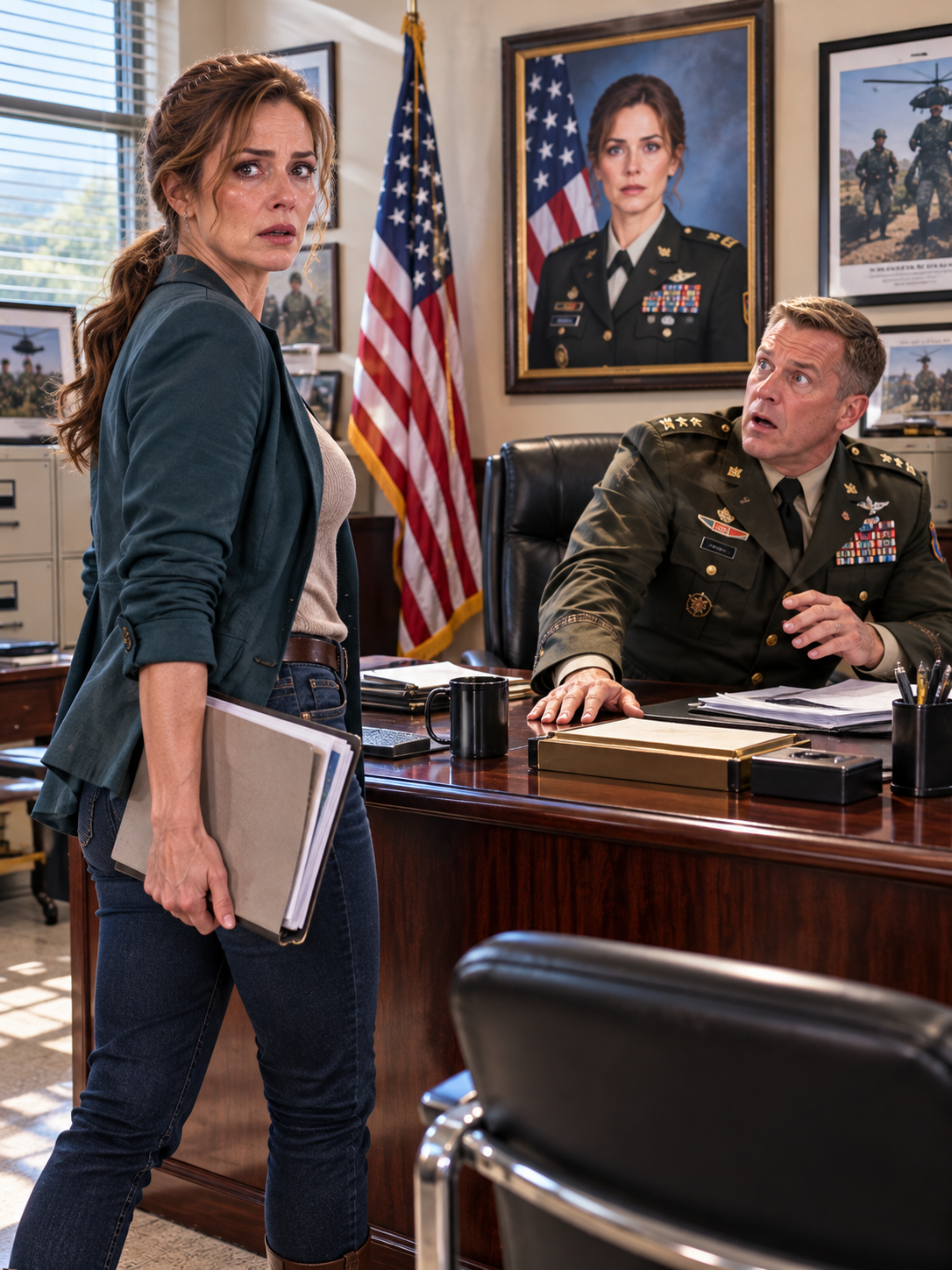
10 minutes after an Army recruiter looked at my jeans, dismissed the folder in my hands, and told me, “Go home and cook for your husband, sweetheart. We enlist fighters here,” he finally noticed the photograph hanging behind his own desk. The woman in that photograph wore a decorated uniform and stared straight into the camera. He looked at her face, then mine, and went completely still. I could have destroyed his career before lunch. Instead, I remembered a woman I had humiliated eighteen years earlier.
### Part 1
Ten weeks later, I stood in front of eleven nervous young people inside a recruiting station squeezed between a nail salon and a check-cashing store. The folding chairs were the cheap metal kind that snapped at your fingers if you closed them carelessly, the air conditioner rattled above the back door, and the room smelled faintly of copier toner and the cinnamon gum Staff Sergeant Cole Mercer chewed whenever he was trying not to look nervous. I wore my Army green service uniform that Tuesday, not because I wanted attention, but because eleven future soldiers had asked me to talk about what happened after you signed the paperwork and before the uniform felt like it belonged to you. Behind me, taped beside the entrance, was a photograph I had spent three years trying not to look at.
The woman in the photograph was thirty-seven, hair pinned into a regulation bun, chin level, ribbons arranged perfectly over her chest. Near the top of the rack was a small blue ribbon that meant more than the smiling recruiting slogan printed beneath her boots, although most civilians entering the station never knew it. People passed that poster on the sidewalk every day without slowing down, and most recruits walked beneath it without studying the face. I understood them, because for a long time I had wished I could walk past her too.
“That really you, Sergeant First Class Bennett?” one of the recruits asked.
I glanced over my shoulder. “Unfortunately, yes.”
A few of them laughed, which was exactly why I had answered that way. People listen better after they have remembered you are human, and I needed them to listen because I had not come to tell them how impressive I was. I had come to explain how badly a person could misunderstand somebody in ten seconds, and what happened when the misunderstanding became impossible to ignore.
So I told them to forget the uniform I was wearing and imagine me ten weeks earlier in faded jeans, running shoes, a gray windbreaker, and no visible indication that I had spent twenty-one years in the Army. It had been one of those July mornings when the parking lot seemed to push heat through the soles of your shoes before you reached the door. I carried a manila folder under my arm containing two things: a boring records correction requiring a station signature and a volunteer form asking permission to help prepare future soldiers before they shipped. I could have handled the paperwork on post, but I remembered being nineteen and terrified before basic training, and I thought maybe I could make somebody else’s waiting easier.
The bell over the recruiting-station door gave a flat metallic ring when I stepped inside. Sergeant Leah Torres sat at the far desk reading a computer screen with a pen cap between her teeth, while Staff Sergeant Mercer had his phone trapped between his shoulder and ear as he studied a whiteboard covered in names, ship dates, and red and green numbers. He was around thirty, sharp haircut, perfectly pressed recruiter polo, the exhausted eyes of someone being measured by numbers every Friday afternoon. Without looking at me, he raised one finger.
I waited.
Waiting has never bothered me. I had spent twenty-one years waiting for convoys, aircraft, briefings, signatures, weather, decisions, and occasionally for grown adults to discover information they could have learned by listening the first time. Mercer finished his call, placed the receiver down, and finally looked at me. His eyes moved from my face to the folder and back again, and I watched him decide who I was before I spoke.
“Help you?”
“Staff Sergeant Mercer,” I said, reading his name from his shirt. “I have two things I need to drop off. Should only take a couple minutes.”
He glanced toward the waiting chairs. “If this is about your son, parents are appointment only. There are cards by the entrance.”
“It isn’t about my son.”
“Your husband trying to reenlist?”
“No.”
Something about that answer irritated him. Maybe he had already missed lunch, maybe one of the red names on the board had stopped answering calls, or maybe he simply believed he had identified me correctly and did not enjoy having his first two guesses rejected. He leaned back, looked toward the whiteboard, and said, “Ma’am, I have ship dates to fill and three people who won’t answer their phones. I don’t have time to walk somebody’s wife through brochures.”
“I didn’t ask you to.”
Sergeant Torres stopped chewing her pen cap.
Mercer gave me an easy smile, and that easy smile bothered me more than anger would have. Anger at least requires energy; his expression suggested dismissing me cost him nothing. “Go home and cook for your husband, sweetheart,” he said. “We enlist fighters here.”
The air conditioner hummed above us.
I had been insulted more creatively than that, in harder places by people with more authority. The sentence was not the cruelest thing anyone had ever said to me, but it landed against an old bruise because I knew exactly what assumption had produced it. I also knew that if I raised my voice, the story would immediately become about the angry woman in the recruiting station instead of the staff sergeant who had looked at a stranger and decided she was not worth two minutes.
So I kept my voice level. “It will still only take two minutes.”
Mercer waved toward the counter without looking at me. “Leave it there. Somebody will get to it.”
I could have placed the folder down and walked out. In fact, before entering the station, I had nearly turned around in the parking lot because I had already noticed the poster through the glass. Seeing my own photograph in public still produced a strange tightening behind my ribs, and part of me had wanted to drive back to post where nobody would connect my face to the worst day of my life.
Instead, I pulled out the chair across from Mercer’s desk and sat down.
I placed the folder across my knees and folded my hands over it. Mercer stared at me with the expression of a man whose simple problem had unexpectedly developed opinions of its own. Behind his shoulder, perhaps eight feet away, my face stared down from the wall.
“Ma’am—”
“I’ll wait,” I said. “I’m very good at it.”
His jaw tightened before he turned back to the whiteboard. Torres looked from him to me, then toward the poster, although at first she did not seem to understand what had caught her attention. I looked only at Mercer, because I already knew what was hanging behind him.
What I did not know yet was whether the next ten minutes would become revenge, humiliation, or something much harder.
Because while Mercer had no idea who was sitting across from him, I knew exactly what kind of mistake he had just made.
I had made the same one eighteen years earlier.
### Part 2
Rank is strange because people think it lives on the cloth. They think authority appears when you attach stripes to a sleeve, pins to a collar, or ribbons above a pocket, but the longer I served, the more convinced I became that rank showed itself most clearly when nobody knew you had any. In uniform, people opened doors, changed their posture, called me Sergeant First Class Bennett, and sometimes listened before I finished speaking. In jeans and running shoes, I became whatever story they could build from my face.
I had enlisted at nineteen from a river town in Ohio where the respectable options seemed to be the manufacturing plant, community college, or the recruiting office beside a grocery store. My mother wanted college, my father wanted anything that included a pension, and I wanted distance from the version of myself everybody back home already understood. I signed because I thought courage meant leaving. Twenty-one years later, I understood that leaving had been the easy part.
I became a sergeant first class slowly, one board and one hard assignment at a time. I worked in rooms where new colonels assumed I was there to distribute copies, at meetings where men repeated an idea I had offered ten minutes earlier and watched it suddenly become worth discussing, and in units where people described me as “surprisingly capable” as though competence had snuck into the building wearing the wrong face. For years I fought every assumption as if each one required immediate correction. Eventually I discovered that constant correction could consume a person faster than the insult itself.
Three years before Mercer’s recruiting station, I walked into a planning conference carrying my laptop and a binder. A colonel who had never met me held out a stack of briefing packets and said, “Great, make sure everybody gets one, and coffee would help.” I looked at his hand, looked at the packets, and almost told him that the section he was about to receive belonged to me.
Instead, I took the packets.
I distributed every copy, started the coffee, and then sat in the chair beside him when the briefing began. Twenty minutes later my name appeared on the screen beneath the operational section, and I stood to deliver forty-five minutes of analysis he had apparently assumed somebody else had prepared. Watching recognition crawl across his face should have been satisfying. Mostly, I felt tired.
That tiredness had taken me years to understand. It was not the exhaustion of being underestimated once; it was the exhaustion of earning the second look after people repeatedly wasted the first one. Somewhere around my fifteenth year, I finally decided I would stop allowing other people’s lazy assumptions to become my internal argument. I would do my work, protect my people, and let somebody else carry the embarrassment of discovering they were wrong.
That was the woman sitting across from Mercer.
But she had not always been that woman.
In 2008, I was twenty-two years old, newly promoted to sergeant, with one deployment behind me and enough confidence to fill every room I entered. Our unit was processing soldiers through a mobilization site inside a warehouse filled with folding tables, fluorescent lights, paper forms, and people who wanted to be anywhere else. My assignment was simple: keep the line moving.
I became obsessed with it.
Near the back stood a woman in her fifties with silver beginning at her temples, glasses low on her nose, and a folder pressed against her chest. She stopped beside my table and asked a question about a form. I barely listened because thirty people were waiting behind her and I had convinced myself that speed was leadership.
“Ma’am,” I said, “wait outside with the families. Somebody will help you when we get through the line.”
She studied me for a moment.
I remember that look more clearly than almost anything else from that warehouse. She was not angry, offended, or embarrassed; she simply looked at me as if deciding whether I was worth correcting. Then she glanced down at the name tape on my uniform.
“Some of us were here before the coffee was, Sergeant.”
Her name tape read PRICE.
If I had looked carefully, I would have noticed the rank too. Sergeant First Class Evelyn Price, an Army reservist with more years in uniform than I had years since high school. Instead, I heard her calm tone as attitude and decided she was another person slowing down my line.
“Outside, please.”
She went.
Through the open warehouse door, I could see her sitting beneath an awning in a folding chair, hands resting on the same folder she had carried inside. I remember feeling satisfaction because I had solved my problem. The line moved again.
That night, a warrant officer mentioned her name over dinner.
“You know Price?”
I shrugged.
He stared at me. “You seriously don’t know who she is?”
Then he told me enough.
Not everything, because people like Price rarely tell everything, but enough that the food in my mouth seemed to turn to paper. She had served in places I had only heard about, carried responsibilities I was years away from understanding, and once kept an entire section functioning during a situation that would have overwhelmed most leaders twice her size and half her age.
I lay awake that night staring at the ceiling of the barracks, replaying her sitting outside with the families because a twenty-two-year-old sergeant had decided she was inconvenient.
I promised myself I would find her the next morning.
Her group had rotated out before sunrise.
I never apologized.
For eighteen years, that unfinished sentence followed me. It appeared whenever I caught myself dismissing someone too quickly, whenever a junior soldier hesitated outside my office, whenever someone older or quieter entered a meeting and became invisible to everybody impatient enough to assume they already understood the room. Sergeant First Class Price became the voice in my head asking, Did you actually look?
So when Mercer dismissed me, I knew his mistake from both sides.
I knew the sting of being reduced to somebody’s assumption, but I also remembered the young sergeant who had looked at Price and felt certain she was right. That memory changed the temperature inside me. Mercer was not some alien species of arrogant fool.
He was me at twenty-two.
That did not excuse him.
It made what happened next more complicated.
While Mercer worked the phones, Sergeant Torres kept glancing toward me. First she looked at my face, then at the poster by the door. She looked down at her computer, frowned, and looked again.
I could have helped her.
I could have turned my head toward the photograph, tapped my folder, said my name, or given any of a hundred clues. Instead I stayed quiet because I wanted to see whether somebody in that room would actually look without being ordered to.
Torres looked a third time.
Then a fourth.
Very carefully, she removed the pen from her mouth and placed it beside her keyboard.
She stood.
And as she crossed the carpet toward Mercer’s desk, I knew the wall was finally about to speak for me.
### Part 3
Sergeant Torres walked the six feet between the desks with the measured caution of somebody approaching a sleeping animal she was not certain she should wake. She stopped beside Mercer, bent toward his shoulder, and spoke quietly enough that I heard only pieces. “Staff Sergeant… wall… look at her.”
Mercer exhaled through his nose.
It was the impatient sound people make before proving somebody else foolish. He turned casually toward the poster, probably expecting to discover a misspelled slogan or a crooked frame. His eyes reached the photograph, stayed there for less than a second, then returned to me.
Then he looked back.
That second look lasted longer.
I had seen faces change after bad radio calls, after casualty reports, after commanders discovered a plan had been built on wrong information. The transformation was never dramatic the way movies make it. Usually the face simply stopped doing whatever it had been doing before.
Mercer stopped chewing his gum.
His shoulders went still.
The color faded around his mouth as his gaze moved between my face and the photograph behind him.
The woman in the poster wore a pressed Army service uniform, hair pulled tight, ribbons arranged above her chest. The photograph had been taken three years earlier after an awards event, and when the photographer asked me to smile, I tried twice before he quietly said we could use the serious one. Beneath the photograph was my name.
SERGEANT FIRST CLASS MARA BENNETT.
Mercer looked at me again.
For the first time since I entered the station, he actually saw me.
Torres took one step backward.
Two young men had entered while Mercer was making calls and now stood near the doorway filling out forms. Neither understood exactly what had happened, but both recognized the sudden silence. Their eyes moved from Mercer to the poster and finally to me.
Mercer reached for the desk phone.
His hand was not steady.
He dialed an internal extension and lifted the receiver. “Get Master Sergeant Ellis out here.”
That was the moment everything changed.
Not because he recognized my rank. A sergeant first class is senior to a staff sergeant, but rank alone was not what frightened him. The poster existed because of the medal visible near the top of my ribbons, and every recruiter who worked in that station had heard the story attached to it.
He knew enough to understand that I could make his morning unpleasant.
More than unpleasant.
He also knew he had handed me the reason.
I sat in the folding chair and suddenly understood that whatever happened next was mine to choose. I could report exactly what he said, request formal counseling, contact his chain of command, or simply remain silent while Master Sergeant Ellis came out and discovered the situation. I would not have needed to exaggerate anything.
“Go home and cook for your husband, sweetheart. We enlist fighters here.”
The sentence was bad enough on its own.
A younger version of me would have enjoyed repeating it.
That realization embarrassed me.
There are moments when revenge presents itself wearing the clothes of justice, and the fit can be convincing. Mercer deserved correction. The question was whether correction required destruction.
The phone connected.
I heard a distant voice answer.
Before Mercer could speak, I said, “Put it down.”
He stared at me.
“Sergeant First Class—”
“Put the phone down, Staff Sergeant.”
He hesitated, then returned the receiver to its cradle.
Fear had replaced arrogance completely. I did not enjoy seeing it, although part of me had expected I would. Instead I saw the red names on his whiteboard, the coffee gone cold beside his keyboard, and the exhaustion carved beneath his eyes.
I slid my folder across his desk.
“This,” I said, opening it, “is a records correction. It needs a station stamp and a signature.”
He looked down.
“And this is a volunteer form. I wanted to help with your future-soldier program on Tuesdays if you needed another mentor.”
Torres turned toward me.
Mercer looked as though I had switched languages.
“That’s why you came here?”
“That’s why I came here.”
His eyes dropped to the volunteer form. My name, rank, years of service, contact information, and awards were all listed because the form required them. His gaze paused halfway down.
“Sergeant First Class, I didn’t—”
“I know you didn’t know who I was.”
“I never would’ve said—”
“That is exactly the problem.”
He stopped.
I kept my voice quiet. “If I had walked through the door in this uniform, you would have stood up before I reached your desk. But I shouldn’t need this uniform to buy two minutes of basic respect.”
Mercer swallowed.
“You thought I was somebody’s mother.”
“Yes, Sergeant First Class.”
“What would have been wrong with that?”
He stared at me.
Nothing in the station moved.
“That woman would still deserve two minutes,” I said. “You thought I was somebody’s wife. She would deserve them too. Rank wasn’t supposed to be the price of being treated like a person.”
Torres looked down at her desk.
One of the young men near the door lowered his pen.
Mercer nodded once. “You’re right.”
“I know.”
The words came out sharper than I intended, so I let silence soften them.
Then the back-office door opened.
Master Sergeant Grant Ellis stepped into the recruiting room carrying a mug of coffee, reading glasses pushed onto his forehead. He had been in uniform for more than twenty-five years and possessed the unhurried expression of a man who believed most problems became smaller if you forced them to explain themselves slowly. He took two steps before seeing me.
He stopped.
His eyes went to my face.
Then the poster.
Then back to me.
“Sergeant First Class Bennett?”
“Master Sergeant.”
Mercer stood.
Ellis looked at him, then at Torres, then at the room. He did not know exactly what happened, but experience filled enough gaps to make his jaw tighten.
“We use your story during orientation,” he said. “Every new future soldier who comes through this station hears it.”
“I know.”
Ellis looked toward Mercer again. “What happened?”
I could feel Mercer preparing to answer.
“This is my call,” I said.
Ellis turned back to me.
Something passed between us that only happens when two people have spent long enough inside the same institution to recognize the weight hidden inside a simple sentence. He wanted to protect the station. He wanted to correct his NCO. He probably wanted to apologize before he even knew the details.
Instead, he nodded.
“Your call, Sergeant First Class.”
That should have ended the danger for Mercer.
It did not.
Because after Ellis signed my records correction, he closed the office door behind us, put down his coffee, reached for a counseling pad, and said, “Tell me exactly what he did.”
And for the second time that morning, I had to decide how much punishment one terrible sentence deserved.
### Part 4
Master Sergeant Ellis did not sit down after closing the office door. He paced behind his desk while I explained the conversation exactly as it happened, including my request, Mercer’s assumptions, and the final sentence about going home to cook. By the time I finished, Ellis had removed his glasses and placed them on the desk with the careful precision of a man trying not to slam anything.
“He said that in my station?”
“Yes.”
“To you?”
I almost laughed. “Master Sergeant, it would not be better if he had said it to somebody else.”
“That isn’t what I meant.”
“I know.”
Ellis picked up a pen. “I’m counseling him today.”
“No.”
His hand stopped over the pad.
“With respect, Sergeant First Class, that isn’t your decision.”
“You’re right.”
That surprised him enough to make him look up.
“It’s your station,” I continued. “Your NCO. Your authority. I’m asking you not to use it yet.”
“He humiliated a walk-in.”
“He did.”
“He made a sexist comment.”
“He did.”
“And you want me to ignore it?”
“No. Ignoring it and handling it intelligently are different things.”
Ellis dropped into his chair and rubbed one hand across his jaw. He was a fair man, and fair people can still become dangerous when anger convinces them that immediate action is the same thing as correct action. I understood his instinct because I had signed plenty of paperwork in my career while still hot from whatever produced it.
I pointed toward the wall separating his office from the recruiting floor. “I sat across from his whiteboard for almost twenty minutes.”
Ellis frowned.
“He has already filled two difficult ship dates this month. He has three more applicants moving through medical. His numbers are green.”
“You’re defending him because he meets quota?”
“No. I’m telling you the whole person matters when you decide the consequence.”
“The whole person just told you to cook dinner.”
“And that was stupid.”
Ellis leaned back.
“Possibly the stupidest thirty seconds of his month,” I continued. “But if he has spent the other twenty-nine days doing right by recruits, I want that included in the arithmetic.”
“He needs to learn.”
“Oh, he learned.”
“You can’t know that.”
“I saw his face.”
Ellis gave me a look that said he was not convinced.
So I told him about Sergeant First Class Evelyn Price.
I told him about the warehouse in 2008, my line of soldiers, the question I barely heard, the woman I sent outside, and the satisfaction I felt when she obeyed. I told him how I discovered that night who she was and promised myself I would apologize the next morning.
“She left before sunrise,” I said. “I’ve carried that conversation eighteen years.”
Ellis’s expression changed.
“I did what Mercer did,” I continued. “Different words, same mistake. I looked at somebody, decided she was slowing me down, and treated my assumption as fact.”
“You were twenty-two.”
“And I was still wrong.”
“That doesn’t make what happened today acceptable.”
“I’m not trying to make it acceptable.”
That distinction mattered to me.
Forgiveness is often described as pretending something did not hurt, and I have never believed that. If you erase the harm, forgiveness becomes meaningless because there is nothing left to forgive. What Mercer said mattered.
But consequences should improve something.
I had seen good soldiers destroyed by leaders who cared more about proving standards existed than asking what outcome those standards were supposed to create. I had also seen bad soldiers protected because somebody liked them, which was worse. The line between accountability and humiliation is narrow, and rank does not magically make you wise enough to walk it.
“What do you want?” Ellis finally asked.
“Talk to him.”
“That’s it?”
“No.”
I leaned forward.
“Make him explain what happened without excuses. Make him explain why he thought the sentence was acceptable when he believed I was just somebody’s wife. Then make him figure out what kind of recruiter he wants to be when the next person walks in wearing ordinary clothes.”
Ellis stared at me.
“And if he gives you garbage,” I added, “if he blames stress, quotas, me, women, the weather, anything except himself, then counsel him. Put it on paper.”
A faint smile moved at the corner of Ellis’s mouth. “So I get your permission eventually?”
“You never needed it.”
He looked toward the closed door.
“You know what bothers me most?”
“What?”
“I’ve been using your picture for three years. I give a talk about not judging what a soldier is capable of by what you expect them to look like.”
I raised one eyebrow.
He sighed. “Yes. I hear it.”
“Good.”
“I’ve apparently been giving that speech in a station where my best recruiter forgot it.”
“Then maybe everybody needed the reminder.”
Ellis turned the pen slowly between his fingers. “Including me.”
That was why I trusted him.
Bad leaders locate every failure beneath them. Good ones look down the chain first and then eventually ask what conditions they created above it. Ellis could have turned Mercer into the single villain of the morning and walked away clean.
Instead he asked, “What did you need from us when you entered?”
“Two minutes.”
He looked toward the clock.
“I suppose we can afford that.”
I signed the records correction.
Ellis stamped it.
Then he picked up my volunteer form.
“Tuesday evenings?”
“That’s what the website said.”
“You really still want to volunteer here?”
That was the first question all morning that caught me unprepared.
I pictured Mercer’s face, Torres noticing the poster, the two teenagers near the door, and Price sitting beneath the warehouse awning eighteen years earlier. Part of me wanted to take my paperwork and never enter that room again. Another part understood that leaving would make the morning a story about one arrogant recruiter instead of an opportunity to change anything.
“Yes,” I said. “I do.”
Ellis signed.
When we returned to the front room, Mercer stood behind his desk with his hands resting flat on the surface. Four future soldiers had appeared while we were inside, apparently summoned by whatever invisible communication system causes young people to detect drama within a ten-mile radius.
One skinny kid in the front chair kept staring at the poster.
Finally he raised his hand.
“Sergeant First Class?”
I looked at him.
“Is that actually you?”
“It is.”
His finger moved toward the small blue ribbon. “What’s that one?”
Every adult in the station became quiet.
The question had shifted the room into territory far more dangerous than Mercer’s mistake.
Because telling eighteen-year-olds why your photograph hangs on a wall is harder than explaining why somebody insulted you.
I looked at the ribbon.
Then I looked at the recruits.
“It’s a Silver Star,” I said.
And somewhere inside me, a door I normally kept locked began opening.
### Part 5
The skinny recruit’s name was Dylan Harper, although I did not learn that until later. At that moment he was simply an eighteen-year-old with long arms, nervous hands, and the complete sincerity of somebody who had not yet learned which questions adults considered uncomfortable. He looked from the ribbon on the poster to the ribbons on the volunteer form still sitting on Mercer’s desk.
“What did you do?”
The recruiting station seemed to shrink.
Mercer lowered his eyes.
Master Sergeant Ellis remained near his office door.
I could have answered with the official language. I had heard my citation read often enough that certain sentences had become detached from meaning, polished phrases describing leadership and disregard for personal safety while leaving out the names, sounds, mistakes, and people who never became paragraphs. Official language is useful because institutions need a way to tell difficult truths without bleeding on the page.
But these young people were about to join that institution.
They deserved something closer to the truth.
“It happened overseas in 2011,” I said. “Some soldiers I was responsible for were hurt. I helped get two of them somewhere safer.”
Dylan waited.
“There was a third.”
His expression changed.
“I didn’t reach him in time.”
Nobody moved.
I pointed gently toward the poster. “That ribbon isn’t a prize. If you stay in the Army long enough, people will tell you awards are something to be proud of, and sometimes they are. But the expensive ones usually come with a story you would trade away if you could.”
A young woman in the second row watched me closely.
Her name, I later learned, was Tessa Morgan. She was twenty, compact, serious, and had the wary eyes of someone accustomed to entering rooms where people underestimated her before she opened her mouth.
“Can I ask something not about the medal?”
“Please.”
She glanced toward Mercer and immediately regretted it.
Mercer noticed.
So did I.
“Does it ever get easier,” she asked, “being the person nobody takes seriously?”
There it was.
Not the military question.
The human one.
I sat in the empty chair beside Dylan.
“No.”
Her face fell slightly.
“I’m not going to lie to you. People do not magically become fair because you work hard enough.”
Tessa looked at her hands.
“But you get better at surviving unfair rooms,” I continued. “Eventually you stop needing everybody’s first opinion to be correct. You do your job well enough that their mistake becomes theirs to carry.”
Her eyes came up.
“And every so often,” I said, “you get a morning where the wall behind somebody tells the truth for you.”
Dylan grinned.
Even Mercer gave a painful half-smile.
“What do you do then?” Tessa asked.
I thought about it.
“You decide whether being right is enough.”
She frowned.
“It usually isn’t.”
That answer surprised the room.
It would have surprised me at twenty-five.
In 2011, I believed outcomes could be divided neatly into success and failure. We were operating in a dry valley where the ground offered very little protection and sound traveled farther than it seemed like it should. I was a staff sergeant then, responsible for people young enough to believe twenty-five was old.
Corporal Noah Reed was twenty-two.
He laughed louder than anybody in our section and spent months drawing plans for the repair shop he wanted to open with his brother after leaving the Army. The drawings appeared on notebook paper, envelopes, cardboard, anything flat enough to hold pencil marks. He had already chosen the number of service bays and argued passionately about the shape of the sign.
One afternoon everything changed quickly.
I will not give you the graphic details because they do not improve the truth.
Noah and two others were caught in a dangerous position. I helped move two soldiers to a place where medics could reach them.
Then I went back for Noah.
I was too late.
Years afterward, people congratulated me for returning.
That always felt backward.
The two soldiers I helped survived. One later became a father and still sends me a photograph of his children every year around the anniversary. No message, no explanation, just three kids standing on a porch getting taller.
Noah never got his repair shop.
That is the arithmetic behind my medal.
They photographed me three years later for an Army recruiting campaign because somebody believed my story represented courage. During the session, the photographer asked me to smile.
I tried.
Nothing happened.
He lowered the camera and said, “We don’t have to.”
So the unsmiling photograph became the poster.
The public sees a decorated soldier.
I see Noah’s garage drawings.
After the ceremony I wrote his brother eleven versions of the same letter before finding one I could mail. I explained that Noah had not been alone, that I had gone back, that people had fought hard to bring him home.
Four months later his brother answered with one sentence.
“Thank you for going back for him.”
I still have the letter.
That sentence has been kinder to me than I knew how to be to myself.
Sitting in the recruiting station years later, I did not tell the future soldiers every detail. Some memories belong partly to the people who did not return, and I have never believed receiving a medal gives you ownership over everybody else’s pain.
But I told them enough.
“The poster makes it look like the story is about me,” I said. “It isn’t.”
Dylan looked toward the photograph.
“Then why keep it up?”
That question landed deeper than he knew.
For years I had wanted every copy removed.
I hated seeing my hardest memory converted into inspiration beneath fluorescent lights. I hated imagining strangers looking at the ribbon without understanding the price. Most of all, I hated the idea that a young recruit could mistake loss for glory.
“I used to wonder that too,” I admitted.
Mercer had moved closer.
He no longer looked frightened.
He looked ashamed.
There is a difference.
Fear worries about what will happen to you.
Shame forces you to consider what you did to somebody else.
I looked at him, then at the poster.
“Maybe it stays because somebody walking through this door needs to know the person in the photograph was once scared too.”
Tessa nodded.
“And maybe,” I continued, “the point isn’t that I was brave once. Maybe the point is that people can carry terrible days and still show up on Tuesdays to help somebody else.”
That was when Mercer finally spoke.
“Sergeant First Class Bennett.”
His voice was rough.
“Can I talk to you before you leave?”
I met his eyes.
“Yes.”
I expected an apology.
What I did not expect was that his next sentence would bring Sergeant First Class Price back into my life in a way I had never imagined.
### Part 6
The station emptied slowly that afternoon. Dylan left with two forms folded into his pocket, Tessa stayed long enough to ask Sergeant Torres about physical training, and Master Sergeant Ellis disappeared into his office after giving Mercer a look that promised their private conversation had merely been postponed. I waited near the door beneath my own photograph while Mercer finished helping the last walk-in.
He approached carrying his recruiter cap in both hands.
“Sergeant First Class Bennett.”
“Staff Sergeant.”
“I don’t have an excuse.”
That was a good beginning.
He stared directly at me, which required effort.
“I was stressed. My numbers are bad in two categories. I haven’t had a full day off in…” He stopped himself. “That sounds like an excuse.”
“It does.”
He nodded.
“I looked at you and decided what you were before you finished speaking. Then I said something I would be furious about if somebody said it to my mother.”
I waited.
“I’m sorry.”
Nothing followed.
No request that I forgive him.
No explanation about how he was usually a good person.
No promise that it was not who he really was.
A clean apology is rare because most apologies secretly ask the injured person to take care of the person apologizing. Mercer simply set his down between us.
“I accept the apology,” I said.
His shoulders loosened slightly.
“That doesn’t erase it.”
“They shouldn’t.”
That answer mattered.
I glanced through the glass door at the parking lot shimmering under the afternoon sun.
“The best recruiters I ever met could look at somebody everybody else ignored and see the soldier hiding inside them.”
Mercer listened.
“You have the hard pieces. Your board tells me that. Learn to look before you decide.”
“Yes, Sergeant First Class.”
“Start with the next person wearing a windbreaker.”
For the first time, he smiled without arrogance.
“I will.”
I stepped toward the door.
“Sergeant First Class?”
I turned.
“Master Sergeant Ellis told me you volunteered for Tuesdays.”
“He works quickly.”
“He does.”
“I’ll be here when I can.”
Mercer nodded. “I’d like that.”
Outside, I sat in my car for several minutes without starting the engine. The heat inside smelled like sun-warmed fabric and old coffee, and my hands remained on the steering wheel while the morning replayed in pieces. I had entered expecting paperwork.
Instead I had found Price’s chair.
For eighteen years I had imagined apologizing to her.
I pictured finding her someday at a reunion or through a personnel directory, walking up as a middle-aged sergeant first class and explaining that the twenty-two-year-old who sent her outside had finally grown up. I searched periodically, but reservists scattered, records changed, and Evelyn Price was common enough that every lead ended in somebody else.
Sitting in the car, I understood something uncomfortable.
Maybe the apology was never supposed to end with her hearing it.
Maybe some debts become unpayable in their original form.
All you can do is stop passing them forward.
Three days later, my phone rang.
Unknown number.
“Sergeant First Class Bennett?”
“Yes.”
“This is Grant Ellis.”
“I recognize the voice, Master Sergeant.”
“Your volunteer paperwork cleared.”
“That was fast.”
“I’m motivated.”
I smiled.
“Tuesday at eighteen hundred. Come whenever your schedule allows.”
“All right.”
He hesitated.
“There’s something else.”
I waited.
“I talked to Mercer.”
“How’d it go?”
“Better than expected.”
“That sounds ominous.”
“He asked me not to counsel him.”
I laughed once. “Of course he did.”
“Not for the reason you think.”
Ellis explained that Mercer believed putting the incident only into a private counseling session would make it too easy to hide. Instead, he asked permission to address the recruiting team himself.
“What did he say?”
“That he had gotten very good at processing applicants and very bad at meeting strangers.”
I became quiet.
“He told Torres she had seen what he missed because she was actually looking,” Ellis continued. “Then he apologized to her too.”
“For what?”
“For talking over her for most of the year.”
That surprised me.
Ellis chuckled softly. “Apparently one bad morning turned into several overdue conversations.”
Tuesday evening, I returned in uniform.
The atmosphere changed the moment I entered, which annoyed me more than I expected. Mercer stood immediately, Torres straightened, and several recruits stared from me to the poster.
“Sit down,” I said.
Everybody sat.
“Rule one for Tuesdays: if you stand every time I enter, I will stop coming.”
Dylan raised his hand. “What if we’re supposed to?”
“Then somebody will tell you.”
A few laughed.
Over the next hour, I talked about basic training in terms they could use. How to write addresses down before losing phone access, how to memorize important numbers, why expensive equipment would not make up for neglected feet, and why fear before leaving home did not mean they had chosen wrong.
When the session ended, an older man entered with his daughter.
Mercer approached them.
The father began speaking for her.
I watched Mercer nearly respond to him.
Then he stopped.
He turned toward the daughter instead.
“What do you want?”
Her father frowned.
The young woman answered quietly.
Mercer listened.
Actually listened.
He asked a second question.
Then a third.
At one point he glanced toward me.
Our eyes met.
I gave him nothing more than a small nod.
That was enough.
You do not celebrate somebody loudly for correcting themselves. If you make improvement performative, people start improving for applause.
So I looked away.
At the far desk, Torres caught me watching.
“Sergeant First Class?”
“Yes?”
She hesitated. “Can I ask you something after everybody leaves?”
Her voice carried the exact careful tone I had used with Sergeant First Class Price eighteen years earlier.
And for one terrible second, I nearly told her I was tired.
Then I looked at the empty folding chair across from me.
“Of course,” I said.
Because sometimes the universe repeats a lesson until you finally answer correctly.
### Part 7
Torres waited until the last recruit left before closing her laptop. Mercer was in the back with Ellis, the fluorescent lights had begun their faint evening buzz, and rain tapped unexpectedly against the storefront windows even though the day had been clear an hour earlier. She sat across from me with both hands wrapped around a paper cup of coffee she had forgotten to drink.
“I’ve been thinking about what you said.”
“That sounds dangerous.”
She smiled.
Then the smile disappeared.
“I’m leaving recruiting in eight months.”
“By choice?”
“Mostly.”
That word carried a lot.
She explained that she had spent eighteen months doing the invisible pieces of the station. She organized files, corrected paperwork, handled families who called angry, remembered birthdays, caught medical documents others missed, and quietly salvaged applicants who might otherwise have disappeared from the process. Mercer consistently produced stronger numbers, while she consistently cleaned problems before they became visible enough to count.
“You think nobody sees it.”
“I know nobody sees it.”
I thought about correcting her.
Then I remembered how useless it feels when somebody answers your lived experience with optimism.
“What do you want?”
“A chance to run something before I leave.”
That was different.
“What?”
“The Tuesday program.”
I looked toward the rows of folding chairs.
“You want the pool?”
“I think I’d be good at it.”
“So do I.”
Her eyes widened slightly.
“You’ve watched me four Tuesdays.”
“I watched you notice me in four seconds.”
That made her laugh.
The next morning I called Ellis.
“I’m not giving Torres anything because you asked,” he said before I finished.
“Good.”
“I’ll give it to her if she earns it.”
“Better.”
Within two weeks, Torres ran Tuesday evenings.
The room changed.
She created fitness pairs for recruits struggling alone, invited recently shipped soldiers to video call when schedules allowed, and started a simple rule that every future soldier had to learn the name of one other person’s parent or partner. “People quit in isolation,” she said. “So stop letting everybody be isolated.”
Mercer backed her publicly.
That mattered more than anything I could have done.
One Tuesday, a seventeen-year-old named Kayla arrived with her mother. The mother’s arms remained crossed so tightly across her chest that I recognized the posture immediately.
Fear pretending to be anger.
Kayla wanted to enlist after graduation.
Her mother wanted the Army to vanish before summer.
Mercer sat with them.
At first the mother answered every question for her daughter.
Six months earlier, I suspect Mercer would have pushed harder and lost her immediately. Instead he closed the folder.
“Ma’am,” he said to the mother, “I’m not going to promise you she’ll always be safe.”
The woman’s eyes sharpened.
“That would be dishonest.”
Kayla looked terrified.
Mercer continued. “I can promise that training exists for a reason, that people will be responsible for teaching her, and that you can call this office after she ships if you are confused or frightened and we will answer what we can.”
The mother’s arms slowly uncrossed.
I stood near the coffee machine and watched.
Mercer glanced toward me once.
I deliberately turned away and refilled my cup.
That moment belonged to him.
Later, Dylan Harper nearly quit.
His shipping date arrived in November, and every rope tying him to home tightened at once. His mother cried constantly, his girlfriend told him long distance would never work, his old car suddenly needed repairs, and a warehouse manager offered him a small raise if he stayed.
He called Mercer after midnight.
Mercer called me at six the next morning.
“I think we’re losing him.”
“Where is he?”
“Parking lot outside the station.”
When I arrived, Dylan sat on the curb beside his duffel with both hands locked behind his head.
“I can’t do it,” he said.
I sat beside him.
Cold air moved through the parking lot and somebody in the nail salon next door was already running a vacuum.
“You can.”
“I don’t mean physically.”
“I know.”
“My mom thinks I’m abandoning her.”
“I know.”
“My girlfriend says if I leave, we’re over.”
“That might happen.”
He stared at me.
“What? You wanted me to lie?”
His laugh sounded miserable.
I nudged the duffel with my shoe.
“Fear doesn’t mean you’re making a mistake, Dylan.”
“What if it does?”
“Then you will learn that too.”
He looked toward the station door.
“I thought brave people were supposed to feel sure.”
“No. People who feel sure are sometimes just people who haven’t thought hard enough yet.”
He was silent.
“Bravery is showing up while your mind gives you twelve excellent reasons to run.”
“What if I change my mind on the bus?”
“Then change it.”
He frowned.
“Changing your mind is free. Getting off the bus is a decision.”
He thought about that.
Ten minutes later, he stood.
Twenty minutes after that, Mercer drove him to his departure point.
Months later, Dylan sent a photograph in uniform.
No dramatic message.
Just three words.
“Still showed up.”
Mercer printed it and taped it beside the whiteboard.
By then I had begun to understand the shape of my debt to Evelyn Price.
I could not give her the apology I had rehearsed for eighteen years.
But I could give Torres a question instead of a dismissal.
I could give Dylan a cold morning on a curb.
I could give Mercer enough mercy to become better rather than merely frightened.
Maybe apologies are not always sentences.
Sometimes they are habits.
That winter, Ellis called me into the office after Tuesday training.
“I found something,” he said.
On his desk was a printed personnel record.
At the top was a name.
Evelyn Marie Price.
For several seconds I could not breathe normally.
“You found her?”
“I think so.”
The record listed a retirement date eleven years earlier.
And beneath it was something I had not expected.
A mailing address in North Carolina.
Eighteen years after I sent her outside with the families, the sentence I owed Sergeant First Class Price finally had somewhere to go.
But staring at the address, I discovered I was suddenly afraid to send it.
### Part 8
I carried Evelyn Price’s address in my wallet for three weeks.
Every night I considered writing the letter. Every night I found another reason to postpone it: too late, too self-serving, too much explanation, not enough explanation. At forty, I discovered I could still become the same frightened twenty-two-year-old who had promised herself she would apologize tomorrow.
Finally, Torres solved the problem without knowing it.
After a Tuesday session she handed me a stack of envelopes.
“Can you mail these on post tomorrow?”
I stared at them.
“What?”
“Nothing.”
I drove home, sat at my kitchen table, and wrote one page.
Sergeant First Class Price,
You probably do not remember me, but in 2008 I was a young sergeant working a mobilization line. You asked me a reasonable question. I did not listen. I told you to wait outside with the families because I had already decided you were slowing me down.
I learned later who you were.
That is not why I am sorry.
I am sorry because who you were should never have been required for me to treat you with respect.
I should have looked.
I should have listened.
I did not.
I have spent eighteen years remembering you sitting in that folding chair, and I wanted you to know that the lesson reached me eventually.
I signed my name.
No rank.
I mailed it.
For twelve days, nothing happened.
Then an envelope arrived.
Inside was a card containing six handwritten lines.
Mara,
Of course I remember you.
You were twenty-two and moving faster than your judgment could keep up.
Most of us have been there.
I accepted your apology before you knew enough to give it.
Now stop carrying me around like punishment and use the lesson somewhere useful.
Evelyn Price
I read it twice.
Then a third time.
I laughed so suddenly I startled myself.
For eighteen years I had imagined Price as the person waiting at the end of my guilt, demanding a debt I could never repay. She had apparently moved on before I left the warehouse.
I was the one who had kept myself sitting in that folding chair.
The following Tuesday, I brought the card to the recruiting station.
I showed nobody.
Some things do not need witnesses.
Ten weeks after the morning Mercer told me to go home and cook, I stood in front of eleven future soldiers beneath my own poster, which is where this story began.
Dylan’s chair was empty because Dylan was already gone.
Tessa sat in the first row now.
Kayla and her mother had returned with more questions.
Torres ran the program.
Mercer stood near the back holding a clipboard and, for once, not trying to control the room.
I told the eleven recruits about fear.
I told them about leadership.
I told them that rank gives you authority but does not automatically give you judgment.
I told them that some of the most important decisions of my career had involved choosing not to use every piece of power available to me.
Then Tessa raised her hand.
“What happened to the recruiter?”
Every face turned toward Mercer.
He sighed.
“Apparently I became part of the lesson.”
The room laughed.
I looked at him.
“He apologized.”
“That’s all?” Tessa asked.
“No.”
Her expression sharpened.
“He changed.”
Mercer became serious.
That distinction mattered.
An apology is words.
Change is evidence.
I never pretended what he said was acceptable, and he never asked me to. The morning remained exactly what it had been: a tired man made a lazy assumption, then turned the assumption into cruelty because he believed there would be no cost.
But punishment alone would not have produced the man standing at the back of that room.
Choice did.
His choice.
Torres’s choice.
Ellis’s choice.
Mine.
After the session ended, I remained beneath the poster while everybody stacked chairs.
Mercer approached.
“Sergeant First Class.”
“Yes?”
“First day you came in, I thought you were the person in my way.”
“I remember.”
“Now you’re here more than I am.”
“That sounds like a personal problem.”
He smiled.
Then he looked at the poster.
“Do you still hate it?”
I considered the question.
For years, yes.
The photograph represented the day I could not save Noah Reed.
The ribbon represented people congratulating me for surviving a memory I would have traded gladly for one ordinary afternoon with everybody alive.
But the poster had also brought me into that recruiting station.
It had forced Mercer to look.
It had given Tessa a question.
It had put me in Torres’s path.
And, in a strange way, it had carried Evelyn Price’s lesson eighteen years forward until I finally became ready to understand it.
“No,” I said.
Mercer looked surprised.
“I still don’t particularly like her.”
He glanced at the photograph.
“She looks terrifying.”
“She was exhausted.”
“That too.”
I studied the woman on the wall.
For the first time, she did not feel like a stranger.
She was twenty-one years of good decisions and bad ones, people saved and people lost, apologies delayed, anger swallowed for good reasons and sometimes for terrible ones. She was not the hero the poster wanted her to be.
She was simply me.
That was enough.
Outside, evening light reflected across the storefront windows. A woman I had never seen before approached the station carrying a folder under one arm.
She wore jeans.
A loose blue jacket.
Running shoes.
Mercer saw her through the glass.
For half a second his eyes moved automatically toward the clock because we were nearly closed.
Then he stopped himself.
He placed his clipboard on the desk.
He opened the door.
“Good evening, ma’am. What can I help you with?”
The woman stepped inside.
“I only need two minutes.”
Mercer smiled.
“I’ve got two minutes.”
From the far desk, Torres looked at me.
I looked at her.
Neither of us said anything.
We did not need to.
I picked up my coat, walked beneath the poster, and stepped outside.
For eighteen years, I thought becoming better meant somehow undoing the moment when I failed Evelyn Price.
You cannot undo those moments.
You cannot reach backward through time and make your younger self kinder, wiser, more patient, or less certain.
What you can do is refuse to repeat her mistake.
What you can do is interrupt it when you see it moving through somebody else.
And if you are lucky, the person you interrupt will someday interrupt it too.
That is how change actually travels.
Not in medals.
Not in posters.
Not in speeches.
Person to person.
Chair to chair.
One second look passed forward until somebody finally gets the first look right.
I reached my car and glanced back through the recruiting-station window.
Mercer was sitting across from the woman now.
Listening.
Actually listening.
The photograph of me hung behind him, exactly where it had always been.
But this time nobody needed to notice it.
That, more than anything, was how I knew the lesson had finally reached the right place.
THE END!
Disclaimer: Our stories are inspired by real-life events but are carefully rewritten for entertainment. Any resemblance to actual people or situations is purely coincidental.


