
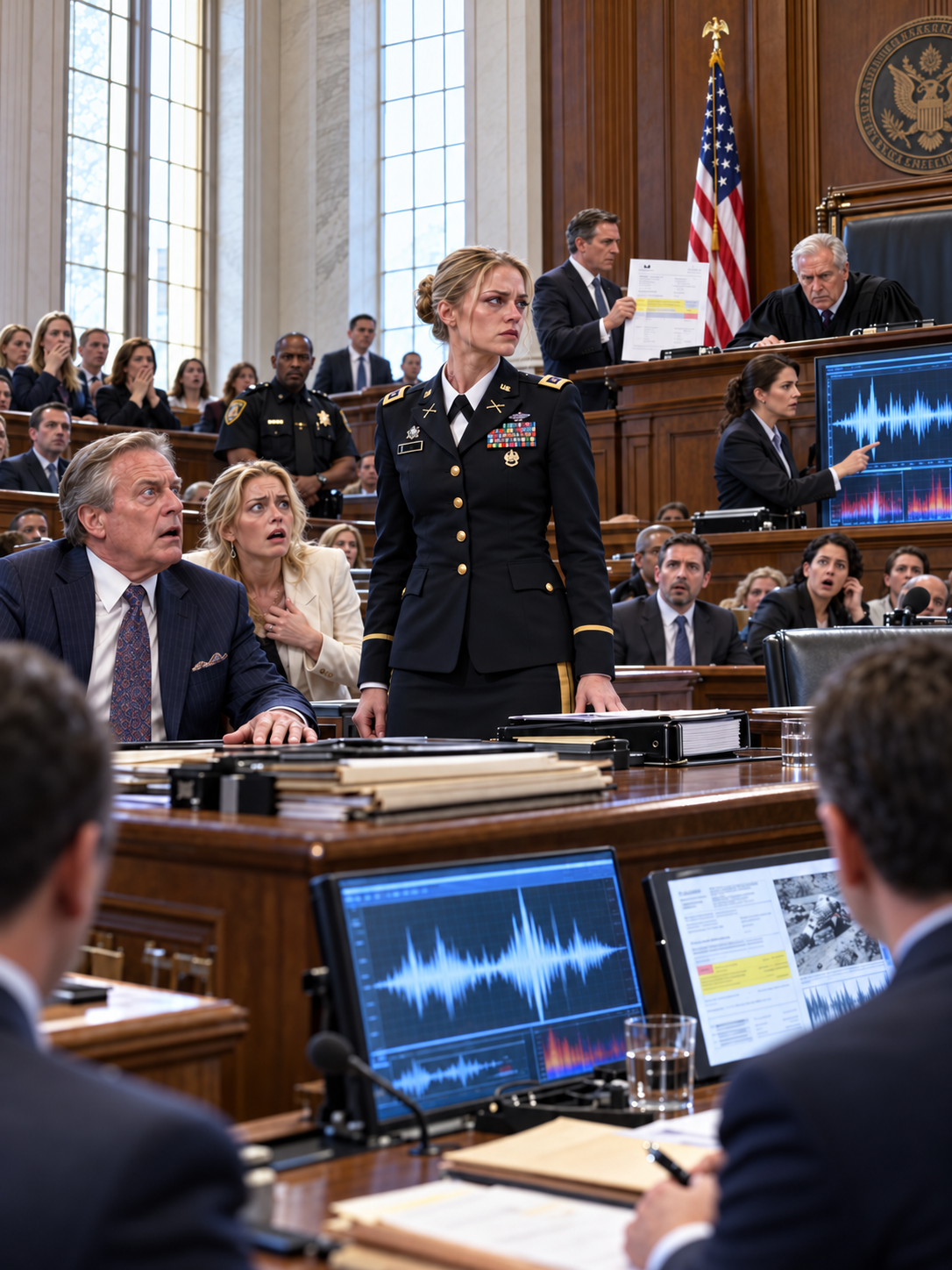
“There she is. Pathetic as ever,” Dad sneered as I entered federal court in my Army uniform. My injured shoulder throbbed beneath the fabric, reminding me of the convoy attack that killed 17 soldiers. My sister had fabricated a recording to make me look unstable, and Dad smiled as his attorney played it. Then a forensic expert exposed the fake. Prosecutors displayed a payment approved after the attack, bearing Dad’s signature. When the judge allowed one final recording, my father suddenly stopped smiling.
### Part 1
“Smile for the camera. Let everybody see how much money this pathetic mess of scars plans to squeeze out of the government.”
My father’s hand closed around my left shoulder.
Pain flashed white behind my eyes.
Three small pieces of metal were still buried near the joint, too close to nerves for the surgeons to remove safely, and Raymond Mercer knew exactly where the injury was. He squeezed anyway.
The smell of his stale cigar clung to his fingers.
Beside him, my younger sister Madison held up her phone, a little ring light clipped around the camera while comments rolled across her livestream.
“Come on, Claire,” she said brightly. “At least pretend you’re happy. People love military stuff.”
Behind us sat seventeen flag-draped caskets.
Seventeen.
I could see them over Madison’s shoulder, arranged in two perfect rows beneath the hard South Carolina sun.
Men and women I had eaten terrible field meals with.
People whose voices I could still hear when a room got too quiet.
People who had been riding with me when the road disappeared beneath fire and dust.
I didn’t smile.
I shifted my weight and pressed my thumb sharply against the inside of my father’s wrist.
His hand opened on reflex.
The cigar dropped into the grass.
Raymond jerked backward.
“What the hell?”
“Don’t touch this uniform.”
I didn’t raise my voice.
That bothered him more than yelling ever would have.
His face darkened.
“You hear that?” he snapped toward Madison’s phone. “She comes home with a couple medals and suddenly she’s too important for her own father.”
My mother, Denise, barely glanced up.
She was busy blotting perspiration from beneath her eyes, careful not to smear the makeup she had spent an hour applying before the memorial.
My brother, Travis, stood beside her scrolling through scores on his phone.
A betting notification chimed.
He cursed.
Nobody looked toward the caskets.
I did.
That was when Colonel Nathan Reed stepped toward me.
Conversation around us died almost instantly.
Reed had the kind of presence that made civilians straighten without understanding why. His silver hair barely moved in the coastal wind, and his expression remained unreadable as he fastened the Purple Heart to my dress uniform.
The clasp clicked.
A tiny sound.
Still, I heard it more clearly than Madison whispering to Travis about where we were having dinner.
Reed adjusted the medal once.
Then he leaned closer.
“This proves what happened to your body,” he murmured. “The rest of the investigation may tell us what happened behind your back.”
My eyes met his.
For weeks, military investigators had been asking questions about the attack.
Questions about timing.
Questions about compromised routes.
Questions about who had known when our convoy would move.
No one had told me much.
Not officially.
But three days earlier, Reed had called and asked one strange question.
Did your father’s company still perform subcontracting work for military freight companies?
Yes.
Mercer Marine had handled storage and repair work for civilian logistics contractors along the Carolina coast for years.
At the time, I had thought nothing of it.
Now Reed stepped away.
Twenty minutes later, the ceremony ended.
Families approached caskets.
People embraced.
Someone near the second row began crying so hard she had to sit down.
Travis stretched and yawned.
“Reservation’s in twenty-five minutes,” he said. “You coming?”
I stared at him.
He nodded toward the caskets.
“Or are you planning to stay here staring at boxes all afternoon?”
Something inside me went completely still.
Denise grabbed her handbag.
“Don’t start being dramatic, Claire. Your father booked that table weeks ago.”
They walked away together.
None of them asked whether I needed a ride.
None of them waited.
Their shoes ground over the gravel, four sets of footsteps becoming quieter in the heat.
I watched them leave.
And suddenly I wasn’t standing at a military memorial anymore.
I was back inside my parents’ house four months earlier.
I had come home on temporary medical leave carrying a sixty-pound duffel over my good shoulder.
Nobody met me at the door.
The hallway smelled like pine cleaner poured over damp wood.
Upstairs, I opened my childhood bedroom.
My bed was gone.
So was the dresser.
In their place stood two enormous ring lights, a folding backdrop, boxes of cosmetics, unopened packages and a desk covered with Madison’s streaming equipment.
She had converted my room into a studio.
“Where am I sleeping?” I asked.
She glanced up from her laptop.
“I don’t know. Couch?”
“The couch downstairs is broken.”
She shrugged.
“Hallway, then.”
That same afternoon, my bank app showed that the $2,000 mortgage payment I had sent my mother had cleared.
That night, I spread an Army blanket across the hardwood floor beside the upstairs bathroom.
Dinner smelled like scorched grease.
Denise cut the best portion of roast and gave it to Travis.
My father pointed his fork at me.
“Send another thousand next month.”
“For what?”
“Boatyard roof.”
“I already covered the mortgage.”
“The Army pays for everything you need.”
Raymond said it like it was a fact beyond argument.
“You don’t have a husband. You don’t have kids. What are you saving for?”
I stared at him.
Nobody at the table seemed embarrassed.
That was what struck me.
Not the request.
The assumption.
My money had become household property simply because I had survived long enough to earn it.
Around midnight, I went downstairs for water.
The kitchen was dark except for the yellow porch light leaking through the screen door.
My father and Travis were outside.
Travis sounded panicked.
“I told you, I’ll get it.”
“With what?” Raymond said. “You’re already buried.”
“I just need a few weeks.”
“Then squeeze Claire.”
My hand stopped beneath the faucet.
Travis muttered something I couldn’t hear.
Raymond answered more loudly.
“She doesn’t have anybody depending on her. If something happens overseas, the insurance comes back here anyway. Stop acting like her money is sacred.”
The glass in my hand became painfully cold.
I stood there listening to my own father discuss my possible death as a financial solution.
I didn’t confront him.
I drank the water.
Washed the glass.
Dried it.
Put it away.
Then I returned upstairs and slept on the floor.
The next morning, I stopped sending money.
Nobody noticed for nine days.
Then all four of them noticed at once.
Back at the memorial, my family’s SUV disappeared through the cemetery gates.
I walked toward my old truck.
Before I reached it, my phone vibrated.
Unknown number.
I opened the message.
One sentence.
CHECK MERCER MARINE’S CONTRACTOR ACCOUNTS BEFORE YOUR FATHER KNOWS THEY’RE BEING AUDITED.
No signature.
A second message appeared.
BOTTOM RIGHT DESK DRAWER.
I looked toward Colonel Reed.
He was speaking with two investigators beside the memorial tent.
He never glanced at me.
I climbed into my truck.
Instead of turning toward the steakhouse, I drove toward the waterfront.
Mercer Marine sat behind a rusted chain-link fence overlooking a brown strip of marsh.
The faded sign creaked in the wind.
I had grown up there.
As a child, I had swept metal shavings from the office floor for five dollars.
At sixteen, I had learned to change an alternator in one of the repair sheds.
At eighteen, my father had told me I was too soft to survive the Army.
Now the place looked half dead.
Several hulls rested on blocks beneath torn tarps.
Past-due notices covered the office door.
Inside, everything smelled like motor oil, wet wood and old cigars.
I went to Raymond’s desk.
Bottom right drawer.
Locked.
I searched the filing cabinet.
Under his coffee mug sat a tiny brass key.
Some habits never changed.
The drawer opened.
Inside were gambling slips bearing Travis’s name, handwritten debts, collection notices and envelopes from lenders.
I moved them aside.
At the back was a stack of thermal receipts.
Most were ordinary.
Fuel.
Equipment.
Roofing supplies.
Then I found one that wasn’t.
TRANSFER CONFIRMATION.
$7,500.
Recipient: Meridian Maritime Consulting.
I had never heard of the company.
What froze me was the date.
Two days before the attack.
The description line contained only six words.
LOGISTICS DATA — PHASE ONE CONFIRMED.
I read it twice.
Then a third time.
Seven thousand five hundred dollars.
Almost exactly what Travis had once admitted owing after a disastrous month of gambling.
My heartbeat slowed rather than quickened.
Training did that sometimes.
Fear didn’t always feel like panic.
Sometimes it felt like every detail in a room suddenly becoming painfully sharp.
A cracked coffee cup.
Dust on the blinds.
A fly hitting the window.
The tiny trembling edge of that receipt between my fingers.
I photographed it and returned everything exactly where I had found it.
As I locked the drawer, my phone buzzed.
Madison.
Dad says get to dinner and stop acting weird.
A second message arrived before I could put the phone away.
This one came from Colonel Reed.
DO NOT CONFRONT HIM.
Then another.
WE JUST IDENTIFIED MERIDIAN.
I stared at the screen.
My fingers went cold.
WHO ARE THEY? I typed.
The answer came thirty seconds later.
NOT WHO YOUR FATHER THINKS WE THINK THEY ARE.
I looked down at the desk.
For the first time, the $7,500 receipt no longer looked like evidence of ordinary financial fraud.
It looked like the edge of something much larger.
And for the first time since the attack, I wondered whether the explosion that killed seventeen people had ever been random at all.
### Part 2
I arrived at the steakhouse twenty minutes late.
My family had already ordered.
The dining room was cool and dim after the brutal afternoon heat, but I could still smell cigar smoke on my uniform where Raymond had grabbed me.
He sat at the head of the table with a bottle of wine beside him.
Denise wore the same expensive dress from the memorial.
Travis was studying betting lines beneath the table.
Madison immediately pointed her phone at me.
“There she is.”
“Put it down,” I said.
She rolled her eyes.
“People are asking about your medal.”
“They can keep asking.”
Raymond laughed.
“Still thinks she’s special.”
I sat.
The waiter approached.
“Ice water.”
“That’s it?”
“That’s it.”
My father shook his head.
“Always making a statement.”
I almost smiled.
He had no idea how much effort I was spending not to make one.
The steaks arrived.
Travis cut into his so aggressively that the knife scraped across the porcelain.
The sound hit me first.
Metal against white ceramic.
Then I saw the red juice spreading beside his mashed potatoes.
For half a second, the dining room vanished.
I smelled burned insulation.
Diesel.
Blood.
Hot sand.
Someone screaming for a medic.
My fingers tightened beneath the table.
In.
Hold.
Out.
I counted my breathing until the steakhouse returned.
Travis pointed his knife toward my medal.
“You should sell that thing.”
Denise laughed.
Raymond did too.
“Probably worth more melted down.”
Madison shoved the phone closer.
“Come on, Claire. Smile.”
My burner phone vibrated inside my jacket.
One message.
CALEB MORROW: MERIDIAN IS A SHELL. MONEY ORIGINATED THROUGH AN OFFSHORE NETWORK UNDER ACTIVE FEDERAL INVESTIGATION.
Caleb was a forensic accountant working with the task force.
I had met him once after my debriefing.
Another message appeared.
THE TRANSFER ID YOU SENT MATCHES A PAYMENT CLUSTER TIED TO COMPROMISED DEFENSE LOGISTICS.
I stopped hearing my family.
Raymond was still talking.
Something about how I had always been ungrateful.
I looked at him carefully.
There were crumbs in his beard.
A gold watch on his wrist.
A new watch.
His boatyard was drowning in debt.
His mortgage had been paid by me.
His roof had leaked for months.
Yet my mother had arrived in a luxury SUV.
Madison had thousands of dollars in equipment.
Travis’s bookmakers had stopped calling.
Where had the rest come from?
I folded my napkin once.
Then twice.
I laid it beside my glass.
“I’m full.”
“You barely touched anything,” Denise said.
“I know.”
Raymond watched me stand.
For the first time that day, uncertainty flickered across his face.
“Where are you going?”
I looked at him.
“Home.”
“You don’t have one,” Madison said with a laugh.
I walked out.
The federal building sat three blocks from the harbor.
Colonel Reed met me upstairs.
Caleb Morrow was already inside.
So were two investigators I knew only by surname: Agent Sloan and Special Agent Bennett.
A thick folder rested on the conference table.
Reed pushed it toward me.
“Before you read this, understand something. You are here as a victim and potential witness, not as an investigator.”
“I understand.”
“You will not take independent action.”
I looked at him.
He waited.
“Understood.”
That answer was technically true when I said it.
I opened the file.
Meridian Maritime Consulting existed mostly on paper.
Its address belonged to a mail-forwarding service.
Its directors were aliases.
Its servers had been accessed through foreign infrastructure.
The company bought transportation schedules, port information, freight manifests and subcontractor credentials from people desperate enough to sell them.
My father’s boatyard had access to a civilian defense logistics portal because Mercer Marine serviced freight equipment for a larger government contractor.
Most of the portal contained harmless information.
Some of it didn’t.
Movement windows.
Cargo handoffs.
Temporary staging points.
Enough fragments, when combined with other stolen data, to predict where military traffic might appear.
Caleb turned a page toward me.
“Your father sold multiple data packages.”
“How many?”
“At least six.”
My jaw tightened.
“Over how long?”
“Fourteen months.”
I stared at the figures.
$1,200.
$2,500.
$1,800.
Then $7,500.
Payments chopped into smaller deposits.
Some flowed into Travis’s betting accounts.
He would place predetermined wagers through offshore platforms and receive apparently legitimate winnings.
From there the money moved into Mercer Marine.
Roof repairs.
Vehicle payments.
Credit cards.
Household expenses.
My family had turned gambling into a washing machine.
“What about my convoy?”
Reed closed the door.
“We’re still proving causation.”
“Meaning?”
“We know a data package left your father’s contractor account forty-eight hours before the attack.”
My shoulder began aching.
Not sharply.
Deeply.
Like the injury itself remembered.
“What was in it?”
Reed’s eyes stayed on mine.
“A movement window associated with your unit’s logistics chain.”
I looked down.
“That doesn’t prove he knew what would happen.”
“No.”
That one word mattered.
I needed it to matter.
Maybe Raymond had been greedy.
Maybe stupid.
Maybe reckless beyond forgiveness.
But there was still a difference between selling information and knowingly sending people to their deaths.
I clung to that distinction longer than I want to admit.
Then Agent Bennett placed another page in front of me.
An intercepted email.
The sender used an alias linked to Meridian.
The recipient was an account investigators believed belonged to my father.
The message asked one question:
CONFIRM SUBJECT G.M. REMAINS DEPLOYED BEFORE FINAL DATA DELIVERY.
My initials.
Claire Mercer wasn’t G.M., though.
Then I realized the task force had been using my middle name in some old deployment records.
Claire Grace Mercer.
C.G.M.
Not G.M.
Red herring.
I exhaled.
“That could be somebody else.”
“It could,” Bennett said.
Nobody challenged me.
That frightened me more.
Around midnight, I returned to my motel.
I had moved there after leaving my parents’ house.
The room smelled faintly of bleach and damp carpet.
I sat on the bed staring at the ceiling.
I tried remembering every conversation I’d had with Raymond before deployment.
Had I mentioned dates?
Routes?
Cities?
I was careful with operational information.
Every soldier learns to be.
But families still know pieces.
Departure windows.
Changes in leave.
Unexpected delays.
Enough ordinary details to become dangerous when combined with stolen logistics data.
At two in the morning, I remembered something.
A week before the attack, Raymond had called.
At the time, I had been exhausted and irritated.
He asked whether my unit was “still stuck near the coast.”
I told him I couldn’t discuss location.
He laughed.
“I’m not asking for a map, sweetheart.”
Then he asked when I expected to rotate inland.
I ended the call.
At the time, it had seemed like another annoying conversation.
Now I sat upright.
I opened my laptop.
I searched old messages.
Three days before the ambush, Raymond had texted:
YOU STILL MOVING THURSDAY?
I had never answered.
My skin prickled.
I forwarded the message to Agent Bennett.
She called immediately.
“Where did this come from?”
“My personal phone.”
“Any others?”
“I’m checking.”
For the next hour, I dug through months of messages.
Most were about money.
Can you cover insurance?
Send Mom $800.
Travis needs help.
The yard is struggling.
Then I found one from the morning of the attack.
It contained no request for money.
No complaint.
Just four words.
BE CAREFUL OUT THERE TODAY.
I stared at it.
My father almost never told me to be careful.
Not before deployments.
Not before missions.
Not ever.
I sent the screenshot.
Bennett went silent.
“Claire.”
“Yes.”
“Do not contact him.”
“I won’t.”
“We are requesting expanded warrants.”
“For when?”
“Soon.”
The call ended.
I lay back down.
Sleep never came.
At sunrise, someone knocked on my motel door.
Three slow knocks.
I looked through the peephole.
Madison stood outside.
No makeup.
No phone in her hand.
I opened the door but kept the chain attached.
“What?”
Her eyes darted toward the parking lot.
“Dad knows somebody was in his office.”
My body became still.
“How?”
“He put a strip of tape inside the drawer.”
Cleverer than I had given him credit for.
Madison swallowed.
“He’s tearing the house apart.”
“Why are you telling me?”
“Because he keeps saying you found something you were never supposed to see.”
The hallway suddenly felt very quiet.
“What did I see, Madison?”
“I don’t know.”
She looked genuinely frightened.
Then she leaned closer to the narrow opening.
“But last night Dad told Travis they needed to destroy the backup before the government found it.”
I stared at her.
“What backup?”
She shook her head.
“I don’t know.”
“Where?”
“I don’t know that either.”
She started walking away.
“Madison.”
She stopped.
“Why help me?”
For a moment, I thought she might finally say she was sorry.
Instead she whispered, “Because if Dad goes down, I need you to remember I warned you.”
Then she left.
Even her fear was transactional.
I shut the door.
My phone rang.
Colonel Reed.
“Claire, warrants were approved.”
“When?”
“Tomorrow morning.”
I thought about Madison’s warning.
The backup.
Whatever it contained would probably be gone by tomorrow.
I looked toward the garment bag hanging beside the bathroom.
For weeks I had been trying to decide whether my father was merely greedy or something worse.
Now I understood one thing with absolute certainty.
A man does not destroy evidence unless he knows what that evidence can prove.
### Part 3
I did not break into Mercer Marine that night.
I wanted to.
Every instinct in me screamed that evidence was about to disappear.
But Colonel Reed’s warning kept repeating in my head.
Victim.
Witness.
Not investigator.
So I called Agent Bennett.
She answered on the second ring.
“There’s a backup at the yard.”
“How do you know?”
“Madison told me.”
“Location?”
“Unknown.”
Silence.
Then Bennett said, “Stay where you are.”
Forty-five minutes later, I was sitting in the passenger seat of an unmarked federal SUV.
That was the difference between anger and discipline.
Anger wanted me climbing through windows alone.
Discipline put the people with warrants in front.
The waterfront was covered in fog when we reached the boatyard.
Bennett’s team entered first.
No dramatic explosions.
No movie-style shouting.
Just clipped commands, flashlights and the metallic sound of doors being opened under lawful authority.
Raymond wasn’t there.
Neither was Travis.
The office looked different at night.
Smaller.
Sad.
Investigators photographed every drawer before touching anything.
A digital specialist found the backup in an old red toolbox.
It was a waterproof external drive hidden beneath socket wrenches.
Agent Bennett looked at me.
“Your sister just earned herself a useful footnote.”
“Don’t give her too much credit.”
I knew Madison.
She hadn’t suddenly developed a conscience.
She had developed survival instincts.
The drive went into an evidence bag.
We left.
By sunrise, federal agents were outside my parents’ house.
I watched from a government conference room several miles away.
Raymond opened the front door wearing sweatpants and fury.
Even through a muted surveillance feed, I recognized the way he moved when he thought volume could substitute for authority.
Denise appeared behind him.
Travis tried slipping through the garage.
Agents stopped him.
Madison began livestreaming from an upstairs window until someone apparently advised her that broadcasting a federal search was not in her best interest.
By nine, the internet had exploded anyway.
She posted a video from somewhere outside the property.
Her mascara was streaked.
Her voice shook beautifully.
“My sister has been struggling since she came home.”
I watched without expression.
“She has trauma. She’s paranoid. She thinks everybody is against her. Now she’s using her military connections to destroy innocent people.”
Then Madison played an audio recording.
My voice filled the speakers.
“I hate this family. I’ll ruin them no matter what it takes.”
Caleb Morrow looked at me.
“Did you say that?”
“No.”
The phrasing was almost right.
The cadence wasn’t.
Too smooth.
My voice after the shoulder injury carried a faint hesitation whenever I took a deep breath.
The recording didn’t.
Caleb rewound it.
“Synthetic.”
“Probably.”
Madison’s video gathered tens of thousands of views.
Comments called me unstable.
Vindictive.
Dangerous.
One account posted that soldiers with PTSD shouldn’t be allowed near weapons.
Another demanded my discharge.
I closed the browser.
“Done?”
Caleb asked.
“Done.”
“You don’t want to respond?”
“No.”
Silence had been the only thing my family never knew how to fight.
At eleven, Denise called.
I answered because Bennett had authorized me to record voluntary incoming communications.
“Claire!”
My mother sounded breathless.
“What have you done?”
“Good morning, Mom.”
“Your father is being treated like a criminal.”
“He is under investigation.”
“For paperwork!”
I looked through the conference room window at the harbor.
Denise continued.
“He sold shipping information. That’s all. People do business every day.”
There it was.
I turned slightly toward Bennett, who was listening from across the table.
“What shipping information?”
Denise realized too late.
“I don’t know.”
“You just said he sold it.”
“He told me after the agents came.”
“What did he tell you?”
“Claire, stop interrogating me!”
Her voice cracked.
Then the truth came out in fragments.
Raymond had said the boatyard needed saving.
He had said Meridian only wanted scheduling information for smugglers.
He had said everybody sold information in business.
He had said no one would get hurt.
My mother repeated each excuse as if enough excuses could form innocence.
Then I asked one question.
“If you believed the money was clean, why did Dad make Travis move it through betting accounts?”
Silence.
“Mom?”
She started crying.
I had heard Denise cry many times.
Over bills.
Over jewelry.
Over insults.
Over television dramas.
This sounded different.
This sounded like fear.
“Your father said it was for taxes.”
I almost laughed.
Instead I asked, “Did he tell you where the Cadillac money came from?”
More silence.
She whispered, “Claire, we’re still your family.”
That sentence used to work.
It had extracted money from me for years.
I looked down at my scarred hand.
“No. You’re people I’m related to.”
Then I ended the call.
That afternoon, investigators opened the backup drive.
The first folders were exactly what everyone expected.
Invoices.
Vendor records.
Maintenance costs.
Then they found encrypted directories.
Caleb reconstructed deleted financial records.
Bennett recovered text documents.
The room became quieter with every file.
Raymond had maintained notes.
Not sophisticated ones.
But enough.
Dates.
Payment amounts.
Descriptions.
One entry corresponded with the $7,500 receipt.
PHASE 1 — MOVEMENT WINDOW.
Another followed eight hours later.
PHASE 2 — IDENTIFIER CONFIRMED.
My stomach tightened.
“What identifier?”
Bennett opened the associated file.
A screenshot appeared.
It was an old photograph from my mother’s social media page.
Me in uniform.
My name tape visible.
Behind me, partly visible on a bulletin board, was a unit insignia.
The photo had been taken during a family event months before deployment.
I remembered yelling at Denise for posting it publicly.
She had called me dramatic.
Someone had later saved it.
Cropped it.
Sent it through one of Raymond’s accounts.
Caleb leaned closer to the screen.
“This was transmitted with the logistics package.”
My mouth went dry.
Raymond hadn’t merely sold anonymous data.
He had supplied a connection.
A soldier.
A unit.
Me.
Bennett opened another recovered message.
The sender asked:
YOUR DAUGHTER STILL ATTACHED TO THIS ELEMENT?
Raymond replied:
YES. SHE SHOULD BE WITH THEM.
I stared at the screen until the letters blurred.
Then came the next message.
BUYER:
CONFIRM MOVEMENT THIS WEEK.
RAYMOND:
THURSDAY FROM WHAT I KNOW.
My father had asked me that exact question.
YOU STILL MOVING THURSDAY?
I had ignored him.
He had guessed anyway.
Or assembled enough clues.
The attack happened Thursday.
Nobody spoke.
I stood.
My knees felt strangely weak.
“I need air.”
Bennett followed me into the hallway but stayed several feet away.
I pressed my palm against the cold wall.
Seventeen.
Captain Lewis.
Sergeant Hall.
Maya Torres, who carried cinnamon gum everywhere.
Private Cole, who was twenty-two and terrified of spiders.
Medic Owen, who had a newborn son he had never met.
They became names instead of numbers.
One by one.
Bennett said quietly, “There’s more.”
I didn’t want more.
“Show me.”
The last recovered document was a scanned authorization.
Final payment required confirmation of operational result.
Below it was a field report collected through the buyers’ network.
17 fatalities.
1 critical.
C. Mercer.
The notation beneath it read:
ACCEPTED.
And beside that word was my father’s electronic signature.
I stopped breathing.
The first sale could have been greed.
The second could have been denial.
But this?
This came after.
After he knew people were dead.
After he knew I was nearly one of them.
He accepted the final payment anyway.
My father had put a price on the possibility of burying his own daughter.
Caleb turned away.
Bennett stared at the table.
Nobody knew what to say.
I did.
“When is he charged?”
“Initial appearance tomorrow.”
“I want to testify.”
“That won’t happen tomorrow.”
“Then when it does, I want to be there.”
Bennett studied me.
“This case could take months.”
“Then I’ll wait months.”
It took seven.
Seven months of hearings.
Motions.
Forensic analysis.
Authentication.
Defense lawyers attacking chain of custody.
Madison’s synthetic audio became part of a separate obstruction investigation.
Travis started blaming Raymond almost immediately.
Raymond blamed Travis.
Denise claimed she knew nothing.
Everybody suddenly became innocent alone.
But guilt had been a family business.
And family businesses keep records.
When the trial finally began, I walked into the federal courthouse wearing my Army service uniform.
No livestream.
No ring light.
No family dinner waiting afterward.
Just polished stone floors and the quiet pressure of seventeen empty seats in my mind.
Raymond saw me from the defense table.
For seven months, he had avoided looking afraid.
That morning, he smiled.
Then he leaned toward his lawyer and said loudly enough for me to hear:
“There she is. Pathetic as ever.”
I sat down behind the prosecution.
He still thought this was about breaking me.
He had no idea the government had saved its worst piece of evidence for the jury.
And neither did Travis.
### Part 4
The courtroom smelled like old wood and paper.
Raymond wore a dark suit that pulled tightly across his shoulders.
Travis sat beside him.
They were being tried together on the central conspiracy and financial counts, though several related charges had been separated for later proceedings.
My mother sat behind the defense.
Madison sat near her.
Neither looked at me.
The first week was boring on purpose.
That surprised my family.
They had spent months turning everything into a performance.
Federal prosecutors did the opposite.
They built the case one brick at a time.
Contractor access logs.
Bank transactions.
Offshore servers.
Recovered messages.
Payment trails.
Expert testimony showing exactly how seemingly harmless freight data could become lethal when combined with stolen operational information.
Raymond looked bored.
Sometimes he smiled at the jury.
Sometimes he shook his head dramatically.
During a recess on the fourth day, he walked past me under supervision.
“You enjoying this?”
I looked straight ahead.
“You always were dramatic,” he said.
I said nothing.
His confidence grew.
Then Travis’s lawyer tried blaming everything on Raymond.
That changed the atmosphere.
The prosecutor displayed betting-account records showing Travis had laundered payments.
Travis began sweating.
Raymond glared at him.
By afternoon, the two men barely looked at each other.
Rats eating each other, just like I knew they would.
My testimony came on the sixth day.
The prosecutor asked about my deployment.
My father’s questions.
The Thursday text.
The memorial.
The money I had sent home.
My discovery that my family had been financially dependent on me.
The defense attorney stood.
He was silver-haired and careful.
“Captain Mercer, you suffer from symptoms related to combat trauma, correct?”
“Yes.”
“You experience intrusive memories?”
“Sometimes.”
“Hypervigilance?”
“Yes.”
“Anger?”
“I’m human.”
A few jurors looked toward me.
The attorney paced slowly.
“And you hated your father by the time this investigation began.”
“No.”
That stopped him.
“No?”
“I stopped trusting him.”
“Isn’t that hatred?”
“No.”
“Didn’t you tell your sister, and I quote, ‘I hate this family. I’ll ruin them no matter what it takes’?”
Madison raised her eyes.
There it was.
The recording.
The defense played it.
My manufactured voice filled the courtroom.
The attorney approached.
“Is that you?”
“No.”
“It sounds like you.”
“It was built from recordings of me.”
He smiled faintly.
“Convenient.”
The prosecutor stood.
“Your Honor, may we address authentication now?”
The judge allowed it.
A digital-forensics expert testified.
Madison’s original files had been recovered from an external drive.
Fragments of my livestream interviews had been cut apart.
Voice synthesis filled missing words.
Metadata showed editing.
Application logs showed creation dates.
Madison’s face collapsed.
Her little weapon died in less than twenty minutes.
The defense attorney returned to his table.
Raymond leaned toward him, furious.
Then the prosecutor called Caleb Morrow.
Financial records appeared on the courtroom monitors.
$1,200.
$2,500.
$1,800.
$7,500.
More.
Travis watched the screen.
His breathing became visible.
The prosecutor traced every transfer.
Meridian to intermediaries.
Intermediaries to betting platforms.
Betting payouts to Travis.
Travis to Mercer Marine.
Then came the $7,500 transaction.
The receipt filled the screen.
My father whispered something to his lawyer.
The lawyer shook his head.
Next came contractor logs.
Raymond’s login.
Movement data accessed.
Downloaded.
Transferred.
Then came the messages.
YOUR DAUGHTER STILL ATTACHED TO THIS ELEMENT?
YES. SHE SHOULD BE WITH THEM.
I didn’t look at my father.
I looked at the jury.
Several jurors had stopped taking notes.
The prosecutor continued.
“Mr. Morrow, does this prove the defendant intended an attack?”
“Not by itself.”
Raymond smiled.
I saw it.
Tiny.
But there.
He thought he had found daylight.
Then the prosecutor said, “Let’s discuss what happened afterward.”
The courtroom changed.
A document appeared.
17 FATALITIES.
1 CRITICAL — C. MERCER.
RESULT CONFIRMED.
The electronic authorization beneath it bore Raymond’s verified signature.
The smile disappeared.
Travis turned toward him.
Really turned.
For the first time in the entire trial, my brother looked at our father with genuine horror.
The prosecutor enlarged one line.
FINAL PAYMENT RELEASED AFTER RESULT CONFIRMATION.
Raymond stood.
“This is fake.”
His lawyer grabbed his sleeve.
“Sit down.”
“No!”
The judge warned him.
Raymond slapped both hands against the defense table.
“She’s doing this!”
His finger pointed toward me.
“She’s sick! She’s always been sick! She went overseas and came back thinking everybody owed her something!”
The judge’s voice hardened.
“Mr. Mercer, sit down.”
“You want a traitor?” Raymond shouted. “Look at her!”
My mother started crying.
Madison covered her mouth.
Travis stared at the document.
The judge ordered the jury removed temporarily.
Raymond kept shouting until marshals stepped closer.
Then the prosecutor spoke to the judge.
“There is one additional authenticated recording relevant to the defendant’s knowledge and consciousness of guilt.”
Raymond froze.
I hadn’t heard it either.
The prosecutor explained.
The backup drive contained a deleted audio memo.
Raymond had apparently recorded it after an argument with Travis, probably to protect himself if the payment dispute turned ugly.
His own paranoia had preserved the truth.
The recording played.
Raymond’s voice.
“I gave them the schedule because you needed that debt gone.”
Then Travis.
“You said nobody would get killed.”
Raymond again.
“I said I didn’t care what they did with it.”
Silence.
Travis’s recorded voice became frantic.
“Claire was out there.”
Raymond answered:
“She chose the Army. That’s her problem. We need the yard.”
The file ended.
Nobody moved.
Not even Raymond.
The judge stared toward the defense table for several seconds before addressing counsel.
The jury returned later.
The trial continued, because real justice is slower and less theatrical than revenge stories pretend.
There were instructions.
Arguments.
Deliberations.
But emotionally, Raymond had already been exposed.
Not by me.
By himself.
The verdict came two days later.
Guilty on the principal conspiracy counts.
Guilty on unlawful transmission of protected defense-related information.
Guilty on money laundering.
Guilty on obstruction-related conduct.
Travis was convicted on the financial conspiracy and several connected offenses, though the evidence showed Raymond had been the one dealing directly with Meridian.
Months later, at sentencing, I gave a victim-impact statement.
I stood at the lectern.
Raymond sat behind his attorney.
For once, he didn’t interrupt.
“I spent most of my life believing strength meant enduring whatever your family did to you.”
My voice stayed steady.
“I thought being a good daughter meant sending money, keeping quiet, ignoring insults and giving people another chance because we shared a last name.”
I looked directly at him.
“I was wrong.”
He stared back.
“You did not betray me when you mocked my scars. You did not betray me when you spent my money or treated my life as a future insurance payment.”
I paused.
“You betrayed me when you decided seventeen human beings were worth less than your failing business.”
Denise began sobbing.
I continued.
“And you betrayed yourself when you accepted money after you knew exactly what that information had helped cause.”
Raymond’s mouth tightened.
I felt nothing.
No victory.
No satisfaction.
Just distance.
The judge later imposed a long federal sentence on him.
Travis received a shorter but substantial term based on his role, cooperation and separate conduct.
Their assets tied to criminal proceeds were seized.
Mercer Marine collapsed.
My mother lost the Cadillac.
She filed bankruptcy months later.
Madison eventually accepted a plea agreement on obstruction and digital-fraud charges, avoiding prison but receiving strict probation, community service and financial penalties.
Outside the courthouse, reporters shouted questions.
“Captain Mercer, do you forgive your family?”
“Captain, do you feel responsible for your father’s sentence?”
I kept walking.
Then I heard my mother behind me.
“Claire!”
I stopped.
Denise stood near the courthouse steps.
She looked smaller than I remembered.
“Please.”
I waited.
She wiped her eyes.
“He’s still your father.”
I almost admired the predictability.
“No,” I said. “He’s the man who raised me.”
“That’s the same thing.”
“Not anymore.”
She stepped closer.
“You can’t throw away your whole family.”
I looked at her.
“I didn’t.”
Her face tightened.
“They threw me away first. They just expected me to keep paying afterward.”
Then I walked down the courthouse steps.
For the first time in my life, nobody from the Mercer family followed me.
Three weeks later, I discovered that freedom could be almost as frightening as captivity.
The phone stopped ringing.
No requests for mortgage money.
No emergencies.
No accusations.
No one demanding anything.
My apartment became unbearably quiet.
And in that quiet, one question began bothering me.
If I was no longer the daughter who rescued everybody, who exactly was I supposed to be?
The answer arrived one rainy afternoon with three nervous knocks on my door.
### Part 5
I opened the door and found my sixteen-year-old niece, Sophie.
Travis’s daughter stood beneath the hallway light wearing an oversized gray sweatshirt and soaked sneakers.
She held a laptop against her chest.
Her eyes were swollen.
“Sophie?”
She tried to speak.
Nothing came out.
Then she stepped forward and broke.
Her forehead hit my shoulder.
She sobbed so hard her entire body shook.
For one second, I froze.
Then I wrapped my good arm around her.
“Come inside.”
She smelled like rain and drugstore shampoo.
I sat her on the couch and gave her a towel.
She kept clutching the laptop.
“Dad says I betrayed him.”
I lowered myself into the chair opposite her.
“What did you do?”
She placed the computer on my coffee table.
“Before the house got searched, Aunt Madison told me to delete everything from her external drive.”
My stomach tightened.
Sophie continued.
“I didn’t.”
She wiped her nose with the towel.
“I copied it.”
The raw recordings used to build my fake audio were on that drive.
So were messages showing Madison knew the recordings were fabricated.
Investigators had later recovered much of it independently, but Sophie had preserved an untouched copy before anyone knew the files mattered.
“I sent it to the prosecutor,” she said.
“Why?”
Her answer came immediately.
“Because it was true.”
I looked at her.
She stared at the floor.
“Grandpa always said family protects family.”
“Your grandfather said many things.”
“Dad says I’m the reason he got convicted.”
“You’re not.”
“He says I should have kept quiet.”
I leaned forward.
“Sophie, look at me.”
She did.
“Your father was convicted because of what your father did.”
Her chin trembled.
“Then why does it feel like I destroyed everybody?”
That question hurt more than anything Raymond had said in court.
Because I knew it.
The guilt of refusing to carry someone else’s guilt.
I moved beside her.
“When people build a house out of lies, the person who opens the curtains didn’t destroy the house.”
She gave a weak laugh through her tears.
“That sounds like something from one of those motivational posters.”
“Probably.”
She leaned against me.
We sat there while rain tapped against the windows.
For months, Sophie stayed with her mother most of the time, but she visited me often.
We didn’t talk about Raymond every day.
That would have let him keep occupying the room.
Instead I taught her how to change a tire.
She taught me how terrible my music playlists were.
We made chili.
Burned cornbread.
Argued over movies.
Sometimes normal life was the most radical thing we could do.
My own life changed slowly.
The Army granted me extended medical leave.
My shoulder improved, but not enough for the future I had once imagined.
A medical board eventually determined that returning to the same operational role was unrealistic.
I thought the news would crush me.
Instead, I felt something unexpected.
Relief.
For years, I had defined myself by usefulness.
Useful officer.
Useful daughter.
Useful sister.
Useful bank account.
Even survival had become another job.
Now I had to learn how to exist without earning permission.
Caleb Morrow stayed in touch after the case.
Not romantically.
Not at first, and not because every wounded person needs to be handed a new relationship as some kind of prize.
He helped me untangle the forfeiture notices surrounding Mercer Marine.
Most of the boatyard went back to creditors.
The property itself eventually entered foreclosure.
I drove past it one morning.
The sign was hanging crooked.
MERCER MARINE.
For decades, that name had meant Raymond.
His rules.
His cigars.
His voice.
His debts.
Then an idea took hold.
I spent six weeks trying to talk myself out of it.
Sophie talked me back into it.
“You always say bad ground can still grow something.”
“I have literally never said that.”
“You say things like it.”
So I made an offer.
Not with seized criminal money.
Not with money belonging to Raymond.
With my savings.
My compensation.
A small business loan.
And funding from a nonprofit group I had begun advising.
The bank accepted.
On a bright October morning, I stood at the old gate while a demolition crew removed the Mercer Marine sign.
The bolts screamed against rust.
Then the sign dropped into the mud.
Sophie cheered.
I didn’t.
I simply watched.
The office came down next.
Then the gambling room.
Then the collapsing storage shed.
We cleared the contaminated soil and saved what could be restored.
The new project would become Harbor Point Transition Center.
Temporary apartments.
Job-placement offices.
Financial counseling.
A workshop.
A quiet place for veterans returning from service who needed somewhere to land before the rest of life made sense again.
No one would have to sleep on a hallway floor because their family had converted their bedroom into a studio.
That detail mattered to me more than any plaque.
On opening day, Colonel Reed came wearing civilian clothes.
Agent Bennett attended.
Caleb helped carry boxes and complained that Sophie kept assigning him the heaviest ones.
“You have long arms,” she told him.
“That is not a qualification.”
“It is today.”
I laughed.
A real laugh.
The sound startled me.
Later, after everyone left, Sophie and I stood near the water.
The evening wind smelled of salt and sawdust from the new construction.
She shoved her hands into her jacket.
“Aunt Claire?”
“Yeah?”
“Do you think you’ll ever forgive them?”
I watched a gull circle over the harbor.
For months, people had asked me that question as though forgiveness were the final box on some healing checklist.
I finally understood my answer.
“No.”
Sophie looked at me.
“No?”
“I don’t hate them.”
“That’s different?”
“Completely.”
I rested my arms against the railing.
“I know what they are now. Your grandfather valued money over loyalty. Your father participated because he wanted his debts erased. Your grandmother protected comfort instead of truth. Madison tried to destroy my reputation to save herself.”
I breathed in slowly.
“I don’t need revenge on them. I don’t need them suffering every morning for me to have a good day. But I also don’t need to pretend what they did deserves another chance.”
Sophie nodded.
“So forgiveness isn’t required?”
“No.”
“What is?”
“Acceptance.”
She frowned.
“Sounds almost the same.”
“It isn’t.”
I looked toward the new building.
“Forgiveness says, ‘I release what you did.’ Acceptance says, ‘I finally believe what you showed me, and I’ll make my decisions accordingly.’”
She was quiet for a while.
Then she asked, “If Grandpa got out tomorrow and begged you?”
“I’d wish him a lawful, peaceful life somewhere far away from mine.”
“What if Dad apologized?”
“I’d hope he meant it.”
“But you wouldn’t let him back?”
“No.”
She studied my face.
“You really mean that.”
“I do.”
The strange thing was, the answer no longer felt angry.
It felt clean.
Months later, I received a letter from Raymond.
I recognized his handwriting immediately.
CLAIRE was written across the envelope in heavy block letters.
I left it unopened for three days.
Then I sat at my kitchen table and read it once.
He blamed Travis.
Blamed Meridian.
Blamed the government.
Blamed financial pressure.
Blamed his lawyer.
Blamed me.
Near the final paragraph, he wrote:
I MADE MISTAKES, BUT YOU DESTROYED THIS FAMILY OVER MONEY.
I stared at that sentence.
Then I laughed.
Not bitterly.
Not hysterically.
Just once.
Of course he still thought this had been about money.
I tore the letter in half.
Then again.
I dropped the pieces into the trash and went to work.
I never answered.
Denise called twice during the following year.
I let both calls go to voicemail.
Madison sent an apology that spent six paragraphs explaining how scared she had been.
I deleted it.
Travis wrote Sophie repeatedly.
That relationship was hers to navigate with her mother and counselor.
I refused to make the decision for her.
Boundaries weren’t another form of control.
That mattered.
My own relationship with Caleb eventually became something more.
Slowly.
Coffee after meetings.
Dinner after late construction days.
Arguments over baseball.
Long drives with no pressure to fill every silence.
I never treated him as proof that my life had become complete.
I was already complete.
That was why I could finally choose someone rather than need someone.
Two years after the trial, Harbor Point expanded.
We added six apartments.
Then ten.
A donor funded a rehabilitation gym.
Sophie painted the community room a terrible shade of blue and insisted it was “coastal.”
I called it “swimming pool disaster.”
We compromised by keeping one wall.
My Purple Heart stayed inside a glass case in my office.
Not because I enjoyed looking at it.
Because people sometimes came through the door believing scars made them weak.
I wanted them to see evidence that surviving did not obligate you to remain where you were wounded.
One afternoon, I stood at my office window watching a former infantry sergeant teach two residents how to repair a boat engine in the workshop.
The old Mercer Marine yard was almost unrecognizable.
Fresh concrete.
Clean siding.
Young live oaks along the entrance.
Sophie came in carrying college brochures.
“You busy?”
“Always.”
She dropped them on my desk anyway.
I looked at the top brochure.
“Forensic accounting?”
She grinned.
“Caleb says criminals are terrible at spreadsheets.”
“He would say that.”
“I think I might be good at it.”
“I think you might be terrifying at it.”
She smiled.
Then her expression softened.
“You know what’s weird?”
“What?”
“When I was little, Grandpa seemed like the biggest person in every room.”
I understood.
“And now?”
She glanced through the window at the center.
“Now he seems really small.”
I leaned back.
That was the ending nobody warned you about.
People who control your life can feel enormous.
Their anger fills houses.
Their approval becomes weather.
Their disappointment becomes gravity.
Then one day you walk far enough away to see their actual size.
My father wasn’t a giant.
He was a frightened, greedy man who had been given too much power by people willing to shrink around him.
I had been one of those people.
Until I wasn’t.
Sophie headed toward the door.
“Dinner at seven?”
“I’ll be there.”
She stopped.
“Don’t be late.”
“Yes, ma’am.”
After she left, I opened the metal case containing my medal.
I lifted the Purple Heart into my palm.
Cold metal.
Purple ribbon.
A reminder of seventeen people who should have been able to grow older.
I thought about the memorial.
Raymond squeezing my injured shoulder.
Madison’s camera.
Travis asking whether I planned to keep crying over “boxes.”
Denise worrying about her makeup while families buried their dead.
Back then, I believed silence meant endurance.
I know better now.
Silence can also be a decision.
A refusal to argue with people committed to misunderstanding you.
A refusal to defend boundaries that require no permission.
A refusal to spend the rest of your life explaining why betrayal hurt.
I returned the medal to its case.
Outside, the late afternoon sun stretched across the harbor.
Workers were locking the workshop.
Someone laughed in the courtyard.
A boat engine turned over, sputtered twice and finally caught.
The sound carried across the water.
I shut down my computer and picked up my jacket.
Above the office door hung a small metal plaque.
Not my name.
Not the Mercer name.
Just five words.
YOU ARE MORE THAN USEFUL.
I touched the edge as I walked out.
My father once called me pathetic because he believed strength meant controlling people.
He believed money could buy loyalty.
He believed blood entitled him to obedience.
He believed my silence meant weakness.
The judge exposed the real traitor in that courtroom.
But the greater truth came later.
Raymond had betrayed his country.
My family had betrayed me.
And for years, I had betrayed myself by confusing endurance with love.
I stopped doing that.
I did not forgive them.
I did not go back.
I did not rebuild the family they destroyed.
I built something better where their wreckage used to be.
And when I drove away from Harbor Point that evening with the windows down and clean salt air filling the truck, I realized I was no longer carrying the Mercer family on my shoulders.
For the first time in my life, I was carrying only myself.
And I was more than strong enough.
THE END!
Disclaimer: Our stories are inspired by real-life events but are carefully rewritten for entertainment. Any resemblance to actual people or situations is purely coincidental.

