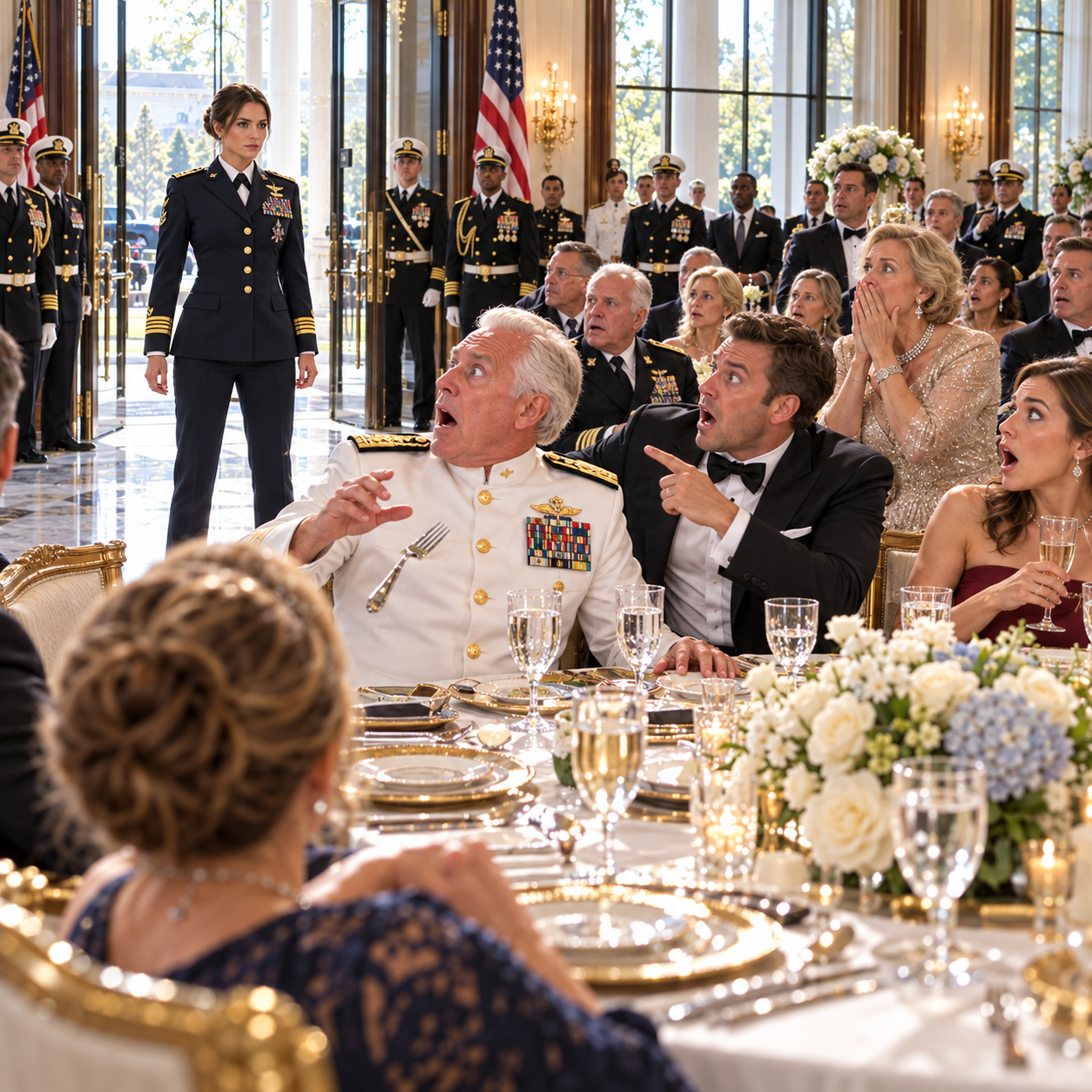
I Never Told My Fiancé I Commanded A Tier-One Ghost Unit. He Told His Arrogant Family I Was Only A Base Supply Typist. They Hosted A Lavish Dinner To Publicly Humiliate Me Over My Salary. I Smiled And Stepped Into The Banquet Hall In Full Regalia. But As Soon As His Admiral Father Noticed My Black Trident… His Fork Hit The Table.
My fiancé’s mother placed me beside the catering doors because she didn’t want an Army typist embarrassing her family. His father demanded I sign away my financial rights, and my fiancé watched without defending me. I didn’t argue. That evening, I walked into their military gala wearing the uniform they never imagined I owned. The room went silent, but their humiliation was only the beginning. Eleven days later, an old visitor log revealed that my fiancé had been investigating me before we ever met.
Part 1
The first time Margot Calder called me an Army typist, I thought she was making a joke. The second time, I understood she wanted me to feel small. By the night she slid a handwritten seating chart across her polished mahogany dining table, I had learned to recognize the slight tightening around her mouth that meant she was about to say something cruel and expected everyone else to agree.
“Table fourteen, Maren,” she announced, tapping a fingernail against the paper. “It’s near the service entrance, but the staff will make sure you’re comfortable. We simply can’t have Rhys’s father explaining your position to every senior officer who asks who you are.”
My fiancé, Rhys Calder, sat beside her, scrolling through his phone with one hand while turning his engagement ring shopping receipt into a paper triangle with the other. He didn’t look up when his mother said I might feel more comfortable around the hotel employees. He didn’t object when she added that a woman who typed inventory reports for an Army depot should understand that certain occasions required discretion.
I looked at the chart. Fourteen tables surrounded a small raised platform, with the first three reserved for senior officers, federal officials, and executives from defense contracting companies. My name appeared on the final table, between a catering supervisor and two guests whose names had been crossed out.
“Table fourteen is fine,” I said.
Margot smiled as though she had negotiated an unpleasant matter without raising her voice. “I’m glad you’re sensible. Rhys has worked too hard to be dragged backward professionally.”
Rhys finally lifted his eyes. “Mom’s just trying to make tonight easier for everyone.”
I watched him straighten the receipt instead of looking at me. Fourteen months earlier, that same man had sat beside me on a picnic blanket at a friend’s barbecue, listening with genuine interest while I explained why I liked the quiet neighborhoods outside Fort Halstead. Back then, he had laughed at my terrible attempts to grow tomatoes and brought me coffee on rainy mornings without being asked.
Somewhere along the way, his interest in my life had turned into embarrassment about it.
I was thirty-nine, lived in a rented duplex, drove a six-year-old Subaru, and usually wore cotton sweaters and comfortable shoes. At the regional Army logistics depot, my publicly visible assignment involved records analysis and inventory reconciliation. What Rhys didn’t know was that the administrative position was one part of a restricted military assignment, and I was not authorized to explain the rest to him.
My actual rank was lieutenant colonel.
I commanded the Joint Materiel Integrity Task Force, a small organization responsible for identifying serious irregularities in military supply systems. Our work brought together Army logisticians, financial analysts, intelligence personnel, and civilian investigators. Some assignments were classified, others were simply sensitive, and the distinction mattered because protecting an investigation often required knowing when to keep your mouth shut.
My records-support assignment had been officially approved. It gave me access to the ordinary transactions and conversations that senior leadership rarely saw firsthand, and I had never been required to invent an elaborate personal history. I simply told Rhys what I could truthfully say about my work, and he made the rest of the assumptions himself.
He never once asked whether I had served as an officer.
He saw a woman who carried her lunch in a canvas bag, came home tired, and sometimes spent Saturday mornings at the laundromat when my washing machine broke. He concluded that I earned very little, had limited ambitions, and was fortunate that someone with his family connections wanted to marry me.
For months, I excused his attitude as ignorance rather than contempt.
Then came the dinner when he corrected my pronunciation of a restaurant’s French name in front of his friends and laughed when I tried to explain that I had lived overseas. Another evening, he told me not to discuss military operations around his father’s colleagues because I would probably misunderstand the terminology. I remember the heat rising in my cheeks while everyone laughed politely and a waiter quietly refilled my water glass.
I had led planning meetings with officers from several countries, yet explaining that to Rhys would have disclosed information I wasn’t free to share. His assumptions left me little room to correct him, but silence was still a choice I made. I was beginning to wonder why I kept choosing it.
Three days before the gala, Rhys arrived at my duplex carrying a garment bag from a department store. Inside was a shapeless beige dress with a stiff collar and a clearance sticker still attached to the lining. He draped it over my couch beside the blue dress I had purchased for the occasion.
“You’re not wearing that blue thing,” he said. “Mom thinks it’s too flashy.”
“It’s a navy dress, Rhys. Not a fireworks display.”
“Please don’t turn this into something. There’ll be people there who can influence my promotion, and I need them focused on me.”
He told me to avoid expensive-looking jewelry and not to mention my job unless someone asked directly. Then he kissed my forehead, took a call from his father, and left the garment bag hanging on my closet door. I stood there for several minutes, looking at the dress and wondering when I’d started feeling relieved whenever my fiancé left my apartment.
The following afternoon, my task force operations chief, Major Soren Bell, stopped at my office with a folder marked for controlled distribution. He was forty-two, painfully punctual, and possessed an impressive ability to remain calm when everybody else around him was losing patience. We had worked together long enough that he noticed things even when I said nothing.
“You’re attending the Calder Foundation gala tomorrow?” he asked.
“Unfortunately.”
He watched me sign the acknowledgment sheet. “Colonel, do you know Victor Calder personally?”
“He’s my fiancé’s father.”
Soren’s expression changed almost imperceptibly. He glanced at the closed office door before speaking again.
“His consulting company is mentioned in the procurement review.”
“I know. That’s why I’m separating myself from any decision involving his firm.”
“There’s another issue,” he said. “One of our analysts found a historical records request bearing your name. It was submitted before you transferred here.”
I lowered my pen. “Who requested it?”
“We haven’t established that yet.”
Soren placed a separate envelope on my desk. Inside was an ordinary-looking visitor authorization form, except the records system showed it had been accessed through an outside consultant’s credential. Someone had searched for my former assignments, employment history, and old personnel references.
I looked at the date.
It was three months before I met Rhys Calder.
Part 2
I spent most of that evening sitting at my kitchen table with the refrigerator humming behind me and the visitor form spread beside an untouched bowl of soup. The document didn’t prove that Rhys had done anything. His father’s company employed more than sixty people, and military contractor personnel routinely requested background information they were entitled to access. What bothered me was the timing, the unusual search terms, and the fact that the inquiry included my old surname from a marriage that had ended years earlier.
I called Soren through our approved work channel. “Preserve the original access records and send them to the review team. Nobody contacts Calder or his company until the facts are established.”
“Already done, ma’am.”
“And, Soren?”
“Yes?”
“Don’t tell me what you think I want to hear.”
He paused. “Then I’ll tell you this. It looks deliberate. I just don’t know what they were looking for.”
After the call, I opened my personal laptop and looked through photographs from the afternoon Rhys and I met. There he was beside the grill, sleeves rolled to his elbows, laughing while my friend Tessa attempted to rescue a tray of burned hamburgers. I remembered how easily he’d approached me and how flattering his attention had felt after a difficult divorce and several years spent putting work ahead of everything else.
He’d asked about the depot almost immediately, but at the time, that seemed natural. Half the guests at the barbecue worked somewhere in the defense community. He told me he was a logistics consultant, and I mentioned that I helped reconcile shipment records.
“That’s important work,” he’d said, handing me a cold lemonade. “Most people don’t realize how much the military depends on ordinary people keeping things organized.”
For a while, he genuinely seemed to believe that.
Our early relationship had been built from ordinary pleasures: roadside diners, minor-league baseball games, homemade pancakes, and evenings spent arguing about which movie to watch. When I developed a fever one weekend, he arrived with groceries and changed the dead batteries in my smoke detector without making a production of it. Those memories were real, which made the question of his intentions more painful rather than less.
At work the next morning, I concentrated on the matter already waiting on my desk. Several batches of replacement components had supposedly passed through the depot, but the receiving reports didn’t match the physical inventory. The discrepancies looked harmless when examined individually: different shipment dates, corrected quantities, and signatures entered by employees who had since transferred.
Together, they suggested someone had been creating a paper trail for equipment that never arrived.
The vendor behind those shipments was a subcontractor represented by Calder Strategic Advisory, Victor’s consulting firm.
Our task force had been studying the discrepancies for several months, long before I realized my future father-in-law had any connection to the company. Independent investigators handled the formal procurement review, and my responsibility was to identify operational risks and preserve the records they needed. I had already informed my superior about the personal connection, and she had directed me to avoid any involvement in decisions concerning Calder’s eligibility for future contracts.
I had no intention of allowing my engagement to compromise that boundary.
Just before noon, Rhys called and asked me to meet him at the Oakridge Country Club before the gala. His parents wanted to discuss something important, he explained, and it would be easier if we all arrived at the hotel together. When I asked what the discussion concerned, he told me not to worry and said his father was simply being careful about family finances.
I arrived at four-thirty. The country club smelled of furniture polish and fresh flowers, and a teenager in a red vest was setting white candles along the dining room windowsills. Rhys led me past the dining area into a private conference room where Victor Calder sat behind a desk with a golf-course view.
Victor had retired from the Army as a brigadier general. His framed photographs showed him shaking hands with senior officials, standing beside aircraft, and receiving awards at ceremonies. He had a habit of talking to civilian employees as though they were recruits who needed constant correction, which was one reason I usually avoided extended conversations with him.
“Maren,” he said, without standing. “Sit down.”
A thick document lay on the desk. Beside it rested an expensive fountain pen positioned neatly across a leather writing pad.
“Page four,” Victor instructed.
I opened the document and discovered a prenuptial agreement prepared by the family’s attorney. There was nothing inherently unreasonable about discussing a prenuptial agreement, particularly when either partner entered marriage with substantial assets. What shocked me was that nobody had discussed it with me beforehand, I had no independent counsel, and the document treated every conceivable financial issue as something Victor’s family should control.
One clause sought to waive claims against several categories of marital property without meaningful disclosure. Another required broad cooperation with future investigations of family business assets, including authorization to provide certain employment-related records wherever legally permitted. That provision had no obvious relationship to protecting inherited wealth.
“Why is my employment information included?” I asked.
Victor tapped his ring against the desk. “Standard due diligence. My family’s business interests attract scrutiny, and we prefer transparency.”
“Then I assume your attorney has no objection to my attorney reviewing this.”
His face hardened. “We’re trying to prevent complications, not create them.”
Rhys stood by the window, watching golfers cross the green. He had been unusually quiet since I arrived, and when I asked whether he’d read the entire agreement, he admitted that his father’s lawyer had explained the important sections.
“Just sign it, Maren,” he said. “We can talk about changes later.”
“Not how contracts work.”
Victor leaned forward. “My son has a future in this industry. Frankly, your salary wouldn’t cover the legal expenses if this marriage went badly.”
I closed the document carefully. There was no anger left in my voice when I said I would not sign anything without independent advice and full financial disclosure. The refusal seemed to surprise them more than an argument would have.
Margot appeared at the door moments later, wearing emerald silk and pearl earrings. She looked at the unsigned document, then at me, and her smile vanished. “Really, Maren? On the one evening we’re asking you to be cooperative?”
I stood, picked up my purse, and walked toward the hallway. Rhys followed far enough to whisper that I was embarrassing him, but stopped when his father called his name. I heard Victor say something about the company’s renewal meeting and Rhys answer, “I’ll handle her.”
Those four words followed me into the parking lot.
At six-fifteen, I returned to my apartment and hung the beige dress behind my bedroom door. Then I unzipped the garment bag I’d collected from the cleaners that morning. Inside was my Army dress uniform, prepared for a formal command appearance that had been authorized once my temporary low-profile assignment ended.
The silver oak leaves of a lieutenant colonel gleamed under the bedroom light.
I dressed slowly, fastening each button and checking the placement of my ribbons in the mirror. Before leaving, I removed my engagement ring and studied the faint indentation on my finger. I slipped the ring into my purse rather than leaving it behind, because there was one conversation I intended to have with Rhys face-to-face.
At seven-ten, my phone vibrated.
It was a message from Soren.
“Colonel, an additional credential match just came back. The visitor request wasn’t submitted by Victor Calder’s office.”
A second message appeared before I could reply.
“It was submitted through an account assigned to Rhys.”
Part 3
I read Soren’s message twice while standing beside my bedroom mirror. For fourteen months, I had told myself that Rhys’s interest in military logistics came from his profession, and that his questions about my work were an awkward attempt to share something meaningful. Now I was staring at evidence that someone using his company account had searched my personnel history before our first date.
I wanted to call him immediately. Instead, I asked Soren to forward the new information to the independent review team and made one request: “Do not assume the account holder made the request. I want that established, not guessed.”
At seven-forty, I pulled into the downtown hotel garage.
The ballroom occupied the second floor, beyond a wide marble staircase and a row of enormous windows overlooking the city. A military band played softly near the entrance, and waiters maneuvered around guests carrying trays of appetizers. I checked my reflection in the polished brass elevator doors and adjusted the sleeve of my uniform before stepping into the reception area.
I had attended enough military ceremonies to know the value of arriving quietly. Tonight, however, the first person who saw me was a young hotel employee holding a clipboard, and his startled expression told me that the evening wasn’t going to remain quiet for long. He glanced from my uniform to the guest list, hesitated, and then called the event coordinator.
“Lieutenant Colonel Holloway?” she asked when she arrived.
“That’s right.”
“We have you on the official command attendance list. Your seat is at the front.”
“I was also placed at table fourteen by the Calder family.”
Her eyebrows rose slightly. “That may have been a private arrangement, ma’am. The military liaison office confirmed your command seating yesterday.”
I thanked her and stepped into the ballroom.
Rhys stood near the front with a bourbon glass in his hand, laughing with two men from his consulting firm. Margot was seated beneath an arrangement of white orchids, wearing the pleased expression she usually reserved for occasions when every detail had followed her instructions. Victor stood nearby discussing a contract modernization initiative with a senior civilian official.
I was halfway across the marble floor when Rhys saw me.
His smile disappeared first. Then his gaze moved over the ribbons on my chest, the silver oak leaves on my shoulders, and the nameplate above my pocket. He set his glass down so quickly that the bourbon splashed over his hand.
“Maren?”
I kept walking.
He crossed the aisle, caught up with me beside a table decorated with candles, and reached for my elbow. I shifted away before his fingers touched my uniform.
“What are you doing?” he whispered.
“Attending the gala.”
“Don’t be ridiculous. Where did you get that uniform?”
I looked at him, waiting for the familiar man I had once loved to recognize something about me. Instead, his face tightened with fear, not for my safety but for the embarrassment he imagined was about to unfold. He glanced over his shoulder at his father’s table.
“Take it off,” he said. “Right now. You can’t just wear an officer’s uniform because my family upset you.”
“Rhys, lower your voice.”
“Do you have any idea what kind of trouble you’ll be in if somebody thinks you’re impersonating an officer?”
His mother arrived before I could answer. She looked me up and down with an expression of horrified disbelief, then grabbed Rhys’s sleeve.
“This is completely unacceptable,” she hissed. “Maren, we bought you a perfectly appropriate dress.”
“I didn’t ask you to buy me one.”
“Don’t be difficult. People are watching.”
Victor came toward us from the front table, his face flushed. The retired general looked at my uniform, then at his son, and finally fixed me with the severe expression he must have perfected during decades of military service.
“Who authorized you to wear those insignia?” he demanded.
“My command.”
“Don’t insult my intelligence. I spent thirty-one years in uniform, young lady.”
“I know, sir.”
“Then you know what wearing unauthorized decorations means. I won’t allow someone associated with my family to make a spectacle of herself.”
Victor waved at a hotel security supervisor, who approached with visible reluctance. Rhys stood beside his father with his arms crossed, offering no resistance while the men discussed escorting me out. Margot glanced toward the guests and announced, loudly enough for several neighboring tables to hear, that I worked as a typist at the depot and had apparently suffered some kind of emotional breakdown.
An Army captain near the entrance turned at the sound of my rank being disputed.
Before he could speak, the double doors opened again.
Major Soren Bell entered with two members of the task force staff and a civilian liaison officer. He had changed into his formal service uniform, and I recognized the narrow folder under his arm. His eyes moved from Victor to the hotel supervisor, then settled on me.
He stopped.
His heels came together, his shoulders straightened, and he stood at attention, as precisely as if we were beginning a morning command briefing. He had clearly recognized that my authority was being publicly challenged, and his unmistakable acknowledgment drew the attention of the officers nearest us.
“Good evening, Colonel Holloway,” he said.
“Good evening, Major.”
“The commander’s briefing materials are secured, ma’am. The regional director has confirmed your presentation for eight hundred tomorrow.”
“Thank you. We’ll review them in the morning.”
“Yes, ma’am.”
Soren stepped aside, and the event’s military protocol officer approached us with a look of sudden recognition. She addressed me by my full rank, apologized for the confusion, and explained that the opening remarks would begin shortly.
The transformation around us was immediate.
Rhys stared at Soren as though the major had begun speaking a foreign language. Margot’s fingers loosened around her purse, and Victor went absolutely still. One of the civilians from Calder Strategic Advisory quietly stepped away from our group, already looking at his phone.
Victor found his voice first.
“Major Bell,” he said carefully, “I believe there’s been a misunderstanding. This woman works in administrative records.”
Soren’s expression remained professional. “Colonel Holloway commands the Joint Materiel Integrity Task Force, General Calder. Her temporary administrative assignment was authorized through command channels.”
Victor’s eyes narrowed.
“Joint Materiel Integrity?”
“Yes, sir.”
For the first time since I had known him, Victor Calder appeared incapable of producing a confident answer.
I understood why. His company had been pursuing a substantial logistics advisory contract, and the task force’s work could affect the systems and vendors involved. He couldn’t know what our investigators had found, but he knew enough about procurement oversight to recognize that his family had just publicly antagonized someone connected to a sensitive review.
Margot was the first to attempt recovery.
“Maren, sweetheart,” she said, reaching toward me with a smile that looked painful to maintain. “Why didn’t you tell us? All these months, we thought you were just handling paperwork.”
“I do handle paperwork, Mrs. Calder. Sometimes it matters quite a lot.”
She laughed nervously. “Well, there’s obviously been some confusion. You must come sit with us.”
I looked at the seating chart still clutched in her hand.
“An hour ago, you thought I wasn’t presentable enough to sit beside your family. Nothing about my character has changed since then.”
Rhys moved closer. “Maren, please. We should talk privately.”
“We should have talked privately when your father put that agreement in front of me.”
His face reddened, but he said nothing.
I opened my purse, took out the engagement ring, and placed it on the table beside him. It made a small sound against the polished wood, almost lost beneath the music.
“The wedding is off, Rhys.”
His hand moved toward the ring, then stopped.
I turned to the protocol officer and asked whether my presence was still required for the evening’s opening presentation. She confirmed that the remarks could proceed without me, and I requested that the senior representative deliver the approved introduction instead. There were security considerations I had no intention of discussing in a ballroom full of contractors.
When I walked toward the exit, Rhys followed.
“Maren, wait. Please.”
We reached the marble staircase before I stopped.
“I can explain,” he said breathlessly. “You don’t understand how complicated my father’s business is.”
“I understand that you let him humiliate me.”
“That’s not what I’m talking about.”
Something in his voice made me turn.
Rhys glanced toward the ballroom doors, then lowered his voice.
“My father didn’t want me dating you at first,” he said. “He wanted me to find out who you were.”
Part 4
For a moment, the sounds from the ballroom seemed to recede behind the steady hum of the hotel’s ventilation system. I stood on the landing with one hand against the cool marble railing, studying the man who had once asked me to marry him in a little Italian restaurant while rain streaked the windows. The same man now looked terrified of what he had almost admitted.
“What exactly did your father want to know?” I asked.
Rhys rubbed his forehead. “You worked with inventory records. Our company had some unresolved shipping questions, and Dad thought you might know which office was handling them.”
“Before we met?”
He looked away.
“Answer me, Rhys.”
“Yes, but I didn’t know everything. I thought it was just a business introduction.”
I felt a cold, unpleasant pressure behind my ribs. He had chosen his words carefully, offering an explanation that was technically possible while avoiding the question that mattered most. I asked whether the barbecue where we met had been arranged specifically for that purpose.
“Tessa invited both of us,” he said quickly.
“That wasn’t what I asked.”
He swallowed. “Dad knew you were going to be there.”
I remembered Rhys arriving with the lemonade, remembered the warmth in his voice, and hated how sharply those small memories suddenly hurt. I had been lonely enough to welcome his attention but not foolish enough to confuse loneliness with an excuse for what he’d done. I stepped back when he tried to take my hand.
“Don’t contact me tonight,” I said. “Anything involving your father’s company needs to go through the appropriate investigators.”
He began to protest, then seemed to realize that every additional word might make things worse. I descended the staircase without looking back. In the garage, I sat behind the steering wheel until my hands stopped trembling enough to start the car.
I didn’t go home immediately.
Instead, I drove to a twenty-four-hour diner across town, changed into a sweater I’d left in the car, and ordered coffee. An exhausted nurse was eating pancakes at the counter, and two truck drivers were discussing the weather. Nobody recognized me, nobody cared what rank I held, and the ordinary indifference of the room gave me somewhere to collect myself.
I called my attorney, Elise Moreno, and told her the engagement was over. She had helped me through my earlier divorce and knew that I never asked for legal assistance lightly. When I explained the prenuptial agreement and its employment-records provision, she instructed me to preserve every message and bring her a copy of the document.
“Don’t have any more private conversations with these people,” she said. “Especially not about your military assignment.”
“Agreed.”
“And Maren? Whatever else is happening, don’t let the investigation become your personal response to a broken engagement.”
I appreciated that she said it. The distinction between personal betrayal and professional responsibility was the only boundary capable of protecting both my judgment and the work my team had done. A family could behave cruelly without committing a procurement violation, and an ugly dinner conversation was not evidence that federal contracting rules had been broken.
The following morning, I formally expanded my conflict disclosure to include Rhys’s admission. My commanding general directed that the existing procurement compliance review remain entirely with an independent team, while I withdrew from all decisions specifically affecting Calder Strategic Advisory. I also turned over the visitor authorization records, the unsigned agreement, and a written account of the conversation outside the ballroom.
Two days later, the review team contacted me for an interview.
The lead investigator was a civilian named Naomi Voss, a woman with close-cropped gray hair and a habit of allowing silence to stretch until people answered their own questions. She worked for an independent oversight office and had no professional connection to Victor Calder. When I entered the conference room, she had three folders arranged neatly in front of her.
“Colonel, we’ll be speaking with you as a potential witness,” she explained. “Not as a member of the review team.”
“Understood.”
She asked about Rhys’s questions during our relationship.
At first, the requests had seemed harmless: Which office approved emergency supply shipments? How long did a corrected inventory entry remain visible? Did depot employees ever receive preliminary equipment lists before a contract was formally awarded? I’d answered general questions about public procedures but declined to discuss internal records.
One memory had remained buried until Naomi asked about specific requests.
Six months earlier, Rhys had invited me to dinner at his apartment. He had left a contractor presentation open on his laptop, and when I walked into the kitchen, he asked whether a particular equipment category looked familiar. I told him I couldn’t discuss internal procurement data and changed the subject.
He’d been irritated for the rest of the evening.
When I finished describing that dinner, Naomi opened another folder. She showed me a copy of a company email directing employees to identify possible sources of nonpublic information about depot transactions. Rhys had been included among the recipients.
“Was that email sent before your engagement?” I asked.
“Before you met him.”
I stared at the date.
Naomi then produced an older inventory discrepancy report. The document had been submitted by a depot records specialist named Evelyn Shaw, who had flagged unusual corrections to receiving reports nearly three years earlier. Evelyn had subsequently faced accusations of making unauthorized changes to inventory entries and had retired before the dispute was resolved.
I remembered Evelyn. She was a quiet woman who kept peppermint candies in her desk drawer and taught younger employees how to find errors without making the people who committed them feel stupid. During my first month at the depot, someone had mentioned that she’d left under unpleasant circumstances, but I hadn’t known the details.
“Her name appears repeatedly in the archived records,” Naomi said.
“Was she involved in the discrepancies?”
“That’s what we’re trying to establish.”
Naomi slid one final page across the table.
It was a preserved email from a former Calder Strategic Advisory employee, written shortly before Evelyn had been accused of altering the records. The message referred to a meeting about suppressing an inventory exception report and named a company executive who had demanded that the problem be kept away from the contracting office.
The executive was Victor Calder.
At the bottom of the email, someone had added a handwritten note.
“Make sure Shaw takes responsibility before the review begins.”
Part 5
Evelyn Shaw called me the following Sunday afternoon.
I was standing in my kitchen, trying to repair the loose handle on a cabinet, when an unfamiliar number appeared on my phone. Her voice sounded older than I remembered, but she still had the careful, patient way of speaking that had made her popular with younger employees.
“I saw a photograph of you at that military dinner,” she said. “Someone put it online. You’re not just the records lady they told us you were.”
“No, Evelyn. I’m not.”
She hesitated. “Does that mean somebody is finally looking at what happened to me?”
I set down the screwdriver.
“I can’t discuss an ongoing review,” I said. “But I can give you the independent investigator’s contact information.”
Evelyn exhaled shakily. “I’ve kept everything. Every message, every corrected shipment report. My husband thought I should throw it all away, but I couldn’t.”
She told me she had spent years trying to explain why inventory corrections appeared under her employee credentials. At first, she’d assumed there had been a software error or a misunderstanding between departments. Then a supervisor told her to withdraw her complaint, and a company representative suggested that continuing to question the records could damage her retirement prospects.
“They made it sound like I was the dishonest one,” she said. “After twenty-six years, I left that building feeling like a thief.”
I listened while she described packing her desk into two cardboard boxes. When she mentioned giving away her peppermint candies because she couldn’t bear to look at them anymore, I felt a sudden, piercing sadness. She had spent decades protecting a system that ultimately failed to protect her.
I asked her to preserve everything and contact Naomi directly. Then I sat at my kitchen table, thinking about how much damage could be hidden inside an ordinary-looking administrative correction. A missing shipment was not just a number on a spreadsheet; it meant mechanics waiting for parts, taxpayers paying for equipment, and honest employees carrying the blame for someone else’s decisions.
That evening, Rhys sent me an email.
He had stopped calling after Elise instructed him to communicate in writing, but his messages had become increasingly desperate. This one was different. Instead of pleading for another chance, he described a meeting with his father before the barbecue where we met.
Victor had learned that a records employee named Maren Holloway was assigned to review historical inventory transactions. Rhys had been asked to establish a relationship with me, learn what I could access, and determine whether I might be persuaded to share preliminary information about discrepancies affecting one of their clients.
Rhys insisted he hadn’t initially understood how improper the request was.
He wrote that our relationship had become real to him, that he’d fallen in love, and that his father’s instructions eventually felt less important than our future together. Then he admitted something that made the entire email difficult to finish.
Even after we became engaged, he had continued reporting details of our conversations to Victor.
The ordinary questions. My schedule. Which coworkers I mentioned. When I seemed unusually tired after work.
He had even told his father about an argument in which I refused to discuss pending equipment reviews.
I forwarded the email to Elise and asked her to coordinate its preservation with Naomi’s office. Afterward, I walked around my apartment opening windows because the rooms suddenly felt unbearably small. The place where I’d cooked dinners with Rhys, fallen asleep beside him on the couch, and imagined building a future now contained memories I didn’t know how to trust.
On Tuesday, Margot appeared at my front door.
She wore a cream-colored coat, held an expensive bakery box, and carried the engagement ring in a small velvet pouch. She smiled when I opened the door, but her eyes moved immediately over my shoulder, searching the apartment as though she expected to discover something embarrassing.
“May I come in?”
“No.”
Her smile faltered.
“Maren, we have all behaved poorly. I’m prepared to admit that. But destroying a family over a misunderstanding is rather extreme.”
“Your family’s contracting review was underway long before I ended the engagement.”
“Victor says these allegations are retaliation.”
“Then his attorneys can present the evidence supporting that claim.”
Margot tightened her grip on the bakery box. “Do you have any idea how many people depend on our company? You could cost innocent families their jobs.”
That accusation angered me more than her insults at the gala. She was asking me to accept responsibility for the consequences of decisions I hadn’t made, while showing no concern for the people whose careers her husband’s company might have damaged.
“Those employees deserve an honest company,” I said.
She looked at me for a long moment. Then her expression became familiar again: the same cold appraisal she’d given me across her dining table.
“You really believe that uniform makes you better than us.”
“No, Mrs. Calder. I believed you when you showed me who you were before you knew about the uniform.”
I closed the door without taking the ring.
Three days later, Victor’s attorneys submitted a formal allegation that I had improperly influenced a procurement review because of a failed personal relationship. My command’s legal office reviewed the chronology, including my written conflict disclosures and the independent investigation’s original start date. I remained recused while the complaint was evaluated, and I cooperated fully with the additional questions.
It was unpleasant to know my professional conduct was being questioned, but I understood why the scrutiny was necessary. The integrity of the review mattered more than my desire to prove Victor wrong. If I wanted the process to be fair when it examined his company, I had to accept the same standards when it examined me.
Late Friday afternoon, Elise called.
She had been informed that the investigators were verifying an additional set of historical visitor records, including physical signatures preserved by the depot’s former security contractor. The records might establish who had personally requested information about me, rather than merely identifying the account used.
“There’s one thing I want you to prepare yourself for,” Elise said.
“What?”
“The evidence may show that Rhys wasn’t just following his father’s instructions. He may have helped design the approach himself.”
I looked at the photograph of us still sitting facedown inside my desk drawer.
For the first time, I wondered whether the relationship I had spent fourteen months trying to save had ever belonged to me at all.
Part 6
Eleven days after the gala, Naomi Voss invited me to a recorded follow-up interview.
A photocopy of an old visitor log lay on the conference table. The date was three months before the barbecue, and the location was the administrative records office at Fort Halstead. The visitor had signed in using his full legal name, Rhys Alexander Calder, and had listed the purpose of his visit as a records-access consultation.
His signature was unmistakable.
Naomi had compared it with other records and confirmed through additional documentation that Rhys had attended the meeting himself. The person who arranged the appointment had initially described it as a routine inquiry about depot recordkeeping procedures. Follow-up records showed that Rhys later requested information identifying which personnel had been assigned to review irregular shipment histories.
One of the names on that list was mine.
“Did he ever mention visiting the depot before you met?” Naomi asked.
“No.”
“Did he tell you he knew your name before the barbecue?”
“No.”
She allowed me a moment before continuing.
“The records indicate that he specifically asked for a social introduction to you. We have corroborating communications from the person who arranged the gathering.”
I felt an unexpected numbness.
For weeks, I had been searching my memories for the moment when Rhys’s kindness became manipulation. I had assumed there must have been a recognizable turning point, some conversation or family meeting that changed him. Now I understood that his interest in my work had preceded the first dinner, the first kiss, and every promise he’d made about our future.
I hadn’t imagined the man I fell in love with. His generosity and affection might have been genuine at times. But he’d chosen to build them on a deception, and he’d renewed that choice every time he gave his father information about me.
When the interview ended, I walked outside and sat on a bench overlooking the parking lot. A maintenance worker was sweeping leaves away from the entrance, pushing them into uneven piles that the wind immediately scattered. I watched him work until the tightness in my chest loosened.
Then I called Elise and asked her to arrange the return of the few belongings Rhys still had at my apartment.
I didn’t want another meeting.
Over the following six weeks, the independent review continued. Investigators interviewed current and former employees, examined purchasing records, and compared the supposed delivery dates of equipment with transportation and warehouse documentation. Evelyn turned over the files she had preserved, including emails showing that she had questioned the corrections before anyone accused her of creating them.
Her records proved important.
The review found substantial support for her account that others had made or directed the disputed changes, and the appropriate offices began correcting the administrative findings that had damaged her reputation. She received a written acknowledgment that the earlier conclusions about her conduct could not be sustained. It didn’t restore the years of humiliation, but it meant her grandchildren would no longer hear that their grandmother had left government service under a cloud of dishonesty.
As for Calder Strategic Advisory, the consequences unfolded through ordinary procedures rather than a dramatic announcement.
The contracting authority excluded the company from the pending competition after identifying material deficiencies in its disclosures and documented conduct during the procurement process. Additional evidence concerning improper attempts to influence record handling was referred to the appropriate federal investigators. The company faced a separate review of its eligibility for future government work, while its board placed Victor on administrative leave.
No one was convicted overnight, and several questions remained for investigators to resolve. But the business opportunities Victor had spent years cultivating were suddenly uncertain, and the partners who once praised his connections began examining exactly how those connections had been used.
Rhys was placed on leave by his employer pending its own review.
He sent me a final letter through Elise, acknowledging that he’d made the first approach deliberately and that he had continued sharing details about my work because he feared losing his father’s approval. He apologized for the gala, the agreement, the months of insults, and his failure to defend me.
He wrote that he still loved me.
I read the letter once, sitting at the kitchen table where we’d planned our wedding guest list. There were passages that sounded painfully sincere, and perhaps they were. But sincerity after exposure did not erase deception before it.
I asked Elise to tell him I had received the letter and would not be responding.
By early December, my conflict review had concluded without a finding of improper influence on the contracting decision. My disclosure and recusal had been timely, and the independent review’s evidence had existed long before the engagement ended. I returned to my normal operational responsibilities, grateful that the team could continue its work without my personal life shadowing every decision.
On my first Friday back, Soren appeared in my doorway with two paper cups of coffee.
“There’s someone downstairs who asked whether you might have a minute,” he said.
“Who?”
“Evelyn Shaw.”
I found Evelyn in the visitors’ waiting area wearing a red knitted scarf and carrying a small brown paper bag. She looked nervous until she saw me, then smiled with an expression that reminded me of our first weeks together at the depot.
“I wanted to thank you,” she said.
“The investigators did the work, Evelyn. You kept the evidence.”
“Maybe. But somebody finally listened.”
She handed me the bag. Inside was a small tin of peppermint candies.
“My husband said you probably have plenty of these at your fancy office,” she said, laughing. “I told him it wasn’t about the candy.”
I hugged her, careful not to crush the paper bag between us.
For a few minutes, we talked about ordinary things. Her daughter had bought a house outside Richmond, her youngest grandson had started kindergarten, and she was considering volunteering at the public library. She no longer wanted to spend every morning replaying what had happened at the depot.
Neither did I.
That winter, I moved into a small townhouse with a narrow garden and a kitchen that received sunlight in the mornings. I bought a secondhand dining table, repaired a leaking faucet myself, and adopted an elderly rescue dog named Otis who considered every upholstered chair his personal property. There were evenings when I missed having someone to share dinner with, but I no longer confused companionship with the obligation to make myself smaller.
Tessa apologized repeatedly for introducing me to Rhys. I told her she couldn’t have known what he’d planned and asked her to stop blaming herself. We resumed our Sunday morning breakfasts, a tradition we’d abandoned while I was trying to accommodate the Calder family’s endless obligations.
Several months later, I attended another formal military dinner.
This one was smaller, held at a conference center near the installation. The guests included officers, civilian specialists, warehouse employees, and a handful of people being recognized for improvements to military supply accountability. Nobody was arranged according to family connections or perceived social value.
Soren found me near the entrance, studying the seating chart.
“You’re at table one, Colonel,” he said.
“I can read, Major.”
He smiled. “Just making sure you don’t wander off toward the kitchen.”
I laughed, genuinely and unexpectedly, until a few nearby guests glanced our way.
Then I noticed a familiar name on the program.
Evelyn Shaw was being recognized for her contribution to the records review and for the years of public service that had preceded it. When her name was announced, she stood slowly, looking startled by the applause. I rose with everyone else, watching her walk toward the front with her shoulders straighter than I had ever seen them.
The applause continued as she accepted her certificate.
I thought about Margot Calder’s handwritten seating chart, Victor’s fountain pen, and the beige dress still hanging in the back of my old closet when I’d moved out. I thought about how easily Rhys had watched his family diminish me and how quickly their behavior changed when they discovered my rank.
They had mistaken my silence for weakness and my privacy for insignificance. The mistake had revealed their character, but it hadn’t been the cause of their downfall. Their own decisions, recorded in emails, contracts, visitor logs, and inventory reports, had finally made their conduct impossible to ignore.
I never spoke to Rhys again.
I heard occasionally that his parents were still dealing with legal and financial consequences, but I stopped asking for updates. Their future belonged to them, just as mine belonged to me.
After the ceremony, Evelyn found me near the coat check and asked whether I was happy.
I considered the question while Soren helped an elderly guest find her missing scarf and the hotel staff began clearing glasses from the tables.
“Not every day,” I admitted. “But most days, yes.”
Evelyn nodded as though that was a perfectly satisfactory answer.
When I stepped outside, the evening air was cold enough to sting my cheeks. I took my keys from my coat pocket and walked toward my car, where Otis’s favorite blanket waited on the back seat for the drive home after I picked him up from Tessa’s house.
There would be dishes in the sink, unfinished reports waiting on Monday, and a stubborn old dog demanding dinner the moment I opened the door.
It wasn’t the grand future the Calders had once told me I could never deserve.
It was a life I had chosen for myself, and for the first time in a long while, I felt no need to explain its worth to anyone.
THE END!
Disclaimer: Our stories are inspired by real-life events but are carefully rewritten for entertainment. Any resemblance to actual people or situations is purely coincidental.