
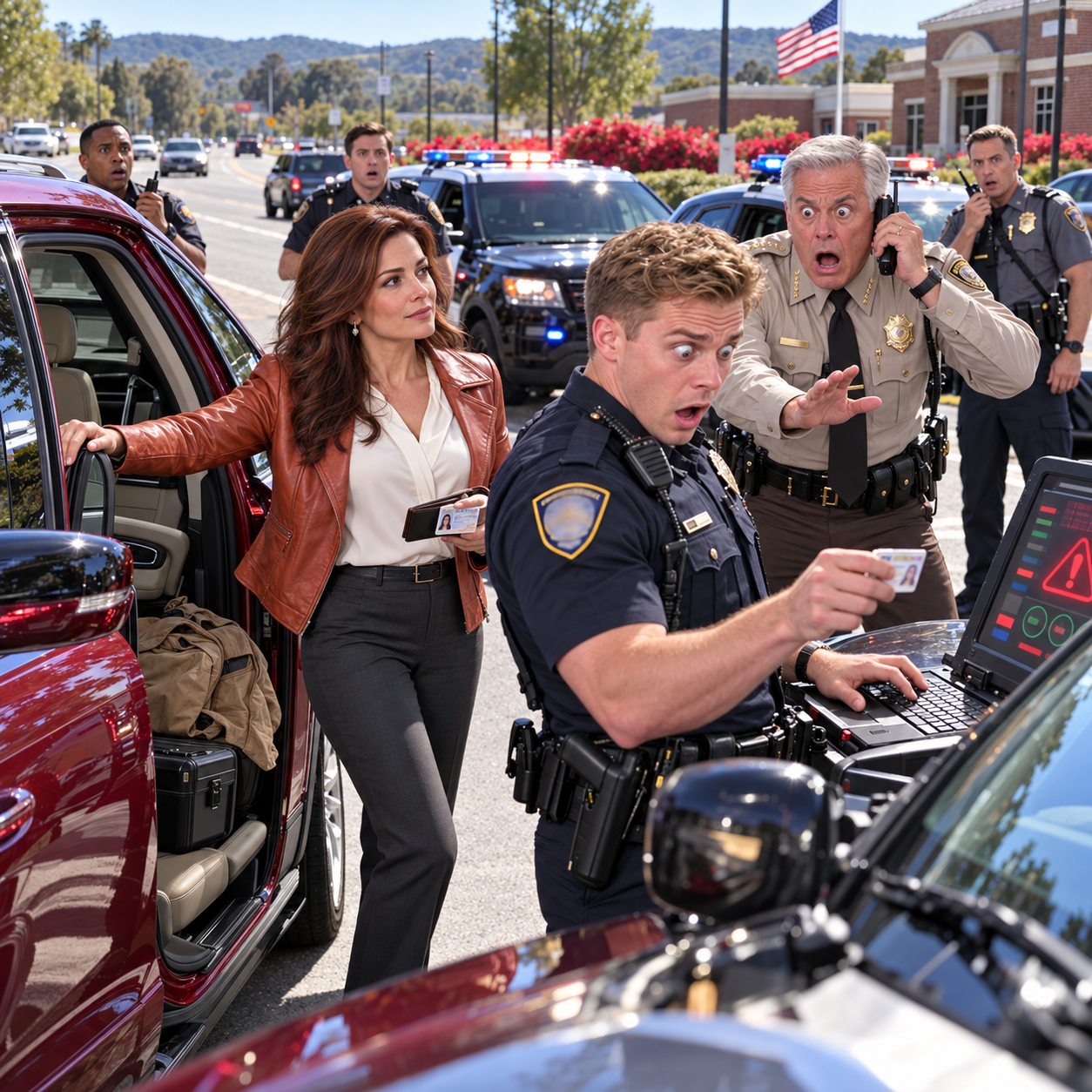
The Rookie Cop Snickered As He Ran My License To Humiliate Me In Front Of His Chief. Two Seconds Later, Every Radio In The County Fell Silent: “Dispatch Order Zero-One: Do Not Engage The Driver. You Just Queried A Retired Tier-1 Federal Asset.”
The young officer laughed at my battered Chevy while his police chief watched from the cruiser, smiling as though humiliating a woman on an empty Georgia highway was entertainment. I handed over my license without arguing, even when he threatened to search my truck. Four minutes later, their computer screens went red, the police radio issued an emergency warning, and neither man would look me in the eye. Three days after that, I found a list of local families with my license plate circled in red.
## Part 1: The Woman in the Old Silverado
My name is Rhea Calder, and until the second Tuesday in October, I believed I had finally learned how to disappear without actually leaving the world. I was forty years old, lived alone in a rented farmhouse outside Dunlow, Georgia, and drove a 2008 Chevrolet Silverado that looked as if every previous owner had lost an argument with a tree. The passenger mirror was secured with two black zip ties, the right taillight sometimes flickered, and the air conditioner made a rattling noise whenever I turned left. None of those things bothered me enough to replace the truck, because after thirteen years of government work, I had developed a deep appreciation for objects that did their jobs without attracting attention.
Dunlow had roughly thirty-six hundred residents, one grocery store, three churches within shouting distance of each other, and a diner where the waitress remembered how much cream you wanted before she remembered your name. My farmhouse stood on eleven acres of red Georgia clay surrounded by pines, with a crooked porch, an unreliable water heater, and a chicken coop that leaned slightly east. I worked remotely for civilian shipping companies, identifying operational risks in transportation contracts and warehouse procedures. People assumed I had once been an accountant, and I never bothered correcting them.
Before Georgia, I had spent thirteen years coordinating sensitive intelligence operations for a defense task force whose work rarely appeared in public reports. I wasn’t a glamorous field agent carrying a hidden weapon through foreign capitals; most of my career involved maps, exhausted colleagues, conflicting information, and decisions that could put people in danger if I got them wrong. I had helped coordinate evacuations, protect personnel, and identify threats before they reached people who couldn’t protect themselves. When I left government service three years earlier, I accepted a protected civilian-record arrangement designed to keep certain parts of my professional history inaccessible through ordinary law enforcement searches.
I had never tested that protection, and I certainly never wanted anyone in Dunlow to discover it. My closest acquaintance was Faye Reddick, a retired school bus driver who lived half a mile down the road and occasionally brought me peach preserves. She knew that I worked on a computer, disliked crowds, and could fix a fence faster than most men half my age. That was enough information for a friendship, and I was grateful she never asked for more.
On that Tuesday morning, I left home at 8:15 with a grocery list on the passenger seat and an empty coffee cup rolling against the floor mat. I needed two bags of pine shavings from the farm supply store, a box of coffee filters, and a replacement latch for the coop. The October sun was just beginning to cut through the trees, making the roadside grass glitter with dew. I was traveling thirty-eight miles per hour in a forty-five-mile zone when blue lights appeared behind me.
I checked my speed, signaled, and pulled onto the gravel shoulder of County Road Seven. Then I switched off the engine, lowered my window, and rested both hands on the steering wheel where the approaching officer could see them. I noticed a second police vehicle behind the first, which seemed excessive for an equipment stop on a quiet country road. A young officer climbed out of the leading cruiser while a heavier, older man remained seated in the second.
The rookie’s name tag read GAGE PRITCHARD, and he couldn’t have been older than twenty-five. He studied the truck before he studied me, lingering on the damaged mirror and the rusty dent above the rear wheel. “Well, this thing’s seen better centuries,” he said, smiling at his own joke. When I didn’t laugh, he leaned toward my window and asked for my license, registration, and insurance.
“Your taillight’s acting up, and your registration sticker looks expired,” he said while examining my documents. I explained that the registration had been renewed electronically and that I had an appointment to repair the light on Friday. He turned my license under the sunlight, squinting at the photograph as though he expected to find something hidden beneath the plastic. “Rhea Calder,” he repeated. “You live out on the old Ellery property, don’t you?”
I looked at him more carefully. “I rent a house on that road.” He gave a short laugh and glanced toward the second cruiser, where the older officer was watching through his windshield. “Quiet little place for somebody driving a truck that looks like it belongs in a junkyard,” Pritchard said.
“I’d appreciate a citation or a warning, Officer, whichever you’re planning to issue.” My voice stayed even, but something about the conversation had begun to feel rehearsed. He hadn’t asked me where I was going or whether the truck belonged to me, yet he’d already connected my name with a particular property. There were plenty of ordinary explanations for that, but I had learned not to dismiss small inconsistencies.
Pritchard stepped back with an exaggerated sigh. “Folks around here usually know how to be friendly,” he said. “Let’s see what else comes up when we run those plates.” As he walked toward his cruiser, I heard him call out, “Chief, you ought to see the mirror on this thing.” The older man stepped from his vehicle and joined Pritchard at the patrol car, and both laughed.
I recognized the older man from a photograph in the diner: Police Chief Silas Ketter. He was a broad man in his early fifties, with thinning silver hair and the comfortable posture of someone accustomed to receiving agreement before finishing a sentence. He leaned through the passenger door while Pritchard settled behind the wheel and opened his dashboard terminal. I watched them through my damaged side mirror, irritated but determined to let the stop end without a confrontation.
The ordinary registration check completed without incident, but Pritchard wasn’t satisfied. Ketter pointed toward something on the screen, and the younger officer opened another search window before typing my full name. His smile disappeared first, followed almost immediately by the color in his face. The terminal flashed red, displayed a warning across the screen, and stopped accepting his commands.
Pritchard pressed several keys and turned toward Ketter. I couldn’t hear their conversation through the closed cruiser windows, but I saw Ketter grab the edge of the dashboard and lean forward. A moment later, the radio chatter stopped beneath a sequence of three sharp electronic tones. The dispatcher returned with a voice so controlled that I recognized the seriousness of the instruction before I understood the words.
“Unit Twelve, stop all restricted-record activity immediately. Do not approach the civilian vehicle again. Both officers are to remain beside their patrol car with hands visible until the responding supervisor arrives.” Pritchard stared at the radio, then reached toward it before Ketter caught his wrist. The chief looked out through the windshield at my Silverado with an expression that had nothing to do with a broken taillight.
He said something to Pritchard, who shook his head so violently that I could see it from thirty feet away. Then the young officer blurted loudly enough for me to hear, “Chief, I only opened the search you told me to use!”
I kept my hands on the wheel and looked toward the empty road ahead. Whatever had just happened wasn’t an ordinary response to my protected record, and Ketter’s sudden fear told me something considerably more disturbing than the computer warning.
He had known exactly what Pritchard intended to search before the officer touched that keyboard.
## Part 2: The Countywide Lockout
For the next twelve minutes, I sat on that gravel shoulder while two police officers stood beside their cruiser like boys who had accidentally broken something expensive. Pritchard repeatedly glanced toward my truck, but Ketter kept his eyes on the road and spoke into his personal phone. I could see the chief’s jaw working as he listened, and at one point he turned his back to me entirely. Whatever he was being told, he clearly didn’t like it.
A dark sheriff’s SUV eventually appeared from the north, followed several minutes later by an unmarked sedan. Sheriff Corinne Maddox climbed out of the SUV, a tall woman in her late fifties with weathered hands and the unmistakable impatience of somebody who had interrupted a difficult day to deal with an unnecessary problem. She approached Ketter first, spoke quietly, and listened while he pointed toward my truck. Then she held out her hand for the printed stop information, and he hesitated before giving it to her.
Maddox crossed the road and stopped beside my open window. “Ms. Calder, I’m Sheriff Maddox. Are you injured, and has anyone searched your vehicle?” I told her no and explained the events exactly as they had occurred, including the remarks about my truck and the unusual interest in my address. She asked whether I had threatened either officer, reached for anything dangerous, or refused instructions. When I answered no, she looked toward Pritchard with an expression that made me grateful I wasn’t the person standing beside his cruiser.
“The equipment violation may justify stopping a vehicle,” she told me, “but it doesn’t automatically justify searching restricted federal information about its driver.” I appreciated the distinction, because I didn’t want special treatment for a taillight that genuinely needed fixing. She also explained that an external security system had suspended the county’s access to certain federal law enforcement databases after detecting an unauthorized protected-record request. The local emergency radio system remained operational, but every terminal using the county’s shared federal-records connection was now blocked pending verification.
Across Bracken County, deputies were suddenly working without services they normally used to confirm interstate warrants and identify missing persons. A jail administrator had already called the sheriff twice, and the county’s dispatch supervisor was coordinating manual requests through the state. It wasn’t a dramatic nationwide computer failure, but it was serious enough to interrupt police work across an entire county. I watched Maddox take a call and instruct her staff to document every delayed request because she wanted to know exactly how much damage the interruption caused.
A federal investigator arrived nearly forty minutes after the original traffic stop. Her name was Special Agent Nia Bellamy, and she wore an ordinary charcoal jacket over a white shirt, with no visible weapon or theatrical entourage. She introduced herself without discussing my former employment and asked permission to speak privately beside the sheriff’s vehicle. I stepped out of my truck for the first time that morning, feeling the gravel grind beneath my boots.
“Your protected identifier was accessed through a search category requiring a documented operational reason,” Bellamy explained. “The officer supplied an officer-safety justification that doesn’t appear consistent with the encounter.” I asked whether that alone had disconnected the county’s terminals. She shook her head and said the immediate alert had prompted a broader security review, during which previous questionable searches associated with the same credentials had become visible.
That answered one question and created several more. I had expected the protection around my identity to generate an inquiry if somebody crossed a boundary, but I hadn’t expected a whole network to be suspended. Bellamy told me that investigators were preserving the access logs and would determine whether the officer had misunderstood the system or knowingly used it for an unauthorized purpose. She didn’t speculate about the chief, although I noticed her glance toward Ketter when she mentioned previous searches.
Pritchard finally approached under Maddox’s supervision to return my documents. The young man who had laughed at my Chevy now seemed uncomfortable meeting my eyes, and his fingers trembled slightly as he held out my license. “Ma’am, I didn’t know you were associated with the federal government,” he said. I took the card from him and replied, “You didn’t need to know anything about my work to treat me respectfully.”
His mouth opened, but Bellamy interrupted before he could respond. “Officer, why did you select the restricted search category after receiving a routine registration result?” Pritchard looked toward Ketter, who was watching from beside the sheriff’s SUV. “We were checking whether she could be a problem,” he said. When Bellamy asked what specific behavior supported that concern, he stared at the gravel.
Ketter stepped forward and claimed that Pritchard was inexperienced and had misunderstood a training exercise. Maddox asked why a training exercise had been conducted during a roadside detention involving an actual civilian. The chief replied that police work required judgment and that outsiders frequently misunderstood the difficulties officers faced in small communities. I recognized the tone immediately, because it was the same tone I had heard from officials who considered accountability an inconvenience.
Bellamy didn’t argue. She simply asked Ketter to identify who had authorized the restricted search and whether he had personally directed the officer to enter an officer-safety reason code. When he insisted that everything had been routine, she requested preservation of both vehicles’ recordings and the communications logs. Ketter’s face tightened at the mention of recorded evidence, although he continued insisting that everyone was overreacting.
I was allowed to leave shortly after eleven, once investigators had taken my statement and verified that my records remained protected. The farm supply store was already crowded, and the cashier asked why three police vehicles had passed through town so quickly. I told her there had been a problem on the highway, bought my pine shavings, and drove home with the radio off. I forgot the coffee filters again.
That evening, Faye Reddick appeared on my porch carrying cornbread in a metal pan. She had heard rumors that a woman driving an old pickup had caused the county police computers to shut down, and she wanted to make sure I was all right. When I mentioned Ketter’s name, her face changed so quickly that I stopped describing the incident. She asked whether either officer had mentioned my landlord’s property, and when I said yes, she pressed her lips together.
“Faye, is there something you want to tell me?” She looked toward the trees bordering the driveway and shook her head. “Not tonight, honey. Just be careful who you talk to about that road.” Before leaving, she asked whether I had seen any survey crews near the farmhouse recently. I told her two men had come through the previous month, but I’d sent them away because they couldn’t explain why they needed to enter the property.
For two days, I tried to resume my ordinary routine while investigators worked through the incident. On Friday afternoon, I found a brown envelope wedged behind the screen door, without a stamp or return address. Inside was a photocopied spreadsheet listing twelve local households, several vehicle registrations, and handwritten notes beside addresses along County Road Seven. My license plate was circled in red, and across the top somebody had written two words: “HOLDOUT PARCELS.”
At the bottom of the page, one sentence had been added in blue ink.
“If they searched you, they’ve already searched the others.”
## Part 3: The Names Nobody Was Supposed to See
I spread the photocopy across my kitchen table and examined it beneath the yellow light above the stove. Twelve households appeared in alphabetical order, each identified by an address, a vehicle description, and a short notation about the occupants. Beside mine, someone had written “Tenant resistant. Confirm residency. Owner contact pending.” Faye’s property appeared two lines below, marked “Priority resolution,” and the remaining addresses followed the same narrow stretch of county road.
I photographed the page and called Agent Bellamy using the number on her card. She asked me not to circulate the document and arranged to have a copy collected the next morning. When I asked whether she recognized the format, she hesitated before saying investigators had encountered similar property references in some of the database queries. Her silence after that sentence told me considerably more than another explanation would have.
Faye was sitting on her front porch when I arrived the following morning, shelling pecans into a chipped ceramic bowl. I placed the photocopy beside her and watched her fingers stop moving. She looked at the heading, sighed, and asked whether anyone had seen me bring it. When I told her no, she pushed her pecans aside and invited me inside.
For twenty-seven years, Faye and her husband, Rufus, had owned fourteen acres beside County Road Seven. After Rufus died, she continued living there, maintaining the house and leasing a small pasture to a neighboring farmer. Six months earlier, representatives from Briarline Distribution had approached her about a proposed truck connector that would shorten the drive between a future warehouse complex and the state highway. They wanted a permanent easement across part of her land, including the strip containing her vegetable garden and the well house her husband had built.
“I told them I wasn’t interested,” Faye said, placing two mugs of coffee between us. “After that, police cars started finding reasons to stop me.” She described inspections for minor vehicle defects, questions about her daughter Cecily’s address, and repeated visits from a town employee who insisted she would regret refusing the proposal. One officer had mentioned an old disagreement involving her husband’s estate, information that had no obvious connection to traffic enforcement. Faye had complained to the police department, only to receive a letter stating that every encounter had been proper.
“Why didn’t you call the sheriff?” I asked. She gave me a weary look and reminded me that she had called twice, but the complaints had been referred back to the town because its officers were involved. Maddox had offered to document new incidents, yet Faye couldn’t prove the separate encounters were connected. “You can live in a place your whole life and still find out nobody wants to get involved when an important employer starts talking about jobs,” she said.
I asked where she’d obtained the spreadsheet. Faye admitted that Mina Lott, a former municipal records assistant, had copied several pages before leaving her job in September. Mina had become concerned about unusual requests involving property owners, vehicle information, and proposed road access agreements. She’d given Faye the documents with instructions to keep them safe, but Faye hadn’t understood their significance until hearing about my traffic stop. Then she had left the envelope at my house.
The next day, I drove to the courthouse and requested public records concerning the proposed connector. The project was presented as an economic development opportunity expected to bring hundreds of jobs to Bracken County. Briarline had offered to finance a substantial portion of the construction, while the town would seek state infrastructure funds for the remaining work. The preliminary application claimed that affected property owners had been notified and that access negotiations were proceeding without substantial opposition.
That statement made no sense after what Faye had told me. Several addresses on the spreadsheet appeared in the application as properties whose residents had already acknowledged proposed survey access. I found an acknowledgment filed for the farmhouse I rented, attached to a survey authorization supposedly signed by my landlord, Maris Ellery. A separate line stated that the current tenant had received notice and agreed to preliminary entry.
The signature beneath that statement was mine.
I sat back in the courthouse chair and looked at it for nearly a minute. The letters resembled my handwriting, but the final stroke had been copied from a rental document I’d signed three years earlier. I remembered that particular flourish because my pen had nearly run out of ink at the time. More importantly, the consent was dated September 18, when I had been in Nashville attending a meeting with a transportation client.
I requested a certified copy and called Maris, who lived in North Carolina and rarely visited the property. She was seventy-eight, spoke in a brisk voice, and initially assumed I was complaining about another plumbing problem. When I explained the authorization, she went quiet and asked me to read the date aloud. “Rhea, I haven’t signed anything concerning that property since I renewed your lease last spring,” she said.
Outside the courthouse, I sat in my truck while the engine cooled and considered the implications. Somebody had wanted surveyors on the property badly enough to manufacture the appearance of permission, and somebody else had been using police resources to identify the residents most likely to object. My traffic stop now appeared less like an officer amusing himself and more like an attempt to collect information about a particular address. The old truck, the questions, and the unnecessary search had all served a purpose beyond enforcement.
I was about to call Bellamy when another detail caught my attention. The survey authorization listed a witness whose name appeared repeatedly throughout the connector documents, including forms involving Faye’s property. His signature was attached to nearly every disputed acknowledgment, often on dates when the property owners said no meeting had occurred.
The witness was Trent Kaylor, Briarline’s local development director.
And according to a photograph published in the town’s newsletter, he had spent the previous month standing beside Chief Silas Ketter at a ceremony announcing the highway project.
## Part 4: The Signature That Opened the Door
Agent Bellamy met me at a roadside café outside town because she didn’t want another official vehicle appearing in my driveway. I brought the certified records, my Nashville hotel receipt, and a copy of the original rental agreement containing the signature someone appeared to have reproduced. She examined each document without commenting until she reached the survey authorization. Then she asked whether Maris Ellery would be willing to provide a sworn statement.
“She will,” I said. “But this is bigger than someone copying a signature, isn’t it?” Bellamy looked toward the rain beginning to streak the café window and explained that investigators had identified an unusual concentration of restricted-record searches involving residents along the proposed connector. The searches had been conducted under several officers’ accounts, but many originated from the same workstation at the Dunlow Police Department. What concerned her most was that private development paperwork contained details that appeared to match information retrieved through official systems.
For the first time, I felt something sharper than irritation. I had spent years helping prevent sensitive information from reaching people who had no right to possess it, yet the residents of Dunlow had been exposed by officials entrusted with protecting them. Faye’s address, her daughter’s information, and the registration details of people who resisted the project had become tools for applying pressure. Nobody needed a classified identity to be harmed by that kind of intrusion.
Bellamy told me the Georgia Bureau of Investigation had joined the records inquiry and that investigators were seeking additional evidence from the town and Briarline. “We’re not asking you to interpret your former work,” she said. “We need your observations, your records, and your testimony about what happened here.” I understood the distinction, but the prospect of public involvement made my stomach tighten. I had chosen Dunlow precisely because nobody there expected me to explain my past.
The situation became more complicated when a local news website published a photograph of my truck beneath a headline about the county database shutdown. The article referred to me as a mysterious former federal employee whose identity had supposedly caused police computers to fail. By lunchtime, strangers were driving slowly past my farmhouse, and someone left a note on the gate asking whether I was hiding from the government. I took the note inside, photographed it, and sat at the kitchen table until the shaking in my hands stopped.
Sheriff Maddox called that afternoon. She apologized for the attention and told me her office hadn’t released any information about my employment. More importantly, she confirmed that investigators had identified additional victims and that the county’s network connection had been restored with stricter access controls and independent monitoring. “Your record didn’t shut anything down,” she said. “The access problem did, and I intend to make that distinction clear.”
Two days later, I met Mina Lott at a church fellowship hall on the outskirts of Dunlow. She was a small woman in her early thirties who spoke carefully and kept checking the door, not because she was dramatic but because she had already lost one job after questioning the project. She explained that survey acknowledgments had begun arriving in batches, sometimes bearing signatures of residents who had appeared at public meetings to oppose the road. When she raised the discrepancies, her supervisor ordered her to file the documents without further review.
Mina had also noticed that Chief Ketter attended development meetings even when no security arrangements were being discussed. After one such meeting, she overheard Ketter instruct a planning employee to identify residents who might cause delays and find out what would persuade them to cooperate. The following week, several of those residents reported unusual traffic stops or official visits. Mina copied the spreadsheet because she believed the connection should be investigated, then resigned when her supervisor threatened disciplinary action.
She showed me one final document: a procurement summary for preliminary construction work. Among the listed contractors was Ketter Site Services, a grading company operated by the police chief’s younger brother. Its proposed payment depended partly on the connector project reaching construction approval before the end of the year. Suddenly, the pressure on residents had a recognizable financial purpose, although the evidence still needed to establish who had approved what.
I took Mina’s information to Bellamy, and the investigation expanded again. The state infrastructure application had relied on the appearance of broad community cooperation, while disputed acknowledgments had reduced the number of objections requiring further review. If the paperwork was unreliable, then the town’s funding representations were unreliable too. The misconduct no longer concerned a few improper police searches; it threatened the legitimacy of the entire project.
My attorney, a quiet Atlanta woman named Eliza Venn, explained that I could provide evidence under protective arrangements without publicly discussing my government background. She also warned that participating in the challenge would make it harder to remain completely unnoticed. I spent that evening repairing a loose fence rail, trying to decide whether preserving my privacy justified leaving Faye and the others to face the town alone. By the time the sun disappeared behind the pines, I had made my decision.
I would give my testimony as Rhea Calder, a resident whose rights had been violated. My previous career would remain irrelevant unless a court specifically required otherwise. I wasn’t interested in becoming a mysterious figure whose hidden credentials solved everyone’s problems. I wanted the people responsible to answer for what they had actually done.
The following morning, Bellamy called with an update from the preserved police records. Investigators had recovered a message sent from Chief Ketter’s official account to Pritchard four days before my traffic stop. It contained a description of my Silverado, my usual route into town, and instructions to verify the identity of its driver.
Pritchard hadn’t noticed my truck by chance.
He had been waiting for me.
## Part 5: The Meeting They Couldn’t Control
Six weeks after the traffic stop, I walked into Dunlow High School’s gymnasium for an emergency town meeting. Folding chairs filled the basketball court, and the air smelled of floor polish, wet jackets, and coffee poured from enormous metal urns. Faye sat beside me in a blue cardigan, holding a folder against her knees. Across the aisle, several families from the spreadsheet had gathered together, some visibly angry, others looking as though they would rather be anywhere else.
The town council had called the meeting after state investigators raised concerns about the connector application. Chief Ketter had been placed on administrative leave, while Pritchard was suspended pending a separate review of his database activity. Briarline’s representatives insisted that the project remained legally sound and warned that delaying construction could cost Dunlow hundreds of promised jobs. I understood why that argument mattered in a community where the old textile mill had closed eight years earlier.
Trent Kaylor spoke first, wearing a navy suit and the careful expression of somebody trying to keep a difficult conversation within familiar boundaries. He described the road as an investment in Dunlow’s future and suggested that misunderstandings about survey permissions could be resolved administratively. When a councilwoman asked about the disputed signatures, he replied that Briarline had relied on documents submitted through authorized municipal channels. He never explained why his own name appeared as a witness on so many of those documents.
Faye stood when public comments opened. Her hands shook slightly as she described the visits, the traffic stops, and the pressure to surrender part of the property she had shared with her husband. Then she opened her folder and held up a photograph of Rufus beside the well house they had built together. “I know some people think this is just land,” she said, “but you don’t get to frighten somebody into signing away their home and then call it progress.”
The room remained quiet when she sat down. A mechanic named Talia Quince followed her, describing how an officer had questioned her about private financial difficulties during a routine vehicle inspection. Another resident explained that his elderly father had received repeated warnings about supposed property violations shortly after declining a survey request. Individually, the encounters had been easy to dismiss; together, they formed a pattern that no one in the room could comfortably ignore.
When my turn came, I carried the certified paperwork to the microphone. I described the traffic stop without mentioning my former government position, then explained how my protected information had been searched without a legitimate investigative reason. I showed the tenant acknowledgment bearing my signature and the documentation proving I had been in Nashville on the date it was supposedly signed. “I am not asking this council to believe I’m important,” I said. “I’m asking you to look at a document that says I agreed to something I never saw.”
A councilman asked whether the computer shutdown had been caused by my unusual identity records. I told him the security interruption had resulted from unauthorized system activity, not from my decision to drive into town. Sheriff Maddox, seated behind the council table, confirmed that explanation and added that the access review had uncovered numerous searches requiring further investigation. She also acknowledged the disruption the suspension had caused to legitimate police work, which made the officials’ misuse of access even harder to excuse.
Mina Lott then presented copies of the disputed paperwork and described the instructions she had received while working in municipal records. She identified documents entered after normal business hours and others that had been modified after residents submitted objections. The council’s attorney asked her to explain the discrepancy between the original filing dates and the revised records. Mina took a long drink of water before answering that her supervisor had told her the project couldn’t afford another delay.
Kaylor stood abruptly and requested that the discussion be moved into a closed legal session. The council chair refused, explaining that residents had a right to address the publicly funded project during the scheduled hearing. Kaylor’s attorney protested, but the chair instructed the clerk to preserve every submitted document and record the objections formally. For the first time that evening, the people in the folding chairs seemed less afraid of speaking.
I saw Chief Ketter near the rear exit, standing without his uniform beside a man I recognized from the construction-company photograph. He listened through the rest of the testimony without approaching the microphone. When our eyes met, he looked away before I did. It was a small moment, but it told me that the man who had once felt comfortable ordering a roadside stop no longer controlled the conversation.
The council voted to suspend further municipal cooperation with the connector project pending independent review. It also authorized the town attorney to seek an order preventing additional work based on disputed permissions. The vote was not unanimous, and several residents left angry about the uncertainty surrounding future jobs. Faye squeezed my hand as we walked outside, but neither of us pretended the problem had been solved.
The next morning, Eliza called with news that made my temporary relief disappear. During its records review, her office had found an easement document recorded against Faye’s property, apparently transferring permanent access rights to the proposed road corridor. The signature was attributed to Faye, but she insisted she had never signed it. Worse, the filing had been used to support a construction schedule that listed her land for clearing within days.
The council had stopped cooperating with the project, but the disputed property document remained on record.
And until a court intervened, Faye’s home was still standing in the path of the machinery.
## Part 6: The Price of Looking Away
The emergency hearing took place in Bracken County Superior Court two days later. Faye sat between Eliza and me while the judge examined the recorded easement, the disputed signatures, and a sworn statement from the notary whose credentials appeared on the document. The notary testified that she had never witnessed Faye sign anything for Briarline and had no corresponding entry in her records. By noon, the court had issued a temporary order preventing work on the disputed property until its ownership and access rights could be fully examined.
Faye cried in the courthouse parking lot, not loudly or dramatically, but with the exhausted relief of someone who had spent months expecting strangers to take something she couldn’t replace. I stood beside her while she searched her purse for a tissue. “Rufus always said this place would be mine to decide about,” she whispered. I told her that was still true, although we both understood how close she had come to losing that choice.
The investigations continued through winter, and the evidence became increasingly difficult for the people involved to explain. The restricted-records review documented repeated searches of residents who had opposed the connector, often accompanied by unsupported officer-safety justifications. Messages recovered from municipal accounts showed Ketter forwarding property and vehicle information to people working on the project. Investigators also found communications concerning the grading contract involving his brother’s company, along with attempts to accelerate approvals before objections could be independently reviewed.
Pritchard eventually admitted that Ketter had instructed him to stop my Silverado and perform the additional search. He said he’d believed the chief was helping him identify a potentially troublesome resident, although he acknowledged having no evidence that I presented a danger. He also admitted entering the officer-safety justification because it allowed him to access information he couldn’t otherwise retrieve. His own recorded words from the roadside made it difficult to portray the incident as an innocent technical mistake.
The Dunlow Police Department terminated Pritchard following its administrative proceedings, and his state law enforcement certification was revoked after a separate review. Ketter resigned before the town completed its disciplinary process, but resignation did not end the criminal investigation. Prosecutors later charged him with offenses involving unauthorized computer access, falsification of official records, and misconduct connected with his public duties. Kaylor and two municipal employees faced separate proceedings over the disputed property filings and representations submitted in support of the project.
Nine months after my traffic stop, Ketter entered a guilty plea to several charges and received a custodial sentence followed by supervised release. He was barred from serving in law enforcement, and the court ordered financial restitution related to the misconduct established in his case. Pritchard accepted responsibility for his unauthorized searches in separate proceedings, while Kaylor’s case continued because he disputed his role in preparing the false documents. Not every person who had enabled the project faced criminal charges, but the administrative findings made clear how many opportunities there had been to stop the conduct earlier.
The state suspended the connector’s funding approval and required an independent examination of the submitted agreements. Briarline eventually abandoned the original route rather than continue defending the disputed easements and associated costs. After further hearings, the recorded access claim against Faye’s property was canceled, along with several other documents that could not be verified. The town also reached civil settlements with affected residents, including Faye and Maris, although the process took longer than any of us wanted.
The results weren’t perfect. Some families had spent savings on attorneys, others had lost income attending hearings, and the publicity had divided neighbors who once greeted each other without considering which side they supported. Several residents still wanted the warehouse jobs and resented how the project had collapsed. I couldn’t blame them for wanting steady employment, but I couldn’t accept the argument that economic opportunity required people to surrender rights they had never agreed to give up.
Dunlow eventually adopted new database-access procedures, outside audits, and a requirement that complaints involving municipal officers be reviewed beyond their immediate chain of command. Sheriff Maddox pushed for the reforms publicly, acknowledging that Faye’s earlier complaints should have received greater attention. At a meeting about the changes, she asked what else I believed was necessary. I told her that training meant little unless supervisors were willing to investigate the people they trusted and correct misconduct before somebody with a protected record happened to expose it.
I encountered Pritchard once more outside the courthouse after his certification hearing. He had gained weight, wore ordinary clothes, and looked considerably older than the laughing officer I’d met on County Road Seven. He approached slowly and said he wanted to apologize for embarrassing me, making the unauthorized search, and ignoring the rules he had sworn to follow. I listened without interrupting, then told him I hoped he’d learned to treat strangers differently.
“Can you forgive me?” he asked.
I considered the question while people moved around us toward the parking lot. “You don’t need my forgiveness to become a better person,” I said. “You need to make better decisions when nobody important is watching.”
He lowered his eyes and stepped aside. I walked to my truck without looking back, knowing that whatever happened next in his life was his responsibility rather than mine.
By the following spring, the road through Faye’s property had disappeared from the county’s active construction plans. She planted two peach trees near the well house and asked me to help build a new fence around her garden. We spent a Saturday working beneath the warm Georgia sun, arguing about whether the posts were straight and eating sandwiches on her porch afterward. For the first time in months, our conversation concerned ordinary problems rather than hearings, legal documents, or people who had abused their positions.
My life never returned to precisely what it had been before October. A few neighbors knew more about my professional past than I preferred, and I occasionally received questions from strangers who imagined I possessed access to government secrets that could solve their personal problems. I declined those conversations politely and continued my consulting work. I had no interest in returning to intelligence operations, becoming a public figure, or allowing somebody else’s misconduct to dictate the remaining years of my life.
One afternoon, Sheriff Maddox stopped by the farmhouse while driving through the area. She brought a copy of the department’s updated complaint procedures and thanked me for staying involved after the original traffic stop. I told her that Faye, Mina, and the other residents had done the harder work by speaking when they had much more to lose. Maddox nodded and said she’d learned that a community could tolerate small abuses for years simply because each victim believed they were alone.
After she left, I stood on my porch and watched the wind move through the pines. The third step still squeaked, the chickens were making a ridiculous amount of noise, and my truck needed another oil change. None of those things bothered me. They belonged to a life that was ordinary, imperfect, and entirely my own.
On the first Tuesday of the following October, I drove into Dunlow along the same stretch of County Road Seven. My taillight had been repaired, the passenger mirror was properly mounted, and a fresh registration sticker sat in the corner of the plate. I passed the place where Pritchard had stopped me and noticed the grass had grown over the tire marks left by the patrol vehicles.
There were no flashing lights, no officers waiting on the shoulder, and no reason to slow down beyond the curve ahead. I stopped at the farm supply store, bought pine shavings, and remembered the coffee filters without checking my list. Then I drove home with the windows down, listening to the tires humming against the asphalt and the quiet rustle of pine branches beyond the ditch.
I had spent three years believing that safety meant remaining invisible. What happened in Dunlow taught me that disappearing wasn’t always enough, particularly when people with authority could turn ordinary citizens into targets for refusing to cooperate. Faye hadn’t possessed a protected identity, and neither had the other families whose information had been misused. Their rights should have mattered just as much as mine, long before a computer warning forced anyone to pay attention.
I still preferred my quiet farmhouse, my aging Silverado, and mornings when nobody knew where I had been or what I had done.
But I no longer confused silence with peace.
Real peace was knowing that when somebody crossed a line, I could stand my ground without becoming the person I had spent thirteen years trying to leave behind.
And when I pulled into my driveway that afternoon, turned off the engine, and heard Faye calling from the neighboring field, I realized I hadn’t thought about the roadside incident once during the entire drive home.
For me, that was the ending I’d wanted all along.
THE END!
Disclaimer: Our stories are inspired by real-life events but are carefully rewritten for entertainment. Any resemblance to actual people or situations is purely coincidental.


