My Eight-Year-Old Son Told Me My Parents Left Him in a Car While They Ate Lunch, So I Took Back the House I Had Bought Them. Three Days Later, after my father’s accident, a lender called about a home-equity loan in my name—and suddenly that cruel lunch looked like part of something much darker.
Part 1: My son’s quiet confession shattered years of tolerated favoritism
My eight-year-old son, Evan, came through the kitchen door just after six, dropped his backpack beside the pantry, wrapped both arms around my waist, and said into my sweater, “Grandma and Grandpa ate at the restaurant while I waited in the car.” He said it so calmly that for a few seconds I thought I had misunderstood him. I was holding a wooden spoon over tomato sauce. “How long?” I asked. “A long time. Grandpa said almost two hours.” Evan pulled back and watched my face as if he were worried he had done something wrong. I set the spoon down. There had been warning signs with my parents, though I had spent years giving them gentler names. My mother had once given my younger sister, Lauren, the spare key to my house because “family shouldn’t need permission.” My father had skipped Evan’s science fair to help Lauren with a pop-up sale, then told Evan not to take disappointment personally. At Christmas, Dad had made Evan sit alone in the den for tapping his fork while Lauren’s children ran circles around the dining table. Three months earlier, Mom had asked me for a copy of the deed to the house I bought for them, saying their insurance company needed it. I sent it without asking why. I had noticed every boundary they crossed. I had simply chosen the least ugly explanation.
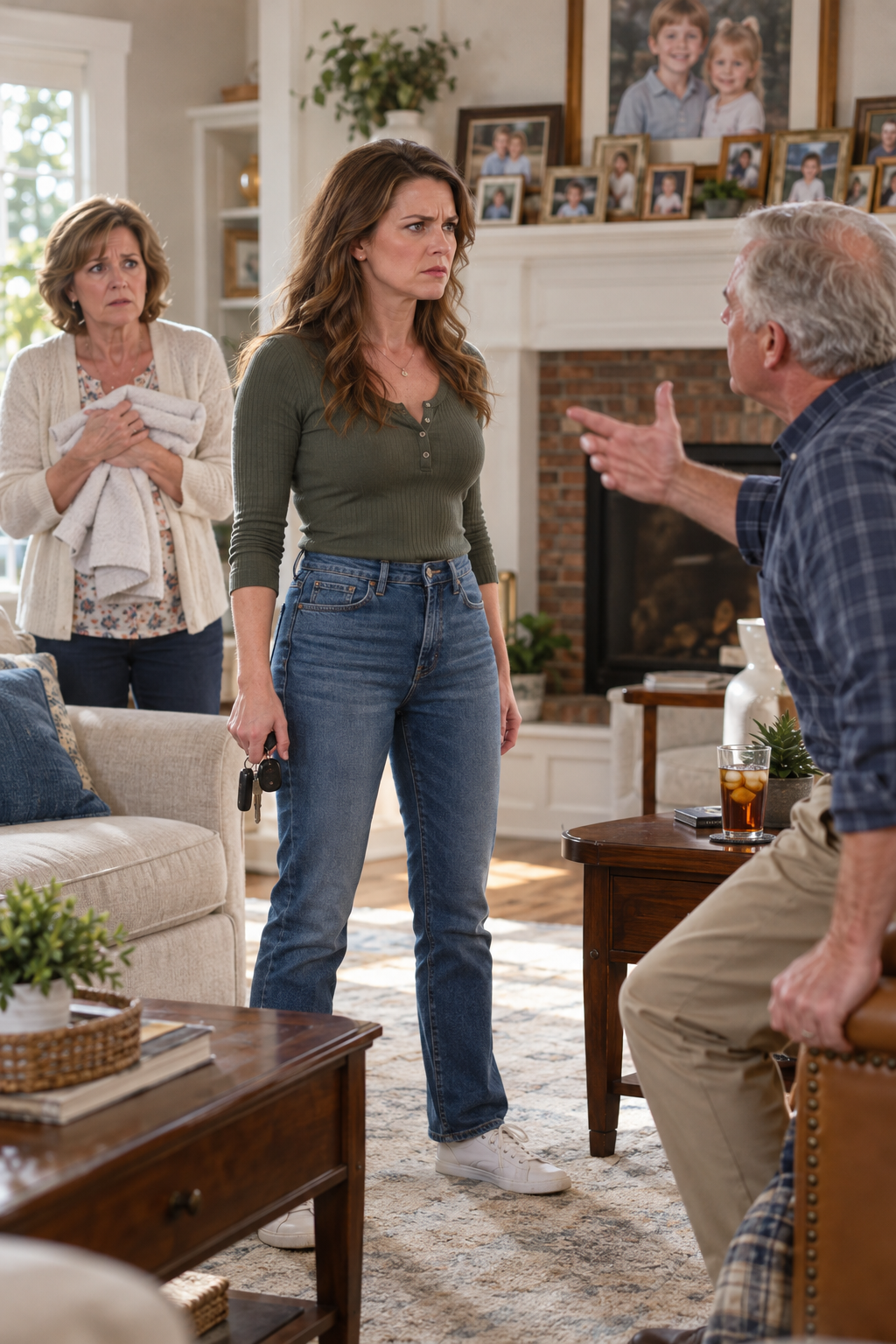
I asked Evan whether he had been hot, whether the doors had been locked, whether anyone had checked on him. He said the windows were cracked, Grandpa came out once, and he ate crackers from his backpack. Then he added, “They told me to say I was tired and didn’t want to go inside.” Leaving him there could be dressed up as stupidity. Planning the lie could not. I called my neighbor to sit with him, grabbed my keys, and drove ten minutes to the brick ranch I had purchased six years earlier after my parents sold their old home and poured most of the money into Lauren’s failed boutique. The title had always remained in my name. I paid the taxes, insurance, and major repairs. When I walked in, Mom was folding towels and Dad was drinking iced tea in front of a football game. “Did you leave Evan alone in the car while you ate lunch?” I asked. Mom began explaining that he had been “in a mood.” Dad said, “He was safe. We checked on him.” I asked who had been at lunch. Lauren and her two kids. Then I asked how many seats the reservation was for. Dad hesitated. “Five.” My parents, my sister, her daughter, her son. Five. They had not forgotten Evan. They had built the table without him.
Mom said Evan had been difficult lately. Dad said Lauren’s kids knew how to behave in public. Then he told me, “Maybe if you taught your son some self-control, he’d get invited more places.” I looked around at the couch I had replaced, the water heater I had financed, the mantel crowded with pictures of Lauren’s children while Evan appeared once near the hallway. My anger became quiet. “You have twenty-four hours to pack,” I said. Dad laughed. Mom stared at me. “Family doesn’t throw family out over one lunch,” he said. “Family doesn’t leave an eight-year-old in a parked car for two hours and teach him the lie he’s supposed to tell afterward.” Mom reached for my arm. I stepped back. For years, she had treated love like a permanent key to my life. This was the first time I made her feel the lock.
Lauren called the next morning before I finished my coffee. She did not ask how Evan was. She accused me of humiliating our parents and using money to control them. When I told her the reservation had been for five, she said, “He was already acting weird in the car.” I asked what that meant. “He kept asking questions that were none of his business.” Then she hung up. That line stayed with me. Later, my attorney, Naomi Chen, prepared a formal notice ending my parents’ permission to occupy the house. While reviewing the property file, she asked, “Have you applied for home-equity financing recently?” I said no. A lender called Harbor Ridge Capital had requested ownership records eleven days earlier using my full legal name. Naomi said it might be clerical. Then I remembered Mom asking for the deed, Lauren casually asking for the last four digits of my Social Security number that summer because she was “updating beneficiary forms,” and a Harbor Ridge envelope that had arrived at my house weeks earlier. Mom had picked it up and said the lender must have mixed up the address. I had let her take it.
That evening I delivered the notice. Boxes were half-packed, but Dad still believed I would soften. I asked whether he understood why this was happening. He said, “Your son hears things, repeats things, asks questions. He needs to learn when adults are talking.” Not restaurant manners. Questions. As I turned to leave, I saw a manila folder on the dining table. On top was a Harbor Ridge brochure and a yellow sticky note in Lauren’s handwriting: closing target — Friday. Mom covered it with a dish towel. I said nothing and drove home. Evan was building a Lego spaceship when I asked what he had been talking about before the restaurant. He frowned, trying to remember. “Grandpa said Aunt Lauren would be okay once the house money came through,” he said. “I told him I thought you owned their house. Then everybody got mad.” I sat very still. The parked car had been cruel enough. Now I was beginning to understand that my son may have been excluded because he had heard something my family did not want reaching me.
Part 2: The eviction exposed a loan application built on my identity
The next afternoon, my parents’ car was packed with boxes when I arrived with a locksmith. Dad stood in the driveway as if he were waiting for an audience. Mom kept saying they had nowhere to go, though Lauren lived twenty minutes away. Dad tried to block the front walk until the locksmith quietly told him he could not interfere with work authorized by the legal owner. That word—owner—made Dad flinch. He followed me toward my car after the locks were changed and said I was letting a child destroy the family. I asked one question: “Would you have left Lauren’s kids in that car?” He looked past me instead of answering. That night Mom texted the address of a motel and wrote, I hope Evan understands someday what he did to us. I took a screenshot and did not reply. I froze my credit, changed every password my parents had ever known, removed them from my emergency contacts, and sent Naomi copies of the Harbor Ridge letter and Lauren’s sticky note. I had spent years believing that being dependable meant leaving doors open. Now I understood that some people experience an unlocked door as an invitation.
I waited two days before asking Evan for the whole story. Grandpa had picked him up from school, and Lauren was already in the passenger seat. On the drive, the adults talked about “approval,” “equity,” and whether someone named Mark could “get the numbers through.” Evan asked what equity meant. Lauren told him to play on his tablet. Then Dad said, “Once this closes, you can clear the cards and start over.” Evan, who knew I paid for his grandparents’ house because he had heard me discuss repairs, asked, “But how can you use Mom’s house money?” Lauren turned around so quickly her seat belt locked and told him not to repeat adult conversations. At the restaurant, Dad ordered him to stay in the car. The reservation for five proved the exclusion was planned before his question, but the question explained their anger and the rehearsed lie afterward. They had decided he was a witness too young to respect and old enough to silence.
Three days after the locks changed, the hospital called. Dad had crashed his car near a storage facility and shattered his left leg. Because my parents had listed me years earlier as their medical emergency contact, a nurse asked whether I could come in while doctors prepared him for surgery. I went. Not because the eviction was forgotten or because I suddenly wanted my father back. Evan was home with my neighbor, and I knew he would eventually ask what I had done when Grandpa was hurt. I wanted the answer to be simple: I made sure he received care. At the hospital Mom looked smaller than I remembered, curled into a vinyl chair with Dad’s jacket in her lap. I signed what I was legally permitted to sign, confirmed the surgeons could proceed, and refused when Mom asked whether I could cover the insurance deductible. “I will not let him go untreated,” I said. “I am not paying your bills anymore.” She started crying. I felt terrible and relieved at the same time. Boundaries, I was learning, can hurt the person setting them too.
While Dad was in surgery, Naomi called. Harbor Ridge had responded to her inquiry. There was an active home-equity loan application for $118,000 against my property. The applicant was listed as me. The phone number belonged to Lauren. The email address was one letter off from mine. A scanned copy of my driver’s license had been uploaded, along with the deed I had sent Mom and two electronic signatures bearing my name. Harbor Ridge had not funded the loan because its title department found inconsistencies and requested in-person verification. “There’s more,” Naomi said. The proposed disbursement sheet showed $71,400 going directly to debts in Lauren’s name, $18,000 to a company called Mercer Retail Consulting, and the remainder as cash to “borrower.” Mercer Retail Consulting was Lauren’s supposed marketing company. Someone had tried to turn my parents’ free house into Lauren’s bailout while putting the debt in my name.
Mom heard enough of the call to know the secret was gone. When I asked who Mark was, she covered her face. Mark Ellison was a mortgage broker Lauren knew through a friend. He had told them the deal could be “structured” because my parents had lived in the house for years and because, as Mom put it, “you always said the house was ours.” I asked whether she had given Lauren my driver’s-license copy. She nodded. Dad had signed an affidavit claiming I had agreed to refinance the property. Lauren had created the email address and filled out the forms. Mom insisted they planned to make the payments after Lauren’s new business took off. “With what money?” I asked. That was when another truth surfaced. My parents had already drained nearly $64,000 from their retirement savings over four years covering Lauren’s rent, business debts, car payments, and school tuition for her children. Their old house had not merely funded her boutique. Almost everything they had left had followed it.
Dad came out of surgery late that evening. Before I left, a nurse handed Mom a clear bag containing his wallet, watch, and papers from the car. Through the plastic I saw the Harbor Ridge logo. Mom clutched the bag to her chest. “Please,” she whispered. “Don’t make this worse.” I finally understood that the family story I had believed for years—Lauren needed help, I was strong enough not to need any—had become the excuse for theft. “I’m not making it worse,” I said. “I’m just not hiding it anymore.” Then my phone buzzed. Naomi wrote that Harbor Ridge’s fraud department wanted a recorded statement in the morning, and Mark had abruptly stopped answering the lender’s calls.
Part 3: Their financial scheme collapsed, and I chose boundaries over forgiveness
The fraud interview lasted ninety minutes the next morning. I gave Harbor Ridge the emails Naomi had gathered, copies of my identification, my real signature, and a statement that I had never applied for the loan or authorized anyone to use my property as collateral. By afternoon the application was dead, the credit inquiry was marked for removal, and the lender had referred the file to investigators. Naomi confirmed no deed transfer or lien had been recorded. Mark, the broker, resurfaced through an attorney and claimed Lauren had told him I was fully involved but “too busy” to attend meetings. That did not clear him; Harbor Ridge ended its relationship with his brokerage, and the state licensing board opened a review. Lauren called me seventeen times in two days. I answered once. She said she had never intended to steal the house and only needed breathing room because creditors were threatening lawsuits. I asked why the application used my name and why she had created an email address pretending to be me. After a long silence, she said, “You can afford to be difficult because you’ve never needed anybody.”
For once, I did not argue with her version of me. I told her all further communication would go through Naomi. Lauren’s cards were already delinquent, and when my parents stopped paying her rent she moved into a smaller apartment, sold the SUV Dad had helped finance, and closed her nearly empty consulting company. The investigation continued, but because no funds had been disbursed, the immediate consequences were mostly financial and professional: attorney fees, frozen accounts while records were reviewed, and the humiliation of explaining forged documents to people who did not care about our family mythology. My parents submitted written statements admitting they had supplied my documents and supported the application. I spent more than six thousand dollars on legal work and security changes, money I would rather have put toward Evan’s college fund. I also lost the convenient fantasy that I had been the peaceful daughter. Sometimes what looks like keeping the peace is just absorbing the cost of everyone else’s behavior until someone smaller is asked to absorb it too.
Dad called two weeks after surgery. Lauren had not visited him. She had sent one text asking whether he could still help with her rent. “I kept thinking about what you asked me in the driveway,” he said. “Would I have left her kids in the car?” I waited. “No,” he said. He admitted the restaurant had been a celebration because Lauren believed the loan was nearly approved. The reservation had always been for five. When Evan asked about the house, Dad became afraid he would repeat the conversation to me, so he punished him for noticing. “I told myself he was disrespectful because that sounded better than saying I was ashamed,” Dad said. It was the closest thing to an honest apology he had ever given me. I thanked him for telling the truth, then told him honesty did not restore access. He and Mom would not babysit Evan, pick him up from school, enter my home, or see him privately. If Evan wanted contact when he was older, I would help him make that choice safely. Dad was quiet. “I understand,” he said. I believed he understood the words. I did not know whether he understood the loss.
Mom wrote me a six-page letter in December. She apologized for the car, the loan, the favoritism, and “assuming your competence meant you didn’t need care.” I read it twice and filed it with the legal papers. I did not answer. An apology can be sincere and still arrive too late to become a bridge. Evan saw a counselor for a few months because he had begun asking permission for ordinary things—getting a snack, opening a window, choosing a TV show—as if one wrong choice might make adults leave him somewhere. That hurt more than the legal bills. I had wanted to believe he had bounced back because he still laughed and built Lego spaceships. Children can keep playing while carrying things they do not have words for.
By spring, our life had become quieter. I sold my parents’ house after the title was cleared and put most of the proceeds into savings, including an education account for Evan. My parents moved into a modest rental they could afford. Lauren and I did not speak. There was no grand reconciliation and no holiday photograph proving everyone had learned a lesson. What changed was smaller and more useful: I stopped confusing access with love. I stopped handing over keys, passwords, money, and second chances just because someone shared my last name. I also stopped teaching Evan, by example, that being dependable means accepting whatever the family asks you to carry.
On the first warm Saturday in April, Evan and I went to a little Italian place near the river. When the hostess asked how many, I said, “Two.” Evan grinned and asked for a booth. We ordered too much garlic bread, and he told me a long story about a classmate’s disastrous volcano project. On the way out, I unlocked the car and remembered the cracked windows, the packet of crackers, and that reservation for five. Then Evan opened the passenger door and looked back at me, waiting. Family should never be measured by who gets a seat at the table and who gets left outside it. Love without respect is only entitlement wearing a familiar face, and I had finally learned that protecting a boundary can be one of the clearest forms of love.
THE END!
Disclaimer: Our stories are inspired by real-life events but are carefully rewritten for entertainment. Any resemblance to actual people or situations is purely coincidental.