
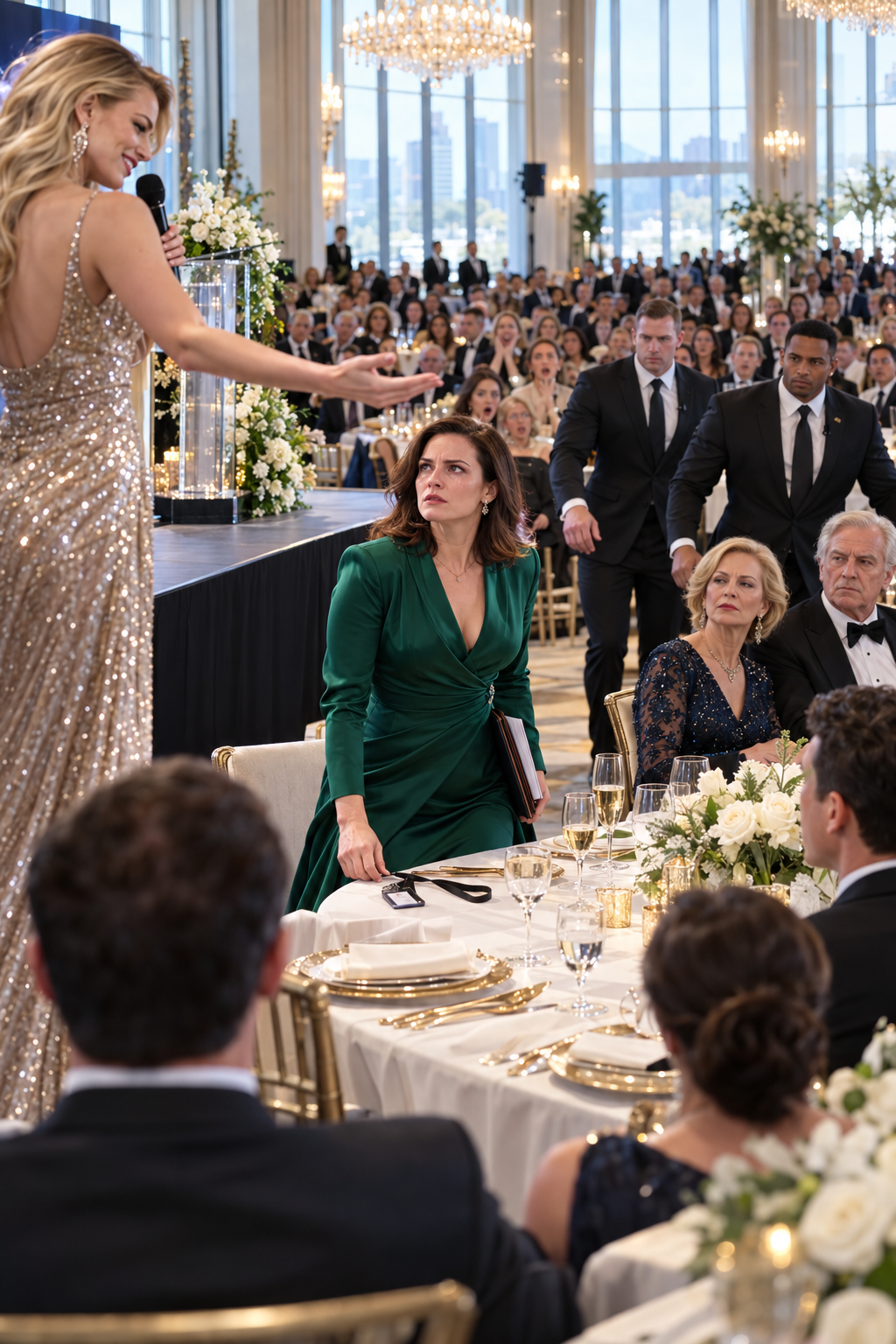
My sister raised a microphone before 200 people and fired me from the company I had spent twenty years saving. Security started toward my chair. My parents watched without moving. Even my badge said GUEST, as though I were a stranger at the business I’d built. I unclipped it, laid it beside my untouched champagne, and stood. “Tell the board we meet in three hours,” I said. Vanessa laughed. She hadn’t read the clause that could end her reign.
### Part 1
The applause was still echoing through the hotel ballroom when my sister, Vanessa, looked directly at me from the stage and said into the microphone, “Claire, you’re fired. Security will escort you out.”
I hadn’t even lifted my champagne glass.
For several seconds, no one moved. The jazz trio had just finished a polished flourish, Vanessa’s smiling portrait still filled the enormous screen behind her, and nearly two hundred employees, investors, clients, relatives, and local business leaders sat frozen beneath chandeliers that threw warm reflections across the crystal stemware. A fork struck a plate somewhere near the front. Someone behind me whispered, “Did she really just do that?” My mother lowered her eyes. My father remained perfectly still. My older brother, Ryan, leaned back in his chair with the uncomfortable expression of a man watching something cruel but convenient.
That told me everything I needed to know.
I stood slowly and removed the badge hanging around my neck. Under the company logo, beneath my name, one word had been printed in neat black letters: Guest. Not founder. Not shareholder. Not executive. Not even family. Guest. I placed it beside my untouched champagne and looked toward the two security guards Vanessa had summoned. They had started down the aisle but stopped when I raised one hand. “You won’t need to escort me,” I said. Then I looked toward the front table where my parents sat. “Tell them the board meeting will be in three hours.”
Vanessa’s expression changed so quickly that most people probably missed it. The smug smile remained, but her eyes sharpened.
“What board meeting?” she asked.
I picked up my purse. “The one you should have known about before you used a microphone.”
I walked through the ballroom without hurrying. People suddenly became fascinated by napkins, bread plates, phones, anything that allowed them not to meet my eyes. That silence hurt more than Vanessa’s words. Many of those people knew me. Some had called me at midnight when contracts collapsed. Some had thanked me for saving accounts Vanessa nearly lost. Several board members knew exactly what I had done for the company over the years, yet not one person stopped the spectacle.
The ballroom doors closed behind me with a padded thump.
Outside, rain streaked the hotel windows. The corridor smelled of lemon polish, coffee, lilies, and the faint sugary scent of a candle burning near reception. My heels sank slightly into the patterned carpet as I headed for the parking garage. I expected rage. Instead, I felt almost unnaturally calm.
Vanessa believed she had just removed the obstacle standing between her and complete control of Bennett Freight Solutions.
What she had actually done was activate a clause she had never bothered to read.
My father founded the company when I was seventeen. Back then it was one rented warehouse north of St. Louis, six employees, two aging trucks, and enough unpaid invoices to keep my parents awake at night. Vanessa was twenty and already understood the part of business she loved: being seen. She shook hands beautifully, remembered investors’ spouses, and could turn a basic sales update into something that sounded like a keynote speech. Ryan handled clients when he felt like it. I handled everything nobody wanted to see.
At eighteen, my father offered me a salary contract. I read it at a folding table while a football game played on an old television above the loading dock. “I want equity instead,” I told him.
He laughed. “Claire, you’re eighteen.”
“I’m still giving you sixty hours a week.”
“Take the salary. Equity is paper.”
“Then the paper shouldn’t bother you.”
Vanessa stood nearby spinning a ring of office keys around one finger. “Why does everything have to become a negotiation with you?”
Because I had already learned that affection in my family changed according to usefulness.
I reduced my salary in exchange for a small ownership stake. When bonuses came, I took additional shares instead of cash. When the company restructured, I read every exhibit while my father skipped to the signature pages. When new investors diluted the original family holdings, I negotiated protections for mine. Nobody fought me because nobody believed the quiet daughter accumulating paperwork represented a threat.
Then came the 2013 expansion deal.
Vanessa had negotiated with a Chicago logistics group and presented the agreement as her masterpiece. I found obligations buried deep in the draft that could have cost us millions if growth slowed. My father grudgingly rejected the deal, but I insisted we adopt new governance rules before another executive could commit the company to something equally reckless. One clause allowed an emergency shareholder action if a senior executive publicly removed, obstructed, or materially harmed a controlling stakeholder without board approval.
My father signed it while watching football.
Vanessa complained that I was “creating drama with paperwork.”
I scanned every page.
For the next thirteen years, I kept doing what I had always done. I traded applause for ownership, visibility for control, and family praise for documentation. Vanessa became the face of expansion. Ryan became vice president of sales. My father remained chairman long after he stopped understanding half the systems running beneath him. My mother told relatives I “helped with operations.”
Meanwhile, I became the person the board called when numbers didn’t match speeches.
By the time I reached my house after the gala, the rain had become steady enough to drum against the garage roof. I didn’t change out of my black dress. I opened my laptop on the workbench and pulled up a folder labeled Continuity.
Fifteen years of contracts appeared on the screen.
My phone vibrated. Vanessa. Then Mom. Then Ryan. Then Dad.
I ignored every call.
I opened the current cap table and checked it one last time.
38.7%.
Vanessa held 17.4. Ryan held 13.2. My father had given away or transferred so much over the years that his stake was now smaller than mine. No one person had an outright majority, but under the voting agreements and proxy rights attached to several early investors, my block represented the controlling position for an emergency action.
I opened the governance clause from 2013.
Then I opened the video clip already sent to me by one of the hotel’s AV contractors after a board member requested preservation of the recording.
Vanessa’s voice filled my garage.
“You’re fired. Security will escort you out.”
I attached the clip, the governing agreement, the current ownership ledger, and seventeen pages of supporting records to an email addressed to the board chair, outside counsel, and three independent directors.
No accusations. No anger.
Just evidence.
My attorney replied first.
Clause triggered. Emergency action is valid.
Thirty seconds later, the board chair sent another message.
Return to the hotel. Three hours. Bring everything.
I stared at the screen as rain hammered the roof.
Vanessa thought she had removed me from the company.
In three hours, she was going to learn who actually had the authority to remove whom.
### Part 2
I arrived back at the hotel shortly before eleven.
The party was technically still going, but the mood had changed. Dessert plates sat abandoned on tables. The band played softly while clusters of guests stood near the bar pretending not to discuss what had happened. Two hotel security officers waited beside the ballroom doors. When they saw me approaching, neither tried to stop me.
One opened the door.
Vanessa noticed me almost immediately.
Her promotion party had been designed around her image. White floral arrangements, silver place settings, huge projection screens showing photographs of company warehouses and smiling employees, even custom napkins embossed with the company initials. She stood near the stage in an ivory suit accepting congratulations when she saw me walking down the center aisle.
She looked toward security.
They stayed where they were.
“What is she doing here?” Vanessa demanded.
Martin Hale, our board chairman, stepped away from the front table. He was sixty-eight, silver-haired, painfully precise, and almost impossible to intimidate. “She requested an emergency shareholder meeting under Article 11C.”
Vanessa blinked. “She’s an employee.”
Martin looked at her for a long moment. “No, Vanessa. She is not.”
My father rose. “Martin, whatever Claire sent you can wait until tomorrow.”
“It cannot.”
Outside counsel, Jonathan Pierce, placed several courier envelopes on the table. My father recognized his own signature through the transparent tab on the top document. His face changed.
That was when I knew he remembered.
The projector went black. Vanessa’s promotional slideshow disappeared. A moment later the screen displayed the emergency meeting notice, the ownership summary, and the governance clause.
Guests who had been preparing to leave slowly sat back down.
Vanessa walked toward me. “You planned this.”
“No. I prepared for people like you.”
“You knew I was going to fire you?”
“I knew you were becoming reckless.”
Her face flushed. “You have been undermining me for years.”
Martin interrupted. “We are not holding a family argument. We are determining whether an executive with insufficient unilateral authority publicly terminated a controlling shareholder and key officer without board approval.”
Ryan stood abruptly. “Controlling shareholder? That’s ridiculous.”
I opened the cap table.
Names and percentages appeared on the screen.
The room became quiet.
Ryan stared at my ownership number, then at Dad. “How does she have that much?”
I almost answered, but Dad did.
“She kept taking stock.”
His voice sounded distant.
For once, he understood the cost of all those signatures he had considered unimportant.
Vanessa shook her head. “Fine. She owns shares. That doesn’t mean she gets to hijack my appointment.”
“No,” Jonathan said. “Your own conduct does.”
He explained the clause. A senior executive who materially interfered with the rights of a controlling stakeholder without board authorization could have executive powers temporarily suspended pending emergency review. Vanessa’s public firing met the standard almost perfectly.
Vanessa looked toward my mother. Mom’s face pleaded for someone else to solve it.
Martin called the first motion.
Temporary suspension of Vanessa Mercer as chief executive officer pending review.
Ryan shouted, “You cannot possibly vote on this tonight.”
Martin looked at him. “We can. Claire’s voting block and the proxies attached to it are sufficient to bring the motion.”
The votes appeared electronically.
Forty-eight percent.
Fifty-four.
Sixty-three.
Vanessa’s face drained of color.
At sixty-eight percent, the motion passed.
A second motion immediately suspended Ryan’s discretionary financial authority after documentation showed he had participated in Vanessa’s unapproved personnel action.
He stared at me. “You’re doing this because she embarrassed you.”
“No,” I said. “I’m doing this because you forgot embarrassment isn’t authority.”
Mom finally stood. “Claire, please. Can we go somewhere private?”
I looked at her.
They had humiliated me before two hundred people. Now, because the humiliation had reversed direction, privacy suddenly mattered.
“No.”
The next slide appeared.
Independent forensic review of executive spending.
That produced a different kind of silence.
Vanessa slowly turned toward Ryan.
“What did you send them?” she asked me.
“Nothing that wasn’t already in our accounting system.”
The records weren’t proof of a crime. Not yet. But they were enough to justify scrutiny: luxury travel classified as client development, interior design invoices charged through corporate hospitality accounts, charter flights on weekends with no corresponding client meetings, and landscaping expenses tied to an address belonging to Vanessa’s lake house.
She pointed at the screen. “Those have explanations.”
“Good,” I said. “Then explaining them should be easy.”
Ryan knocked his chair backward while standing. “You went through our personal accounts?”
“Our personal accounts?”
He froze.
Martin looked at him.
Ryan immediately realized what he had said.
The board approved preservation orders on executive emails, reimbursement records, vendor communications, and expense accounts.
My father finally stepped toward me. “You’ve made your point.”
“No, Dad. You made mine.”
“This company is our family’s legacy.”
I looked around the ballroom. Employees sat stunned beside half-eaten desserts. Investors whispered behind their hands. Vanessa stood beneath a twenty-foot photograph of herself labeled CEO even though she no longer held the office. My mother was crying quietly. Ryan looked ready to blame everyone except himself.
“It was supposed to be a company,” I said. “You’re the ones who turned it into a family reward system.”
Vanessa stared at me. “You hate me.”
The strange thing was that I didn’t.
Hate would have been simpler.
“I trusted you once,” I said. “That was much more expensive.”
When the emergency meeting ended, no one applauded. Power shifts in real life are rarely cinematic. They consist mostly of signatures, votes, access changes, frozen permissions, and attorneys repeating phrases nobody wants to hear.
I collected my laptop and walked toward the back table where I had been seated earlier.
My champagne glass was still there.
So was the badge.
Guest.
I picked it up, turned it over once in my hand, then placed it back on the table.
Vanessa had followed me.
Her voice was barely above a whisper. “What else do you have?”
I looked at her.
“Enough that you should start reading your own records.”
The next morning, I reached the office before seven.
Her door had already been sealed pending document preservation.
Ryan’s too.
At noon, our senior accountant came into my temporary office carrying three thick folders.
“You need to see these before anybody starts negotiating,” she said.
I opened the first one.
By page six, I understood the gala had only exposed the smallest betrayal.
And what my family had done to me professionally was about to look almost gentle compared with what they had done to the company.
### Part 3
The forensic review lasted six weeks, but the first forty-eight hours told us enough.
Vanessa had treated company money like an extension of her lifestyle. Some expenses were explainable, some careless, and others deeply questionable. Furniture for her lake house had been routed through a staging vendor we used for corporate properties. Private catering appeared under investor hospitality. Ryan had approved travel reimbursements with no meetings attached and signed sales agreements that inflated current-quarter revenue while burying penalties in future years.
The worst part wasn’t that they had become criminal masterminds. They hadn’t. They were simply entitled enough to believe rules would bend around them forever.
My parents came to the office on the second afternoon.
I refused to meet with Dad.
Mom came alone carrying a cedar document box I remembered from childhood. She placed it on the conference table and said, “You should see these before your lawyers do.”
The smell of cedar and old paper filled the room when I opened it.
Inside were handwritten notes, early partnership drafts, compensation plans, and board correspondence stretching back nearly two decades. At first I assumed Mom was helping because the financial investigation had frightened her into honesty.
Then I found a yellow legal pad in my father’s handwriting.
My name appeared across the top.
Keep Claire close. Never let her control the board.
I felt something inside me go still.
The next page listed all three children.
Vanessa — public face, investors respond well.
Ryan — sales relationships, needs supervision.
Claire — operationally indispensable. Keep internal.
Another note from years later said: Give her incremental equity if necessary. Approval motivates her more than money.
I looked at Mom.
“Did you know?”
She hesitated.
That was my answer.
“You knew he was doing this?”
“I knew he was worried about how the board would react to you.”
“To me?”
“You were young. Direct. You challenged him constantly.”
“I saved his company constantly.”
“I know.”
“No. You know now because it failed.”
Mom began crying. “That isn’t fair.”
The words almost made me laugh.
Fair.
After all those years, fairness suddenly interested her.
I continued searching the box after she left. Near the bottom I found a sealed envelope addressed in my handwriting.
I had written it when I was eighteen.
Dad,
If you want me in this company, I need to know I actually belong here. I am willing to work harder than anyone, but I don’t want to spend ten years building something I will always be told belongs to somebody else.
If you only want labor from me, tell me now.
I’ll leave.
I remembered writing it. I also remembered deciding not to give it to him because some instinct had warned me that honest vulnerability was dangerous in our house.
On the back, my mother had later written: You understood them before I did.
For several minutes, that sentence almost softened me.
Then I found another document.
Eleven years earlier, the board had apparently considered placing me on its succession committee. According to handwritten notes, several directors believed I was already functioning at an executive level and wanted my authority formalized.
The proposal died before reaching me.
Beside the meeting notes, Mom had written: Delay Claire. Support Vanessa. Thomas guarantees Arizona house remains solely mine.
I read the line repeatedly.
My father hadn’t merely favored Vanessa.
My mother had benefited from keeping me out.
That evening Vanessa emailed me from an unfamiliar address because every family account had been filtered.
She wrote only a few sentences.
Dad didn’t force me to fire you. That part was mine. I wanted to humiliate you because I was tired of feeling like you were the smartest person in every room. But if you think I was the only one using you, ask Mom what she got when they kept you away from the board.
For once, my sister had told the truth.
I agreed to one final family meeting after the audit produced enough findings for settlement discussions. We met at Jonathan’s law firm, thirty floors above downtown in a conference room too neutral to belong to anyone. Dad entered first. Mom followed. Ryan looked furious. Vanessa looked exhausted.
Dad started with, “This has gone too far.”
I almost smiled.
“You chose how far it went.”
Ryan leaned forward. “Can we please stop pretending we aren’t family?”
“You use the word family whenever you want immunity.”
Vanessa looked down.
Mom said, “We made mistakes.”
“Which ones?”
No one answered.
I laid copies of the old succession notes on the table.
“Let’s start with the board seat.”
Mom turned pale.
Dad glanced toward her sharply.
“Tell me what happened,” I said.
Dad rubbed his jaw. “The board wasn’t ready for you.”
“Why?”
“You were too aggressive.”
“I was competent.”
“You made people uncomfortable.”
“Because I read contracts?”
“Because you never knew how to soften yourself.”
Vanessa gave a short laugh. “So you promoted me because I was prettier.”
Dad didn’t respond.
That silence broke something in her too.
She looked at him. “Was I ever actually better?”
Dad stared at the table.
Vanessa’s eyes filled.
I expected satisfaction.
Instead I felt tired.
Ryan suddenly said, “Every family gives people roles. Vanessa was good publicly. Claire was good internally. Why are we pretending this is some massive betrayal?”
“Because you stole money from the company,” I said. “Because Vanessa tried to erase me when I stopped being useful. Because Mom traded my opportunity for property. Because Dad deliberately kept me working beneath authority he knew I had already earned. The fact that you normalized it does not make it normal.”
Jonathan entered with settlement papers.
The terms required resignations, repayment of certain disputed expenses, surrender of specific company privileges, cooperation with the forensic audit, and legal restrictions concerning confidential company information. Any more serious findings would remain subject to additional action.
Mom signed first.
Fast.
That hurt more than her tears.
When consequences became real, remorse immediately lost to self-preservation.
Vanessa signed next.
Ryan complained until his attorney told him to stop talking.
Dad signed last.
He used the same careless grip I remembered from that warehouse almost twenty years earlier.
Afterward, Mom reached toward me.
“Claire, please. Maybe someday—”
“No.”
She froze.
“You do not get access to me because the strategy failed. You had years to choose me while choosing me cost you something. Now you’re asking because losing me costs you more.”
Vanessa whispered, “Are you really never going to forgive us?”
I looked at her.
“I might eventually stop being angry. That isn’t the same as letting you back into my life.”
I collected my documents and walked out.
For the first time, I did not feel like I was leaving my family.
I felt like I was leaving a job I should have quit years ago.
And when the elevator doors closed, I realized the company was the easy part to rebuild.
The harder question was what I would become when I no longer spent my entire life proving that I deserved a seat in rooms I had already built.
### Part 4
Six months later, the company no longer felt like a family monument.
That was the best thing that ever happened to it.
We replaced informal approvals with independent controls, separated reimbursement authority, renegotiated Ryan’s worst contracts, ended questionable vendor relationships, and repaid clients who had been charged under agreements I considered indefensible. I promoted Melissa Grant, the accountant who had carried those first three folders into my office, to director of compliance.
On the morning I offered her the job, she stared at me and said, “You’re serious?”
“I rarely prepare compensation paperwork as a practical joke.”
She laughed, then started crying.
The company stabilized faster than expected. Employees stopped whispering when executives walked past. People brought bad news into meetings because they no longer feared being punished for it. Client retention improved. Two directors who had once been enthusiastic supporters of Vanessa privately admitted that they had confused charisma with leadership.
I did not gloat.
I understood the mistake.
I had spent half my life making the same error in reverse, confusing loyalty with love.
The board formally appointed me chief executive that winter.
When the new metal nameplate appeared outside my office, I stood in the hallway before sunrise and ran my thumb across the letters.
Claire Bennett
Chief Executive Officer
For years I had imagined the title might feel like vindication.
Instead, it felt like responsibility.
That surprised me.
Vanessa sold her lake house. Ryan tried to join a competitor until the restrictions in his settlement reminded him that contracts still mattered after the signing ceremony. Dad and Mom moved permanently to Arizona. Mom sent several letters, then emails, then finally stopped when she understood silence was the only answer she would receive.
Dad never apologized.
In some ways, I respected that more than a false one.
Vanessa contacted me once more.
I was attending a scholarship luncheon at another downtown hotel when I heard her voice behind me.
“Claire.”
I turned.
For half a second, I was back in childhood. Vanessa stealing my clothes. Vanessa sleeping on my bedroom floor after watching a horror movie. Vanessa promising when we were teenagers that neither of us would ever become like our parents.
Then I saw the woman who had stood beneath a spotlight and fired me for entertainment.
She wore a simple navy dress. No designer bag. No entourage. No polished CEO performance.
“I won’t keep you long,” she said.
“You shouldn’t.”
She winced. “I deserved that.”
I said nothing.
Around us, waiters carried coffee trays between tables. Silverware clicked against china. Two women nearby were obviously listening while pretending to discuss the centerpiece.
Vanessa looked toward the floor. “I was jealous of you almost my entire adult life.”
“I know.”
“No, I don’t think you understand how much. Every time something broke, everyone asked where Claire was. Every time investors had hard questions, you had answers. Every time Dad praised me publicly, I knew there was a chance you had done half the work.”
“A chance?”
She gave a small embarrassed smile. “Fine. Most of the work.”
I waited.
“When they announced me as CEO, I thought I had finally won something you couldn’t take away. Then I saw you sitting there, and you looked calm. You weren’t impressed. You weren’t angry. You just looked like you knew something I didn’t.”
“I usually did.”
She nodded.
“That’s why I fired you. I wanted one moment when everybody saw me as powerful and you as nothing.”
The honesty landed differently than an apology.
She rubbed her thumb over the edge of her watch. “I thought if you disappeared, I would finally stop feeling inadequate.”
“And did it work?”
She laughed once, painfully. “For about three minutes.”
I almost smiled.
Almost.
Then her face tightened. “I’m sorry.”
“I believe you.”
Hope appeared immediately in her eyes.
I hated how familiar that reaction was. People hear acknowledgment and assume it means a door is opening.
It wasn’t.
“I still don’t want a relationship with you.”
Her eyes filled. “Ever?”
“I don’t know what I’ll feel in ten years. But I’m not building my life around the possibility that you might become safe.”
She nodded slowly.
“That’s fair.”
“Yes.”
I turned back toward my table.
She called my name once more, but I didn’t turn around.
That evening, I stayed late at the office. Most employees had gone home. The cleaning crew worked somewhere below me, vacuum motors humming faintly through the floor. Downtown St. Louis glowed blue and silver beyond the glass.
The cedar box sat inside my credenza.
I still kept everything.
Dad’s notes.
Mom’s margin comments.
My unsigned eighteen-year-old letter.
The old governance agreements.
Even the gala badge that said Guest.
I had eventually gone back for it.
Not because I enjoyed remembering the humiliation, but because evidence changes meaning after you survive what it was meant to prove. That badge no longer said I had been unwanted.
It reminded me how desperately they had needed me to believe I was.
I placed it back inside the box and closed the lid.
My phone vibrated.
For years, a buzzing phone after eight at night usually meant family chaos. Vanessa needed something. Ryan had broken something. Dad wanted a report immediately. Mom wanted me to smooth over some argument without calling it that.
This time it was Melissa.
Payroll audit complete. No exceptions. Have a good night, boss.
I laughed softly.
Outside, traffic moved steadily beneath my window. People were driving home, ordering dinner, picking children up from practice, living ordinary lives that had nothing to do with ownership percentages or emergency board clauses.
For the first time, ordinary sounded wonderful.
I turned off my office light and stood for a moment in the doorway.
I had once believed winning meant making my family admit what they did.
It didn’t.
Winning was no longer needing the admission.
It was hiring people who could disagree with me without being punished. It was paying employees correctly. It was closing my laptop at a reasonable hour because I no longer had three incompetent relatives turning every week into an emergency. It was understanding that love without respect is simply another form of debt.
Most of all, it was learning that forgiveness and access are not the same thing.
Maybe I would forgive them someday.
Maybe I already had in some distant, unemotional sense.
But they would never again be entitled to my trust, my work, my money, my silence, or my presence simply because we shared blood.
I locked my office and walked toward the elevator.
The polished metal doors opened, reflecting me back at myself—forty years old, tired around the eyes, carrying a laptop instead of a champagne glass, finally standing in a company that no longer required me to disappear in order to keep everyone else comfortable.
The night Vanessa fired me, she believed she was showing an entire ballroom how little power I had.
What she actually gave me was permission to stop protecting people who had spent years mistaking my restraint for weakness.
My sister had the microphone.
My father had the title.
My brother had the confidence.
My mother had the excuses.
I had the signatures.
And in the end, the signatures were the only part of their story that could not lie.
THE END!
Disclaimer: Our stories are inspired by real-life events but are carefully rewritten for entertainment. Any resemblance to actual people or situations is purely coincidental.


