
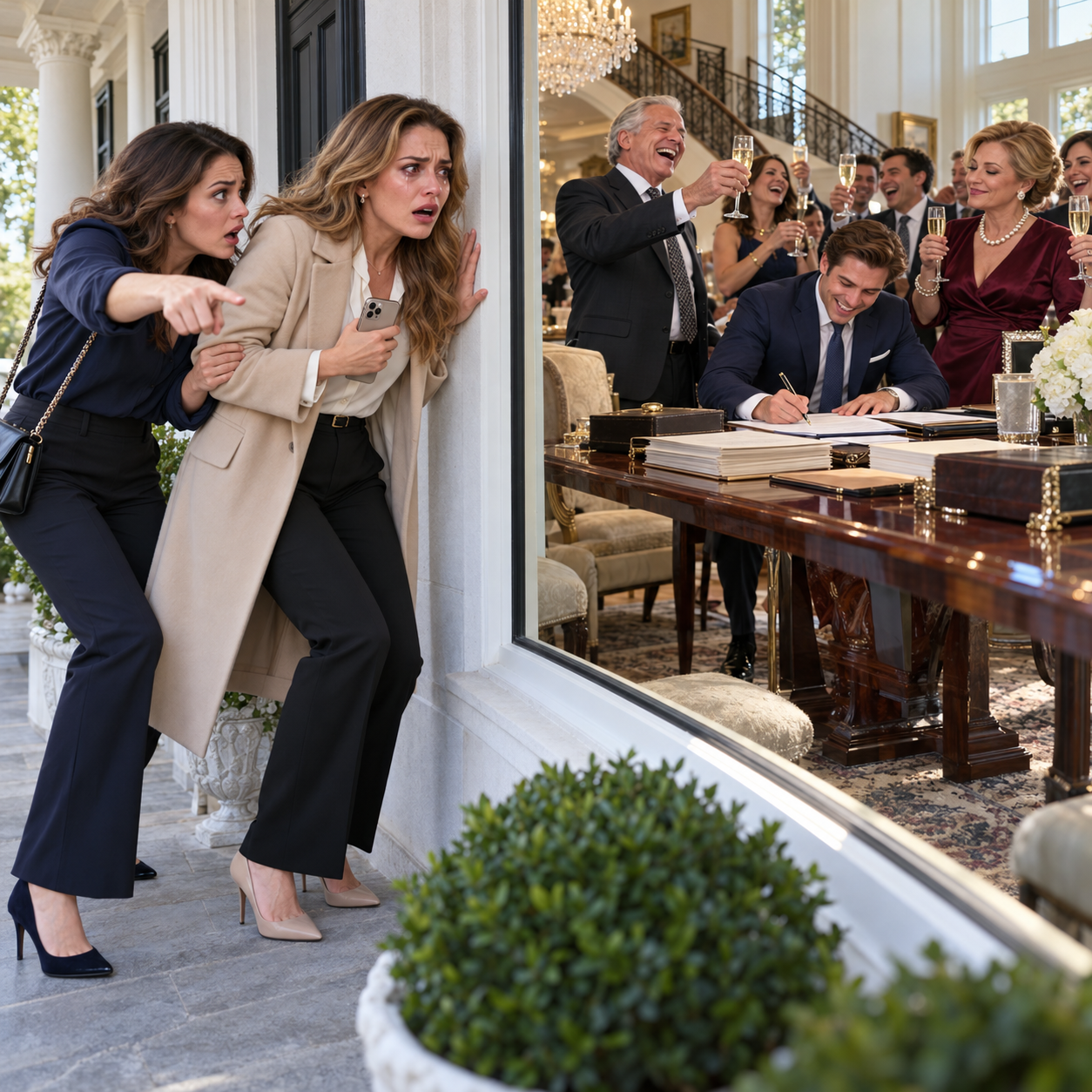
My hand was inches from my parents’ door when Mom texted, “Party’s cancelled. Don’t come.” Then I heard glasses clink inside—and my father laugh, “Everything is easier when Mara isn’t here.” I almost stormed in, but my cousin dragged me into the shadows and whispered, “Watch first.” Through the window, I saw my brother signing documents beside inheritance papers. That was when I realized they weren’t just excluding me. They were celebrating because they thought they had stolen my future.
### Part 1: One cancelled invitation exposes what my family truly thinks
My fingers were less than an inch from my parents’ front door when my phone vibrated inside my coat pocket. I expected some last-minute request from Mom—ice, wine, maybe the bakery order she always forgot until guests arrived. Instead, I saw one short message from Diane Bennett: “Party’s cancelled. Don’t come. Dad isn’t feeling well.” I read it twice, then looked through the frosted glass beside the door. Warm light spilled across the porch. Music hummed behind the walls. Someone inside laughed hard enough to cough, followed by the unmistakable clink of champagne glasses. My father, apparently too sick to have his daughter over, sounded healthier than he had in months.
I should have knocked. The old version of me would have. She would have walked in smiling, pretending not to notice the lie because admitting your parents deliberately excluded you feels worse than accepting almost any excuse they offer. Then my father’s voice carried through the door. “Honestly, it’s so much better without Mara hovering over everything.” A woman laughed. My mother answered, “Tonight is supposed to be about family, not another one of her moods.” More laughter followed. My stomach tightened so sharply that for a second I thought I might be sick on the hydrangeas my mother spent every spring obsessing over. I had brought her favorite lemon cake. I was standing on her porch holding it like an idiot while my family toasted my absence.
A hand touched my sleeve. I spun around so fast the cake box tilted. My cousin Tessa stood two steps behind me, still wearing her wool coat, her dark hair damp from the drizzle. “Don’t go in,” she whispered. Her expression wasn’t sympathetic. It was furious. “Why?” I asked, although my voice barely came out. Tessa glanced toward the narrow side window. “Because I’ve been inside for twenty minutes, and this isn’t just dinner. Your parents invited Caleb, two board members, your dad’s accountant, and some people from the company. Your mother told everyone you had a migraine and asked not to be disturbed.” My younger brother Caleb had apparently been enjoying my imaginary illness without feeling the need to check on me. Tessa took the cake box from my hands. “Come around the side. There’s something you need to hear.”
We moved behind the hedge beneath the dining room windows, where my mother had never fixed a gap in the curtains. Through it, I could see the long walnut table set with candles, crystal glasses, and the expensive dishes she only used when she wanted people impressed. My father, Robert, sat at the head with one hand around his glass. Caleb lounged beside him in a jacket I’d helped him choose for his first management interview two years earlier. My mother wore emerald silk and the smile she reserved for rooms where she needed admiration. Dad raised his drink. “To the next chapter,” he announced. “To keeping this company where it belongs.” Everyone lifted their glasses. Caleb grinned. “Finally.” Mom touched his shoulder. “Your grandmother would understand eventually.” That sentence changed the temperature of the night.
My grandmother Evelyn had been dead for three months. She was the closest thing I’d ever had to unconditional family. When my parents spent my childhood growing Bennett Specialty Supply from a cramped warehouse into a profitable regional company, Grandma Evelyn was the one picking me up from school, helping with science projects, and sitting beside my bed when thunderstorms rattled the windows. Caleb was six years younger and arrived after the business became successful, so his childhood looked completely different. Dad took him golfing. Mom introduced him at company dinners as “our future.” When I complained, I was told I was jealous. “You’re too sensitive, Mara,” Dad would say. “Caleb has leadership instincts.” I had a degree in finance, twelve years of company experience, and responsibility for several accounts Caleb couldn’t identify without checking his phone, but somehow his instincts mattered more.
Grandma had noticed. During her final week, when the hospital room smelled faintly of disinfectant and lavender lotion, she squeezed my wrist with surprising strength. “Don’t let them convince you that what is yours belongs to them,” she said. I assumed medication and exhaustion had made the sentence stranger than she intended. When I asked what she meant, she only said, “You’ll understand when people stop pretending.” Three weeks after her funeral, I accidentally found a folder on Dad’s home-office desk while bringing over soup. My name was printed on the tab. Inside were draft documents involving Grandma’s house, company shares, and something labeled the Evelyn Carter Family Trust. Several pages had sticky notes in my mother’s handwriting. One sentence had been underlined twice: Move everything before Mara starts asking questions.
I had photographed every page before putting the folder exactly where I’d found it. I didn’t confront them. That restraint had felt cowardly at first. Now, crouching behind their hedge while Caleb accepted congratulations from people who apparently believed he was inheriting something, restraint suddenly felt like the smartest thing I’d ever done. Dad continued speaking. “By the time the annual donor dinner happens, we should have everything finalized. Caleb can step into the role without unnecessary drama.” One of the board members shifted uncomfortably. “And Mara?” he asked. My mother gave a tiny laugh. “Mara will do what she always does. Get upset, make it personal, then calm down.”
Tessa slowly turned toward me. “They think you’re stupid,” she whispered. I barely heard her. On the other side of the glass, Dad placed a document beside Caleb’s plate. I couldn’t see the full page, but I recognized the blue cover immediately. It matched the trust documents I’d photographed. Caleb signed something while my mother watched. Then Dad said the sentence that erased whatever doubt I had left. “Once this is transferred, she won’t be able to undo it.”
I walked away from the window before they could see me. My hands weren’t shaking anymore. That scared me more than anger would have. “Tessa,” I said, “do you still know that estate attorney Grandma used?”
She stared at me for a second, then nodded. “Yes.”
“Call him.”
Because if my parents believed that signature had just given Caleb my inheritance, I wanted to know exactly what they had signed—and how much trouble they had just created for themselves.
### Part 2: Quiet questions uncover the plan hidden behind my inheritance
The next morning, Tessa and I sat across from Daniel Mercer in an office that smelled like coffee, old paper, and furniture polish. Daniel had handled Grandma Evelyn’s affairs for almost twenty years. He was in his early sixties, silver-haired, careful with every word, and visibly irritated that no one had contacted him about the documents I placed on his conference table. He examined the photographs on my phone without speaking. When he reached the page containing my mother’s handwritten note, his jaw tightened. “Where did you get these?” he asked. I explained the soup, the folder, the dinner, and the document Caleb had signed. Daniel removed his glasses. “Mara, your parents do not have authority to transfer most of these assets.”
That should have relieved me. It didn’t. I wanted to know why my name appeared throughout the trust. Daniel hesitated before opening a locked cabinet behind his desk. “Your grandmother instructed me to give you the complete trust documents after probate reached a specific stage. That happens next week. But given what you’ve shown me, there’s no reason to wait.” He placed a thick envelope in front of me. Grandma had left my parents comfortable assets, Caleb a significant cash inheritance, and several charitable gifts. But her controlling company shares had gone into a trust for me. So had the first purchase right to her home and a separate investment account she’d built over decades. The documents didn’t make me instantly wealthy in cash. They did something my parents cared about much more. They gave me voting control over the largest block of shares in our family company.
I stared at the percentage until the numbers blurred. “Why me?” Daniel gave me the kind of look older people give when they know more about your family than you do. “Because Evelyn believed you understood the company and wouldn’t treat employees like pieces on a game board.” He slid another paper forward. It was a letter in Grandma’s handwriting. She said she loved all of us but had watched Robert and Diane become obsessed with succession. She feared they intended to hand control to Caleb regardless of experience, then pressure me into surrendering anything that interfered. The trust specifically prevented my parents from moving those shares without my independent consent. Any attempt to manufacture consent could trigger board review and temporary suspension of related voting privileges.
For two months, I said nothing. That was the hardest part. I kept attending work meetings while Dad interrupted me. I let Mom call and ask whether I was “still upset about missing dinner,” as though the lie had been a scheduling misunderstanding. Caleb walked into my office one afternoon, dropped into a chair, and asked me to prepare revenue projections for “some future planning Dad has me doing.” I almost laughed. Instead, I printed the reports and watched him leave with information he didn’t understand. Every interaction gave us another clue. Tessa helped organize timelines. Daniel contacted the trust administrator. I quietly requested copies of board communications I was legally entitled to review. The deeper we looked, the uglier it became.
My parents had been telling several board members that Grandma had verbally promised Caleb operational control. They had prepared draft resolutions describing me as unwilling to participate in leadership. One email from Mom suggested I was “emotionally overwhelmed by grief” and should not be burdened with financial decisions. Another from Dad proposed transferring voting authority temporarily, then extending that arrangement indefinitely once Caleb was established. They weren’t stealing by smashing a safe. They were building a paper trail designed to make surrender look voluntary. The smartest thing Daniel told me was not to interrupt them too soon. “You need evidence of intent,” he said. “A bad draft can be explained. A pattern is harder.”
I hated pretending everything was normal, especially because my mother became sweeter as their plan advanced. She invited me to lunch. She complimented my coat. She even apologized for the cancelled party. “Your father really was exhausted,” she said while stirring tea she barely drank. “We ended up having a few people over spontaneously.” I looked at the woman who had taught me to tie my shoes and stayed awake beside me when I had pneumonia at nine. Part of me wanted to ask whether any of that had been real. Instead, I said, “Of course. I understand.” Her shoulders relaxed. She believed I had accepted the lie. That was when I realized my parents’ greatest advantage had never been money or legal knowledge. It was my lifelong willingness to doubt myself before doubting them.
The annual donor dinner was six weeks away. It was our company’s largest public event, attended by investors, nonprofit partners, board members, longtime employees, and several local business reporters. Mom traditionally planned the dinner and treated it like a royal ceremony. This year she became obsessed with it because Dad intended to announce Caleb’s expanded leadership role. I volunteered to help. She looked delighted. “That’s the spirit,” she said. “Family supporting family.” I handled audiovisual arrangements, guest confirmations, and the presentation system. I also made certain Daniel Mercer received a front-table invitation.
Ten days before the event, we found the piece I’d been waiting for. The accountant my parents had brought to their secret dinner had forwarded a chain of emails after receiving a formal records request. In one message, Dad wrote, “Once Mara signs the standard administrative packet, we can attach her signature page to the control authorization. She never reads the routine documents closely.” My mother replied, “Then do it before Mercer contacts her.” They had planned to hide a transfer authorization inside paperwork I’d signed dozens of times without concern.
I read the email three times. There was no ambiguity left, no explanation I could invent to protect them. My own parents had counted on my trust as a tool against me.
Daniel leaned back in his chair. “Now we can stop them.”
I looked at the donor dinner invitation lying beside my laptop.
“No,” I said. “Now we let them announce what they think they’ve won.”
### Part 3: Their perfect celebration becomes the stage for their exposure
The ballroom smelled of fresh flowers, roasted herbs, and expensive perfume. By six-thirty, more than two hundred people filled the room beneath white chandeliers while servers moved between tables carrying trays of sparkling water and wine. Mom had chosen emerald silk again, perhaps because she’d felt powerful in it at the secret dinner. Dad wore the dark suit he saved for important speeches. Caleb had spent most of the evening near the front table accepting handshakes from people who had obviously been told something I hadn’t officially heard. Every few minutes, someone congratulated him. He never once asked why.
I wore a simple navy dress and kept moving. I spoke to employees, thanked donors, checked the slideshow, and made sure the laptop at the podium was connected exactly as planned. Tessa sat near the back where she could see both the room and the exits. Daniel Mercer sat with two board members who had quietly agreed to review the evidence. Only four people besides me knew what was coming. That mattered. If my parents sensed trouble, they’d reshape the story before I could put facts in front of witnesses.
Dinner went smoothly. Dad eventually stepped onto the stage to deliver his annual speech about “legacy, responsibility, and family stewardship.” I had heard versions of it since college. This time, each sentence sounded almost comic. He praised Grandma Evelyn’s sacrifice. He thanked Mom for protecting the company’s values. Then he gestured toward Caleb. “And I’m proud that the next generation is ready to carry that legacy forward.” Applause spread through the ballroom. Caleb stood and waved modestly, although nothing about him looked modest. My mother dabbed one eye with a napkin. Dad continued, “In the coming weeks, Caleb will assume expanded executive responsibilities as part of a transition we’ve been planning for some time.”
I waited until the applause faded. Then I stood. “Before we move on,” I said, “I’d like to say something about Grandma Evelyn’s legacy too.” Mom’s eyes found mine immediately. Her smile remained in place, but I saw the warning underneath it. Dad hesitated at the podium. “Of course, Mara. Perhaps later—” “It’ll only take a few minutes.” One of the board members beside Daniel nodded toward him. Dad had no graceful way to refuse without making the room curious, so he stepped aside.
The stage lights felt hotter than I expected. I looked at people I’d known for years—warehouse supervisors, accountants, vendors, families of longtime employees. Then I looked at my parents. “I’d like to thank my mother and father,” I began, “for teaching me something important this year. They taught me the difference between love and ownership.” Mom’s smile vanished. I pressed the remote.
The first slide contained Grandma’s trust summary. Nothing dramatic. Just dates, signatures, and the percentage of voting shares assigned to the Evelyn Carter Trust for my benefit. A ripple moved through the room. Dad stepped toward me. “Mara, this isn’t the place.” “I agree,” I said. “Unfortunately, you chose this place when you decided tonight would be used to announce a succession plan involving assets you don’t control.”
The next slide showed the draft transfers I’d photographed. Then came board emails describing me as emotionally unstable. Then my mother’s handwritten note: Move everything before Mara starts asking questions. I didn’t editorialize. I let their own words do the work. Dad’s face shifted from anger to calculation. He knew immediately how bad it looked. Mom whispered something to Caleb, who had gone pale. I advanced to the email about attaching my signature to the control authorization. The ballroom became so quiet that I heard a fork strike a plate near the back.
Dad moved toward the laptop. Two event security officers stepped between us. He stopped, stunned. “Are you serious?” he demanded. One of them spoke quietly. “Sir, the board asked us to prevent interference with the presentation.” That was the moment he finally looked toward the front table. Three directors were no longer sitting beside him. They were sitting beside Daniel Mercer.
Daniel stood. “For clarity,” he announced, “the documents displayed tonight have been reviewed by counsel and the trust administrator. No allegation is being resolved in this ballroom. However, pending formal review, several attempted transfers have been flagged as unauthorized.” My mother rose. “This is a family misunderstanding.” Daniel didn’t raise his voice. “Then the review will establish that.”
Dad looked at me as though I’d betrayed him. The irony almost made me laugh. “You planned this,” he said. “Yes.” My voice surprised me with how calm it sounded. “After discovering you planned to use my signature without informed consent.” Mom stepped closer to the stage. “We were protecting the company.” “From whom?” I asked. “Me?”
Caleb finally spoke. “I didn’t know about the signature thing.” His voice cracked. For one second, the sister in me wanted to believe him completely. Then I remembered the secret dinner, the blue document, his grin when Dad toasted the transfer. “How much did you know?” I asked. He stared at the table. That silence answered enough.
Daniel continued with the announcement my parents had never expected to hear. Eleven days earlier, after probate conditions had been satisfied, the trust’s voting shares had formally activated under my control. I was now the company’s largest single voting stakeholder. Under the shareholder agreement, that gave me authority to demand an emergency review of executive conduct. The board had scheduled one for eight the next morning.
My mother’s face looked almost unfamiliar. “What have you done?” she whispered.
I looked directly at her. “I finally read the paperwork.”
Then Dad’s phone buzzed. He glanced down, and whatever he saw drained the last color from his face.
The board chair had just sent notice that his executive access would be suspended at midnight.
And for the first time in my life, my father had no speech prepared.
### Part 4: I keep what they tried taking and leave them behind
The emergency board meeting lasted four hours. Nobody shouted. That almost made it worse. Dad had always been strongest in emotional situations because he knew how to dominate them—raise his voice, invoke sacrifice, turn disagreement into disrespect. A formal review gave him nowhere to hide. Emails appeared on screens. Dates were compared. The accountant confirmed what he’d been asked to prepare. Daniel explained the trust restrictions. My parents’ attorney repeatedly asked for private conferences. By noon, the board voted to remove Dad from day-to-day authority pending a full investigation and suspend Mom’s access to company financial systems. Caleb’s proposed promotion disappeared with a single motion.
I didn’t become chief executive. I didn’t want to. That surprised everyone, especially my father. “So this was all revenge?” he snapped in the hallway afterward. “You blow up the family business and don’t even take the job?” I shook my head. “You still don’t understand. I protected my ownership. I never said I wanted your chair.” I supported an experienced operations director as interim executive and required an independent governance review. The employees had already endured enough family drama. I wasn’t going to punish them just to prove I could sit behind Dad’s desk.
The house was more complicated. Grandma Evelyn had given me first purchase rights at a fixed estate valuation, along with enough assets in the trust to exercise them. My parents had assumed the house would effectively become theirs because they’d used it for family gatherings and stored company records there after Grandma moved into assisted care. They had even discussed renovating it for Caleb. I exercised my right fourteen days after the donor dinner. When the deed recorded, Mom drove to my apartment without calling.
She stood in the hallway with red eyes and a paper shopping bag containing old photographs. “Can I come in?” she asked. For most of my life, that question would have been unnecessary. I stepped outside and closed the door behind me instead. Her mouth tightened. “Mara, I’m still your mother.”
“I know.”
“Then stop treating me like a criminal.”
“I haven’t called you one.”
“You humiliated us in front of everyone.”
I looked at her for a long moment. “You told everyone I was sick so you could celebrate giving my inheritance to Caleb.”
Her face changed. “That isn’t fair.”
The sentence almost impressed me. After everything, she could still reach for fairness. She said she and Dad had only wanted stability. Caleb had always shown interest in leadership. I was independent, successful, “less attached” to the family company. They believed Grandma’s arrangement would create resentment. According to Mom, they had simply been trying to correct a decision that would divide us.
“You thought stealing it would bring us closer?” I asked.
She flinched. “Don’t use that word.”
“Which word would make you feel better?”
Mom began crying then, quietly at first. Years earlier, those tears would have ended every argument. I would have apologized just to stop seeing them. This time, I felt sad but not guilty. There is a difference, and learning it probably saved the rest of my life. She handed me the bag of photographs. “Your father hasn’t slept. Caleb won’t answer our calls. Everything is falling apart.”
“No,” I said. “Everything you controlled is falling apart.”
She stared at me like she was waiting for the daughter who always softened eventually. When I didn’t, she asked, “Are you really willing to lose your family over money?”
That question gave me the cleanest answer I’d had in months. “I didn’t lose my family over money. I lost them when they decided money mattered more than I did.”
I gave my parents thirty days to remove their belongings from Grandma’s house. Legally, Daniel said I could have moved faster. I didn’t. I wanted no story about their daughter throwing aging parents into the street. They owned another property and had more than enough resources. Dad nevertheless told relatives I had “evicted” them. Some believed him. A few called to lecture me about forgiveness until I asked whether they had read the emails. Most hadn’t. I stopped defending myself to people committed to misunderstanding me.
Caleb came to see me during the final week. We met at a quiet coffee shop halfway between our apartments. He looked exhausted. “I knew Dad wanted me running things,” he admitted. “I knew Grandma left you more shares. I didn’t know they were planning to use your signature.” I believed that part. I also knew it wasn’t enough. “You sat at that dinner while they celebrated excluding me.” He looked down. “Yeah.” “You signed the papers.” “Dad told me they were preliminary.” “And you never asked whether I’d agreed.” He had no answer.
He apologized without asking for forgiveness, which was probably the first mature thing I’d seen him do in years. I told him I hoped he built a life that belonged to him instead of one Dad designed. But I didn’t offer him a position. I didn’t promise we’d become close. Some relationships don’t need dramatic hatred to end. Sometimes you simply stop carrying them.
A year later, the company was steadier than it had been before the scandal. The independent review strengthened oversight, professional management replaced several family-controlled functions, and I remained the largest voting shareholder while working in strategic finance rather than running daily operations. Grandma’s house became mine in more than paperwork. I repainted the kitchen, turned her old sewing room into an office, and planted herbs near the back steps where she’d once grown tomatoes.
I still have the original text from Mom saved on my phone.
“Party’s cancelled. Don’t come.”
Sometimes I look at it and think about how close I came to knocking anyway. If I had walked through that door, they would have scrambled, hugged me, invented explanations, and convinced me that what I’d heard wasn’t what it sounded like. They had spent my entire life teaching me to distrust my own hurt.
Instead, I stayed outside long enough to hear the truth.
My parents have apologized several times since then. Maybe some of those apologies are sincere. I don’t hate them, and I don’t spend my days wishing them misery. But forgiveness, at least the kind they want, would mean returning to a relationship where they expect access to me simply because we share blood.
I won’t do that.
Grandma once warned me not to let people convince me that what belonged to me belonged to them. For months, I thought she meant the house, the shares, and the trust.
Eventually, I understood she was talking about something more important.
My life belonged to me too.
THE END!
Disclaimer: Our stories are inspired by real-life events but are carefully rewritten for entertainment. Any resemblance to actual people or situations is purely coincidental.

