
His Grandma Said ‘He’s Not One of Us’ — Then My Son Spoke Up and Stunned the Entire Family
My mother-in-law told my 13-year-old son he was “not really one of us” while fourteen relatives stared into their wineglasses and my husband said nothing. Ethan answered her before I could. Then I asked Margaret three quiet questions, made one phone call, and left. Eleven days later, an auditor found the real reason she had spent seven years trying to erase my son from the family.
**Part 1: My son finally named the cruelty we kept excusing.
The morning before Margaret Bington’s annual spring dinner, my son sat at our kitchen island folding paper napkins into exact little triangles. Ethan did that when he was nervous. He had done it before his first middle-school presentation, before the dentist removed two stubborn baby teeth, and once in the hospital waiting room while Nathaniel—Nate to everyone outside his family—had stitches put into his palm after a broken wineglass. At thirteen, Ethan had become good at disguising anxiety as concentration. If you didn’t know him, you saw a quiet boy making neat folds.
I saw someone trying to make one small corner of the world obey him. “Should I call her Grandma tomorrow?” he asked.
The kettle clicked off behind me. I poured hot water into his mug and mine. “Call her whatever feels right.” “What if nothing feels right?”
That question hurt more than I expected. “Then you don’t have to call her anything.” He nodded and smoothed the crease of the napkin with his thumbnail.
Nate had met me when Ethan was four. Ethan’s biological father had disappeared before his second birthday and signed away his parental rights three years later. Nate never tried to replace anyone. He just showed up. Soccer games, stomach flu, science fairs, nightmares, parent conferences.
When Ethan turned six, Nate adopted him legally. There had been a courtroom, a judge, photographs, and a chocolate cake Ethan insisted should say NOW OFFICIALLY STUCK WITH YOU.
Margaret attended the adoption ceremony wearing pearls and a beige suit. She didn’t appear in a single photograph. At the time, I told myself that was her way. Reserved. Traditional.
Formal. Over the next seven years, I became very skilled at translating cruelty into softer words.
When Margaret mailed Christmas stockings for every grandchild and Ethan’s was missing, I called it forgetfulness. When she opened investment accounts for Chloe’s son Liam and Nate’s cousin’s daughters but said Ethan could “build character by earning his own,” I called it a difference in philosophy. When she invited Ethan to the Bington family’s Cape Cod week and then put him in the converted laundry room because the “real grandchildren” had already chosen bedrooms, I told myself at least he had been invited.
The worst part wasn’t Margaret. It was that Nate and I kept returning.
His sister Chloe was the reason everyone else tolerated Margaret’s hierarchy so easily. Chloe was the golden child before any of us had language for it. She had attended the university Margaret selected, married Trevor Caldwell after Margaret introduced them at a charity auction, joined the Bington Family Foundation board at twenty-eight, and produced Liam—the first biological grandson carrying Bington ancestry through Margaret’s preferred branch.
Margaret spoke about Chloe as though she’d personally invented competence. The fact that Trevor’s property-development company had been struggling for three years never seemed to alter that story. Neither did their second mortgage, the abruptly canceled kitchen renovation, or the lake house Chloe insisted they had bought as an “investment” even though I’d once heard her whisper to Nate that Margaret had covered the down payment.
Meanwhile, I was the woman Nate had married despite better options. I worked in contract compliance for a regional hospital system. I wasn’t glamorous, old-money, or especially interested in performing either. Margaret once told me I had “a useful little career,” then asked if I could recommend a billing clerk for one of the family clinics.
Three weeks before the dinner, a foundation invoice had been emailed to me by mistake. Forty-two thousand dollars to Heritage Strategic Advisory LLC for “legacy consulting.” I recognized the mailing address. It was Trevor’s office.
I forwarded the invoice to Margaret with a polite note saying I assumed someone had used the wrong email. She replied fourteen minutes later. Thank you. Accounting cleanup. Please delete.
I did. That decision would bother me later.
The day before the dinner, Ethan showed me something else. He handed me his phone while Nate was upstairs ironing a shirt Margaret had chosen for him. The audio file was labeled DECEMBER CALL.
Margaret’s voice came through the speaker, crisp and unmistakable. “He’s not really part of us. He’s Lauren’s, not ours.”
Someone laughed quietly. Then Margaret said, “Nathaniel adopting him doesn’t rewrite blood.” I stopped the recording.
“How long have you had this?” “Since December.” “Why didn’t you tell me?” Ethan shrugged.
“I thought you already knew.” There are moments when your child says something so simple that it rearranges your understanding of yourself.
I had spent years believing I was absorbing Margaret’s contempt so Ethan wouldn’t have to. He had been absorbing mine, too—the part where I smiled, minimized, returned, and taught him that keeping a family together sometimes meant volunteering to be humiliated.
The following afternoon we drove to the Bington estate beneath a gray April sky. Margaret’s house sat behind iron gates and thirty acres of aggressively maintained Connecticut landscaping. The stone façade was beautiful in the way museums are beautiful: expensive, preserved, and not remotely interested in your comfort.
Near the dining room entrance stood a seating chart on a polished wooden easel. Nathaniel Bington. Lauren Parker-Bington. Chloe Caldwell. Trevor Caldwell.
Liam Caldwell. I read every card twice. Ethan wasn’t listed.
“There must have been a printing mistake,” I said. Too quickly. Ethan looked at me but said nothing.
Margaret appeared behind us. “Trevor handled the printing this year,” she said. “With so many guests, details get missed.”
Trevor lifted his wineglass from across the room. “My fault, buddy.” He smiled.
There was an empty chair at the far end of the table. No name card. That was Ethan’s place.
Before dinner, I walked toward the powder room and passed Margaret’s study. The door was open several inches. A man’s voice said, “If Nathaniel challenges the classification, this gets complicated.”
Margaret answered, “He won’t.” I stopped.
“He’s not going on the list. He’s not blood. The legacy trust was created for true descendants.” “And the adoption?” “A legal technicality.”
I moved before they could see me.
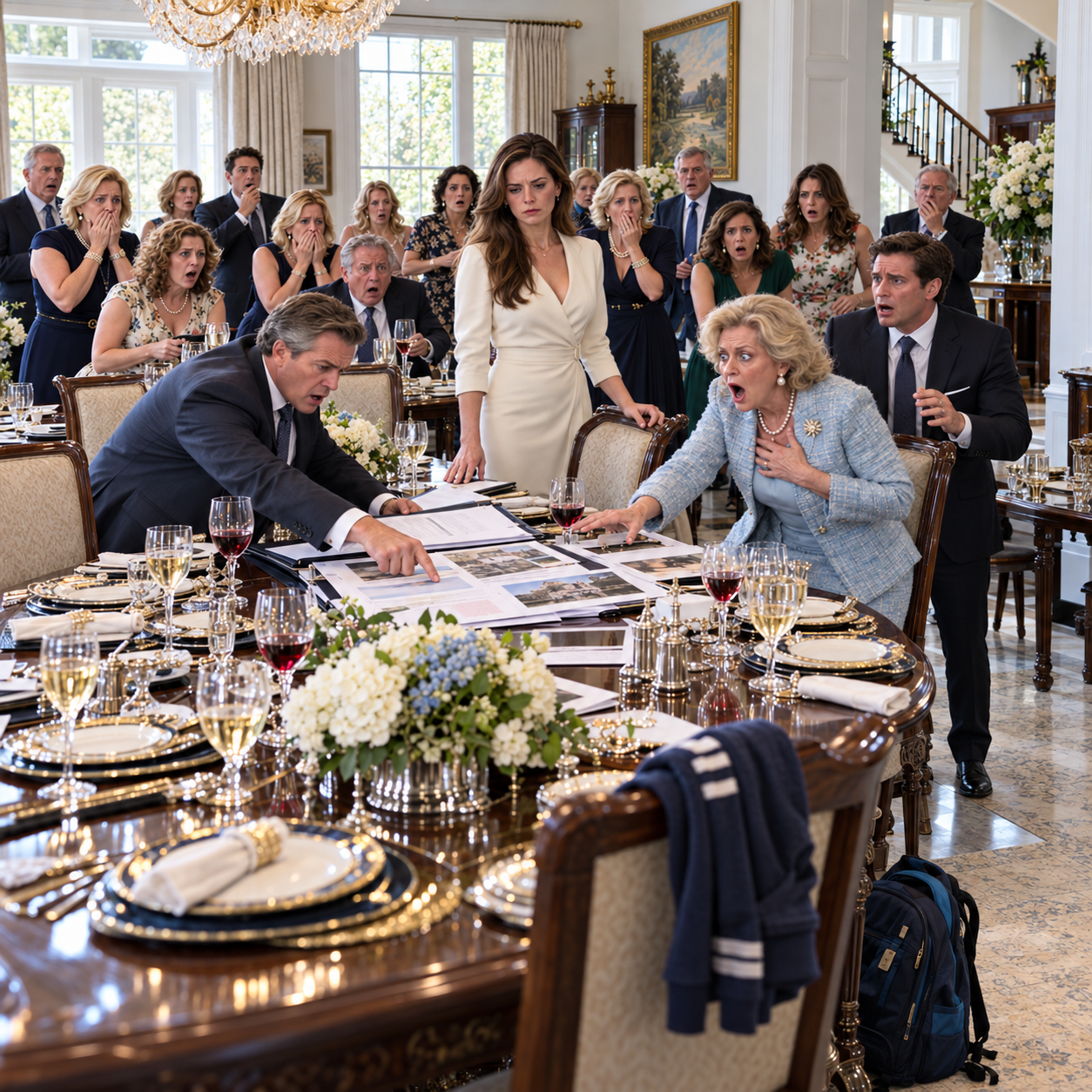
At dinner, Liam received a Bington heirloom watch that had belonged to Nate’s grandfather. Margaret announced that it would someday pass to “another proper heir.” Ethan folded his napkin. Nate stared at his plate.
Dessert arrived beneath silver domes. Then Margaret raised her wineglass.
“To family,” she said. “And to those who carry our blood with pride.” Her eyes settled on Ethan.
“Well,” she added with a small smile, “he’s not really one of us anyway.” The room went still. I felt heat climb my neck.
Ethan placed his folded napkin beside his plate and stood. “Good,” he said. Margaret blinked.
His voice remained calm. “Because I don’t want to be part of you.” Chloe’s face changed first.
Ethan continued before anyone could interrupt him. “I’ve tried since I was six. I wore the clothes you bought me. I listened to stories about people I never met. I said thank you when you gave everyone else something and explained why I didn’t need one. I kept thinking there was some version of me you’d finally like.”
“Ethan,” Margaret said, “I didn’t mean—” “You did.” No anger. That made it worse.
“You always mean it. You just don’t like hearing it repeated.” Then he looked at Nate. My husband had gone white.
“Dad, if you don’t say anything now, I’ll know exactly what you chose.” For several seconds Nate didn’t move. I remember hearing the faint hum of the chandelier.
Then his chair pushed backward. He stood beside Ethan. “You’re right,” he said.
Margaret’s expression hardened. “Nathaniel.” “If this table can’t see Ethan as my son, this table doesn’t define my family.”
It was seven years late. But it was the first time Nate had said it without qualification.
Margaret started to protest. I raised my hand. Not dramatically. Just enough.
“Margaret, I need to ask you three questions.” She looked irritated rather than worried.
“Was Ethan removed from the Bington Legacy Trust’s descendant schedule?” Her eyes flickered. “That is a private family matter.”
“Was he?” “Yes.” Nate turned toward her.
I asked the second question. “Did Nate authorize it?” Margaret sighed. “Nathaniel authorized the restructuring.”
“I did not,” Nate said. Trevor shifted in his chair.
I asked my third question. “Was a document submitted with his signature?” Nobody answered.
That was enough. I took out my phone. Margaret actually laughed.
“Oh, Lauren, don’t make this theatrical.” I wasn’t calling the police.
I called Diane Keller, the trusts-and-estates attorney who had handled Ethan’s adoption and, two years earlier, reviewed a beneficiary notice Nate had received from the Bington trust. When Diane answered, I said, “I’m sorry to bother you after hours. I think someone filed a trust amendment using my husband’s authorization without his knowledge. Ethan may have been removed as a descendant. What do we preserve?”
The room became completely silent. Diane asked me several questions.
Then she told me not to argue, not to sign anything, not to delete any messages, and not to let Nate access the family trust portal until she spoke with the bank serving as independent co-trustee. I thanked her and ended the call.
Margaret shook her head. “This is exactly why outsiders shouldn’t be involved in family affairs.” Chloe gave a nervous laugh.
“Mom changed a beneficiary list, Lauren. Nobody robbed a bank.” Trevor leaned back and muttered, “This is getting ridiculous.”
Maybe that was the strangest part. They still believed the insult was the story.
I looked at Ethan. “Ready?” He nodded.
The three of us left before anyone served coffee. And for the first twenty-four hours, absolutely nothing happened.
That silence was what made Margaret believe she’d won.
**Part 2: One forged signature turned humiliation into a financial investigation.
The next morning Margaret sent Nate six messages before seven-thirty. The first three were angry. The next two were maternal. The last one said, Call me before lawyers poison this family.
Nate placed his phone facedown on the kitchen counter. Ethan was eating scrambled eggs in mismatched socks. Nobody discussed the dinner.
At 9:12, Diane called. The Bington Legacy Trust had been established by Nate’s grandfather in 1987. It wasn’t an unlimited pot of inherited money, as people often imagined. It held interests in several family companies, investment accounts, and real estate partnerships. Margaret served as family trustee.
A national bank served as independent co-trustee. The trust defined descendants to include biological and legally adopted children.
Not stepchildren. Not informal dependents. Legally adopted children. Ethan qualified.
“He has since the adoption decree became final,” Diane said. Nate sat beside me at the kitchen table, staring at nothing.
“So Mom couldn’t remove him?” “She could propose a classification change if there were a legal question,” Diane answered. “She could not simply redefine him out of existence.”
Then came the problem.
On December 18, the bank had received a Family Descendant Certification identifying Liam and three cousins while specifically listing Ethan as “non-descendant issue of spouse.” The document carried Margaret’s signature. It also carried Nate’s.
Nate leaned toward the speakerphone. “I never signed that.” Diane paused.
“I believe you. But the bank currently has a document saying you did.” Nate stood and walked toward the window.
I remembered December. Margaret had sent a courier to our house with what she called “year-end insurance housekeeping.” Nate had been leaving for a client meeting. He signed two documents and refused to sign a third because several pages were missing.
Margaret had called him that evening. She’d been furious. I had overheard him say, “Send the complete packet and I’ll look at it.” She never did.
There was our first clue.
The bank froze all pending discretionary trust activity by noon. That was the first reversal.
Margaret had expected Diane to send an angry letter. Instead, because a trustee certification might contain a forged signature, the bank’s fiduciary department suspended amendments, extraordinary distributions, related-party payments, and new beneficiary changes until the signature issue was resolved.
The freeze affected everyone.
At 12:43, Chloe called Nate. I could hear her from across the room. “What did you do?”
“Nothing.” “Our construction draw got rejected.” Nate closed his eyes.
“What construction draw?” Silence. Then Chloe said, “Forget it.”
That afternoon Margaret arrived at our house without calling. I met her on the porch. She didn’t ask about Ethan.
“The bank has frozen a legitimate family transaction because of this stunt.” “What transaction?” “That’s irrelevant.”
“Then why are you here?” Her nostrils flared. “Tell Nathaniel to confirm his signature.”
“He says it isn’t his.” “He signed dozens of documents last year.” “Then verification shouldn’t be difficult.”
For once, I didn’t explain myself further. Margaret looked past me into the house.
“You have no idea what you’re interfering with.” That sentence stayed with me.
Not because it frightened me. Because it sounded less like a threat than panic.
Three days later, a forensic document examiner retained by the bank found that Nate’s signature on the December certification appeared to have been digitally extracted from a legitimate 2022 insurance document. The compression artifacts around the signature didn’t match the rest of the PDF.
Someone had pasted it. Trevor had uploaded the certification from an IP address assigned to Caldwell Development’s office.
When Diane told us, Nate sat down. “Trevor?”
I thought about the seating chart. Trevor’s in charge of the printing this year.
I thought about Margaret’s study. If Nathaniel challenges the classification, this gets complicated.
And I thought about the $42,000 invoice I had deleted. “Diane,” I said, “I may have something.”
I told her about Heritage Strategic Advisory LLC. There was a silence. “Can you recover the email?”
“Yes.” “Do that.”
I checked my deleted folder. The message was still there. The invoice had been paid by the Bington Family Foundation, not the Legacy Trust, but the billing address matched Caldwell Development.
Diane asked me to forward everything to her. Then she said something that changed the direction of the investigation.
“Lauren, there may be a reason they cared so much about Ethan’s classification beyond inheritance.” “What reason?”
“Minor beneficiaries receive annual accountings through their legal guardian.” I looked at Nate. He looked at me.
Diane continued. “If Ethan had remained correctly classified as Nate’s adopted son, you would have been entitled to certain notices and account summaries on his behalf.”
The second clue clicked into place.
Two years earlier, Margaret had told Nate that beneficiary statements had become “paperless internal documents” and there was no reason to bother me with them. At the time, I had been grateful.
One less piece of Bington bureaucracy. Now I understood.
They hadn’t simply wanted Ethan excluded from a future inheritance. They had wanted me excluded from the paperwork.
An independent accounting began the following Monday. Margaret called it harassment. Chloe called it Lauren’s revenge tour. Trevor stopped calling anyone.
Ethan went to school, came home, built a small robot for his engineering club, and refused every attempt we made to tell him details. “I don’t want their money,” he said one night.
“This isn’t about giving you money,” I told him. “Then what is it about?” I took longer than I should have to answer.
“Finding out why adults worked so hard to pretend you weren’t legally there.” He considered that. Then he nodded.
The answer arrived eleven days after the dinner. Diane asked Nate and me to come to her office.
On the conference-room table sat three binders. The first contained related-party trust transactions. The second contained foundation invoices. The third contained loans approved under Margaret’s trustee authority.
Over four years, entities connected to Trevor had received $1.26 million in loans, consulting contracts, and accelerated investment distributions. Some were legitimate. Many were not.
Almost $610,000 had gone to cover losses from a failed luxury townhouse project outside Stamford. Another $180,000 had indirectly funded the down payment and renovations on Chloe and Trevor’s lake property. Margaret had approved nearly all of it.
But that still wasn’t the worst part. Diane opened the third binder.
“Someone altered the beneficiary reports before they went to Nathaniel.” Nate stared at her. “What?”
Payments to Caldwell-related entities had been relabeled as general family investments on the summaries Nate received. The original reports contained more detail. The copies sent to him did not.
“Who changed them?” Diane slid a printout across the table. Metadata showed the altered files had been created by Margaret’s executive assistant using credentials from Margaret’s office.
Nate’s face collapsed. Not dramatically. Just the slow expression of a son realizing his mother hadn’t merely been difficult.
She had used his trust in her as infrastructure. Then Diane pointed to one more document.
An internal email from Margaret to Trevor. December 14. Four days before Nate’s signature was forged.
If Ethan remains listed, Lauren receives guardian reporting until he’s eighteen. I will not have an outsider combing through transactions she doesn’t understand. Resolve this before year-end.
I read it twice. So did Nate. My hands began to shake.
For seven years I had wondered what Margaret saw when she looked at Ethan. A threat to bloodline. A reminder of my previous life. An unwanted branch on her family tree.
Those things were true. But they weren’t the whole truth.
My son had also been a paperwork problem. And I was the person she was trying to keep from reading it.
**Part 3: Their favorite daughter was protected by everyone else’s silence.
The Bington family board met forty-eight hours after the accounting report. Nate was asked to attend. I wasn’t.
For once, that didn’t bother me. This was something he needed to walk into without hiding behind either his mother or his wife.
He came home three hours later and stood in the kitchen without taking off his coat. Ethan was upstairs. I was rinsing a coffee mug.
“They removed her,” he said. I turned off the faucet. “From the trust?”
“Temporarily. Pending review. The bank invoked the misconduct provision.” Margaret remained a beneficiary of certain assets, but her discretionary authority as family trustee was suspended. A professional fiduciary would take over pending a full audit.
Trevor was removed from two family-company advisory roles and his consulting firm was barred from receiving new related-party work. The loans to his companies became immediately reviewable. Chloe was required to disclose whether she knew family assets were being used to cover private obligations.
“Did she?” I asked. Nate rubbed his face. “She says Mom told her it was an advance against future distributions.”
“Was it?” “No.”
The board had also referred several transactions to outside tax counsel because charitable-foundation funds had potentially been used for private benefit. Nobody knew yet whether regulators would become involved.
There were no handcuffs. No dramatic arrests. No detectives marching through the estate. Real consequences looked more boring than television.
Account freezes. Lawyers. Repayment schedules. Insurance carriers. Board minutes.
People suddenly discovering that the phrase we always do it this way isn’t a defense.
Chloe and Trevor listed the lake house for sale six weeks later. Trevor’s development company laid off nine employees and entered a restructuring agreement with its lenders.
I felt no satisfaction about the employees. That was another thing revenge stories often leave out: guilty people rarely absorb consequences alone.
Nate resigned from the family foundation board voluntarily. When I asked why, he said, “Because I signed reports without reading them carefully. Not the forged one. Others. Mom would say, ‘It’s routine,’ and I’d sign.”
“You trusted her.” “I outsourced responsibility to her.” There was a difference.
He knew it. So did I.
My own realization came more slowly. I had spent years blaming Nate for not defending us, and I was right to blame him. But I had also participated in the arrangement.
Margaret insulted me, and I returned the following Christmas. She excluded Ethan, and I taught him to smile politely. She made cruelty look like etiquette, and I helped translate it for my son.
I had called silence maturity because confrontation frightened me. That was my price.
I couldn’t undo what Ethan had learned from watching us. I could only stop teaching it.
He began seeing a counselor that summer, not because something was wrong with him, but because thirteen was too young to spend years wondering why an entire branch of adults had evaluated his worth. At first, he hated therapy.
Then he began coming home with phrases that made Nate and me uncomfortable. “Dad, saying you didn’t notice is different from admitting you didn’t want to notice.”
Or: “Mom, you don’t have to explain why Grandma acts like that every time I say I’m mad.”
He was right often enough to become irritating. Which, I decided, was probably healthy.
Chloe contacted me in July. Not by text. She came to the house.
She looked different without Margaret’s rooms around her. Smaller somehow. She wore jeans, no jewelry, hair tied back.
I almost didn’t let her inside. Then Ethan saw her through the hallway and said, “It’s okay.”
We sat at the kitchen table. The same place he’d folded napkins before Margaret’s dinner.
Chloe kept both hands around a mug she never drank from. “I knew Mom was helping Trevor,” she said. I waited.
“I didn’t know about the forged signature.” “Did you know about the trust money?” “I knew there were loans.”
“Did you know they weren’t being disclosed properly?” She stared down. That answered me.
“Why?” Her jaw tightened.
“Because Trevor’s first project failed. Then the second one got delayed. Liam’s school tuition was due. We’d bought a house we couldn’t afford because Mom kept saying the right Caldwell house mattered for the family. Every time we got in deeper, she fixed it.”
“That doesn’t explain Ethan.” “No.”
“Then explain Ethan.” Chloe’s eyes filled.
“I was jealous of him.” I hadn’t expected that. She laughed once, bitterly.
“I know how ridiculous that sounds.” “It does.” “At least I’m aware.”
She looked toward the hallway. “Dad died when Nate and I were young adults. After that, Mom built her whole life around legacy. Who represented the family correctly. Who married correctly. Who gave her the right grandchildren.”
“You did everything she wanted.” “Exactly.” I said nothing.
Chloe’s voice dropped. “Then Nate married you and adopted Ethan because he loved him. He didn’t ask permission. He didn’t need money. He didn’t care that Mom hated it. And Ethan loved him anyway.”
She wiped her cheek angrily. “I spent my whole life earning a place Ethan got because Nate chose him.”
There it was. Not justification. But motive.
Margaret had feared losing control. Chloe had feared discovering her obedience wasn’t the same thing as love. Trevor had feared financial failure.
Three people with ordinary human fears had built an extraordinary amount of dishonesty around them.
“Did you hear the December call?” I asked. Chloe nodded.
“Were you the one who laughed?” Her face broke. “Yes.”
That hurt more than I expected. Not because I liked Chloe. Because Ethan had heard it.
“You need to tell him.” “I came to apologize.”
“No. You came to tell me because I’m easier.” She looked up.
“If you want to apologize to Ethan, you ask whether he’s willing to hear it. And if he says no, you accept that.” She nodded.
Ethan eventually agreed to ten minutes. He sat across from her at our dining table.
Chloe said she was sorry for laughing, for the seating chart, for letting Margaret turn him into a symbol instead of treating him like a kid. Ethan listened.
Then he said, “I believe you’re sorry.” Chloe exhaled.
“But I don’t trust you.” Her face tightened.
He continued. “I don’t think those are the same thing.” “No,” Chloe whispered. “They’re not.”
That was the entire conversation. No hug. No reconciliation montage.
She left fifteen minutes later. I was proud of Ethan.
I was also ashamed that he had learned boundaries because the adults around him had failed to demonstrate them.
The investigation ended in September. Margaret agreed to resign permanently as trustee rather than contest removal.
Trevor and Chloe signed a repayment agreement covering $487,000 in improperly documented personal-benefit transfers. The lake house sale paid most of the first installment. Trevor lost his family-company contracts.
The foundation corrected its filings and paid penalties after tax counsel identified reporting violations. No one went to prison. No one lost everything.
But the Bington system changed. Independent approval became mandatory for related-party transactions. Family trustees could no longer modify beneficiary classifications without outside review.
Annual statements went directly to every adult beneficiary and legal guardian entitled to receive them. Ethan’s status was restored retroactively.
When Diane told him, he shrugged. “So I’m officially one of them again?” Nate smiled sadly.
“Legally, you always were.” Ethan looked at him. “That’s not what I meant.”
Nate’s smile disappeared. “I know.”
**Part 4: Restoring Ethan’s name could not restore years of trust.
Margaret asked to see me in October. Not Nate. Not Ethan.
Me. I considered refusing.
Instead, I chose a public café halfway between our homes. For years, every meaningful conversation with Margaret had happened on her territory—her dining room, her garden, her holiday schedule, her rules.
I wanted neutral ground. She arrived exactly four minutes early. Of course she did.
Her hair was still perfect. Her coat probably cost more than my first car. But something about her had changed. Maybe it was simply the absence of people waiting to agree with her.
She sat across from me. For a while, neither of us spoke.
Then she said, “The house feels very quiet.” I didn’t rescue her from the silence.
“I suppose you think I deserve that.” “I didn’t come to decide what you deserve.” Her lips tightened.
“You’ve always been very skilled at sounding reasonable.” “And you’ve always treated that like an insult.” For the first time, Margaret almost smiled.
Almost. Then she looked out the window.
“When Richard died, everything became mine to hold together.” Richard was Nate’s father.
“I had shareholders calling. Trustees. Cousins. Employees. Everyone suddenly wondering whether the family would fragment. Chloe was twenty-six. Nathaniel was twenty-nine. I decided that if I controlled enough things, nothing could disappear.”
“And when Nate married me?” “You were something I hadn’t chosen.” There was no point pretending that sentence didn’t hurt.
“And Ethan?” Her eyes lowered. “He made it permanent.”
I waited. “He could have married you and still remained…” “Recoverable?”
Margaret flinched. But she nodded.
“When he adopted Ethan, I understood that Nathaniel had built a family I couldn’t revise.” “So you punished a six-year-old.”
“I told myself I was preserving the trust according to Richard’s intentions.” “The trust specifically included adopted children.” “I know that now.”
“You knew it then.” Silence. Finally, she said, “Yes.”
Outside, a delivery truck stopped at the curb. People passed the café window carrying umbrellas. The world remained offensively normal.
“Why protect Trevor?” I asked. Margaret’s posture changed. “Because Chloe begged me.”
That part, at least, sounded simple.
“His company was failing. Chloe thought he would leave if she admitted how bad things were. Then Liam’s school, the mortgages, the development guarantees—it accumulated. Every time I helped them, the next problem became larger.”
“So you hid it.” “I contained it.” “No. You moved it.”
Her eyes sharpened. I continued.
“You moved their problems into the trust. Then into the foundation. Then into altered reports. Then Ethan became a problem because his legal status meant I could receive information.”
She closed her eyes briefly. “Yes.”
There was the truth. Not dramatic. Not shouted. One syllable.
“You weren’t afraid Ethan would inherit money,” I said. “You were afraid I’d see what you’d done.”
“At first.” “At first?” She looked at me again.
“Later, it became personal.” I almost laughed. “At least that’s honest.”
“I disliked what you represented.” “What was that?” “Choice.”
I didn’t expect that answer. Margaret folded her hands.
“Chloe did what was expected. Nathaniel did not. You didn’t come from our world, yet he chose you. Ethan wasn’t born to him, yet he chose him. And every time you three were content without our approval, it made everything I had demanded from Chloe look…”
She stopped. “Unnecessary?” I offered.
“Cruel,” she said. That was the closest Margaret had ever come to naming herself accurately.
I thought of Chloe at my kitchen table saying she had spent her whole life earning a position Ethan received through love. Families repeat their injuries in different accents.
“I am sorry,” Margaret said. I studied her.
A year earlier, I would have been desperate for those words. Now they seemed appropriately small.
“I believe you’re sorry that you lost us.” Her eyes filled. “Is there a difference?”
“Yes.” I leaned forward.
“Being sorry you lost access to someone isn’t the same as understanding why they needed distance.” She looked down.
“What do you want from me?” “Nothing.” That surprised her.
“I don’t want control of the trust. I don’t want an apology dinner. I don’t want you explaining bloodlines to Ethan. I don’t want you sending gifts because you don’t know how else to relate to people.”
“Then what can I do?” “You can respect his answer.”
“What answer?” “When you’re ready, you can write Ethan a letter. One letter. No guilt. No inheritance talk. No asking him to comfort you. I’ll give it to him. He decides whether to read it.”
“And if he doesn’t?” “Then he doesn’t.” Margaret’s mouth trembled.
For decades, she’d lived in a world where money, tradition, and persistence eventually opened every door. I watched her understand that my thirteen-year-old son now possessed a door she couldn’t purchase a key for.
Six weeks later, her letter arrived. Ethan left it unopened on his desk for nine days. Then he read it.
He didn’t tell us what it said. I didn’t ask.
At Thanksgiving, we didn’t go to the Bington estate. We cooked at home.
Nate burned the first batch of dinner rolls because he was watching football. Ethan made mashed potatoes with enough butter to concern a cardiologist. Diane stopped by for pie because her own children were spending the holiday with their father.
Our table seated six. Only four chairs were occupied. Nobody moved the empty ones.
Halfway through dinner, I noticed Ethan doing something with his napkin. My chest tightened automatically.
For years, nervousness had turned his hands into little machines, folding corners into perfect triangles whenever a room felt unsafe. He made one fold. Then another.
Nate noticed too. Neither of us said anything.
Ethan looked down at the napkin. Then he laughed. Actually laughed.
He crumpled it into a loose ball and tossed it beside his plate. “I’m terrible at breaking habits.” Nate smiled.
“We’ve got time.” Ethan reached for another dinner roll.
There was no heirloom watch on his wrist. No Bington crest on the plates. No seating chart announcing who belonged.
Months earlier, I might have looked at that table and thought about everything Ethan had been denied. Now I saw something else.
Nobody there had to earn a chair.
Nate and I still had work to do. Ethan still kept Margaret’s letter in a drawer instead of answering it. Chloe sent him a birthday card and received no reply. Nate spoke to his mother occasionally, but only when he chose to, and he no longer passed the phone to us out of obligation.
Trust didn’t return because someone apologized. It returned in inches. Sometimes it didn’t return at all.
I once believed protecting my family meant absorbing insult after insult so nobody had to experience the ugliness of conflict. I know better now.
Peace that requires one person to disappear isn’t peace. Tradition that survives by humiliating someone isn’t tradition worth preserving. And blood may explain where a family began, but it doesn’t give anyone the right to decide who deserves dignity.
Margaret spent years trying to keep Ethan’s name off one list because she believed belonging was something she controlled. In the end, the missing name exposed the forged signature, the forged signature exposed the money, and the money exposed something deeper than fraud.
It exposed the bargain all of us had been making. Margaret traded honesty for control. Chloe traded independence for approval. Nate traded confrontation for temporary peace. And I traded boundaries for acceptance.
Ethan was the first person brave enough to stop trading.
After dinner, he carried the plates to the kitchen while Nate wrapped leftovers. I picked up the crumpled napkin Ethan had left beside his plate.
For a second, I nearly smoothed it out. Then I stopped myself.
I left it exactly as it was. Some things don’t need to be folded neatly enough for other people to accept them.
THE END!
Disclaimer: Our stories are inspired by real-life events but are carefully rewritten for entertainment. Any resemblance to actual people or situations is purely coincidental.

