
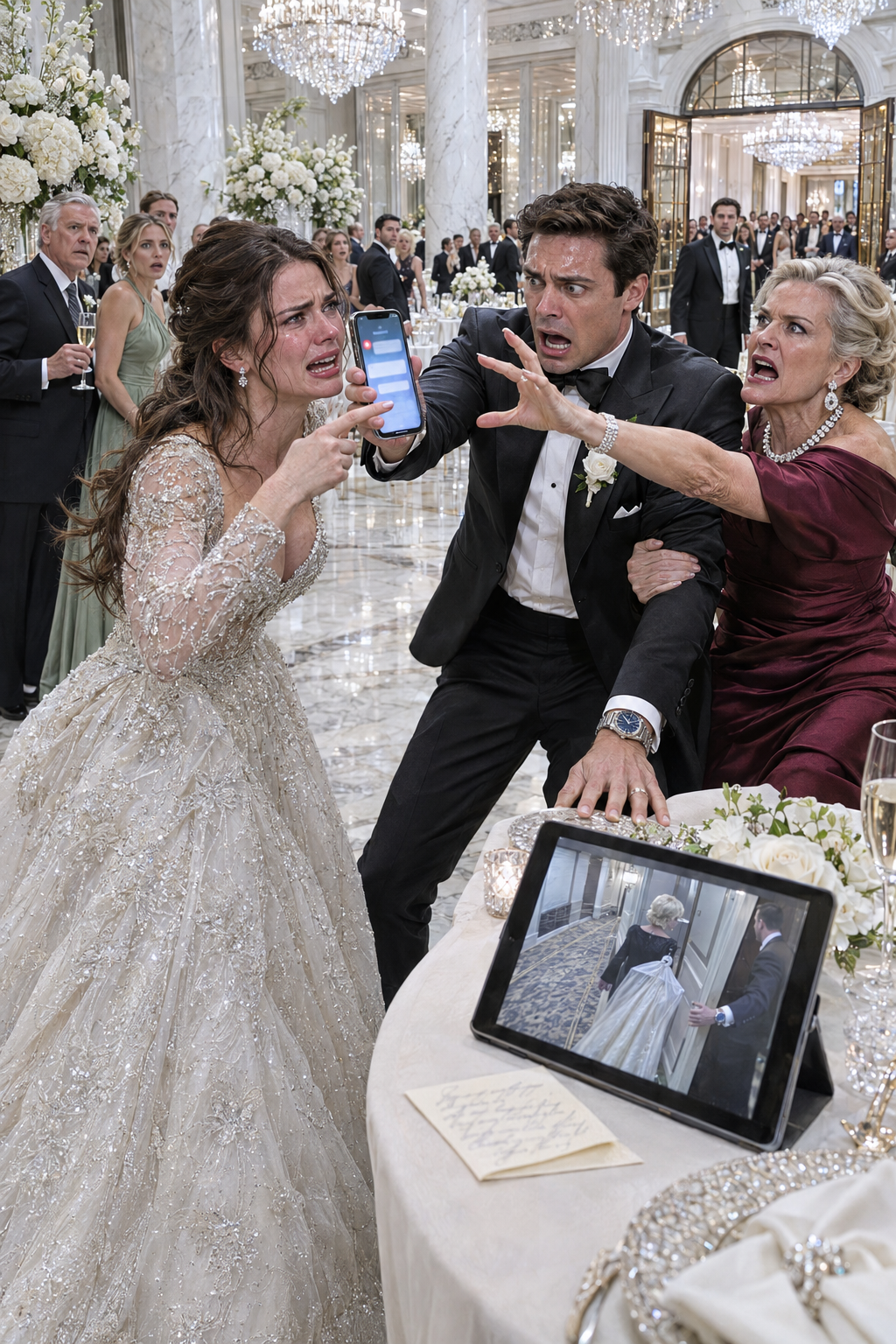
On my wedding morning, I unzipped my garment bag and found a rhinestone gown instead of my ivory dress. My future mother-in-law left a note: “The other dress was too plain for a Whitfield wedding.” Security footage caught her stealing it at 2:47 a.m.—and a man holding the door wore my fiancé’s watch. Nate swore he knew nothing. I married him anyway. Hours later, his phone lit up: “I did exactly what you asked, and she still made a scene.”
Part 1: My stolen wedding dress exposed a betrayal before vows began
At seven-thirty on my wedding morning, I stood barefoot in the bridal suite of the Whitfield Inn with coffee in one hand and the zipper of my garment bag in the other, feeling the world split into before and after. I had hung my dress there myself at eleven the night before: ivory silk, cap sleeves, a clean A-line skirt, and a lace bodice hand-finished by Rosa Gutierrez, the seventy-four-year-old seamstress who had spent months making it feel completely mine. Instead, I found a huge rhinestone ball gown with swollen sleeves and a skirt wide enough to block a doorway. A folded note was tucked into the neckline in Judith Whitfield’s handwriting: “The other dress was too plain for a Whitfield wedding. You’ll thank me later.” My maid of honor, Keisha Rodriguez, read it, set down her coffee, and said, “Don’t touch anything else.”
Keisha had been my best friend since college, but that morning it mattered that she was also a property-crimes detective. While I sat on the bed trying not to cry, she called the front desk for the hallway security footage. I called Nate. He arrived eight minutes later, stared at the replacement gown, and cursed under his breath. He looked furious enough to convince me, and I wanted desperately to be convinced. Then Keisha’s laptop chimed. At 2:47 a.m., the camera showed Judith walking down the hall carrying a garment bag. She used a key card to enter my suite and emerged four minutes later with another bag. Just before she went inside, a man appeared near the stairwell, holding the door. His face was hidden, but the light caught a round watch on a brown leather strap. I had given Nate one exactly like it for his thirtieth birthday.
Nate insisted the man could have been anyone, then called Judith and demanded my dress. She responded as though she had merely corrected a flower arrangement, complaining that the original gown did nothing for the ballroom before admitting it was in her car trunk. Nate retrieved it. When I opened the bag and saw the ivory silk intact, I nearly broke. The lace smelled faintly of Judith’s gardenia hand cream. Nate apologized, and for a few minutes I believed we were on the same side. Keisha quietly reminded me that getting my dress back and deciding whether to marry him were two separate questions. I decided I would not cancel simply because Judith wanted control of the ending. By noon, my mother had buttoned my sleeves, my bridesmaids were ready, and I walked down the garden aisle wearing the dress Judith had tried to erase. Nate cried when he saw me. I hated how much that still mattered.
We were married at 12:17 p.m. For several hours, the day almost repaired itself. We took photographs under flowering trees, cut cake in a pale-blue ballroom, and accepted congratulations from relatives who knew nothing about the morning. I might have survived believing the incident was Judith’s alone if our photographer, Lila, had not approached me during cocktail hour and asked whether I still wanted portraits in the “backup gown.” When I asked what she meant, she explained that Nate had told her weeks earlier that his mother had arranged a more formal second dress in case I wanted ballroom photographs after dinner. Across the room, my brand-new husband was laughing with his cousin, wedding ring catching the chandelier light. I suddenly understood that he had known the gown existed long before that morning.
I confronted him in the service hallway behind the ballroom. Nate admitted Judith had been shopping for another dress, that he knew she had bought one, and that he had not warned me because he had been “trying to manage her.” That phrase struck harder than a confession. He had not protected my choice; he had managed information so my reaction would not interfere with the wedding. Then his aunt Patricia appeared and confirmed Judith had been talking for weeks about my need for “guidance.” Patricia looked at Nate with tired disgust and told him his family had spent years translating Judith’s controlling behavior into smaller, nicer words. I returned to the ballroom feeling as though every smiling guest were standing inside a stage set only I could see through.
Keisha found me before the first dance and pulled me aside. The hotel had another camera aimed at the side entrance. It showed Judith arriving at 2:42 a.m. with the replacement gown. Four seconds later, Nate appeared behind her, checked the corridor, and opened the door. The night clerk also remembered Nate saying his mother might need access to my suite for a “dress matter” and asking that I not be awakened. I made it through the reception because I refused to collapse in front of Judith. I smiled for photographs, danced with my father, danced with Nate, and ran through a tunnel of sparklers while guests cheered. The pictures would later look beautiful. That became one of the cruelest lessons of the day: betrayal photographs perfectly when the lighting is good.
Near midnight, I went upstairs and watched the footage myself. There was no ambiguity. It was Nate, wearing the same jacket from the rehearsal dinner, the same watch, favoring the same injured left leg I had watched him protect for years. When he entered the sitting room and saw the laptop, he stopped. Then he said the sentence that destroyed the last innocent explanation I had left: “I wanted to tell you after the ceremony.” After the vows. After the legal commitment. After leaving would be messier. He claimed he thought Judith was only dropping off the second gown, but his phone lit up before he could finish. A message preview from his mother appeared on the screen: “I did exactly what you asked, and she still made a scene.” Nate saw me read it. For the first time that day, my new husband looked afraid.
Part 2: Hidden messages proved my husband secretly helped plan my humiliation
I asked for Nate’s phone, and his hesitation told me more than his apology ever could. When he finally handed it over, the conversation with Judith ran back for days. She mocked my “schoolmarm dress,” complained that teachers from my side made the wedding look small, and insisted a Whitfield bride needed to understand presentation. Nate pushed back occasionally, but not because he disagreed. In one message, he wrote that my gown did look too simple for the ballroom. In another, he warned Judith that if she pressured me before the wedding, I would “dig in.” Then came the exchange that made my hands shake. Judith proposed bringing the second gown. Nate answered, “No public scene.” She said she could handle it. He told her to make sure the photographer had both options. This was not a son failing to stop his mother. It was a man helping her design a quieter form of coercion, one that depended on keeping me uninformed until I was surrounded by guests and commitment.
Nate kept saying, “It was a dress,” as though reducing the object could reduce the betrayal. I told him it had been my dress, my choice, Rosa’s work, and the one thing I had selected because it felt entirely like me. More importantly, he had treated my awareness as negotiable. When he accused me of turning his worst mistake into his whole character, I removed my wedding ring and placed it on the side table. “No,” I told him. “Your worst mistake is showing me what your character becomes when telling me the truth might inconvenience you.” I changed into the navy wrap dress I had packed for brunch, put my wedding gown back into its garment bag, and left the inn with Keisha while employees stacked chairs in the ballroom. My wedding flowers were already drooping in silver vases.
The next morning, Keisha and I drove to the boutique that had sold Judith the replacement gown. I had found the receipt inside its garment bag. The manager went pale after hearing what happened and explained that Judith had claimed the surprise dress was approved by the groom. She returned with a cream folder containing the rush order, event notes, and a second authorization signature for incidentals: Nathaniel Whitfield. The worst item was a handwritten instruction clipped behind the sketch of the dress. In Judith’s blue ink were five words: “Hide original until vows complete.” The plan had not been to offer me another gown. It had been to make sure my choice was inaccessible until the public and legal portions of the wedding were over.
That afternoon, I went to the townhouse Nate and I had shared to collect my things while he was at work. Inside, a card from Judith welcomed me to my “first day as Mrs. Whitfield.” I turned it facedown and packed books, clothes, school files, my grandmother’s recipe cards, and the ordinary things that reminded me who I had been before their family made me feel unfinished. Looking for tax records in Nate’s desk, I found a navy binder labeled “Whitfield Wedding Master Notes.” Judith had built a management plan for our marriage before it even began. There were seating charts, approved photo groupings, and a page called “Optics,” where she complained that my choices looked too understated. Beneath it, in Nate’s handwriting, was a note agreeing that I needed to learn “elevated doesn’t mean fake.”
The deeper I read, the worse it became. Emails between Nate and Judith discussed my friends as though they were a demographic problem, our future house as though my taste were temporary, and possible neighborhoods based on how easily Judith could stay involved. There were notes about holiday hosting, dining-room upgrades, and even future children’s names. Then I found the line that ended any temptation to reinterpret him generously: “Once we’re married, she’ll settle in.” Those words did not sound like love. They sounded like a project timeline. Nate arrived while I was carrying boxes to the door and begged me to talk. When I showed him the binder, he said the messages were private. “Exactly,” I answered. “That’s where you stopped performing for me and told the truth.”
He admitted he had spent the engagement trying to “manage both sides.” I told him there were no sides. There was Judith, who believed I was editable, and Nate, who loved me while quietly agreeing that parts of me should change. He said he loved me, and the tragedy was that I believed him. But love from someone who is always measuring how you could fit better into his life is not safety. It is renovation. I carried my final box outside and told him I was not leaving because of one dress. I was leaving because he expected marriage to make me easier to manage. As Keisha drove away, my phone lit up with a message from Judith accusing me of proving everything she had warned Nate about. Even then, she believed the story was about my failure to adapt rather than their choice to control.
Three days later, Judith invited me to lunch with the tone of a woman summoning a committee member. Keisha came with me. Judith called the situation a “mistake” and said Nate had merely failed to keep peace between two stubborn women. When I refused that framing, she finally said what she had always believed: Nate had “chosen downward” by marrying me. My parents were decent working people, I was a teacher with a graduate degree, and my closest friends were teachers, nurses, detectives, and small-business owners. To Judith, none of that mattered because we did not belong to her social world. I stood to leave. That was when she admitted her own mother-in-law had chosen her china, doctor, curtains, and children’s school, and she had convinced herself that surrender was what marriage into a prominent family required. For one second, I understood her. Then I told her understanding was not permission. “That was the life you accepted,” I said. “It will not be mine.”
Part 3: Divorce exposed how deeply his family’s control shaped our marriage
I hired Dana Mercer, a divorce attorney whose calmness made the chaos feel sortable. Pennsylvania law was not going to erase the marriage simply because I had discovered the truth almost immediately, but Dana explained separation, disclosures, filings, and the practical steps of ending something that had lasted legally for days and emotionally for years. I gave her copies of the boutique order, screenshots of the messages, the hotel footage, and pages from the binder. She raised one eyebrow and called it “unusually well-documented bad behavior.” That phrase made me laugh when almost nothing else could. School resumed, and I returned to teaching eleventh-grade English, spending my days discussing unreliable narrators while privately realizing I had married one. Routine saved me. Teenagers still forgot essays, printers still jammed, and bells still rang whether or not my marriage had exploded.
The gossip arrived exactly as Judith would have designed it: polished, indirect, and impossible to trace to a single mouth. I was supposedly overwhelmed by commitment, unable to adjust to a prominent family, or emotionally unstable after the wedding. I ignored it until Judith drove into the school parking lot one afternoon while I was loading essays into my trunk. She stepped out wearing sunglasses and informed me that Nate was devastated and I was humiliating him. I asked her what she believed I owed them. “A chance to make amends,” she said. When I told her to name what she had done, she called it “overstepping.” I corrected her. She had entered my locked suite, taken my property, conspired with her son to withhold my dress, insulted my family, and now appeared at my workplace to pressure me. That was not overstepping. It was a pattern. Judith’s face hardened, and she warned me that pride could disguise itself as principle. I told her the only thing I regretted was not seeing sooner how much Nate had learned from her.
Nate’s attorney soon sent a proposal for reconciliation counseling. The document said “outside influences, particularly Detective Rodriguez,” had escalated a family disagreement into marital dissolution. That sentence finally killed my remaining patience. Keisha had not created the footage, written the texts, signed the boutique form, or filled a binder with plans for my future. She had simply stood beside me while I stopped accepting explanations that required me to distrust my own eyes. When Nate called asking for one conversation without Keisha, lawyers, or parents, I agreed to meet him at Long’s Park on a Sunday morning. I did not go because I wanted him back. I went because I wanted one thing he had avoided giving me from the beginning: the unedited truth.
We sat at opposite ends of a bench near the lake while joggers passed and geese argued across the water. Nate looked thinner and older. He admitted that he had disliked my wedding dress when he first saw it because it looked “small” compared with the ballroom and his mother’s plans. He admitted that when we met, he loved how grounded and unpolished I was compared with the world he grew up in, but as the wedding approached, he began wanting me to fit more smoothly into that world. The dress, the house, entertaining, my relationship with Judith—he had imagined shifting each piece slightly until the friction disappeared. “Smooth for who?” I asked. He looked down at his hands and said, “For me.” That answer hurt less than I expected, because by then pain had already done its work and become clarity.
I told him what he had really done: he had been willing to lose pieces of me so he would not have to fight for all of me. Nate did not argue. He said yes. Then he begged me not to make that truth unforgivable. I stood and told him forgiveness was not a moral debt I owed so he could feel transformed. He said he still loved me. I told him I believed him, and I was leaving anyway. That was the first moment I saw him understand that love and entitlement to a future with me were not the same thing. Before I walked away, he said Judith had once told him that if I ever saw “the whole machinery,” I would never stay. I almost smiled. “That may be the smartest thing either of you said.”
That afternoon, I visited Rosa’s alteration shop in Philadelphia. The place smelled of steam, starch, thread, and bread from the bakery next door. I told her the shape of what had happened. Rosa listened while pinning a hem, then said that betrayal was often frightening because it could be neat, organized, and polite. “A messy man is easy to recognize,” she told me. “A tidy man can ruin your life while insisting he is keeping the peace.” I asked whether I had been stupid. She looked offended on my behalf and said, “No. You were hopeful. That is different.” Her answer released something in me I had been carrying since the wedding. I had not failed because I trusted the person I planned to marry. He had failed because he used that trust as room to maneuver.
That night, a small package waited on my parents’ porch. Inside was my wedding ring and a note from Nate. He wrote that I had been right: he wanted peace at my expense, he was ashamed, and he would not fight the divorce. I read it twice, put the ring back in its box, and felt no urge to call him. The acknowledgment mattered, but it changed nothing. Months earlier, I might have believed a sincere apology required reconciliation. Now I understood that an apology could simply be the first honest thing someone did after losing the right to ask for more.
Part 4: I rebuilt my life without forgiving those who controlled it
The divorce became final nine months later on a gray Tuesday that smelled like rain. By then, I had moved into a second-floor apartment above a used bookstore in Lancaster. The floors sloped, the kitchen cabinets were faded green, the radiators hissed at night, and none of the dishes matched. Judith would have hated it. I loved it immediately. Nothing in that apartment had been selected to impress a family I did not belong to. My sofa was secondhand, my dining table had scratches, and the hallway tile had a crack the landlord kept promising to repair. For the first time in years, imperfection felt luxurious. I kept my wedding dress hanging in its cloth garment bag inside my bedroom closet. I did not preserve it in a sealed box or hide it in my parents’ attic. I wanted to see it. It reminded me that I had chosen myself while wearing something meant to represent choosing another person.
Judith wrote after the divorce. Her first note was so formal that it might have been an apology for damaged luggage: regret for distress, sorrow for escalation, hope for eventual civility. I threw it away. Six weeks later, another envelope arrived with a check made out to Rosa’s shop for three times what my alterations had cost. The note contained only one sentence: “For workmanship I failed to respect.” I sent the check to Rosa with permission to use it however she wanted. She called me laughing and announced that the “Whitfield guilt fund” would buy her a new pressing station. That became the first thing connected to that wedding that made me laugh without pain.
Nate kept his promise not to contest the divorce. I heard through mutual acquaintances that he moved into a smaller apartment, stopped attending some family gatherings, and finally began therapy on his own. None of that was my business. The hardest lesson of leaving him was accepting that he might genuinely become better and still not become mine again. Growth does not retroactively make a person safe at the moment you needed them. Occasionally an email from him would appear late at night and disappear before morning. Once I saw only the preview: “I know silence is what I owe you, but—” He never sent the rest. Silence, at last, was one boundary he learned to respect.
The strangest final encounter happened the following spring when I stopped at Rosa’s shop after school to collect a navy dress she had altered for a fundraiser. The bell above the door rang, and there was Judith standing on a fitting platform in a cream slip while Rosa pinned a hem. Judith saw me in the mirror. Her shoulders tightened. Mine did too. Rosa glanced between us and said, “Good. Now nobody move. This is a fitting, not a duel.” I nearly laughed. For several moments, Judith and I stood inside the warm shop surrounded by bolts of fabric, spools of thread, and the smell of bread drifting from next door. Then she said, without qualifiers, “I was wrong.”
I waited. Judith said she had been wrong about my dress, wrong about me, and wrong about what she had taught Nate to believe a wife should surrender for the sake of family harmony. It was the first apology she had ever offered that did not ask me to reassure her. She told me I did not have to forgive her. “No,” I said. “I don’t.” The old Judith might have argued. This one simply nodded. I believed she finally understood some part of the harm. That understanding did not rebuild a relationship between us, and I did not want it to. Peace is not always reconciliation. Sometimes it is the moment two people stop demanding that the other person rewrite the past.
Nearly a year after the wedding, on the first warm Saturday in April, I took my wedding dress from the closet and put it on. The silk still fell cleanly over my hips. The cap sleeves sat exactly right. Rosa’s lace caught the afternoon light without glittering or shouting for attention. I stood barefoot in front of my bedroom mirror while a spring breeze moved the curtains. For a long time, I looked at the woman reflected there and remembered the bride who had opened a garment bag believing the worst thing she might face that day was a controlling mother-in-law. She had not known how much truth would cost. She had also not known how much freedom would follow.
My phone buzzed on the dresser. Keisha was asking whether I wanted brunch and added, “Wear something dramatic.” I laughed, looked down at the dress Judith had once considered too plain, and typed back, “I already am.” Then I changed into jeans, left the gown hanging in the sunlight for a few more minutes, and went downstairs. The bookstore owner was arranging a sidewalk sale. Two customers were arguing cheerfully about first editions. A dog pulled its owner toward a paper bag that smelled like pastries. The entire street looked ordinary, and after the year I had lived through, ordinary felt sacred.
I never went back to Nate. I never forgave him in the way people usually mean when they ask whether a painful story has a happy ending. I did not need to hate him forever, and I did not need to reopen the door simply because he eventually understood why I had closed it. I built a life that no one had to approve, polish, elevate, or integrate. I taught, traveled, filled my apartment with friends, bought mismatched plates on purpose, and learned that being respected is quieter than being adored but far more durable. The wedding dress stayed mine. So did my name, my choices, and the future they had once planned around me. Once I stopped trying to save a marriage built on the belief that love gave someone permission to edit me, my life became larger than anything the Whitfields had ever imagined for me.
THE END!
Disclaimer: Our stories are inspired by real-life events but are carefully rewritten for entertainment. Any resemblance to actual people or situations is purely coincidental.


