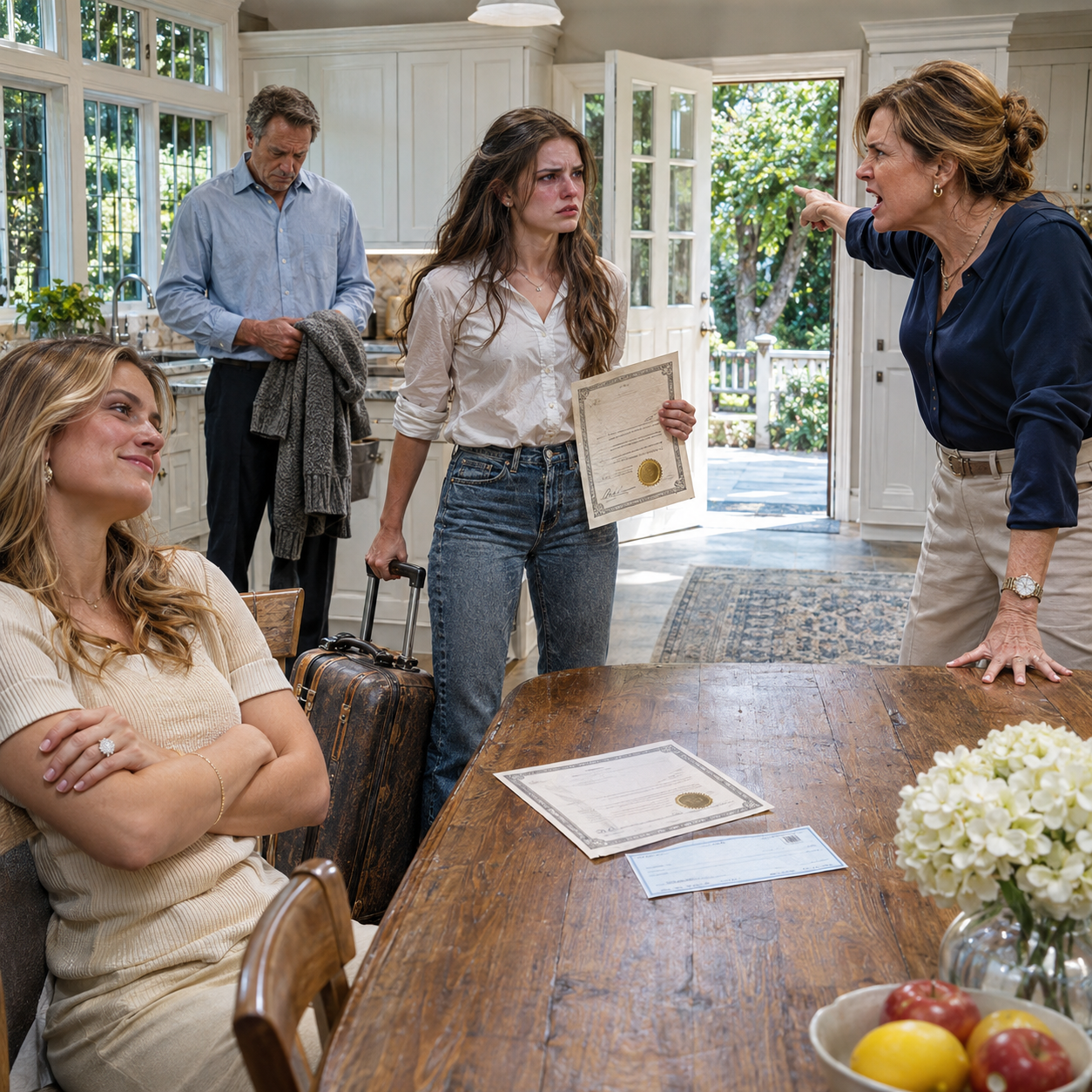
At My MIL’s Birthday Banquet, She Pushed Me To The Ground While I Was Holding My Son. My Husband Even Scolded Me: “You Just Slipped On Your Own. Don’t Embarrass Mom.” In The Emergency Room, The Doctor Glanced At My Address And Turned Pale… “You Are The Third Person…!”
My mother-in-law shoved me down four icy concrete steps while I was holding my four-month-old son. My husband watched me struggle to protect our baby, then told me to stop embarrassing his mother at her birthday party. I didn’t argue. I took my injured arm and screaming child to the emergency room, where a doctor recognized the address before I finished explaining. Three days later, I discovered that my fall wasn’t the first incident connected to that house—and my husband’s silence might have been protecting something far worse than his mother’s reputation.
Part 1: Four Frozen Steps Exposed What My Husband Refused to See
The first thing I remember is the sound of my son’s crying changing. One moment Oliver was making the small, irritated noises of a tired baby whose evening had gone on too long, and the next he was screaming with a desperation I had never heard before. We were falling through the bitter February air, my boots searching for a step that was no longer beneath them, and somehow my body understood what was happening before my mind did. I curled around him, turned my right shoulder toward the ground, and felt my forearm strike the frozen walkway with a crack so sharp that I thought, for one impossible second, that somebody had broken a piece of firewood beside my head.
I was thirty-one years old, four months into motherhood, and lying on the front walk of a house that looked like something from a luxury real estate magazine. Above me, warm yellow light spilled through enormous windows, illuminating a stone entrance, two decorative cedar planters, and the four steps that had just changed my life. My son was pressed against my chest beneath my winter coat, his little face red with outrage, his knitted cap sliding over one ear. I could not move my right hand, but with my left I checked his head, his neck, his tiny fingers, and every part of his body I could reach.
“Oliver,” I whispered. “Mommy’s here. I’ve got you.”
He kept screaming, but he was breathing, moving, and looking directly at me. That was enough to keep me from falling apart during the first terrible minute.
At the top of the steps stood my mother-in-law, Vivian Vale, wearing a forest-green evening dress and a pearl-and-gold brooch shaped like a flowering branch. It was her sixtieth birthday, and she had spent the afternoon making sure everybody understood how much she had accomplished in six decades. She held a champagne flute in one hand, looking down at me with the same expression she used when a server brought her the wrong salad. Behind her, three guests had stopped in the doorway, their faces pale beneath the porch lights.
“Honestly, Mara,” Vivian said. “I warned you about those boots.”
I could barely breathe through the pain. “You pushed me.”
She tilted her head, almost amused. “Don’t be ridiculous. You stepped backward without looking.”
A man behind her cleared his throat, but nobody contradicted her. Someone glanced toward the dining room, where music was still playing, and another guest quietly retreated inside. Vivian took a sip of champagne while my son’s cries echoed across the driveway.
Then my husband appeared.
Luke Vale had been inside retrieving his car keys because I had insisted on taking Oliver home before the birthday cake. He wore the charcoal suit I had bought him for our first wedding anniversary, and there was a smear of frosting on his thumb from something he had sampled in the kitchen. He looked at me, then at the unnatural angle of my arm, and finally at his mother. For a fraction of a second, his face revealed that he understood exactly how bad the situation was.
“Luke,” I gasped. “Call an ambulance.”
He rubbed his forehead. “Mara, what happened?”
“Your mother shoved me.”
Vivian made a wounded little sound. “She was blocking the doorway while people were trying to come outside. I asked her to move, and she lost her balance.”
Luke looked toward the guests, who suddenly found the trees fascinating. “Can we please not do this in front of everybody?” he asked me, lowering his voice. “Mom’s had a stressful day.”
My arm was broken, our baby was crying, and my husband was worried about his mother’s evening.
“Please,” I said. “I can’t get up.”
He hesitated, then glanced toward the open door when somebody called his name. “I’ll order you a car. There’s an urgent care on Route Nine.”
“Luke, I need help carrying Oliver.”
“Just give me a minute.”
He disappeared into the house.
I waited because, even then, some foolish part of me believed he would return carrying a blanket or call somebody who knew what to do. Instead, I heard laughter from the dining room, followed by the unmistakable opening notes of the birthday song. Vivian looked toward the music, adjusted the brooch at her throat, and told the remaining guests that dessert was ready.
They went inside and closed the door.
For several minutes, I lay on the freezing concrete trying to figure out how to stand without letting go of Oliver. The cold had soaked through my jeans, and each attempt to shift my weight sent burning pain through my arm. Eventually, I managed to roll onto my left side, push myself against the bottom step, and struggle upright while keeping Oliver pinned safely against my body. I leaned against a stone planter, shaking hard enough that I was afraid I might drop him.
The car that finally pulled up wasn’t an ambulance. It was a gray sedan driven by a man in his late sixties, with a faded baseball cap and a small photograph of two grandchildren clipped to his dashboard. He took one look at me and immediately got out, moving carefully as he opened the rear door and helped me secure Oliver’s infant seat. When he noticed my arm, his expression changed from concern to alarm.
“Ma’am, are you sure somebody called the hospital?”
“No,” I admitted. “Please just take us there.”
He didn’t ask why nobody had accompanied me. He switched on the heat, checked that Oliver’s seat was secure, and drove toward County General Hospital without wasting another word. Halfway there, he glanced at me in the mirror and said, “You don’t have to tell me what happened, but I hope somebody knows where you are.”
I looked at my phone.
Luke hadn’t called or texted.
At the emergency entrance, the driver refused payment and walked beside me until a nurse came with a wheelchair. She carefully lifted Oliver from his carrier, settled him into my uninjured arm, and told me that somebody from pediatrics would examine him immediately. Only then did I notice blood dried along the edge of my right sleeve, and the sight made the room tilt.
“My baby comes first,” I told her.
“He’s first,” she promised. “And we’re taking care of you, too.”
My X-rays showed a displaced fracture of the right radius. A physician named Dr. Adrian Bell, a soft-spoken man with silver at his temples and reading glasses hanging from his collar, explained that the break would require careful alignment and possibly surgery if the fragments wouldn’t remain stable. He asked how I had fallen, and I found myself answering with the same words my husband had already given everyone.
“I lost my footing.”
Dr. Bell looked at my face for a long moment. “Were you carrying your son?”
“Yes.”
“Did somebody cause you to lose your footing?”
I couldn’t answer. I could still hear Vivian telling everyone I was clumsy, and Luke asking why I always made things difficult.
A nurse entered with a tablet and asked where the incident had happened. I gave her the address: 46 Briar Glen Road, inside Ridgecrest Estates. Dr. Bell, who had been reaching for a fresh pair of gloves, stopped so abruptly that the nurse looked up.
“Forty-six Briar Glen?” he repeated.
“Yes.”
He glanced toward the closed examination-room door, then asked the nurse to give us a moment. When she stepped outside, he pulled a chair beside my bed and spoke quietly.
“Was Vivian Vale there tonight?”
My stomach tightened. “She’s my mother-in-law.”
His expression changed in a way I would remember long after my arm healed.
“Her again?” he murmured.
I stared at him. “What do you mean, again?”
Dr. Bell rested his hands on his knees. “Mara, before you tell me anything else, I need to ask you a very important question.”
He looked toward Oliver, who had finally fallen asleep against my shoulder.
“Is there somewhere you and your son can go tonight where that family cannot reach you?”
Part 2: The Doctor’s Question Uncovered Years of Carefully Hidden Warnings
I wanted Dr. Bell to tell me everything, but he was careful with his words. He explained that he had worked in the same emergency department for twenty-six years and occasionally recognized addresses connected to injuries that troubled him. He couldn’t share another patient’s private medical history, but there were circumstances in my description that reminded him of something he had encountered before. When he asked whether anyone had witnessed the shove, I told him about the birthday guests, Luke’s response, and the strange little red light I had noticed on a camera tripod in the front garden.
“That’s important,” he said. “Please don’t forget that detail.”
The pediatric resident returned with Oliver, who had passed a thorough examination and was sleeping peacefully after a feeding. A nurse helped me change into a clean hospital gown, photographed the bruising beginning to appear across my upper back with my permission, and asked whether I wanted a hospital advocate to speak with me. I said yes, though I still couldn’t quite make myself say aloud that I had been assaulted. It was easier to discuss the swelling around my wrist than to admit that the grandmother of my child might have deliberately put his life in danger.
Dr. Bell sat beside me again before I was discharged.
“The official record needs to reflect what you tell us happened,” he said. “If somebody pushed you, saying so can help us treat you properly and connect you with support.”
I stared at the pale blue hospital blanket covering my knees. “She put both hands on my back.”
He waited.
“I wasn’t stumbling. I was standing still, holding the railing, waiting for my husband.”
For the first time that night, saying the truth didn’t make me feel disloyal. It made me feel frightened by how long I had been willing to accept anything else.
To understand that fear, you need to know how thoroughly I once wanted to belong to the Vale family.
I grew up in a two-bedroom rental outside West Mercer, Pennsylvania, where the windows rattled whenever freight trains passed behind our building. My mother died when I was five, and my father disappeared from our lives soon afterward, leaving my grandmother, Ruth Bennett, to raise me on a grocery-store pension and an almost magical ability to stretch leftovers. She taught me to read before kindergarten, took me to the public library every Saturday, and saved quarters in a blue ceramic jar until she could buy me my first winter coat that wasn’t secondhand. When she died during my final year of graduate school, I lost the person who had always made ordinary life feel safe.
By twenty-eight, I had earned a master’s degree in elementary education, found a permanent teaching position, and rented a small apartment with a balcony full of struggling herbs. I wasn’t wealthy, but my bills were paid, I had friends I trusted, and I genuinely enjoyed my work. Luke entered my life at a neighborhood cookout, carrying a tray of hamburgers and apologizing because he had accidentally burned the vegetarian patties. He made me laugh so hard that lemonade came out of my nose.
Luke sold luxury cars, loved old detective movies, and seemed endlessly fascinated by my classroom stories. He remembered the anniversary of my grandmother’s death without being reminded, once drove forty minutes to bring me soup during a winter cold, and told me he admired the independence I had built for myself. When he proposed after eight months together, I believed I’d found a man who wanted to build a family rather than inherit one. I didn’t realize those were two entirely different ambitions.
I met Vivian during a Sunday dinner at the Vale estate.
The house stood behind iron gates on nearly an acre of wooded land, with tall windows, a slate-colored driveway, and a front porch supported by thick white columns. Vivian opened the door in a cream silk blouse and immediately looked down at my inexpensive leather shoes. She was a retired school administrator who had spent decades correcting teachers, controlling meetings, and speaking with the confidence of someone accustomed to having the final word.
“So this is Mara,” she said. “Luke tells me you’re a schoolteacher.”
“Second grade.”
“How sweet. Children are easier to manage before they develop opinions.”
I laughed because I thought she was joking.
Over dinner, Vivian asked where I’d grown up, what my parents did, whether I owned property, and how much money teachers earned in my district. When I explained that my grandmother had raised me, she gave a thoughtful nod and exchanged a glance with her husband, Paul. He was a broad-shouldered, gray-haired man who spent most of the evening quietly refilling his glass.
“Then you haven’t any relatives nearby to interfere,” Vivian said. “That simplifies things.”
Luke squeezed my hand beneath the table. I remember deciding to interpret her remark as a compliment because the alternative would have spoiled the evening.
His older brother, Dean, arrived halfway through dessert with his wife, Nora. She was thirty-four, pretty in a subdued way, and wearing a cardigan buttoned to her throat despite the warmth of the house. When Vivian told her to bring fresh coffee, Nora stood so quickly that her chair scraped against the hardwood floor.
“Dean’s fortunate this time,” Vivian announced after Nora left the room. “His previous marriage was a dreadful mistake.”
Dean stared into his wine. “Mom.”
“Leah was always making accusations. Some women are never satisfied with what they’re given.”
I noticed Nora’s hands trembling when she returned with the coffee tray. At the time, I assumed she was nervous around her demanding mother-in-law, just as I was.
A few weeks later, Luke’s cousin casually mentioned that Luke had also been married before.
When I asked him about it, he was irritated that the information had reached me through someone else. He said his first wife, Sophie, had been jealous, emotionally unpredictable, and unwilling to work through ordinary marital problems. Their marriage had lasted less than two years, and he insisted there was nothing useful to discuss.
“Mom tried to warn me,” he said. “I should’ve listened.”
I accepted his explanation because I loved him and because I believed failed relationships belonged in the past. It never occurred to me that Sophie might have a completely different story, or that I would one day need to hear it to understand my own marriage.
Vivian assumed control of our wedding within a week of our engagement. She selected the venue, rejected my preferred flowers, and ordered a gown with sleeves because she thought my shoulders looked too broad in the dress I loved. At the reception, she introduced me as a hardworking girl who had been fortunate enough to find a family willing to embrace her. Seventy guests applauded while I stood beside Luke, smiling through the peculiar humiliation of being treated as someone his mother had rescued.
After the honeymoon, Vivian’s visits to our apartment began.
Luke gave her an emergency key without asking me, explaining that she needed access in case something happened while we were traveling. Within days, she was entering whenever she pleased, rearranging our cabinets and commenting on the groceries in our refrigerator. One afternoon, I returned from work to find two boxes of my grandmother’s books missing from the hallway shelf.
“They smelled musty,” Vivian said when I called her. “I donated them.”
Those books contained my grandmother’s handwriting in the margins, birthday messages on the inside covers, and pressed flowers she’d tucked between pages when I was a little girl. I cried in our kitchen while Luke stood beside the refrigerator, annoyed by what he called my unnecessary sentimentality. He told me his mother had merely been trying to help us establish a respectable home.
The next thing Vivian wanted was my grandmother’s garnet ring.
It was a narrow gold band with a dark red stone, worth little financially but priceless to me. Vivian noticed it during Thanksgiving dinner and said jewelry was frequently stolen from city apartments. Before I could object, Luke agreed that his mother’s fireproof safe would be a sensible place to keep it.
I handed it over because I had become accustomed to surrendering small things in exchange for peace.
When I asked for it back several months later, Vivian looked genuinely astonished.
“Mara, you never gave me a ring.”
Luke believed her.
That evening, as I searched my jewelry box for something I knew wasn’t there, I realized that every disagreement in our marriage ended with me apologizing for bringing it up. My memories were questioned, my feelings were dismissed, and the ordinary boundaries of my home had gradually become subject to somebody else’s permission. Still, I told myself marriage required compromise, and I confused silence with keeping the peace.
Then I became pregnant.
Vivian’s interest in our lives changed almost overnight. She began calling before seven every morning to ask what I had eaten, insisted on accompanying me to medical appointments, and brought containers of food that she expected me to finish while she watched. Luke called it devotion, and I wanted badly to believe him.
But during my seventh month, when I insisted on choosing my own hospital, Vivian stared at me with an expression I had never seen before.
“You think being pregnant makes you independent of this family?” she asked.
I told her it meant I was responsible for making decisions about my baby’s medical care.
She smiled, but the anger in her eyes remained.
That same afternoon, as I washed dishes in her kitchen, she brushed past me carrying a heavy kettle, and hot water splashed across my right forearm. The burn blistered painfully, leaving me unable to comfortably hold a pencil for days. Vivian called it an accident, Luke told me to be more understanding, and I once again persuaded myself that no grandmother would deliberately harm the woman carrying her grandchild.
But a month later, while I was still pregnant, something happened that even now makes my stomach tighten.
I was visiting the estate when Vivian asked me to fetch a box of old baby linens from the enclosed sunroom. The moment I stepped outside, I heard the heavy lock turn behind me. Through the glass, I watched Vivian walk past the kitchen entrance, look directly at me, and continue toward the living room.
I knocked until my knuckles hurt.
She didn’t return for nearly forty minutes.
When she finally opened the door, she claimed the lock had caught by itself. I was shaking from the cold and anger, but Luke simply reminded me that his childhood home had always had troublesome doors. That night, I lay awake with my hands over my pregnant stomach, wondering why every supposed accident happened after I’d disappointed his mother.
I didn’t know then that somebody else had once stood outside that same house, asking herself exactly the same question.
Part 3: My Pregnancy Revealed a Cruelty Everyone Else Called Accidental
The baby arrived on October 12, following seventeen hours of labor and an emergency decision that had frightened me more than I admitted. I named him Oliver James Bennett Vale, giving him my grandmother’s family name as a second middle name and honoring the promise I had made to her before she died. Luke cried when he first held him, and for several minutes in that bright hospital room, I believed we had crossed into a better chapter of our marriage. Then Vivian arrived, picked Oliver up without asking, and announced that the baby had inherited every attractive feature from her side of the family.
She wanted him called Lawrence after her grandfather. I explained that his birth certificate had already been completed, and she smiled at the nurse before saying, “Young mothers sometimes make decisions they regret.” Luke laughed awkwardly, and I held out my arms until she finally returned my son. It was the first time I noticed how quickly she could turn a moment that belonged to me into something I felt I needed to defend.
During the following four months, Vivian came to our apartment almost every morning. She criticized the temperature of Oliver’s nursery, the diapers I bought, and the way I held him during feedings. When he gained weight steadily at his pediatric appointments, she accused the doctor of being inexperienced and claimed I was withholding proper nutrition because I wanted to prove a point. Luke rarely challenged her, even when she woke Oliver from a nap simply because she wanted to show him off during a video call.
I was exhausted, recovering from childbirth, and increasingly aware that my husband preferred the version of me who never complained. He worked long hours at the dealership, attended dinners with clients, and occasionally stayed overnight at his parents’ house when he said the drive home was inconvenient. Whenever I needed help, he reminded me that his mother had raised two successful sons without professional advice. Whenever Vivian wanted something, he found the time to make it happen.
One morning, she arrived carrying an expensive leather-bound photo album and a stack of documents. She had arranged a professional portrait session for Oliver without consulting me, and she wanted copies of his birth certificate and Social Security information for what she described as a family legacy folder. When I asked why she needed those documents, her expression cooled.
“All the Vale children are accounted for in our estate planning,” she said. “I handled this when my three children were young.”
I looked up from changing Oliver. “Three?”
She paused.
“Two boys,” she corrected. “I was thinking about the children at school.”
Her explanation was plausible, but she had said it with such certainty that I remembered it. Later, while sorting through old photographs at home, I found pictures from Luke’s childhood showing only him and Dean. I wondered whether Vivian had lost a child, or whether there was some family history nobody wanted to discuss.
Two weeks before her birthday, Luke insisted we attend the celebration at Ridgecrest Estates. Vivian had invited nearly forty people, including retired educators, business owners, county officials, and several neighbors whose approval mattered enormously to her. I reminded him that Oliver was too young for a noisy evening filled with people passing him around, especially during respiratory illness season. Luke said the gathering was important to his mother’s reputation and that refusing would make us look ungrateful.
“Then take him yourself,” I said.
He stared at me. “You know I can’t manage all his things without you.”
That sentence stayed with me because Luke could manage an entire luxury-car showroom but apparently couldn’t manage our infant son for an evening. We argued until Oliver started crying in his bassinet, and Luke finally said he would take the baby to his mother’s house whether I accompanied them or not. I agreed to go because I no longer trusted anyone there to recognize when Oliver needed me.
The night before the party, I packed extra clothing, bottles, diapers, and a warm blanket. Then I added our identification documents, Oliver’s birth certificate, his insurance card, and several hundred dollars I had quietly saved from my teaching income. I told myself it was sensible preparation because we would be driving through worsening winter weather. What I couldn’t admit was that I had been thinking about leaving Luke for weeks and wanted the option of going somewhere without asking permission.
We arrived at three on Saturday afternoon.
Vivian’s driveway was crowded with polished SUVs, and the house smelled of roasting beef, expensive perfume, and fresh flowers. She greeted Luke with a kiss and barely acknowledged me before pointing toward the kitchen, where trays of appetizers needed arranging. Nora was already working beside the stove, dressed in a thick navy cardigan that concealed her arms despite the oppressive heat. When I offered to help her finish so she could rest, she glanced toward the hallway.
“Just do what she asks,” Nora whispered. “It’s easier.”
I watched her arrange delicate pastries onto a silver tray, her fingers moving quickly even though one hand trembled. She seemed afraid of making the smallest mistake, and I wondered how many years it took for a person to begin anticipating criticism before it arrived. When Vivian entered and complained that the pastries were crooked, Nora apologized before her mother-in-law had finished speaking.
At four, a young videographer named Eli Moreno began filming guests as they entered. He introduced himself while adjusting a camera outside the front steps and explained that Vivian wanted a professionally edited birthday film. A second camera stood on a tripod near the driveway, aimed toward the entrance and the front garden, where decorative lights had been hung between the trees. I remember its red indicator blinking because Oliver seemed fascinated by it when I carried him inside.
By dinner, Vivian was glowing with the satisfaction of having every important person in her circle beneath her roof. She seated me near the kitchen doorway, announced that I could easily escape with the baby if he became troublesome, and introduced me to several guests as Luke’s young wife from humble beginnings. When a retired superintendent complimented my teaching career, Vivian interrupted to explain that she’d personally helped me develop proper social skills. Luke smiled from across the table, apparently unaware of how deeply I wanted the floor to open beneath me.
The evening became uncomfortable when Vivian raised a glass to the women who had married into the Vale family.
“Nora understands the value of loyalty,” she said. “Mara is still learning.”
Several guests laughed because they assumed she was teasing.
“Women arrive with their own little notions,” Vivian continued, “but eventually they discover that families need someone strong enough to maintain order.”
I looked at Nora, who was standing beside the sideboard holding a pitcher of water. She didn’t raise her eyes.
Later, I passed the small study beside the staircase and noticed Vivian speaking urgently with a man in a dark suit. An ivory folder lay open on the desk, displaying what looked like property records, and I heard her say, “The inheritance paperwork should have been resolved by now.” The man noticed me in the doorway and stopped talking. Vivian closed the folder and asked why I was wandering around instead of looking after Oliver.
I forgot the conversation until much later, when I understood that not every secret inside that house concerned the family’s cruelty.
By eight o’clock, Oliver was overstimulated and miserable. Guests crowded the living room, cigarette smoke drifted inside from the covered patio, and somebody had turned the music loud enough to make the glassware vibrate. I found Luke standing beside the drinks table and told him we needed to leave. He glanced toward his mother, who was receiving compliments on her decorations.
“Can’t you wait until the cake?” he asked.
“No. Oliver needs to go home.”
Vivian approached before he could answer.
“If my party is such an ordeal,” she said, “perhaps Mara should take the baby home and spare everyone her suffering.”
Luke offered to bring the car around, then return for the rest of the evening. I was so tired that I accepted without arguing. I bundled Oliver into his winter clothes, collected the diaper bag, and went to wait on the porch while Luke retrieved the vehicle from the crowded side driveway.
As I stood there, several guests came outside to smoke. Vivian followed them, holding her champagne glass and wearing the expression she used whenever she wanted an audience. She remarked that I was always finding excuses to remove Oliver from his grandmother’s company. I told her quietly that he was tired and that we would discuss it another day.
“Don’t make promises you can’t keep,” she said, moving closer.
Then she leaned toward my ear.
“You girls never understand when you’ve been given a good life. Leah didn’t understand, Sophie didn’t understand, and apparently neither do you.”
I turned slightly, startled to hear both former wives mentioned in the same breath.
Vivian looked straight into my face.
“I’ve watched three of you come into this family thinking you could make the rules. I don’t intend to start losing now.”
I opened my mouth to ask what she meant.
Instead, I felt both her hands strike my upper back.
The memories returned while I sat in the emergency department, watching Oliver sleep inside his portable bassinet. My right forearm was immobilized, and the skin between my shoulder blades had begun to darken where Vivian’s hands had landed. A hospital advocate helped me make a safety plan and offered to contact police, while Dr. Bell documented my account carefully. He didn’t promise a particular outcome, but he told me the injuries and my explanation deserved to be taken seriously.
Luke finally texted at 12:46 a.m.
“Mom says you ruined the cake cutting. Hope the wrist isn’t too bad. Staying here tonight.”
I read the message twice.
Then I opened the browser on my phone and searched for Sophie Vale, Luke’s first wife.
Her old wedding announcement appeared almost immediately, followed by a professional profile showing that she worked in corporate accounting in a town forty miles away. I sent a short message explaining who I was and asking whether she would speak with me about a family incident. I didn’t mention the hospital or Oliver because I was afraid the details would overwhelm her.
At 2:18 a.m., my phone vibrated.
Sophie had answered.
Her message contained only nine words.
“Was it the front porch, and which arm broke?”
Part 4: Two Former Wives Revealed the Pattern Behind Our Family’s Accidents
I read Sophie’s message until the words blurred. She hadn’t asked whether Luke and I were having marital problems or why I wanted to discuss his family. She had gone directly to the porch and my injury, as though she knew a sequence of events that had been repeated before. I typed that my right forearm was broken, that Oliver was safe, and that Vivian had pushed me while I was waiting for the car.
A minute later, Sophie called.
Her voice was steady, but I heard something change when I described the shove. She asked whether Vivian had accused me of blocking people, whether Luke had called me clumsy, and whether the others had gone back inside. Each question made my stomach sink because Sophie knew details I hadn’t included in my message.
“She did it to me four years ago,” Sophie said.
I couldn’t speak.
“I was ten weeks pregnant. I thought I was the only one.”
We arranged to meet the following afternoon at a diner halfway between our homes. Kendra Moss, my closest friend from school, drove Oliver and me because I couldn’t safely manage everything with my cast. Kendra had been furious when I told her what happened, but she’d responded with the practical kindness I desperately needed: groceries, help changing diapers, and a standing invitation to stay in her guest room. She sat at another table with Oliver while I waited for the woman whose name had once made my husband uncomfortable.
Sophie arrived carrying a brown leather folder.
She was thirty-three, with close-cropped dark hair, intelligent eyes, and the exhausted composure of someone who had spent years explaining a truth that nobody wanted to hear. She sat opposite me, ordered coffee, and looked at the thick white cast resting on the table. Her expression softened when Oliver made a small noise from his stroller.
“He’s beautiful,” she said.
“Thank you.”
She stirred her coffee without drinking it.
“I was going to have a little girl.”
The words landed between us with a weight that changed everything.
Sophie explained that her parents had left her a small condominium in downtown West Mercer. Shortly after she married Luke, Vivian began insisting that the property should be transferred into a family holding company for tax and estate-planning purposes. Sophie refused because it was the last substantial thing her parents had left her, and she didn’t want to surrender control of it. Luke initially said he understood, but his mother repeatedly accused Sophie of keeping one foot outside the marriage.
When Sophie became pregnant, Vivian renewed the pressure. She argued that family assets should be consolidated before a child was born and said Sophie was selfish for refusing to protect the next generation. Sophie suspected that the documents would give the holding company control over her condominium, and her lawyer advised her not to sign. Two weeks later, at a family gathering, Vivian followed her onto the front porch.
“She said I was obstructing the doorway,” Sophie told me. “Then she pushed me hard enough that I couldn’t catch the railing.”
Sophie fractured her right wrist when she hit the concrete. Luke drove her to the hospital, but he told the medical staff she’d slipped, just as he’d told everyone about me. She was admitted for observation because of the pregnancy, and over the following days she developed complications that ended in a miscarriage. Her physicians never told her they could establish the fall as the sole cause, but Sophie knew she had gone from an uncomplicated pregnancy to an emergency hospitalization after being violently shoved.
“Luke said accidents happened,” she whispered. “His mother said perhaps it was better that I wasn’t bringing a child into the world while I was so emotional.”
She pushed the folder toward me.
Inside were copies of hospital records, photographs of bruising across her shoulder, and emails from Vivian demanding that she reconsider the property transfer. There were also messages Luke had sent during their separation, accusing Sophie of embarrassing his family and fabricating accusations out of bitterness. I recognized his language immediately because he’d used the same phrases with me.
“Why didn’t you report it?” I asked.
“I tried,” she said. “But I was grieving, and Luke told everyone I was unstable. I had no recording, no willing witnesses, and a husband who backed his mother. After a while, I wanted to survive more than I wanted to convince strangers.”
She told me about Leah, Dean’s first wife, who had divorced him after another terrible incident at the family estate. Unlike Sophie, Leah had inherited a small lakeside cabin from her mother, and Vivian had tried to persuade her to sign it over to the same holding company. Leah refused, and during a winter gathering six years earlier, she’d been pushed down the porch steps and suffered a serious ankle fracture. Vivian subsequently spread stories that Leah abused alcohol, turning her into the supposed cause of the accident.
Sophie had found Leah after her own divorce, searching for somebody who might confirm that she wasn’t imagining the pattern.
“Leah believed me immediately,” she said. “That’s when I started understanding what happened.”
I asked about Nora, Dean’s current wife.
Sophie’s expression became troubled.
“Nora married into that house after Leah left. She knows why Leah was pushed, but she has never been willing to talk about it. Last year, I ran into her at a pharmacy, and she started shaking when I said Vivian’s name.”
Before leaving, Sophie gave me Leah’s contact information and promised that I could share her documents with an attorney. She also asked me to make copies of everything I had from the emergency department. When I told her about Dr. Bell recognizing Vivian’s address, she said he had been present during her hospital admission and had asked difficult questions that she hadn’t been ready to answer.
“Maybe he recognized something the rest of us were trained not to see,” she said.
Leah called that evening.
She was a hospice nurse, forty years old, with a calm voice and a habit of asking questions before offering opinions. After listening to my account, she told me that Vivian had used nearly identical words when she pushed her. Dean had left her at the hospital and returned to his mother’s dinner, and later he’d accused Leah of being careless because her boots were wet.
“I spent two years trying to persuade people I wasn’t drunk,” Leah said. “Eventually, I stopped defending myself to people who enjoyed believing her.”
She agreed to speak with the police if I made a report. Sophie offered the same promise, though both women understood that their old cases might be difficult to prosecute. What mattered immediately was that their experiences could help investigators understand why my account should not be dismissed as an ordinary dispute.
At home, Luke arrived while I was struggling to prepare Oliver’s evening bottle with one hand.
He took one look at the stack of documents on the kitchen table and frowned. “What’s all this?”
“Information about Sophie and Leah.”
His face tightened.
“Why are you talking to my ex-wife?”
“Because your mother pushed her down the same steps where she pushed me.”
Luke stared at me for several seconds, then looked away.
“Don’t start that.”
“She lost a pregnancy after the fall, Luke.”
“That’s not what happened.”
“Then tell me what happened.”
He opened the refrigerator, removed a bottle of water, and stood drinking it while I waited. Finally, he said Sophie had always exaggerated, that Leah had been irresponsible, and that his mother had spent years dealing with their accusations. He seemed more offended by the fact that I’d contacted them than by what I was saying.
I told him I was going to the police.
Luke lowered the bottle.
“You’re making a mistake.”
“My arm is broken.”
“You’re alive. Oliver’s fine.”
I looked at him, remembering the man who had once driven forty minutes to bring me soup.
“What would have happened if I’d landed on him?”
Luke swallowed but didn’t answer.
“Your mother could have killed our son.”
“Don’t say that about my mother.”
There it was again, the sentence that ended every argument.
I asked whether he’d ever seen Vivian hurt Sophie or whether he’d simply accepted her explanation afterward. He told me the matter was closed, that he wouldn’t allow me to drag his family through another public scandal, and that if I filed a complaint, he’d have to reconsider our marriage. When I said I was filing one anyway, he reached for his phone.
Vivian answered on speaker.
“Has she finally come to her senses?” she asked.
“No,” Luke said. “She’s talking about the police.”
There was a long silence.
Then Vivian said, “Come home, Luke. We need to discuss protecting Oliver.”
I felt cold despite the heat running through the apartment.
“Protecting him from whom?” I asked.
Vivian’s voice remained pleasant.
“From instability, dear. You can’t expect a woman with a broken arm and no family of her own to manage an infant properly.”
Luke left fifteen minutes later with a suitcase.
The next morning, I found an unfamiliar email in our joint account. It was from a law firm specializing in family law and guardianship, addressed to Luke and copied to Vivian. The subject line read, “Emergency Custody Strategy—Preliminary Instructions.”
The attachment had been created eleven days before Vivian pushed me.
For the first time, I understood that somebody in that family had been preparing for my removal before I ever fell down those steps.
Part 5: A Custody Petition Turned My Broken Arm Against Me
The email attachment contained six pages of neatly organized questions about Oliver’s daily care. At first glance, it looked like the kind of intake form any family lawyer might prepare for a parent seeking custody. But several sections had already been filled out, and the language was unmistakably designed to make me appear incapable of raising my son. Under concerns about maternal fitness, someone had typed, “Limited family support, emotional instability, resistance to extended-family involvement, possible inability to ensure child’s physical safety.”
The file date was February 4.
Vivian pushed me on February 15.
I checked it three times because I couldn’t believe what I was seeing. Then I forwarded the email to my personal account, saved copies of the attachment, and photographed the screen in case Luke changed the password. The document didn’t prove that anyone had planned the shove, but it established that Luke and his mother had been discussing how to remove Oliver from my care before my injury gave them a more convincing argument.
Kendra arrived an hour later carrying breakfast and a bag of baby supplies. She found me sitting at the kitchen table with Oliver asleep against my shoulder and the custody document open on my laptop. I showed her the date, the allegations, and the section describing Vivian as an available full-time caregiver. Kendra read the pages without interrupting, then quietly placed her coffee on the counter.
“You’re not spending another night here,” she said.
“I can’t just disappear with Oliver.”
“Then we’ll do it properly. My friend Nadia handles family law, and she’ll know what you need to do.”
Nadia Ellis called that afternoon. She was a family-law attorney in her early forties, known for representing parents in difficult custody and protection cases, and she listened without making promises about what the courts would decide. She asked whether Luke had ever physically hurt me, whether Vivian possessed a key to our apartment, and whether the hospital had documented my injuries. When I mentioned the photograph of my back and the custody memo prepared before the fall, her voice became very serious.
“Preserve that email exactly as it is,” Nadia said. “Don’t edit the attachments or communicate about them through the joint account.”
She explained that Luke had parental rights but that neither he nor Vivian could simply declare me unfit because my arm was fractured. Any custody decision would depend on the child’s welfare, evidence, and the applicable court orders, not on how confidently Vivian described herself as a respected grandmother. Nadia also urged me to report the shove and obtain information about a protection-from-abuse order. I agreed to meet her the following morning, then moved Oliver’s essential belongings to Kendra’s house while a neighbor helped me pack.
At the township police department, Detective Janelle Ortiz took my statement.
She was a compact woman with dark hair pulled into a low braid, and she listened more carefully than anyone in Luke’s family ever had. She asked me to describe the position of Vivian’s hands, the location of the steps, how I landed, and what happened afterward. She also asked for names of people who were outside when I fell. I identified Dean, two retired school administrators, and a local council member whose name I’d heard during dinner.
When I mentioned Eli’s camera, Detective Ortiz stopped typing.
“Was it recording continuously?”
“I don’t know. There was a red light on the camera outside, but I don’t know what it captured.”
“Do you have the videographer’s contact information?”
“No. Only his first name.”
She wrote it down anyway.
Detective Ortiz explained that the medical records, photographs, and my statement were significant, but she needed to establish who had witnessed the incident and whether any independent evidence existed. Sophie and Leah agreed to provide their own statements and authorized appropriate access to their medical records. Dr. Bell confirmed my documented injuries and what I had reported during treatment, while the hospital advocate offered additional resources. For the first time, the case was being handled as an investigation rather than a disagreement between relatives.
Vivian responded two days later.
She called while I was helping Kendra fold laundry at the dining room table. Her voice was so calm that I initially thought she wanted to negotiate.
“Mara, I hear you’ve been talking to the authorities.”
“Yes.”
“You’ve made a terrible error in judgment.”
I didn’t answer.
“Luke is speaking with attorneys. Your arm makes caring for an infant difficult, and your emotional behavior since the accident concerns us. If you withdraw these accusations, perhaps we can arrange a period of rest while Oliver stays with his father.”
“Oliver is staying with me.”
Vivian laughed quietly.
“You’re a schoolteacher without a wealthy family behind you. Do you truly believe you can fight us and win?”
I ended the call and sent Nadia a written account of the conversation.
By Friday, Luke had filed an emergency custody motion. His petition asserted that I had become emotionally unstable since childbirth and that my fractured arm created a substantial risk to Oliver. Attached was a statement from Vivian offering to supervise his care at her home, along with photographs of her large nursery and references to her decades in education. The filing barely mentioned how my arm had been broken.
Nadia prepared a response using the hospital records, pediatric examination, and documents showing that I had arranged appropriate help during my recovery. She also highlighted the earlier custody memorandum, making clear that the family’s concerns hadn’t originated with my injury. The judge scheduled a prompt hearing, and an interim arrangement preserved Oliver’s residence with me while both parties were heard. Vivian was not granted the authority she had confidently predicted over the telephone.
That should have relieved me.
Instead, it seemed to make her more determined.
Two days later, while I was returning from Oliver’s pediatric appointment, a dark SUV pulled up near Kendra’s building. Vivian stepped out, followed by Luke and Dean. I was standing beside the sidewalk with Oliver secured in his front carrier, waiting for Kendra to bring our bag from the car. The three of them approached so quickly that I instinctively moved backward.
“Give me my son,” Luke said.
“Not here,” I answered. “Talk to Nadia.”
Vivian smiled at a woman walking her dog nearby.
“Mara’s been overwhelmed,” she explained pleasantly. “We’re only trying to help her.”
Then she reached toward the carrier.
I turned my body, keeping Oliver away from her hand.
“Don’t touch him.”
Dean moved toward my other side, narrowing the space between us. Luke insisted that I was violating his rights and that his mother could provide a safer home. Vivian stepped closer until I could smell her perfume.
“You were fortunate the last fall only injured one arm,” she whispered.
I took out my phone.
“I’m calling the police.”
For a moment, none of them moved. Then a window opened above us, and an elderly woman called down from the second floor.
“I saw that,” she said loudly. “Leave the young mother alone.”
Vivian turned toward the building with a furious expression.
Kendra came around the corner carrying Oliver’s bag, immediately understood the situation, and stood beside me. I called emergency services and reported that three people were blocking my path while attempting to take my infant. By the time an officer arrived, the SUV had left, but the woman upstairs, Mrs. Doreen Walsh, had remained outside to give her name.
“I heard the grandmother threaten another fall,” she told the officer. “And I watched that man move so the mother couldn’t get around him.”
Her statement was recorded, and Nadia used the incident to support my request for protective relief.
That evening, another surprise arrived.
Nora sent a message from an unfamiliar number.
“Please don’t respond here. Dean checks my phone. I know why Vivian wanted Sophie and Leah to sign their properties away. She asked me to keep the paperwork.”
A second message followed.
“She has been hiding something about the house for years.”
Before I could respond, Detective Ortiz called.
“Mara, we found the videographer,” she said. “And there’s something you need to know about what happened to the original recording.”
Part 6: The Birthday Video Revealed a Scheme Bigger Than One Family
Eli Moreno operated a small production studio in a renovated storefront near downtown West Mercer. Detective Ortiz had located him through a neighbor who remembered receiving his business card during the birthday party, and he had initially been reluctant to discuss his work. Vivian had hired him to film a private family event, he explained, and he was worried about revealing client material without proper legal authorization. But when the detective described the allegations and asked whether he still possessed original footage, Eli admitted that he’d kept a complete copy.
He had already delivered Vivian a shortened birthday film.
The version she’d approved showed guests arriving, dinner speeches, the cake, and fireworks over the back lawn. It contained no footage of the shove, no images of me struggling on the pavement, and nothing that contradicted her story. Vivian had instructed Eli to remove what she called an embarrassing family misunderstanding, then demanded written confirmation that all unused footage had been deleted. He hadn’t obeyed the last instruction.
“I couldn’t bring myself to do it,” he told Detective Ortiz.
He explained that the outdoor camera had continued recording while he was inside filming dinner. When he reviewed the footage the next morning, he saw the entire incident and immediately understood that what Vivian called a fall had actually begun with a deliberate shove. He’d been afraid to confront her because she threatened to destroy his business if he exposed anything recorded on her property. Instead, he archived the original files and quietly refused to delete them.
Detective Ortiz obtained the recordings through the proper investigative process and arranged for them to be preserved and examined. Eli supplied the original storage media, camera information, and editing history rather than merely handing over a compressed video clip. After the files had been copied securely, Nadia and I were permitted to view the relevant footage during a meeting with investigators. I brought Kendra, who held Oliver in a separate room while I watched.
I thought I was prepared.
I wasn’t.
The video showed the porch from a wide angle, with the driveway lights illuminating patches of ice along the steps. There I was in my dark winter coat, gently rocking Oliver while I waited for Luke. Several guests emerged behind me, followed by Vivian in her green dress, her champagne glass catching the light. She said something to me, and I turned my head slightly without moving my feet.
Then she stepped forward.
Both hands struck my upper back.
I pitched forward so quickly that there was no possibility of mistaking the motion for an accidental stumble. I watched myself twist around my son, my right arm extending toward the pavement, before we hit the ground. The camera didn’t capture every word spoken near the door, but its microphone recorded the first scream, my request for help, and Vivian’s clear insistence that I had tripped.
The next part was worse.
Luke appeared in the doorway while I was still lying on the ice. He looked directly at my injured arm, glanced toward Oliver, and stood there as Vivian explained what she claimed had happened. He didn’t call emergency services, didn’t reach down to help, and didn’t follow when I tried to lift myself. When somebody announced that the cake was ready, he turned and went inside.
I covered my mouth with my left hand.
I had spent days wondering whether I remembered his expression accurately, whether pain had distorted the incident, and whether perhaps he hadn’t understood how badly I was hurt.
Now I knew.
Detective Ortiz paused the recording.
“Would you like to stop?”
I shook my head.
She let the video continue.
Several minutes after everyone returned inside, Vivian and Dean came back onto the porch. They stood near the railing while I remained farther down the walkway, struggling to arrange my phone and Oliver’s carrier. Vivian pointed toward me, and her voice carried clearly across the quiet winter yard.
“She’ll leave eventually,” she told Dean. “They always do.”
Dean asked whether I might report what happened.
“Luke will tell them she slipped,” Vivian replied. “He knows which side he’s on.”
Then she said something that made Nadia straighten in her chair.
“And once Oliver is settled here, she won’t have anything left worth fighting for.”
Dean looked uncomfortable.
“What about the custody paperwork?”
“It’s being handled,” Vivian answered. “We prepared for this before the party.”
I had to watch that section twice.
The custody memorandum wasn’t merely a precaution. Vivian had anticipated that I might resist her control over Oliver, and she’d begun constructing a case against me before the birthday gathering. The video didn’t establish that she had planned to injure me, but it proved that she understood how the injury could serve the plan she’d already made. She had not accidentally discovered an opportunity after I fell; she had been pursuing the same outcome before and after the assault.
Detective Ortiz stopped the recording and quietly excused herself to speak with another investigator. Nadia remained beside me, looking at the dark monitor. She didn’t tell me we had won, because there were still legal proceedings ahead, but she said the video substantially strengthened the evidence supporting my account.
I stared at the blank screen.
For weeks, Vivian had told everyone that I was confused, emotional, and incapable of remembering what happened.
Now the camera remembered for me.
Three days later, Nora came to Nadia’s office.
She entered through a side door, carrying a canvas tote bag and wearing an oversized coat despite the mild afternoon. Without Vivian beside her, she looked almost like a different person, though she still checked the hallway before sitting down. She told us Dean had become suspicious after police contacted him and that she’d temporarily moved in with a cousin. Then she placed three thick folders on Nadia’s conference table.
“These are copies,” she said. “I didn’t take the originals.”
Nora had worked as a bookkeeper before marrying Dean. After the wedding, Vivian gradually assigned her responsibility for organizing household bills, maintaining insurance records, and sorting documents for the Vale family holding company. Nora discovered that the estate was carrying far more debt than its carefully maintained appearance suggested. The mortgage had been refinanced repeatedly, several investments had lost substantial value, and Vivian had been borrowing against family assets while presenting herself publicly as financially secure.
“She couldn’t afford to lose that house,” Nora said.
Vivian had apparently hoped that transferring Leah’s cabin and Sophie’s condominium into the holding company would provide additional collateral for borrowing. She had described the transactions as family planning, but internal correspondence suggested the properties might have been exposed to debts their owners hadn’t agreed to assume. When both women refused, Vivian treated their decisions as personal betrayals.
Nora showed us copies of emails, account summaries, and unsigned property documents that she had lawfully retained through her bookkeeping work. Nadia made clear that the financial evidence needed independent verification and couldn’t simply be accepted as proof of criminal wrongdoing. Still, it provided a plausible explanation for why Vivian had been so relentless about possessions that didn’t belong to her.
“What did she want from me?” I asked. “I don’t own a condominium or a cabin.”
Nora looked down.
“You have Oliver.”
She explained that Vivian had been furious when I refused to surrender Oliver’s original documents and declined to participate in her elaborate family trust arrangements. The child wasn’t a source of money, but he represented something Vivian considered equally important: control over Luke’s household and the public image of a family that remained united under her authority. She believed that if Oliver lived in her home, Luke would remain financially and emotionally dependent on her, and I would eventually disappear like the women before me.
Then Nora opened the smallest folder.
Inside were old family photographs showing Vivian and Paul with three children: two boys and a dark-haired little girl.
“Her name is Caroline,” Nora said. “She’s Luke’s older sister.”
I stared at the photograph.
“Luke never told me he had a sister.”
“She left home at nineteen. Vivian cut her off after Caroline refused to marry the man she’d chosen and told relatives what life was like inside that house.”
Nora turned another page and showed me a letter written nearly twenty years earlier. Caroline had begged Paul to intervene because Vivian had threatened to destroy her college savings and reputation unless she returned home. Paul had never answered. Eventually, Caroline moved away, changed her surname, and stopped trying to remain part of the family.
I finally understood Vivian’s strange reference to raising three children. The missing daughter hadn’t died or disappeared by accident. Vivian had simply erased someone who refused to obey her.
Nora began crying as she described her own marriage.
She rolled back the sleeve of her cardigan and revealed a long, pale burn scar extending across her right forearm. During an argument about sending money to her ill mother, Vivian had deliberately tipped a kettle against her arm, then warned her not to tell anyone. Dean had accepted the story that Nora spilled it herself, and she had spent months hiding the scar because she feared what would happen if she contradicted his mother.
“I watched what she did to you,” Nora whispered. “I knew you hadn’t slipped.”
“Why didn’t you help me?”
Nora closed her eyes.
“Because I thought she’d turn on me next.”
She took a breath.
“But I was wrong. She was going to turn on me eventually anyway.”
That evening, Nora agreed to give Detective Ortiz a formal statement.
Before she left, she reached into her handbag and placed a small velvet jewelry pouch on the table.
“I found this inside Vivian’s safe while I was sorting insurance records,” she said. “I thought you should recognize it.”
Inside was my grandmother’s garnet ring.
For a moment, I couldn’t move.
Vivian had denied ever receiving it, and Luke had accused me of inventing the entire incident. Now the ring lay in front of me beside the records of the other women whose possessions she had tried to claim. I began to understand that her control hadn’t depended on one terrible crime, but on years of smaller humiliations, stolen choices, and relatives who found it easier to believe her than the people she hurt.
Nora looked at the ring, then at my broken arm.
“She kept trophies,” she said quietly. “I think she wanted us to remember who could take things away.”
Part 7: The Woman Who Controlled Our Family Finally Faced the Evidence
Vivian was arrested on a gray Tuesday morning, nearly six weeks after the birthday party. Detective Ortiz called to tell me that investigators had authenticated the relevant video files, interviewed additional witnesses, and presented their findings to the district attorney’s office. The charges arising from my fall included aggravated assault and endangering the welfare of a child, with other allegations still under investigation. Vivian was released under strict conditions after her initial appearance, including orders that prohibited contact with me and restricted her access to Oliver.
I had imagined feeling relieved when that moment finally arrived.
Instead, I stood at Kendra’s kitchen window, holding Oliver against my shoulder, and wondered whether Vivian would somehow persuade everyone that the arrest was another misunderstanding.
For years, people had accepted her version of events because she delivered it with absolute confidence. She’d managed school committees, received civic awards, and maintained friendships with influential people who considered her demanding but respectable. Even after her arrest, several acquaintances posted sympathetic messages describing her as a distinguished educator victimized by a family dispute. Vivian’s attorney publicly emphasized her years of service and said she intended to challenge both the allegations and the interpretation of the video.
But some people had begun looking at the family differently.
Leah traveled to West Mercer to meet Detective Ortiz and give a detailed statement about her own fall. Sophie followed with her records, the correspondence surrounding her inherited condominium, and an account of the pregnancy she lost. Nora provided information about her burn, the family finances, and Vivian’s statements regarding the other women. The detective treated their separate accounts carefully, distinguishing events investigators could independently verify from memories that had to be corroborated.
Then Caroline Vale contacted the prosecutor’s office.
She was forty-two, lived in Vermont, and worked for a nonprofit organization that assisted families facing housing insecurity. Nora had reached her through an old email address, and when Caroline learned that her mother had been charged with pushing another woman down the front steps, she agreed to speak with investigators. She explained that Vivian had spent much of Caroline’s adolescence controlling her friendships, finances, clothing, and decisions about school. When Caroline refused a marriage proposal from the son of one of Vivian’s closest friends, her mother threatened to withdraw financial support and tell the extended family that Caroline had become mentally unstable.
“My mother never accepted ordinary disagreement,” Caroline told the investigator. “If you refused her, she needed everyone else to believe something was wrong with you.”
Caroline had left home with two suitcases and several hundred dollars saved from a summer job. Her father had watched her walk down the driveway without saying goodbye, and neither brother had contacted her afterward. Vivian told relatives that Caroline had chosen a destructive lifestyle and demanded that family members stop discussing her. Within a few years, people who married into the Vale family had no idea she existed.
When I eventually spoke to Caroline by telephone, she surprised me by asking about Oliver before discussing anything else.
“Is he safe?”
“Yes.”
“Good. That’s the only answer I needed first.”
She didn’t offer dramatic promises or claim she could make the legal case simple. She told me that leaving her mother had cost her nearly every childhood relationship, but that remaining had felt like slowly surrendering her identity. When I described Luke’s refusal to acknowledge what Vivian had done, Caroline was silent for several seconds.
“Luke learned early that agreeing with Mom made life comfortable,” she finally said. “I learned that disagreeing meant losing everything.”
I asked whether she hated her brothers.
“Not anymore,” she answered. “But I wouldn’t trust either of them with something precious.”
The preliminary hearing was held in early April.
I entered the courthouse wearing a navy dress Kendra had helped me put on because the movement still hurt my arm. My cast was supported by a fabric sling, and I carried a small photograph of Oliver inside my purse. Nadia walked beside me while Kendra waited downstairs with the baby, and for the first time since the attack, I saw Vivian without her carefully arranged setting of expensive furniture, smiling friends, and family members waiting to follow instructions.
She sat beside her attorneys in a cream jacket, her hair perfectly styled, wearing the same pearl-and-gold brooch she’d worn on her birthday.
Luke and Dean occupied the row behind her.
Paul sat several seats away, his hands folded tightly together.
Across the aisle were Sophie, Leah, and Nora.
Vivian noticed us and whispered something to her attorney. Then she looked away, refusing to acknowledge that all three women she’d previously dismissed had come to support the woman she’d most recently hurt. She seemed to believe that ignoring us might somehow return us to the roles she’d assigned.
The hearing wasn’t a trial, and the judge made clear that the purpose was to determine whether sufficient evidence supported moving forward with the criminal charges. Detective Ortiz described the investigation, the documented injury, witness interviews, and the video recovered from Eli’s studio. The defense questioned the camera angle and suggested that a brief physical contact might have caused an unintentional fall on dangerous ice. Their argument depended on transforming a deliberate act into something that could be described as an unfortunate accident.
Then the prosecutor played the recording.
The courtroom monitor showed the porch, my dark coat, the waiting guests, and Vivian approaching from behind. Everyone watched her plant both hands against my back and forcefully push me toward the steps. The video continued as I fell, Oliver cried, and Vivian stood above us without offering assistance.
I had watched it before, but seeing it in a room full of strangers was different.
I heard somebody in the gallery gasp when my arm struck the pavement.
Luke leaned forward.
His face went pale.
The second clip showed Vivian returning to the porch and discussing the custody arrangements with Dean. Her words about Luke supporting the accidental-fall story were clear enough that the prosecutor asked the technician to replay that section. Vivian shifted in her chair, and for the first time, she appeared unable to control the meaning of what everyone had just seen.
Her attorney stood and requested permission to question the technical foundation of the recording. The judge allowed appropriate objections and testimony, and Eli explained how he’d preserved the original files and provided them for forensic examination. The prosecutor then introduced the supporting authentication report and testimony concerning the camera system. After hearing the evidence, the judge allowed the video to remain part of the preliminary record.
Vivian leaned toward her attorney and whispered angrily.
When the prosecutor mentioned the other women who had reported similar incidents, she turned toward Sophie.
“You should be ashamed,” Vivian said loudly enough for several people to hear.
The judge immediately warned her against addressing witnesses.
Vivian sat back, but her expression had changed. She was no longer a gracious retired educator enduring an unfortunate accusation. She looked like somebody who couldn’t understand why the people she considered beneath her were being allowed to speak.
When the hearing continued, Detective Ortiz described the threatening confrontation outside Kendra’s building. Mrs. Walsh’s statement had corroborated the account, and investigators had also obtained security footage from a nearby business showing the SUV and the family approaching me. The prosecutor argued that the later conduct was relevant to the need for protective conditions because Vivian had attempted to intimidate me after I reported the assault.
The judge found sufficient evidence for the principal charges to proceed.
The protective restrictions remained in place, and the court imposed additional conditions concerning contact with witnesses.
Vivian stood as the hearing ended, then turned toward me before her attorney could guide her away.
“You’ve destroyed this family,” she said.
Her voice was loud enough to carry through the courtroom.
I looked at her.
“No,” I answered. “I told people what happened.”
The judge ordered her to stop speaking to me, and a court officer stepped between us.
Outside, Luke caught up with me near the courthouse entrance.
“Mara, please.”
I stopped because I wanted to know whether he’d finally found something truthful to say.
His eyes were red, and he looked considerably older than the man I’d married. He said he had watched the video twice with his attorney and hadn’t understood until then how violent the shove had been. He told me Vivian had always been controlling, but he’d convinced himself that her behavior was harmless because she was his mother.
“You saw me on the ground,” I said.
“I know.”
“You saw Oliver crying.”
“I know.”
“You left us there.”
He covered his face with his hands.
“I’m sorry.”
I waited.
Then I asked the question that had been sitting inside me since the first time Sophie called.
“Did you know your mother had pushed Sophie?”
Luke lowered his hands.
He looked toward the courthouse doors.
“I suspected,” he admitted. “But Mom said Sophie was lying, and I didn’t want to make everything worse.”
My throat tightened.
“You suspected while Sophie was in the hospital?”
He said nothing.
“You suspected while she was losing the baby?”
Tears began running down his face, but I felt no desire to comfort him.
He had spent years presenting his loyalty to Vivian as an innocent inability to choose sides. Now he was telling me that he’d chosen a side all along, even when he knew somebody might have been badly hurt. He wasn’t simply a son manipulated by a powerful mother; he was a grown man who repeatedly decided that protecting his comfort mattered more than protecting his wives.
“I’m filing for divorce,” I told him.
He nodded, almost as if he’d been expecting it.
Then he said something that revealed just how deeply Vivian’s thinking had shaped him.
“Maybe once Mom’s gone through this, we can start over somewhere else.”
I looked at him for a long moment.
“Luke, I wasn’t waiting for your mother to change so you could become my husband.”
He started crying harder.
“I was waiting for you to become somebody our son could trust.”
I walked away before he could answer.
At the courthouse steps, Nora stood beside Dean, who was pleading with her to come home. He promised to keep his mother away, offered to find them a new apartment, and said he hadn’t understood how frightened she was. Nora listened without interrupting, then removed her wedding ring and placed it in his hand.
“You watched me become smaller every year,” she said. “You called it peace because you weren’t the one paying for it.”
She turned and walked toward Leah and Sophie.
The three women waited for me near the bottom of the steps.
As I joined them, my phone vibrated with a message from Nadia’s office. A civil investigator reviewing the financial records had discovered that the Vale estate was heavily encumbered, and additional records suggested Vivian had used misleading statements to secure family loans. Investigators were still sorting through the transactions, but one conclusion was already clear.
The expensive house Vivian had been so desperate to control might not belong to the family for much longer.
Part 8: I Saved My Son and Built a Life Beyond Their Control
Vivian’s criminal case continued for months, and the financial investigation became a separate ordeal. Investigators reviewed borrowing arrangements, property records, and documents connected to the family holding company. The evidence did not make every questionable financial decision a crime, but it revealed substantial debts Vivian had concealed from her children and husband. She had repeatedly tried to draw other people’s inherited property into arrangements that would have helped preserve the estate’s appearance of prosperity.
The grand house had been mortgaged and refinanced until there was almost no equity left.
Paul eventually admitted that he’d signed documents without fully understanding the family’s financial position. He also acknowledged that Vivian had controlled the household accounts for years and that he had avoided questioning her because he feared the arguments that followed. His silence hadn’t protected the family; it had allowed problems to grow until nearly everything they claimed to possess became vulnerable.
Nora’s records helped clarify which transactions required further investigation. Sophie and Leah reviewed the correspondence with their attorneys, relieved that they’d never signed away their properties. Caroline provided historical information about Vivian’s conduct, while Paul gave investigators a statement acknowledging that his wife had threatened and intimidated family members for years. He stopped short of claiming responsibility for her actions, but for the first time, he admitted that he’d watched suffering he could have tried to prevent.
The estate was eventually sold as part of the family’s efforts to settle debts and resolve financial obligations.
When I heard the news, I expected to feel triumphant.
Instead, I remembered the first afternoon I’d visited that house, walking up the spotless front steps with a plate of homemade cookies and imagining future Christmas dinners. I had wanted Oliver to grow up surrounded by grandparents, cousins, and holiday traditions. The tragedy wasn’t that the house would be sold; it was that I’d mistaken an impressive building for a place where love lived.
Vivian’s trial began that autumn.
I testified about the shove, the fall, and the minutes when I lay injured with Oliver against my chest. I described her previous boundary violations without pretending that every troubling incident could be proven to have been deliberate. Under questioning, I acknowledged that I had initially described the event as losing my footing because I was frightened and accustomed to accepting the family’s explanations. Then I explained why I’d corrected my account after Dr. Bell asked whether somebody had pushed me.
The prosecutor presented the video, medical evidence, witness testimony, and records supporting the intimidation allegations. Sophie, Leah, and Nora testified within the limits permitted by the court, and their testimony helped establish the larger context of the family’s relationships. Eli explained why he’d preserved the original recordings despite Vivian’s demand that he erase them. Luke was required to confront his own earlier statements, including the assertion that he’d seen no reason to suspect his mother.
Vivian maintained that she had never intended serious injury.
Her attorneys argued that the porch was icy and that the consequences of her actions had been unforeseeable. But the jury could see the force of the shove and the immediate danger to an infant being held near four concrete steps. After deliberating, they returned guilty verdicts on the principal assault and child-endangerment charges.
At sentencing, the judge also considered the impact of the injury and Vivian’s conduct afterward.
Vivian was given an opportunity to speak.
She stood in a dark suit, looking smaller than I remembered, and insisted that everything she had done had been for the good of her family. She claimed that younger women no longer understood respect, that her sons had been manipulated, and that she was being punished for maintaining traditional expectations. She never apologized to me, to Sophie, or to Leah.
When she finished, the judge told her that family authority did not excuse violence or intimidation.
Vivian received a state prison sentence of three years and four months, subject to the applicable correctional and supervision rules. Her attorneys pursued the legal options available after sentencing, but none of that changed the immediate reality. She was escorted away while her sons sat silently in the gallery.
I didn’t cheer.
I simply leaned back in my seat and felt the exhaustion of a fight that had consumed most of my son’s first year.
My divorce from Luke was finalized several months later.
By then, Oliver and I had moved into a two-bedroom rental near the elementary school where I taught. The kitchen was small, the bathroom faucet sometimes dripped, and the upstairs neighbor played jazz on Sunday mornings. I loved every imperfect corner because I controlled who entered, where my belongings were kept, and what kind of life unfolded inside.
Nadia helped negotiate the custody arrangements, and the family court considered Luke’s conduct, the criminal case, and his efforts to participate responsibly in Oliver’s care. Oliver’s primary residence remained with me, while Luke received supervised parenting time under conditions designed to protect our son. I did not use Oliver as a weapon against his father, but I refused to pretend that biology alone made somebody trustworthy.
During one of the early supervised visits, Luke brought a wooden toy train.
He sat across from Oliver in a quiet visitation room, awkwardly demonstrating how the wheels moved along the floor. Oliver crawled toward the toy, laughed, and pushed it backward instead. For a moment, Luke looked so much like the man I’d once loved that I felt a sudden ache for the marriage I’d imagined.
Then he glanced toward me.
“Do you think we’ll ever be a family again?”
I looked down at Oliver, who was examining the train’s bright red wheels.
“We are a family,” I said. “Just not the one you wanted me to keep pretending we were.”
Luke nodded.
I didn’t tell him I forgave him, because I hadn’t.
I also didn’t promise that forgiveness might come someday. He was free to become a more responsible father, but he would have to do that through consistent actions rather than apologies directed at me. His relationship with Oliver would be shaped by what he did next, not by how desperately he wanted me to erase the past.
Dean and Nora divorced later that year.
Nora moved closer to her mother, returned to bookkeeping, and began attending a support group for people recovering from abusive family relationships. She stopped wearing the heavy cardigans that had hidden her injured arm and sent me a photograph of herself standing outside her new office in a short-sleeved blouse. Her scar was visible, but she was smiling with the unguarded happiness I’d never seen during our years as sisters-in-law.
Leah continued working in hospice care and occasionally visited us on weekends. She liked reading Oliver picture books in ridiculous voices, and he loved her imitation of a roaring dinosaur. Sophie remained in corporate accounting, adopted an elderly rescue dog, and began volunteering with a local organization that helped women navigate difficult family transitions. She told me she wasn’t interested in anyone else’s expectations about marriage or motherhood.
“I’m learning to have a life that doesn’t need explaining,” she said.
Caroline became part of our lives more slowly.
She visited Pennsylvania twice after the trial, meeting Oliver in a public park and bringing him a small wooden puzzle. She never pressured me to reconcile with Luke or the other Vales, and she spoke about her childhood only when she wanted to. Over time, I came to appreciate that Oliver had an aunt who understood the importance of boundaries and had spent most of her adult life learning how to maintain them.
Paul wrote me a letter after Vivian entered prison.
He admitted that he’d seen signs of mistreatment long before my fall, including the fear in Nora’s face and the accusations Leah had made years earlier. He said he’d spent decades choosing temporary quiet over difficult confrontation and understood that his apologies could not undo the consequences. He asked whether he might someday get to know Oliver.
I read the letter carefully, then put it away.
Paul had been present during enough family gatherings to recognize what was happening, and his passivity had helped Vivian maintain control. I wasn’t going to punish him forever simply for being weak, but I wouldn’t reward his silence with immediate access to my son either. I told him that any future relationship would have to develop gradually, with clear boundaries and proof that he respected them.
My right arm healed over the following months.
Physical therapy was frustrating, particularly because I was accustomed to doing everything quickly and independently. Some mornings I couldn’t comfortably lift a saucepan, and some evenings I cried after Oliver went to bed because even simple tasks exhausted me. Kendra helped without turning her kindness into a debt, and the school district arranged my return to teaching when I was medically ready.
On my first morning back, I stood before twenty-five second graders and wrote my name across the whiteboard.
The movement felt ordinary.
That was what made it extraordinary.
For so long, every physical sensation had reminded me of Vivian’s shove. Now I was holding a marker, listening to children argue cheerfully about classroom jobs, and realizing that my body was beginning to belong to ordinary life again.
Dr. Bell saw me for a final follow-up after my recovery.
He studied the imaging reports, asked about my range of motion, and smiled when I told him I could write comfortably again. I thanked him for asking the questions that had helped me tell the truth and find support. He shook his head gently.
“You were the one who answered,” he said.
I asked whether he’d heard what happened to the other women.
He told me he couldn’t discuss anyone else’s care, but he was glad I’d connected with people who understood what I had experienced. He said that patients sometimes returned years later to describe changes that began with one difficult conversation, and that those moments reminded him why careful listening mattered. I left the hospital carrying Oliver on my uninjured hip and a small bag of cookies for the nurses who had helped us.
I never returned to 46 Briar Glen Road.
After the property was sold, someone sent me a photograph of the house under renovation. The front steps had been removed, and construction workers were building a wider entrance with improved drainage and a safer walkway. The green front door was gone, replaced by a plain wooden one waiting for paint.
I looked at the photograph for a moment, then deleted it.
I didn’t need to watch the house disappear piece by piece to know I had escaped what happened there.
Months later, Vivian sent me a letter from prison.
It was written in careful, elegant handwriting on ordinary ruled paper. She accused me of destroying her family, taking away her grandson, and humiliating her before people whose respect she’d spent a lifetime earning. She insisted that she would never forgive me and claimed that every woman who had married into the Vale family owed her gratitude.
At the bottom, she added one final sentence.
“You will understand one day that a family needs someone in charge.”
I folded the letter and placed it with the court documents.
There was no apology to answer, no misunderstanding to correct, and no reason to reopen a conversation that had cost me so much. For years, I had exhausted myself trying to persuade Vivian that I deserved basic respect. Now I understood that my future did not depend on whether she ever recognized my humanity.
Oliver was nearly eighteen months old when he began climbing steps without wanting to hold my hand.
One Saturday morning, we visited Kendra’s house for breakfast, and he hurried toward the three wooden steps leading to her back porch. I followed him, close enough to catch him if he stumbled, but he immediately waved me away with the stubborn determination of a toddler discovering his independence. He placed one small foot on the first step, gripped the railing, and pulled himself upward.
“Easy, sweetheart,” I said.
He looked back at me and grinned.
Then he climbed the next step.
I watched him reach the porch, turn around, and lift both arms in triumph. Sunshine fell across his dark hair, and somewhere behind us Kendra was laughing while her coffee maker finished brewing. I felt an unexpected sting of tears because the scene was so simple: a child climbing steps, a mother standing nearby, a home where nobody was afraid.
For a moment, I remembered that February night when I’d held him against my chest and fallen through freezing air.
I remembered Luke turning away, Vivian raising her champagne glass, and the awful certainty that nobody inside the house intended to help us.
Then Oliver reached for me.
I climbed the steps and lifted him into my arms.
My right arm supported his back without pain.
He tucked his face against my neck, warm and safe, and I kissed the top of his head.
For most of my life, I had believed that family was something you earned by being agreeable, helpful, and easy to love. I thought that if I endured enough small cruelties without complaining, eventually I would be accepted into the kind of family I’d always wanted. But the people who deserved a place in Oliver’s life were the ones who helped when he needed them, respected his boundaries, and never expected obedience in exchange for affection.
Vivian lost her freedom because of the choices she made. Luke lost our marriage because he repeatedly chose to protect those choices rather than confront them. Their consequences belonged to them, and I no longer felt responsible for softening them.
My son would grow up knowing the difference between loyalty and silence, between kindness and control, and between a home that looked impressive and one that actually felt safe.
As I carried him through Kendra’s open back door, Oliver rested his small hand against my shoulder, right where Vivian had once struck me.
I didn’t flinch.
There was nothing left in that touch to fear.
The porch where I nearly lost my child was gone, my arm had healed, and the people who once controlled my life could no longer reach us.
For the first time, I wasn’t trying to become part of somebody else’s family.
I was building my own.
THE END!
Disclaimer: Our stories are inspired by real-life events but are carefully rewritten for entertainment. Any resemblance to actual people or situations is purely coincidental.