My sister-in-law spent years humiliating my quiet son while the rest of the family called it teasing, so when she suddenly invited him to an adventure park, I smiled, sent him with a smartwatch, and said nothing. Three days later, a detective handed me a bank statement bearing my forged signature.
Part 1: Her sudden kindness hid a cruel plan for my son
The morning Annala Harper called and invited my nine-year-old son to spend the day with her family, I stood at my kitchen counter long enough for the coffee in my mug to go cold. “Cousins’ day,” she said brightly. “Lily’s been begging me to ask. I know things have been tense between us, Emily, but maybe we should stop making the kids pay for adult disagreements.” That last sentence was pure Annala. She could wrap an accusation so neatly inside kindness that you almost thanked her for it. Four years earlier, after my husband Ben died in a highway accident, his sister had arrived at my house carrying casseroles, flowers, and the kind of sympathy that filled a room. For a while, I believed she was becoming the sister I had never had. Then her little jokes started. Andy was sensitive because I babied him. Andy drew too much because I let him “hide inside his imagination.” When he cried after another kid broke one of his model airplanes, Annala laughed at Thanksgiving dinner and called him “our little Victorian poet.” Everyone chuckled except me. I told her later, privately, not to make him the family joke. She kissed my cheek and said, “Relax. I’m trying to toughen him up.”
That had been the first boundary. She crossed it again when she posted a picture of Andy asleep at a family barbecue after I specifically asked her not to put him on social media. Then she enrolled him in a weekend climbing class with Lily without asking me because, according to her, “boys need somebody to push them.” Six months later, she told my mother-in-law, Marlene, that I kept Andy isolated because I was afraid he would grow independent and leave me like Ben had. Ben had died. He had not left me. Even Marlene looked uncomfortable when she repeated that one. The fourth incident bothered me for reasons I couldn’t explain at the time. At Christmas, I found Annala standing by the hall table with an envelope addressed to Andy from Harper Family Trust Services. Ben’s father had created a small education trust for his grandchildren years earlier, and after Ben died, Andy inherited what would have been his father’s family share. Annala picked up the envelope before I could. “Tax duplicate,” she said casually. “Dad gets these too.” She handed it over, but not before I noticed it had already been opened. Two months later, she brought me a form at Sunday dinner and said the trust administrator needed my signature for “routine expense verification.” I told her I would read it at home. Her smile tightened for half a second. “God, Emily. You really don’t trust anybody anymore, do you?” I never signed it.
Around that same time, Andy came home from an afternoon at Annala’s house and asked why Aunt Annala had papers in her office with his name printed across the top. “What papers?” I asked. He shrugged and kept building a Lego spaceship. “Camp stuff, maybe. It said Pine Ridge Adventure Academy. Did I go there when I was little?” He had never gone to Pine Ridge. When I asked Annala, she laughed. “Probably Lily’s summer packet. He must’ve read it wrong.” Andy did have mild dyslexia. She knew that. That answer sat wrong in my stomach, so I began keeping screenshots, dates, messages, and notes about every incident. I told myself I was being careful rather than confrontational. What I did not admit was that I still wanted Marlene and David, Ben’s parents, to believe our family could remain intact. Losing Ben had ripped one hole through Andy’s childhood. I was terrified that another family fracture would widen it. So I documented instead of leaving. That decision would become one of the hardest things I ever had to forgive myself for.
The invitation to the adventure park came three weeks after I overheard Annala telling a friend on speakerphone, “He cries so easily. One good scare and maybe he’ll stop acting like everything is trauma.” She didn’t know I was standing in the mudroom. I walked out before she saw me, furious enough that my hands shook, and that night I ordered Andy a child smartwatch with location tracking and an emergency call function. It could also record short audio clips when activated. I showed Andy exactly how to use it. “This isn’t because I think something bad will happen,” I told him. “It’s so you can reach me whenever you need me.” He grinned and said it made him look like a spy. When Annala saw it the morning she picked him up, she turned his wrist toward the sunlight. “Fancy. Does this thing record everything we say?” Her voice was joking, but her eyes stayed on me. “Only when he uses it,” I said. She gave me that polished smile. “Peace of mind, huh?” “Exactly.”
For the first two hours, nothing happened. Andy sent me a picture of Lily wearing a ridiculous foam helmet and another of a ropes course stretching between wooden towers. At 11:43, his location stopped moving near the north side of the park. I texted him. No answer. I texted Annala. She responded with a thumbs-up and, He’s fine. At 12:07, my phone rang from Lily’s number. I answered expecting laughter. Instead I heard my niece breathing so hard she could barely speak. “Aunt Emily?” she whispered. “Andy won’t wake up.” My coffee cup slipped from my hand and exploded against the tile. “Where is your mother?” I asked. Lily started crying. “She said it was just a prank. She said he was supposed to get sleepy and then we were going to scare him when he woke up, but he’s not waking up right.” I was already grabbing my keys. “Call 911. Put an adult on the phone. Do not let anyone give him anything else.” Then I called the police myself.
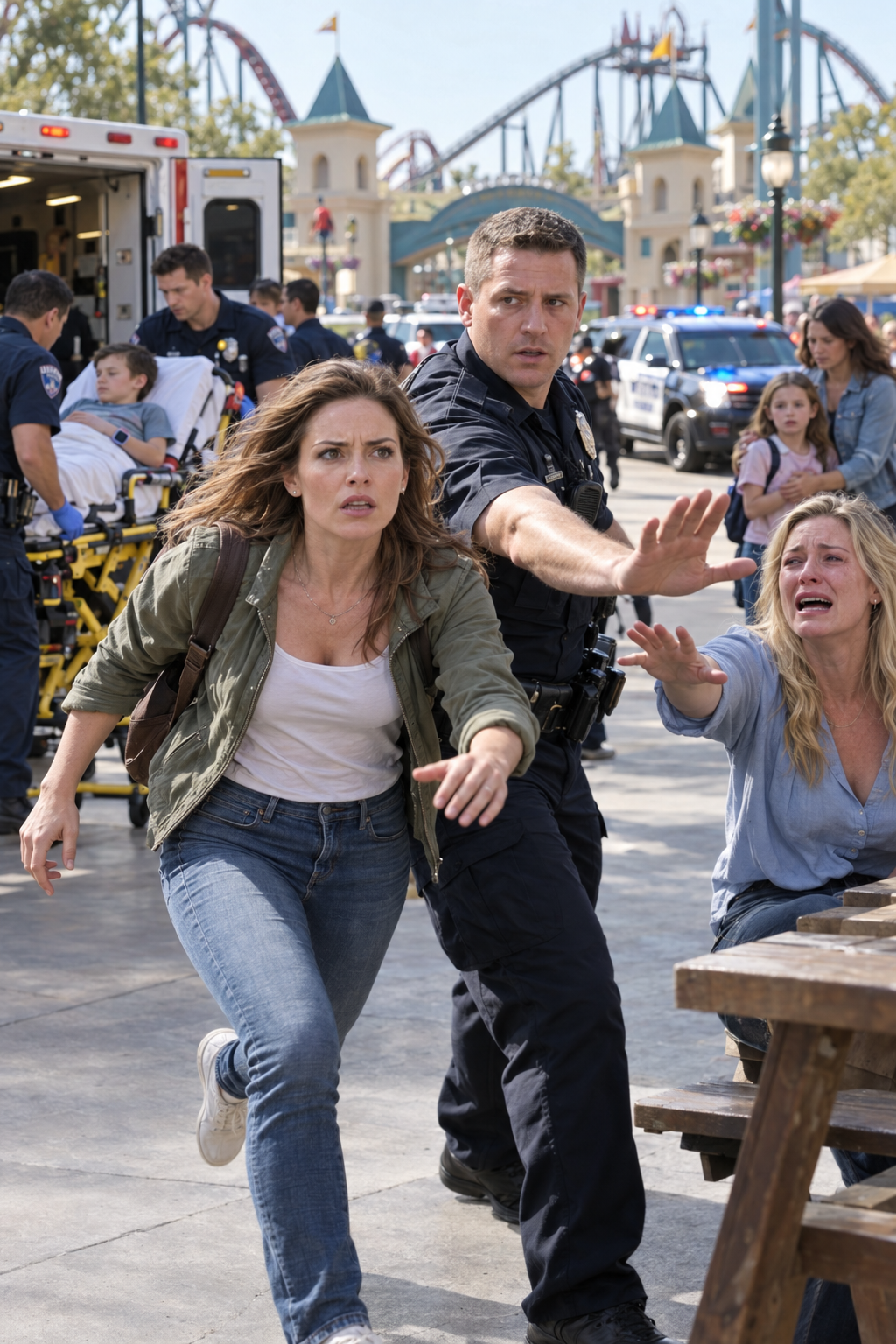
The drive to the park took thirty-two minutes. I remember every red light. Every driver who seemed to be moving too slowly. Every stupid ordinary thing outside my windshield: a landscaper unloading a mower, two teenagers sharing fries, a woman walking a golden retriever. By the time I turned into the parking lot, an ambulance and two police cruisers were angled across the entrance. I saw Annala before I saw Andy. She stood beside a picnic table in a pale blue blouse, crying with her whole body, loudly enough that strangers were watching. “It was a joke,” she kept saying. “It was just supposed to make him sleepy.” Then the paramedics rolled my son past me on a stretcher, his face pale beneath an oxygen mask, his arm hanging too still at his side. I moved toward him, but a police officer stopped me long enough to ask who I was. “His mother.” The words came out as a sound I barely recognized. Behind the officer, Lily stared at me with wet, terrified eyes. Annala tried to reach for my arm. I stepped away. I did not scream at her. I did not hit her. I did not give her the scene she would later claim had made everyone misunderstand her. I looked at the smartwatch still strapped around Andy’s wrist and said to the officer, “Please preserve whatever is on that device.” For the first time all day, Annala stopped crying.
Part 2: The smartwatch exposed her prank, then police found something worse
At the hospital, a physician told me Andy had ingested a sedating medication that should never have been given to him without medical supervision. The amount in his system had affected his breathing badly enough that they wanted him monitored in intensive care. I sat beside his bed watching machines translate his body into numbers and tones while anger moved through me in quiet waves. Marlene arrived first, white-faced and shaking, with David behind her. Neither knew what to say. “Annala says it was candy,” Marlene finally whispered. “She says she didn’t realize—” I turned toward her. “She gave my child something to make him sleepy.” Marlene looked down. “She says she thought it would be harmless.” “Then why did Lily know it was a prank before Andy even woke up?” That silenced the room. David lowered himself into a chair as if his knees had given out. For years, they had dismissed Annala’s behavior as personality—dramatic, competitive, insecure, spoiled by a mother who preferred peace over consequences and a father who solved every financial mess before anyone else heard about it. Now the habit of explaining her had followed us into a pediatric ICU.
Detective Laura Kim met me the next morning. She had already spoken to park employees and reviewed security footage showing Annala buying regular snacks at a kiosk, then later taking a separate piece of candy from her purse and giving it to Andy. “She says a friend gave it to her as a gag item,” Kim told me. “We’re trying to identify the friend.” I unlocked Andy’s smartwatch with trembling fingers. The device had captured several audio clips because Andy had pressed the side button repeatedly shortly before losing consciousness. The first was mostly wind and children shouting. The second carried Annala’s voice clearly. “Eat it. Stop being dramatic. Lily already tried one.” Lily immediately protested, “No, I didn’t.” Then Annala laughed. “He’ll just get sleepy. When he wakes up in the pirate tunnel, he’ll lose his mind.” A boy’s voice—Andy’s—said, “I don’t want it.” Annala answered, softer this time, “Don’t embarrass me again.” There was another clip eight minutes later. Andy sounded confused and frightened. “My legs feel weird.” Annala said, “That’s the point. Sit down before you make a scene.” I heard Lily say, “Mom, he looks sick.” Annala’s reply was so flat that even Detective Kim stopped writing. “He always looks sick when somebody tells him no.”
Annala was arrested that afternoon. Prosecutors initially filed charges related to child endangerment and administering a harmful substance, with the possibility of adding more after toxicology was complete. Her husband, Tom, left their house with Lily and stayed with his brother. Annala called me twice from the detention center before I blocked the number. Marlene asked whether I would consider telling the prosecutor I believed Annala had not intended serious harm. I stared at her across the hospital cafeteria. “Do you?” I asked. She pressed her fingers around a paper cup. “I believe she didn’t understand how dangerous it was.” “That wasn’t my question.” Marlene began crying then, but I had no energy left to comfort her. The truth was uglier than one bad afternoon. Annala had spent years training the family to translate cruelty into humor, entitlement into confidence, and consequences into persecution. I had helped in my own way by staying quiet too often. I had told myself that keeping records was strength, but records do not protect a child if the adult holding them keeps allowing access. Sitting beside Andy that night, I promised him something while he slept. I would never again confuse avoiding conflict with creating safety.
He woke properly on the third morning. His eyes opened slowly and moved around the room until they found me. “Mom?” “I’m here.” His voice was dry and small. “I knew you’d come.” That broke whatever composure I had left. I bent over his bed and cried into the blanket while he patted my shoulder like I was the one who needed reassurance. Later, when he was more alert, he asked whether Lily was in trouble. I told him she wasn’t. He seemed relieved. Then he said something I didn’t understand. “Aunt Annala was mad because I remembered the camp paper.” I looked at him. “What camp paper?” “The one at her house. She asked me about it in the car. She said I shouldn’t tell Grandma things I don’t understand.” My body went cold. “Did you tell Grandma?” Andy nodded. “Last Sunday. I asked why she paid for Pine Ridge if I never went there.” I had not known that conversation happened.
I called Detective Kim. Her silence after I explained was different from confusion; it was recognition. “Mrs. Harper, there’s something I was planning to discuss with you once your son was stable.” She arrived at the hospital that afternoon carrying a thin evidence folder. Inside was a photocopy of a reimbursement request from the Harper Family Education Trust. It listed six weeks at Pine Ridge Adventure Academy for Andrew Harper, tuition, equipment, transportation, and counseling fees totaling $18,640. At the bottom was a signature that looked enough like mine to fool someone who had seen it only a few times. It was dated fourteen months earlier. “I never signed this,” I said. Kim nodded. “We know. Pine Ridge has no record of your son ever being enrolled.” She placed another document beside it. Then another. Private tutoring. Occupational therapy. Summer robotics. Youth grief counseling. Some services Andy had used, but the listed amounts were inflated. Others had never happened at all. Over three years, the requests totaled more than seventy thousand dollars.
My first thought was that Annala had forged paperwork to steal from the trust. My second was worse. “Why are these in your case?” I asked.
Detective Kim closed the door to Andy’s room before answering. “Because when we obtained a warrant for Mrs. Harper’s phone in connection with the park incident, we found messages discussing these reimbursements. And your son’s name appears repeatedly.” She watched my face carefully. “Emily, we no longer believe the park prank was only about humiliating Andy.”
Part 3: Her secret fraud shattered our family, but freed my son
The financial investigation took six weeks to show us the shape of what Annala had been doing, but once it did, pieces of the previous three years locked together with nauseating precision. Her event-planning company had begun failing after she lost two corporate clients. Rather than admit it, she borrowed against credit cards, then used money from the family education trust to cover business expenses. Because David and Marlene had appointed her administrative trustee years earlier, she was allowed to approve routine reimbursements for Lily and Andy, provided a parent submitted documentation. Annala created that documentation herself. She invented programs, inflated legitimate bills, and routed reimbursements through accounts tied to vendors that were either friends of hers or shell businesses she controlled. My forged signature appeared on seventeen requests. David’s appeared on nine more. The small cruelty toward Andy had served another purpose too. For more than a year, Annala had been telling Marlene and David that he confused facts when he was anxious, exaggerated conversations, and had become emotionally unstable after Ben’s death. Detective Kim showed me texts Annala sent to a friend after Andy mentioned the Pine Ridge invoice to Marlene: If he keeps talking, Dad’s going to start digging. Later that night: He needs to learn that not every thought belongs in his mouth.
The park incident had been Annala’s version of control, not attempted murder. That distinction mattered legally, but it did not comfort me. She had wanted to scare Andy badly enough that he would stop questioning her and, according to another message, give everyone “one more example of him freaking out over nothing.” She had planned to blame his reaction on anxiety. The sedating candy was supposed to make him groggy before they put him inside a dark pirate attraction and filmed him panicking. Her friends had apparently done similar stupid pranks to one another as adults. Annala knew it contained medication; what she claimed not to understand was how strongly a child might react. It was reckless, vicious, and connected directly to the financial fraud she was desperate to keep hidden. She had not woken up that morning intending to put Andy in intensive care. She had simply spent so many years believing everyone else would absorb the cost of her choices that she no longer recognized where the edge was.
The consequences arrived without the theatrical satisfaction people imagine when they talk about justice. There was no single courtroom moment where everyone gasped and Annala collapsed. Instead, her life contracted piece by piece. She was removed as trustee. The family trust froze her distributions pending recovery of misused funds. Her business closed after creditors learned its finances were under investigation. She sold her SUV and eventually the house she and Tom owned together. Tom filed for legal separation, not because of the affair or secret lover that people initially whispered about, but because he discovered Annala had also opened business credit in his name without telling him. He sought primary custody of Lily while Annala dealt with the criminal cases. On the child-endangerment charges, she eventually accepted a plea that included probation, mandatory counseling, restrictions on unsupervised contact with minors, and community service. The financial case took longer. She was ordered to repay the trust, and the court prohibited her from serving as a fiduciary. Some relatives thought the punishment was too harsh. Others thought it was too light. I stopped measuring justice by whether everyone agreed with it.
Marlene apologized to me twice. The first time, three weeks after Andy came home, she said, “I should have listened to you.” I told her, “Yes, you should have.” She flinched because she expected me to soften it. I didn’t. The second apology came months later and was better because it contained no request. She admitted she had protected Annala since childhood because Annala reacted to consequences by threatening to disappear from the family, and Marlene had always been afraid of losing her daughter. “So I asked everybody else to bend instead,” she said. “You did,” I replied. We did not hug. We did not suddenly become close. But over the next year, she began respecting rules she once considered insulting: no unscheduled visits, no discussing Annala with Andy, no pushing him toward reconciliation. David handled it differently. He became quiet and old almost overnight. He transferred management of the trust to an independent professional and repaid Andy from his own savings while the courts pursued restitution. “I should never have put family harmony ahead of oversight,” he told me. It was the closest thing to an apology he knew how to give.
Andy paid a price too, which was the part that made every adult consequence feel insufficient. For months he refused candy unless I opened the package in front of him. He would not go into dark attractions, and if someone joked about “scaring” him, his shoulders tightened. I found a trauma therapist he liked, and progress came in boring increments rather than inspiring breakthroughs: one birthday party he attended without calling me, one field trip he completed, one night he slept without checking twice that the doors were locked. Lily entered counseling as well. She had been carrying secrets for her mother longer than any of us realized. Tom eventually allowed the cousins to see each other again under supervision, and their relationship recovered faster than the adults’ did. Children sometimes understand the difference between responsibility and guilt better than grown-ups. Lily had called me when it mattered. Andy never blamed her.
As for me, I stopped romanticizing my silence. I had believed that being calm meant being wise. Sometimes it did. Other times it meant I was giving a dangerous person one more opportunity because I wanted to avoid looking difficult. I still keep records when something matters, but I no longer collect evidence as a substitute for action. Boundaries do not become real because you explain them beautifully. They become real when crossing them changes access to you.
Almost eighteen months after the adventure park, Andy asked whether we could try another one. Not the same place, he clarified quickly. A smaller park near the coast with go-karts, mini golf, and a ropes course that never went higher than twenty feet. I wanted to say no. Every cell in my body wanted to keep him somewhere soft and predictable forever. Instead I asked what would make him feel safe. He thought about it and lifted his wrist. He still wore the little smartwatch, scratched now around the edges. “This,” he said. “And you don’t leave.”
“I won’t.”
At the park, he made it halfway across the ropes course before freezing. I stood below him with a helmet on, looking ridiculous, while an instructor waited nearby. “You can come down,” I called. “Or you can keep going. Your choice.”
Andy looked at the next platform, then down at me. “Peace of mind, right?”
I laughed because he remembered exactly what I had said the morning Annala took him away. “Exactly.”
He crossed the next rope.
Family used to mean, to me, the people you kept making room for because history said they belonged. I know better now. Family is not unlimited access. Love is not a waiver for cruelty, and forgiveness is not the same thing as restored trust. Sometimes the most loving thing you can do for your child—and for yourself—is stop waiting for someone to respect a boundary they have already chosen to cross.
THE END!
Disclaimer: Our stories are inspired by real-life events but are carefully rewritten for entertainment. Any resemblance to actual people or situations is purely coincidental.