
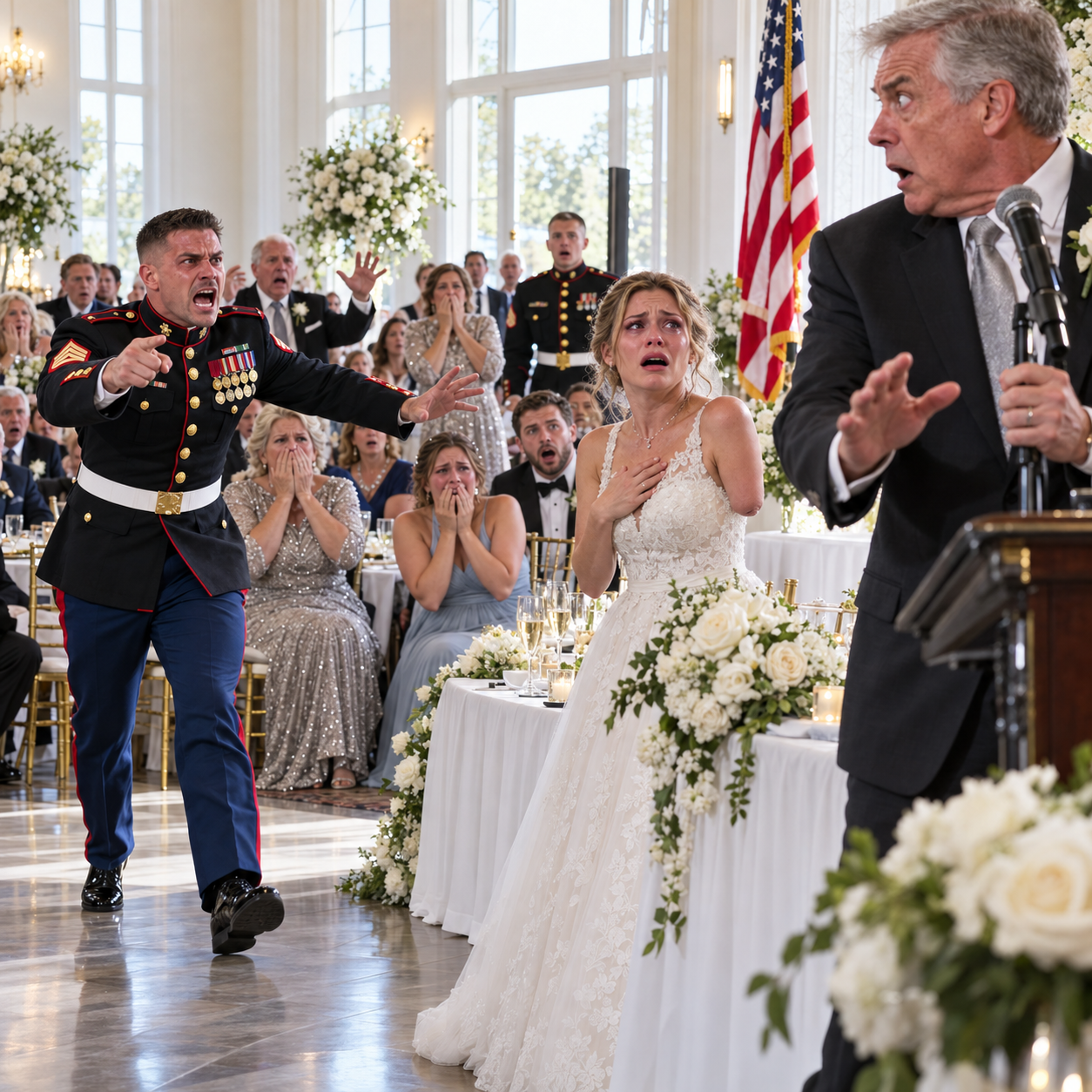
At The Reception Toast, My Father Took The Mic. He Announced, “The World Will Always See Her As Diminished.” The Hall Went Dead Quiet. Then A Decorated Marine Walked Straight To The Stage, His Voice Shaking With Rage. “That Arm Pulled Two Marines From Bleeding Out Under Fire.”
On the morning of my wedding, my father handed me a pair of custom white gloves and asked me to hide the prosthetic hand I came home from war with. My mother looked away, my family said nothing, and for one humiliating hour I let him have his way. At the reception, a Marine captain stood up and told two hundred guests what my father had spent years minimizing. Three weeks later, a courier delivered a document bearing his signature—and the date on it proved my wedding had been part of his plan long before I ever walked down the aisle.
Part 1
The note appeared under my hotel-room door at 8:12 on the morning I was supposed to get married. I know the exact time because I had been sitting at the vanity trying to fasten one of my grandmother’s pearl earrings with my prosthetic left hand, and the digital clock beside the coffee maker was reflected in the mirror. The note was written in my mother’s careful blue handwriting: “Your father needs five minutes with you before the ceremony. Please don’t make a scene.” I read it twice, then set it facedown beside the hairspray while my maid of honor pretended not to notice.
My name is Rachel Mercer, and by then I was thirty years old and had spent seven years serving as a combat medic with Marine units overseas. Two deployments, a handful of commendations I rarely talked about, and one afternoon in Afghanistan had left me with shrapnel scars climbing from my left elbow to my collarbone and a prosthetic hand built from titanium, carbon fiber, silicone, tiny motors, and more patience than I knew I possessed. I had spent almost eighteen months learning how to button a shirt, chop an onion, drive, type, and eventually stop apologizing when strangers stared. By the time I met Evan Hale, the arm felt less like evidence of something I had lost and more like proof that I had survived long enough to become someone new.
Evan taught American history at a public high school outside Charlottesville and had the irritating habit of remembering every student’s birthday. On our third date, during a movie neither of us was watching, he took my prosthetic hand in his and kept holding it through the credits without examining it, asking how much it cost, or making the face people sometimes made when they were trying too hard to seem comfortable. Two years later, when he proposed on my back porch during a thunderstorm, he told me he wanted to take my last name because his own family name carried no particular meaning to him and mine belonged to the woman he had chosen. I cried harder over that than I did over the ring.
My father, Graham Mercer, did not understand choices that could not be translated into leverage. He had spent thirty years turning a Richmond construction company into Mercer Development Group, a firm large enough to build office parks, waterfront complexes, and transportation hubs, and influential enough that city council members returned his phone calls before they returned calls from their own cousins. He understood permits, campaign contributions, zoning committees, seating charts, favors, rivalries, and exactly how long to let a silence hang during a negotiation. What he never understood was why his only daughter joined the military without consulting him, or why I refused to treat my injury like a family embarrassment he had been unfairly forced to manage.
Two years after I came home, he suggested over dinner that I wear a cosmetic glove over my prosthesis whenever we attended “important events.” He said it while cutting a steak, as casually as if he were recommending a different brand of toothpaste, and my mother, Eleanor, stared at her plate with the stillness she had perfected during twenty-seven years of marriage. My parents had divorced by then, but separation had not erased the reflexes Graham had trained into all of us. I told him no, left before dessert, and stopped calling him Dad not long afterward.
I invited him to my wedding anyway. Some childish corner of me had imagined that a daughter in a white dress might still be capable of reaching the part of him that boardrooms, divorces, money, and pride had not completely calcified. Instead, he arrived with his third wife, Pamela, and sixty additional guests whose names I learned only after the venue coordinator mentioned that “Mr. Mercer’s corporate tables” had required a last-minute seating adjustment. Evan wanted to remove them from the list, but the invitations had already gone out under our names.
The five minutes Graham requested took place in a small sitting room beside the estate chapel. He stood near an antique mirror in a charcoal suit, checking the brushed-gold cuff links he wore at ribbon cuttings, while I stood behind him in my wedding dress and watched his eyes move through my reflection from the magnolias pinned into my hair to the exposed carbon-fiber fingers resting against the skirt. “You look beautiful,” he said. Then his mouth tightened in the almost invisible way I had learned to read before I was old enough to drive.
He reached into a garment bag draped across a chair and removed a pair of white satin gloves with pearl buttons. “I had these made for you,” he said, opening the left one to show a reinforced interior shaped to fit over my prosthesis. “The seam is structured. It won’t bunch, and no one will be able to tell.” For several seconds I simply stared at them because humiliation, when it comes from someone who has practiced delivering it politely, can take a moment to register.
“There are Marines in that chapel who know exactly what happened to me,” I said. Graham nodded as though I had raised a reasonable but ultimately irrelevant concern, then told me there were also members of the Virginia Transportation Development Board in that chapel, along with lenders, investors, and people deciding which consortium would receive the Shenandoah Transit Corridor project. “They came to a wedding,” I said, and he looked at me with something close to pity.
“They came because I asked them to come,” he replied. “Rachel, perception matters. I’m not saying that is fair, but mature people understand the difference between reality and presentation.” He placed the gloves in my hand and added, very softly, “Today is not the day to make strangers confront something they didn’t ask to confront.”
That was the moment I should have dropped them on the floor and walked away. Instead I thought of my mother’s note, the chapel full of guests, Evan waiting at the altar, and all the small ways my father had trained me to calculate the cost of refusing him in public. I put the gloves on.
And when I walked toward the chapel doors, I failed to notice that Graham stayed behind just long enough to send someone a message from his phone.
Part 2
Evan saw the gloves during the ring exchange. His eyes dropped to my left hand, then lifted immediately to my face, and I gave him the smallest shake of my head because I could not explain my father’s cruelty while a minister was talking about covenant and two hundred people were watching us breathe. Evan did not press me. He slid the ring over the satin-covered prosthetic finger, held both my hands between his, and said his vows as though nothing in the room mattered except the promise he was making.
The moment we were alone in the corridor afterward, he closed the door behind us and asked, “Did Graham do that?” I nodded, suddenly ashamed in a way I had not felt since the first months after losing my hand, when grocery-store clerks would look from the prosthesis to my face and then quickly away. Evan reached for the pearl buttons. “Take them off.”
“The reception starts in ten minutes,” I said, which was not an argument and we both knew it. Evan held my gaze until I removed the right glove, then helped me work the left one over the carbon-fiber joints because the reinforced lining kept catching. He folded both gloves once, put them inside his jacket, and said, “You never have to protect me from him, Rachel.” Then we went into our wedding reception with my scars uncovered.
Meadowcrest Estate looked like the sort of place designed specifically to make ordinary people afraid to touch anything. Cream linens covered long tables beneath strands of warm Edison lights, blush roses sat in silver bowls, and beyond the open garden doors the Blue Ridge foothills faded into an October sunset. A jazz trio had replaced the string quartet from the ceremony, champagne moved through the room on polished trays, and Graham’s corporate guests occupied three tables directly facing the dance floor.
I heard my father before I saw him. He was standing near the outdoor bar with three men in tailored suits, including Commissioner Martin Corwin of the state development board, laughing with the relaxed confidence he used when he wanted powerful people to believe they had known him longer than they had. I would have kept walking if I had not heard my own name.
“The service was a phase at first,” Graham said, smiling into his bourbon. “You know young people. They need to test themselves, push back against family expectations, prove something dramatic.” One of the men asked about my recovery, and Graham lowered his voice just enough to signal intimacy while remaining loud enough for everyone nearby to hear.
“We’ve supported her through all of it,” he continued. “The military handles the basic hardware, of course, but there are expenses afterward people don’t consider. Therapy. Specialists. Psychological adjustment. I’ve covered a great deal privately.” He sighed and added, “The hardest thing is convincing someone who survived something terrible that surviving it doesn’t mean they’re finished healing.”
I stepped around the floral arrangement between us. Graham’s smile did not disappear, but his eyes changed with the speed of a man discovering an unexpected clause in a contract. “There she is,” he said warmly.
“Commissioner Corwin,” I said, extending my prosthetic hand. Corwin looked at it, then took it without hesitation, his grip firm and ordinary. When he asked where I had deployed, I told him, and he grew quiet before saying his nephew had served in the same province two years after I did.
“He came back,” Corwin said. “Three men in his unit didn’t.” I nodded. “That happens.” Graham touched my elbow as though he intended to steer me away, and I moved half a step so his hand fell.
Dinner began at seven. From the head table I watched my father circulate through the room, pausing exactly long enough at each corporate table, introducing a lender to a transportation consultant and a lobbyist to a county executive as if my wedding were a conference he had designed. I had grown up watching him work rooms and would have admired the skill if the room had not been mine.
At one point I noticed a woman I did not recognize carrying a slim tablet from table to table. She wore a Mercer Development name badge beneath the corsage pinned to her dress and seemed to be checking something each time Graham completed a conversation. When she reached Commissioner Corwin’s table, she tapped twice, looked toward my father, and moved on.
“Who is that?” I asked Evan. He glanced over. “I assumed she was family.”
“She isn’t mine.”
Dessert plates were being cleared when Graham picked up the wireless microphone. Evan’s fingers tightened around mine under the table before my father had spoken a word. The jazz trio stepped back, and Graham moved into the middle of the dance floor wearing the genial expression of a man who believed the next ten minutes belonged to him.
He welcomed Evan “to the Mercer family,” even though Evan had legally become Evan Mercer that afternoon, and earned the expected laughter with a joke about patience. Then his expression softened, his voice dropped, and I recognized the transition because I had seen it in charity speeches and investor presentations since childhood. Graham was about to turn my life into a story that served him.
“I have watched my daughter navigate extraordinary difficulty over the last seven years,” he began. “Her injuries changed all of us, and as a father, you never stop wishing you could have protected your child from consequences she was too young to understand.”
The room changed. Conversations stopped not because people were moved, but because they sensed danger.
“Some wounds are internal,” Graham continued, turning his eyes toward my left arm, “and some are visible. Families learn to adapt. We learn to cover what needs to be covered, present the best version of ourselves, and keep moving forward.”
At table twelve, a chair scraped against the floor.
Captain Monica Reed stood up.
Part 3
Monica was forty-three, broad-shouldered, close-cropped hair silvering slightly at the temples, and wearing Marine dress blues because she had asked me months earlier whether I wanted her there as a friend or as the officer who had once signed my evaluation reports. I told her both. She had driven almost eight hours to attend the wedding, and Graham had never bothered to ask who she was.
Seven years earlier, Monica had carried me nearly two hundred yards toward an evacuation point while blood soaked through her own trouser leg. She had later received fourteen stitches without anesthetic because the med tent had been overwhelmed, and the next morning she had yelled at me for apologizing about the weight of my gear. There were people in my life I loved because they were gentle, and people I loved because they had once refused to let me die.
Monica crossed the reception hall without hurrying. When she stopped in front of Graham, she extended one hand toward the microphone, and something in the absolute calm of that gesture made him surrender it before his pride could catch up with his instincts. She turned toward the guests.
“My name is Captain Monica Reed, United States Marine Corps, retired,” she said. “I served with Rachel Mercer during the operation in which she sustained the injuries being discussed tonight.” She paused, not theatrically but long enough to ensure every person in that hall understood she had not stood up to offer a toast.
“I want to correct part of the record,” Monica continued. “Accuracy matters when you are speaking publicly about another person’s service.”
Graham’s champagne glass remained suspended near his waist. Pamela stared at the floor.
Monica described the afternoon I lost my hand with the same discipline she had used in after-action reports. An explosion disabled the lead vehicle of our convoy and pinned Staff Sergeant Calvin Webb beneath twisted metal while gunfire came from a ridge north of the road. I moved forward because Webb’s femoral artery had been severed and because standing where I had been assigned to stand would have meant watching him die from a distance.
I treated Webb, then learned Lance Corporal Mateo Ruiz had been missed during the first casualty sweep. I went back for him. A secondary blast detonated while I was working, filling my left forearm and shoulder with fragments and destroying enough tissue that surgeons eventually had no choice about the hand, but I remained conscious long enough to finish the pressure dressing around Ruiz’s chest.
Both men lived.
“Staff Sergeant Webb has a four-year-old daughter now,” Monica said. “Her middle name is Rachel.”
Someone near the back of the hall inhaled sharply.
Monica turned toward Graham. “Her arm was not damaged because she was reckless, dramatic, confused, or too young to understand consequences. It was damaged while she was performing her duty and saving the lives of people entrusted to her care.”
My father’s face had gone gray beneath the reception lights.
“The suggestion that what remains should be hidden for anyone’s comfort is something I am unwilling to leave unchallenged,” Monica said. “Rachel Mercer is one of the finest people I served beside. She is not diminished. She is not a liability. She is the reason two families were spared a knock on the door and a folded flag.”
Then Monica looked directly at me. Her expression softened by a degree so small only someone who knew her well would have noticed.
“Congratulations, Rachel,” she said. “You have always known who you are. Don’t let anyone negotiate that away from you.”
She handed the microphone back to Graham.
For a few seconds, nobody moved. Then Commissioner Corwin stood. Two other development-board members beside him rose almost immediately, followed by Evan’s parents, my former unit, my cousins, teachers from Evan’s school, and eventually nearly everyone in the room.
The applause did not feel triumphant to me. It felt enormous and painful, because buried inside it was the realization that two hundred relative strangers had been willing to offer me a respect my father had withheld for years. Evan was crying beside me, and when I looked at my mother, she was crying too, but she still had not stood.
Graham placed the microphone on the bandstand and left through the catering corridor without saying another word. Pamela followed him so quickly she nearly collided with a server carrying coffee. I watched them disappear, then looked down at my left hand resting on the white tablecloth.
My mother had given me a silver bracelet that morning, telling me it would “soften the line” where the prosthetic met my wrist. At the time I had assumed the phrase was simply another inherited cruelty from Graham. Now I unclasped it, laid it beside my plate, and left my arm bare.
The rest of the reception became strangely beautiful. People danced. Evan’s students attempted a line dance nobody knew. Commissioner Corwin came to our table and shook my prosthetic hand again, then told me his nephew had once mentioned a medic named Mercer in an email from overseas, though he had never connected the name to me until that night.
Near eleven, Monica found me by the garden doors. “You should have taken off the gloves before the ceremony,” she said.
“I know.”
She studied me for a moment. “You know now.”
Then she hugged me with the force of someone checking structural integrity and drove back toward North Carolina before midnight because she had a training commitment the next afternoon.
Graham called three weeks later. His voicemail lasted more than four minutes and contained the words “context,” “optics,” “misinterpretation,” and “unfortunate scene.” He did not say “sorry” once.
I deleted it.
The next morning, a courier arrived at our house with an envelope addressed to me in block letters. Inside was a photocopy of a Mercer Development expense report, six pages of emails, and a seating chart from my wedding marked in red, yellow, and green.
Across the top, someone had typed:
SHENANDOAH CORRIDOR — RELATIONSHIP ACCESS EVENT.
And next to my name, in Graham’s handwriting, were four words:
Control prosthetic visibility. Essential.
Part 4
I sat at our kitchen table for nearly twenty minutes before I showed the papers to Evan. Rain tapped against the windows, the coffee beside me went cold, and the expense report remained open beneath my hand like something contaminated. Mercer Development had paid for hotel rooms, transportation, premium liquor, and “event hospitality” for eleven people connected to the state board evaluating bids for the Shenandoah Corridor project.
My wedding was listed internally as a “relationship cultivation opportunity.”
The attached emails were worse. Six months before Evan and I married, Graham had circulated a proposed guest list to his director of government relations, chief financial officer, and an outside public-relations consultant named Jocelyn Pike. Board members were color-coded by influence, spouses were identified by profession, and next to Commissioner Corwin’s name someone had written, “Family military connection—potential resonance with Rachel story.”
My story.
Not my life. Not my service. Not my injury.
My story.
Another email discussed photography. Jocelyn recommended “limiting visual emphasis on the prosthetic during formal family images because the metal component reads severe in lifestyle coverage.” Graham replied, “Agreed. We want resilience, not trauma.”
I read that sentence until the letters blurred.
The final page included a note about a business magazine that had been expected to photograph part of the reception. Graham apparently planned to pitch them a profile about “three generations of Virginia leadership and service,” positioning himself as both developer and devoted father of an injured veteran. The article had never happened because the reporter canceled two days before the wedding.
“He wanted to hide your hand and use your injury at the same time,” Evan said.
That was exactly it.
Graham did not hate what had happened to me. Hatred would have required honesty. He wanted the sacrifice when it made him look honorable, the wounded daughter when it generated sympathy, and the prosthetic removed whenever the physical reality became inconvenient.
At the bottom of the stack was a handwritten note from whoever had sent the package.
I’m sorry. I worked on the event billing and told myself it was ordinary corporate hospitality. After the wedding speech, I realized you had no idea. There is more. If you want it, call me.
A phone number followed.
I waited two days before calling. The woman who answered introduced herself as Leah Benton, a senior accounting manager at Mercer Development, and asked if I could meet somewhere public. We chose a diner halfway between Richmond and Charlottesville.
Leah was thirty-six, nervous, and carried a canvas tote bag she kept pressed against her ankle beneath the table. She told me Graham’s pursuit of the corridor contract had begun almost two years earlier and had grown increasingly aggressive after Mercer Development lost a major waterfront project in Norfolk. The company was overextended, two lenders were asking difficult questions, and winning Shenandoah had become less an ambition than a necessity.
“The wedding wasn’t the first event,” Leah said. “Golf weekends. Foundation dinners. Hunting trips. Your father is careful. Nothing obvious is ever paid directly to an official. It goes through consultants, nonprofits, spouses, conferences.”
“Why give this to me?”
She looked down at her coffee. “Because he made you part of it without your permission.”
Leah had watched Monica’s speech from the edge of the reception hall because Graham required several employees to attend. Afterward, she heard two executives laughing near the service corridor about how “the arm strategy” had backfired spectacularly.
Something in her expression told me that was not the whole answer.
“What else?” I asked.
She reached into her tote and removed a folder.
Inside was a three-year-old press packet I had never seen. It featured a photograph of me in uniform taken before my second deployment and a letter from Graham describing himself as the father of “a severely wounded combat veteran whose recovery revealed gaps in the systems serving America’s heroes.”
The letter had been used to support Mercer Development’s charitable foundation while soliciting donors, political contacts, and invitations to veterans-related events.
“He raised money with this?” I asked.
“Some of it went to veteran programs,” Leah said. “Some paid for foundation operations, events, consultants. I don’t know that anything was stolen. I’m telling you because your name opened doors.”
I drove home barely remembering the interstate.
For years Graham had told people he paid for my rehabilitation. In reality, the military and my insurance had covered almost everything. He had paid for one specialist consultation and several weeks in a private rehabilitation facility I never asked to attend because he preferred telling friends I was receiving “elite care.”
That small expenditure had grown in his stories until he became the man carrying his broken daughter back toward civilization.
When I confronted my mother, she went silent for so long I could hear the refrigerator compressor cycle on and off behind her.
“You knew,” I said.
“I knew about the foundation.”
“How much?”
“Rachel—”
“How much?”
She pressed one hand to her forehead. “Your father said the publicity helped donors understand why the work mattered.”
“And the wedding?”
“No.”
Her answer came too quickly.
I stood.
“Rachel, wait.”
That was when I understood something worse than the papers in Leah’s folder. My mother had spent my childhood teaching me that silence prevented explosions, when what it really did was leave the person throwing matches completely undisturbed.
As I reached the door, she said, “There was a meeting.”
I turned around.
She looked smaller than she had five minutes earlier.
“Six weeks before your wedding,” she whispered. “Graham asked me to help convince you to wear something over the prosthetic. He said the contract could save hundreds of jobs.”
Part 5
I did not speak to my mother for nearly a month. She called twice, sent three messages, and finally mailed a handwritten letter I placed unopened in the drawer where I kept warranty documents and old tax forms. Evan never told me what to do about her, which was one of the reasons I trusted him more than almost anyone I knew.
Graham reacted differently. Once he learned Leah had contacted me, his attorney called to remind me that Mercer Development’s documents were confidential and that “dissemination could cause significant harm to innocent employees.” The message was clever because the threat was buried beneath concern for people who had nothing to do with my father’s choices.
I told the attorney I had not disseminated anything. Then I hired my own.
Her name was Denise Harper, a former state ethics investigator with silver hair, red glasses, and the conversational warmth of a courthouse metal detector. She read the documents, asked me three questions, and said, “This stopped being a family disagreement the moment company money began purchasing access to officials involved in an active procurement.”
I told her I did not want revenge.
“Good,” she said. “Revenge makes people sloppy. Facts are usually sufficient.”
Commissioner Corwin had apparently reached the same conclusion. Two weeks after the wedding, he had recused himself from all deliberations concerning Mercer Development and privately disclosed to the board’s ethics counsel that he had accepted hospitality connected to an event he later learned was partly financed by a bidder. Other officials were interviewed.
The corridor award was postponed.
Financial reporters noticed.
Graham called me the evening the first article appeared. I answered because I wanted to hear what he would say when there was no audience to perform for.
“You understand what this is doing to the company?” he asked without greeting.
“You mean the investigation into what the company did?”
“Do not play semantics with me.”
I almost laughed. Graham accusing someone else of manipulating language was like a casino complaining about gambling.
He told me four hundred people depended on Mercer Development for their livelihoods. He told me competitors were feeding allegations to the press. He told me Leah was a disgruntled employee who had misunderstood normal relationship management.
Then he said, “You started this at the reception.”
I became so still that even Evan, sitting across the room, looked up.
“No,” I said. “You started it when you turned my wedding into a business event.”
“I invited colleagues.”
“You billed their rooms to the corridor pursuit.”
Silence.
That was how I knew the documents were real.
Graham changed tactics. His voice softened, becoming almost paternal. “Rachel, there are things you don’t understand about keeping a company alive. Decisions become more complicated when hundreds of families depend on you.”
“I understand triage,” I said. “You decide what can be saved without killing someone else.”
He hung up.
Three days later Denise received a formal request for an interview from the state procurement integrity office. I agreed to cooperate and gave them every document Leah had provided, along with the gloves Graham had commissioned and the card from my mother describing the bracelet she wanted me to wear. The investigator asked why the gloves mattered.
“Because they show intent,” Denise said before I could answer.
She was right.
The misconduct was not that Graham disliked my prosthesis. The misconduct was that he had tailored my appearance, guest list, family history, and military service to influence people controlling public money. The gloves were not merely cruel.
They were part of the presentation.
Leah provided records directly to investigators after obtaining her own counsel. Within another month, Mercer Development’s chief financial officer resigned, though his statement claimed the departure had been planned for personal reasons. Two executives went on leave.
My father’s board appointed an outside committee.
My mother appeared at our house on a Sunday afternoon carrying the unopened letter I had mailed back to her.
Evan offered her coffee and disappeared into the garden.
“I should have stood up,” she said.
“At the reception?”
“Long before that.”
I wanted to hate her cleanly. It would have been easier.
Instead I saw a sixty-two-year-old woman who had spent half her life arranging herself around one man’s temper and calling the arrangement peace. Understanding her did not make me ready to forgive her.
“Why did you put the note under my door?”
“Because he told me the company could lose the contract if you embarrassed him in front of the board.”
“And you believed him?”
She swallowed.
“I believed that if you refused, he would blame you.”
“He did anyway.”
“I know.”
Before leaving, she took a small envelope from her purse. Inside was an old photograph of me at seventeen, sitting on the hood of my first car with grease on my cheek and both hands raised toward the camera.
“I found something else when I was going through papers,” she said. “It isn’t about the wedding.”
The document beneath the photograph was dated eight years earlier, two months before I enlisted.
It was a letter from Graham to a state senator.
In it, my father described me as “a likely future face of the Mercer family’s civic leadership.”
My entire adult life, it seemed, had once existed on one of his plans.
Part 6
The letter should not have surprised me, but it did. Graham had written that I would eventually join Mercer Development’s community relations division, sit on charitable boards, and “extend the Mercer presence into the next generation.” I remembered being twenty-one and telling him I had enlisted, and suddenly his reaction made more sense.
He had not merely been angry that I chose a dangerous life.
I had walked away from the role he had already assigned me.
My mother admitted there had been conversations about my future for years. Graham had arranged an internship for me without asking, spoken to a graduate business program about admissions, and once told a donor that I would eventually run the family foundation. When I enlisted, he did not see independence.
He saw defection.
My injury made everything worse because it allowed him to rewrite the story. Instead of a daughter who had chosen a life beyond his control, I became a wounded child whose independence had supposedly ended in disaster and whose father had graciously stepped forward to repair the damage.
That was the deeper lie.
And once I saw it, dozens of old memories rearranged themselves.
Every time Graham introduced me as “our Marine” at a fundraiser after telling me privately not to wear sleeveless dresses because my scars attracted attention. Every time he offered to “handle” appointments I did not need him to handle. Every time he told a room full of people I was brave while treating me alone like I had ruined a product he once intended to display.
The procurement inquiry widened. Investigators found several instances where Mercer Development employees had charged personal hospitality involving officials to unrelated consulting accounts. None of the transactions alone was spectacular, but together they showed a culture built around plausible deniability.
Graham had always understood that the safest ethical line was the one crossed in increments.
The board placed him on temporary leave.
He blamed me publicly without using my name.
In an interview outside his office, he said “a painful family misunderstanding has been weaponized by competitors and former employees.” The sentence appeared in newspapers across Virginia before lunchtime.
I watched the clip once.
Then I turned it off.
Monica called that evening.
“Want me to come up there?” she asked.
“No.”
“Want me to threaten anyone?”
“You’re retired.”
“That was not an answer.”
I laughed for the first time all day.
The state asked me to testify at a closed administrative hearing. I wore a navy suit with sleeves ending above the wrist and no bracelet, glove, or cosmetic cover. Graham sat across the room with three attorneys.
He looked older.
I expected that to satisfy something in me.
It did not.
The investigators asked whether my father had invited development officials with my knowledge. No. Whether I had approved company payment for their travel or lodging. No. Whether I knew my military background was being referenced internally as part of an influence strategy. No.
Then they asked about the gloves.
I described the small room beside the chapel, his language about presentation, and the board members he mentioned by title. Graham stared at the table throughout my answer.
His attorney later suggested that any father might reasonably worry about a daughter feeling self-conscious on her wedding day.
I looked directly at Graham.
“I was not self-conscious until he told me I should be.”
No one in the room spoke for several seconds.
That line appeared in the final investigative report.
The state eventually concluded that Mercer Development had violated procurement ethics rules governing bidder hospitality and undisclosed attempts to cultivate decision-makers. The matter was referred for additional review, and the company was suspended from the corridor competition.
The contract went to a consortium from Northern Virginia.
Mercer Development did not collapse. That mattered to me because Graham had spent months implying that consequences for him would destroy hundreds of innocent families.
The company’s board removed him as chief executive, installed an interim leader, canceled two executive bonuses, and sold a recreational property that had been used for client weekends. Most employees kept their jobs.
The apocalypse my father predicted turned out to be governance.
My mother filed for a legal separation from the life she had built around him, though they had already been divorced for years emotionally and practically. She sold the house Graham still treated as his family headquarters and moved into a townhouse fifteen minutes from her sister.
I visited once.
We sat on folding chairs because her furniture had not arrived.
“I don’t expect you to forgive me,” she said.
“Good.”
She nodded, and strangely, that was the first conversation we had ever had that felt completely honest.
Graham sent me a letter the week he was removed from the company. It was six pages long.
The first five explained him.
The sixth finally contained the sentence I had waited years to hear.
“I am sorry you believed I was ashamed of you.”
I read it twice.
Then I understood he still could not say it.
He could apologize for my interpretation.
Not for what he had done.
I folded the letter, placed it back in the envelope, and never answered.
Part 7
A year after the wedding, Evan and I bought a small house outside Charlottesville with a deep front porch, warped hardwood floors, and a vegetable garden that received too much shade. The first summer we planted four zucchini plants because neither of us understood that four zucchini plants constituted an agricultural emergency. By August we were leaving vegetables on neighbors’ porches like anonymous threats.
Ordinary life turned out to be the thing I had wanted most.
Not vindication.
Not applause.
Not a newspaper correction.
I wanted Sunday coffee, Evan grading essays at the kitchen table, mud on the back steps, friends who entered without knocking, and a home in which nobody adjusted the lighting to make parts of me disappear.
I left the hospital position I had taken after active service and joined a veterans nonprofit coordinating employment and peer-support programs. The work was underfunded, frustrating, and more meaningful than almost anything I had done since leaving the military. My job was often less about finding veterans jobs than convincing them their lives had not become smaller simply because the world they returned to did not understand what they had carried home.
One afternoon a twenty-four-year-old former infantryman named Cody sat across from me and kept his right arm under the table. He had severe burn scarring and had been wearing long sleeves through a Virginia summer because his father told him employers might find the injuries “distracting.” I listened until he ran out of words.
Then I told him about the gloves.
Not Monica’s speech.
Not the applause.
The gloves.
I told him I had worn them.
His expression changed.
“You did?”
“For about an hour.”
“I thought people like you didn’t care what anybody thought.”
“There are no people like that.”
The next week he came to an interview wearing a short-sleeved shirt.
He did not get the job.
A month later, he got a better one.
Those were the victories I learned to trust because they did not depend on humiliating anyone else.
Graham’s name disappeared gradually from business pages. Mercer Development rebranded under a shortened name and issued ethics policies so detailed they were probably written by attorneys who had not slept. Leah Benton became controller at another company after spending months convinced no firm would hire a whistleblower.
When she called to tell me about the new job, I said, “You know none of this happens if you don’t send that envelope.”
She was quiet.
“Monica stood up first,” she said.
“Standing up is contagious.”
We both laughed, though there was truth in it.
My relationship with my mother settled into something narrower than reconciliation and more humane than estrangement. We had coffee every few months. I did not tell her everything anymore, and she no longer expected access to every part of my life simply because she was my mother.
Boundaries sounded cold when Graham used the word.
In practice, they felt like doors with handles on both sides.
He tried contacting me twice over the next two years. Once on my birthday, once after an article about our nonprofit mentioned me by name.
Both messages included updates about his life before asking about mine.
I did not respond.
People sometimes assume refusing reconciliation requires constant anger. For me it required the opposite.
Anger kept Graham in the room.
Indifference finally allowed him to leave it.
Evan never pushed me toward forgiveness. He had watched enough history repeat itself in textbooks to distrust the idea that peace required pretending harm had ended before the person causing it changed.
On our second anniversary, he placed a small wrapped box beside my breakfast plate.
Inside were the wedding gloves.
For one terrible second I thought he had misunderstood everything.
Then I saw they had been cut into narrow strips.
“What did you do?”
“I asked first,” he said quickly. “You told me last year I could throw them away.”
The strips had been sewn into the back of a shadow box beneath our wedding photograph. In the picture my prosthetic hand rested uncovered on Evan’s chest while we danced.
A brass plate below it read:
Nothing hidden.
I cried so hard I ruined breakfast.
Later that afternoon, another envelope arrived.
This one came from Monica.
Inside was a photograph taken at the reception just after she finished speaking. The camera had caught Graham leaving, Commissioner Corwin standing, Evan holding my hand, and me staring at my bare prosthesis on the table.
On the back Monica had written one sentence.
You were never waiting for me to stand up, Mercer.
You were waiting to see yourself remain seated without permission.
Part 8
It took me another year to understand what Monica meant. For a long time I remembered that reception as the night someone rescued me from my father, which was comforting but incomplete. Monica had defended me publicly, but the real change had happened earlier in a quiet hallway when Evan told me to take off the gloves and I chose to do it.
No applause.
No speech.
No witness except the man I had married.
Just a decision.
Years later, the wedding became one story among many I told only when it served some purpose. I stopped introducing myself through the injury. I stopped measuring progress by how little the prosthetic inconvenienced other people.
I learned woodworking badly.
I learned gardening worse.
I learned that carbon-fiber fingers can hold a paint roller surprisingly well and that dropping screws with a prosthetic hand is no more humiliating than dropping them with a biological one, because Evan dropped twice as many and blamed the floor.
Monica visited every autumn. She claimed the eight-hour drive was worth it because Virginia had better apple cider, though I suspected she simply liked insulting my vegetable garden in person. Staff Sergeant Calvin Webb came once with his wife and daughter, whose middle name was Rachel.
Meeting that little girl nearly destroyed me.
She was six by then, missing one front tooth, wearing purple sneakers, and entirely uninterested in the emotional significance of her own name. She asked whether my hand could crush a soda can.
I told her it could not.
She looked disappointed.
Her father laughed until he had to sit down.
Those moments mattered more than anything Graham ever said at the wedding.
Commissioner Corwin retired from state service a few years later. We exchanged Christmas cards but never became close, which I preferred. He had done the correct thing by reporting an ethical problem once he recognized it, and correctness did not need to become friendship to remain meaningful.
Leah married a firefighter and sent us a photograph from her own wedding.
Her note said, “No corporate tables.”
I framed it.
My mother eventually became someone I could spend an afternoon with without carrying armor into the room. She volunteered at a library, joined a hiking group, and learned to make decisions without immediately predicting Graham’s reaction. She once apologized again for the hotel-room note.
This time she did not explain herself.
“I helped him hurt you because I was afraid of what would happen if I didn’t,” she said. “That was still my choice.”
I believed her.
Forgiveness did not arrive dramatically.
I never told her everything was fine because it was not.
But I stopped needing her to suffer in proportion to the years I had spent wishing she would defend me.
Graham and I never reconciled.
I heard occasionally through relatives that he consulted on small development projects and spent part of each year in Florida. Someone told me he had softened.
Someone else told me he still described the investigation as a political ambush.
Neither report interested me very much.
That surprised people.
They expected the story to end with him crawling back, transformed by consequences, finally admitting I had been right.
Real life rarely arranges itself that neatly.
Some people lose status and learn humility.
Others lose status and develop better explanations.
My ending did not require Graham to become someone else.
It required me to stop postponing my peace until he did.
On our fifth wedding anniversary, Evan and I returned to Meadowcrest Estate. The property had changed owners, the reception hall had been renovated, and nobody working there recognized us until the events manager looked up our old reservation.
She asked whether we wanted to see the chapel.
We did.
The small side room where Graham had given me the gloves was still there, though the ivory bench had been replaced by two blue chairs. I stood in front of the same antique mirror and looked at myself.
Thirty-five.
A few new lines around my eyes.
Scars faded from angry red to silver.
Prosthetic upgraded twice since the wedding.
Still me.
Evan appeared behind me in the mirror.
“You okay?”
“Yeah.”
I meant it.
Outside, we walked through the reception hall, and I found roughly where table twelve had been. Nothing marked the spot where Monica stood.
No plaque.
No photograph.
No evidence that two hundred people once went silent while one woman corrected another person’s lie.
I was glad.
Some moments do not need monuments.
They simply change the direction of everything after them.
At home that night, I opened the drawer where I kept the few documents from the investigation I had chosen not to destroy. Graham’s six-page letter was still there beside the old photograph of seventeen-year-old me sitting on my first car with grease on my face and both hands raised toward the camera.
For years, that photograph hurt.
I used to look at the girl in it and think she had no idea what she was about to lose.
Now I saw something else.
She had no idea what she was going to survive.
I returned the picture to the drawer and threw Graham’s letter away.
Not ceremonially.
Not angrily.
I simply realized I no longer needed proof that he had failed to apologize correctly.
The next morning I went to work.
A newly separated Marine was waiting in my office, sitting rigidly in the chair near the window. He had a cane leaned against his knee and kept apologizing because his appointment had run long.
“You’re fine,” I told him.
He glanced at my prosthetic hand.
People still did that.
I let them.
After a moment he said, “Does it ever stop feeling like everybody notices?”
I considered giving him something polished about confidence.
Instead I told the truth.
“No. But eventually you stop believing their attention belongs to you.”
He looked at me.
I rested my titanium-and-carbon-fiber hand on the desk between us.
“My father once gave me a glove and told me covering this would make everyone else more comfortable,” I said. “For a little while, I believed him.”
“What changed?”
I thought of Evan in the hallway. Monica rising from table twelve. Leah sending the envelope. My mother finally admitting that fear did not erase responsibility. A child in purple sneakers asking whether I could crush a soda can.
Then I thought of myself taking off the glove before any of them knew what would happen next.
“I got tired of carrying someone else’s shame,” I said.
Outside my office window, late-afternoon sunlight reflected off the metal joints of my hand and scattered small bright shapes across the wall.
I did not move it out of the light.
THE END!
Disclaimer: Our stories are inspired by real-life events but are carefully rewritten for entertainment. Any resemblance to actual people or situations is purely coincidental.

