For 20 years, my father told relatives, old soldiers, and anyone who would listen that I had washed out of the Army and ended up “playing with dogs.” I let him. Then, at his old unit’s reunion, he introduced me as the daughter who couldn’t make it while hundreds of people stood nearby. I was ready to swallow the humiliation again—until a retired military working dog broke command, crossed an entire field, and pressed himself against my legs. Suddenly, every veteran around my father understood something he didn’t.
### Part 1
The kennels always woke before sunrise, and after twenty-one years in the Army, so did I. By 4:15 in the morning, the first restless claws would scrape against concrete, another dog would shake hard enough to rattle a kennel gate, and soon thirty animals would be standing, stretching, watching for me through the dim white lights. I knew which dog ate slowly, which one tried to flip his bowl, which retired shepherd needed medication hidden in wet food, and which young Malinois would pretend his left paw was fine until I touched it. The dogs never asked whether my father was proud of me; they only wanted to know whether I had shown up, and I always had.
My name is Camille Mercer, I was forty years old that summer, and I had spent almost my entire adult life as a military police soldier and military working dog handler. By then I supervised the kennel operation at the installation, trained younger handlers, evaluated teams, and dealt with enough paperwork to make my eighteen-year-old self laugh bitterly. None of that was particularly interesting to my father, Grant Mercer, who had served twenty-six years in the infantry and believed, with religious certainty, that there were soldiers like him and then there were people who supported soldiers like him. To Grant, dog handlers belonged firmly in the second category.
He had not always treated me like a disappointment because, when I was a child, he was gone too often to know enough about me to be disappointed. He existed mostly as framed photographs, postcards, and an enormous man who occasionally appeared in our kitchen smelling like canvas bags, aftershave, and airports. When he came home, my mother Evelyn cooked too much food, neighbors stopped by, and I sat at the table listening to stories about patrols, training exercises, impossible sergeants, and men whose names became familiar to me despite never meeting them. I worshiped him because children are good at turning absence into mythology.
When I was eighteen, I put my enlistment paperwork on that same kitchen table and expected one of the proudest moments of my life. Grant read the first page without sitting down, then looked at me as though I had announced I was moving to another planet. “Why would you want to do this?” he asked. I actually laughed because I thought he was joking, then realized from his expression that he wasn’t. “Because you spent my entire childhood telling me it mattered,” I said, and he immediately began listing careers that had nothing to do with the Army—teaching, nursing, county administration, anything except following him through the door he had spent years describing as sacred.
For a long time I told myself he had been worried about me. Age gave me a less comforting explanation. The Army had been the only place where Grant Mercer felt completely important, and the thought of his daughter entering that world did not feel to him like admiration; it felt like trespassing. I enlisted anyway, joined military police, and two years later earned selection for the working dog program. I called him expecting that accomplishment, at least, to change something.
“Dogs?” he said after a long silence.
“Military working dogs, Dad.”
“Right. Dogs.”
That single word carried more disappointment than shouting could have.
Soon a story began circulating through my family. According to Grant, I had tried to become a “real soldier,” failed, and been redirected somewhere easier. He never explained what test I supposedly failed because no one pressed him for details. He was Grant, the twenty-six-year infantryman, and I was the daughter who was always away, so his version arrived first and settled into the family like dust.
My mother knew it wasn’t accurate. That hurt more than his lies sometimes. Evelyn never repeated them enthusiastically, but she rarely contradicted him, either, because her entire marriage had been built around keeping Grant’s weather from becoming everybody else’s storm. When cousins joked about me “washing out,” she changed the subject. When neighbors asked what I really did, she said, “Camille works with Army dogs,” in the same tone another mother might use to explain that her daughter managed a pet store.
And I let them.
Every year I stayed silent made Grant’s version stronger. I told myself I was protecting something. I did not want my deployments, awards, scars, handlers, or dogs turned into pieces in a family argument, as though everything I had accomplished existed only to prove my father wrong. The work mattered too much to me to use it as ammunition. So I kept my career private, and privacy eventually became mistaken for emptiness.
That summer, my mother called while I was checking inventory in the kennel office. “Your father’s old company reunion is coming up,” she said. “They’re holding it during the installation open house.”
“I know.”
There was a pause. “He’d like you there.”
That surprised me enough to put down my pen.
“Did he say that?”
“Not exactly.”
I smiled despite myself. “Then you would like me there.”
“I would. And, Camille… please be patient with him. These men matter to him.”
Those words were so familiar that I could have mouthed them with her. Be patient. Don’t embarrass him. Let him have his day. Keep the peace.
“I’ll come,” I said.
What I did not mention was that I was already scheduled to be there because my own handlers were conducting a working dog demonstration during the open house. I could have attended in uniform, stood beside my teams, and let Grant discover the truth naturally. Instead, I made what I believed was the kinder choice. I arranged coverage, planned to wear jeans and a plain shirt, and decided that for one afternoon I would attend only as Grant Mercer’s daughter.
Three weeks before the reunion, my father called.
He skipped greeting me properly and went directly to instructions. “Some of the old guys haven’t seen each other in twenty years. Just don’t make anything weird, okay?”
“What would I make weird?”
“You know what I mean.”
I did, but I made him say it.
“No, Dad. I don’t.”
He exhaled through his nose. “They remember me a certain way. They don’t need the whole dog story.”
The dog story.
Twenty-one years had become the dog story.
“I won’t make it a thing,” I said.
“Good.”
Afterward I sat alone in the office, staring through the glass toward the retirement runs. One old dog was already watching me.
His name was Ranger.
He was a Belgian Malinois, thirteen years old, gray through the muzzle and nearly deaf in one ear. For six years, Ranger had been my partner. We had deployed twice, shared aircraft floors, freezing mornings, unbearable heat, boredom, fear, and the particular silence that happens when a dog stops walking because his nose has told him something human senses cannot.
He had retired years earlier, but arrangements had been made for him to remain near the kennel under the care of people who understood exactly what he was. I visited him constantly. Even at thirteen, even moving stiffly, Ranger recognized my footsteps from farther away than seemed possible.
That evening I opened his run and sat on the concrete beside him. “Apparently you’re just part of my dog story,” I murmured.
Ranger pushed his gray head under my hand.
A voice came from behind me. “You’re still letting your old man tell it wrong.”
I looked up and saw Henry Caldwell leaning against the doorway. Henry had run working dog programs longer than I had been in uniform, and retirement had failed to convince him to stay away.
“It’s easier,” I said.
“For him.”
“For everybody.”
Henry shook his head. “No. It’s easier for one person.”
Ranger sighed and settled his head across my thigh.
Henry looked at him, then back at me. “One day that dog is going to tell the truth for you, and you’re not going to be able to stop him.”
I laughed. “He can barely hear.”
“He can still smell your stubbornness.”
“Across a field full of people?”
Henry’s expression barely changed. “That dog found you once through smoke, blood, and enough noise to take half his hearing. You really think a bunch of retirees eating barbecue are going to confuse him?”
I ran my fingers through Ranger’s thinning fur and dismissed the thought.
A week later, my mother called again, and this time her voice sounded different. “Camille, I owe you an apology.”
I stopped walking.
She continued before courage left her. “I let your father tell that story because fighting him was harder. I told myself you didn’t care. I think I knew you did.”
For twenty years, I had imagined my father’s apology. I had never imagined hers.
“I kept quiet too,” I said.
“Yes, but you shouldn’t have needed your mother to be given instructions before she defended you.”
After we hung up, I sat in my truck for nearly half an hour, listening to the cooling engine tick beneath the hood. For the first time, I understood that my silence had not only protected my career from my father. It had helped him erase it.
I still planned to attend quietly.
I still left my uniform at home.
But when I drove toward the reunion that bright Saturday morning, something inside me had shifted.
For the first time in twenty years, I wasn’t sure I was willing to disappear just because disappearing made my father comfortable.
And somewhere across the installation, an old dog was about to make that decision for me.
### Part 2
The open house looked almost aggressively cheerful beneath the clear morning sky. Children ran between static displays, families posed beside military vehicles, smoke rolled from enormous barbecue grills, and loudspeakers carried announcements across the parade field. Farther down, beyond a rope line three people deep, my handlers were preparing for the working dog demonstration, but I deliberately walked in the opposite direction.
I found my father near a row of vehicles surrounded by men whose names I had heard since childhood. They were older now, heavier or thinner, their hair white or missing, but I recognized several from faded photographs. Grant stood in the middle of them laughing with his entire body, shoulders back and hands moving as he told some old story they had apparently heard enough times to interrupt at the correct places.
Watching him, I felt unexpectedly tender. He looked ten years younger. These men remembered him before mortgages, blood pressure medication, retirement, and the slowing knees he pretended not to have. They remembered Sergeant Mercer in the version of himself he loved best.
Then he saw me.
“Camille!” he called.
For one foolish second, I thought his happiness might carry over.
He hooked an arm lightly around my shoulder and turned me toward the group. “This is my daughter.”
A few men smiled.
Grant paused.
I knew that pause.
“She gave the Army a shot too,” he continued. “Washed out early, couldn’t really stick it. She’s still around the installation, though. Does some work with the dogs.”
The words landed almost gently, which somehow made them more humiliating.
One veteran nodded sympathetically. “Well, military life’s not for everybody.”
Another said, “At least you tried.”
My throat tightened. Twenty-one years of predawn concrete floors, deployments, injured handlers, broken equipment, training records, funerals, evaluations, and dogs growing old collapsed into at least you tried.
I could have corrected him with one sentence.
Instead I smiled.
“Nice meeting you gentlemen.”
I turned away before my face could betray me.
Then something changed across the field.
It started with the crowd near the dog demonstration shifting strangely. People stopped looking forward and began turning sideways. One of my young handlers, Staff Sergeant Leah Brooks, suddenly moved toward the rope opening with an expression that made me stop walking.
Then I saw Ranger.
He had been brought out only for a brief retirement recognition, not to work. He had apparently been lying beside Leah moments earlier, old joints stretched in the sun.
Now he was standing.
Even from a distance I recognized the posture. His head was high, ears forward, body trembling with an intensity I had not seen in years.
He was looking directly at me.
“Ranger,” Leah commanded.
He ignored her.
My breath caught.
“Stay.”
Nothing.
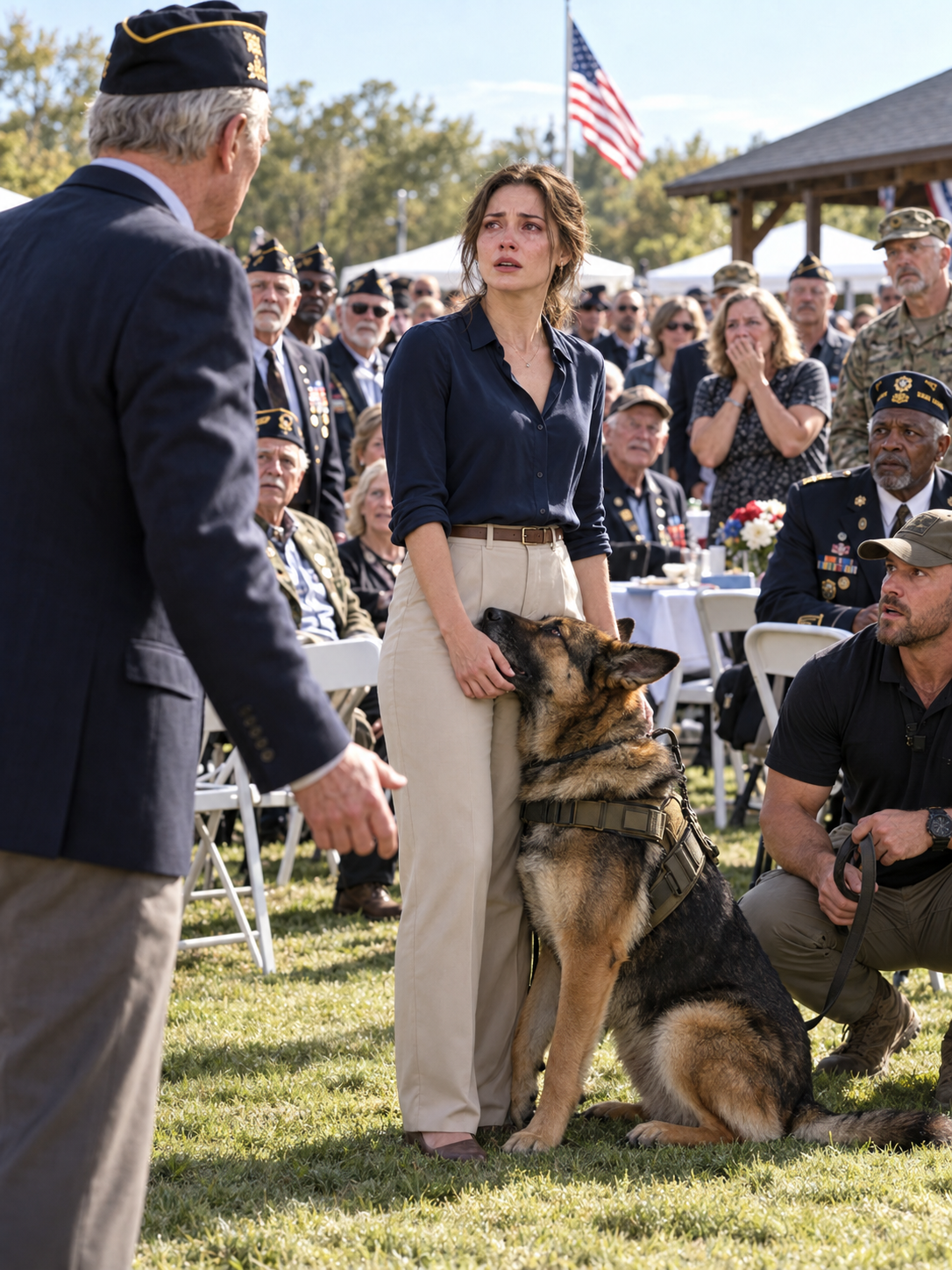
Then the old dog began walking.
Not running. He couldn’t run anymore. Each step looked deliberate, stiff, almost painful, but he moved straight toward me.
People parted automatically.
“What’s he doing?” someone near my father asked.
I could not answer.
Ranger passed between strangers, children, folding chairs, and veterans. Leah followed several paces behind but did not pull him back. She understood what everyone familiar with working dogs was beginning to understand.
This was not an excited pet recognizing someone.
Military working dogs were trained around distractions until obedience became as automatic as breathing. Ranger had spent his career learning that commands mattered regardless of noise, fear, exhaustion, or instinct. Now, thirteen years old and nearly deaf on one side, he had ignored a trained handler and crossed roughly a hundred feet of crowded field because he had found me.
When he reached me, he pressed his entire body into my legs.
I almost fell.
“Hey,” I whispered, dropping immediately to my knees. “Hey, old man.”
Ranger pushed his head hard against my chest.
He was shaking.
I wrapped both arms around him and felt the frantic rhythm beneath his ribs.
“You found me,” I whispered near his ear. “I’m right here.”
The field around us seemed impossibly quiet.
I slid one hand behind Ranger’s scarred ear, touching the exact place I had touched hundreds of times after searches, flights, medical checks, nightmares, and long hours when neither of us needed anything except confirmation that the other was still there.
Someone stepped beside my father.
Henry Caldwell.
“Grant,” he said.
My father looked irritated by the interruption. “Henry.”
“Do you know whose dog that is?”
Grant gave a short laugh. “Apparently Camille knows him.”
No one joined him.
Henry looked toward me kneeling in the grass.
“That isn’t what I asked.”
Something in his voice finally made Grant pay attention.
Henry continued. “That dog was Sergeant Camille Mercer’s working partner for six years.”
Grant’s smile weakened.
One of his old friends looked sharply at him.
Henry kept going. “Two deployments. Patrol and detection. One of the strongest teams we had in that period.”
Grant glanced around as though expecting someone to correct Henry.
Nobody did.
“She told me she worked around dogs,” he said.
Henry’s jaw tightened. “She didn’t work around them. She worked them. Then she trained handlers. Then she ran teams. Now she runs this kennel.”
My father’s face emptied.
I stayed with Ranger.
I had imagined confronting Grant hundreds of times, but now the confrontation belonged to everyone except me. My only concern was the dog trembling against my chest.
A gray-mustached veteran beside Grant removed his cap.
The gesture was small, almost private, but I saw it.
So did my father.
“Grant,” another man said quietly, “you told us she washed out.”
My father stared at me.
For once, he had no immediate answer.
Henry looked down at Ranger and seemed to make a decision. “You know why that dog won’t leave her?”
“Because she trained him?” Grant asked weakly.
“No.”
I closed my eyes.
I knew what was coming.
Henry pointed toward the scar along Ranger’s side, visible beneath his thinning coat. “That scar and the one Camille carries came from the same morning.”
My father looked at me as though I had suddenly become a stranger.
The memory came back despite every effort I had spent years making not to invite it. Spring of 2015. A road covered in dust. Ranger stopping so sharply that the lead tightened in my hand. His alert. The convoy halting. Then the sudden violence that followed because the buried danger had only been the beginning.
There had been a young soldier caught away from cover.
I had moved toward him.
Ranger came with me.
Noise erased thought. Dust filled my mouth. Somewhere between one step and the next, something struck hard enough to turn the world white. I remember hitting the ground. I remember Ranger yelping. I remember seeing blood near his ear and thinking, absurdly, not the dog.
We got the soldier behind cover.
Ranger lay across my legs afterward and refused to move.
Part of his hearing never returned.
Neither did the clean movement in my hip.
I received decorations for that morning that eventually disappeared into a drawer because metal cannot explain what a day cost. Ranger received recognition too, plus years of veterinary care and the retirement I had promised him every time he had climbed into another aircraft beside me.
I had never told my father.
Not because I hated him.
Because there had been a night in a hospital when I held my phone and imagined explaining everything, and I realized I would be offering the worst morning of my life as evidence in a family argument. I could already hear the invisible sentence beneath the story: See, Dad? I was a real soldier after all.
I refused.
That morning belonged to the soldier we carried, the dog who lost part of his hearing, the people who had been there, and the version of me who woke afterward hurting. It did not belong on my father’s scoreboard.
So I put down the phone.
And silence became twenty years of misunderstanding.
Now Henry was giving those buried facts back to the world without my permission.
“She was decorated for what happened,” he told Grant.
“What decoration?” someone asked.
Henry answered quietly.
The men around my father changed.
Nobody applauded. Nobody gasped. Soldiers rarely react the way movies suggest they do. They simply became still.
Grant crouched beside me, awkwardly because his knees bothered him.
“Camille.”
I kept stroking Ranger’s neck.
“What are they talking about?”
“His name is Ranger,” I said.
“I know that now. I mean—”
“He was my partner.”
My father swallowed.
“We deployed twice. We were injured on the same mission.”
“You never told me.”
That hurt more than I expected.
I finally looked at him.
“You never asked.”
His face shifted as if I had slapped him, though I had barely raised my voice.
Behind him stood the men whose approval had mattered enough for him to reduce his own daughter.
Now every one of them was looking at him.
Grant opened his mouth.
No story came out.
And for the first time in my life, I watched my father realize that the lie he had spent twenty years telling about me had said far more about him than it had ever said about me.
### Part 3
My father tried to stand and recover himself the way he had recovered from awkward moments his entire life. “Now hold on,” he said, looking toward his old friends. “She’s my daughter. Obviously I know what—”
His sentence died halfway through.
Nobody challenged him.
They did something worse.
They looked at Ranger.
The old dog had finally lowered himself onto the grass but still leaned against my thigh, one paw resting across my boot. He had made his decision about me years ago, and everyone on that field who understood working dogs knew exactly what they were seeing. Rank could be exaggerated, stories could be polished, families could repeat convenient lies, but you could not explain away a retired patrol dog breaking command and spending the last strength in his legs to reach one specific person.
The gray-mustached veteran who had removed his cap stepped closer. “Grant, you said she couldn’t cut it.”
My father’s eyes dropped.
“I thought—”
“No,” I said.
It was the first time I interrupted him.
He looked at me.
“You didn’t think I washed out. You decided I did.”
His face reddened, but I continued before he could retreat into anger.
“You decided what my career meant before you ever asked me about it. There’s a difference.”
Ranger shifted, and I automatically steadied him.
Henry stepped in before the moment could become something uglier. He announced that Ranger had been brought out for recognition and asked everyone to give the dog some room. Leah knelt beside me, one hand gently touching Ranger’s flank, and several members of my kennel section quietly moved closer.
That was when my father noticed them.
“Morning, Sergeant Major,” one young soldier said to me.
Grant’s eyes flicked toward my civilian clothes.
Another handler leaned over Ranger. “He’s breathing easier now, Sergeant Major.”
I watched the final piece land.
My father had been told I was not merely someone who happened to remain around the installation. He was now watching younger soldiers defer to me without performance or hesitation.
Henry crouched and examined Ranger. “Stubborn old animal.”
“He learned from you,” I said.
“That’s insulting.”
Leah almost laughed through the tears in her eyes.
My father stood a few feet away, isolated in a crowd of his own making.
Eventually Henry told the public version of Ranger’s service. He kept my role brief, exactly as I would have wanted, but there was no way to tell the dog’s story without explaining why he had crossed the field.
The buried hazard Ranger detected had stopped a convoy. The attack that followed had wounded people. Ranger and I had moved together toward one of them. We had both been injured.
Henry did not describe blood or chaos. He described choices.
That was worse for my father.
When Henry mentioned my commendation, Grant physically flinched.
“You had that?” he asked after the crowd began moving again.
“I still do.”
“And a Purple Heart?”
“Yes.”
“Where?”
“In a drawer.”
He stared. “Why would you put that in a drawer?”
“Where did you want me to put it?”
He looked toward his friends.
I understood instantly.
“On a wall?” I asked. “So you’d have noticed it?”
His mouth tightened.
I stood slowly, my hip protesting in the familiar way it did after kneeling too long. Ranger attempted to rise with me, so Leah supported his harness while I kept a hand under his chest.
My father saw the movement.
“That’s from then?”
“Partly.”
He rubbed his face. “Camille, I didn’t know.”
“You keep saying that like someone prevented you from knowing.”
My mother appeared through the crowd at that moment. One look at Grant’s face, another at Ranger against me, and she understood enough to stop moving.
Grant looked at her. “Did you know?”
She hesitated.
“Some of it.”
His hurt almost made me laugh, but there was nothing funny in it.
“You knew and didn’t tell me?”
Evelyn’s expression changed in a way I had rarely seen during their marriage. “She was your daughter, Grant. Why was it my job to brief you on her life?”
He had no answer.
My mother came to me instead and touched my shoulder.
“Is this Ranger?”
I nodded.
Her eyes filled immediately. Unlike my father, she had heard his name over the years, though mostly in fragments I had allowed myself to share.
“He found you,” she whispered.
“Apparently.”
She knelt carefully and let Ranger smell her fingers.
My father watched us from several feet away.
Then, perhaps because embarrassment was becoming unbearable, he shifted toward his old friends. “Gentlemen, I need to correct something.”
I stood.
“Dad.”
He turned.
“Not here.”
Confusion crossed his face. “I’m trying to fix it.”
“No. You’re trying to fix what they think of you.”
His expression tightened.
Maybe the sentence was unfair. Maybe it was exactly fair.
“You lied to them publicly,” I said. “Correct that if you want. But don’t turn apologizing to me into another performance for your unit.”
“I’m not performing.”
“You’ve been performing since I arrived.”
The words stayed between us.
Grant glanced at Ranger, then at the men nearby.
“What do you want me to do?”
It was such an unfamiliar question from him that I nearly missed its importance.
“Come to the kennel Thursday.”
“The kennel?”
“Yes.”
“Why?”
“Because nobody there cares about your reputation.”
He looked genuinely uncomfortable.
I almost smiled.
“Just dogs, feed bags, concrete, and me,” I said. “If you want to talk, do it there.”
He considered arguing.
Instead he nodded.
Thursday morning, I expected him not to show.
At 8:07, he appeared in the kennel doorway wearing khakis, polished shoes, and a collared shirt completely inappropriate for the environment. Thirty dogs announced his arrival in a deafening wave.
Grant froze.
I continued filling out a medication log.
“You going to let me stand here?” he asked after several seconds.
“I’m working.”
He waited.
That alone was new.
When I finished, I gestured toward the office. Ranger was asleep on a thick blanket in the corner, his breathing slow.
My father sat across from me.
For nearly a minute neither of us spoke.
Finally, Grant stared at his hands.
“I knew.”
I frowned.
“Not the details,” he said. “I didn’t know about the mission or the medals. But I knew you hadn’t washed out.”
The admission struck harder than the public humiliation had.
“You knew?”
“I knew you stayed in. Obviously.”
“Then why tell people I failed?”
He looked toward Ranger instead of me.
“Because if you succeeded…”
He stopped.
“Say it.”
His jaw worked.
“If you succeeded in the Army, then the Army wasn’t mine anymore.”
I felt something cold move through my chest.
He continued slowly, each word apparently costing him. “I had twenty-six years. That was what I was good at, Camille. That’s where people respected me. Then you enlisted and I told myself you’d understand after a year that it wasn’t your life. You didn’t. You kept going.”
“I was supposed to quit so you could feel special?”
“When you say it like that, it sounds pathetic.”
“It is pathetic.”
He nodded.
That surprised me more than anger would have.
“When you got the dog assignment,” he said, “I grabbed onto it. Told myself you’d been pushed sideways. Then every year you stayed in made that explanation harder to believe, so I told it more often.”
“You needed me to fail.”
“I needed me to still be the soldier in the family.”
Ranger stirred in the corner.
My father looked at him.
“Then that dog crossed the field.”
Neither of us spoke.
Grant swallowed.
“And I saw those men look at you the way they used to look at people I admired. I realized I’d spent twenty years making my own daughter smaller because I was afraid she’d become bigger than me.”
I leaned back in my chair.
There it was.
No excuses.
No misunderstanding.
No “I only wanted what was best for you.”
Just something ugly and human.
“I can’t give you those twenty years back,” he said.
“No.”
“I can tell everyone I lied.”
“You should.”
“And I can ask you to forgive me.”
“You can ask.”
He looked up.
I did not rescue him.
“I’m not there yet,” I said.
Pain crossed his face, but I continued.
“You don’t get one honest conversation and a clean slate. That’s not how this works.”
He nodded slowly.
“Can I come back?”
The question surprised both of us.
“Why?”
He glanced toward Ranger.
“Because I realized yesterday I don’t know anything about the life my daughter actually lived.”
For the first time, I believed he might understand the size of what he had done.
Not enough to forgive him.
But enough to allow another Thursday.
### Part 4
My father returned the following week, then the week after that. At first he stayed near the office because the kennel aisle overwhelmed him. Thirty dogs can make a man who once crossed hostile terrain look suddenly uncertain, especially when several decide simultaneously that his suspiciously clean shoes deserve investigation.
He asked questions badly in the beginning. “So what does that one do?” eventually became, “What is Sergeant Brooks training Atlas to indicate?” and “Why does Cooper respond differently to hand signals?” He stopped calling them “the dogs” and started learning names. I had spent two decades hoping my father would respect my work, yet when respect finally began appearing, it arrived in such ordinary forms that it almost hurt more.
One Saturday morning, I heard him walking down the aisle before he knew I was nearby.
“Morning, Cooper.”
A kennel door rattled.
“Settle down, Atlas.”
Then another few steps.
“Hey, Ranger.”
I stood motionless in the feed room holding a scoop of kibble.
My father had called my entire career the dog story.
Now he knew their names.
I stayed in the feed room until the pressure behind my eyes passed.
Ranger grew weaker as summer moved toward fall. He slept more, ate less, and needed help standing on bad mornings. I moved a bed into my office made from an old military blanket because he preferred being near familiar sounds rather than isolated somewhere quiet.
Grant began sitting with him.
At first Ranger merely tolerated him.
Then one afternoon I returned from inspecting equipment and found my father asleep on a crate, chin against his chest. His hand hung beside him, fingers nearly touching the floor.
Ranger’s gray head rested against those fingers.
I did not wake either of them.
At family dinner that August, my cousin Daniel accidentally reopened the old wound. He had been teasing me about always smelling like kennels and said, “Well, at least Uncle Grant gave the family one real Army career.”
The table became quiet.
I kept cutting my food.
Grant placed his fork down.
“Daniel.”
My cousin grinned, expecting reinforcement.
“Camille didn’t wash out.”
Daniel’s smile faded.
Grant looked around the table. “I said she did. For years. That was a lie.”
My mother stopped moving entirely.
“I was jealous of my own daughter,” he continued. “I decided that if I made her service sound small, mine would stay important. So don’t repeat that joke again.”
Nobody spoke.
Grant picked up his fork and returned to dinner.
My mother stared at him like she had discovered someone wearing her husband’s face.
Later we washed dishes together.
“I should have stopped him years ago,” she said.
I handed her a plate.
“You should have.”
She winced, perhaps expecting comfort.
I did not want to punish her, but I was finished making true things softer just because the people hearing them wished they were different.
“I was afraid of fighting with him,” she said.
“I know.”
“I told myself you were strong enough not to care.”
“That was convenient.”
She nodded.
After a moment she whispered, “I’m sorry.”
I looked at my mother, really looked at her. She had spent decades arranging herself around Grant’s certainty, and I had spent nearly as long pretending I needed nothing from either of them.
“I kept you out too,” I said. “After a while I stopped giving you a chance to know me.”
She dried another plate.
“We were a strange little family, weren’t we?”
“We’re still strange.”
That made her laugh.
The laughter helped.
My father did not become a completely different person. He still interrupted stories, drove too fast, believed instructions were improved by repeating them louder, and occasionally began sentences with “Back when I was in…” before remembering that everyone at the table already knew.
But he began catching himself.
That mattered.
One rainy Saturday, my hip was aching badly while we checked Ranger.
Grant noticed me favoring one leg.
“Does it always hurt like that?”
“No.”
“When?”
“Cold. Rain. Too much kneeling.”
He stared at the floor.
“Did it hurt badly when it happened?”
There was no competition in the question.
No opportunity waiting behind it for him to tell me about his worst injury.
So I answered honestly.
“Yes.”
He nodded.
“Was Ranger conscious?”
“Mostly.”
“You were worried about him.”
“More than myself.”
“I figured.”
I looked at him.
He gave a sad little smile. “I’m starting to understand you.”
“You’ve had forty years.”
“I’ve wasted time before.”
That was the closest he came to asking me not to waste more with him.
I did not promise anything.
Forgiveness, if it came, would not be a declaration. I had no interest in giving him a dramatic scene where twenty years vanished because he had finally learned enough humility to regret them.
What I gave him was access.
Another Saturday.
Another conversation.
Another opportunity not to repeat what he had done.
That was enough.
In early September, Ranger stopped finishing meals.
I knew before the veterinarian said anything. People who work with dogs long enough learn that knowledge in the worst possible way—the slight change in breathing, the eyes that remain peaceful but distant, the moment getting up becomes an effort instead of a habit.
I spent more afternoons in the office beside him.
Grant started arriving without being invited.
He never touched Ranger immediately. He always sat nearby first and let the old dog decide.
One afternoon, while Ranger slept with his muzzle across my boot, my father asked, “Do you think he knew what he was doing at the reunion?”
“Crossing the field?”
“Yes.”
“I think he smelled me, recognized me, and wanted to be where I was.”
Grant shook his head.
“No. I mean the rest of it.”
I almost laughed.
“You think he deliberately destroyed your reputation?”
“When you put it that way… maybe.”
“He was a very judgmental dog.”
Grant smiled.
Then his eyes became serious.
“He did something for me too.”
I waited.
“He made me ashamed.”
“That’s a gift?”
“It was apparently one I needed.”
That answer stayed with me.
Two weeks later, I arrived before dawn and found Ranger already awake.
He watched me come through the office doorway.
His tail tapped once against the blanket.
“Morning, old man.”
I lowered myself beside him.
He put his head on my boot.
I worked from the floor that morning with my laptop balanced on one knee.
Around noon, I realized his breathing had changed.
I called the veterinarian.
Then I called no one else.
Ranger had spent his life surrounded by commands, radios, engines, strange buildings, aircraft, and human urgency. I did not want his last moments turned into an event.
I kept one hand behind his ear.
“You’ve done enough,” I whispered. “You can quit now.”
His chest rose.
Fell.
Then did not rise again.
The kennel went strangely quiet during the afternoon, as though every dog understood one voice was missing.
I wrapped Ranger in the old blanket and sat beside him until arrangements were made.
At six that evening, my father’s truck appeared outside.
I had not called him.
Grant walked into the office, saw the empty bed, and stopped.
Neither of us spoke for a long time.
Finally he sat on the overturned feed crate where he always sat.
I kept cleaning because cleaning was something my hands knew how to do when the rest of me did not know how to exist.
My father looked at Ranger’s empty place.
Then he said the sentence I had waited my entire life to hear.
“Tell me about him.”
I stopped moving.
“The whole thing,” Grant added. “From the beginning. I want to know everything this time.”
So I sat down on the concrete across from my father.
And for the first time, I began telling him my life without making any part of it smaller.
### Part 5
I started with Ranger at three years old because that was the version I could bear remembering first. He had too much drive, terrible patience, and a ridiculous habit of trying to continue working long after every other dog had decided the day should be over. During our first weeks together, he tested every boundary I established and then looked offended when I enforced one.
Grant smiled. “Sounds familiar.”
“Don’t insult the dog.”
That earned a quiet laugh.
Then I told him about our first successful search together, the moment Ranger suddenly understood that the game we had practiced endlessly was real work. I described the change in his body when he found something, the focus, the certainty, the way learning to read him eventually became almost like reading another part of myself.
My father listened.
That was the miracle.
He did not interrupt with a story from his infantry days. He did not compare. He did not explain my own career back to me.
I told him about deployments without turning them into action stories. Most of military life, I explained, was waiting—the same equipment checks, the same routines, the same uncomfortable hours repeated until suddenly the routine mattered more than anything in the world.
Then I told him about 2015.
Not every detail.
Some memories still belonged to the people who had lived them.
I described Ranger’s alert, the stopped vehicles, the attack afterward, the soldier who needed help, and the decision to leave cover. I told Grant that Ranger came because telling him to stay had never mattered much when he believed I was going somewhere dangerous.
I told him about the blast.
The ringing silence afterward.
Ranger’s injured ear.
The warm weight of the dog refusing to leave my legs while other people tried to assess both of us.
Grant’s eyes closed.
I continued.
“I almost called you from the hospital.”
His eyes opened.
“You did?”
“I had the phone in my hand.”
“Why didn’t you?”
“Because I realized I was about to use the worst day of my life to prove something to you.”
He looked down.
“I imagined saying, ‘See? I count now.’ And I hated myself for even thinking it.”
“Camille—”
“I didn’t want the soldier we helped or Ranger getting hurt or anything that happened that morning turned into evidence in some argument between you and me. So I put the phone away.”
My father covered his mouth with one hand.
“All those years,” he whispered.
“Yes.”
“I could have known.”
“Yes.”
He sat with it.
That was another thing he had learned.
He no longer demanded that discomfort end immediately.
I told him about becoming responsible for younger handlers, about sending people toward assignments knowing exactly what uncertainty waited for them. I explained why I liked the kennels before dawn, why thirty animals waking together made more sense to me than rooms full of people, and why there was peace in a relationship where trust could not be negotiated with reputation.
Finally I said, “This was the place where I became myself, Dad. That’s why I protected it from you.”
He nodded slowly.
“I understand.”
“No, you don’t fully.”
He accepted that too.
“But I’m trying.”
“That I believe.”
We sat surrounded by the smell of disinfectant, canvas leads, dog food, and rain blowing against the windows.
My father looked toward Ranger’s empty bed.
“I spent twenty-six years being proud that I was the soldier in this family.”
I said nothing.
He rubbed his palms against his knees.
“Turns out I wasn’t the soldier. I was just the loudest one.”
I wanted to reject that because I knew what his service had meant and because cruelty would have been easy in that moment.
Instead I gave him the same truth I had given him on the reunion field.
“Your service is yours, Dad. Mine is mine. You never needed to make either one smaller.”
He nodded.
“I know that now.”
Then his voice broke slightly.
“I’m sorry it took that dog dying before I learned how to listen.”
I looked at the empty blanket.
“He had good timing.”
Grant laughed through something dangerously close to tears.
My father almost never cried. I had seen him at funerals with his jaw locked and eyes dry. That evening he stared toward the floor until his breathing steadied, and I gave him the dignity of pretending not to notice.
Before he left, he paused in the doorway.
“At the next reunion, I want to tell them the truth.”
“You already corrected some of it.”
“Not enough.”
I waited.
“I told the lie in front of those men for years,” he said. “I should tell the truth in front of them too. But only if you’re okay with it.”
That final sentence mattered more than everything before it.
He was asking permission.
“Tell them,” I said. “Just don’t turn me into another one of your stories.”
He smiled faintly.
“Fair.”
The following summer, he did exactly what he promised.
I did not attend his reunion. I had nothing to prove there anymore.
According to my mother, Grant stood in front of the same men and told them plainly that he had lied about his daughter because he had been jealous of her career. He explained that I had served for more than two decades, deployed as a working dog handler, been decorated, later trained handlers, and eventually supervised the kennel operation.
Then he did something that surprised me.
He stopped talking.
No speech about fatherhood.
No dramatic conclusion about redemption.
No attempt to make my accomplishments proof that he had raised me correctly.
He simply said, “I was wrong about my daughter, and some of you believed what I said because you trusted me. That’s on me. I wanted to correct it.”
Then he sat down.
When my mother told me, I believed her because that version sounded nothing like the old Grant.
He kept coming to the kennels.
Sometimes he helped with harmless chores. Mostly he stayed out of everyone’s way, which was an achievement in itself.
Ranger was buried near the kennel area beneath a simple marker arranged by handlers who had known him.
My father visited it alone sometimes.
I once saw his truck parked near the site and considered walking over, then decided against it. Some apologies do not need witnesses.
People occasionally ask whether I forgave my father.
The answer is complicated.
I did not forgive him because Ranger crossed a field.
I did not forgive him because he embarrassed himself publicly, confessed privately, corrected the lie, or learned the dogs’ names.
Those things mattered, but twenty years do not disappear because someone finally understands what they cost.
What changed was that I stopped requiring the past to become different before I could have a future.
My father and I built something new alongside the damage.
There were still subjects that hurt.
There were still family gatherings where someone repeated an old version and I felt anger rise before remembering that Grant would now correct them before I had the chance.
There were mornings when I looked at Ranger’s empty bed and thought about how absurd it was that a dying dog had managed to accomplish what decades of human conversation had not.
But the strongest memory remained the field.
Grant with his old unit.
His hand on my shoulder.
“Washed out early.”
Then Ranger standing.
The leash going slack.
The crowd opening.
That old gray dog walking directly toward me as though nobody else existed.
He did not care what Grant had told anyone.
He did not care what rank I wore, which medals were hidden in my drawer, or whether people believed my career had mattered.
Ranger remembered something simpler.
I was the person who had shown up.
Every morning.
Every search.
Every terrible day.
Every recovery afterward.
To him, that had always been enough.
Years later, my father admitted something while we sat near Ranger’s marker.
“When he crossed that field, I knew before Henry said anything.”
I looked at him.
“Knew what?”
“That I’d been wrong.”
“You didn’t know his history yet.”
“I didn’t need to.”
He stared at the marker.
“I saw the way that dog looked at you. I’ve served around enough working dogs to know they don’t fake trust. I knew whatever story I’d been telling myself, the dog knew a different one.”
We sat quietly.
Then he said, “I think that’s why I hated the moment before I understood it. Animals don’t care about the lies that help you sleep.”
“No.”
“He took mine away.”
“He was good at taking things.”
Grant smiled.
“I miss him.”
“So do I.”
That was where I finally understood what forgiveness looked like for me.
Not forgetting.
Not pretending my father had always loved me well.
Not deciding the years of humiliation were acceptable because he eventually changed.
Forgiveness was simply reaching a point where his old failure no longer controlled the size of my life.
I did not need Grant’s approval to validate what I had done.
I did not need his friends’ respect.
I did not even need Ranger’s loyalty to prove anything, though I will admit it mattered more than any ribbon locked away in my drawer.
The life itself was enough.
The handlers I trained were enough.
The soldiers who came home were enough.
The dogs sleeping safely after years of service were enough.
And the woman walking the kennel aisle every morning before sunrise had always been enough.
My father could finally see her.
That was good.
But I no longer needed him to see her in order for her to exist.
Sometimes, before sunrise, I still catch myself expecting to hear Ranger shift on his blanket in the office. For half a second I imagine his claws clicking against the floor and his gray head appearing around the doorway.
Then the newer dogs start waking.
One stretches.
Another barks.
A kennel gate rattles.
The day begins again.
I pick up the clipboard I barely need and walk the concrete aisle, checking paws, bowls, coats, medication, and thirty pairs of eyes that only care about one question.
Did you come?
Yes.
I came.
I always did.
And if there is one thing Ranger taught me beyond every search, every deployment, and one unforgettable afternoon on a crowded field, it is this:
You do not owe anyone a smaller version of yourself just because your full size makes them uncomfortable.
For twenty years, I hid my truth to keep my father’s peace.
Then an old dog crossed a field and showed me that real loyalty does not require you to disappear.
My father eventually learned that too.
Not because I defeated him.
Not because I humiliated him.
Because for once, when the truth stood directly in front of him, he chose to stop arguing with it.
And Ranger, stubborn to the last, made absolutely certain he couldn’t look away.
THE END!
Disclaimer: Our stories are inspired by real-life events but are carefully rewritten for entertainment. Any resemblance to actual people or situations is purely coincidental.