
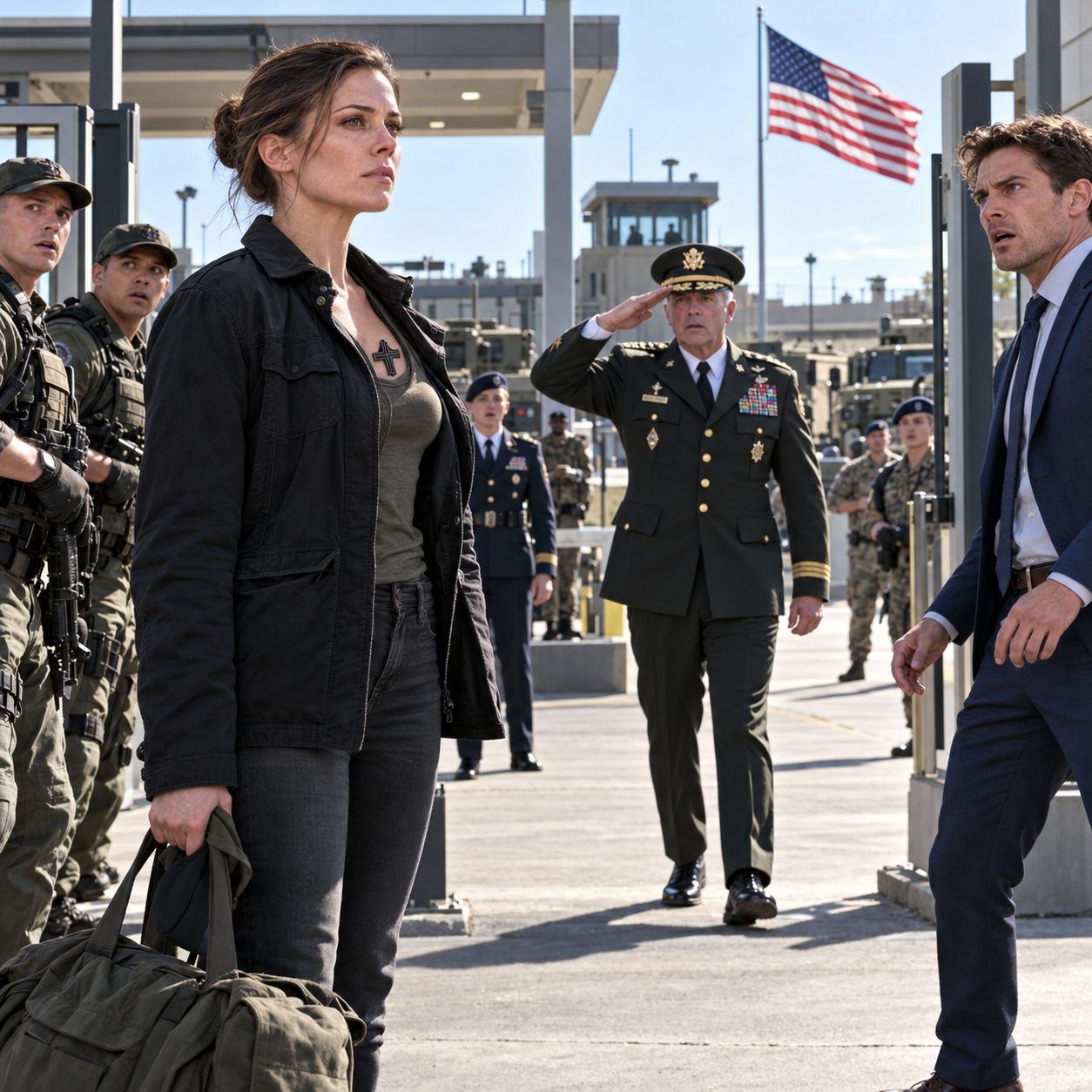
“She’s Just A Broken Medic,” My Ex Scoffed As Guards Approached. I Didn’t Move. The Base Commander Stepped Out, Saw The Black Ops Cross Beneath My Jacket, Froze Mid-Stride, And Saluted. “Major Vance… The Life You Saved Was Mine.” Silence Took Over.
My ex-fiancé called me a disgraced combat medic in front of two hundred defense donors and told security I was unstable. No one challenged him. I stayed quiet, opened my coat, and let the uniform beneath it answer for me. Minutes later, the four-star general Adrian Mercer had spent months trying to impress saluted me in front of the entire ballroom. Three weeks after Adrian’s company collapsed, though, an envelope arrived at my office containing a photograph I had never seen—and proof that stealing my research had never been his only plan.
Part 1
The first thing I noticed inside the Fairmont ballroom was the smell of white lilies. They were everywhere—floating in glass bowls, tucked beside silver place cards, arranged beneath a twenty-foot wall carrying the logo of Sentinel BioSystems. I had always hated lilies because Walter Reed had kept them near the rehabilitation wing elevators, but Adrian Mercer loved anything that looked expensive in photographs, so he had apparently bought enough of them to perfume an aircraft hangar.
I stood near the back of the room with a club soda in my hand and watched the man I had once planned to marry explain battlefield medicine to people who had never watched anyone bleed. Adrian was forty-one now, broader through the shoulders than when we had shared a cramped apartment outside Fort Sam Houston, his dark hair touched with deliberate gray at the temples. He wore a midnight dinner jacket and the calm expression of someone who had spent years practicing sincerity in reflective surfaces.
Behind him, three enormous screens displayed Sentinel’s newest product: the VeloSeal Trauma Stabilization System. The animated video showed a medic applying a compact clamp and gel cartridge to a simulated junctional wound while a clean male voice promised “faster control, safer transport, superior survivability.” No blood, no screaming, no dust, no rotor wash. Just graphics, applause, and Adrian smiling beneath my ideas.
I had not attended because of him. My invitation had come from the Army Medical Research and Development Command, where I now served as a senior liaison between trauma researchers and acquisition teams. I had spent the previous fourteen months helping auditors untangle discrepancies in Sentinel’s clinical records, and tonight’s gala happened to coincide with what Adrian thought would be the final announcement of a large procurement contract.
He saw me twenty-seven minutes after I arrived.
I knew the exact number because I had checked my watch when General Thomas Calder’s aide texted that his convoy was delayed. One second Adrian was laughing with a venture capital executive near the stage; the next his gaze crossed the room and stopped on me. His smile remained in place for two or three beats after his eyes had changed.
He handed his champagne to an assistant and came toward me.
Two private security officers followed.
“Mara.”
My name sounded different in his voice now. We had not spoken face-to-face in almost four years, yet he managed to put the same weary disappointment into those two syllables that he used to employ whenever I questioned one of his financial decisions.
“Adrian.”
His eyes traveled over my black wool coat, my sensible heels, the briefcase at my feet. “I wondered whether you would try something like this.”
“Attend an event I was invited to?”
“Don’t.”
The orchestra continued playing behind us, but several nearby conversations had already softened. Adrian noticed. Public attention had always altered him faster than alcohol.
He raised his voice.
“For everyone’s sake, you need to leave.”
I saw one of the security officers glance at the other. “Mr. Mercer?”
Adrian turned just enough to include the people around us. “This woman is my former fiancée. She was a combat medic before a medical discharge. She’s had difficulties since then.”
There are lies designed to fool strangers, and there are lies designed to injure the person who knows exactly why they are false. Adrian’s sentence managed both.
I had never received a disgraceful discharge. After the blast that damaged my knee and left me with months of neurological rehabilitation, an Army retention board had allowed me to remain in service. I had eventually returned to duty, promoted to major, completed a research fellowship, and spent years avoiding journalists who wanted to turn one bad afternoon in Afghanistan into the only interesting thing about me.
Adrian knew every one of those facts.
A woman wearing a donor badge slowly lowered her champagne flute.
Adrian continued.
“She’s been fixated on Sentinel for years. There have been accusations, threats, claims that our technology belongs to her. I didn’t want to discuss something this personal tonight, but I’m not allowing her to disrupt a federal contracting event.”
The security supervisor stepped forward. “Ma’am, may I see your event credential?”
I reached inside my coat.
The younger guard stiffened.
I stopped moving. “My identification is in the inside pocket.”
The supervisor nodded. “Go ahead.”
I removed my credential wallet and opened it.
His eyes moved from my Common Access Card to the blue-striped Defense Department liaison credential clipped beneath it. He read it twice before looking at Adrian.
“Mr. Mercer, she’s cleared for the restricted acquisition briefing.”
Adrian’s face barely moved. I knew him well enough to see panic anyway.
“That credential doesn’t belong here.”
“It lists this venue.”
“I don’t care what it lists. I’m paying for security.”
“You’re paying for the reception,” I said. “You aren’t paying for the federal oversight team.”
His jaw tightened.
The people nearest us were no longer pretending not to listen.
For four years Adrian had controlled the story because I had been recovering when he first told it. He had told friends that the blast had changed me, investors that I was confused about the origin of his research, and former colleagues that discussing me might trigger some kind of breakdown. By the time I understood the size of what he had done, defending myself sounded exactly like the obsession he had already warned everyone to expect.
That had been the cleverest part.
Not stealing the work.
Preparing people to distrust me before I could object.
Adrian leaned closer. His cologne carried the same dry cedar scent I remembered from our engagement party.
“You have no idea what you’re walking into.”
“I know exactly what’s in the contract package.”
For the first time, genuine fear flashed across his face.
Then the ballroom doors opened.
The orchestra stopped almost mid-note.
General Thomas Calder entered with two aides and Colonel Sofia Reyes, the acquisition attorney attached to his command. Four stars gleamed beneath the lights as half the room turned toward him.
Adrian transformed instantly.
His shoulders relaxed. His smile returned. He left me standing between the guards and crossed the marble floor with his hand extended.
“General Calder. Welcome. We’re honored.”
Calder did not take his hand.
Adrian tried again.
“I’m sorry about the disturbance. My former fiancée appeared unexpectedly. She has a history of—”
Calder’s eyes had moved past him.
Straight to me.
I set my glass on a tray and unbuttoned my coat.
Beneath it I wore my Army Service Uniform.
The Distinguished Service Cross above my left breast caught the chandelier light.
Calder stopped.
His expression changed with a speed I will never forget. The commander disappeared for one second, replaced by the wounded colonel I had treated beside a burning vehicle six years earlier while both of us waited for a helicopter we weren’t sure was coming.
He brought his heels together.
Then a four-star general raised his hand and saluted me.
“Major Vance.”
No one in the ballroom moved.
Calder held the salute a second longer than protocol required.
“The last time I saw you,” he said, his voice carrying through the room, “you were keeping me alive.”
Behind him, Adrian Mercer’s face emptied of color.
And that was when I knew the evening was no longer going to unfold according to his script.
Part 2
I returned General Calder’s salute and lowered my hand. For several seconds, the ballroom remained so quiet that I could hear ice shifting inside the glass I had left on the tray. Then someone near the stage whispered, “Major?” and the word moved through the crowd with the strange energy of a match touching dry grass.
Calder looked at the security officers surrounding me. “Is there a problem?”
The supervisor cleared his throat. “No, sir. We were verifying credentials.”
Adrian recovered enough to step forward. “General, I can explain.”
Calder finally looked at him.
“I didn’t ask you.”
It was not loud. That made it worse.
I had learned long ago that people who actually possess authority rarely need to perform it. Adrian had spent years filling rooms with confidence because silence frightened him; Calder could stop one with five words.
Colonel Reyes joined us, carrying a leather portfolio. “Major Vance, we expected you with the technical delegation.”
“I arrived early.”
Her eyes moved toward Adrian, then the guards. “Apparently.”
Adrian gave a thin laugh. “Sofia, surely we don’t need to turn a personal misunderstanding into theater.”
“I don’t know yet,” Reyes said. “Do we?”
I picked up my briefcase.
Four years earlier, Adrian had carried that same briefcase for me on mornings when my left knee hurt too badly to manage stairs and coffee at the same time. Back then it had been scratched brown leather instead of black government issue, and he had worn cheap running shoes because we were saving money for a wedding neither of us could afford.
I had loved him most during that period.
That was still difficult to admit.
Before Sentinel, before investors and gala photographs, Adrian had been a biomedical engineer with an overdue student loan, a failing consulting business, and a tendency to fall asleep with spreadsheets open on his chest. He made excellent omelets, terrible coffee, and once drove ninety minutes at two in the morning because I had forgotten a field notebook in a laboratory refrigerator.
When I started developing the first version of the stabilization system, I trusted him because trust was the architecture of our life.
My problem wasn’t that I had been foolish.
It was that I had behaved normally with someone I believed loved me.
The project began after my second deployment. I had treated too many wounds in places where evacuation took longer than the textbooks assumed, and I became obsessed with one specific gap: stopping severe bleeding in areas where ordinary tourniquets could not be placed effectively.
The original system was ugly.
Our first clamp looked like something assembled in a garage because part of it had been. The gel cartridges leaked. The applicator jammed in cold-weather tests. I kept notebooks filled with calculations, failed trials, diagrams, and profanity.
Adrian offered to help.
At first, he genuinely did.
He knew manufacturing tolerances better than I did. He redesigned the clamp housing, identified a cheaper medical-grade polymer, and helped me organize measurements I had recorded on three different kinds of paper because field research has little respect for neat filing systems.
The mistake came later.
I gave him access to everything.
My raw data.
My encrypted backups.
My proposal drafts.
My military grant correspondence.
My trust.
Then came the extraction mission near Darun Pass.
Our convoy took the blast shortly before dawn. I remember the inside of the vehicle becoming white, then orange, then strangely silent. I remember crawling toward someone shouting for a medic even though one of my legs would not support my weight.
I remember Calder, then a colonel, bleeding from a wound high on his thigh.
The evacuation helicopter took twenty-three minutes to reach us.
My memory ends four minutes before it landed.
I woke at Walter Reed almost two weeks later.
Adrian was sitting beside my bed.
He cried when he saw my eyes open.
That memory had tortured me more than the betrayal because I still did not know whether the tears had been real.
During my surgeries, he brought nurses coffee. He called my mother. He spoke to my command. He kissed my forehead and told me not to worry about the research because he had “secured everything.”
He had.
Just not for me.
By the time I could walk from the rehabilitation gym to my room without vomiting from pain, Adrian had filed a provisional patent through a newly formed company. Three of my binding ratios had been adjusted slightly. My name was gone. My military grant number was gone.
He told investors the technology had originated from private civilian work.
Two months later, he moved out.
I came home from outpatient therapy to an apartment that felt staged for an eviction. Half the closets were empty. His coffee grinder was gone. The framed photograph from our trip to Santa Fe was missing, although he had left the engagement ring in a kitchen drawer beneath a stack of takeout menus.
My laptop had been wiped.
That frightened me more than the ring.
When I called him, he said I sounded unstable.
When I called again, his attorney contacted my command.
When I told former friends what had happened, several stopped returning messages.
Adrian had already spoken to them.
Back in the ballroom, I placed my briefcase on a small cocktail table.
Adrian watched me unlock it.
“Mara,” he said quietly.
It was the first time that evening he sounded like the man from our apartment.
I almost hated him more for that.
Colonel Reyes stood beside me while I removed a thick binder marked with Defense Department seals and audit-control numbers.
Adrian stared at it.
His expression told me he recognized the format.
Calder looked from him to me. “What am I receiving, Major?”
“A formal investigative referral, sir.”
The room seemed to contract around us.
I placed my hand on the binder.
“Sentinel BioSystems didn’t just misattribute the original invention.”
Adrian took one involuntary step toward me.
I met his eyes.
“The investigators found something worse.”
Part 3
Colonel Reyes took the binder from me and opened it to the executive summary. She read for less than thirty seconds before the muscles along her jaw tightened. Calder watched her instead of me, which told me he understood immediately that whatever came next had to be institutional, not personal.
Adrian tried to reclaim the room.
“This is absurd. Whatever she’s alleging can be handled through counsel.”
Reyes looked up. “It already has been handled through counsel.”
“We have intellectual property counsel.”
“This isn’t primarily an intellectual property matter.”
That stopped him.
The investigation had started eleven months earlier with something so small that I almost ignored it.
A field medic at a stateside training center filed a routine equipment complaint after a Sentinel demonstration unit failed to maintain pressure during a simulated casualty exercise. No one was injured. The report should have disappeared into a contractor quality database with thousands of similar complaints.
Instead, the medic attached photographs.
I recognized the clamp immediately.
Not because it resembled mine.
Because one component did not.
The original design used a locking mechanism that deliberately limited compression beyond a tested threshold. Adrian and I had argued about that feature one night in our apartment because he thought it made manufacturing unnecessarily expensive. I refused to remove it.
The unit in the photograph didn’t have it.
At first I assumed Sentinel had redesigned the mechanism after commercial testing. Then I pulled the public patent amendments and found language claiming the simpler mechanism had been present in the earliest developmental prototype.
That was impossible.
I had built the earliest prototype.
I requested archived grant material.
Three days later, the request was denied because several original documents were missing from the digital record.
That was when the old fear returned.
Not anger.
Fear.
Someone had not simply stolen my invention. Someone had been altering the history around it.
I contacted the Inspector General’s office.
The first investigator assigned to me, Special Agent Daniel Cho, was younger than I expected and possessed the unnerving habit of letting silence stretch until people filled it. He never said he believed me. He asked for dates, names, devices, passwords, notebooks, witnesses, deployment records, and every location where Adrian might have encountered my research.
For six weeks, I gave him everything.
Then Cho asked a question I had spent four years avoiding.
“Who else knew he had access?”
I named three people.
Captain Owen Price, my former research partner.
Dr. Lillian Park, our supervising investigator.
And Colonel Nathan Bell, who had overseen grant administration at the time.
All three had supported me after the blast.
All three had later distanced themselves from the patent dispute.
One of them, I eventually learned, had done more than stay silent.
The gala crowd did not know any of that yet. They only saw Colonel Reyes turning page after page while Adrian’s confidence evaporated.
Calder extended his hand.
Reyes passed him the binder.
He read the first page.
“What exactly was altered?” he asked.
I kept my voice even. “The provenance records, portions of the test history, and several safety parameters submitted during Sentinel’s government funding applications.”
Adrian shook his head. “No. That’s deliberately misleading.”
I continued.
“The commercial design removed a compression-limiting component from the original clamp. Sentinel represented the cheaper configuration as equivalent to the military prototype.”
“It was equivalent.”
“Your own internal testing says otherwise.”
A woman near the front table covered her mouth.
Adrian looked toward the crowd.
That was the moment he understood he could no longer speak only to me.
His investors were listening.
So were journalists.
He pointed at the binder. “That information is privileged company material.”
Calder’s expression hardened. “Not if it was submitted in support of a federal contract.”
“It was preliminary engineering.”
Reyes turned another page. “You certified it.”
Adrian stopped speaking.
During the investigation, Agent Cho had recovered internal documents through subpoenaed contractor systems. One spreadsheet compared the original military design to Sentinel’s cheaper commercial version.
The failure rates were different.
Not dramatically different.
That was what made the deception dangerous.
A device that fails every other time never survives development. A device that fails rarely enough to look like bad luck can travel much farther.
Sentinel’s engineers had flagged the difference.
Someone ordered them to change the test assumptions.
Then someone removed three unfavorable trial runs from the package submitted for federal review.
Calder read another page.
“When did we learn this?”
“Nine days ago, sir.”
“And the acquisition office?”
“Only Colonel Reyes and the legal review team were notified. We needed to prevent document destruction before tonight’s event.”
Adrian gave a disbelieving laugh. “So this was a setup?”
“No,” I said. “You scheduled your contract celebration before the contract was signed.”
Several people looked toward the giant screens displaying the VeloSeal logo.
Adrian’s event committee chairman quietly signaled to a technician.
The screens went black.
That small action seemed to injure Adrian more than anything I had said.
He stared at the dark screens as if someone had switched off his future.
Then his eyes came back to me.
“You planned this.”
“I filed evidence. Other people made decisions.”
“You’ve wanted to destroy me for years.”
“No.”
My answer came easily.
“I wanted my work back. The rest happened because of what you did after you stole it.”
Calder closed the binder.
“Colonel Reyes.”
“Sir.”
“Place the pending procurement action on administrative hold.”
Adrian stepped forward. “General—”
“Immediately.”
Reyes pulled out her secure tablet.
Around us, phones began appearing in hands.
Adrian’s public relations director hurried toward the stage.
The security officers who had surrounded me earlier were suddenly standing several feet away from him.
Then my phone vibrated.
I almost ignored it.
The message came from an unfamiliar number.
YOU DON’T KNOW ABOUT PROJECT LANTERN.
A second message followed.
ASK WHO SIGNED THE 2019 TRANSFER AUTHORIZATION.
Below it was a photograph of a document.
I enlarged the image.
The signature at the bottom belonged to Colonel Nathan Bell.
The man who had assured me, after my injury, that my research files were safe.
Part 4
I had not seen Nathan Bell in nearly three years, but I could still hear his voice from the rehabilitation hospital.
“Don’t chase paperwork right now, Mara. Heal first.”
At the time, it had sounded paternal.
Looking at the photograph on my phone, I finally understood how useful that advice had been to everyone except me.
I stepped away from the crowd and showed the message to Colonel Reyes. Her eyes narrowed when she saw the document header.
“Where did you get this?”
“Unknown number.”
She zoomed in.
Project Lantern appeared nowhere in our existing case file.
The transfer authorization did.
At least, a version of it did.
After my injury, Bell had approved the movement of several research archives from an Army laboratory server to what was described as a temporary continuity repository. Investigators assumed the transfer had been administrative housekeeping during a network migration.
The photograph showed a different destination code.
Reyes looked at me.
“Don’t respond.”
“I wasn’t planning to.”
She forwarded the image through a secure channel and handed the phone back.
Across the ballroom, Adrian was surrounded by lawyers.
He kept glancing toward us.
I wondered whether he knew what I had received.
General Calder had moved the official delegation into a private conference room upstairs, but word of the contract hold spread faster than anyone could contain it. Investors left in clusters. A local reporter spoke quietly into a phone near the coat check.
The party had not technically ended.
It had simply died while still standing.
Adrian found me near the service corridor twenty minutes later.
He was alone.
“Mara.”
I kept walking.
He caught up.
“Please.”
That word stopped me.
Not because I felt sympathy.
Because Adrian rarely used it when he meant it.
He lowered his voice. “Whatever Bell did, I wasn’t part of it.”
I looked at him.
He had no reason to know Bell’s name had just appeared on my phone.
“Interesting.”
His face changed.
I said, “I never mentioned Bell.”
For the first time that night, Adrian looked truly frightened.
He recovered quickly. “Your investigation interviewed him. Of course I know.”
“Agent Cho never told Sentinel who was interviewed.”
“You think I don’t have attorneys?”
“I think you just answered a question I hadn’t asked.”
He rubbed one hand across his mouth.
“Mara, listen to me. There were people around your grant who saw commercial potential before I did.”
“Who?”
“I can’t discuss this here.”
“Then we have nothing to discuss.”
I started walking again.
His voice hardened behind me.
“You still don’t understand what happened.”
I turned.
For years I had imagined confronting him and watching arrogance collapse into confession. Reality was less satisfying. Adrian looked tired, sweaty, almost ordinary.
“What happened,” I said, “is that I was unconscious while you copied my research.”
“Yes.”
The word was so quiet I thought I had misheard him.
He looked at the floor.
“Yes. I took the files.”
Four years of denial ended in a hallway beside stacked banquet chairs.
I felt almost nothing.
He continued. “But I didn’t create the opportunity.”
“Who did?”
“Bell contacted me.”
The name landed with less surprise than I expected.
“He said the Army would bury the technology for ten years. He said your grant would disappear into committees and licensing offices while people kept dying.”
“And you believed him.”
“I believed parts of it.”
“You filed yourself as sole inventor.”
“I was told military ownership would make outside funding impossible.”
“You erased my name.”
His expression tightened. “I made a decision.”
“You made dozens of decisions.”
A catering employee pushed a cart past us and pretended not to hear.
Adrian moved closer.
“Bell gave me access to a backup repository after your convoy attack. He told me which files mattered. He introduced me to the attorney who created Sentinel.”
“Why?”
“I don’t know.”
“You expect me to believe that?”
“He wanted the system commercialized quickly.”
“That isn’t a motive. That’s a slogan.”
Adrian looked toward the ballroom entrance.
“When Sentinel closed its first funding round, a consulting company received a percentage.”
“What company?”
He hesitated.
“Northbridge Strategic.”
I knew the name.
Northbridge had performed regulatory consulting for several defense contractors and had been dissolved two years earlier.
Agent Cho had searched it during the investigation.
On paper, it had no connection to Bell.
“Who owned it?”
“I never knew.”
“Then why were you paying them?”
“Because Bell told me to.”
I stared at him.
That answer sounded too pathetic to be false.
“You built a company worth almost a hundred million dollars and never asked where the money went?”
“I asked later.”
“And?”
Adrian’s eyes flicked toward mine.
“That’s when things changed.”
Before he could continue, two federal compliance officers appeared at the far end of the corridor.
“Mr. Mercer?”
Adrian stepped back.
One officer held out a hand. “We need your phone and company laptop pursuant to the preservation order.”
Adrian looked at me as if I could stop them.
I could not.
I would not have.
He surrendered his phone.
As the officers escorted him away, he twisted around once.
“Mara.”
I said nothing.
“Northbridge wasn’t taking a consulting fee.”
The officers kept him moving.
He raised his voice.
“It was buying something.”
Then he disappeared through the conference-room doors.
My phone vibrated again.
Another message from the unknown number.
This time there were only six words.
YOUR ACCIDENT WASN’T THE FIRST ONE.
Part 5
I did not sleep that night.
At 2:13 in the morning, I sat at my kitchen table in Alexandria wearing an old Army sweatshirt and stared at those six words until they began to feel less like language and more like a threat.
Your accident wasn’t the first one.
Agent Cho called at 6:40.
“Don’t delete anything.”
“I haven’t.”
“Don’t respond.”
“I haven’t.”
“Good.”
I waited.
Cho never wasted words when he could create anxiety with silence.
“Do you know who sent it?” I asked.
“Not yet.”
“Do you think it’s credible?”
“I think whoever sent the transfer authorization had access to records we didn’t.”
“That’s not an answer.”
“It’s the answer I have.”
By noon, Sentinel’s gala had become national defense-industry news. The company issued a statement describing the contract hold as a “routine administrative review.” Adrian temporarily stepped aside as chief executive while insisting no safety problem existed.
Sentinel’s stock—privately held but widely traded through secondary investment vehicles—became nearly impossible to price.
None of that mattered to me as much as Project Lantern.
Cho arrived at my office that afternoon with Colonel Reyes and a document examiner. They closed the blinds, collected my phone, and projected the anonymous photograph onto a secure monitor.
The transfer authorization had been signed six days after the attack that injured me.
Project Lantern’s destination code pointed not to an Army repository but to a contractor-accessible research enclave used for emergency technology transition.
Bell had authority to approve access.
Adrian did not.
Someone inside the program had sponsored him.
The authorization contained three project numbers.
Mine was one.
The other two belonged to medical technologies developed by service members who had subsequently left active research positions.
One scientist had retired after a stroke.
The other had died in a training accident.
I stared at the names.
“That’s what the message meant.”
Cho did not agree.
He did not disagree either.
“Coincidence is still possible.”
“Three researchers become unavailable and their work moves through the same transition program?”
“We investigate patterns. We don’t decide what they mean because they look ugly.”
That was why Cho was good at his job.
It was also why talking to him could make me want to throw furniture.
The second researcher, Captain Elise Warren, had developed a portable temperature-control system for blood products. She died in a vehicle rollover during a training exercise eighteen months before my deployment.
Her technology was later licensed through a civilian contractor.
Northbridge Strategic had advised the company.
The retired scientist, Dr. Peter Yang, had created a compact diagnostic platform for field hospitals. His work also passed through Northbridge.
Neither case had previously been considered suspicious.
Now they sat side by side on a screen with mine.
Colonel Reyes leaned back.
“We’ve been treating Sentinel as the problem.”
Cho nodded. “It may be a customer.”
The room went quiet.
That sentence changed everything.
Adrian had betrayed me.
He had stolen files, lied about me, falsified records, and built his career on work that was not his.
But someone may have built a system that made men like Adrian useful.
At 4:00 that afternoon, Cho received authorization to reopen the older transfers.
By 7:00, investigators located Northbridge’s former accountant in Maryland.
By the next morning, she had retained counsel.
Two days later, she agreed to an interview.
Her name was Frances Dwyer.
She was sixty-three, wore thick red glasses, and requested tea before answering a single question. I was not allowed inside the formal interview, but Cho brought me in afterward because she claimed she had something specifically for me.
When I entered, she looked at my left knee.
“Still hurts?”
My body went cold.
“How do you know about my knee?”
Dwyer glanced at Cho.
He said, “Answer her.”
She folded her hands.
“Northbridge kept profiles on researchers.”
“What kind of profiles?”
“Availability risk.”
I felt Reyes shift beside me.
Dwyer continued. “Health problems. deployments. retirement eligibility. divorce. debt. anything that could interrupt a project or weaken someone’s ability to contest a transfer.”
I stared at her.
“Contest what?”
“Ownership.”
The room seemed to tilt.
“You selected people who couldn’t fight back.”
“I processed payments. I didn’t select anyone.”
“Who did?”
She looked down at the table.
“Colonel Bell.”
Cho asked, “Anyone else?”
Dwyer hesitated.
“Bell wasn’t the top.”
My mouth went dry.
“Who was?”
“I never met him. We used initials.”
“Which initials?”
“T.R.”
Reyes exchanged a look with Cho.
Dwyer turned toward me again.
“After your convoy was hit, Bell called the office personally. He said your project had become available.”
My hands curled beneath the table.
“Available.”
“That was the word.”
“Was Adrian already involved?”
“Yes.”
That hurt in a place I had thought was numb.
Dwyer reached into the document envelope beside her.
Cho stopped her until an agent inspected it.
Inside was an old photograph.
She slid it across the table.
Adrian stood outside a restaurant beside Colonel Bell.
The date printed on the back was eleven days before my convoy attack.
Not after.
Before.
And the third man in the photograph was someone I recognized immediately.
Lieutenant General Theodore Rusk.
The officer who had approved my deployment research grant.
Part 6
Theodore Rusk had retired with honors two years after my injury.
His official biography described thirty-six years of service, multiple combat commands, and a second career advising defense companies on innovation. He appeared regularly at conferences, wrote editorials about “accelerating battlefield technology,” and sat on the board of a nonprofit supporting wounded service members.
I had shaken his hand twice.
The first time, he congratulated me on my research proposal.
The second time, he visited Walter Reed.
He brought me a challenge coin.
I still had it in a drawer.
The photograph did not prove Rusk had done anything illegal.
That became Agent Cho’s refrain for the next month.
Bell meeting Adrian before my injury proved only that they knew one another. Rusk appearing in the same photograph proved only that all three had shared a meal.
Northbridge’s accounting records proved consulting payments, not criminal intent.
But investigations are rarely solved by one dramatic document.
They are built from boring things people forget.
Travel reimbursements.
Calendar invitations.
Parking records.
Archived text messages.
Old invoices.
One of Bell’s retired assistants had kept paper appointment books because she distrusted electronic calendars. She allowed investigators to scan them.
Three weeks before the photograph, Bell had written:
RUSK / MERCER — TRANSITION CANDIDATES.
Six days later:
VANCE PLATFORM — REVIEW AVAILABILITY.
The word made my skin crawl now.
Availability.
As though researchers were rental property.
Rusk’s attorney denied everything.
Bell requested immunity before he would answer questions.
Adrian requested a meeting with prosecutors.
When I heard that, I was in a rehabilitation gym at Fort Belvoir observing a new medic-training program. I had spent the morning kneeling beside a mannequin while young soldiers complained that officers never let them improvise.
My knee still hurt when rain approached.
It always would.
That afternoon it ached fiercely.
Maybe weather.
Maybe memory.
Adrian’s attorney eventually proposed what he called a “global resolution.”
Adrian would cooperate against Bell and Rusk.
He would admit to improper patent attribution and selected procurement violations.
In return, he wanted prosecutors to consider reduced charges.
Then came the part meant for me.
He offered to acknowledge my inventorship publicly, transfer his remaining patent interest, and pay a personal settlement.
The attorney asked whether I would support the agreement.
I read the proposal twice.
Then I slid it back.
“No.”
My attorney looked at me. “You understand your view isn’t controlling.”
“I understand.”
“You could recover a significant amount of money.”
“I don’t want his money.”
“What do you want?”
“The truth.”
It sounded sentimental, so I clarified.
“I want the record to show what happened to the research, what happened to the safety data, and what happened to the people who tried to object.”
Because another discovery had emerged from Sentinel.
A quality engineer named Marcus Hale had warned Adrian two years earlier that the redesigned clamp failed outside specific laboratory conditions more often than company reports showed.
Hale recommended restoring my original safety mechanism.
Adrian refused because it increased manufacturing cost.
Hale escalated the concern.
He was fired.
Sentinel called it restructuring.
Months later, during a contractor demonstration overseas, the simplified device failed during treatment of an actual injury after a training accident. The casualty survived, but only because a medic abandoned the Sentinel device and used a conventional method.
Sentinel recorded the incident as operator error.
Adrian had personally approved the classification.
That was the moment my anger changed shape.
Stealing my name had been personal.
Suppressing a safety failure was not.
He had reached a point where protecting the story of his brilliance mattered more than whether the product worked.
Everything after that belonged to him.
Not Bell.
Not Rusk.
Him.
Adrian finally met investigators in early January.
He talked for nine hours.
Then seven more the next day.
Bell had recruited him before my deployment because Rusk wanted civilian commercialization pathways ready for promising military technologies. Researchers were identified based on what Northbridge called “transition vulnerability.”
Adrian had been encouraged to establish a company.
He had been promised introductions to investors.
He had been told that if I became unavailable, there were legal mechanisms for moving quickly.
“What does unavailable mean?” Cho asked him.
Adrian said he assumed reassignment, retirement, or injury.
He denied knowing anything about my convoy route.
Investigators found no evidence that Bell or Rusk caused the attack.
That mattered.
My injury had been war, not conspiracy.
The timing had simply created an opportunity they were prepared to exploit.
Strangely, that truth disturbed me more than the darker theory.
No one had needed to arrange my suffering.
They had only needed to watch for it.
Bell pleaded guilty to conspiracy involving procurement fraud and undisclosed financial conflicts.
Rusk was indicted on corruption and fraud charges related to multiple technology transfers.
Adrian faced his own charges for false statements, wire fraud, obstruction, and falsification of procurement records.
Months after the gala, I saw him again in a federal courthouse.
He looked smaller.
No cameras were allowed inside, no orchestra played, and there were no lilies.
When the judge asked whether he understood the charges, Adrian said yes.
Then he turned before sitting down.
His eyes found mine.
For the first time since we had been engaged, I did not wonder what he was thinking.
I discovered I no longer cared.
Part 7
Adrian pleaded guilty before the case went to trial.
People later told me that should have felt anticlimactic.
It did not.
Courtrooms are not built for dramatic satisfaction. They are built for records, dates, exhibits, standards of proof, and sentences that become real whether anyone applauds or not.
That suited me.
At the plea hearing, prosecutors described how Adrian had taken research files while I was hospitalized, removed attribution, misrepresented development history, and later falsified safety documentation to protect federal funding.
His cooperation exposed Bell and strengthened the case against Rusk.
It did not erase what he had done independently.
The judge made that point carefully.
So did I.
I was permitted to submit a victim-impact statement.
I almost declined.
Then Marcus Hale, the fired Sentinel engineer, called me.
“You should say something,” he told me.
“Why?”
“Because he spent years telling people you were unstable. Let the official record contain your voice.”
That changed my mind.
I did not write about revenge.
I wrote about the first wounded soldier whose bleeding had made me think the existing tools were not enough. I wrote about nights in the laboratory when every failed prototype smelled like plastic, alcohol wipes, and burnt coffee.
I wrote about the technicians, medics, statisticians, machinists, and researchers whose contributions Adrian had folded into a myth about himself.
Then I wrote about the safety report.
“Stealing credit harmed me,” I told the court. “Changing evidence could have harmed people who had no idea our private history existed. That is the part I cannot excuse.”
Adrian stared at the table.
I did not ask for the maximum sentence.
I did not ask for mercy either.
The judge sentenced him within federal guidelines and ordered substantial restitution connected to fraudulent funding.
His remaining ownership interest in the disputed patents was surrendered.
Sentinel entered restructuring under independent oversight.
The company did not disappear.
At first, that irritated people who wanted a cleaner ending.
But hundreds of employees had done nothing wrong.
Destroying their livelihoods would not have restored mine.
Instead, Sentinel’s medical division was sold, its leadership replaced, and every product derived from the compromised program underwent outside review.
The VeloSeal system never entered Army-wide service.
My original design did.
Not exactly as I had built it.
That would have been its own kind of vanity.
A new team improved the clamp housing, refined the applicator, reduced manufacturing cost without removing the safety feature, and credited every contributor correctly.
The patent was assigned to a military medical technology trust with licensing terms that kept procurement prices low.
That mattered more to me than owning it personally.
The first production units arrived at Fort Cavazos the following spring.
General Calder invited me to the fielding ceremony.
I declined the podium.
He found me afterward beside a row of training ambulances.
“You know they were going to give you a plaque,” he said.
“I have enough objects I’m supposed to dust.”
He laughed.
Calder had recovered fully from the injury I treated years earlier, although he still favored one leg after long periods standing.
“You’re difficult to celebrate, Major.”
“I’ve been told.”
He looked toward the young medics opening equipment cases.
“You did all right.”
The compliment landed harder than any speech would have.
A medic in her early twenties removed one of the kits and turned it over in her hands.
She did not know my name.
I liked that.
She did not need to.
If she ever opened that package somewhere far from a hospital, I wanted her to trust the device, not the story behind it.
Bell was sentenced later that year.
Rusk fought his case longer.
His defense argued that accelerated technology transition had been legitimate policy and that Northbridge’s financial relationships were misunderstood consulting arrangements.
Jurors disagreed on several counts and convicted him on others.
The result was messy.
Reality usually is.
Afterward, reporters wanted a quote.
I gave them one sentence.
“Research done for wounded service members should never become private property through deception.”
Then I went back to work.
The strangest aftermath happened with people who had believed Adrian.
Some apologized.
Others explained.
“I only knew what he told me.”
“I didn’t want to get involved.”
“You seemed so angry back then.”
“You have to understand how it looked.”
I listened politely.
Then I stopped answering.
I did not need revenge on them.
I also did not need them back.
Dr. Lillian Park, my old supervisor, was different.
She came to my office carrying a cardboard archive box.
“I failed you,” she said before sitting down.
No explanation first.
No excuse.
She admitted Bell had discouraged her from supporting my patent complaint and implied my career could suffer if she did.
She had chosen silence.
“I was afraid,” she said.
“I know.”
“I wish that helped.”
“It doesn’t.”
She nodded.
That honesty saved us from pretending.
I accepted the box.
Inside were copies of laboratory notes, emails, and photographs she had kept at home.
At the bottom was one picture of Adrian and me in the old lab.
He was holding a prototype clamp and grinning.
I was laughing at something outside the frame.
For a long moment, I looked at the woman I had been.
Then I placed the photograph back in the box.
I did not tear it up.
Some memories do not need destruction.
They only need to stop controlling the room.
Part 8
A year after the gala, I returned to the same hotel.
Not for Sentinel.
The ballroom had been rented for a military medicine foundation dinner honoring combat nurses, medics, surgeons, evacuation crews, and researchers.
The lilies were gone.
Someone had chosen small arrangements of eucalyptus and white roses instead.
I noticed anyway.
Trauma teaches you strange forms of inventory.
Smells.
Doors.
Distances.
Places where you once stood while someone tried to erase you.
I arrived in uniform this time without a coat covering it.
No revelation required.
Colonel Sofia Reyes met me near registration and handed me a glass of club soda.
“For tradition.”
“I didn’t drink the last one.”
“I know. It sat on a tray through half the investigation.”
We laughed.
That surprised me.
For years, I had assumed healing would feel like a dramatic moment when the past finally stopped hurting.
It did not.
It felt more like discovering you had gone an entire afternoon without thinking about it.
Then a day.
Then a week.
My knee remained damaged.
Certain memories remained ugly.
Adrian’s choices remained his.
None of that required me to live in reaction to him.
He wrote to me once from prison.
The letter arrived through my attorney.
I nearly returned it unopened.
Instead, I read it at my kitchen table.
He apologized.
Not perfectly.
There were still sentences about pressure, Bell’s influence, ambition, fear, and how quickly events had moved after my injury.
But there was one line I believed.
I kept waiting for a version of what I did that would let me live with myself.
I understood that impulse.
I had spent years waiting for a version of his betrayal that would make my trust seem less humiliating.
Neither of us got one.
At the end, he asked whether I might someday forgive him.
I did not answer.
Forgiveness had become a word other people seemed to need from me more than I needed for myself.
I was no longer angry every morning.
I did not fantasize about his suffering.
I hoped he eventually became a better man.
That did not mean he was entitled to reenter my life.
The absence of hatred is not the same thing as reconciliation.
Some doors stay closed because you have finally learned what belongs outside them.
My promotion to lieutenant colonel came that winter.
I almost turned it down.
Then Reyes told me that declining a promotion because I disliked ceremony was “the most Mara Vance thing imaginable and therefore not a valid reason.”
So I accepted.
General Calder pinned the new insignia.
Afterward, my mother cried harder than she had at my first commissioning.
She had never forgiven Adrian, which made family dinners easier.
I eventually moved out of the apartment where I had spent so many nights building the first prototype. I bought a small brick townhouse with a crooked back patio and a kitchen large enough for more than one person to stand in without apologizing.
For the first six months, the spare bedroom remained empty.
Then I turned it into a workshop.
Not because I wanted to rebuild the past.
Because I still liked solving problems.
That part of me had survived everything.
One Saturday, I spent five hours redesigning a cheap plastic connector used in training equipment simply because it irritated me.
When it finally worked, I laughed alone at the workbench.
That was when I realized Adrian had not taken the thing I once believed he had stolen.
He had taken files.
Credit.
Years.
Trust.
He had not taken my ability to make something useful.
No patent could contain that.
At the foundation dinner, General Calder eventually took the stage.
I stayed near the back.
He spoke about battlefield medicine, logistics, lessons learned, and the danger of confusing speed with integrity.
He never mentioned Adrian.
He did not need to.
Near the end, he asked every combat medic in the room to stand.
Chairs moved.
Men and women rose throughout the ballroom.
Some were twenty years old.
Some were retired.
Some walked with canes.
One had a prosthetic leg.
I stood with them.
Not in front.
Among them.
That felt right.
After the ceremony, a young sergeant approached me.
“Ma’am, are you Lieutenant Colonel Vance?”
“Yes.”
He looked suddenly nervous.
“I used your stabilization kit during a deployment.”
I waited.
“The casualty made it.”
For one second, the ballroom disappeared.
No chandeliers.
No cameras.
No gala.
Just a young medic standing in front of me with tears threatening his composure.
“Good,” I said.
My voice nearly failed.
“That’s what it was for.”
He thanked me and walked away.
I remained where I was.
A year earlier, I had stood in almost the same place while Adrian told strangers that I was broken, unstable, disgraced, and unwanted.
At the time, I thought the great correction would be people learning who I really was.
I had been wrong.
The important correction was people learning what had really happened.
Adrian’s fraud exposed Bell.
Bell exposed Northbridge.
Northbridge exposed a system that had quietly treated vulnerable researchers as opportunities.
Their own shortcuts brought everything down.
I did not defeat them by becoming more powerful than they expected.
I survived long enough to keep records.
I asked questions when the answers felt wrong.
I trusted the people who cared more about evidence than spectacle.
And when the truth finally reached a room large enough that Adrian could no longer control it, I did not have to shout.
Outside the ballroom, rain tapped against the tall hotel windows.
I watched it for a moment before walking toward the exit.
My phone buzzed with a message from Reyes asking whether I wanted breakfast after our morning briefing.
I typed back yes.
Then I put the phone away and stepped into the cool night.
For years, I had thought closure would arrive when someone powerful finally declared that I had been right.
It didn’t.
Closure came when being right was no longer the center of my life.
Adrian had built his future by treating my worst day as his opportunity.
I built mine by refusing to let that day become my identity.
And in the end, that was the one thing he had never known how to steal.
THE END!
Disclaimer: Our stories are inspired by real-life events but are carefully rewritten for entertainment. Any resemblance to actual people or situations is purely coincidental.
