
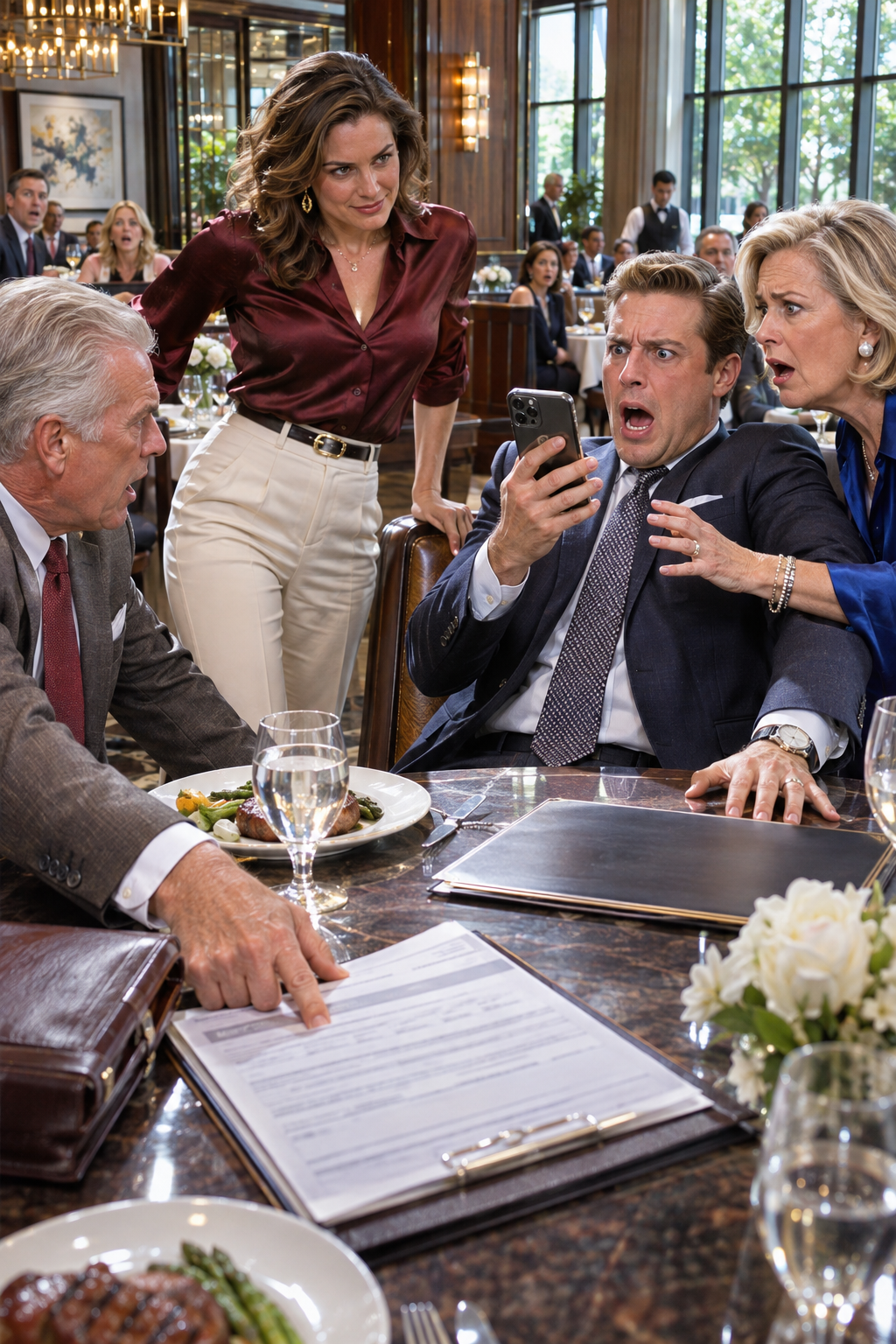
My Parents Invited Me To A Steakhouse To “Discuss My Future.” My Dad Slid Over A Job Application. “Your Brother Needs A Receptionist. It’s Time You Found Real Work.” My Brother Laughed. Then His Phone Lit Up With An Email About Monday’s Company Sale. I Watched Him Read The Buyer’s Name. He Looked At Me, Then Back At The Screen. Then He Said…
My father invited me to an expensive steakhouse, handed me an application for a receptionist position at my brother’s company, and told me it was time to stop pretending my little repair business was a career. My brother laughed, and my mother said nothing. I folded the application and thanked him for dinner. Two days later, I was holding documents that could change everything our family had built, including a financial secret my brother had kept from our father for years.
## Part 1/5
The first thing my father did when I sat down was tell the waiter I’d have the grilled chicken. I was thirty-five years old, had been paying my own bills since college, and hadn’t ordered grilled chicken at a restaurant in probably fifteen years, but Warren Voss had never been particularly interested in what people wanted once he’d decided what was good for them. The restaurant was a place called The Oak Barrel outside Perrysburg, Ohio, where the booths were upholstered in dark leather and the servers carried steaks on plates too hot to touch. My father had reserved the largest booth, which told me he hadn’t invited me to dinner simply because he missed his daughter.
Four hours earlier, I’d been standing on the roof of an elementary school in Toledo, replacing a failed compressor while the November wind pushed straight through my insulated jacket. My lead technician, Omar Vega, held the flashlight while I checked the pressure readings and listened for anything that sounded wrong. Below us were classrooms that needed heat before Monday morning, and the building superintendent had been calling every twenty minutes because the district couldn’t afford to close another school. When the system finally started humming properly, Omar grinned and said, “That’s twelve hundred kids who won’t have to wear coats indoors next week.”
That was what I did for a living, although nobody at my parents’ dinner table had ever asked enough questions to understand it. Four years earlier, I’d started Copperline Mechanical with a used service van, twenty-seven thousand dollars in savings, and a commercial contractor’s license that had taken years of night classes and practical experience to earn. We now had twelve employees, five vehicles, contracts with three school districts, and a small office above our workshop on the west side of Toledo. I had moved into that office’s upstairs apartment six months earlier after selling my house, and my parents had somehow concluded that my life was falling apart.
“Your mother tells me you’re still living over that garage,” Dad said as the waiter poured water into our glasses. He was sixty-seven, broad-shouldered, silver-haired, and still wore the heavy gold watch he’d bought when Voss Heating & Air completed its first million-dollar year. “An apartment over my workshop,” I corrected, reaching for my napkin. “Same difference,” he replied, turning toward my older brother. “Grant, tell your sister about the new trucks.”
Grant was thirty-nine and had inherited our father’s residential heating company five years earlier, along with its customers, equipment, and reputation. He talked about purchasing six trucks, increasing advertising, and attracting customers from two neighboring counties, although I noticed he never mentioned whether any of that growth was profitable. His wife, Lena, watched him with an expression I couldn’t quite read, while my mother, Miriam, quietly rearranged the silverware in front of her. Dad listened with obvious pride, occasionally interrupting to explain something about running a successful business as though Grant were delivering a quarterly report to shareholders.
Then the steaks arrived, and Dad reached into his jacket.
He unfolded a sheet of paper and pushed it across the white tablecloth until it touched my plate. At the top was the familiar orange sunrise logo he’d designed when he founded Voss Heating & Air in 1990, and beneath it were the words “Application for Employment.” He had already filled in the position I was supposedly applying for, writing RECEPTIONIST in his unmistakable block capitals. “Grant’s front-desk girl left in September,” he said, cutting into his steak. “Your brother needs somebody dependable, and you need real work.”
For a moment, I thought he’d made a particularly cruel joke, but nobody at the table was smiling except Grant. “It’s a good opportunity, honey,” Mom said, placing her hand over mine. “A regular paycheck, health insurance, somewhere warm to work instead of climbing around on rooftops.” I looked at her hand, remembering that she’d answered phones and managed invoices for Dad for more than three decades without once appearing on the official payroll. “I already have employees and insurance,” I said, but Dad waved his fork dismissively.
“You have a few vans and some repair calls,” he answered. “Grant has a company with a future, and someday you’ll appreciate having a proper job.” Grant gave a short laugh and suggested that I would probably be good at answering phones because I rarely had anything to say. Lena kicked him beneath the table hard enough to make his water glass tremble. I folded the application twice, slipped it into my blazer pocket, and said, “I’ll consider it.”
Dad smiled as though he’d successfully negotiated a contract.
My brother’s phone vibrated beside his steak knife, and I watched him glance at the screen while Dad began describing an expensive fishing trip. Grant opened an email, scrolled through the attachment, and suddenly stopped chewing. From where I sat, I could read the subject line reflected faintly across his polished phone case: “FINAL ACQUISITION DOCUMENTS — MONDAY, 10:00 A.M.” His eyes moved down the screen, found something, and lifted directly toward me.
I knew precisely what he’d discovered because my name appeared on the personal guarantee inside those documents. For six weeks, my banker and attorney had been arranging financing for Copperline Mechanical to acquire a struggling residential heating business advertised through a regional broker. The broker’s listing hadn’t mentioned the owner’s name, but the founding year, number of employees, service territory, and supplier accounts had made the identity painfully obvious. I had submitted an offer anyway, knowing exactly whose company I was trying to keep from disappearing.
Grant set down his phone so abruptly that his knife jumped against his plate. “Tessa,” he said, forcing a smile that didn’t reach his eyes, “could you come outside for a minute?” Dad frowned and asked whether something was wrong, but Grant told him it was a small business matter that wouldn’t take long. I put down my napkin, rose from the booth, and followed my brother into the parking lot.
The cold air smelled of damp leaves and exhaust, and Grant didn’t speak until the restaurant door closed behind us. “You’re Copperline,” he said, staring at me as though I’d committed some kind of fraud. “You bought my company without telling me it was you.” I reminded him that he’d instructed his broker not to identify interested buyers until the final paperwork was prepared, and that he’d personally signed the agreement on Thursday. He dragged a hand through his hair and whispered, “Dad doesn’t know I’m selling.”
I had suspected as much, but hearing him say it made my stomach tighten. Dad had built that company with two borrowed ladders and a service truck that broke down every other week, and he’d eventually transferred ownership to Grant because he believed a son should inherit what his father created. Now Grant was selling the business before our father even knew it was in trouble. “Why haven’t you told him?” I asked, and my brother glanced toward the restaurant windows before answering.
“Because you don’t understand what happens if this deal falls apart,” he said. “Just show up Monday, sign your papers, and keep your mouth shut until everything’s finished.” Before I could respond, the restaurant door opened and Dad stepped outside, irritated that we’d abandoned dinner. Grant instantly straightened his jacket and told him we were discussing a supplier issue, but Dad looked at me instead. “Whatever financial mess you’ve gotten yourself into, Tessa, don’t drag your brother down with you.”
I could have explained everything right there, but our transaction was still subject to confidentiality restrictions, and I had spent too many years watching my father reject explanations he hadn’t asked to hear. I told him my finances were fine, thanked him for dinner, and drove back to Toledo with the application tucked behind my sun visor. At a red light, my phone buzzed with a message from Grant: “Don’t come Monday. I’m working something out.” Before I could answer, another message arrived from my banker, Nadine Keene, containing a warning that made the situation considerably worse.
The lender had discovered a problem with the company’s existing debt, and someone had to address it before closing.
## Part 2/5
At six twenty Saturday morning, Omar called while I was standing in my kitchen waiting for the coffee maker to finish. He’d received a message from a former coworker at Voss Heating & Air, someone who’d heard that Grant was holding an emergency staff meeting at eight. According to the rumor circulating among the technicians, the company had been purchased by an aggressive commercial contractor from Toledo that planned to close the Perrysburg location and dismiss most of the longtime employees. I put down my coffee without drinking it and asked Omar who had started telling people that.
“Your brother,” he replied. “He’s apparently making it sound like everybody’s getting fired, including the guys who’ve been there since you were a kid.” I asked him to meet me at our shop in thirty minutes, then called Nadine to find out whether I could address the employees without violating the purchase agreement. She confirmed that I could discuss the employment protections already included in the signed documents, provided I didn’t disclose confidential financial details before closing. By seven thirty, I was driving toward Perrysburg with a copy of the employee transition plan on the passenger seat.
The old shop stood on a narrow industrial street beside a tire warehouse, its brick walls stained by thirty-six winters of exhaust and road salt. Inside, fourteen employees were gathered around the workbench where my father used to spread blueprints, while Grant stood beneath the faded orange sunrise logo holding a clipboard. I recognized most of the faces immediately, especially sixty-two-year-old Silas Moreno, who’d taught me how to repair furnaces when I was fourteen. Grant stopped speaking when he saw me enter, and the silence that followed was so complete I could hear the compressor cycling in the back room.
“Well, here’s your new boss,” Grant announced with a strained smile. “My sister bought us, apparently, so you can ask her who gets to keep their jobs.” Several employees looked at me in confusion, and a younger technician named Nolan asked whether the rumors about layoffs were true. I explained that every existing employee had been included in the acquisition plan, with their current compensation and benefits protected, and that the purchase agreement specifically required continuity of operations. “There are no planned layoffs,” I said, placing the documents on the workbench. “And the reason I insisted on that is because I know what this company means to the people who work here.”
Grant folded his arms and asked whether I’d ever managed a residential operation of that size. I reminded him that Copperline had been servicing residential systems alongside our commercial contracts for four years, and that I’d spent my teenage summers working in the very building where we stood. Silas took the papers, read the first page, and looked at me with a small nod, but Nolan remained worried about the rumors. “Why would Mr. Voss tell us we were losing our jobs if that wasn’t true?” he asked.
Grant’s jaw tightened, and before I could answer, he pulled out his phone and called our father. He told Dad that I’d walked into the shop claiming ownership of the business and refusing to leave, which was not remotely what had happened. Eight minutes later, Dad’s pickup rolled into the parking lot, gravel scattering beneath its tires. He marched inside without taking off his coat and demanded to know why his daughter was interfering with his son’s company.
For the next several minutes, Grant and I explained the same transaction from opposite directions. Grant described it as a desperate decision made under difficult circumstances, while I explained that he’d listed the business voluntarily, accepted my offer through a broker, and signed the purchase agreement without knowing the buyer’s identity. Dad stared at me as though he couldn’t understand how I had managed to participate in a deal involving a company he considered part of his own identity. “You bought it out from under your brother,” he finally said.
“Grant put it up for sale,” I answered. “I offered a price he accepted, and the agreement protects the employees.” Dad told the staff to leave the room, then walked toward his old office, expecting us to follow. The office still contained his oak desk, a filing cabinet that never closed properly, and a photograph of the first company truck parked outside my childhood home. When he shut the door, he turned directly toward me instead of his son.
“Why would you do this to your family?” he asked. I told him that I had reviewed the business carefully and believed it could survive under different management, but he interrupted before I could explain the financial difficulties. “Your brother has spent five years building this company,” he said. “You can’t just walk in with a loan and pretend you know what you’re doing.”
That was when I realized my father had never seen Copperline’s financial statements, employee roster, or contracts, despite knowing the company had existed for four years. He knew I’d sold my house and moved above my shop, but he’d never asked why, and he’d mistaken the sacrifices I’d made to expand my business for evidence of failure. I wanted to tell him that Copperline’s annual revenue had passed two million dollars last year, but I was suddenly exhausted by the thought of presenting my life as evidence in a trial he had already decided. Instead, I asked Grant to tell him why the company was actually being sold.
Grant looked toward the window and said the economy had become difficult. Dad nodded sympathetically, accepting the explanation before another question could be asked, then ordered me to withdraw my offer. When I refused, he reminded me that the building belonged to him personally and that no business could operate there without his permission. He picked up his keys, pointed toward the door, and said, “We’ll discuss what happens Monday after you’ve had time to reconsider.”
I stayed behind after he left because Silas was waiting beside the service counter, turning an old brass fitting between his fingers. He told me Grant had delayed payroll twice that year and that several suppliers had stopped extending credit, neither of which was included in the optimistic stories Dad had been hearing. Then he lowered his voice and mentioned something that troubled me more than the debts. Three weeks earlier, Grant had asked the employees to sign statements confirming that certain equipment had been delivered, even though nobody remembered receiving it.
“I didn’t sign anything,” Silas said. “But I know two guys who did because they were afraid of losing their jobs.” I asked him to photograph whatever records he could lawfully access and send them to the transaction attorney, then drove home wondering what else Grant had concealed. When I reached my apartment, Nadine had left a voicemail asking me to call about the landlord’s signature on our new lease. I listened to it twice before understanding that my father had a way to stop the transaction without owning a single share of the company.
## Part 3/5
My father arrived at my workshop at nine Sunday morning, carrying a leather folder under one arm and wearing the same expression he’d worn when I was sixteen and came home with a speeding ticket. It was the first time he’d visited Copperline since I opened the business, although he’d driven past the property dozens of times on his way into Toledo. He walked through the reception area without looking at the framed licenses, inspected the service bays, and stopped beside a red toolbox I’d owned since high school. “Still have that thing,” he observed, running his thumb across the scratched lid.
“You gave it to me for my fifteenth birthday,” I reminded him. He looked surprised, then said he’d bought plenty of tools over the years and couldn’t remember every one of them. For a moment, I considered telling him about the summer I’d spent repairing neighbors’ air conditioners using the same toolbox while Grant played baseball and collected praise for helping at the shop twice a week. Instead, I offered him coffee and waited for him to explain why he’d come.
Dad placed the folder on my desk and opened it to a ten-year commercial lease prepared for Copperline Mechanical. The property was the old Voss Heating & Air building, and the lease was one of the documents required by the bank before releasing acquisition funds. He tapped the blank landlord signature line and said he wouldn’t sign it, then informed me that he’d already spoken to Grant about giving him another opportunity to recover. “Without this lease, your bank won’t fund the deal,” he said. “And without the deal, your brother keeps his business.”
I explained that the company had outstanding obligations which couldn’t be solved merely by canceling the sale, but Dad dismissed them as temporary cash-flow problems. He said Grant needed support instead of competition and asked how I could justify taking something from my own brother during a difficult period. I reminded him that I was paying for the business and assuming substantial risk, but his expression hardened. “You’re making this about money,” he said, “when it ought to be about loyalty.”
Then he told me something I had never heard before.
When Dad was nineteen, his own father had transferred the family farm to his older brother, leaving Dad with an aging pickup and a few hundred dollars in savings. Dad had spent the following twenty years resenting that decision, convinced that his parents had valued his brother more simply because he was born first. “I promised myself my son would never be treated like that,” he said, staring at the toolbox. “I was going to leave him something that couldn’t be taken away.”
I asked whether he’d ever considered making the same promise to his daughter. He didn’t answer, and after a long silence, he returned to the lease as though the question had never been spoken. He said the company would stay with Grant if I withdrew my financing, and that he’d personally help stabilize the situation. When I refused to abandon the purchase, he closed his folder and told me not to come to Thanksgiving or Christmas.
“Your mother doesn’t need this kind of fighting at her table,” he said. I looked at him for several seconds, wondering whether he’d ever considered how often he’d used family celebrations as leverage whenever I disagreed with him. “Then I won’t be there,” I answered, and his expression changed from anger to disbelief. He waited for me to correct myself, but when I didn’t, he walked out without another word.
I called Nadine immediately and told her the landlord wouldn’t sign. She said the acquisition loan required either a long-term lease on the current property or an acceptable alternative location, with the second option involving more paperwork and additional collateral. Copperline occupied three service bays, but I’d rented two vacant units next door during the summer because expansion had been part of my business plan. After reviewing their dimensions and lease terms, Nadine agreed to ask the credit committee whether we could relocate the acquired operation there.
The problem was that moving would mean disturbing fourteen employees, losing the original shop’s visibility in Perrysburg, and placing more of my own assets at risk. Nadine warned that I might have to pledge Copperline’s equipment, vehicles, and remaining savings to satisfy the revised financing requirements. I looked through my office window at the service vans lined up outside and imagined how much would disappear if the acquisition failed under my management. “Submit the alternative,” I told her. “I need the option.”
That afternoon, I stopped at Silas’s house to ask whether the employees would consider commuting to Toledo if the relocation became necessary. He was repairing a wooden porch railing, and he listened without interrupting while I explained the situation. “I’d make the drive,” he said, wiping sawdust from his hands, “but some of the younger guys might not.” He considered me for a moment before adding, “Your father doesn’t know half of what you can do, Tessa, and I’m starting to think that’s because he’s been afraid to find out.”
From Silas’s house, I drove to my parents’ place after Mom called asking to see me. She was sitting at the kitchen table surrounded by old accounting ledgers, with an apple pie cooling beside the stove and the sound of Dad’s table saw coming from the garage. She said Dad wanted to review the company’s historical financial records before trying to help Grant, and she’d brought the books up from the basement. I opened one at random and immediately recognized her careful handwriting, the same handwriting I’d seen on invoices and service schedules throughout my childhood.
Each year contained detailed columns for wages, equipment, supplies, fuel, and office expenses. My mother’s name appeared repeatedly under administrative work, yet there were no corresponding wage payments, retirement contributions, or employee benefits recorded for her. She’d run the phones, handled customer accounts, and kept the business functioning for thirty-four years, but Dad had never acknowledged her as anything more than a wife helping out. “He says everything we have belongs to both of us,” Mom explained when I asked about it.
Before I could respond, she revealed that Dad had contacted a bank about borrowing against their house to cover Grant’s obligations. He believed a few hundred thousand dollars would solve the problem, although neither of my parents had actually seen the full amount the business owed. I closed the ledger and asked whether Dad knew precisely what he was offering their home to protect. Mom stared toward the garage and admitted that Grant had refused to show them the company’s current financial statements.
When I reached my workshop that evening, a secure email from the acquisition attorney was waiting in my inbox. The requested supplier records had revealed questionable equipment invoices, and the closing attorney wanted Grant to explain them before approving the transfer. There were also references to a second account that hadn’t appeared in the financial summary my father had received. I opened the supporting schedule, found an outstanding balance large enough to threaten the entire transaction, and realized that Grant hadn’t merely hidden a struggling business from our father.
He had been hiding how close the company was to losing everything.
## Part 4/5
Grant arrived at my workshop shortly after eight Sunday evening, looking as though he hadn’t slept in days. He stood outside the glass door for nearly a minute before knocking, and when I let him inside, he walked straight into my office and dropped into the chair opposite my desk. His wedding ring kept turning around his finger, a nervous habit he’d developed after getting married. “The bank’s giving me until five tomorrow,” he said. “If the sale doesn’t close, they’re calling the business line of credit.”
I asked him to tell me how much he owed, and he stared at the floor before answering. “One point one million, approximately, not counting some supplier balances.” I already knew the amount from the records, but hearing him say it made the situation feel more real. Our parents’ house was worth less than half of that, and Dad was preparing to put it at risk without understanding how little the additional borrowing would accomplish.
“Why didn’t you tell him?” I asked. Grant leaned back, staring at the ceiling, and said Dad had spent his entire life describing the company as something that would remain in the family forever. When the business began losing money, Grant borrowed against equipment and expanded into neighboring counties, believing that larger revenue would eventually solve everything. Instead, the expansion increased overhead, and the suppliers started demanding payment before delivering materials.
Then I asked about the equipment invoices and the second account. Grant admitted that several trucks listed in the expansion budget hadn’t been delivered, even though he’d included their expected availability in his projections. He’d also collected substantial advance payments on long-term maintenance agreements to keep the business operating, creating service obligations that would continue after the sale. “I kept thinking the next month would fix the last one,” he said, rubbing his eyes. “Then the next month made everything worse.”
I told him the deal couldn’t close on inaccurate records and that he needed to disclose everything to the attorney and lender immediately. He nodded, then admitted something else I’d never expected to hear. He had wanted to become a middle-school science teacher after college, but Dad had laughed when he’d mentioned it and offered him the keys to a service truck instead. “He didn’t want me running a company,” Grant said. “He wanted somebody who looked like him running his company.”
For a moment, I saw the brother I’d known before resentment and expectation had made conversations between us feel like competitions. Then I remembered the employees he’d frightened, the obligations he’d concealed, and the way he’d laughed when Dad offered me a receptionist position. His unhappiness explained some of his choices, but it didn’t excuse what those choices had cost other people. “You can still decide what you want to do with your life,” I told him. “But first you have to stop making everybody else pay for the decisions you’ve already made.”
We spent the next hour speaking with the transaction attorney and preparing corrected disclosures for the lender. The acquisition documents were revised to account for outstanding service obligations, disputed equipment commitments, and a portion of the sale proceeds that would be held back until specific liabilities were verified. Grant would receive considerably less money than he’d originally expected, and he agreed to a ninety-day transition period to assist with customer accounts and existing contracts. His debts would be addressed through the closing process, but years of mismanagement meant he wouldn’t walk away with the financial security he’d once imagined.
At ten forty, Nadine emailed me conditional approval for the alternative location in Toledo. The revised structure required me to personally guarantee the acquisition loan and pledge additional Copperline assets, leaving far less protection if the combined operation struggled. I read through the documents while the heating pipes clicked inside my upstairs apartment, then signed each required page. By the time I finished, I understood that I wasn’t simply purchasing my father’s former company; I was gambling much of what I’d spent twelve years building to preserve the livelihoods attached to it.
Before going to bed, I took the folded employment application out of my van and placed it beside my laptop. Then I texted Dad the address of the attorney’s office and told him the closing would take place at ten Monday morning, whether we used his building or relocated to Toledo. I invited him to attend because I wanted him to hear the financial facts directly rather than through Grant. After several minutes, he replied with one word: “Fine.”
At six Monday morning, Omar and two Copperline technicians were already clearing the vacant bays in preparation for a possible relocation. Nobody had ordered them to come in early, and when I asked why they were there, Omar shrugged and said the employees from Perrysburg might need somewhere to put their tools. My phone rang while I was checking the space, and Mom told me Dad was getting dressed in the dark navy suit he normally reserved for funerals. She said he was bringing the papers for a home equity loan and still believed he could convince Grant to cancel everything.
“Mom, I need you there too,” I said. She hesitated, explaining that the meeting concerned business matters she’d never been officially involved in. I thought about thirty-four years of ledgers, invoices, customer calls, and unpaid administrative work, then told her that she’d been involved in the business longer than almost anybody attending. She was quiet for a long moment before agreeing to come.
When I arrived at attorney Elaine Prescott’s office at nine forty-five, the closing documents were already arranged across a polished walnut conference table. Nadine sat beside me with the revised financing package, while Grant studied the carpet and the broker checked his watch. At exactly ten, the door opened and my parents walked inside, Dad carrying a thick bank envelope against his chest. He looked directly at me, then at the unsigned lease waiting on the table, and said, “Before anyone starts, there’s something my daughter needs to understand.”
## Part 5/5
Dad remained standing while everyone else sat down, his bank envelope pressed flat against the conference table. “I built this business with my own hands,” he said, looking toward Elaine. “And I won’t let my daughter force her brother out just because she found somebody willing to lend her money.” Elaine explained that the transaction had been voluntarily negotiated and signed, but Dad interrupted and announced that he would not provide the property lease. “Without my building, there isn’t going to be a sale.”
Nadine opened her folder and explained that the lender had approved an alternative operating location in Toledo. The acquisition could proceed without Dad’s property, provided I accepted the revised collateral requirements, which I’d already done. Dad stared at her, then demanded to know how I could qualify for a loan of that size when I supposedly lived above a garage and drove around fixing air conditioners. Nadine looked confused before calmly explaining that Copperline Mechanical had twelve employees, established commercial contracts, audited financial records, and a documented history of meeting its obligations.
Dad slowly lowered himself into his chair. “Twelve employees?” he repeated. I told him there would be twenty-six once the transaction was complete, assuming everybody accepted their employment offers, and then placed my contractor’s license and most recent payroll register on the table. “I built this company from one truck,” I said. “I sold my house because I needed the equity for the acquisition, not because I couldn’t afford to keep it.”
Dad looked at the documents without touching them, and I reminded him what he’d told me over steak three nights earlier. I explained that I’d spent years earning my qualifications, managing contracts, paying employees, and expanding my business while he’d assumed I was struggling because my work didn’t look like Grant’s. “You didn’t know what I was building because you never asked,” I said. “And I’m done letting that misunderstanding decide what I’m allowed to do.”
He started to answer, but I turned toward Grant and asked him to explain the company’s financial position. Grant took several breaths before telling our father about the $1.1 million debt, the delayed supplier payments, the advance customer obligations, and the deadline for the bank’s credit line. Dad opened his envelope and removed the home equity paperwork, then looked from the papers to his son. “Why didn’t you tell me?” he asked.
“Because I knew you’d look at me the way you’ve always looked at Tessa,” Grant answered, his voice unsteady. He explained that he’d been afraid of disappointing Dad, had expanded recklessly to disguise the losses, and had concealed the growing problems until selling became the only practical way to avoid a worse collapse. Dad sat perfectly still while Grant admitted that the proposed loan against the house wouldn’t solve the financial problem. For the first time, nobody at the table tried to turn the conversation into a criticism of me.
Then Mom reached across the table and took the home equity papers away from Dad. “We’re not putting our house at risk for this,” she said, with a firmness I rarely heard from her. Dad looked shocked, but she reminded him that she’d spent thirty-four years keeping the company’s books and answering its phones, and that she knew the difference between a temporary shortage and a business that could no longer pay its obligations. “I’ve spent enough of my life working for promises,” she added. “I’m not putting our retirement into another one.”
Elaine returned everyone’s attention to the documents and asked whether the lease would be signed. I told Dad the choice was his, but that Copperline would close the acquisition regardless. If he signed, the business would remain in its original building under a ten-year lease at the existing market rent; if he refused, the equipment and employees would begin relocating to Toledo the following morning. The lease income was an important part of my parents’ retirement, and Dad knew that an empty industrial building could remain vacant for months.
He asked what would happen to Silas and the other longtime employees. I told him their positions were protected in the transition plan, with existing compensation maintained, and that I intended to review the maintenance accounts personally before introducing any changes. Dad took out his reading glasses, read the lease twice, and finally signed his name. I didn’t thank him because he’d made a business decision after trying to make the same decision a family punishment.
Grant signed the remaining sale documents, and Nadine confirmed that the financing and required payoff arrangements had been authorized. The company that my father had once believed only a son could run now belonged to his daughter, but the responsibility felt much heavier than any victory I’d imagined. Grant would stay ninety days to complete the transition, after which he would have to find a different path. I wasn’t offering him permanent management simply because we shared a last name.
Before everyone left, I unfolded the application Dad had handed me at the restaurant and placed it in front of Mom. I told her that Copperline needed an experienced office coordinator to manage scheduling, customer accounts, and the transition of the two businesses, and that the position offered wages, benefits, and paid time off. “You’ve done this work for thirty-four years,” I said. “I think it’s time somebody paid you for it.”
Mom stared at the form, then picked up a pen and filled in her name. Under previous employment, she wrote Voss Heating & Air, thirty-four years, and beneath it added the words “unpaid administrative work.” Dad watched her finish without interrupting. At the door, he quietly said that Thanksgiving was still on, but I told him I’d already made other plans.
The following Tuesday, I arrived at the Perrysburg shop at six thirty and found all fourteen employees waiting beside their vehicles. Silas handed me the master keys, and I explained that the first priorities were restoring supplier confidence, completing the existing customer commitments, and making payroll predictable again. Nobody applauded or made a speech, which suited me perfectly. We had work orders waiting, and for the first time, I was the one responsible for deciding how that work would be done.
Over the following weeks, Copperline negotiated payment schedules with remaining suppliers, corrected the equipment inventory, and introduced tighter controls over customer deposits. Grant completed his transition period and eventually enrolled in a teacher preparation program, though our relationship remained distant and strictly professional until his last day. Mom proved remarkably effective at coordinating the two offices, but I made it clear that having a job with me didn’t erase the years she’d stayed silent while Dad belittled my work. She accepted that without arguing, and we began learning how to relate to each other without pretending the past hadn’t happened.
Dad called twice before Thanksgiving, once to ask about the company and once to suggest that we forget the unpleasantness of the closing. I told him the employees were doing well, but that I wasn’t interested in returning to the dinner table where he’d repeatedly treated me as a disappointment. He said he’d only been trying to protect Grant, and I answered that protecting one child had never required humiliating the other. When he asked whether I’d ever forgive him, I said I didn’t know, and I wasn’t going to promise something simply to make him comfortable.
On Thanksgiving afternoon, I set up two folding tables inside the Copperline workshop for the employees who were working holiday emergency shifts. Omar brought homemade enchiladas, Silas arrived with smoked turkey, and Mom came carrying an apple pie she’d baked that morning. Grant sent a short message wishing me a good holiday, and I replied politely without inviting him to join us. I didn’t feel guilty about keeping those boundaries, because I finally understood that loving people didn’t require giving them unlimited access to my life.
After dinner, Silas’s granddaughter wandered toward my workbench and picked up an old set of pressure gauges. She asked what they were for, so I connected them to a training unit and showed her how the needles revealed what was happening inside a system. She watched the readings settle, then looked up and asked whether girls were allowed to become mechanics. “Absolutely,” I told her, and handed her the flashlight.
Across the room, my mother was laughing with Omar while helping pack leftovers, and outside the shop windows, the service vans sat in a neat row beneath the orange sunrise logo. My father had drawn that logo thirty-six years earlier, believing he was creating something his son would inherit, but the company had survived because people he underestimated had kept it running. I hadn’t bought it to prove I was worth more than my brother, and I hadn’t accepted the risk to earn the approval my father had withheld for decades. I’d done it because fourteen families depended on those paychecks, because the business could still be repaired, and because I knew how to do the work.
I never filled out the receptionist application my father gave me over steak. I kept it in my office drawer, beside the original purchase agreement, as a reminder of the difference between the future somebody had chosen for me and the one I’d built myself. On Monday morning, my father had finally asked what I intended to do with his company, and I’d given him the same answer I gave my employees every morning. We were going to get to work, and this time, nobody needed his permission.
THE END!
Disclaimer: Our stories are inspired by real-life events but are carefully rewritten for entertainment. Any resemblance to actual people or situations is purely coincidental.

