
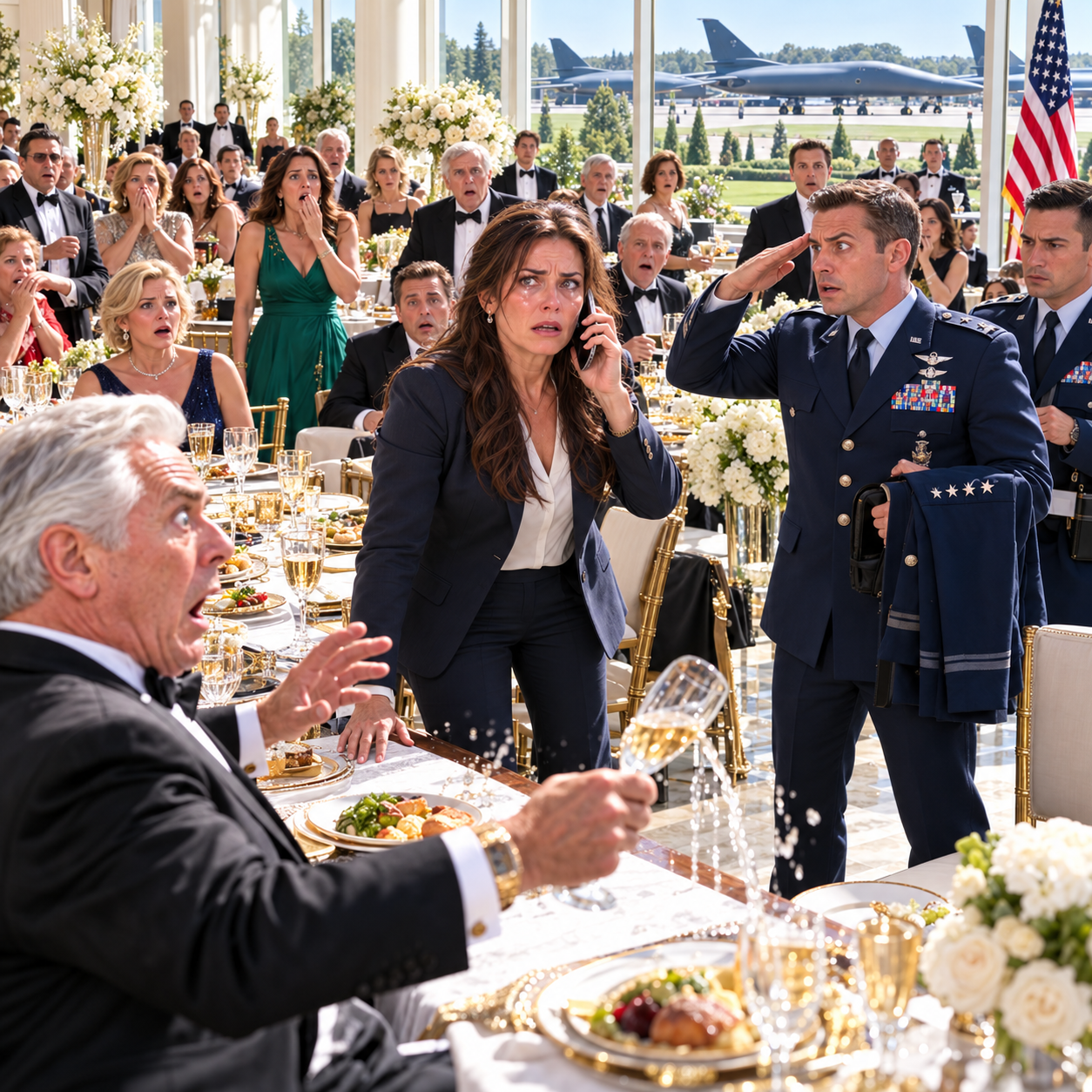
For 30 Years, A Billionaire Father Belittled His Daughter As Nothing More Than A Lowly “Flight Attendant.” At An Elite High-Society Party, He Made Her The Public Punchline. But Little Did He Know, She Was Actually A 4-Star General Commanding America’s Strategic Bomber Fleet. One Fateful Phone Call Completely Shattered The Entire Family’s Arrogance…
My father called me a glorified flight attendant in front of three hundred guests at his seventieth birthday party. My brother laughed, my mother looked away, and I quietly set down my glass before walking out. None of them knew I commanded one of the most consequential organizations in the United States Air Force. I decided that night I was finished asking my family to respect me. Eleven days later, a confidential document surfaced with my name on it, and I realized my humiliation might have served a purpose far more dangerous than anyone understood.
Part 1
The first thing I noticed about my father’s birthday party was the smell of fresh paint. Someone had repainted the white columns outside his Southampton estate, although there hadn’t been anything wrong with them when I’d visited the previous spring. Malcolm Calder believed appearances required constant maintenance, whether he was talking about a house, a company, or a person. He had built Calder Aeronautics from a small engineering business into a defense manufacturing corporation worth more than a billion dollars, and at seventy, he still inspected every room as though an important customer might discover a flaw. Unfortunately, he’d never shown the same interest in examining his own family.
I arrived shortly after seven wearing a navy evening dress and a pair of low heels I’d bought specifically because they wouldn’t hurt after several hours of standing. Three hundred guests filled the illuminated gardens, and beyond the terrace, the Atlantic reflected the last orange light of sunset. A jazz quartet played beneath a white canopy while servers moved between tables carrying champagne and plates of tiny crab cakes. My father’s company logo appeared on the napkins, the menus, and even the ice sculpture beside the bar. It was supposed to be his birthday, but everything looked remarkably like a corporate investor reception.
My older brother, Bennett, intercepted me near the entrance with a glass of bourbon in one hand and his phone in the other. At fifty-one, he had inherited our father’s square jaw, expensive taste, and remarkable ability to make people feel that speaking to them was an inconvenience. “Sloane, you made it,” he said, looking briefly at my dress before checking the notification on his phone. “Dad thought you might have another one of those mysterious government emergencies.” I told him my schedule had cleared, and he laughed. “Good, because somebody needs to keep Mom entertained while the rest of us work.”
I had spent the previous forty-eight hours reviewing readiness reports and preparing for meetings involving senior military and civilian leadership. My actual position was commander of Air Force Global Strike Command, a responsibility that reached across strategic bomber operations, missile forces, and thousands of service members whose safety depended on decisions made by people they might never meet. The four stars on my uniform represented nearly three decades of assignments, sacrifices, mistakes, and responsibilities that had nothing to do with the Calder family fortune. Bennett had never asked what those stars meant, despite the fact that my appointment had been publicly announced. As far as he was concerned, the military was an expensive hobby I’d stubbornly refused to abandon.
“Where’s Mom?” I asked, taking a glass of sparkling water from a passing server. Bennett pointed toward the garden and reminded me that the official photographs would begin in twenty minutes. “Try not to disappear before then,” he added, his voice suddenly businesslike. “Dad wants the whole family together tonight.” I thought that was an unusually sentimental request from my brother, but I agreed.
My mother, Ruth, sat beneath a flowering trellis speaking to a woman I recognized from my childhood. She stood when she saw me, and for one brief moment, her face showed uncomplicated happiness. She hugged me tightly enough that I caught the familiar smell of lavender perfume in her hair. “You look tired, sweetheart,” she whispered, brushing a strand of hair from my cheek. “Are they treating you well at work?”
It was the question she always asked, carefully avoiding anything that might lead to an argument with my father. She knew I had become a general, although I doubted she understood the difference between one star and four, because we had learned long ago that discussing my promotions at home was unwelcome. When I’d earned my first star, she’d sent flowers with a note telling me my grandfather would have been proud. My father had sent nothing, and Bennett had replied to my announcement with a photograph of his new yacht. I told her work was demanding but worthwhile, and she squeezed my hand as if that answer relieved her.
At eight-thirty, the lights surrounding the terrace dimmed, and a master of ceremonies invited everyone to gather near the temporary stage. Bennett stood beside our father in a perfectly fitted charcoal suit while his fiancée, Willa Fenwick, adjusted the cuff of his jacket. Willa was a corporate attorney with a quick intelligence and a nervous laugh that appeared whenever Bennett spoke too sharply to someone. I’d met her only twice, but she had once spent an entire dinner asking thoughtful questions about military families while my brother talked over us. Tonight, she looked unusually tense.
My father began with stories about building his company, praising the people who had supported his ambitions and the businessmen who had believed in him when he had little money. Then he turned toward Bennett, calling him the future of Calder Aeronautics and the son who had understood the meaning of responsibility from childhood. Bennett accepted the applause with a modest tilt of his head that I recognized from company photographs. My mother smiled politely, but when my father’s gaze traveled across the crowd toward me, her expression changed. She must have recognized the look on his face before I did.
“And then there’s my daughter, Sloane,” he announced, holding his glass toward me. “When she was little, I thought she’d become an engineer or maybe a lawyer, but she decided she wanted to spend her life flying around the world at the taxpayers’ expense.” Several guests laughed, and I forced myself to remain still. “She says she’s an officer in the Air Force, but from what I can tell, she’s basically a glorified flight attendant with better government benefits.” This time the laughter was loud enough to drown out the music.
My father enjoyed the reaction and continued, explaining that while Bennett negotiated serious business deals, I apparently organized schedules and made sure pilots knew where to park their airplanes. A man near the front asked whether I could arrange a complimentary upgrade on his next military flight, and my father laughed so hard he had to lower the microphone. Bennett applauded with the rest of the crowd, and Willa produced a brief, uncomfortable smile before looking toward me. My mother stared at the tablecloth, her fingers twisted around a folded napkin. I realized with an almost physical sense of exhaustion that I had spent thirty years waiting for someone in that family to say, “That’s enough.”
Nobody did, so I set my glass down and walked toward the stage. My father watched me approach with the amused anticipation of a man expecting another opportunity to entertain his guests. “Well, here’s our aviator,” he said as I stopped beside him. I leaned close enough that only he could hear me and said, “I came because you asked me to, Dad, and I hope you enjoy your birthday.” Then I stepped away before he could turn my words into another joke.
As I crossed the terrace, an older gentleman standing near the exit moved slightly to give me room. His silver hair was neatly combed, and I recognized him as retired General Marcus Vale, who had attended several strategic leadership conferences during my earlier assignments. He had watched the entire exchange without smiling, and when our eyes met, he gave me the smallest respectful nod. I returned it without stopping, grateful that he understood why I wasn’t acknowledging him more formally. Behind him, a younger man in a dark suit held a small notebook against his chest and watched me with an expression that suggested he was trying to solve a puzzle.
I reached the driveway just as a catering truck pulled away from the service entrance. Through an open window behind the house, I heard Bennett speaking sharply into his phone. “She’s here, isn’t she?” he said. “We have the family photographs, and that’s what we agreed to provide.” I stopped beside the hedge because his next words were spoken with a strange urgency. “Don’t worry about what my father said tonight. The people reviewing the proposal only need to see that she’s connected to us.”
Part 2
I stayed beside the hedge long enough to hear Bennett end the call, then continued toward my rental car without confronting him. He had spent years using family photographs to promote Calder Aeronautics, and I assumed he was referring to another investor presentation. Still, something about his choice of words bothered me, particularly the suggestion that someone was waiting for proof of our connection. I made a mental note to ask him about it once I was back in Washington. Then I drove away, leaving the lights of the estate behind me.
At a traffic signal outside Southampton, I looked down at the small silver compass attached to my key ring. It had belonged to my maternal grandfather, Nathaniel Price, who flew military cargo aircraft during World War II and spent the rest of his life repairing airplanes at a small Connecticut airport. He died when I was thirteen, but he was the first adult who listened seriously when I said I wanted to fly. He used to let me sit inside an old training aircraft while he explained the instruments, making me identify the difference between heading, altitude, and airspeed. I remembered his work-worn hands pointing at the compass and saying that knowing where you were meant very little unless you knew where you wanted to go.
My father considered Grandpa Nathaniel an unsuccessful man because he’d never owned more than his modest house and an aging pickup truck. He ignored the fact that Grandpa had helped raise three children, served his country, and spent twenty years teaching young pilots how to keep themselves alive. Whenever they met, Dad discussed stock prices and expansion plans, while Grandpa asked about school, books, and the things that interested me. That difference shaped my childhood more than either man understood. I wanted to become the kind of person whose accomplishments made someone else’s life better, not merely the kind whose name appeared on a building.
When I received my acceptance letter to the Air Force Academy at seventeen, my mother cried and hugged me in the kitchen. My father read the letter while standing beside the refrigerator, then asked whether I understood what I was sacrificing. He had already arranged an interview for me at an East Coast university, where he expected me to study business and eventually join Calder Aeronautics. “You can have a good career without becoming someone’s obedient little soldier,” he told me. I answered that I wanted to fly military aircraft, and he said he’d give me six months before I came home admitting my mistake.
Those first months in Colorado Springs nearly convinced me he was right. The altitude left me breathless during morning exercises, my academic workload consumed nearly every spare hour, and I struggled to adjust to an environment where nobody cared that my father owned a successful company. During my second week, I received a blistering evaluation because I’d failed to check an equipment roster carefully enough. I sat on the edge of my bunk that evening feeling ashamed until another cadet named Elena Ortiz sat beside me and offered half a granola bar. “You planning to quit over a clipboard?” she asked, and when I said no, she told me to stop staring at the floor and start fixing the mistake.
Elena became my closest friend, although our careers eventually carried us through different commands and continents. We learned to fly, endured demanding assignments, and gradually discovered that competence meant accepting responsibility even when nobody was watching. I became a bomber pilot and later an instructor, spending long stretches away from home and learning how quickly a minor maintenance problem could become a serious safety concern. During one difficult deployment, I had to recommend delaying a mission because a crew had reported an unresolved aircraft issue. The decision angered several senior officers, but the subsequent inspection confirmed a problem that needed correction before anyone flew.
I thought about that experience often as my responsibilities expanded. Commanding people was different from commanding machines, because service members carried worries about mortgages, children, aging parents, and marriages strained by separation. I remembered a young crew chief named Patrick Holloway who once admitted that he was afraid to report a supervisor for pressuring technicians to rush an inspection. We addressed the problem, protected the reporting personnel, and changed how that unit documented maintenance concerns. Years later, Patrick sent me a photograph of his daughter graduating from college with a note thanking me for showing him that doing the right thing didn’t have to end his career.
My family knew almost none of those stories. My father occasionally asked whether I was still flying, even after I’d moved into command positions that required far more time behind a desk than inside an aircraft. When I told him about a promotion, he congratulated me with the same distracted tone he used when a distant acquaintance mentioned buying a car. Bennett once introduced me to a prospective investor as his sister who worked somewhere in military transportation. I corrected him afterward, and he told me not to embarrass people over technical distinctions they couldn’t understand.
For years, I convinced myself that their ignorance was something I had chosen. I liked being able to visit Connecticut without worrying that someone would ask about my official duties or try to turn dinner into a conversation about national security. I had never needed the Calder fortune, and my career had given me colleagues who understood the sacrifices involved in military service. But beneath those practical explanations was an uncomfortable truth: I kept hoping my father would eventually become curious enough to ask who I’d become. At the birthday party, I finally understood that he preferred the version of me he’d invented.
The following morning, Elena called while I was sitting in a hotel room overlooking a gray stretch of Manhattan. She had reached the rank of major general herself and was serving in a senior planning position that kept her busy with problems far more important than my family’s behavior. Nevertheless, she’d heard about the party from someone who knew Marcus Vale, and she wanted to make sure I was all right. When I told her what my father had said, she was silent for several seconds before asking whether I’d considered going home for Christmas somewhere else. I laughed despite myself and admitted that the idea sounded wonderful.
Then her voice changed. A defense industry journalist named Gabriel Wynn had contacted her office the previous week, asking whether I had any role in evaluating aircraft sustainment contracts involving Calder Aeronautics. Elena had declined to discuss my official responsibilities beyond public information, but the inquiry had struck her as unusually specific. She wanted to know whether my family had recently discussed company business with me. I told her about Bennett’s phone call outside the estate, and she asked me to write down every word I remembered.
Before we finished talking, Elena forwarded a publicly available contracting notice involving replacement assemblies for aircraft maintenance programs. Calder Aeronautics appeared among the companies seeking a substantial multiyear agreement, and the work related to aircraft operated by organizations within the broader strategic bomber enterprise. The purchasing decisions belonged to acquisition officials outside my command, but the appearance of family influence could still damage public trust and my professional reputation. I called my legal adviser and requested an immediate ethics review, including written instructions removing me from any involvement in matters connected to my family’s company. By noon, I had begun documenting a potential conflict I hadn’t known existed, and my father’s seventieth birthday was starting to look less like a family celebration than an opportunity someone had carefully arranged.
Part 3
Three days after the party, my father called while I was leaving a meeting at Barksdale Air Force Base in Louisiana. His number appeared on my personal phone, and I nearly ignored it because I was already late for another appointment. Something made me answer, perhaps the fact that he’d never called me on a weekday without wanting something. Instead of his usual impatient greeting, I heard him clear his throat twice before saying, “Sloane, I think there’s been a misunderstanding about your career.” I stopped walking beneath the covered entrance of the headquarters building and asked what he meant.
“Marcus Vale called me,” he explained. “He said you’re a four-star general, that you’re in charge of some enormous Air Force organization, and that people in Washington take your advice seriously.” I confirmed that the information was accurate, then waited while he seemed to search for an appropriate response. “Why in God’s name didn’t you tell me?” he finally demanded, sounding more bewildered than impressed. I reminded him that I’d invited him to my promotion ceremonies, sent announcements after major assignments, and repeatedly tried to discuss my work at family dinners. He became quiet, and I could hear a clock ticking somewhere near his phone.
“I thought you were doing administrative work,” he admitted. “Bennett said you handled flight coordination, and I assumed that was what you wanted.” I looked across the parking lot at a group of young airmen walking toward the dining facility, laughing about something one of them had said. For the first time, it occurred to me that my father had never bothered to verify anything Bennett told him about my life. “Dad, I’m responsible for people and missions that require years of preparation and constant accountability,” I said. “You could have learned that much in five minutes if you’d ever wanted to.”
He asked whether we could meet at the family’s Manhattan apartment, promising that he wanted to apologize privately. I told him I would consider it, although I didn’t mention the ethics review or the contract. I had no intention of giving him advance warning about an issue that might involve his company, especially after Bennett’s suspicious conversation. When the call ended, I remained outside for several minutes, feeling surprisingly empty. The apology I’d once imagined receiving had finally become possible, yet it seemed to have arrived only because another powerful man had explained my value to him.
My legal adviser, Colonel Miriam Hale, met me that afternoon with a short memorandum and several questions about my family’s business interests. She was precise, direct, and unimpressed by the size of anyone’s bank account. We reviewed the circumstances under which I might have encountered acquisition matters connected to Calder Aeronautics, including briefings about aircraft readiness and long-term sustainment requirements. Miriam confirmed that no evidence suggested I’d participated in evaluating the company’s bid, but she recommended a formal recusal and additional documentation to prevent any question about future involvement. I signed the paperwork immediately.
“You’re not responsible for what your relatives do without your knowledge,” she told me as she gathered the documents. “But now that you’ve become aware of the situation, you need to maintain a clean boundary.” I explained that a journalist had been asking questions and that my brother might have used our relationship in business discussions. Miriam advised me to preserve relevant personal communications, avoid private discussions about the contract, and report any suspected misrepresentation through appropriate channels. Her calm professionalism helped more than reassurance would have. I had spent enough years in command to know that integrity was best protected by records, not declarations.
That evening, Gabriel Wynn contacted my public affairs office requesting an interview about my family’s involvement in the defense industry. He worked for a respected investigative publication and had spent years reporting on government procurement, manufacturing practices, and corporate accountability. I declined a personal interview while the ethics matter was being reviewed, but I authorized my staff to provide publicly releasable information about my career and the command’s organization. Gabriel sent a brief acknowledgment and said he understood. Then he added one sentence that troubled me: “My questions concern more than whether your brother has exaggerated his connections.”
Five days after the party, I agreed to meet my family in Manhattan, partly because I wanted to hear their explanation and partly because silence would allow Bennett to invent one for me. My father waited in the apartment’s library, surrounded by leather-bound books that looked untouched and photographs of himself with political and business leaders. He stood when I entered and studied my face with an unfamiliar uncertainty. “I’m sorry about the party,” he said before I’d taken off my coat. “I had no idea you were so important.”
I sat across from him and asked whether humiliating me would have been acceptable if I held a lower rank. His mouth opened, but he appeared genuinely unable to answer. My mother entered carrying a tray of coffee, and the cups rattled slightly as she lowered it onto the table. “Malcolm, she has been telling you for years that her work matters,” Ruth said, her voice so firm that both of us turned toward her. “You made it impossible for anyone in this house to celebrate her without worrying about how you’d react.”
Bennett arrived fifteen minutes late, bringing Willa with him despite my request for a private family conversation. He congratulated me on my rank with an exaggerated smile, then complained that the situation had been blown out of proportion by Marcus Vale and a few overly sensitive guests. When I mentioned the Calder Aeronautics bid, the smile disappeared. “That’s a legitimate commercial opportunity,” he said, leaning forward. “Your command operates the aircraft, but you have nothing to do with buying the parts, so there’s no conflict.” I told him he was correct about the acquisition authority, but the company still had no right to imply I could influence a decision.
My father looked sharply at Bennett. “What implication?” he demanded, and for the first time, my brother seemed less certain of himself. Bennett explained that some potential investors had been informed of my military position because our family history was a matter of public record. He insisted nobody had requested a favor and that mentioning my name was no different from discussing my father’s industry contacts. I asked why he’d been concerned about obtaining photographs of me at the birthday party, and Willa’s head turned toward him before he answered. “The marketing department wanted an updated family picture,” he said, but he wouldn’t meet my eyes.
I stood to leave, telling them that my professional responsibilities and the company’s business interests would remain entirely separate. My father followed me into the hallway and asked whether we could start over, perhaps with dinner the following weekend. I told him I wasn’t interested in performing a reconciliation while he still believed the problem was my rank rather than the way he’d treated me. He looked wounded, but I had spent too many years protecting him from the consequences of his own behavior. As I reached the elevator, Willa hurried after me and quietly asked whether she could speak to me without Bennett present.
We met two mornings later at a coffee shop near Central Park, where Willa arrived carrying a canvas tote and looking as though she hadn’t slept. She explained that Bennett had asked her to review a presentation prepared for potential financing partners because of her experience with corporate transactions. One slide had identified senior industry relationships that supposedly strengthened Calder Aeronautics’ position for the upcoming contract. Willa said she’d questioned why my name appeared there, and Bennett had told her it was harmless because I was family. Before I could ask to see the document, she told me she’d refused to approve the presentation and had begun reconsidering their engagement.
On the eleventh day after the party, a confidential corporate presentation reached Gabriel Wynn through a source he refused to identify. He contacted my public affairs office to request comment on a page identifying me as a strategic connection to the military command that would operate the equipment Calder Aeronautics hoped to supply. The presentation described my position accurately, then made a claim that stopped me cold: “Senior leadership access supported through established Calder family relationships.” Bennett had spent years pretending my career was insignificant, yet someone inside his company had apparently been using it to suggest an advantage worth millions.
Part 4
I read the disputed page in Colonel Hale’s office while rain tapped against the windows. Gabriel had supplied the relevant excerpt with his request for comment, and Miriam had obtained an official copy through the proper legal channels so we could document the allegation. My name appeared beside a photograph taken from a publicly available military biography, accompanied by language suggesting my position provided Calder Aeronautics with access unavailable to competitors. There was no signature from me and no evidence I’d approved the document. Nevertheless, someone had deliberately made my career part of a commercial sales argument.
Miriam advised that we refer the material to the appropriate ethics and investigative offices rather than attempt to determine its origin ourselves. She also contacted the acquisition organization overseeing the competition, without asking anyone to favor or penalize Calder Aeronautics. I approved a carefully worded public response stating that I had no role in the company’s business development, no authority over the contract’s source selection, and no involvement in promoting its products. The statement mentioned my documented recusal but avoided commenting on an active review. I disliked how clinical it sounded, though I knew that was precisely what the circumstances required.
Within twenty-four hours, the story began circulating among defense industry reporters. Most coverage focused on whether a senior military officer’s family could benefit from the appearance of personal access, even without her participation. A few commentators asked why my brother’s company had included my military biography in materials prepared for financing discussions. Others replayed the birthday footage, now circulating online, and contrasted my father’s humiliating remarks with my actual military position. The cruelty that had entertained his guests became a national embarrassment, but I found no satisfaction in watching strangers ridicule an old man.
Bennett responded differently. He issued a statement through Calder Aeronautics describing the presentation as an outdated internal draft and insisting that nobody had attempted to influence government officials. The statement also suggested that the company was being unfairly targeted because of my prominent military career, a phrase that made it sound as though I had somehow caused the controversy. My father called three times that evening, leaving messages asking me to help clear up the misunderstanding. I returned none of them until Miriam had reviewed the situation. Even then, I told him only that he should cooperate fully with whatever review followed.
Meanwhile, Gabriel continued investigating the company’s manufacturing operations. He had received information suggesting that one of Calder Aeronautics’ facilities had experienced problems with quality-control documentation, although he refused to publish the allegations without corroboration. His reporting eventually led him to June Wexler, a former quality assurance engineer who had worked at the company’s Ohio plant for fourteen years. June was fifty-eight, a widow with two grown children, and someone whose professional reputation mattered far more to her than corporate politics. She had resigned six months earlier after a dispute about test results.
I first learned June’s name through a notification from the appropriate investigative office advising that allegations involving a company connected to my family had been referred for review. The notice contained no detailed findings, and I deliberately avoided asking for more. My position made that restraint essential, although it also left me anxious about the people who might be affected. I had spent too many years watching aircrews place their trust in maintenance records to dismiss concerns about inaccurate documentation. A manufacturing certificate might look like another piece of paperwork to a corporate executive, but to the person climbing into an aircraft, it represented someone’s promise that the work had been done correctly.
Several days later, Gabriel published an interview with June after verifying portions of her account through independent records. She described how her team had identified inconsistencies during testing of a replacement assembly intended for military aircraft maintenance programs. The component had not met a required performance standard during an initial series of tests, and June had recommended additional engineering work before certification. According to her, management delayed the corrective process because the company feared losing a production milestone. She said she became especially concerned when later documentation appeared to describe the failed tests as successful.
June had preserved contemporaneous notes and had raised the matter through company reporting procedures before leaving. Gabriel emphasized that her allegations remained unproven and that investigators would need to examine the original records. He also reported that the company’s previous deliveries were being reviewed to determine whether any equipment required inspection or replacement. The article included no sensitive operational information, but it raised questions about the reliability of records on which military maintenance personnel depended. For the first time, I understood that the contracting issue could involve more than influence or reputation. It might involve the physical safety of people I’d sworn to protect.
I remembered an inspection at Minot early in my career when a senior maintenance officer showed me a small component that had been tagged for further examination. It looked ordinary enough to fit in the palm of my hand, yet he explained that nobody should judge aviation equipment by its appearance or price. Its importance depended on what happened when the aircraft was operating under conditions most people would never experience. That conversation had stayed with me because he’d spoken about procedure as a form of respect for the crew. Now I wondered how many employees at Calder Aeronautics had felt pressure to substitute confidence for evidence.
The company denied June’s allegations, and Bennett called her a disgruntled former employee in a televised interview. He insisted that Calder Aeronautics maintained strict quality standards and that any documentation differences were routine administrative matters. Two former employees subsequently came forward with accounts suggesting June had raised legitimate concerns before her departure. Gabriel reported that one had retained meeting notes describing pressure to finalize certification before an investor update. The company’s assurances began sounding increasingly thin, especially when it refused to explain why its internal review had never been shared with the quality assurance team.
My mother called late on a Sunday afternoon, asking whether I had seen the news. She sounded frightened, and I assumed she was worried about my father until she mentioned June by name. “I remember that woman,” she said quietly. “She wrote to Malcolm last winter, and he was furious about it.” I asked why an engineer would contact my father directly, and my mother hesitated long enough that I could hear her breathing change. Finally, she admitted that the letter had warned of serious documentation problems and alleged that Bennett was pressuring employees to approve work before outstanding questions were resolved.
“Did Dad read it?” I asked, already certain of the answer. My mother said he’d read it at breakfast, complained that employees had become impossible to manage, and handed it to Bennett to resolve. She had suggested that he speak to the engineer himself, but he’d dismissed the matter as an attempt to undermine management. When I asked why she hadn’t told me sooner, she said she’d never imagined the problem could affect the military. I closed my eyes, remembering how often she’d used the same explanation for remaining silent when my father hurt me.
The next morning, I received an unexpected personal letter from June Wexler, forwarded through my lawyer after she had obtained advice about contacting me. She didn’t ask for help influencing the investigation or request any special treatment. Instead, she explained that she’d wanted me to understand why she’d refused to change her original findings, even after managers told her the company’s future depended on her cooperation. Near the end, she wrote that she had once believed Malcolm Calder would intervene if he understood what was happening. Then she added a detail that changed my understanding of my father completely: the letter he’d received had included copies of the disputed records, and he had personally authorized Bennett to close the complaint without an independent review.
Part 5
I called my mother that evening and asked whether she understood what June’s letter meant. There was a long silence before Ruth admitted that she’d been trying to persuade herself the situation wasn’t as serious as the news reports suggested. “Malcolm has always trusted Bennett with the business,” she said, sounding defensive even though she knew I wasn’t attacking her. I reminded her that trusting someone was not the same as ignoring evidence of misconduct. She began crying, and for once, I didn’t immediately try to comfort her.
Growing up, I’d watched my mother smooth over countless arguments by explaining that my father was tired, distracted, or worried about work. When he missed my school events, she said his absence proved how hard he worked for us. When he dismissed my ambitions, she told me he was frightened I’d choose an unstable career. When he humiliated me at his birthday party, she looked at the table instead of asking him to stop. I loved her, but I was beginning to understand that her instinct to preserve peace had repeatedly allowed other people to pay the price.
“Mom, you knew an engineer had raised concerns about military equipment, and you said nothing,” I told her. She answered that she wasn’t an engineer and hadn’t known how to judge the accusations. I agreed that technical conclusions belonged to qualified investigators, but she hadn’t needed an engineering degree to understand that a serious complaint required independent attention. “You keep treating silence like kindness,” I said. “Sometimes silence is the reason someone else gets hurt.”
Three weeks later, the contracting organization announced that it was pausing consideration of Calder Aeronautics’ proposal pending further review of the company’s compliance information. Separately, the appropriate quality assurance personnel began examining earlier deliveries to determine whether any assemblies needed to be held for additional inspection. Those actions were taken without my involvement, and I learned the publicly releasable details through official reporting channels. My command worked with the responsible organizations on general readiness planning, while I remained excluded from decisions specifically concerning the family company. It was an uncomfortable arrangement, but preserving the independence of the process mattered more than my curiosity.
The pause created immediate problems for Calder Aeronautics. Company executives had projected revenue from the proposed agreement before the award was made, and the possibility of losing it alarmed lenders and investors. A planned expansion at the Ohio plant was postponed, sending hundreds of employees into uncertainty about their jobs. Bennett began telling anyone who would listen that federal officials had overreacted to sensationalized reporting. My father repeated the same argument, apparently convinced that the family’s previous success should count as evidence against the allegations.
Then a story appeared in a regional business publication claiming that I’d maintained unusually close contact with Calder Aeronautics executives during the contracting competition. It included a photograph of me standing beside Bennett and our father at the birthday party, with a caption suggesting we’d been celebrating the company’s expected expansion. The article also mentioned my brief visit to the Manhattan apartment, presenting it as a private meeting with company leadership. Every statement was carefully worded to suggest something improper without directly accusing me of a specific act. Someone had taken ordinary family events and arranged them to create the appearance of influence.
I contacted Miriam, who immediately began working with the ethics office to document the allegations and provide the dates of my recusal. The meeting in Manhattan had occurred after my formal notification, and the available records supported my account that no acquisition decisions had been discussed or influenced. Still, an internal review of my conduct was appropriate, and I welcomed it despite the distraction. I had nothing to gain by avoiding scrutiny. What angered me was the realization that Bennett seemed willing to damage my professional reputation to protect his own.
Willa called the following Saturday, asking whether she could visit while I was in Washington. She arrived at my townhouse carrying a paper bag from a bakery and wearing jeans instead of the tailored business clothes I’d always seen her in. We sat at my kitchen table eating cinnamon rolls, and after several minutes of ordinary conversation, she admitted that she’d left Bennett. She had returned her engagement ring in their apartment after he accused her of being disloyal for questioning the presentation. “He told me family loyalty meant protecting each other no matter what,” she said. “I asked whether that included protecting somebody who might have falsified test results, and he told me to get out.”
Willa explained that the birthday photograph had been taken by a photographer hired through Calder Aeronautics’ communications department. She had seen an internal email asking staff to obtain images of the entire Calder family for use in financing materials, and Bennett had been unusually insistent that I attend. After the journalist’s report, the photograph appeared in an investor briefing with a caption describing our family’s connections to military leadership. Willa had questioned that use before ending the engagement, but Bennett dismissed her concerns. She’d since consulted independent counsel about preserving what she’d witnessed and providing information through legitimate investigative channels.
“There is something else,” she said, setting down her coffee cup. “Bennett knew what you did long before your father found out.” I stared at her, remembering every dismissive joke my brother had made about my career. Willa told me she’d seen my official biography in Bennett’s office almost a year earlier, attached to a background memorandum prepared for a business development meeting. He had researched my position thoroughly enough to identify the people and organizations associated with my command. Yet at the birthday party, he’d laughed while our father described me as a flight attendant.
The revelation hurt more than I expected. My father’s ignorance had been cruel, but Bennett’s behavior involved a deliberate choice to keep him ignorant while quietly attempting to benefit from my achievements. I remembered how often Bennett had interrupted me whenever I started describing my work, usually with a joke about paperwork or passenger service. For years, I’d interpreted his behavior as arrogance and sibling rivalry. Now I wondered whether keeping me in the role of the unsuccessful younger sister had served an additional purpose: it had made my father less likely to ask questions about the military connections Bennett was advertising.
I didn’t ask Willa to investigate anything further, and I encouraged her to follow her lawyer’s advice rather than risk becoming entangled in matters she didn’t fully understand. She looked relieved that I hadn’t asked her to choose between helping me and protecting herself. Before leaving, she paused beside the front door and said she wished she’d spoken up during the birthday speech. I told her the apology mattered, but that her decision to stop accepting Bennett’s behavior mattered more. She nodded and left, carrying a kind of sadness I recognized from my own childhood.
Two days later, my father appeared unannounced at my townhouse, looking older than he had at the party. He said the company’s financing was in danger and asked whether I’d be willing to make a short public statement expressing confidence in Calder Aeronautics’ history. I told him I couldn’t endorse equipment or business practices I hadn’t evaluated, particularly while independent authorities were reviewing serious allegations. His expression hardened, and for an instant, I saw the man who had stood in our kitchen when I was seventeen, furious that I wouldn’t follow the life he’d chosen. “After everything this family has provided for you,” he said, “you won’t even help us survive?”
I opened the front door and told him our conversation was over. He remained standing in the hallway, his face flushed with anger, while I explained that my service had never been a family asset he could call upon when his company encountered trouble. I asked him to consider why an engineer had felt compelled to leave a career rather than approve work she believed was unsafe. He answered that businessmen sometimes had to make difficult decisions and that outsiders rarely understood those pressures. Watching him walk away, I realized he still considered the injured party to be himself.
Part 6
The investigation continued through the winter, unfolding more slowly than the news coverage suggested. Investigators reviewed company records, interviewed employees, and examined the documentation surrounding the disputed component tests. Some of the earlier deliveries were placed on hold while engineers assessed whether they complied with the applicable requirements, and alternative sources helped reduce the effect on maintenance schedules. There was no dramatic announcement about an imminent catastrophe, only the painstaking work of verifying what could be trusted. That made the process less exciting to reporters, but far more important to the people whose lives depended on the results.
I continued running my command, although the controversy had become an unwelcome presence in my daily life. During a visit to a maintenance unit, I watched a young technician explain how she tracked inspection findings and corrected discrepancies. She had no reason to connect her work to the allegations involving my family, yet her careful explanation brought the situation into sharp focus. The technician believed that the signatures preceding hers represented work performed to the required standard. I thought about June Wexler, who had tried to preserve exactly that trust and had been treated as a problem for refusing to surrender it.
One afternoon, Elena joined me for lunch in the headquarters dining facility, carrying two sandwiches and a bag of pretzels. She’d been following the public developments but had deliberately avoided asking for details about the investigation. “You look like you’re trying to carry everyone’s mistakes,” she said after we’d sat down. I admitted that I felt guilty about the uncertainty facing employees in Ohio, even though I hadn’t been involved in the company’s decisions. Elena reminded me that accountability belonged to the people who controlled the work, not to everyone unfortunate enough to share their surname.
She also asked whether I’d spoken to my father since he visited my townhouse. I said no, and she didn’t press me to change my mind. Elena had known me long enough to remember holidays when I’d returned from Connecticut withdrawn and exhausted, then spent days insisting everything was fine. She had watched me make room for my family regardless of how little room they made for me. “You don’t have to keep proving you’re willing to be loved,” she said quietly. “The people who care about you should be able to meet you without demanding that you make yourself smaller.”
In February, Gabriel published a detailed account of the company’s internal handling of June’s complaint, supported by documents he had independently authenticated. According to the records, June’s team had identified discrepancies between original test data and later certification summaries. Several managers had requested clarification, but the concern was repeatedly sent back through the same reporting chain rather than being referred for independent technical evaluation. One email attributed to Bennett instructed a subordinate to resolve the issue before the next financing presentation. The investigation had not yet established every person’s responsibility, but the available documents contradicted the company’s description of a routine paperwork disagreement.
The most troubling record was a memorandum prepared after June contacted my father. It summarized her concerns, identified the possibility that certification documents were inaccurate, and recommended a separate review by personnel who had not been involved in approving the work. My father had written a short response authorizing Bennett to handle the matter internally and directing staff not to disrupt the company’s upcoming financing discussions without confirmed findings. His instruction did not prove he had understood every technical detail, but it established that he knew enough to recognize the complaint deserved serious consideration. Instead, he had entrusted it to the executive whose conduct was being questioned.
The morning after publication, Calder Aeronautics announced that its board had retained outside counsel and an independent engineering firm. Bennett stepped away from day-to-day operational responsibilities, officially to allow an impartial review. Investors reacted poorly, and the company’s share price fell sharply as lenders questioned the accuracy of its earlier projections. My father issued a statement promising transparency, though he avoided explaining why the independent review hadn’t begun months earlier. For the employees in Ohio, the public turmoil meant postponed equipment purchases, uncertain schedules, and a growing fear that management’s mistakes might threaten their livelihoods.
I called my mother after reading the announcement, not because I wanted an explanation but because I needed to know whether she understood how serious the situation had become. She admitted that my father had spent the night pacing the house, complaining that everyone he’d trusted was abandoning him. When I asked whether he felt any responsibility for what had happened to June, she said he hadn’t mentioned her. Instead, he’d focused on the possibility of losing control of the company and the shame of being questioned by people who once sought his approval. I listened without interrupting, recognizing the same pattern that had shaped his relationship with me.
Several weeks later, Ruth requested a private meeting. We sat in a quiet public garden near my townhouse, watching early spring rain collect on the benches. She told me she’d spent much of her marriage believing that protecting Malcolm from unpleasant truths was a form of devotion. As the company grew, she had learned which subjects made him angry and which questions he considered disloyal. “I thought I was keeping our home peaceful,” she said. “I didn’t realize how much of that peace depended on you keeping quiet.”
I asked whether she had anything to tell investigators about June’s letter, and her hands began trembling. She admitted that she’d seen the original complaint and remembered Malcolm expressing concern that an independent review could delay the company’s expansion. She had also witnessed Bennett arguing that the company’s competitors would exploit any interruption in production. Ruth had assumed the matter would eventually be resolved, partly because believing that was easier than confronting her husband. After obtaining legal advice, she’d decided to provide a truthful account to the appropriate investigators if requested, including the correspondence she’d preserved.
I thanked her for making that decision, but she seemed disappointed that I didn’t offer immediate forgiveness. “I know I should have protected you better,” she said, her eyes filling with tears. I told her I believed she loved me, yet love hadn’t prevented her from repeatedly choosing the comfort of our household over my dignity. The same instinct had now helped conceal a problem that might affect people who had never met any member of our family. She lowered her eyes and acknowledged that I had a right to be angry.
The first substantive findings from the independent technical review arrived several months later. Certain manufacturing records could not be reconciled with the underlying test information, and several assemblies required additional evaluation before their documentation could be accepted. The company’s review also identified failures in its internal complaint procedures and the way managers handled concerns raised by technical staff. Federal authorities separately continued examining whether any inaccurate representations had been made in connection with government work. Calder Aeronautics faced the possibility of repayment obligations, civil penalties, contract restrictions, and further legal consequences for individuals involved.
By early summer, my father’s attorneys were preparing him to answer questions about his handling of the original complaint. Bennett had retained separate counsel and was reportedly blaming senior managers for the disputed documentation. June, who had spent years hoping someone in the company would examine her findings honestly, was finally being heard by investigators who had no personal stake in the answer. Then I received a letter from my father asking to speak with me before his formal interview. In it, he admitted that he’d protected Bennett because acknowledging his son’s mistakes would have meant questioning the future he’d spent his life building, and he asked whether I could help him understand how he’d lost both his company and his daughter.
Part 7
I read my father’s letter twice before putting it in the drawer beside my desk. For most of my life, I’d imagined how it would feel to hear him admit that he’d been wrong about Bennett and me. I’d expected satisfaction, perhaps relief, or some small sense that the years of being dismissed had finally been acknowledged. Instead, I felt tired, because his confession had arrived only after everything he’d valued began falling apart. Even in his moment of honesty, he seemed to be looking for someone to help him carry the consequences.
I discussed his request with Miriam, who advised me to avoid any conversation about the investigation while official proceedings continued. I wrote back that I would not discuss the company’s affairs or participate in his preparation for questioning. I also told him that my relationship with him could not be repaired by a single admission written under the pressure of a legal investigation. He replied several days later, saying he understood and would respect my decision. It was the first time I could remember my father accepting a boundary without arguing about it.
Meanwhile, Bennett’s effort to distance himself from the manufacturing problems began to unravel. Investigators had obtained communications and testimony indicating that he received repeated warnings about discrepancies in certification records. The evidence showed that managers had been encouraged to treat unresolved technical questions as obstacles to meeting commercial deadlines, while employees who insisted on further review were described as uncooperative. The outside engineering review also documented weaknesses in the way the company verified certain supplier and testing records. Those findings did not establish that every disputed assembly was defective, but they demonstrated that the company’s assurance systems had failed.
The distinction mattered to me because I’d watched public discussions turn complicated technical issues into simple accusations. Some commentators claimed the Air Force had been operating aircraft with dangerous equipment, although no official finding supported that sweeping conclusion. Others suggested that June’s concerns were exaggerated because no catastrophic failure had occurred. Neither position reflected the careful work needed to establish what had happened. I knew from experience that a safety system was supposed to identify problems before disaster, not wait for someone to be injured before taking evidence seriously.
Calder Aeronautics eventually agreed to a comprehensive corrective action program, while questions about its earlier government representations remained under investigation. The company’s board replaced several senior executives and established an independent committee to oversee quality and compliance improvements. Bennett resigned his executive position after the committee presented preliminary findings to directors. My father initially resisted the changes, arguing that outsiders were dismantling the business he’d spent decades creating. When several lenders threatened to withdraw support unless management was reorganized, he finally agreed to step down as chairman.
The consequences extended far beyond our family. In Ohio, employees worried about layoffs while the company negotiated financing, rework obligations, and the cost of replacing questionable documentation and affected materials. Some workers were reassigned while certain production lines underwent additional review, and others accepted positions with competing manufacturers. Gabriel published interviews with technicians who felt betrayed by executives who had spoken constantly about excellence while ignoring the people responsible for ensuring it. Their stories affected me more than the headlines about my father’s declining fortune. They had trusted Calder Aeronautics to provide honest work, and that trust had been damaged by decisions they hadn’t made.
I contacted June through her attorney after confirming that doing so would not interfere with the official process. We met for coffee in a quiet restaurant outside Dayton, where she arrived wearing a faded blue jacket and carrying a folder she never opened. She told me she’d found temporary consulting work but remained uncertain whether she wanted to return to aerospace manufacturing. “I used to love walking into that plant,” she said, stirring her coffee long after the sugar had dissolved. “I knew the equipment, the people, and the sound the machines made when everything was running properly.”
June described the day she’d first questioned the test summary, remembering the uncomfortable silence that followed her request for additional verification. She hadn’t expected the complaint to reach my father or become part of a public controversy. She’d assumed that once someone reviewed the original measurements, the company would correct the documentation and move forward. “I wasn’t trying to embarrass anybody,” she said. “I wanted the record to say what actually happened.”
I told her about Patrick Holloway, the young crew chief I’d once helped after he reported pressure to rush maintenance work. I explained that people like him depended on engineers willing to ask difficult questions, even when those questions disrupted schedules and budgets. June listened without interrupting, then reached into her handbag and showed me a photograph of her late husband standing beside their two children at a high school graduation. “He used to tell me I was stubborn,” she said with a small smile. “I suppose he was right.”
As we prepared to leave, June thanked me for meeting her, although I felt that the gratitude should have traveled in the other direction. She had risked her livelihood to protect the accuracy of work that might eventually affect people under my command. I couldn’t offer her a job, change the findings, or personally influence the investigation, and she hadn’t asked me to. What I could do was acknowledge that her insistence on proper verification mattered. When we shook hands outside the restaurant, I thought about how differently my father had treated a woman whose only demand had been that someone take her seriously.
Later that year, prosecutors announced charges against Bennett and a former Calder Aeronautics executive concerning alleged false statements associated with government supply work. Bennett pleaded not guilty, and his attorney described the charges as a misunderstanding of decisions made during a difficult production period. My father was not charged, but the company’s internal findings and his own acknowledgment of how he’d handled June’s complaint left him facing severe criticism for his leadership. Calder Aeronautics entered negotiations to resolve separate civil matters related to inaccurate records and affected contract work. The birthday photographs disappeared from the company’s website, replaced by a statement about governance reform and accountability.
My father requested another meeting after his formal interview with investigators was complete. This time, I agreed to see him in a private room at his attorney’s office, with the understanding that we wouldn’t discuss evidence or ask each other to influence the case. He arrived without the expensive watch he normally wore and looked considerably thinner than he had at his birthday party. For several minutes, he sat across from me studying his hands. Then he said, “I spent my whole life believing Bennett understood everything I’d built, and I treated you like you had rejected me simply because you wanted something different.”
I asked whether he remembered laughing when the guests mocked me. He nodded, his eyes filling with tears, and said he’d watched a recording of the speech more times than he could count. “I didn’t know you were a four-star general,” he whispered, as though the fact still astonished him. I told him that was precisely the problem, because he’d spent nearly thirty years dismissing my work without finding out what it involved. “You didn’t need to know my rank to treat me with respect,” I said. “You only needed to remember that I was your daughter.”
He began crying then, quietly and without the theatrical anger I remembered from childhood. I allowed him a few moments before explaining that I wasn’t ready to rebuild a relationship with him, and I couldn’t promise that I ever would be. His apologies couldn’t recover the celebrations he’d missed, the years he’d belittled me, or the opportunities he’d had to make different choices. I wasn’t asking him to suffer indefinitely, but neither would I pretend his remorse erased the harm. When I stood to leave, he asked whether he could hug me, and I told him no.
He lowered his arms before he’d fully extended them. For the first time, he accepted that my answer belonged to me.
Part 8
Eighteen months after my father’s birthday party, I stood outside a hangar at Barksdale watching the morning sun spread across the flight line. The Louisiana air was already warm, and somewhere beyond the maintenance buildings, an engine started with a low rumble that I felt through the soles of my shoes. I’d returned from an inspection visit the previous evening and was reviewing plans for an upcoming training exercise when Elena called. She asked whether I had read the latest news about Calder Aeronautics, and I told her I’d seen the headlines but hadn’t opened the articles. She suggested we have dinner when she returned to Washington because there were things worth celebrating that had nothing to do with my family.
The company had reached a civil resolution with the government over certain inaccurate certifications and related claims, agreeing to substantial financial payments and continued independent compliance oversight. Its board had also completed a restructuring that reduced the Calder family’s control and brought in new leadership with experience in engineering quality and corporate governance. Some of the company’s operations had been sold to preserve financing, while other facilities continued under revised procedures. The resolution was expensive, but it gave employees who remained a chance to rebuild a business that no longer depended entirely on the decisions of one family. My father’s name stayed on the company, though the authority he’d once exercised there was gone.
Bennett’s criminal case took longer. After additional proceedings, he entered a guilty plea to a charge involving a conspiracy to make false statements in connection with federal contract work. The court imposed a custodial sentence and financial penalties, and his professional reputation collapsed under the weight of records he’d once assumed would remain private. I read the public account of his sentencing in my office, then closed the page without feeling the triumph I might have expected. He was my brother, and I remembered the little boy who used to help me build model airplanes on our bedroom floor before he learned that making me feel small earned our father’s approval.
For a long time, I’d wondered whether Bennett’s cruelty came from jealousy, insecurity, or a desire to maintain his place as our father’s chosen successor. The investigation revealed that he’d understood my military responsibilities well enough to see my position as a business advantage, while continuing to ridicule it whenever our family gathered. He had also known about June’s concerns and the pressure being placed on employees to resolve problems without disrupting production. Those were conscious decisions, not misunderstandings or the careless remarks of a brother who didn’t know any better. I decided I would not visit him during his sentence or participate in rebuilding a relationship with him afterward.
Willa wrote to tell me she had accepted a position with a different law firm in Chicago. She was working on corporate governance matters and had started volunteering with an organization that helped employees understand their rights when reporting workplace misconduct. She admitted that leaving Bennett had been painful, particularly because she’d spent years imagining a future with him. But she also said she’d begun recognizing the difference between loving someone and allowing that love to determine what she was willing to ignore. I invited her to visit whenever she was in Washington, and she accepted without hesitation.
June eventually found permanent work with a smaller aerospace manufacturer that valued her experience in quality assurance. Gabriel wrote a follow-up article about employees who had challenged improper practices and the difficulties they faced after leaving Calder Aeronautics. June agreed to be interviewed only after the relevant proceedings permitted her to discuss her experience openly. She told him she hoped the next young engineer who questioned a test report would be listened to before the situation became a public scandal. When I saw the article, I printed a copy and kept it in a drawer with letters from service members whose lives had intersected with mine.
My own ethics review concluded without a finding of improper influence or participation in the company’s contracting decisions. The documentation from Miriam’s office established when I’d become aware of the bid, how I’d disclosed the family relationship, and the steps taken to keep me away from relevant matters. Gabriel published a separate account explaining those findings, correcting speculation that the mere existence of a family connection meant I’d acted improperly. The article included a description of my father’s birthday speech, but I wished the public would stop treating the humiliation as the most important part of the story. There were larger lessons in what had happened, especially about the danger of organizations that punished people for reporting inconvenient facts.
That experience changed several things about how I approached command. I had always believed in the importance of accountability, but I became more deliberate about asking junior personnel whether they felt safe raising concerns. During visits to operational units, I made time to speak with technicians, administrative specialists, and support staff whose work rarely appeared in public ceremonies. I also encouraged leaders to examine whether their reporting systems actually protected people who delivered unwelcome information. None of those actions required special knowledge about my family’s case. They reflected principles I’d learned throughout my career and now understood with even greater clarity.
My mother continued writing occasionally. Her letters were thoughtful and increasingly free of excuses for my father’s behavior, although I answered only when I genuinely wanted to. She had moved into a smaller apartment near the Connecticut coast and begun volunteering at a community aviation museum that ran educational programs for young people. Sometimes she sent photographs of students standing beside restored aircraft, reminding me of my grandfather and the first time I’d discovered what flying could mean. I appreciated that she’d finally begun making choices separate from my father, but I wasn’t prepared to pretend our relationship had always been safe or uncomplicated.
One afternoon, Ruth mailed me an envelope containing a faded photograph of Grandpa Nathaniel standing beside a cargo aircraft during the war. On the back, in his careful handwriting, he’d written that a journey was worthwhile when you came home knowing you’d helped someone. My mother enclosed a note saying she’d found it among his old belongings and thought I should have it. She didn’t ask for forgiveness, demand a telephone call, or attach another explanation for the past. I placed the photograph on my bookshelf, where I could see it from my desk.
My father never stopped asking about me, according to my mother, but he eventually stopped contacting me directly. He had begun counseling and was spending time working with organizations unrelated to his former company, although I knew very little about his new routine. Sometimes I wondered what we might have talked about if he’d shown genuine curiosity when I was young, or whether he would have attended my graduation if he’d understood how much it mattered. Those thoughts still hurt, but they no longer made me question the choices I’d made. His regret belonged to him, just as the direction of my life belonged to me.
I remained close to Elena, who visited whenever our schedules allowed. We celebrated birthdays with ordinary dinners, exchanged terrible jokes about our increasingly sore knees, and occasionally argued about which of us had worked the most unreasonable hours during our younger years. She had been beside me when my career seemed impossible, when difficult decisions kept me awake, and when I struggled to understand why success hadn’t changed how my family treated me. Unlike my relatives, she had never needed a public announcement to recognize my worth. Our friendship reminded me that family could be defined by the people who consistently showed up, not merely by shared history.
One evening, a young lieutenant approached me after a leadership discussion and asked how I had handled people who underestimated me early in my career. She was a capable officer, but I recognized the uncertainty in her expression and remembered what it felt like to enter a room where others had already decided what I could accomplish. I told her that proving people wrong could provide motivation for a while, but it wasn’t a stable foundation for an entire life. “Build the kind of record you can respect when nobody is watching,” I said. “And when you make a mistake, correct it before protecting your pride becomes more important than protecting the people who depend on you.”
After she left, I remained in the conference room for a few minutes, looking at the empty chairs and the notebook she’d forgotten to take with her. I thought about the officer I’d been at her age, carrying my grandfather’s compass and hoping someday my father would be proud enough to say so. I had reached a position I once considered almost unimaginable, and the people responsible for defending our country trusted me with work that demanded everything I could give. Yet the most important change in my life had occurred outside any promotion ceremony. I had finally stopped measuring my happiness against the approval of people who had repeatedly refused to see me.
That autumn, I returned to the aviation museum in Connecticut where my grandfather had once taken me. I hadn’t visited in decades, and the building seemed smaller than I remembered, with scuffed floors and the familiar smell of old metal and machine oil. A volunteer invited me to speak to a group of teenagers about military aviation careers, and I agreed on the condition that the discussion remain informal. We sat beneath the wing of a restored aircraft while they asked questions about training, leadership, fear, and what it felt like to fly. Nobody asked about my father or the company that carried our surname.
Afterward, a girl with a notebook covered in airplane sketches approached me while the other students wandered toward the exhibits. She said her family thought aviation was an unrealistic ambition and asked whether I believed someone like her could succeed. I looked at her drawings, carefully labeled with details she’d obviously spent hours studying, and remembered myself at seventeen, holding an academy acceptance letter in a kitchen where my father refused to celebrate. I asked what she enjoyed most about flying, and when she began explaining the answer, I listened without interrupting. We talked until the museum staff began turning off the lights.
Outside, the evening sky had turned a deep blue, and the parking lot was nearly empty. I took Grandpa Nathaniel’s compass from my pocket, feeling the familiar weight of its worn metal case before returning it to its place. For years, I’d carried it as a reminder to go farther than the limits other people had imagined for me. Now it reminded me of something equally important: having the freedom to choose where I belonged.
I drove home that evening without calling my father, without checking whether Bennett had written, and without wondering what anyone in the Calder family might say about my achievements. The people whose respect mattered to me had already demonstrated it through their actions, and the work I’d spent my life pursuing remained meaningful whether my relatives understood it or not. My father had finally learned what four stars meant, but he had learned it too late to change the person I’d become without his encouragement. I no longer needed him to be proud of me.
For the first time in my life, that knowledge felt less like a loss than a beginning.
THE END!
Disclaimer: Our stories are inspired by real-life events but are carefully rewritten for entertainment. Any resemblance to actual people or situations is purely coincidental.

