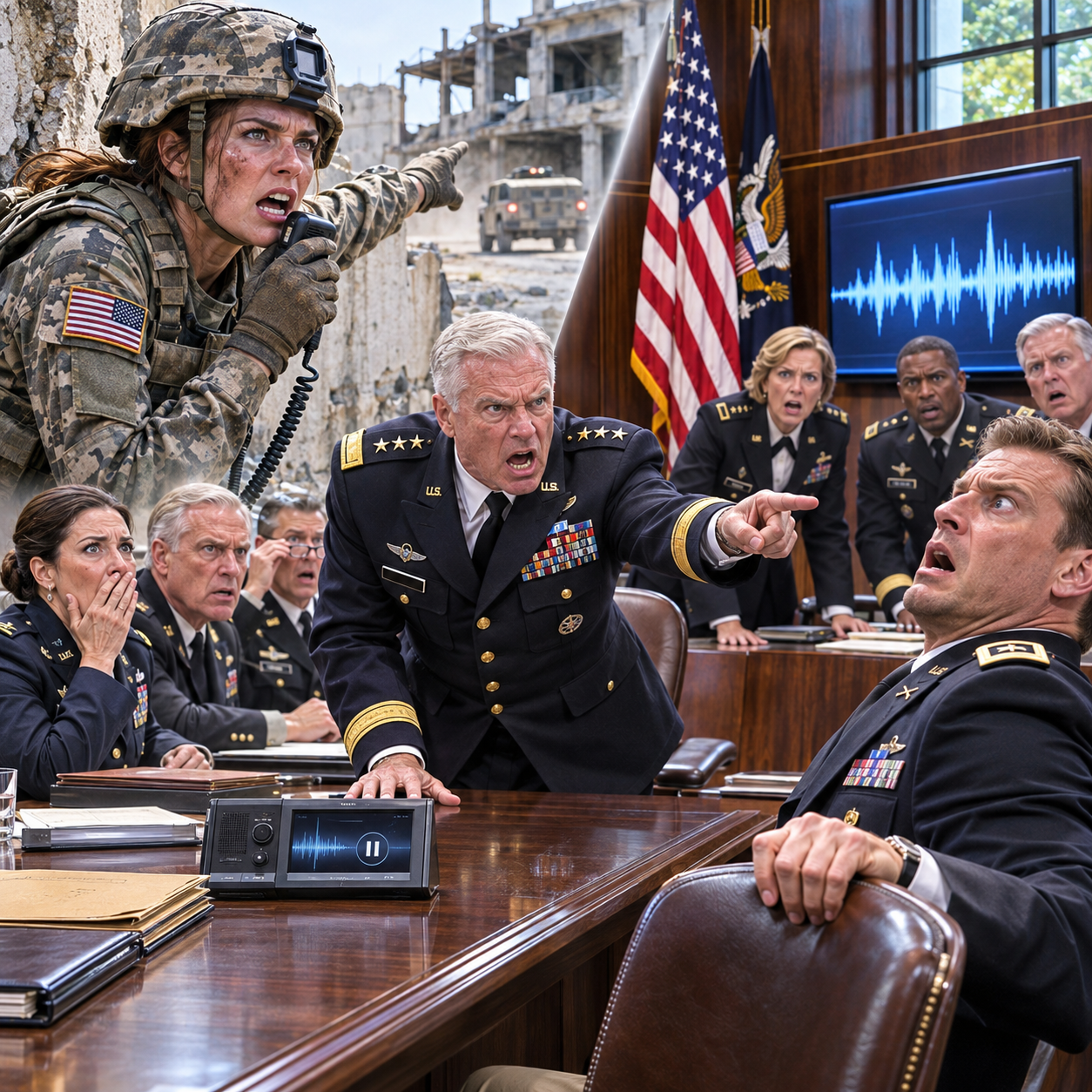
“She Panicked And Got Herself Killed!” My Captain Told His Promotion Board. Then The General Played My Final Transmission From Behind Enemy Lines. “Captain, The Children Are Still Inside. I Need Extraction.” His Voice Answered, “Leave Them! That’s An Order!” The General Paused The Recording. “Then Explain Why Forty Children Were Rescued After You Left.”
My captain told the Army I had panicked, disobeyed orders, and died behind enemy lines. He described abandoning me as the hardest decision of his career, while four soldiers who escaped with him stayed silent. I never contacted him after our rescue. Six months later, I stood outside the Pentagon room where his promotion was being reviewed, listening to him repeat that story. What he didn’t know was that a damaged communications recorder had preserved something far more disturbing than his final order.
## Part 1/5
The first time I heard Captain Graham Sloane describe my death, I was standing twelve feet away from him, separated by two oak doors and six months of secrets. My name is Staff Sergeant Nora Keene, I’m twenty-nine years old, and the last official account Sloane had seen listed me as missing and presumed killed during Operation Northern Lantern. Through the doors of a Pentagon conference room, I could hear him speaking in the measured, sorrowful voice he used whenever important people were listening. “Sergeant Keene made a decision I couldn’t control,” he told the promotion review panel. “I regret that I couldn’t bring her home, but my responsibility was to the soldiers still under my command.” I looked down at my polished shoes and remembered the last time I’d heard that voice, coming through my headset while I lay exposed on a concrete landing pad.
Six months earlier, our detachment had been stationed at a small allied security compound in a mountain valley known only as Sector Four on our operational maps. The facility housed eighteen American medical workers and civilian relief specialists supporting displaced families from nearby communities, while our military team maintained communications and provided security. I was the senior enlisted communications specialist, responsible for keeping the compound connected to regional command when the surrounding mountains interfered with ordinary radio traffic. Captain Sloane commanded the security element, an assignment he considered a temporary inconvenience before his expected promotion to major. He was thirty-six, handsome in the polished way of military recruiting photographs, and exceptionally skilled at making routine accomplishments sound historic.
At first, I admired him because he remembered everyone’s hometown and never forgot to thank visiting officers for their support. That admiration began fading when I noticed how differently he behaved after those visitors left, especially toward enlisted soldiers who questioned his decisions. During our second week, a young specialist named Owen Mercer reported that the medical evacuation vehicle had developed an intermittent electrical problem, and Sloane told him to record it as routine maintenance rather than a readiness concern. When I suggested requesting another vehicle, Sloane studied me across his desk and said, “Sergeant, I need people who solve problems, not people who manufacture paperwork.” I repaired what I could, but I couldn’t repair a command climate where inconvenient information disappeared before reaching headquarters.
The civilian medical team worked in a converted supply building below our communications bunker, with a narrow concrete stairwell leading into old underground utility passages. Their lead physician, Dr. Celia Whitmore, was a forty-three-year-old emergency surgeon from Michigan who had spent most of her career working in places people were desperate to leave. Celia had a habit of keeping coffee in a chipped blue mug and greeting every patient as though she had all the time in the world. One afternoon she found me examining the emergency radios and asked why the evacuation vehicle still hadn’t been replaced. I told her a request was pending, although I knew Captain Sloane had returned my report without approving it.
Three days before the attack, Celia brought me a handwritten list of patients who would need assistance if the facility was evacuated. I helped her identify the strongest members of her team and showed them the utility passage that led beneath the southern perimeter wall. She watched me test the emergency door and said, “I hope you understand how much we’re depending on your people.” I told her our assignment included protecting everyone at the compound, a statement I believed without hesitation. Looking back, I wish I had asked whether everyone wearing our uniform believed it too.
The attack began at 1:17 a.m. on a Thursday, with a deep metallic crash that shook dust from the ceiling above my communications desk. For one confused second, I thought the backup generator had exploded, but then the northern observation post transmitted a warning before its signal dissolved into static. Mortar rounds struck the outer courtyard, the power flickered, and our surveillance cameras went black in sequence. I switched to battery power and contacted Captain Sloane, who was stationed uphill near the aircraft landing zone. “Multiple impacts, possible coordinated assault,” I reported. “I’m establishing the emergency relay and requesting immediate support.”
His response was almost instantaneous, and it was nothing like the deliberate voice he used during inspections. “All personnel fall back to the aircraft,” he shouted. “We’re leaving this position.” I checked the medical building’s emergency channel and heard Celia reporting eighteen personnel inside, including two staff members assisting an injured colleague. When I reminded Sloane that the medical team’s vehicle was out of service, he snapped, “The perimeter is collapsing, Sergeant, and I will not lose this aircraft because you can’t follow instructions.” Behind his voice, I could hear helicopter engines already accelerating.
I transmitted our distress coordinates through the satellite backup, then secured the communications console and ran downhill toward the medical station. The air smelled of burned insulation and pulverized stone, and every explosion briefly turned the courtyard white. Celia was helping a nurse named April Salazar guide their injured coworker down the utility stairwell, while the remaining workers crowded around the open hatch. I directed them into the reinforced lower passage, counted all eighteen, and showed April how to secure the interior door. “I’m getting the helicopter back for you,” I told them, and Celia caught my sleeve long enough to answer, “Don’t make a promise you have to die keeping.”
I reached the landing pad less than four minutes later, slipping on loose gravel as the helicopter’s loading ramp began to rise. Four soldiers were already aboard, and Captain Sloane stood beside the open doorway with his helmet secured and one hand gripping the frame. I raised both arms and shouted that the civilians were sheltered, the southern approach remained passable, and we still had time to coordinate their evacuation. He looked directly at me, lowered his gaze toward his radio, and gave the order that would follow me into every nightmare afterward. “Leave them, Sergeant. Your position is no longer recoverable. That’s a direct order.”
The helicopter lifted while I was still running toward it, and the force of the rotor wash knocked me against the concrete. I watched the aircraft bank toward the western ridge, carrying five military personnel away from a compound containing eighteen defenseless civilians. Through my headset, a different voice briefly broke through the noise, saying, “Sir, the southern perimeter is still holding,” before Sloane ordered the channel closed. I didn’t understand the significance of those words until months later. At that moment, I understood only that my captain had abandoned us before the position was actually lost.
## Part 2/5
I had spent years training myself to think clearly under pressure, but nothing in that training prepared me for watching the only available helicopter disappear into the night. For several seconds I stayed behind a concrete barrier, trying to understand whether Sloane might have ordered another aircraft to our position without telling me. Then a round struck the barrier above my shoulder, scattering chips across my helmet, and the question became irrelevant. I crawled toward a drainage opening, slipped into the muddy channel beneath the landing pad, and followed it downhill until I reached the service entrance beside the medical building. By the time I climbed inside, my gloves were torn, my knee was bleeding, and I had decided the eighteen people below me were going home, whether headquarters knew we were alive or not.
Celia met me at the bottom of the stairwell with a flashlight and an expression I still remember. “Where’s the helicopter?” she asked, looking past me as if the answer might be coming down the stairs. “It’s gone,” I told her. April stopped wrapping a bandage around their injured colleague’s arm, and the silence that followed was worse than the explosions outside. I explained that I had transmitted our coordinates and that reinforcements would eventually arrive if the message reached regional command, but I couldn’t promise when. “Until then,” I said, “we stay together, conserve everything, and make this place as difficult to enter as possible.”
Our underground shelter had originally been built to carry electrical lines and water pipes through the foundation of an abandoned industrial facility. It smelled of wet concrete, mildew, and old machine oil, and its narrow passages were lined with metal shelving that rattled whenever another impact shook the ground. I organized the civilians into small teams, assigning people to inventory supplies, monitor the emergency radio, assist the injured, and watch the reinforced entrances. We secured unused access points with maintenance barriers and reinforced doors, then moved everyone into the deepest section of the passage. None of us knew exactly how many armed men were outside, but the sounds above us made it clear that leaving before daylight would be dangerous.
The first morning brought no rescue aircraft, only intermittent gunfire and the distant rumble of vehicles moving through the valley. Our radio reception was unreliable, and the emergency transmitter had enough power for only short bursts unless I found another battery. Celia made rounds with April, checking temperatures, cleaning wounds, and keeping the frightened workers occupied with practical tasks. One of the youngest, twenty-four-year-old logistics coordinator Benjamin Harker, asked whether the captain knew we were still alive. I told him yes, and then I had to look away because the question underneath his words was one I couldn’t answer.
That afternoon, Celia found me beside the emergency equipment cabinet, trying to salvage usable batteries from damaged communications units. She handed me half a protein bar and sat on an overturned storage crate, her shoulders trembling with exhaustion. “He heard you tell him we were down here, didn’t he?” she asked. I confirmed it, and she stared at the floor for so long that I thought she might be crying. Instead, she said, “Then whatever happens next, I want that written down somewhere.” I promised her it would be.
During the second night, a series of heavy impacts brought down part of an unused exterior passage and filled our shelter with dust. We moved the patients farther underground while I checked the emergency beacon, which continued transmitting at irregular intervals. Benjamin discovered that the damaged vehicle telemetry cabinet in the maintenance room still had a functioning storage module, protected behind a bent steel housing. I recognized the system immediately because I had helped verify its automated reporting functions during our arrival inspection. It collected aircraft-position information, radio traffic routed through the compound, and selected emergency transmissions for later operational review.
Most of the cabinet was ruined, but the storage unit appeared intact, and I knew there might be an independent record of the helicopter’s departure. I spent several hours connecting it to our surviving backup terminal, checking what could be recovered without damaging the original files. At first the screen displayed corrupted entries and incomplete timestamps, which made me fear the recorder had failed during the attack. Then a directory appeared containing the final communications between the landing pad and our command network. I recognized my own voice, heard Sloane order the helicopter to leave, and watched an aircraft-position marker continue moving across the display long after he had claimed the compound was completely surrounded.
I replayed one segment three times because I couldn’t believe what I was hearing. A member of the flight crew had reported that the southern approach remained accessible and asked whether they should continue holding for personnel still on the ground. Sloane answered, “Negative. Departure is authorized. Record the remaining personnel as unable to reach extraction.” When the crew member asked for confirmation, he repeated the instruction and told them to proceed immediately. There was no mention of the civilians, no acknowledgment of my request, and no indication that he had contacted the facility to determine whether we could still evacuate.
On the third day, our food was nearly gone, and one of the medical workers had developed a fever that made Celia increasingly concerned. The emergency radio carried occasional fragments of allied transmissions, but every attempt to establish a reliable connection failed beneath the mountain interference. I kept the recovered storage module wrapped in a waterproof medical pouch inside my vest, checking it whenever the explosions outside grew close enough to shake the lights. April caught me touching the pouch and asked what I was protecting. “A record of what happened,” I told her. “If we get out, nobody gets to change the sequence.”
Just before sunrise on the fourth morning, the valley filled with a sound that made every person in the shelter freeze. Helicopter engines rolled across the mountains, followed by the unmistakable noise of armored vehicles approaching the compound. I reached the emergency radio, transmitted our coordinates again, and finally heard an American voice answer clearly, “Unidentified station, repeat your call sign.” I gave my identification, our location, and the number of civilians sheltered below, fighting to keep my voice steady as the operator confirmed that an allied recovery force was approaching. Minutes later, twenty years seemed to fall from Celia’s face when we heard soldiers calling to us from the other side of the reinforced entrance.
All nineteen of us emerged into a ruined courtyard under a sky so bright it hurt my eyes. A rescue officer looked at our group, checked his manifest, and asked me to confirm that I was Staff Sergeant Nora Keene. When I answered, his expression changed in a way that frightened me more than any question he could have asked. “Sergeant,” he said carefully, “your commanding officer reported this entire detail lost three days ago.” Then he showed me the preliminary casualty summary, and I saw something even worse than my own name listed among the missing: according to Sloane’s report, the eighteen civilians had already been evacuated before he departed.
## Part 3/5
At the regional air base, the first person waiting beside our transport wasn’t a medic or a counselor. It was Brigadier General Daniel Carrow, a silver-haired officer whose name appeared on the original deployment orders, accompanied by two military investigators. He watched eighteen exhausted civilians walk down the ramp before approaching me and asking how many people we had lost. “None, sir,” I answered. “We have injuries, but everyone assigned to the medical facility survived.” His gaze dropped to the waterproof pouch in my hand, and when I explained what it contained, he immediately requested that it be preserved as evidence.
I expected the investigators to ask me why I had disobeyed Sloane’s evacuation order, and they did, but they also asked questions that suggested they were investigating something much larger. Major Camille Arden, an experienced military investigator with a habit of writing everything in a small black notebook, interviewed me for nearly four hours. She wanted the exact sequence of transmissions, the condition of the southern perimeter, and every statement I remembered hearing from the helicopter crew. When I described the civilian evacuation vehicle, she paused and asked whether I had personally inspected it after Sloane rejected my replacement request. I admitted that I had checked its electrical system but hadn’t seen it during the final forty-eight hours before the attack.
That detail bothered me, although I couldn’t immediately explain why. Back at the compound, I had accepted the vehicle’s absence because Specialist Mercer told me maintenance personnel had moved it to an upper storage area. I remembered a conversation with Sloane about acquiring a replacement, but I couldn’t recall seeing a signed work order authorizing the vehicle’s removal. Major Arden showed me a copy of the official readiness report submitted two days before the attack, which listed every evacuation asset as operational. Captain Sloane had signed it himself.
When I returned home to Virginia, my mother hugged me in the airport parking garage so tightly that my ribs hurt. She had been informed of my rescue but knew little about the circumstances, and the restrictions surrounding the investigation meant I couldn’t explain everything she had heard through military channels. For the first week, she slept in my guest room because I kept waking at night convinced I could hear someone pounding on the shelter door. The Army arranged counseling, and I attended, even though I initially resented having to describe things I was desperately trying to forget. I had survived an enemy attack, but what followed me home was the memory of a man looking straight at me and deciding my life was an acceptable loss.
Celia called regularly, usually after finishing a hospital shift, and we talked about ordinary things before either of us mentioned Sector Four. One evening, she told me that Benjamin had returned to his family in Oregon but couldn’t stand the sound of helicopters. April had transferred to another medical program, and several survivors were struggling with injuries and interrupted careers. “I keep thinking about the equipment you were asking them to replace,” Celia said. “What if we’d had a functioning evacuation vehicle?” I didn’t tell her that investigators were asking the same question.
Two months into the investigation, Major Arden asked me to return to Washington for a meeting with General Carrow. She brought photographs, maintenance records, flight data, and a detailed timeline assembled from multiple independent sources. The vehicle had not suffered a catastrophic mechanical failure, as we had been told; its original electrical fault had been repaired the day before the attack. Instead of being returned to the medical facility, it had been reassigned to transport personnel supporting a visiting readiness evaluation. Sloane had personally approved the transfer while leaving the medical compound’s evacuation plan unchanged.
The evidence went beyond one missing vehicle. Intelligence analysts had transmitted two warnings about unusual armed movement near the mountain pass, requesting a review of our defensive posture. Those warnings reached Sloane’s command post, but he classified them as insufficient to change the mission schedule and did not forward their full contents to the medical team. According to a written exchange recovered from the command network, his concern was that another readiness exception might postpone his unit’s evaluation and complicate his promotion recommendation. One message carried a sentence that made my stomach tighten: “We will not create another readiness deficiency on the eve of inspection.”
I had spent weeks wondering whether Sloane had abandoned us because he was afraid, because he believed the situation was hopeless, or because he simply didn’t care enough to wait. Now the documents suggested he had been building a record of perfect readiness while removing the very safeguards that might have made an orderly evacuation possible. Investigators found earlier discrepancies involving emergency supplies, outdated personnel counts, and unresolved communications faults that had been repeatedly marked corrected. None of those mistakes caused the hostile attack, and I was careful not to claim they had. But they explained why we entered that night with fewer options than our approved plans promised.
General Carrow then told me something I hadn’t expected: Sloane was being considered for promotion, and his account of our mission had become part of the command record supporting that recommendation. “He was instructed to preserve his records and has provided sworn statements,” Carrow explained. “He continues to maintain that the compound was overrun before his departure and that you were killed after refusing evacuation.” The rescue reports, civilian witness identities, and surviving telemetry had been restricted during the investigation, so Sloane had not been given the complete evidentiary picture. Carrow asked whether I would testify at a special command review connected to his pending promotion, warning me that the proceedings could lead to formal military justice action. I agreed because I wanted every decision judged against what had actually happened, not the story Sloane had written afterward.
Three weeks before the review, Major Arden showed me the final reconstructed timeline, including one recovered audio exchange that hadn’t been included in my first debriefing. At 1:11 a.m., six minutes before the attack began, Sloane had contacted the helicopter crew and instructed them to prepare for immediate departure, without notifying the medical facility. His explanation to the pilot was that civilian evacuation would be handled separately, although no second aircraft or ground vehicle had been requested. I looked at the timestamp until the numbers blurred. My captain hadn’t merely decided to leave us when the shooting became unbearable; he had arranged his own exit before the first explosion.
## Part 4/5
On the morning of the review, I arrived at the Pentagon wearing my Army service uniform, with my hair secured neatly and a small scar visible above my left eyebrow. General Carrow had warned me that Sloane might react unpredictably, but the thought of seeing him frightened me less than I expected. What troubled me was the possibility that he would sound reasonable, that a room full of senior officers might accept the familiar language of operational necessity and never understand the people abandoned beneath that compound. Major Arden met me outside the conference room, checked that I was prepared, and reminded me to answer only what I knew firsthand. Through the closed doors, Sloane was already telling the panel how difficult it had been to leave his missing sergeant behind.
He described our position as completely surrounded, the helicopter as nearly disabled, and my decision to remain as an unauthorized attempt to rescue people who were already beyond help. “There was no viable ground route,” he said. “Every additional second exposed the entire aircraft to unacceptable risk.” He spoke about the five military personnel who escaped and the burden of being the officer required to choose between competing lives. When a senior panel member asked whether he had received confirmation that the civilians were evacuated, Sloane replied, “All available reports indicated their evacuation had been completed before our withdrawal.” I closed my eyes briefly, remembering Celia’s flashlight moving across the faces of eighteen people who had never boarded any vehicle.
General Carrow waited until Sloane finished before asking him to clarify the time of the southern perimeter breach. Sloane identified a point shortly before his aircraft departed, citing a report he claimed to have received through the command network. Carrow then displayed the synchronized operational timeline, reconstructed from the helicopter’s flight records, independent satellite tracking, and the compound’s recovered telemetry system. The earliest confirmed breach occurred eight minutes after the aircraft had lifted away from the landing pad. “Captain,” Carrow said, “your report places the breach before your departure, but three independent systems contradict that sequence.”
Sloane answered that the records must reflect equipment delays or incorrect timestamps, and his voice remained steady enough that I felt a sudden, familiar anger. Carrow nodded toward the technician seated beside the panel, who started the recovered audio recording without introduction. The speakers filled with rotor noise, scattered gunfire, and my own strained voice reporting eighteen civilians sheltered in the lower facility. I heard myself demand that the ramp remain open, followed by Sloane’s order to abandon the position. Then came the flight crew member’s report that the southern approach remained accessible, and Sloane’s instruction to leave immediately.
For the first time that morning, Sloane stopped speaking. One officer asked why the recording contained no reference to the civilian evacuation he claimed had already occurred. Sloane suggested that portions of the radio exchange might have been altered, possibly by hostile interference during the attack. Major Arden presented the technical verification results and the matching aircraft records, while Carrow asked him whether he had any evidence supporting his allegation. Sloane looked toward the door and said, “General, Sergeant Keene was killed in that incident, and I cannot ask her to verify what she may have transmitted.”
“That assumption is one of the reasons we’re here,” Carrow replied. He gave a brief instruction to the officer waiting near the entrance, and the door opened in front of me. I walked into the room, approached the designated witness position, and rendered a salute before identifying myself. “Staff Sergeant Nora Keene, reporting as directed, sir.” When I turned toward Sloane, he was gripping the edge of the table, staring at me as if the room had suddenly tilted.
For several seconds, nobody spoke, and I noticed that his face had lost its carefully controlled expression. He whispered, “Nora?” I had spent six months imagining what I might say when he finally saw me alive, but none of my imagined speeches seemed necessary. Carrow asked whether I could identify the voice issuing the evacuation order on the recording, and I answered that it belonged to Captain Graham Sloane. I then described what I had observed on the landing pad, including the aircraft departing while the southern route remained open.
Sloane finally interrupted, insisting that he had believed the civilians were already evacuated and that he had made the only decision available under the circumstances. Carrow placed the earlier vehicle reassignment authorization beside the readiness report Sloane had signed, along with his message rejecting additional evacuation arrangements. “These records establish that you knew the civilian team had no dedicated transport,” Carrow said. “Your own radio communications establish that Sergeant Keene told you they were still inside.” Sloane’s answer came quietly: “I believed the bunker wouldn’t hold.”
That admission changed the room more than his anger or his denials ever could. Carrow asked whether Sloane had attempted to determine the bunker occupants’ condition before departing, and he acknowledged that he had not. The panel then reviewed his false casualty summary, his inaccurate readiness certifications, and the independent testimony collected from the survivors and flight crew. When the questioning ended, Carrow informed him that his promotion recommendation would not proceed and that he was being relieved of command pending the military justice process. Investigators were waiting outside to complete the next steps, but the panel made clear that any criminal findings would be decided through separate proceedings.
As Sloane gathered his papers, he turned toward me and asked something I hadn’t expected. “Why didn’t you contact me when you got back?” His voice held a strange mixture of fear and resentment, as though I had somehow betrayed him by surviving without permission. I looked at the folder containing the casualty report and answered, “Because I wanted you to finish telling your version before everyone heard mine.” He stared at me, then lowered his eyes and walked out under escort, leaving behind the documents he had spent months depending on to protect his career.
## Part 5/5
The consequences of Captain Sloane’s actions unfolded through months of interviews, legal proceedings, and uncomfortable questions that reached well beyond his own career. Investigators expanded their examination of the readiness reports he had submitted during the previous year and discovered that multiple unresolved deficiencies had been marked corrected without proper verification. Several junior soldiers described being pressured to change maintenance entries or withdraw concerns before inspections. Specialist Owen Mercer admitted that he had been instructed to close the evacuation vehicle’s original repair ticket without documenting its reassignment. None of us had recognized the full pattern while serving under Sloane, but once investigators compared our experiences, the similarities were impossible to ignore.
The Army initiated corrective reviews of emergency planning, readiness reporting, and civilian evacuation procedures at other locations under the same command. I was invited to participate in one assessment, and I insisted that medical workers and enlisted communications personnel be allowed to raise concerns directly without having them filtered through the officers whose performance was being evaluated. The changes couldn’t erase what had happened in Sector Four, and I refused to pretend that revised procedures guaranteed safety. Still, when Celia learned that medical teams would receive independent confirmation of their evacuation arrangements, she called me after work. “That’s the first thing I’ve heard in months that makes me feel like somebody actually listened,” she said.
Sloane eventually faced a general court-martial after declining an opportunity to resolve the matter through a negotiated agreement. His defense maintained that the attack had created extraordinary pressure and that some of his decisions were reasonable judgments made under dangerous conditions. The prosecution relied on the false official statements, inaccurate readiness reports, surviving communications, and testimony establishing what he knew when he ordered the aircraft to depart. The court did not need to decide whether he had been frightened, because fear alone was not the central issue. The question was whether he had knowingly falsified information and neglected responsibilities that others had depended upon for their lives.
I testified for most of one afternoon, describing the final exchange on the landing pad and the seventy-two hours that followed. Across the courtroom, Sloane sat beside his defense counsel, looking smaller than I remembered him, although I knew his appearance should have no bearing on my testimony. When his attorney asked whether I could be certain the helicopter could have remained safely on the ground, I acknowledged that I couldn’t predict what might have happened if Sloane had waited. “What I can tell you,” I said, “is that he reported conditions that had not yet occurred, abandoned people he knew were still there, and later submitted an account that wasn’t true.” I had no interest in turning speculation into certainty, because the documented facts were already serious enough.
The court convicted Sloane of false official statements and additional offenses connected to his failure to carry out assigned duties and his conduct as an officer. His sentence included dismissal from military service, and his career ended without the promotion he had spent years pursuing. I attended the sentencing but felt no sudden rush of happiness when the judgment was announced. I thought instead about the civilians lying on the cold floor of the utility passage, April counting bandages by flashlight, and Celia asking whether anyone would ever know what had happened. That was the part of the verdict that mattered: the official record would no longer treat their survival as an inconvenience to somebody else’s story.
Several weeks later, I received a letter from Sloane through the appropriate legal channels, requesting an opportunity to apologize privately. He wrote that he had lived with regret since the attack, that he understood the suffering his choices had caused, and that he hoped I might eventually forgive him. I read the letter once at my kitchen table, beside the same chipped coffee mug Celia had sent me after returning to Michigan. Then I placed it in a drawer with the court documents and declined the meeting. I wasn’t interested in becoming the person who helped him feel better about what he had done.
My recovery was less dramatic than the hearing and much harder than receiving public recognition. I still had nights when a passing helicopter woke me, and I still sometimes checked the locks on my apartment twice before going to bed. Counseling helped me understand that surviving a disaster did not require me to feel grateful every moment afterward, and I gradually learned to accept ordinary days without searching for the next emergency. I returned to communications work with a training assignment that allowed me to teach younger soldiers why documentation, contingency planning, and the willingness to question unsafe decisions mattered. I told them that following orders was part of our responsibility, but so was recognizing when lives depended on accurate information.
Nearly a year after the attack, I stood on a parade field at Fort Belvoir as General Carrow presented me with the Silver Star. My mother sat in the front row, holding a folded tissue, while Celia, April, Benjamin, and other survivors watched from the seats reserved for our guests. The citation described my efforts to protect eighteen civilians, maintain communications, and sustain our group until rescue forces arrived. As the general pinned the medal to my uniform, I looked past the assembled officers toward the people whose names had once been incorrectly recorded as already evacuated. They were the reason I had stayed, and seeing them alive together mattered more than any ceremony.
Afterward, Benjamin approached me carrying a small photograph taken outside the medical shelter during our first week in Sector Four. Everyone looked tired and sunburned, and I stood near the edge of the group holding a clipboard while Celia laughed at something outside the frame. “I thought you should have this,” he said. On the back, the survivors had written their names and a simple message thanking me for coming back. I held the photograph longer than I held the medal, because it showed nineteen ordinary people before any of us knew what we would eventually survive together.
That evening, I returned home, hung my uniform in the closet, and placed the photograph on the bookshelf beside my mother’s family pictures. I still didn’t know whether Sloane truly regretted abandoning us or simply regretted the consequences, and I had stopped trying to answer that question. His decisions had cost him the position he valued, but they had also exposed a system of misleading reports that might otherwise have continued until another emergency revealed its weaknesses. The Army had corrected the record, the survivors had their lives back, and I had a future that no longer depended on proving anything to him. For three days, I had believed nobody was coming to save us, but when I looked at that photograph, I understood that the nineteen people who walked out of Sector Four had already begun saving one another long before the rescue helicopters arrived.
THE END!
Disclaimer: Our stories are inspired by real-life events but are carefully rewritten for entertainment. Any resemblance to actual people or situations is purely coincidental.