
Sister-In-Law Broke My Nose With Wedding Album For Refusing Venue Fee—The Facial CT Scans Reached…
My brother’s fiancée broke my nose with our parents’ wedding album when I refused to fund her $18,000 venue. While everyone stood frozen, I told Mom to call 911 and leave the album untouched. Eleven days later, I found a company name on the invoice that suggested the wedding bill was a lie.
### Part 1: An outrageous wedding demand turns Sunday dinner into evidence.
The email arrived Wednesday morning while I was drinking coffee. Ashley Mercer had attached a glossy six-page brochure for Riverside Estate, showing a champagne fountain and a terrace overlooking the Ohio River. The price: $18,000 for six hours. Above it, she had typed, “Your share. Pay by Friday so we can secure the date.” I was thirty-four, worked as a scheduling coordinator for the city water department, and had spent three years building an emergency fund after a difficult divorce. That was almost all of it. I responded, “I’m happy for you and Ben, but I won’t pay for the venue. I’ll come to the wedding as a guest.” She called immediately. “Everyone else is contributing,” she said. “Your parents have catering. Uncle Robert has flowers. You’re the only one making this ugly.” I told her those relatives had volunteered, whereas she was presenting me with a bill. “We’ll discuss it Sunday,” she snapped.
Ashley had crossed boundaries long before the engagement. At Christmas, she announced to our cousins that I would host her bridal shower without asking me first. In February, she used my saved credit card for a $460 bridal appointment, then took three weeks to reimburse me. When I asked her to remove the card from her account, she called me “weird about money.” Then she listed me as “venue sponsor” on a family spreadsheet. Ben had laughed uncomfortably when I asked him to take it off. “She gets ahead of herself,” he said. I had accepted that explanation too often. He ran a cabinet shop outside Cincinnati and was exhausted by a delayed contract. He’d mentioned an odd charge on the shop account, then changed the subject when Ashley walked into the room. I dismissed it as stress.
On Sunday, my parents’ kitchen smelled of grilled chicken and rosemary potatoes. Ashley was standing at the island in an ivory dress, a binder labeled WEDDING PLANNING spread open beside the fruit bowl. Ben was next to her, rubbing the back of his neck. The moment I entered, she said, “Good. Sarah can explain why she thinks she’s exempt.” Mom looked up from the salad. “Exempt from what?” When Ashley repeated the $18,000 demand, Dad put down his grilling tongs. “Nobody asked Sarah to fund your wedding,” he said. Ashley described the sunset photographs she had dreamed of since childhood. I told her beauty didn’t give her access to my savings. Ben suggested touring a less expensive place. Ashley shut the binder so hard the silverware rattled. “You promised we’d make this happen,” she told him. “I didn’t promise we’d make Sarah pay for it,” he answered. I noticed his phone lighting up with a call labeled FIRST VALLEY CREDIT UNION. He turned it facedown without answering.
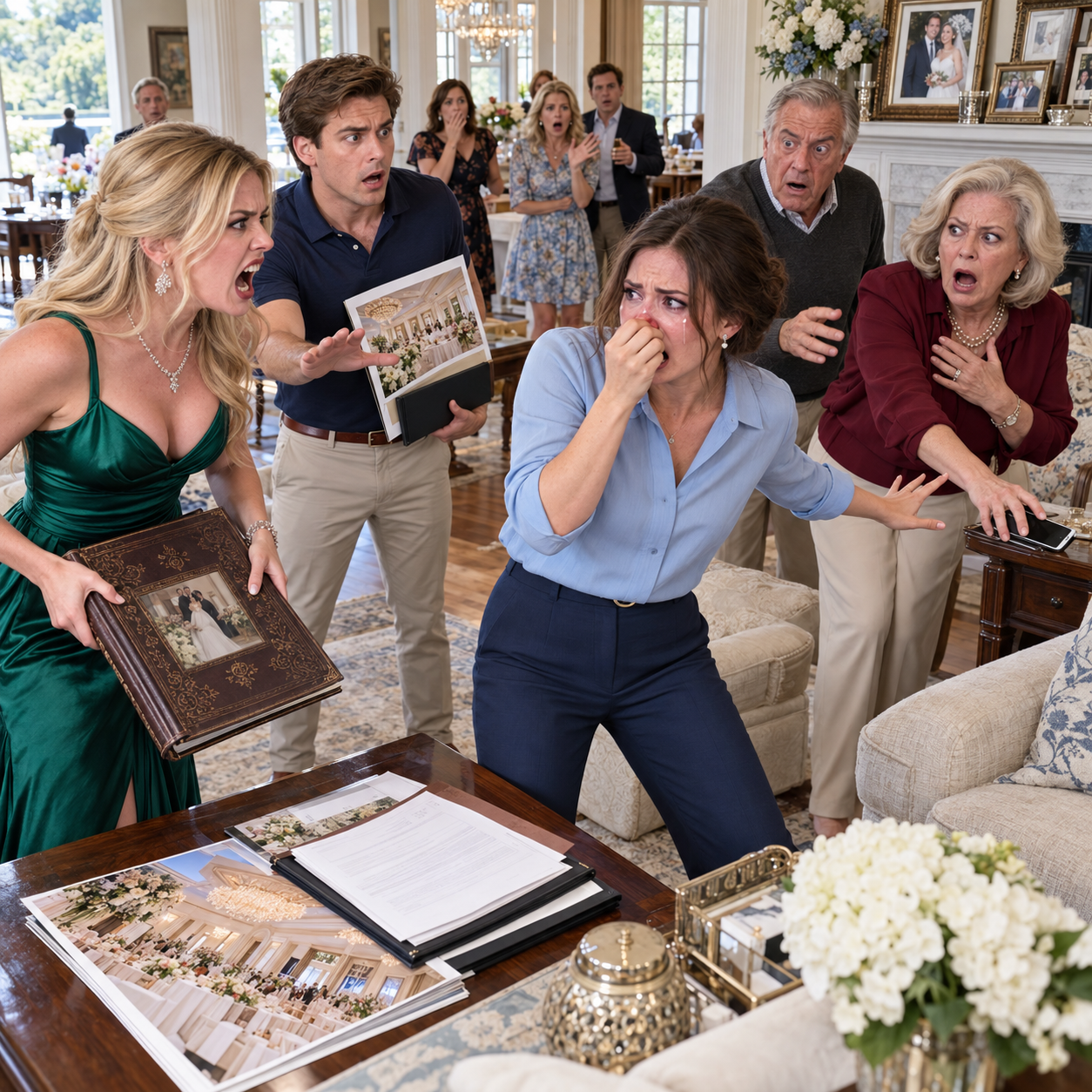
We ate on the patio in strained silence. By dessert she had developed a compromise: I could pay $1,500 a month for a year. I told her I wouldn’t pay one dollar. Mom said the discussion was over. Ashley stared at me for several seconds, then disappeared upstairs toward the little office where my parents kept tax folders, family photographs, and their old wedding album. She had borrowed the office key the previous weekend, supposedly to print address labels for invitations. I’d objected, but Mom had brushed it off. “She’ll be family soon.” Ten minutes later, Ashley returned holding the enormous leather album from my parents’ 1989 wedding. I remembered struggling to lift its brass-reinforced cover as a girl. “This is what family looks like,” Ashley said, gripping it against her chest. “People sacrifice.” Mom told her to put it back. I stepped away from the sink and said, “You don’t get to use their marriage to threaten me.” Ashley’s expression hardened. “You’re embarrassing me in front of everyone,” she said. “You’re ruining everything.”
She swung before Ben could cross the kitchen. The album’s metal corner struck the bridge of my nose, and for one impossible second I registered the weight of the impact more clearly than the pain. Then my knees buckled against the cabinet and blood soaked the front of my shirt. Dad caught me, pulled a clean dish towel from a drawer, and told me to lean forward while he pressed it gently against my face. Mom was shaking so badly she almost dropped her phone. “Call 911,” I told her. “And don’t touch the album.” It lay open on the tile, showing my parents smiling beneath a church archway. Ashley kept saying she hadn’t meant to hit me that hard. Ben looked at her as though he had never seen her before. “You picked it up,” he said. “You walked right at her.” When the paramedics arrived, I was sitting against the refrigerator, dizzy and trying not to swallow blood. I heard Ashley ask Ben if there was a way to keep this “in the family.” He said no.
At the emergency department, a nurse asked how the injury happened. I told her exactly what Ashley had done and why. The physician ordered facial CT scans, which showed two nasal bone fractures and a displaced septum. I would need an ENT surgeon and possibly reconstructive surgery to breathe normally again. A police officer photographed the album after my parents gave permission for it to be collected; another recorded my statement and those of all three witnesses. I consented to the release of my medical documentation for the investigation. Early the next morning, Ashley was arrested on a charge of aggravated assault. Ben called to say the wedding was over. Even speaking hurt. “Please don’t ask me to make this easier for her,” I said. “I won’t,” he replied. That was the first promise from him I was prepared to believe.
Eleven days later, while I was checking the invoice to send it to the victim advocate, I noticed a line in tiny gray type: PAYMENT PROCESSING — JUNIPER EVENT SERVICES. The payment instructions named that company, not Riverside Estate. I called Riverside directly, using the number on its public website, and asked whether they had sent the invoice. The events manager requested a copy, went quiet, and then said, “Ms. Bennett, we never issued this. Your brother and his fiancée don’t even have a reservation with us.”
### Part 2: The forged invoice exposes a threat to our family business.
Riverside’s manager sent me a genuine invoice showing that the estate collected payments through its own merchant account. Ashley had copied its logo and rental language from an old proposal. Her $18,000 demand would have sent my money somewhere entirely different. With an ice pack over my swollen face, I compared the two documents twice, willing myself to find an innocent explanation. There wasn’t one. The real venue had offered Ashley a tentative date months earlier, the manager said, but let it go when she failed to provide a deposit. I requested written confirmation, forwarded the documents to Detective Hall, and called Ben. “What is Juniper Event Services?” I asked. He was silent for so long that I thought the call had dropped. Finally he said, “I saw that name on one of the invoices at work.”
Ben’s cabinet shop employed twelve people, including two apprentices he had trained since high school. He used to remember every supplier’s birthday; lately he barely looked up from his phone. Ashley had offered to enter bills while his administrator recovered from surgery. Ben gave her access to the accounting software and permission to prepare payments for him to approve. Ben still had to approve payments, but admitted clicking through batches on his phone without checking descriptions. Among legitimate purchases of hinges, lumber, and freight charges were invoices from Juniper for “specialty finishing” and “site delivery.” None of his carpenters recognized the company. Ben and his accountant, Nora, began reviewing records and found $58,600 transferred over four months. They did not yet know where all the money went. Nora found a state registration: Juniper Event Services LLC, formed under Ashley’s name the previous spring. Its mailing address was my parents’ house.
The address chilled Mom. She remembered Ashley asking to use the upstairs printer, the office key, and a recent utility bill because a “wedding supplier” needed proof of address. Mom had handed over the bill without reading the request. Dad kept his palms flat on the table. “We told ourselves she was enthusiastic,” he said. “We didn’t want to make Ben choose between us and her.” I remembered the shower, credit-card charge, and spreadsheet. None of us had mistaken Ashley’s behavior for kindness. We had merely decided that confronting it was harder than tolerating it. Now we were paying for it.
The financial investigation proceeded separately. Detective Hall referred the altered invoice and bank records to a financial-crimes investigator. Ben filed a bank dispute, changed credentials, removed Ashley’s software access, and hired a forensic bookkeeper to establish which payments were legitimate. The bank might not reimburse him: he had approved the batches. He had payroll due and a commercial customer threatening to cancel an unfinished installation. My brother looked suddenly older. For years I’d watched him drive to work before sunrise because he refused to lay off even one employee during a slow season. Now his determination alone couldn’t replace the missing money. We sat in his truck outside my apartment. “She told me I’d never understood what it felt like to be judged for not having enough,” he said. Ashley’s family’s furniture store had closed when she was in college, and she had been paying off personal debt for years. Her wealthy friends posted extravagant wedding photographs. “She said Riverside would prove we’d made it.” I understood the shame, not the behavior.
The financial investigator later traced some Juniper payments to wedding vendors and others to overdue credit accounts in Ashley’s name. The $18,000 invoice was another attempt to move cash through Juniper, disguised as a venue contribution. Ashley’s attorney called it a misunderstanding and claimed she intended to repay everything with wedding gifts. That did not explain the false invoices. Ben’s signature appeared on approvals he had made carelessly; his error helped hers remain hidden, but it did not make the invoices real. He called off the wedding, canceled the joint apartment lease when he could, and returned the ring through their attorneys. He stopped worrying about Ashley and started worrying about payroll. I asked whether he still loved her. “That isn’t the question anymore,” he said. It was the clearest answer I had heard him give in months.
My recovery couldn’t pause for his crisis. Dr. Patricia Hendris, the ENT surgeon, reviewed my CT images, ordered an additional examination after the swelling eased, and showed me how the fractured bone and displaced cartilage obstructed airflow. She recommended surgery once the tissues were ready. With my permission, Dr. Hendris shared anonymized images at a regional surgical conference attended by ten ENT and facial specialists. Their input guided her reconstruction plan; I separately authorized the medical records and radiology report for the prosecutor. The images proved injury, not fraud; separate evidence would establish that. I had surgery in mid-October. My nose was stabilized, the septum repaired, and I woke with splints, a dry throat, and the depressing realization that making a cup of tea could exhaust me. I missed six weeks of work and owed thousands despite insurance. Whenever a door slammed, I flinched before I could reason with myself.
The worst conversation came after I returned home from my first post-operative appointment. Mom arrived with soup and sat on my couch twisting a tissue. She said their $25,000 certificate of deposit was pledged as security for part of the shop’s business credit line. They’d guaranteed the loan years before Ashley arrived. Now, with the diverted money missing and invoices for materials still coming due, that savings account was at risk if the business defaulted. “Your father wonders whether, if this goes to trial, it will make things worse,” Mom said. I set my soup on the coffee table. “Worse for whom?” She couldn’t answer. “You should have protected my safety before you worried about a trial,” I said. “I’m not withdrawing my account of what happened to protect anyone’s finances.” Mom lowered her eyes. I knew then we would need more than one conversation to repair that distance. After she left, Ben emailed me a scanned page Nora had recovered from Ashley’s draft files. It was Ashley’s draft spreadsheet, with a line beneath the Juniper payments: “If Sarah says no: $25K remaining on Ben’s line. Frank and Linda guarantee it.”
### Part 3: The truth reaches court, leaving no wedding to save.
An aunt I rarely saw was the first to call me vindictive. After Ashley’s parents posted bail, she asked whether I’d considered “ruining a young woman’s future.” I told her I had considered the consequences every time I tried to breathe through my nose. I ended the call and mentioned it to my victim advocate. I never learned who had encouraged her. It hurt more than I expected that relatives who hadn’t called after the surgery suddenly found time to defend Ashley. My parents stopped hosting Sunday dinner for a while. Dad visited to fix a cabinet hinge and apologized for calling Ashley “high-strung” instead of challenging her. I believed him but wasn’t ready for family dinner. He didn’t push.
Ben was meanwhile trying to keep twelve people employed. His bank froze further draws on the business line during its review, and he had to negotiate payment schedules with suppliers. Nora confirmed that materials listed on Ashley’s invoices never arrived. Ben sold an expansion truck, arranged a modest replacement loan, and worked weekends to finish an overdue job. My parents’ $25,000 CD remained restricted under the guarantee, unavailable for emergencies. Any recovery would come too late for immediate payroll. “I signed approvals I didn’t even read,” Ben said one afternoon. “I was so worried about seeming controlling that I stopped being responsible.” I told him he’d been deceived, but his careless approvals had helped. He didn’t argue. The accountant had prepared a plan that might keep the business afloat, but it involved smaller salaries, delayed renovations, and several years of careful scrutiny. No one was stepping in with a miraculous check.
In January, the prosecutor explained the assault case. The case rested on what happened in that kitchen and the documented injury: the stained album, my emergency-room photographs, the CT report, Dr. Hendris’s surgical findings, and the testimony of three people who had watched Ashley step toward me and swing. The defense might claim Ashley was merely waving the album; a conviction wasn’t guaranteed. I’d spent months wondering whether I should have stayed home or kept quiet. Hearing the prosecutor distinguish an argument from an attack helped. My therapist had already asked why I treated keeping the peace as my job, and I still didn’t have a good answer. I had said no. Ashley had chosen what came next.
The trial began in March. I wore a navy blazer and a soft-collared blouse because rough fabric irritated the skin near the healing incision. Outside the courthouse a local reporter asked whether I felt responsible for the canceled wedding. I walked past without answering. Ashley sat beside her attorney, hair neatly pinned, looking strangely familiar. I testified about the invoice, the Sunday conversation, her words, and the impact. The defense asked whether I’d called the wedding irresponsible. I said yes. He suggested Ashley had only tried to show me the album. “She carried it across the kitchen,” I said. “I watched her lift it and swing it.” Ben testified after me. He did not avoid looking at Ashley when he described her stepping forward. Mom cried identifying the wedding photographs. Dad testified that Ashley blamed me as he tended my injury.
Dr. Hendris explained the CT images on a courtroom monitor, indicating the nasal fractures and the shifted septum that had required reconstruction. She emphasized that the scans showed damage, not intent. The prosecution also presented a message Ashley had sent Ben after the incident: “I didn’t mean to hit her that hard. She just kept saying no.” That contradicted the account of a harmless accident. The defense argued that reckless anger did not establish intent. After two days of testimony and several hours of deliberation, the jury found Ashley guilty of aggravated assault. I didn’t celebrate. I felt my shoulders finally relax. Ben sat beside me for a long minute while the courtroom emptied, neither of us speaking.
Before sentencing, I prepared a victim-impact statement with the advocate. I described surgery, unpaid leave, and waking at sudden noises. I described losing the safety I’d once felt at home. Her attorney sent an apology letter. Ashley admitted shame about her debts and fear that Ben would leave. She’d made the wedding proof of her success. Those feelings sounded painfully human. They didn’t turn her actions into an accident. I asked that the letter not be forwarded again. I wanted no relationship with her.
The judge sentenced Ashley to thirty months in state custody, with supervised release and restitution for my documented uninsured losses. In the separate financial case, she later pleaded guilty to charges arising from the falsified business invoices and received an additional restitution order. Court orders wouldn’t guarantee that either of us got repaid. My first payment arrived months later and covered less than one specialist visit. I deposited it, then put the envelope away rather than letting it dictate another day of my life. Riverside Estate kept none of my money because I’d never sent any. The expensive wedding simply never happened. Ashley lost her position at a home-staging firm, and Ben obtained a civil judgment against her business. The shop survived, but Ben postponed expansion. He was rebuilding his livelihood, not winning some dramatic revenge.
By the next summer, I could breathe clearly again, though cold air sometimes made the bridge of my nose ache. My savings were lower, and I trusted people more slowly. Sometimes I still caught myself rehearsing an explanation for a simple refusal. Then I remembered that nobody was entitled to one. Ben and I began having coffee every other Saturday, and when he asked whether I would ever forgive Ashley, I told him that forgiveness was not a condition of my healing. He nodded and never asked again. Mom invited the four of us to dinner, promising no surprise guests. I went, but I drove myself, and I left when I wanted to. On the kitchen sideboard sat the wedding album, returned after the trial, its damaged brass corner repaired and a faint stain still visible on the leather. Mom reached to put it away. “You don’t have to hide it,” I said. It still held beautiful memories. But I had learned that family meant respecting a person’s answer, especially when the answer was no.
THE END!
Disclaimer: Our stories are inspired by real-life events but are carefully rewritten for entertainment. Any resemblance to actual people or situations is purely coincidental.


