
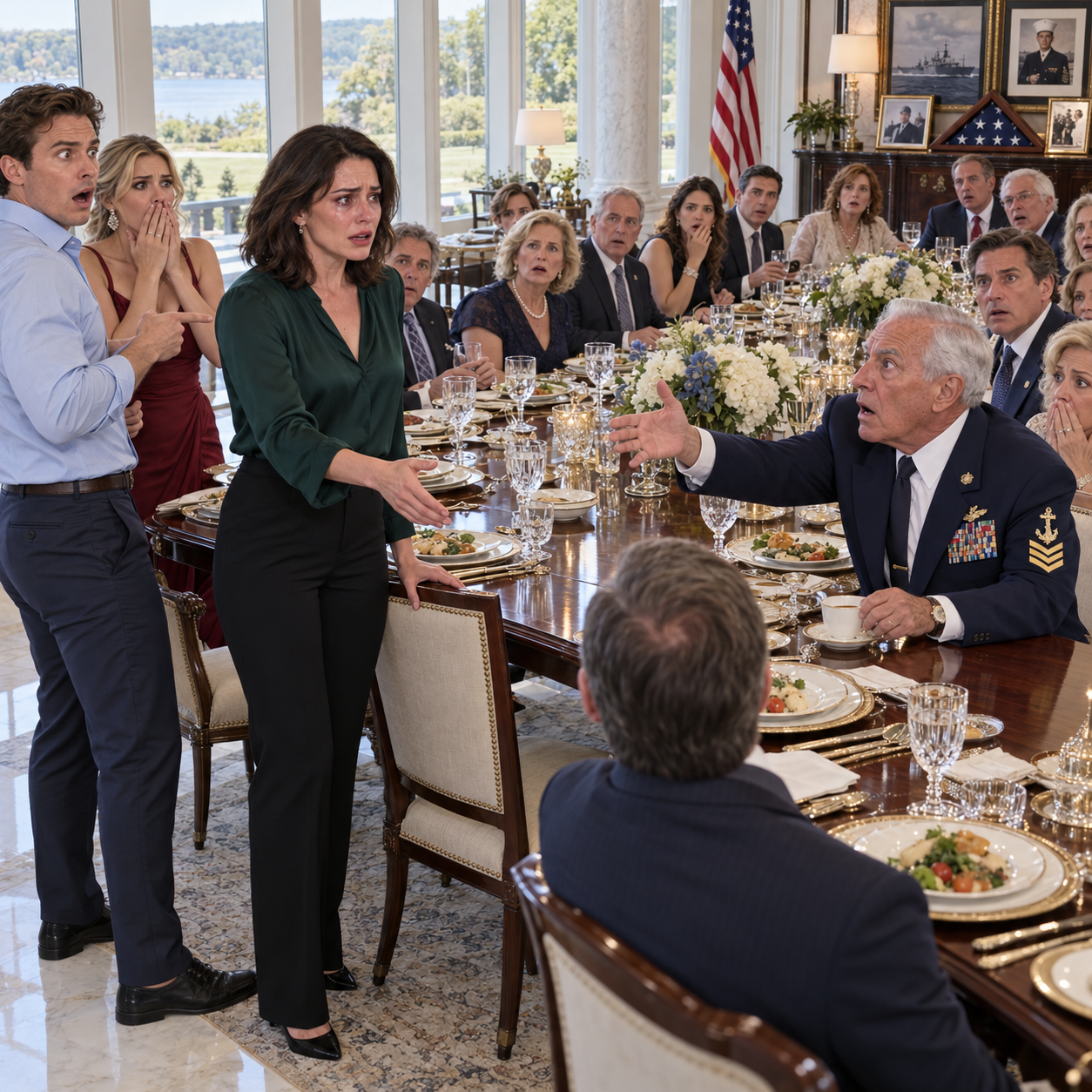
My Brother Introduced Me To His Fiancée’s Family. “This Is The One Who Deserted.” 14 Relatives. Nobody Shook My Hand. Her Grandfather, A Retired Navy Chief, Didn’t Look Away. “Where Were You Stationed?” I Said Two Words. He Set His Coffee Down. Slowly. “Say That Again. For The Whole Table.”
My brother waited until his fiancée’s family had gathered around the dinner table before telling them I had abandoned our father when he needed me most. Nobody defended me. Even the woman who invited me lowered her eyes. I could have exposed his lie immediately, but I answered one quiet question from her grandfather instead. Eleven days later, an envelope arrived containing my father’s final instructions. Beneath his signature was another name I recognized, and suddenly I understood why my brother had spent seven years making sure nobody heard my side.
## Part 1: The Things We Leave Unsaid
The first thing you should know about my father is that he never trusted a clear sky. He worked as a power-company lineman for thirty-one years, climbing utility poles outside Spokane, Washington, through freezing rain, summer windstorms, and weather that made sensible people stay indoors. When thunderstorms rolled over the hills east of our house, he would sit with my little brother and me on the back porch and teach us to measure the distance between lightning and thunder. “You can see the lightning coming,” he always said. “It’s the wind that’ll catch you when you’re not paying attention.”
My name is Maren Whitlock. I was thirty-nine when my brother finally told the truth about what happened to our father, although by then the truth could no longer repair what he had broken. My brother, Beckett, was two years younger than me, with our father’s stubborn jaw and our mother’s talent for making strangers feel like old friends. Growing up, we were inseparable in the untidy way siblings sometimes are, forever arguing over the television remote and defending each other from everybody else. When he fractured his wrist jumping his bicycle off a homemade ramp, I sat beside him in the emergency room and took the blame for daring him.
He returned the favor when I was seventeen and accidentally backed our mother’s station wagon into a fence. Beckett told Dad he had been trying to teach himself to drive, even though he could barely reach the pedals. Our father knew perfectly well who had been driving, but he repaired the fence without mentioning it. That was how our family handled uncomfortable things: we found a way to make them disappear without discussing them.
I graduated from the University of Washington with an engineering degree and a Navy commission in 2009. Beckett stayed in Spokane Valley, found work at an automotive repair shop, and eventually became the man everyone called when something wouldn’t start. He attended my commissioning ceremony wearing a necktie he’d borrowed from Dad, then hugged me in the parking lot until my feet left the pavement. “Just promise you won’t disappear forever,” he whispered. I laughed because I thought he was joking.
By 2011, I was among the women beginning to serve aboard American submarines, a place that had been closed to us for generations. The training was relentless, the expectations unforgiving, and the first time I descended through a submarine hatch, I felt as though I’d stepped into an entirely different world. The air smelled faintly of machinery, coffee, and the accumulated laundry of people living without fresh air. Nothing was spacious, nothing was quiet in the ordinary sense, and nearly everything depended on somebody doing a difficult job correctly when nobody was watching.
I loved it.
A ballistic missile submarine spends long stretches beneath the ocean, carrying out a mission whose effectiveness depends on remaining undetected. Our families couldn’t call us whenever they wanted, and we couldn’t simply send an email when we missed somebody. Short, screened messages from home sometimes reached us, but serious emergencies followed a separate command process, and operational requirements could prevent us from returning. My parents understood those limitations because I explained them before every patrol, sometimes more than once.
Beckett always seemed less interested in the details. “So you’re basically unavailable for two months while everybody else handles real life,” he said once, leaning against the kitchen counter. I told him that was a harsh way of describing it, and he shrugged. “Doesn’t make it inaccurate.” At the time, I thought he was teasing me.
Our mother died in 2015 after a long illness. I was ashore when her condition became critical and managed to obtain leave, but Beckett had already spent months driving her to appointments and sleeping in the recliner beside her bed. He knew which blankets she preferred and how much sugar she wanted in the little cups of tea she could barely finish. When she died, I held his hand at the funeral, grateful that he’d been there during the months I hadn’t.
Afterward, Dad began depending on him more heavily. His heart was failing, his knees were worn out, and the stairs became a project that required planning. Beckett arranged appointments, stocked the refrigerator, repaired the furnace, and sometimes called me simply to describe another exhausting afternoon. I paid for a stairlift and contributed toward the home-care expenses, but money couldn’t replace somebody sitting in a hospital waiting room at three in the morning.
I knew that. Beckett made certain I never forgot it.
By September 2019, our father had grown so frail that I barely recognized him when I came home before another patrol. He slept upright because breathing was easier that way, and the medication organizer beside his chair looked like something from a hardware store. Beckett had begun sleeping at the house several nights each week. When I offered to arrange professional overnight assistance, he snapped that Dad wasn’t a burden to be passed around.
That evening, Dad asked me to sit beside him at the kitchen table. Beckett was washing dishes while rain clicked against the windows, and Dad had a folder of Navy emergency-contact paperwork in front of him. One page explained that operational circumstances could delay notification of family emergencies until a deployed submarine returned. Dad read it slowly, checked the option requesting that distressing news be withheld when appropriate, and signed his name.
“You keep doing your job,” he told me. “Whatever happens here, you don’t need to worry about us.”
I looked at Beckett, hoping he’d say something reassuring. He turned off the faucet and dried his hands without meeting my eyes. “Easy for you to say,” he muttered.
Dad’s expression tightened. “That’s enough, Beck.”
I could have stayed and forced the conversation we had been avoiding for years. Instead, I told Dad I loved him, promised to call before leaving, and let my brother carry the folder into the hallway. I remember hearing the metal drawer of Dad’s filing cabinet slide open, followed by a sound like someone pressing down hard on a stack of papers.
When I left for Naval Base Kitsap three days later, Beckett didn’t hug me. He simply stood in the driveway with his arms folded while Dad waved from the front window. I waved back until the house disappeared behind the maples, never imagining that one of those two men had just seen me for the last time.
## Part 2: The Funeral I Never Knew About
We sailed on October 15, 2019. I was the navigation officer aboard the Gold Crew of the USS Maine, responsible for work that required precision, concentration, and a willingness to check the same numbers until they were unquestionably correct. My days became a rotation of watches, training exercises, maintenance discussions, brief meals, and sleep interrupted by machinery humming through the bulkheads. Above us, ordinary people were planning Thanksgiving dinners, arguing over parking spaces, and calling home whenever they wanted. Below the Pacific, time moved differently.
On November 19, my father died in his recliner.
I know that now because I’ve read the medical report, the emergency notification, and the account Beckett eventually wrote in a trembling hand. He had brought Dad a container of homemade chicken stew and found the television playing to an empty room. Dad’s glasses were beside him, and the blanket our mother had knitted was folded over his knees. There was nothing violent or dramatic about the scene, which somehow made imagining it worse.
Beckett called emergency services, then the American Red Cross to request notification through military channels. The message reached the proper authorities, but our operational situation prevented my return, and notification to me was deferred until the boat could safely complete its mission. That decision was consistent with the circumstances and with the communication preferences our father had documented. It was not a decision I made, because I did not know anything had happened.
The funeral took place eight days later at the small church where my parents had married. Beckett selected the flowers, arranged the service, chose the photographs, and delivered a eulogy people still described as beautiful. My cousin later told me he paused when he mentioned Dad’s daughter, letting the empty space beside the front pew communicate something he never explained. Afterward, the family gathered at our house, ate food from neighbors, and watched Beckett accept condolences meant for both of us.
I was underwater, checking navigation records and eating a dinner I cannot remember.
We returned to Bangor on December 31. A thin rain was falling, and I had already pictured myself calling Dad from the parking lot to complain about the weather when my commanding officer asked me into his stateroom. He had a document on his desk and an expression I recognized from difficult conversations with young sailors. “Maren, I need you to sit down,” he said.
I read the message three times before the words settled into something I could understand. My father had been dead for forty-two days, buried for thirty-five, and there had been an entire Christmas season during which everyone who mattered to me knew something I didn’t. My commanding officer explained the notification decision, gave me privacy, and offered the chaplain’s assistance. I thanked him because gratitude was the only response I could manage without falling apart.
Beckett answered my call on the sixth ring. I could hear tools clattering in the background, followed by a door closing and sudden silence. “I just found out,” I told him. “Beck, I swear to God, this is the first I’ve heard about Dad.”
“You didn’t come,” he answered.
“I couldn’t. They held the notification until we returned.”
“You always have a reason.”
I gripped the steering wheel until my fingers hurt. “I would have come if there’d been any possible way.”
He was quiet long enough that I thought we’d lost the connection. Then he said, “He spent his last years waiting for you, Maren. At least he doesn’t have to do that anymore.” The call ended before I could respond.
I drove to Spokane the next morning and went directly to the cemetery. The grass around Dad’s grave was covered in frozen mud, and someone had left a small plastic model of a utility truck beside the headstone. I stood there for almost an hour, trying to imagine his last morning, wondering whether he’d been frightened or lonely. At Beckett’s house, I knocked until my knuckles turned red, but he never opened the door.
Over the following months, I wrote letters and sent birthday cards. The first two came back marked RETURN TO SENDER, and afterward they simply disappeared. When I learned that Beckett had sold our childhood home, I called to ask whether any of Dad’s tools or photographs remained. He answered only long enough to tell me I had forfeited the right to ask.
Eventually, the relatives stopped including me in conversations about Dad. They believed Beckett had cared for him alone, and that much was true. What wasn’t true was the story spreading through the family about my supposedly walking away from my military responsibilities or deliberately refusing to attend the funeral. Beckett had begun using one particular word, a word with a precise and ugly meaning in military life.
Deserted.
I remained in the Navy, completed additional assignments, and eventually returned to the Maine as executive officer. Every advancement brought a strange mixture of satisfaction and private guilt, because my father had always been the first person I wanted to tell about good news. Beckett never called. Once, after receiving another cold message from an aunt, I nearly mailed him the documents explaining exactly why I hadn’t been able to leave the submarine.
Instead, I put the papers back in my desk. I didn’t want my father’s death turned into a courtroom argument between his children.
In June 2026, a message arrived from a woman named Sloane Bellweather. She introduced herself as Beckett’s fiancée and said her family was hosting an engagement dinner in September. She admitted that Beckett rarely spoke about me, but she’d found my name in an old photograph and wanted us to meet before the wedding. “Families can be complicated,” she wrote. “But I don’t want to start a marriage by pretending somebody doesn’t exist.”
I read that sentence several times before replying that I would come.
On the evening of September 12, I drove to her parents’ house on Spokane’s South Hill carrying flowers and an envelope with a wedding gift. The house smelled of rosemary chicken and freshly baked bread. Sloane met me at the door, smiled nervously, and said, “He’s upset you’re here, but I’m glad you came.”
Beckett stood near the fireplace, older and heavier than I remembered. When I approached, I felt the embarrassing hope that something might finally change, that seven years might have softened whatever had hardened inside him. I offered my hand and said, “Congratulations, Beck. I’m happy for you.”
He looked at my hand, then at the relatives gathering around us.
“Everybody,” he announced, raising his drink, “this is my sister, Maren. She’s the one who deserted our dying father.”
Nobody moved.
Then Beckett smiled, as if he’d finally said something he’d been waiting seven years to say in front of the right audience.
## Part 3: The Man Who Took Off His Glasses
The silence after Beckett’s announcement was unlike anything I had experienced aboard a submarine. On the boat, silence usually meant people were concentrating, listening, or waiting for orders. In that living room, it meant fourteen people had decided they didn’t want to be involved. A woman holding a plate of appetizers lowered it onto a side table, and somebody near the dining room quietly cleared his throat.
Sloane stepped beside me. “Beckett, that was completely unnecessary.”
“What?” he replied. “They’ve been asking why my sister isn’t around. Now they know.”
Her father, a broad-shouldered man named Martin, tried to smooth things over by asking whether I had recently retired from the military. Before I could answer, Beckett laughed. “Ask her why she stopped showing up when things got difficult.” I felt my face grow warm, but I kept my hands relaxed at my sides.
I had imagined confronting my brother hundreds of times. I’d rehearsed explanations in airport terminals, empty hotel rooms, and the dim passageways of ships where personal problems seemed impossibly far away. Now, standing in front of strangers who had already heard his version, I realized I didn’t want to perform my grief for them. I wanted to put down the flowers, congratulate Sloane, and leave before I said something neither of us could take back.
“Thank you for inviting me,” I told her. “I don’t think staying would be good for anyone.”
She caught my wrist. “Please don’t leave because of him.”
Before I could answer, an elderly man approached from the kitchen. He wore wire-rimmed glasses, a faded cardigan, and a dark-blue Navy cap embroidered with gold submarine dolphins. His hands were large and weathered, with the thick knuckles of somebody who had spent decades working with machinery. Unlike the others, he looked directly at me.
“Russell Bellweather,” he said. “Sloane’s grandfather. My wife calls me Russ, but most people still call me Chief.”
“Maren Whitlock,” I answered.
He glanced at Beckett before returning his attention to me. “Your brother says you were in the Navy.”
“I’m still in the Navy, Chief.”
His expression changed slightly. “What kind of work?”
“Submarines.”
He studied me for a moment, then asked, “Which boat?”
“The Maine. Gold Crew.”
Russell’s fingers tightened around his coffee mug. He turned the faded cap around in his hands, revealing lettering beneath the dolphins that identified the same submarine. “I reported aboard when she was new,” he said quietly. “Gold Crew. Nineteen ninety-five.”
For the first time that evening, I smiled without forcing it. “She’s still a fine boat.”
“What do you do aboard her?”
“I’m the executive officer.”
He nodded slowly, and I could see him placing the pieces together. My brother had described somebody who’d abandoned her responsibilities, but Russell understood what it meant to be entrusted with hundreds of millions of dollars’ worth of machinery and the lives of an entire crew. He didn’t look impressed by my rank so much as interested in the contradiction standing in front of him.
“Then there’s something I’m not understanding,” he said. “Your brother says you deserted your father. What actually happened?”
Beckett stepped forward. “Chief, it’s family business.”
Russell didn’t raise his voice. “I’ve asked your sister a question.”
I looked across the room at Beckett, remembering the boy who used to bring me broken toys because he believed I could fix anything. His expression was hard, but underneath it I recognized the same frightened stubbornness I’d seen when our mother died. I could have told everyone about his cruel phone calls, returned letters, and rumors. Instead, I answered the question.
“Our father died on the thirty-sixth day of my submarine patrol,” I said. “I learned he was dead on day seventy-eight, when we returned.”
Russell stopped moving.
He placed his mug on the kitchen island, removed his glasses, and folded them carefully with both hands. When he looked up again, his eyes were wet. His gaze moved past me to my brother, and something in his face made Beckett take a step backward.
“Son,” Russell said, “did you know she was submerged when your father died?”
Beckett looked down at his drink. “I knew she was deployed.”
“That’s not what I asked.”
“She could have found a way.”
Russell exhaled slowly. “No. She couldn’t simply leave that submarine. When the mission requires it, those sailors remain out there until their orders allow them to return. I know because I spent years doing exactly that.”
He told us about losing his own mother while serving aboard an earlier submarine. He’d learned the news after returning to port, long after his family had buried her. His brother had blamed him for years, not understanding the restrictions of submarine service or how difficult it was to grieve someone whose death had already become old news to everyone else. Russell spoke without theatrical anger, and somehow that made every word more difficult to ignore.
“I wasn’t there when my mother died,” he continued. “But I never stopped being her son.”
The room remained completely still. Sloane’s grandmother, Ada, pressed a napkin against her mouth, while Martin stared at Beckett with an expression that had hardened into disappointment. My brother seemed desperate to find something wrong with Russell’s explanation, something he could attack without acknowledging what it meant.
“That’s easy for everyone to say now,” Beckett muttered. “None of you were the one taking care of him.”
“I believe you took care of him,” Russell answered. “But that doesn’t give you permission to tell an untruth about somebody else.”
Beckett set his glass down so sharply that it rattled against the counter. He pushed through the sliding door onto the back deck without another word. Sloane followed him, and I stood beside Russell feeling strangely exposed, as if someone had opened a door inside me that I had spent years keeping locked.
One by one, people approached to apologize. Martin admitted he should have asked questions rather than accepting Beckett’s account. Ada held my hand and asked about my father, and I managed to tell her he had been a lineman who loved thunderstorms. I appreciated their kindness, but it couldn’t undo seven years of being described as a daughter who had chosen her career over a dying parent.
Eventually, Sloane returned. “He wants to talk to you outside,” she said.
Beckett stood against the deck railing, staring into the darkened yard. When I approached, he turned with the furious expression he’d worn as a teenager whenever Dad caught him lying. “You made me look terrible in there.”
“I answered a question.”
“You could have done it privately.”
“You introduced me to your future family as a deserter.”
His face twisted. “I found Dad, Maren. I was the one who walked into that house and found him dead. You weren’t there for any of it.”
“I know,” I said. “And I’m sorry you had to do that alone.”
For a moment, he looked almost relieved. Then I continued, “But your pain doesn’t make the story you’ve been telling true. You can be angry about what you carried. You cannot use what I missed as permission to destroy my name.”
He stared at me, breathing hard, then looked away.
I left before dessert. Russell walked me to my car and thanked me for coming, but just as I opened the door, he touched my shoulder. “Your father’s communication paperwork,” he said. “Did you ever see what happened to the original?”
“I have copies of what I signed.”
Russell glanced toward the house. “Ask your brother about the rest. Sometimes the reason somebody tells a story is buried in what they’ve kept hidden.”
## Part 4: The Second Signature
Eleven days after the engagement dinner, a thick envelope arrived at my apartment in Silverdale. The return address belonged to Sloane, and she’d written PERSONAL across the front in careful black letters. Inside were photocopies of Navy family-contact documents, several handwritten pages from our father’s filing cabinet, and a sealed envelope bearing my name. A short note explained that she and Beckett had spent the previous weekend going through boxes from our childhood home.
I sat at my kitchen table without opening the final envelope. Rain tapped against the window, and the apartment smelled of coffee I’d forgotten to finish. Across the top of the first document, I recognized Dad’s careful handwriting, the same square letters he’d used to label his tool drawers. It was his family communication worksheet, completed before my October 2019 patrol.
The first page contained the preference I already knew about. Dad had requested that upsetting information be held when operational circumstances made a meaningful response impossible, subject to command judgment. He’d signed it on September 27, less than three weeks before I sailed. Beneath his signature was another line I hadn’t paid attention to on my copy.
“Family contact briefed and acknowledgment received.”
Beckett Whitlock.
The date matched our last evening together at Dad’s kitchen table.
For several minutes, I stared at that second signature. Beckett hadn’t merely heard me explain the restrictions of submarine service. He had participated in the discussion and acknowledged the possibility that serious news would not reach me until the end of a patrol. His account of my supposed refusal to return had never been an innocent misunderstanding.
The next page made my stomach tighten further. It was a photocopy of a notebook Dad kept in his filing cabinet, the sort of cheap spiral notebook he used to track furnace repairs and household expenses. On a page dated October 12, he’d written, “Maren leaving Tuesday. Talked through the emergency plan with Beck. He doesn’t like it, but he understands. Gave Beck the letter to keep until she gets home.”
I read the last sentence again.
Gave Beck the letter.
Beside me on the table was the sealed envelope. On its front, Dad had written, “For Maren, when she comes back.”
My brother had kept it from me for almost seven years.
I called Sloane immediately. She answered on the first ring, sounding exhausted, and told me she’d insisted on reviewing the old documents after the engagement dinner. Beckett had resisted opening the cabinet, claiming it contained nothing important, until Russell reminded him that our father’s things belonged to his children, not just the one who’d remained in Spokane. When they finally sorted through the papers, Sloane discovered several letters I had mailed during the years Beckett refused to answer me.
“He kept them,” she said. “Every birthday card. Every Christmas letter. They’re still in their envelopes.”
I closed my eyes. I’d spent years imagining my letters being thrown into the trash. Somehow, knowing they had been preserved and deliberately ignored felt worse. He had kept physical evidence of my attempts to reach him while telling relatives that I never tried.
Sloane hesitated before continuing. “There’s something else. I found the paperwork from when he sold your parents’ house.”
I knew Beckett had sold it in 2021 to settle Dad’s expenses and close the estate, but I had never asked for an accounting. At the time, I was still hoping we might eventually speak, and I didn’t want a disagreement about money to destroy that possibility. Sloane explained that Beckett had recorded my personal belongings as declined, including the wooden tool chest Dad had promised me when I was young.
“I never declined anything,” I said.
“I know.”
“How do you know?”
“Because I found the letter you wrote him asking whether there was anything of Dad’s you could keep. He saved it with the estate records.”
I remembered that letter. I had asked for Dad’s lineman identification badge, his battered toolbox, or even the small wooden ruler he’d carried in his shirt pocket. I hadn’t wanted money, furniture, or half the value of a house. I had wanted something that still smelled like the garage where he’d taught me to fix broken appliances.
“Why are you telling me this?” I asked.
Sloane was silent for a moment. “Because I asked Beckett whether he knew you couldn’t come home during that patrol. He admitted he knew. Then he told me he’d spent years letting people believe otherwise because he couldn’t stand hearing anybody defend you.”
My throat tightened. “And what did you say?”
“I asked him what else he’d been willing to let people believe.”
She told me the wedding plans were on hold. She wasn’t asking me to interfere or convince her to stay with him, and she didn’t want me to feel responsible for what happened between them. She had simply realized that the man she’d planned to marry could maintain a damaging lie for years while looking directly into the eyes of people who trusted him.
After we ended the call, I spread the papers across my kitchen table. Dad’s handwriting appeared everywhere, on expense records, maintenance receipts, old appointment cards, and the note he’d written to Beckett before my patrol. There was proof of how much my brother had done for him, including lists of medical appointments and nights when Dad had been too ill to sleep.
For the first time, I could see both truths together. Beckett had been a devoted son during an extraordinarily difficult time, and he had also deliberately turned me into the villain of a story he knew was incomplete. His sacrifice had been real. So had his cruelty.
I contacted a civilian attorney to review the estate records, not because I wanted the house or its proceeds, but because my personal possessions had been described as unwanted without my knowledge. Then I sent Beckett one message, my first direct communication in several years.
“I have Dad’s paperwork. I have his letter. I know you understood what the Navy told us before he died. I need you to explain why you kept telling people I abandoned him.”
He responded the following morning.
“Meet me at Dad’s grave on Saturday. There’s something I need to admit that isn’t in those papers.”
## Part 5: What My Brother Finally Admitted
I arrived at Greenwood Memorial Terrace fifteen minutes early. The October air was cold enough to make my hands ache, and the grass around our parents’ headstone was scattered with fallen leaves. Dad’s grave had a small metal marker identifying his years with the power company, something Beckett had arranged after the funeral. I stood beside it remembering the man who’d climbed utility poles in storms, who’d repaired our neighbors’ porch lights without accepting payment, and who had somehow raised two children incapable of speaking honestly about their grief.
Beckett appeared carrying a small cardboard box. He looked tired, with dark circles beneath his eyes and a beard that hadn’t been trimmed in several days. Instead of greeting me, he placed the box on the grass and stared at the headstone. We stood together without speaking until the wind pushed a dry leaf across the engraved letters of our father’s name.
“I knew what the form meant,” he said finally. “I knew why Dad signed it.”
I waited.
“I hated it. I hated that he could be lying in that chair barely able to breathe, and you could still go back to your ship.”
“That’s what he wanted.”
“I know.”
He rubbed both hands over his face. “That’s the part I couldn’t stand. He wanted you to go. He kept telling me how proud he was of your career while I was the one cleaning up after him and taking him to doctors.”
I looked toward the distant trees. There was no useful answer to that kind of resentment, because I had benefited from responsibilities my brother carried. He had sacrificed evenings, weekends, relationships, and years of his life to care for our father. Nothing I said could give those years back.
“You deserved help,” I told him. “You deserved recognition. You didn’t deserve to do all of that alone.”
His eyes filled with tears. “I just wanted somebody to understand what I gave up.”
“So you made everybody believe I gave up nothing.”
He nodded.
Then he told me something I hadn’t expected. On the morning before I left for Bangor, Dad had given him the envelope and asked him to make sure I received it when my patrol ended. Beckett had slipped it into the cabinet, telling himself there would be time later. When Dad died, he found the envelope again while gathering paperwork for the funeral, but the anger of those first awful days made him put it away.
“I told myself I’d give it to you when you finally came home,” he said. “Then you came home after the funeral, and I couldn’t bear to look at you.”
“You could have mailed it.”
“I know.”
“You could have put it on my car when I came to your house.”
“I know.”
“You could have given it to Aunt Cora. You could have told me it existed.”
His mouth trembled. “I know, Maren.”
He reached into the cardboard box and lifted Dad’s old metal lineman badge. Beneath it were a few photographs, my childhood science-fair ribbon, and the wooden ruler Dad used to mark measurements around the house. Beckett had kept everything in the garage despite telling the family those belongings were unwanted.
“I didn’t want you to have anything that made you feel like you had been there,” he whispered.
That sentence hurt more than his accusation at the engagement dinner. It exposed the cruelty underneath years of silence, the deliberate effort to control not just how others remembered our father’s death, but how I was permitted to grieve him. Beckett had wanted to make my absence permanent, even after I returned.
I picked up the badge. The edges were worn smooth, and there was a dark stain near the clip where Dad’s work shirts had rubbed against it. I remembered being eight years old, sitting at the kitchen table while he explained why utility workers wore identification on their clothes. He’d told me that somebody should always know who was responsible when a dangerous job needed doing.
“What happened to the letters I sent you?” I asked.
Beckett stared at the ground. “I read them. Most of them.”
“Then why did you tell everyone I never contacted you?”
“Because the truth made me look unfair.”
It was the first completely honest thing he’d said to me in years. His voice broke afterward, and he began crying in the awkward, breathless way adults sometimes cry when they’ve spent too long holding something inside. I felt sorry for him. But sympathy wasn’t the same as forgiveness.
“Sloane told me she’s reconsidering the wedding,” I said.
He nodded. “She moved out on Thursday.”
“Is that why you’re finally talking to me?”
“No. Maybe. I don’t know.” He wiped his face. “I started losing the story when her grandfather asked about the boat. Then Sloane found the papers, and I couldn’t keep pretending.”
“That’s the problem, Beck. You didn’t decide to stop hurting me. You stopped because other people discovered what you’d done.”
He looked at me with an expression I recognized from childhood, the desperate hope that I would somehow make the consequences disappear. “Can we start over?” he asked. “I know it won’t be easy, but you’re my sister. I don’t want to lose you.”
I thought about the funeral I couldn’t attend, the house I would never enter again, and the seven years during which he had told anybody who would listen that I wasn’t worth remembering as Dad’s daughter. I thought about every holiday spent wondering whether sending another letter would make him angrier. Most of all, I thought about the choice he’d made each morning to continue the lie long after his grief had become familiar.
“No,” I said quietly. “We can’t start over.”
He lowered his head.
“I can understand why you were hurt without excusing what you did. I can acknowledge everything you sacrificed without allowing you to decide what my relationship with Dad meant. You took years from me that I can’t recover, and I won’t spend the rest of my life pretending we’re fine because you’re finally sorry.”
I asked him to correct the story with our relatives, give the attorney the complete estate records, and stop discussing my personal life with people who didn’t know me. After that, I wanted no contact unless I decided otherwise. Beckett agreed without arguing, perhaps because he finally understood that making promises wasn’t enough to earn back trust.
Before leaving, I carried the box to my car. He remained beside Dad’s grave, shoulders bent, looking older than his thirty-seven years. I didn’t turn around when he called my name.
That evening, I opened Dad’s sealed letter. His handwriting was shaky, the blue ink uneven in places, but the first sentence was perfectly clear.
“Maren, if you’re reading this after I’m gone, there’s something I need you to understand about the day I told you to leave.”
## Part 6: The Distance Between Lightning and Thunder
I sat on my living-room floor with my father’s letter resting across my knees. Outside, a storm was moving toward Puget Sound, pushing rain against the windows and making the balcony railing tremble. I had waited seven years to hear my father speak to me again, and now his words were sitting on an ordinary sheet of lined paper. I was afraid to keep reading because part of me still believed he might be disappointed in the choices I’d made.
“Maren,” the letter continued, “I know you’ve spent years trying to be everywhere at once. You call when you’re ashore, you send money when I need help, and every time you come home, you look at me like you’re trying to decide whether I’m getting worse. I know you’re scared. I also know you’ve built a life doing something important, and I don’t want my last years to become the reason you stop living it.”
I pressed my fingers against my mouth. Dad had never spoken that openly about feelings when he was alive. He’d spent his life fixing things with tools, errands, and stubborn determination, rarely explaining what any of it meant. Seeing the words written down made me realize he’d understood far more about my guilt than I’d ever imagined.
“Your brother has been good to me,” Dad had written. “Better than I had any right to expect. I’m grateful for every meal and every ride to the doctor, even when he complains about my terrible taste in television. But his life matters, too. I hope someday he’ll understand that taking care of a family shouldn’t mean forgetting how to live his own life.”
Near the bottom, the handwriting became uneven.
“If the worst happens while you’re away, don’t let anyone tell you that you chose wrong. I signed the paperwork because I knew what I was asking. I raised you to finish the job you promised to do, and I would never ask you to break that promise just to make my leaving easier. There’s nothing you need to prove to me, sweetheart. I’m already proud of you.”
I read the letter three times. Then I folded it carefully and cried until the storm moved east.
During the following weeks, Beckett began correcting the story he’d told for years. He sent messages to our extended family acknowledging that I’d been on an active submarine patrol, had not known about Dad’s death, and had never deserted either my service or our father. He admitted withholding letters and personal belongings, and he stopped claiming I’d chosen to miss the funeral.
Aunt Cora called after receiving his message. She sounded embarrassed as she told me she’d repeated Beckett’s accusations because she couldn’t imagine someone inventing something so damaging about his own sister. I appreciated her apology but declined her invitation to Thanksgiving dinner. Being vindicated didn’t automatically make seven years of family gatherings feel safe.
The attorney helped me obtain the remaining estate documents and recover the personal possessions Beckett had kept. I wasn’t interested in turning our father’s memory into an expensive financial battle, but I wanted the record corrected where it inaccurately described my wishes. Beckett cooperated, and eventually the matters I cared about were resolved without a courtroom confrontation.
Sloane ended the engagement in November. She called once to explain, not because she owed me an explanation, but because she didn’t want me to hear a distorted account through the family. She said Beckett had finally begun counseling and was trying to understand how years of caregiving and resentment had shaped his behavior. She hoped he would become healthier, but she no longer trusted him enough to marry him.
“Are you angry with me?” she asked.
“For what?”
“For inviting you that night. None of this would have happened if I’d left things alone.”
I thought about Dad’s sealed letter sitting in my desk and the lineman badge beside my keys. “It would still have happened,” I told her. “We just wouldn’t have known how much had been hidden.”
Sloane and I stayed in occasional contact. There was no sudden replacement family, no dramatic declaration that we’d become sisters, and no attempt to make every unhappy event mean something wonderful. Sometimes she sent me a photograph of the autumn maples in Spokane, and sometimes I sent her pictures from a hiking trail near my apartment. It was a simple friendship that didn’t require me to defend myself.
Russell called a few days before my next patrol. He wanted to know whether I’d recovered Dad’s letter and whether the Maine was still treating her crew properly. We spent twenty minutes discussing the submarine’s old machinery, changes in the service, and the terrible coffee he remembered from his own patrols. Before hanging up, he became quiet.
“Your father sounds like a good man,” he said.
“He was.”
“Then don’t let the worst thing your brother did become the only thing you remember about him.”
I looked at the photograph above my desk, taken when I was fourteen and Beckett was twelve. We were standing beside Dad in the driveway, the three of us holding fishing poles and squinting into the afternoon sun. I still loved the boy in that picture. I simply couldn’t trust the man he had become, and I was no longer willing to sacrifice my peace to pretend otherwise.
“I won’t, Chief,” I promised.
On the morning our crew prepared to leave, I drove to the base before sunrise. The sky was dark blue, and the pavement glistened beneath the security lights. In my bag were two clean uniforms, a notebook, photographs of my parents, and a photocopy of Dad’s letter. His metal badge remained at home, where I could see it every time I walked through the door.
Nine days into the patrol, a petty officer named Amaya Torres brought me a family message. She handed it over with the ordinary efficiency of someone who understood that even a few words from shore could change the shape of a sailor’s day. I thanked her and waited until I was alone to unfold the paper.
It was from Russell and Sloane.
“Storm over Spokane last night. Russ sat on the porch counting seconds after the lightning. Ada says you should eat more vegetables. Sloane says the mountains are beautiful this year. Everybody here is doing fine. Your old chief says the Maine is in good hands. Come home safe.”
I read it twice, smiling at the part about vegetables. Then I tucked it into my notebook beside Dad’s letter. It was the first time in years I’d received a message from people on shore who expected nothing from me except that I return safely.
Later that night, I went forward to the control room. The lighting was dim, the equipment hummed steadily, and the officers on watch were bent over their instruments with the concentration I’d come to recognize as the sound of people doing their jobs properly. A young lieutenant asked me to review a navigation calculation, and we worked through it together until he understood where he’d made his mistake.
When he returned to his station, I stayed near the chart table for a moment, listening to the submarine move through the water. Somewhere above us, storms were crossing coastlines, families were preparing dinner, and people were making choices they’d have to live with tomorrow. I couldn’t control any of that. But I could decide what I would carry into the future.
I no longer hoped Beckett would call. I no longer checked whether he’d sent a holiday card or wondered what I might say if he apologized again. His regret was his responsibility now, just as his years of caregiving had been real and worthy of acknowledgment. Neither truth required me to welcome him back into my life.
The strange thing about finally receiving Dad’s letter was that it hadn’t taught me something entirely new. Deep down, I’d always known he loved me, and I’d always known he understood why I couldn’t return. But grief has a way of making you question everything, especially when someone you trust keeps insisting that your love wasn’t enough.
Now I had his words, his handwriting, and his deliberate choice recorded on paper. More importantly, I had stopped allowing my brother’s anger to speak louder than my father’s love.
I thought again about the porch in Spokane Valley, where Dad had taught us to count the seconds between lightning and thunder. When we were children, Beckett and I had believed that knowing the distance made us safe. Growing older had taught me that some storms arrive without warning, and some damage comes from the people standing right beside you.
But I also understood something my father had never needed to explain.
Counting the distance doesn’t stop the storm. It simply tells you where you stand.
I stood aboard a submarine, surrounded by people who depended on me, doing work I had chosen and still believed in. My father’s letter was secure in my notebook. Somewhere in Washington, my brother was beginning the long, uncomfortable work of living with what he’d done, and I didn’t need to be there to help him through it.
For seven years, he’d told everyone I had abandoned our father.
The truth was that my father had sent me into the world knowing exactly who I was, and I had spent too long allowing someone else to convince me that being his daughter required an apology.
I turned back to the navigation plot, picked up my pencil, and went to work.
For the first time since Dad died, I felt no need to explain why I was there.
THE END!
Disclaimer: Our stories are inspired by real-life events but are carefully rewritten for entertainment. Any resemblance to actual people or situations is purely coincidental.


