Homecoming Morning. Mom Read The Pier List Out Loud To The Whole Family. Four Names. Not Mine. “Passes Are For People Who Served, Not People Who Quit.” I Said, “I’ll Be At The Fence, Mom.” 300 Sailors Came Down The Brow. The Captain Stopped At The Bottom And Asked A Petty Officer One Question. The Petty Officer Pointed Past Mom, At Me. “Then Put Her Name At The Top.”
My mother looked me straight in the eye and said I wasn’t welcome at my little brother’s Navy homecoming. She had given my place on the pier to someone else, and the rest of my family watched without defending me. I didn’t argue. I drove to the naval station alone and waited behind a chain-link fence. Then my brother’s captain came down the gangway and started asking for me. Three weeks later, an old email surfaced that made me question how long my mother had been deciding my future without telling me.
Part 1
The first message arrived on a Wednesday evening while I was standing barefoot in my kitchen, trying to wash the smell of smoke out of my hair.
My name is Mara Ellison. I was thirty-nine years old, lived alone in a two-bedroom apartment outside Norfolk, Virginia, and worked as a civilian damage-control instructor for the Navy. Most days, I taught young sailors how to find their way through smoke-filled compartments, control flooding, and keep their heads when alarms started screaming. It wasn’t glamorous work. I came home exhausted, with sore knees and a permanent collection of small burns on my work gloves, but I loved it.
My younger brother, Wesley, was coming home after seven months at sea.
His email was short, written between watches aboard the guided-missile cruiser USS Stone Harbor.
“Three days until real food. Tell Mom I want her pot roast. Also, you’re coming Saturday, right? Chief Navarro said to make sure you were there. He asked twice.”
I smiled at the pot roast part. Wesley had been requesting that meal since he was seven.
The part about his chief made me pause.
I didn’t recognize the name Navarro, although I knew plenty of sailors who had passed through my training facility. Wesley was twenty-four, a second-class gas turbine technician, and still relatively young in his Navy career. Perhaps his chief was simply reminding him not to take his family for granted.
I called our mother.
Darlene Ellison answered with the television playing loudly behind her.
“Wes wants to know whether I’m on the pier access list,” I told her.
“Everything’s arranged, sweetheart.”
“Can you check?”
“Mara, I’ve been organizing Navy homecomings since before you were born. I think I can manage four names.”
There was that tone again. Patient, slightly offended, as though I’d questioned her ability to operate a microwave.
I apologized for interrupting and hung up.
It was easier than arguing.
Our family had been connected to the Navy for nearly fifty years. My father, Graham Ellison, had served twenty-six years as an enlisted sailor, retiring as a senior chief petty officer. He understood machinery better than people and could identify an engine problem by listening to a vibration through a steel bulkhead.
My mother understood people, or believed she did.
She coordinated family events, organized meal deliveries for deployed sailors’ spouses, and kept everyone’s telephone numbers in an enormous address book beside the kitchen. If someone needed transportation to a hospital, she arranged it. If a homecoming date changed, she knew before half the families did.
People thanked her constantly.
At home, that generosity came with an expectation: nobody questioned Darlene Ellison’s decisions.
I grew up in a brick house in Chesapeake, with a magnolia tree beside the driveway and a garage full of my father’s tools. When Wesley was born, I was fourteen and Dad was somewhere in the Mediterranean.
Mom had already spent years raising me through deployments. By the time Wesley arrived, she was exhausted.
So I became useful.
I learned to change diapers before I could drive. I took Wesley to kindergarten, signed permission slips when Mom was overwhelmed, and stayed up helping him with science projects while my friends went to football games.
When he was six, he accidentally called me Mom in front of his teacher.
I laughed about it.
Later, alone in my bedroom, I cried without understanding why.
At eighteen, I accepted a Navy ROTC scholarship to Old Dominion University. My father drove me to campus himself, carrying my boxes up three flights of stairs despite the August heat.
He stood inside my tiny dorm room looking at the photographs I’d taped above the desk.
“You’re allowed to have a life that doesn’t revolve around this house,” he told me.
I didn’t appreciate those words until much later.
I received my commission in 2009 and became a surface warfare officer, eventually specializing in shipboard engineering.
Dad was delighted.
Mom introduced me as “our future admiral” to practically everyone she met.
For a while, I thought we were equally proud of the same accomplishment.
I served aboard two destroyers, spent long months overseas, and learned how much responsibility could fit inside a steel hull. By twenty-eight, I was serving as chief engineer aboard the USS Harlan Voss, responsible for an aging propulsion plant and nearly ninety sailors.
In the Navy, a chief engineer is usually called the CHENG.
For years, that was what everyone called me.
Then, in March 2016, something happened aboard that destroyer that changed my understanding of leadership, fear, and what a person could survive.
I came home carrying memories I couldn’t explain to ordinary people.
Six months later, my father began dropping things.
First a coffee cup. Then his keys. Then a screwdriver he had been holding for forty years without trouble.
The diagnosis was ALS.
Within months, he needed help walking. Eventually, he couldn’t stand without assistance.
My mother was small, and the physical demands of his care became overwhelming. Wesley was still in high school.
I resigned my commission in early 2017 and moved home.
I told my family I wanted to spend whatever time Dad had left with him.
That was true.
It wasn’t the entire truth, but it was enough.
Dad died in August 2018.
At the reception after his funeral, I overheard my mother explaining our family to a retired Navy chaplain.
“Graham gave twenty-six years to his country,” she said. “Wesley will carry on that tradition. Mara had a promising career, but she quit.”
The chaplain looked toward me.
I pretended to be interested in the food.
I didn’t correct her.
Over the following years, “Mara quit” became an accepted family fact. Wesley heard it often enough that he stopped asking what I’d done aboard ship.
Meanwhile, I took the civilian instructor position and built a quiet, independent life.
I paid my bills. I fixed my own truck. I spent Sunday afternoons at Mom’s house because that was what we had always done.
Then came the Friday evening before Wesley’s homecoming.
Mom had invited Aunt Jocelyn, Uncle Paul, and Wesley’s girlfriend, Hannah, for dinner.
Her dining room was crowded with folding chairs, flower arrangements, and a twenty-foot welcome-home banner she had painted herself.
During dessert, she announced the departure schedule for Saturday morning.
I noticed she hadn’t mentioned where I would sit in the van.
“Mom,” I asked, “did you confirm my pier pass?”
She smiled without looking up from her notebook.
“We’ll discuss everything tomorrow.”
Something in her voice made me uneasy.
The next morning, she gathered everyone around the kitchen table at six o’clock. She held a printed email in one hand and her reading glasses in the other.
“These are the four people authorized to enter the family section,” she announced.
Then she read the names.
“Darlene Ellison. Jocelyn Mercer. Paul Mercer. Hannah Bell.”
I waited.
She folded the paper.
There was no fifth name.
There was no Mara Ellison.
And when I looked at my mother’s expression, I realized she hadn’t forgotten me.
She had made a decision.
Part 2
For several seconds, the only sound in the kitchen was the refrigerator motor and the ticking of the cheap clock above the sink.
Hannah lowered her coffee mug.
Aunt Jocelyn studied the tablecloth. Uncle Paul suddenly became fascinated with the weather outside.
I looked at my mother.
“Wesley asked specifically whether I was coming.”
“He’ll have plenty of people waiting for him.”
“That’s not what I asked.”
Mom placed the folded email beside her car keys and aligned its edges carefully with the counter.
“There were only four passes, Mara. Your aunt and uncle traveled all the way from North Carolina, and Hannah has been waiting seven months to see him.”
“You could have told me before this morning.”
Her expression tightened.
“I didn’t want unnecessary drama before your brother came home.”
That was when I understood she’d anticipated my reaction and arranged the announcement in front of witnesses to discourage an argument.
Then she said something I have never forgotten.
“This is a special day for people who committed themselves to the Navy. You had your opportunity, honey. You walked away.”
I glanced at Jocelyn and Paul, neither of whom had served.
The contradiction was obvious.
Nobody mentioned it.
I could have told them about the deployments, the engineering watches, and the nights when my sailors’ lives depended on decisions I made in seconds.
I could have explained why I had really left.
Instead, I picked up my keys.
“All right. I’ll watch from the fence.”
Mom seemed relieved.
“That’s sensible. You’ll still get to see the ship.”
I drove away before the others finished breakfast.
Interstate 64 was already busy, with families heading toward Norfolk and trucks hauling containers toward the port. The early May sunlight flashed across my windshield, and the radio played a song I remembered from high school.
I turned it off.
At Naval Station Norfolk, I used my installation credentials to reach the visitor parking area. My civilian position allowed me onto the base, but it didn’t grant access to the controlled family section at the pier.
By eight o’clock, hundreds of relatives had gathered beside the water.
Children wore miniature sailor uniforms. Someone carried balloons shaped like anchors. A woman in a purple dress held a baby against her shoulder while struggling to unfold a homemade sign.
The smell of coffee drifted from a white canopy near the entrance.
I found a place beside the chain-link fence, close enough to see the gangway but far enough from the designated family section that I wouldn’t cause problems.
An elderly man standing nearby asked who I was waiting for.
“My little brother.”
“First deployment?”
“First long one.”
He nodded.
“My granddaughter’s aboard. Haven’t seen her since October.”
We talked about the weather until the ship appeared around the harbor bend.
The USS Stone Harbor came slowly into view, assisted by two tugboats. Her gray hull rose above the water, and sailors in dress whites lined the rails in precise rows.
The crowd erupted.
I had experienced homecomings from the other side before, standing on a ship and scanning hundreds of faces for someone familiar.
This time, I couldn’t even stand with my family.
The realization caught me unexpectedly.
I gripped the fence and swallowed.
At approximately nine-thirty, the ship secured alongside the pier.
Lines were passed. Equipment was positioned. The metal brow was lowered, and after a short delay, the first sailors began coming ashore.
The crowd surged forward.
I spotted my mother immediately. She stood near the front, waving one end of her enormous banner while Paul held the other.
Then Wesley appeared.
He looked older than he had in the photographs he’d emailed from overseas. His face was thinner, and his shoulders had broadened beneath his white uniform.
Hannah ran toward him.
He caught her around the waist, laughing as she nearly knocked off his cap.
Mom embraced him next, followed by Jocelyn and Paul.
I smiled despite myself.
I was glad he was home.
Then I saw him look around.
At first, I thought he was searching for someone behind the banner. He scanned the nearby families, leaned toward Hannah, and said something.
She looked toward the fence.
I raised one hand.
Wesley didn’t see it.
A moment later, another officer came down the brow.
He was tall, broad-shouldered, and gray at the temples. Four gold stripes marked the sleeves of his dress uniform.
I recognized his walk before I recognized his face.
There are people you spend so much time beside during difficult circumstances that you remember their smallest habits.
The way they tilt their head when they’re listening.
The way they stop walking before asking a question.
The way they study a room without appearing to study anyone.
Captain Adrian Vale had been my executive officer aboard the USS Harlan Voss ten years earlier.
He had stood beside me on the worst night of my naval career.
I had no idea he commanded my brother’s ship.
For a moment, I thought about leaving.
Not because I disliked him. Quite the opposite.
I knew what would happen if he recognized me, and I didn’t want Wesley’s homecoming turned into a discussion about my past.
But Vale had already stopped beside a sailor wearing chief petty officer insignia.
The chief turned toward Wesley.
Something was said.
Then all three men looked toward the family section.
Wesley pointed at my mother.
The chief shook his head and pointed beyond her, toward the fence.
My stomach tightened.
Even from that distance, I could see my mother’s smile become rigid.
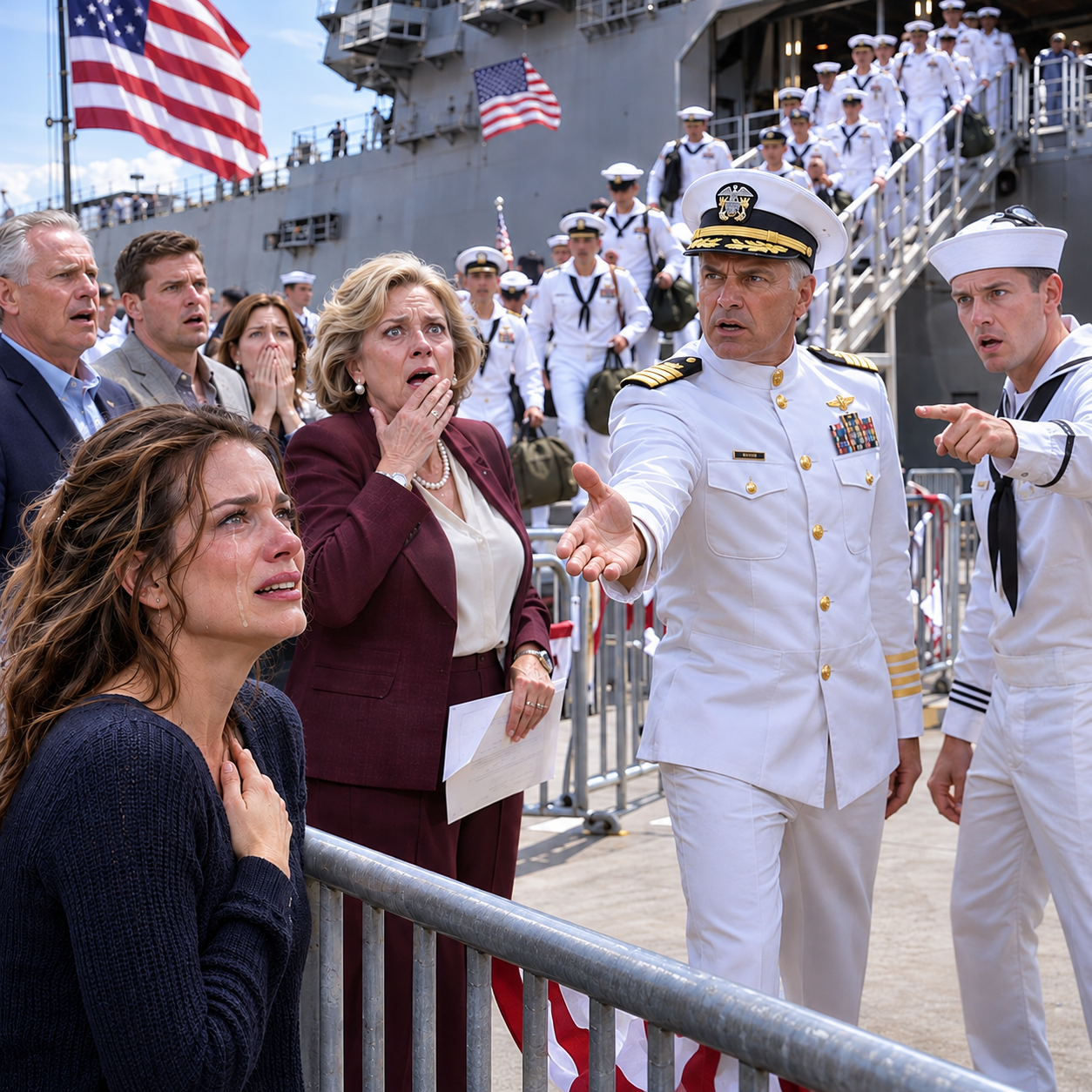
Captain Vale approached her.
He spoke briefly.
She answered, gesturing toward the printed list she still held in her hand.
Then he started walking directly toward me.
People moved out of his way.
The chief followed him, and Wesley came behind them with Hannah holding his hand.
At the gate, a security sailor straightened and moved the barrier aside.
Captain Vale stopped in front of me.
For a second, neither of us spoke.
He looked older than I remembered. There were deeper lines around his eyes and a slight stiffness in his right shoulder.
But his expression was the same one I remembered from the engine-room control station.
“Mara,” he said quietly.
“Captain.”
He gave a small smile.
“Still teaching sailors how not to sink ships?”
“Trying to.”
“Good. We could use more people doing that.”
Then he looked behind him.
“Chief Navarro.”
The chief stepped forward.
He was a muscular man in his early thirties, with dark hair closely cropped beneath his white cap.
I stared at him.
The last time I’d seen Leon Navarro, he had been a terrified young petty officer recovering in a military hospital, his hands trembling so badly that he couldn’t hold a cup of water.
Now he wore the gold anchors of a Navy chief.
“Ma’am,” he said.
His voice broke.
I reached for his hand, but he stepped forward and hugged me instead.
For several seconds, he couldn’t speak.
When he finally pulled away, tears ran down his face.
“I didn’t know if I’d ever see you again.”
My mother had reached the gate by then.
She looked bewildered.
“Captain, I’m sorry, but my daughter wasn’t included on our list.”
Vale turned toward her.
“Mrs. Ellison, I understand that.”
“She left the service years ago.”
“I know exactly when she left.”
There was no anger in his voice.
Somehow, that made his next words harder to hear.
“Your daughter was my chief engineer. In March 2016, a fuel fire nearly destroyed one of our main engineering spaces. Two sailors were trapped below decks.”
He glanced at Leon.
“Your daughter went back into that compartment to bring them out.”
Mom looked at me.
I had never seen that expression on her face.
Confusion, disbelief, and the beginning of something that looked like fear.
Vale continued.
“One of those sailors is standing beside me. The other is alive and raising a family in Ohio.”
Wesley stopped moving.
His eyes shifted from the captain to Leon, then settled on me.
“But Mom said you quit because you couldn’t handle the Navy anymore.”
Captain Vale didn’t answer for me.
He simply stepped aside.
And for the first time in my life, everyone in my family was waiting to hear what I had to say.
Part 3
I wish I could tell you I finally gave a speech that morning.
That I explained everything beautifully, made my mother understand, and walked away feeling lighter.
Nothing like that happened.
I stood beside a chain-link fence with my brother staring at me and an old shipmate crying into his uniform, trying to decide how much of my life I wanted to explain in front of strangers.
“Wes,” I finally said, “there are things about my service I’ve never told you.”
He looked hurt.
“Why?”
“Because some of them are difficult to talk about.”
My mother recovered before anyone else.
“Well, nobody told me anything about a serious fire,” she said. “Mara, you always said it was just an equipment incident.”
“It was an equipment incident.”
“You made it sound routine.”
I looked at Captain Vale.
He understood what I was asking without words.
“Mrs. Ellison,” he said, “your daughter has a right to decide what she tells people. But I won’t describe what happened aboard my ship as routine.”
Mom glanced around.
Nearby families were watching. The gate security team had gone unusually quiet.
Her face flushed.
“I think this is becoming inappropriate,” she announced.
Then she turned and walked toward the parking lot.
Jocelyn hurried after her.
Paul stood awkwardly with one end of the banner still in his hand. Eventually, he lowered it to the concrete and followed them.
Wesley remained.
For the first time since coming ashore, he looked more tired than happy.
“You could have trusted me,” he said.
“I know.”
“Was it really that bad?”
I looked at Leon.
He was rubbing his thumb across the edge of his chief’s anchor.
“Yes,” I said.
Wesley nodded slowly.
“I can’t do this right now.”
Hannah took his hand, and they walked away.
I didn’t blame him.
Captain Vale stayed beside me until most of the returning sailors had disappeared into the crowd. Before leaving, he reached into his pocket and handed me a business card.
“I’ve been trying to get you back aboard one of my ships for years.”
“You know why I couldn’t.”
“I do.”
He glanced toward the empty space where my mother had stood.
“But that reason doesn’t exist anymore, Mara. Think about what you want next.”
After he left, Leon sat with me on a concrete barrier near the parking area.
He told me about his wife, their baby daughter, and his promotion. I told him about my job.
Neither of us mentioned the fire until he stood to leave.
“I can still hear you counting,” he said.
I knew exactly what he meant.
On March 9, 2016, at 10:40 p.m., the general alarm sounded aboard the USS Harlan Voss while we were operating in the Arabian Sea.
I was in engineering control when a watchstander reported a sudden pressure drop.
Seconds later came the fire alarm.
A fuel-line failure had released fuel onto extremely hot machinery. The resulting fire spread rapidly through the compartment.
I remember the first smell more clearly than the flames.
Hot insulation.
Burning oil.
That sharp metallic odor that tells an engineer something expensive and dangerous has gone very wrong.
The emergency response teams moved into position. Ventilation was secured, boundaries were established, and personnel began evacuating the affected spaces.
We were preparing to activate the fixed fire-suppression system when the casualty-accountability report reached me.
Two sailors were missing.
Leon Navarro and Eli Pritchard.
Leon was twenty-three, clever with machinery, and determined to make chief someday.
Eli was nineteen and had been aboard less than a year.
Both had been working near the affected compartment.
The officer coordinating the response told me we had only a narrow window before suppression had to proceed.
I understood the danger.
I also knew the layout of that engine room better than I knew my childhood bedroom.
I put on emergency breathing equipment and went in with the rescue team.
The heat struck first.
Then darkness.
Smoke swallowed the beam of my flashlight almost immediately. I kept one glove against the rail and moved by memory, checking the places where a disoriented sailor might have fallen.
We found Leon collapsed near a machinery enclosure.
Getting him toward the escape route took both training and strength I didn’t know I still had.
Other sailors helped bring him out.
Then someone told me Eli was still missing.
I remember Captain Vale, then our executive officer, standing at the access point.
He looked at the time, then at me.
“We cannot keep this compartment open indefinitely, CHENG.”
“I know.”
I went back with another rescue team member.
We found Eli behind a maintenance station, unconscious but alive.
By the time we brought him out, the emergency team had already extended its planned withdrawal interval. The fire-suppression sequence began after personnel were confirmed clear.
The ship survived.
Both sailors survived.
I spent several days recovering from smoke exposure and an injury to my left wrist.
For weeks afterward, sudden alarms made me feel as if the deck were disappearing beneath my feet.
The official investigation eventually identified mechanical failures and maintenance deficiencies that had contributed to the casualty.
I cooperated with every review.
I also spent months questioning whether I’d missed warning signs that might have prevented the fire altogether.
People called what I did courageous.
I remembered two unconscious young men and how close we’d come to losing them.
Later, the Navy awarded me the Navy and Marine Corps Medal for noncombat heroism.
The ceremony was small.
I asked that it remain that way.
My father was the only person in my family I told about the citation.
We sat on the tailgate of his truck while I explained the fire, the rescue, and everything I wished I had done differently.
He listened without interrupting.
Then he said, “You brought your people home.”
I started crying.
He didn’t tell me to stop.
He simply put his arm around me.
When my father became ill, every other part of my life moved into the background.
That Saturday night, after the homecoming, my mother called at ten-fifteen.
I knew immediately she hadn’t called to ask whether I was all right.
“Do you understand how embarrassing today was?” she asked.
I sat at my kitchen table.
“Yes, Mom. It was embarrassing to be deliberately excluded.”
“Don’t twist this around. Everyone was staring at me.”
“Because you told the captain I didn’t belong there.”
“Because you never told me what really happened.”
I stared at the wall.
“You knew I served. You knew I was an officer. You knew I came home to help Dad.”
“That’s not the point.”
“Then what is?”
She hesitated.
“I want you to contact Melanie Quinn and explain that the captain exaggerated things. She’s the homecoming coordinator. People are already talking.”
“I’m not doing that.”
“Mara, I am asking you to protect this family.”
“And I’m asking you to stop making me responsible for your reputation.”
She hung up.
On Sunday afternoon, Wesley sent me a photograph of a document.
It was a copy of the original guest-request form submitted through his ship’s family-support office.
He had requested four names in March.
Darlene Ellison.
Hannah Bell.
Jocelyn Mercer.
And Mara Ellison.
Beneath the photograph, he wrote:
“I never asked Mom to put Uncle Paul on the list. She told the coordinator you’d decided not to come.”
I enlarged the image.
Beside my name was a notation recording its removal, along with the date of an approved family-contact amendment.
Mom hadn’t made an innocent mistake.
She had told another person that I didn’t want to see my brother come home.
And she had made that decision weeks before telling me everything was handled.
Part 4
I called Wesley as soon as I finished reading his message.
He answered from his apartment in Virginia Beach, where Hannah was apparently unpacking his sea bag.
“Tell me this is a mistake,” he said.
“I wish I could.”
“She told me you weren’t interested in coming. She said you hated homecomings because they reminded you of everything you gave up.”
I closed my eyes.
“I asked her twice whether I was on the list.”
He was quiet.
Then he said, “I’m sorry I didn’t call you myself.”
That was the first apology anyone in my family had offered.
We met the next morning at a diner near Little Creek Road.
Wesley arrived in jeans and an old college sweatshirt. Without his uniform, he looked younger, almost like the boy who used to wait on our porch for me to come home from school.
He ordered pancakes, eggs, and bacon but barely touched them.
“I want to hear about the fire,” he said.
“All of it?”
“Whatever you’re comfortable telling me.”
So I told him.
I described the failed fuel line, the alarms, and the confusion of trying to account for ninety sailors while an engine room filled with smoke.
I told him about Leon and Eli.
I explained how Captain Vale had allowed the rescue effort to continue as long as he safely could, while other teams controlled the fire and prepared the ship’s suppression systems.
Wesley listened with his elbows on the table.
When I finished, he stared into his coffee.
“Chief Navarro talked about you during deployment,” he said.
My heart gave a strange little jump.
“What did he say?”
“Not much. He told me there was an officer who saved his life. He said she knew every sailor in the engineering department by name.”
Wesley looked up.
“He asked me about you during my first month aboard. I told him my sister had served for a while but couldn’t finish her career.”
I didn’t speak.
“He stopped asking after that.”
I pictured Leon hearing those words and deciding that correcting a young sailor’s family history wasn’t his responsibility.
Wesley rubbed his face.
“Mom told me you couldn’t take the pressure. That’s why I used to make those stupid comments about how Dad was the real sailor.”
I remembered them.
Thanksgiving dinners. Birthday parties. The afternoon Wesley came home from boot camp and announced that somebody needed to keep Dad’s legacy alive.
I’d smiled through all of them.
“I let you believe it,” I admitted.
“She encouraged me to believe it.”
Neither statement erased the other.
After breakfast, we drove separately to our mother’s house.
I hadn’t planned to confront her with Wesley beside me, but he insisted on coming.
Mom opened the door wearing gardening gloves.
Her expression darkened when she saw us.
“What now?”
“We need to talk about the guest list,” Wesley said.
She pulled off her gloves.
“I already explained that.”
“You told the coordinator Mara declined. She didn’t.”
“I had four spaces and five people.”
“Then why didn’t you ask me whom I wanted?”
“Because you were at sea and I was handling everything.”
Wesley’s voice rose.
“It was my homecoming.”
Mom looked genuinely startled.
For years, she had been accustomed to organizing our lives as though our preferences were details she could resolve herself.
I stepped forward.
“There’s something else you need to see.”
I walked through the kitchen to Dad’s garage.
The workbench still held his jars of screws, labeled in handwriting that grew less steady toward the end of his life.
His old canvas sea bag hung on a hook beside the door.
I took it down.
Mom followed me into the garage.
“What are you doing with your father’s things?”
“Getting something he kept for me.”
Inside the bag, beneath his old Navy jacket, was a leather folder containing my medal, the citation, and a photograph from the award ceremony.
Dad had placed it there after I told him about the rescue.
I carried it into the kitchen and opened it.
Wesley leaned forward.
Mom picked up the citation and began reading.
Her expression changed as she reached the description of the fire.
She sat down.
“Your father knew?”
“Yes.”
“He never told me.”
“He wanted me to tell you myself.”
“Why didn’t you?”
I considered giving her the easy answer.
I could have said Dad’s illness made everything else seem unimportant. I could have explained that I didn’t enjoy discussing an incident that still appeared in my nightmares.
Both would have been true.
But neither was complete.
“Because whenever something happened to us in the Navy, you decided what it meant,” I said. “Dad’s deployments became your sacrifices. My commission became your accomplishment. And when I came home to take care of him, that became my failure.”
Mom set the citation down.
“That isn’t fair.”
“You told Wesley I couldn’t handle my job.”
“I was worried about you.”
“You knew why I resigned.”
Her eyes filled with tears, but her voice hardened.
“Your father was dying. I needed help. I couldn’t manage everything alone.”
“I know. That’s why I came home.”
“Then why are you acting as though I forced you?”
“Because you let everyone believe I abandoned my career for no reason.”
She looked toward the garage.
“I didn’t want people thinking I couldn’t care for my own husband.”
That sentence explained more than anything she’d said in years.
If people knew I’d left the Navy to become Dad’s primary caregiver, they might wonder why she needed me so badly.
Protecting her reputation had been more important than telling the truth about my choice.
Wesley pushed back his chair.
“You watched me criticize her for years.”
Mom whispered, “I didn’t know about the medal.”
“You didn’t need to,” he answered.
She began crying then, quietly and without looking at either of us.
I left the citation on the table but took the medal home.
I wanted it somewhere I could see it without asking permission.
Over the following weeks, Wesley and I spent more time together than we had in years. He visited the training facility, met some of my coworkers, and asked questions about Dad that he’d never thought to ask before.
Mom called repeatedly.
Sometimes she sounded apologetic. Other times she wanted to discuss the people who had stopped inviting her to Navy family events.
The homecoming coordinator had confirmed the unauthorized change to Wesley’s preferred guest list, and Mom was asked to step away from organizing future family-support activities.
She blamed the embarrassment on me.
I stopped answering calls that began with accusations.
Three weeks after the homecoming, Wesley forwarded me an old email exchange he’d found while searching his messages from his first year in the Navy.
The date was September 2021.
He had written to Mom asking why I never attended the veterans’ breakfasts or military ceremonies he enjoyed.
Her response was brief.
“Mara doesn’t like those things because they remind her she couldn’t make a career of the Navy. Your father never needed her to quit. I handled his illness. Please don’t encourage her to make everything about herself.”
I read it three times.
Then Wesley sent another message.
“There’s more. She told me that when I enlisted. I thought she was protecting you from something.”
I put down my phone.
For years, I had believed my mother was simply repeating an unfortunate misunderstanding.
Now I knew she had actively taught my brother to see me as a disappointment.
And the hardest part was realizing she’d done it while I was still coming to her house every Sunday, bringing groceries, fixing things, and thanking her for dinner.
Part 5
I didn’t respond to my mother’s email from five years earlier.
There was nothing left to argue about.
For a long time, I’d imagined that if my family ever learned the truth about my Navy career, everything would suddenly make sense. They would understand why I kept my uniforms in storage, why loud alarms sometimes made me uncomfortable, and why I didn’t enjoy conversations about medals and military recognition.
Instead, learning the truth had given us a different problem.
My mother hadn’t simply misunderstood me.
She had needed a version of me that made her own choices easier to defend.
And I could no longer pretend that hadn’t happened.
Wesley called the evening after forwarding the messages.
“Are you going to talk to her?”
“Eventually.”
“She’s telling Jocelyn the email was taken out of context.”
I watched the lights of a passing car move across my living-room wall.
“Do you believe that?”
“No.”
It was the first time I had heard my brother disagree with our mother without immediately explaining or softening his answer.
He continued.
“I told her I won’t discuss you with her anymore. If she wants to know something about you, she can ask you herself.”
“Thank you.”
“I should have done that years ago.”
We sat quietly on the phone.
Then he asked whether I would teach him something about damage control before his next deployment.
I laughed.
“Your chief is going to be delighted.”
That summer, Wesley joined several engineering training sessions at my facility.
Chief Navarro accompanied his division.
I watched my brother struggle through smoke-filled passageways, lose his bearings during an emergency drill, and learn how difficult it was to remain calm when visibility disappeared.
He wasn’t especially graceful the first time.
He stumbled over a hose and shouted a word that made his chief laugh.
But he went back in.
Afterward, while the sailors were removing their equipment, he sat beside me on a bench outside the building.
“How did you know you could get those guys out?”
“I didn’t.”
He looked surprised.
“I knew where they might be. I knew what training told me to do. The rest was hoping we had enough time.”
He considered that.
“So you were scared.”
“Terrified.”
For some reason, that answer seemed to help him more than anything else I’d told him.
By July, the relationship between us had changed.
Wesley no longer treated me like the older sister who had given up on something important. He asked about my deployments and occasionally called for technical advice.
Sometimes he still got irritated when I corrected him.
Sometimes I still behaved as though he were twelve.
But we were learning to speak to each other as adults.
My mother was a different matter.
She called less frequently after I told her I wouldn’t continue conversations about her damaged reputation.
In August, she asked to visit the training facility.
I nearly refused.
Then I decided that watching me work might teach her something another family argument couldn’t.
She arrived on a Wednesday wearing comfortable shoes and carrying a small purse.
My supervisor, Imani Foster, greeted her and showed her to the observation area.
During the morning exercise, a young sailor froze at the bottom of a ladder.
I climbed down beside her.
“Look at me,” I said through our communication equipment. “Find the rail. Take one breath. Now tell me where your right hand is.”
She followed my instructions.
A minute later, she was moving again.
After the exercise, I found Mom waiting beside my truck.
“That young woman was frightened,” she said.
“Yes.”
“You didn’t get angry with her.”
“That wouldn’t have helped.”
Mom looked toward the training building.
“Did somebody do that for you when you were young?”
I thought about my father standing beside me in the garage, patiently showing me how to replace a broken part.
“Sometimes.”
She nodded.
Then she said, “I owe you an apology.”
I waited.
“Not because that captain spoke to me. Not because people found out about your medal. Because I knew you came home to help your father, and I let Wesley think you were weak.”
Her hands trembled around her purse strap.
“I was ashamed that I needed you. I was afraid people would think I hadn’t been a good wife.”
“You needed help, Mom. There was nothing shameful about that.”
“I know.”
“But you made me carry the shame instead.”
She covered her eyes.
For the first time, she didn’t try to correct my understanding of what had happened.
“I’m sorry,” she whispered.
I believed she meant it.
That didn’t mean I was ready to forgive her.
“I appreciate you saying that,” I told her. “But I’m not going back to how things were. I won’t be responsible for managing your feelings or protecting the version of this family you tell other people.”
She lowered her hands.
“I understand.”
“I hope so.”
We said goodbye in the parking lot.
I drove home alone.
In September, Captain Vale contacted me about the USS Stone Harbor’s upcoming decommissioning.
The ship would be retired at Naval Station Norfolk in October, and he wanted me to attend the ceremony.
I initially declined.
He didn’t argue.
Instead, he mailed a formal invitation with authorization for ten guests.
Inside was a handwritten note.
“Mara, you’ve spent years making sure other people got home. This time, you choose who stands beside you. No one else will be making changes to this list.”
I placed the invitation on my kitchen table.
For several evenings, I looked at it without picking up a pen.
Then I began writing names.
Imani Foster.
Eli Pritchard, the second sailor we had rescued, who now worked as an electrician in Ohio.
Eli’s wife.
Chief Navarro’s wife and mother.
A retired sailor who had served with my father.
Several people who had supported me during the years after Dad died.
Wesley would be participating with his ship’s crew, so he didn’t need a guest pass.
I saved the first line until last.
Eventually, I wrote my mother’s name.
It wasn’t forgiveness.
I had spent too much of my life confusing kindness with surrender.
But my mother had been part of my father’s Navy life, and I wanted her to witness this ceremony without controlling it.
When I called to invite her, she was silent for several seconds.
“Are you sure?”
“Yes.”
“I don’t want you to think this means everything is fixed.”
“It doesn’t.”
“All right,” she said quietly. “Thank you for including me.”
On October 23, the harbor was cold and windy.
The flags along the pier snapped sharply in the morning air, and sailors directed guests toward rows of folding chairs facing the ship.
I arrived with Eli and his wife.
He hadn’t been back to a Navy pier since leaving the service. When he saw the gray hull towering above us, he stopped walking.
“Still makes my stomach turn,” he admitted.
“Mine too, sometimes.”
He offered his arm.
We walked through the gate together.
Mom was already waiting near the seating area.
She wore a navy-blue coat and my father’s small gold anchor pin.
For once, she didn’t rush toward an organizer to ask questions or tell anyone where to stand.
She looked at me.
“Where would you like me?”
“There’s a seat beside Imani.”
“All right.”
She went there without argument.
The ceremony was simple and dignified.
Former crew members stood beside active-duty sailors. Families listened as officers spoke about the ship’s service, her deployments, and the thousands of people who had lived and worked aboard her.
Wesley stood in formation wearing his dress uniform.
I caught his eye once.
He gave me the smallest possible smile.
Near the end, Captain Vale stepped to the microphone.
He thanked the crew and the families who had supported them.
Then he asked everyone who had served aboard a United States Navy vessel to stand.
Chairs scraped across the concrete.
Eli stood beside me.
Imani rose.
Several elderly veterans pushed themselves upright with help from their families.
For nine years, I had avoided standing at ceremonies like this.
I told myself I didn’t need recognition.
But somewhere along the way, that private choice had become another way of agreeing that my service didn’t count.
I stood.
My mother remained seated, looking up at me.
Her eyes filled with tears.
She didn’t reach for my hand or say anything.
And that was enough.
After the ceremony, Wesley found us near the gate.
He hugged me so tightly that I laughed.
“You’re crushing my ribs.”
“Consider it payback for making us run that engineering drill four times.”
“You needed the practice.”
He grinned.
Mom stood a few feet away.
When Wesley left to rejoin his crew, she approached me.
We walked together toward the place along the fence where I had stood that morning in May.
The light pole was still there.
So was the narrow strip of concrete where I’d waited while my family celebrated without me.
Mom stopped.
“I left you out there,” she said.
“Yes.”
“I thought I was protecting the family.”
“You were protecting the story you wanted people to believe.”
She looked toward the water.
“I know that now.”
For a moment, I could see how much older she’d become since Dad died. I could also see how much energy we’d both wasted trying to preserve a family arrangement that had never been fair.
“Can we start over?” she asked.
I considered the question.
“Not from the beginning. Too much happened.”
She swallowed.
“But maybe we can learn how to know each other as we are now. Slowly.”
“I’d like that.”
I nodded.
I wasn’t promising Sunday dinners or regular telephone calls. I wasn’t agreeing to become her caretaker again.
I was simply leaving room for a relationship that might eventually be honest.
We said goodbye beside the gate.
She walked toward her car.
I went back to find Eli, Imani, and the others.
That evening, I returned to my apartment and opened the small wooden case containing my Navy and Marine Corps Medal.
Beside it, I placed a photograph from the decommissioning.
In the picture, I was standing between Wesley and Chief Navarro. We were all laughing about something, and none of us was looking at the camera.
I liked that photograph better than the formal award portrait.
Over the following months, I continued teaching sailors. I helped develop a training program built around real engineering emergencies and the decisions people make when frightened.
Wesley transferred to another ship.
Mom and I spoke occasionally. Some conversations went well. Others reminded me why distance was necessary.
I didn’t move back into the old house.
I didn’t become the family’s organizer.
And I never again allowed anyone to introduce me as the daughter who couldn’t finish her Navy career without correcting them.
I had spent years believing that keeping the peace meant accepting whatever version of my life made other people comfortable.
Now I understood something my father had tried to teach me when he carried those boxes into my college dorm room.
I was allowed to have a life that belonged to me.
My mother’s decision to leave me off a guest list had cost her the unquestioned authority she’d enjoyed for decades. It had also forced my brother to confront the stories he’d accepted without asking questions.
None of us could undo those years.
But Wesley and I could build something different, and I could decide how much space my mother would have in my future.
That was enough.
Sometimes I still think about the homecoming pier, the cold metal beneath my fingers, and the moment Captain Vale came walking toward the fence.
For years, I believed the most important thing he did was recognize me in front of my family.
It wasn’t.
The important thing was what happened afterward.
I stopped asking my mother to recognize a life she had spent years rewriting.
I started living it openly instead.
And the next time a Navy ship came home, I didn’t wait for someone to put my name on a list.
I knew where I belonged.
THE END!
Disclaimer: Our stories are inspired by real-life events but are carefully rewritten for entertainment. Any resemblance to actual people or situations is purely coincidental.