
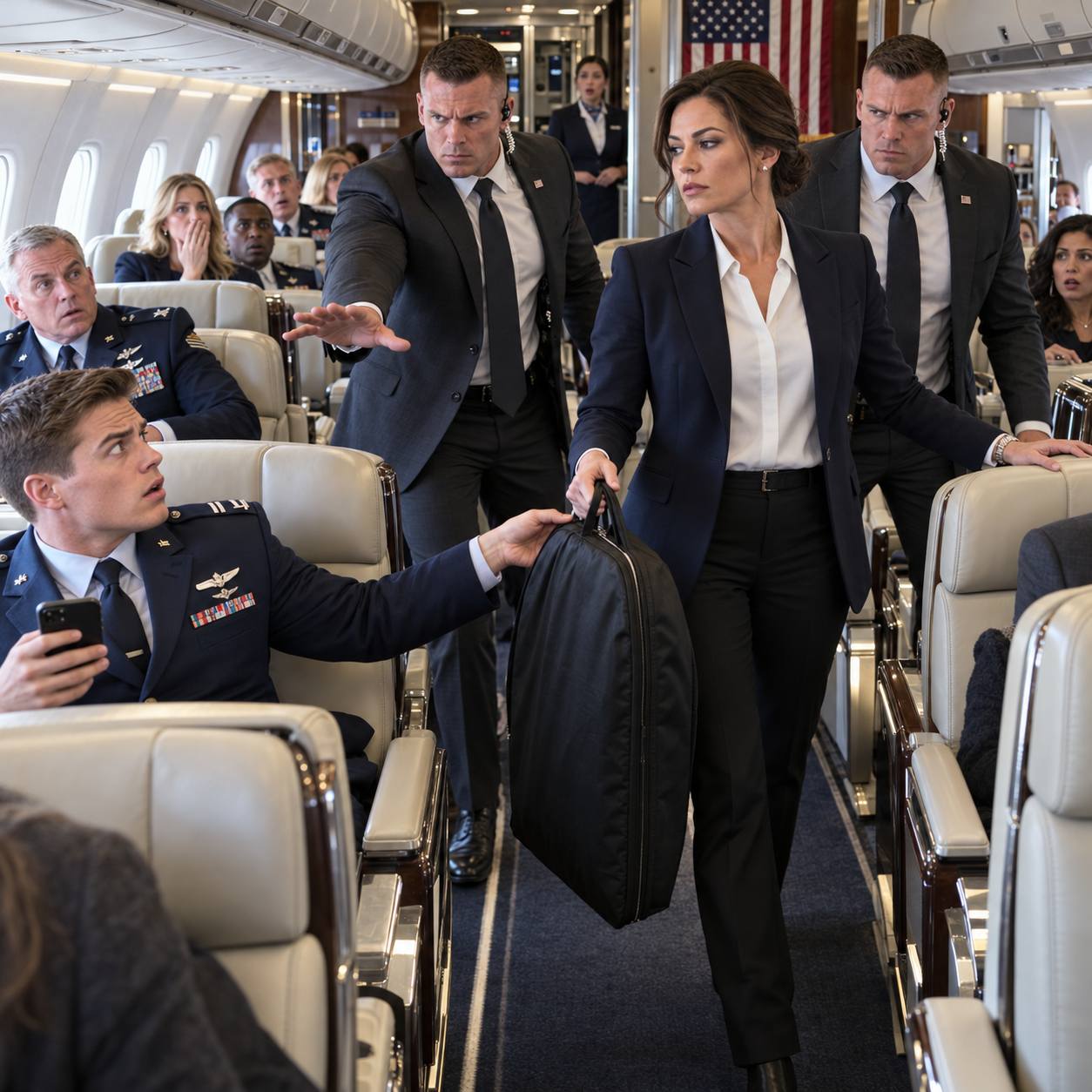
A Young Lieutenant Handed Me His Garment Bag Without Looking Up. “Hang That When We Board, Ma’am.” I Held It. Two Men In The Row Behind Me Stood At The Same Time. Same Haircut. Same Earpiece. He Kept Scrolling His Phone. “Sir, You’ll Want To Put That Down.”
At Gate B41, a young Army lieutenant handed me his garment bag without looking at my face and told me to hang it when we boarded. I took it without arguing. Then he raised his phone to photograph me for a private group chat, and the two men sitting behind me stood at the same time. He went pale when he noticed their earpieces. Three weeks later, I learned his careless joke had exposed something far more dangerous than either of us understood.
Part 1
At 9:47 on a Thursday night, Gate B41 at Dulles International Airport looked like every place people become less civilized after waiting too long. Children slept on jackets spread across the carpet, a teenage soccer team had claimed three rows of seats, and a businessman across from me was eating crackers over his laptop with the blank concentration of a man who had missed dinner and no longer cared where the crumbs landed. Our flight to Doha had been delayed for the third time, and I was sitting by the window in jeans, a gray sweater, and reading glasses, trying very hard to look like nobody worth remembering.
That part mattered more than anyone around me could have known. I was forty-four years old, tired enough that the words in my paperback kept slipping sideways, and traveling with one battered rolling suitcase that had crossed enough borders to look older than it was. Two men sat directly behind me in quarter-zip pullovers, close enough that I could hear one open a bag of trail mix every twenty minutes, but they never spoke to me unless necessary. If anyone had asked, I would have said I was traveling for work, which was true in the same way saying a hurricane involves weather is true.
The lieutenant arrived loudly. I heard him before I saw him, telling someone on his phone that he was about to become “the right hand of a one-star,” which he pronounced with the careful casualness of a man hoping strangers would overhear. His name tape read MERCER, and the staff sergeant following him carried two duffel bags while he carried one backpack, one coffee, one garment bag, and an opinion about nearly everything.
“General Whitmore wants me in the room for everything,” he told the person on the phone. “Not outside the room. In the room. There’s a difference.”
The staff sergeant, whose name was Dana Ruiz, sat at the far end of my row and closed her eyes. The expression on her face was one I had seen on noncommissioned officers for twenty-two years: the disciplined patience of someone who understood that correcting an officer in public was sometimes less useful than letting gravity do the work.
Mercer paced while he talked. At one point he put his backpack on the empty seat beside me without asking, set his coffee on the windowsill near my elbow, then walked away as though I had been assigned custody of both. I looked at the backpack, then at Ruiz, who had opened one eye.
“Sir,” she said, “your gear.”
“She’s fine,” Mercer replied, already turning away. “Right, ma’am?”
He didn’t wait for an answer.
Behind me, I heard the soft shift of fabric. Aaron Vale, the older of the two men in gray, had probably moved half an inch. Nathan Cole, his partner, was younger and less patient, so I lifted one finger from my book without turning around. It meant leave it alone. The backpack wasn’t a threat, the coffee wasn’t a threat, and I had survived twenty-two years in the Army partly by knowing when dignity cost more energy than it was worth.
Ten minutes later Mercer returned, finally noticed the garment bag digging into his shoulder, and looked down at me for the first time. I watched him make a complete decision about who I was in less than a second.
Middle-aged woman. Gray sweater. Near military travelers. Tired face. Helpful-looking.
He slipped the garment bag from his shoulder and held it toward me by the brass hook.
“Hang that when we board, ma’am,” he said. “Front closet. Thanks.”
I took it.
To this day, people ask why. Pride would make a cleaner story if I said I accepted it because I wanted to teach him something, but that wasn’t true. I took the bag because carrying somebody else’s things had been muscle memory for me long before Evan Mercer learned how to shine boots, and some reflexes survive promotions, wars, grief, and common sense.
He was already turning away when both men behind me stood.
Vale rose first, Cole half a heartbeat later. They did it quietly, but trained people notice coordinated movement the way musicians hear a wrong note. Ruiz’s eyes opened completely.
Mercer didn’t notice anything. He was scrolling again.
Vale stepped around the end of my row and stopped beside him. Cole remained just behind my right shoulder. Neither touched Mercer, and neither spoke, because technically nothing had happened yet.
Then Mercer turned back with his phone held horizontally.
“Hold still, ma’am,” he said, grinning. “This one’s going in the aide chat.”
The camera lens pointed directly at me.
That changed everything.
Cole’s voice came from behind my shoulder, calm enough to sound almost friendly.
“Sir. Put the phone down.”
Mercer frowned. For one second he had the offended expression of a lieutenant being corrected by someone not wearing a uniform. Then he noticed Cole’s earpiece.
His eyes moved to Vale.
Same gray quarter-zip. Same clear coil behind the ear. Same posture that looked relaxed until you understood what relaxed professionals looked like before they moved.
Mercer’s face changed in stages. Confusion went first. Annoyance followed. Then he looked back at his screen and saw my face framed by Gate B41, the Doha departure board glowing behind me, and the garment bag across my knees.
The color drained from his face.
Vale held out his hand.
“Delete it, sir.”
“I didn’t—”
“Delete it.”
Mercer’s thumb shook slightly as he tapped the trash icon. Vale took the phone, confirmed the image hadn’t been transmitted, cleared the recently deleted folder, and handed it back.
“Thank you.”
That was all.
No one raised a voice. No one flashed a badge. The soccer players kept sleeping, and a toddler three rows away continued pushing a plastic truck between his mother’s shoes.
But everyone within twenty feet was watching now.
Mercer looked at me as though I had changed while he wasn’t paying attention. His eyes dropped to the garment bag across my lap, then rose again.
“Ma’am,” he began. “I thought—”
I waited.
He didn’t finish.
Vale touched his elbow lightly and guided him toward the windows. I heard only fragments of the conversation. “Can’t discuss who we’re with.” “Don’t approach again.” “No photographs.” Mercer nodded after every sentence.
Ruiz walked over after Vale returned. She stopped in front of her lieutenant, spoke quietly, and whatever she said made him sit in the farthest chair from me.
I opened my paperback.
I did not feel victorious.
Mostly I felt tired.
Because ten minutes earlier I had been invisible, and now half the gate knew I was somebody who required two men with earpieces. They didn’t know who, but that was almost worse. Strangers began constructing versions of me in their heads: politician, witness, diplomat, criminal, billionaire’s wife.
Ruiz returned to her seat eventually.
“I’m sorry, ma’am,” she said.
“You didn’t hand me the bag.”
“No, ma’am.”
She glanced toward Mercer.
“He’s not a bad officer.”
“I didn’t say he was.”
“No, ma’am.”
She closed her eyes again.
An hour later, when boarding began, I stood, lifted Mercer’s garment bag from the chair, and carried it with me.
Vale leaned close as we entered the jet bridge.
“You don’t have to do that.”
“I told him I’d hang it.”
“He didn’t ask.”
“I noticed.”
Vale gave me the look he saved for decisions he disliked but couldn’t classify as dangerous.
I smiled.
“Relax, Aaron.”
“I am relaxed.”
“You have three different kinds of relaxed.”
“This is the middle one.”
I hung the lieutenant’s uniform in the forward closet myself, zipper toward the wall so the jacket wouldn’t crease.
Then I took my seat in Row 11.
Mercer boarded near the end. When he saw me, he slowed. When he saw the corner of his garment bag inside the closet, something almost worse than fear crossed his face.
Shame.
He walked past without speaking and sat in Row 17.
At 11:56 p.m., we lifted over Virginia and turned east.
Four hours later, somewhere above the Atlantic, I was still awake when Vale leaned over my seat.
“Ma’am,” he whispered, “there’s something about that phone incident you need to know.”
The tone of his voice made me close my book.
“What?”
“We found the same group-chat name in the threat brief.”
And suddenly Evan Mercer’s bad manners were the least important thing that had happened at Gate B41.
Part 2
Vale didn’t tell me more in the cabin. He couldn’t, not with passengers sleeping three feet away and a flight attendant moving through the aisle collecting plastic cups. He simply said, “We’ll talk in Doha,” then sat back down, leaving me with the hum of the engines and a black garment bag hanging six rows ahead like a punctuation mark.
The group chat Mercer had mentioned was called Aide Life. I knew that much because he’d said it loudly at the gate, and because young officers are capable of treating supposedly private digital spaces like kitchens during family holidays. According to Vale, the phrase had appeared in a security report several days earlier after an analyst noticed screenshots from a military social-media account being reposted on a foreign messaging channel. Nobody had connected it to my travel, and nobody knew whether it mattered.
Maybe it didn’t. Coincidences still happened.
But I had stopped believing in convenient coincidences years earlier.
The first time invisibility saved my life, I was twenty-nine and carrying a different garment bag.
In 2012 I had been Captain Mara Ellison, aide-de-camp to Major General Thomas Harland at a coalition headquarters in Afghanistan. The compound was a collection of blast walls, gravel, plywood offices, generators, satellite dishes, and exhausted people from more countries than I could name before coffee. Harland was brilliant, demanding, courteous, and capable of forgetting his own reading glasses while remembering the names of three hundred officers.
My job was to make the rest of his life possible.
I carried schedules, radios, briefing books, gifts from provincial governors, extra pens, medicine, maps, uniforms, and more coffee than any human should consume. I knew which door Harland preferred to enter, which colonel would talk for twelve minutes if given an opening, and which interpreters could tell when a visiting official was lying before the official finished his first sentence.
A logistics colonel started calling me “Luggage.”
He meant it as a joke.
“Here comes Luggage,” he’d announce when I followed Harland into headquarters carrying a garment bag and three folders. “Ask Luggage where the boss is.”
People laughed, including me.
That was how nicknames survived.
By winter, officers who didn’t know my first name knew I could get them fifteen minutes on Harland’s calendar. They also knew I was the woman standing behind him holding the things he needed.
What they didn’t know was that I wrote half the assessments he signed.
One night after a meeting with a provincial police commander, I stayed awake on a small aircraft while Harland slept across from me. The commander had told us seven things, and I believed three. I wrote a summary explaining why, including a paragraph labeled AIDE’S NOTE.
The next morning Harland read it twice.
He crossed out AIDE’S NOTE and wrote COMMANDER’S ASSESSMENT.
Then he sent it to a four-star headquarters.
I remember staring at that page longer than I should have.
Harland noticed.
“Problem?”
“No, sir.”
He looked at me carefully.
“You disagree?”
“No, sir.”
The report was excellent. The assessment was correct. Washington liked it.
I told myself that was the point.
Three months later, at eleven in the morning, a man wearing an Afghan security uniform entered an annex building with a rifle and started shooting.
The first burst sounded like metal doors slamming.
Then the alarms started.
Harland was inside a conference room with several colonels and a congressional staff member. The electronic locks sealed automatically. The internal phones failed when somebody cut the wrong breaker.
I was in the outer office with Harland’s radio clipped to my belt.
The radio used his call sign.
Viking Six.
Every guard tower, medical team, quick-reaction force, and operations center on the compound monitored that net. When Viking Six spoke, people moved.
Harland couldn’t reach the radio.
I could.
I pressed the transmit button.
“All stations, all stations, this is Viking Six. Lock down. Shooter in the annex. Quick-reaction force to the east entrance. Medical stage behind Building Seven. All others shelter in place and acknowledge.”
Nobody asked whether the voice belonged to a general.
They heard the call sign.
They acknowledged.
For forty-one minutes, I was Viking Six.
I worked from a paper roster torn off the wall, tracked personnel, coordinated medics, redirected the reaction force around the shooter’s line of sight, and told a furious allied brigadier he could not enter through the north gate until the situation was contained.
Fourteen people were trapped in a rear office.
We got all fourteen out.
Two Americans were wounded, one badly.
The shooter was killed.
When it ended, I opened the conference-room door. Harland came out wearing his reading glasses, looked at the radio on my hip, and understood.
“You used my call sign.”
“Yes, sir.”
He stared at me.
Then he nodded.
“Good.”
Three months later, Major General Thomas Harland received an award for his calm and decisive command during the attack.
At the ceremony, he thanked his staff.
I stood in the back holding his garment bag.
I don’t tell that story because I hated him. I didn’t. Harland later recommended me for assignments that changed my career, and I owe him more than one thing. But organizations have a strange way of attaching credit to the highest visible person and labor to the lowest visible one, even when everyone involved knows reality is more complicated.
The only person who ever acknowledged exactly what happened was Sergeant Major Frank Dwyer.
He found me outside after the ceremony and placed his personal challenge coin in my palm.
“Ma’am,” he said, “I was on that net.”
I looked at him.
“I know who ran it.”
That was all.
I still carried that coin.
Years later, when I became a foreign area officer, Colonel Leila Benton taught me another version of the same lesson. She had served in embassies across the Middle East and North Africa and possessed the unnerving ability to remember every driver’s child, every minister’s assistant, and every argument from meetings held six months earlier.
One night I complained that a report I had written had been forwarded under someone else’s name.
Benton listened while drinking mint tea.
Then she said, “Mara, if you need people to know you did the work, you’re in the wrong field.”
“That’s bleak.”
“It’s accurate.”
She smiled.
“The better you become at this job, the less visible you should be.”
By the time I sat in Row 11 on the Doha flight, I had spent fifteen years becoming difficult to notice.
That was why Vale’s warning bothered me.
Somebody had noticed enough.
At 3:15 in the morning Atlantic time, Mercer walked toward the rear galley. I watched him pass my row without looking at me.
Cole rose thirty seconds later.
I waited another minute, then went for water.
Behind the curtain, I heard Mercer’s voice before he saw me.
“Sir, can I ask you something?”
Vale answered.
“You can ask.”
“Who is she?”
A pause.
“I can’t tell you.”
“Should I have known?”
“No.”
Another pause.
“I didn’t mean anything. I thought she worked at the airport.”
Vale didn’t answer.
“I’m not an asshole,” Mercer said quietly. “I know I looked like one.”
“You photographed a stranger without asking.”
“I know.”
“You handed her your gear without looking at her.”
“I know.”
“Then maybe stop worrying about who she is.”
Mercer swallowed.
Vale continued.
“She has carried heavier things than your bag.”
Silence.
Then Mercer said, “Is this about that group chat?”
Vale’s voice changed.
“What about it?”
And through the thin galley curtain, I heard Mercer say the sentence that turned an embarrassing airport encounter into something else entirely.
“Because somebody hacked it last month.”
Part 3
I stayed behind the curtain.
Cole had heard it too. He looked at me once, and the expression in his eyes told me not to move.
Vale spoke very quietly.
“Why didn’t you mention that at the gate?”
“It wasn’t really hacked.”
“Those are two different answers.”
Mercer lowered his voice, but aircraft curtains are not walls.
“One guy lost access to his account for a few hours. He changed his password. That’s it.”
“When?”
“Three weeks ago.”
“Which guy?”
“I’m not giving you someone’s name because you’re mad I took a picture.”
“I’m not mad.”
That was true. Vale rarely got mad in recognizable ways.
“Lieutenant, listen carefully. Did anyone outside your group gain access to messages, photos, shared links, or files?”
“I don’t know.”
“Did your chain of command know?”
A long silence followed.
“No.”
Cole closed his eyes for a second.
Vale asked, “Why not?”
“It was a private chat. Mostly jokes.”
“Mostly?”
“Schedules sometimes. Flight stuff. Hotels. Nothing classified.”
I had heard that sentence in five countries and three investigations.
Nothing classified.
People say it as if classified information is the only information capable of getting someone killed.
Vale sent Mercer back to his seat.
Then he stepped behind the curtain and found me waiting beside the water cart.
“Well,” I said.
“I preferred him when he was just rude.”
“So did I.”
Cole glanced toward the cabin.
“We need to notify Washington.”
“You have secure communications?”
“Limited.”
“Then send only what you have to send.”
Vale nodded.
I filled a paper cup from a bottle and took one sip.
“Do we know whether this connects to my threat stream?”
“No.”
“Guess.”
He hesitated because professionals dislike guesses.
“Maybe.”
That was enough.
My travel had been modified twice in the previous month because analysts found references to my incoming assignment circulating among people who should not have known it. No exact itinerary had appeared, but there were fragments: a woman replacing the previous defense attaché, an arrival window, a reference to Doha, one description of an American military diplomat that was close enough to be uncomfortable.
Most of the information could have come from local sources.
Or from loose American ones.
People imagine espionage as hidden cameras and envelopes slid under doors. Sometimes it is. More often, someone posts a hotel lobby, someone else names a general in the caption, and a third person complains about a delayed flight.
Then somebody patient puts the pieces together.
I returned to my seat but didn’t sleep.
Near dawn, Mercer passed me on the way to the lavatory. He kept his eyes down. On the return trip he stopped.
“Ma’am.”
I waited.
“I’m sorry.”
“For which part?”
He flinched.
“All of it.”
“That’s broad.”
“I shouldn’t have handed you my bag.”
“No.”
“And the picture.”
“No.”
He nodded.
“I really thought you were with the USO.”
“Would that have made the picture acceptable?”
His face reddened.
“No, ma’am.”
“Then don’t use the wrong assumption to excuse the wrong behavior.”
He looked as if he wanted to disappear into the carpet.
I softened my voice, not the message.
“Go sit down, Lieutenant.”
“Yes, ma’am.”
He took two steps, then turned back.
“Did I put you in danger?”
That was the first intelligent question he had asked me.
“I don’t know.”
His face changed.
There was no entitlement in it now.
Only fear.
“That’s the problem,” I said.
When we landed in Doha, heat pressed against the aircraft walls before the door opened. Passengers stood too quickly, pulled bags from overhead bins, and became territorial about aisle space.
I went to the forward closet.
Mercer’s garment bag was exactly where I had left it.
I took it down.
Inside was his Army green service uniform, carefully pressed, with a small row of ribbons and lieutenant bars that still looked too shiny. Beneath the uniform were polished shoes and a framed photograph wrapped in a brown T-shirt.
I didn’t unwrap it.
I didn’t need to.
I had heard his call to his mother at the gate.
She had reminded him about a picture.
While everyone waited to deplane, I borrowed a piece of hotel stationery from the flight attendant and wrote a note.
Lieutenant,
I was an aide once.
Carry the bag yourself. Carry it well. Taking care of another person’s burdens is not beneath you.
But don’t become the bag.
Do the work in the room. Learn why decisions are made. Speak when it matters, even if nobody remembers who said it first.
And if you’re ever important enough that other people carry things for you, look at them before you hand anything over.
A former aide.
I folded the page twice and pinned it inside the collar of his jacket.
Ruiz came down the aisle first.
She saw the bag in my hands and slowed.
“Ma’am.”
“Staff Sergeant.”
She glanced behind her. Mercer was still several rows back.
“Thank you for not destroying him.”
“I don’t have that kind of authority.”
She gave me a look suggesting we both knew better.
“I mean professionally.”
“I know.”
Ruiz lowered her voice.
“He’s arrogant, but he’s teachable.”
“Those are not mutually exclusive.”
“No, ma’am.”
She almost smiled.
“He packed that picture of his parents three times. Kept worrying the glass would break.”
“I heard.”
“His father died last year.”
That surprised me.
Ruiz continued.
“He wanted this aide job because his dad was enlisted. Twenty-six years. Never got past first sergeant. Mercer thinks getting close to a general proves something.”
There it was.
Not an excuse.
A shape.
“Does the general know about the chat?”
Ruiz’s expression tightened.
“I told Lieutenant Mercer two weeks ago they were getting sloppy.”
“And?”
“He said everyone used it.”
“Everybody uses lots of bad ideas.”
“Yes, ma’am.”
Mercer reached us then.
Ruiz stepped aside.
I held out the garment bag.
He took it with both hands.
“Your general’s jacket goes on the left hook in the hotel,” I said. “Ribbons facing out.”
Mercer stared at me.
“Why?”
“Because most right-handed people reach for it while they’re putting on their watch. Save him ten seconds often enough and he’ll think you’re a genius.”
For the first time all night, Mercer almost smiled.
Then it disappeared.
“Ma’am, who are you?”
I considered telling him.
“Mara Ellison” would mean nothing. My rank might mean too much. My new job definitely would.
So I said, “Someone who carried bags before you did.”
His eyes dropped.
I stepped into the jet bridge with Vale and Cole behind me.
At the transfer desk, another security team was waiting.
Before Vale left, he asked the question I expected.
“Do you want me to recommend an adverse report on Mercer?”
“No.”
“He attempted to photograph you.”
“You stopped him.”
“He concealed a possible compromise.”
“That part isn’t mine to decide.”
Vale nodded.
“Fair.”
Then his phone vibrated.
He looked at the secure display and his face hardened.
“What?”
He angled the screen so only I could see the message.
Washington had searched archived threat reporting for the phrase Aide Life.
Three matches.
One contained a cropped photograph of a departure board in Bahrain.
Another showed a hotel lobby used by a visiting American general.
The third image had been posted forty-eight hours before my travel.
It showed a whiteboard.
At the top was General Whitmore’s schedule.
At the bottom, partly reflected in a glass frame, was a handwritten note.
Incoming attache through Doha. Female. Mid-40s.
For the first time since Gate B41, I forgot about Mercer’s embarrassment completely.
Someone in that little group chat had been feeding a much larger machine.
Part 4
The security office in Doha had no windows and the air-conditioning was cold enough to make the back of my hands ache. Vale stayed because Washington told him to. Cole went to coordinate my onward travel, which was now delayed indefinitely while people several time zones away decided how many assumptions had just become facts.
I sat across from a regional security officer named Miriam Shaw while she scrolled through printed screenshots laid across a metal table.
“None of this is classified,” Shaw said.
“I know.”
“Which makes people stupid.”
“I know that too.”
She tapped the Bahrain photograph.
The original had been taken by one of Mercer’s friends during an airport delay. A reflection in a decorative mirror showed an escort officer holding a card with hotel and vehicle details. Someone had zoomed in, sharpened the image, and reposted the information elsewhere.
The hotel-lobby image was worse.
An aide had posted a picture of a general’s luggage with a joke about carrying “the kingdom.” In the background, the hotel’s distinctive tile pattern identified the location. A timestamp narrowed the window. A later message mentioned a dinner with local officials.
Individually, the details were harmless.
Together, they were a route map.
“Who compromised the chat?” I asked.
“We don’t know yet.”
“What did Mercer say?”
“Enough to make Washington unhappy.”
That was diplomatic language.
Shaw continued.
“One member reported losing access to his personal cloud account. It was restored after password changes. Nobody notified security because they believed the chat contained only unclassified material.”
“And the threat reporting?”
“Still being compared.”
She slid the whiteboard image toward me.
Mercer had taken that photograph.
Not the one of me.
This one was from Fort Stewart two weeks earlier.
He had been proud of his new assignment and sent a picture of General Whitmore’s office to the group. The whiteboard behind him contained a visitor line mentioning my replacement ceremony in Mogadishu.
My name wasn’t there.
My title almost was.
A reflected scheduling note filled in the rest.
Mercer hadn’t intended to expose me. He probably hadn’t noticed the writing at all.
That didn’t matter.
Intent is important in courtrooms and marriages.
Operational security is less sentimental.
By sunset, the flight to Mogadishu had been moved twenty-four hours. My route changed. Two meetings were canceled. People at the embassy had to rearrange vehicle movements, local security coordination, and arrival procedures.
One careless photograph created work for dozens of people.
That was the first consequence.
The second belonged to Mercer.
He was removed from onward official travel before leaving Doha.
General Whitmore had already flown by a different route. Mercer was supposed to join him later. Instead, he was directed to report to a transient personnel office and wait.
I learned that because Ruiz found me in a secure waiting area.
She looked furious.
Not at me.
“He’s being sent back.”
“Temporarily?”
“Pending investigation.”
“I’m sorry.”
She studied my face.
“Are you?”
“Yes.”
That seemed to surprise her.
“He did something stupid.”
“Yes.”
“It could have gotten you killed.”
“Possibly.”
“Then why are you sorry?”
“Because consequences can be necessary and still hurt.”
Ruiz sat across from me.
For several seconds she stared at her hands.
“I told him.”
“I know.”
“I saw the group chat. I told him schedules shouldn’t be in there.”
“What did he say?”
“That I was paranoid.”
Her jaw tightened.
“He said officers in his cohort used it to help each other. Hotel recommendations. Uniform details. Aircraft information. Drivers. Meeting etiquette.”
“A digital aide school.”
“Pretty much.”
“With no instructor.”
“Exactly.”
I understood why it had grown.
Young aides live terrified of making small mistakes in front of powerful people. Which entrance does the general use? Where should the car wait? How many minutes early is too early? How do you pack a dress uniform for a twelve-hour flight?
If someone built a private group where new aides could ask those questions without looking incompetent, people would use it.
Then they would share too much.
Not because they were traitors.
Because they were helpful.
That frightened me more.
Malice is easier to identify than convenience.
Ruiz looked toward the door.
“He’s taking it badly.”
“Meaning?”
“He thinks his career is over.”
“Is it?”
“I don’t know.”
Neither did I.
That evening Mercer asked to speak with me.
Vale objected until I said yes.
They brought him into the secure lounge without his phone. His uniform was wrinkled now, his hair less perfect, and his eyes had the swollen look of someone who had not slept.
He stood at attention.
“Ma’am.”
“Sit.”
He sat.
For several seconds, neither of us spoke.
Then Mercer said, “They showed me the whiteboard picture.”
I waited.
“I didn’t even see the note in the reflection.”
“I believe you.”
“I’ve gone through every picture I sent.”
“And?”
His face crumpled slightly.
“There were more.”
“How many?”
“Enough.”
He swallowed.
“One had General Whitmore’s vehicle plate. One had a hotel sign. One showed a binder with tomorrow’s schedule partly open. I thought I was showing my friends what being an aide looked like.”
“You were.”
He looked confused.
“You showed them exactly what being a careless aide looked like.”
He took that without protest.
Then he said, “My dad would’ve killed me.”
“Your father?”
“First Sergeant Daniel Mercer. Retired.”
“I heard.”
His eyes flicked up.
“Ruiz told you.”
“Only that he served.”
“He used to say officers were dangerous when they thought rank made them smarter.”
I almost smiled.
“Your father sounds observant.”
“He died last year.”
“I’m sorry.”
Mercer nodded.
“I wanted this assignment because he never got near people like General Whitmore except when they inspected the motor pool. I thought if I got selected as an aide, it meant I’d made it farther.”
“Farther than him?”
His eyes went wet.
“I don’t know.”
“Yes, you do.”
He looked down.
“Yeah.”
There are moments when punishment teaches less than silence.
I let him sit in his answer.
Finally, he said, “Did my photo cause the threat against you?”
“We don’t know.”
“But it could have.”
“Yes.”
He pressed his palms together until the knuckles whitened.
“I almost took another one.”
“At the gate.”
He nodded.
“Of you.”
“Yes.”
He looked sick.
That was the moment I stopped seeing the loud lieutenant who had handed me his garment bag.
He still had to face what he’d done.
But now he could see it too.
And seeing is where responsibility starts.
The next morning, Shaw entered the lounge carrying a folder.
“They found the compromised account,” she said.
“One of the aides?”
“Yes.”
“Hostile access?”
She shook her head.
“Worse in a different way.”
She placed the folder in front of me.
The account had not been broken through sophisticated espionage.
The owner had reused a password from an old commercial website.
That password had appeared in a public data breach.
Someone tried it.
It worked.
Inside the synchronized account were months of screenshots from Aide Life.
The enemy hadn’t penetrated a secret military network.
Young American officers had built the intelligence package themselves and stored it somewhere convenient.
Shaw turned the page.
“We’ve identified at least four protected movements that may have been reconstructed from this material.”
“Casualties?”
“None confirmed.”
“Yet.”
She didn’t answer.
Then she pointed to a familiar image.
It was the photograph Mercer had taken of General Whitmore’s office.
Except this version had been enlarged.
A red box surrounded the reflection.
Inside the reflection was the note about me.
And beneath it, almost invisible until magnified, was another line.
Possible congressional delegation, 22 October.
I looked at Shaw.
“When?”
“Next week.”
“Do they know?”
“They do now.”
Mercer’s mistake hadn’t merely exposed my arrival.
It had uncovered a vulnerability that was still actively putting other people at risk.
Part 5
By the time I finally reached Mogadishu, nothing about my arrival looked like the plan I had memorized in Washington. The flight changed, the vehicle sequence changed, the people meeting me changed, and my luggage arrived twelve hours after I did. The only familiar object in my pocket was Sergeant Major Dwyer’s old challenge coin.
Major Ethan Keller, my deputy, met me beside an armored SUV.
He was thirty-seven, sunburned, prematurely gray at the temples, and carried the restless expression of someone who had been acting commander long enough to develop opinions about everyone else’s work.
“Lieutenant Colonel Ellison?”
“Mara is fine when nobody’s listening.”
“Then welcome to Mogadishu, Mara.”
He looked toward the Indian Ocean beyond the barriers.
“Sorry the arrival got complicated.”
“Complicated is why we’re employed.”
That earned the first smile.
The embassy compound sat behind layers of walls inside the protected airport zone, and my office contained a gray desk, a secure phone, two stacks of briefing folders, and a potted plant that had clearly survived multiple diplomatic rotations by refusing to acknowledge death.
I spent my first week learning names.
Drivers first.
Then guards.
Then interpreters, local staff, communications technicians, military partners, administrative assistants, and the people who knew which generator failed during heavy rain.
Senior visitors often begin by asking for commanders.
I had learned to ask who fixed the generator.
Nine days after arrival, I made my first official call on a Somali general whose career had survived governments, insurgencies, alliances, betrayals, and three different uniform designs.
His aide met me at the entrance.
He was a young captain carrying the general’s leather folio, a ringing phone, and two cups of tea.
When he tried to salute, the folio slipped.
I took one cup from him.
His eyes widened.
“Thank you, ma’am.”
“Use both hands.”
He adjusted the folio and saluted properly.
Then I gave the tea back.
Inside, his general had seen the whole thing.
During the meeting he watched me more carefully than before.
Later, when the formal conversation ended and we moved into the part where useful things are actually said, he spoke to his aide in Somali.
My Somali was weak.
I understood one word.
Sister.
That tiny moment stayed with me because Mercer had made me think about the difference between service and servility.
Carrying another person’s tea is not humiliation.
Treating the person carrying yours as invisible is.
Three weeks into the assignment, I received a secure summary of the Aide Life investigation.
Twenty-three officers had participated in versions of the chat over two years. Most were current or former aides. Most had shared nothing serious.
Seven had posted operational details that should never have been aggregated.
Two had exposed travel patterns.
One had accidentally uploaded a picture containing a temporary access badge whose barcode was readable after enhancement.
Mercer’s whiteboard photograph was among the most consequential.
But he was not the worst offender.
That mattered.
His mistake had triggered the inspection, but the problem predated him.
The group existed because young officers were being placed into high-trust positions without enough practical preparation and were solving the knowledge gap themselves.
Someone in Washington finally asked the question organizations usually avoid until after embarrassment:
Why had nobody trained them better?
The answer was uncomfortable.
Everyone assumed somebody else had.
I read the summary twice.
Then I called Colonel Leila Benton, now working at the Pentagon.
“You heard?”
“I hear everything three days late.”
“What do you think?”
“I think twenty-three young officers built an unofficial professional network because the Army gave them responsibility without enough instruction.”
“That’s generous.”
“It’s also true.”
“They endangered people.”
“Also true.”
Benton paused.
“You planning to recommend heads?”
“No.”
“Good.”
“That doesn’t mean no accountability.”
“I didn’t say it did.”
She had not changed.
I spun Dwyer’s coin on the desk.
“What would you do with Mercer?”
“Wrong question.”
“Of course it is.”
“What would you do with the system that produced Mercer?”
I stopped the coin with my palm.
That was why Benton had always been more useful than comfortable.
A week later Washington asked me for a statement because my incident had become part of the review.
I described exactly what happened.
Lieutenant Mercer placed his garment bag in my hands without identifying himself beyond his visible uniform. He attempted to photograph me without permission. Protective agents intervened. During subsequent conversation, he disclosed the existence of the group chat and the earlier account compromise.
I did not describe him as arrogant.
I did not mention his father.
I did not mention the apology.
Those things were real but irrelevant to the security finding.
At the end, investigators asked whether I believed he should permanently lose his aide assignment.
My answer was short.
“That decision belongs to his chain of command. I recommend you distinguish between misconduct, poor judgment, and a training failure while pretending none of them cancel the others.”
Two days later, I received an unexpected call from Major General Whitmore.
I had met him once, years earlier.
His voice was rough and direct.
“Ellison.”
“Sir.”
“I’ve got a lieutenant who managed to turn a garment bag into a Pentagon briefing.”
“So I’ve heard.”
“Did you really carry it onto the airplane?”
“Yes, sir.”
“Why?”
“I said I would.”
Whitmore laughed once.
“That’s stupid.”
“Probably.”
“He says you left him a note.”
I leaned back.
“He found it?”
“Apparently while putting on his uniform for the event he never attended.”
That hurt more than I expected.
“What did he do with it?”
“Put it in his pocket.”
Whitmore became serious.
“I’m not keeping him as my aide.”
“I understand.”
“Not because he embarrassed himself.”
“I understand.”
“He ignored an NCO who warned him about security. That’s the part I can’t get past.”
Ruiz.
Of course.
“He told you?”
“Eventually.”
Whitmore sighed.
“I am sending him to the division plans shop after the investigation. He’ll hate it.”
“Good place to learn.”
“That’s what I think.”
Then he surprised me.
“I want Ruiz.”
“As your aide?”
“As my senior enlisted assistant for the travel team. She saw the problem before the officers did.”
I smiled.
“That sounds wise.”
“Don’t sound so shocked.”
“Never, sir.”
Before hanging up, Whitmore said, “One more thing.”
“Sir?”
“Mercer asked if he could write to you.”
My hand stopped on Dwyer’s coin.
“How did he get my name?”
“He doesn’t have it.”
“Then how?”
“He asked me to send something to ‘the woman from Gate B41.'”
I looked out the narrow window toward a concrete wall.
“What’s it say?”
“I didn’t open it.”
“Good.”
“So?”
I thought about Benton.
About Dwyer.
About Harland’s award.
About a twenty-five-year-old lieutenant standing in an aircraft doorway holding his own garment bag.
“Send it through channels,” I said.
The message arrived five days later.
It was one page.
The first sentence made me put it back on the desk and stare at the wall.
Ma’am, I was angry with you for exactly twelve hours, and then I realized every thing I was angry about was something I had done myself.
Part 6
I finished Mercer’s letter after dinner.
He wrote that he had blamed Vale first, then the security office, then “the anonymous woman who apparently had enough influence to ruin my life without giving me her name.” By the next morning, investigators had shown him the images recovered from the compromised account, including his own whiteboard photograph.
After that, blame became harder to maintain.
He described the meeting where General Whitmore removed him from the aide position.
“I told him I had never meant to expose anyone,” Mercer wrote. “He said if intent were enough, armies wouldn’t need procedures.”
That sounded like Whitmore.
Mercer had been reassigned to the division plans section at Fort Stewart pending final disposition. His career wasn’t over. His humiliation was real, his evaluation would reflect what happened, and the elite assignment he had bragged about at Dulles was gone.
Then came the sentence that mattered more.
“Staff Sergeant Ruiz warned me twice, and I treated her caution like fear because admitting she knew more than I did felt like giving something up.”
I read that line again.
There it was.
The deeper problem had never been a bag.
It was the habit of deciding a person’s value before listening to them.
He had done it to Ruiz.
He had done it to me.
Years earlier, officers had done it to Captain Mara Ellison while calling her Luggage.
The settings changed.
The mistake did not.
Mercer ended the letter by saying he still carried my note.
“I don’t know your name, ma’am. I am trying not to find out. I think that might be the first instruction you gave me that I followed correctly.”
I laughed out loud.
Keller appeared in my doorway.
“Everything okay?”
“Yes.”
“Good news?”
“Complicated news.”
“The best kind.”
He set a folder on my desk.
“Security reform package from Washington. They want comments.”
The proposed changes were surprisingly practical: mandatory OPSEC training for aides, standardized travel checklists, secure professional forums so junior officers could ask logistical questions without resorting to personal platforms, and formal involvement of senior NCOs in travel-security preparation.
Ruiz’s warnings appeared anonymously in the lessons-learned section.
I added one comment.
Make the NCO involvement mandatory, not recommended.
Recommendations disappear when schedules get busy.
Requirements survive.
Six months passed.
The Aide Life incident faded from daily attention, which is what happens to almost every crisis once enough PowerPoint slides are created about it.
My work in Somalia became harder and more absorbing.
There were meetings where nothing happened for weeks, then one sentence over tea changed access to an entire region. There were nights when security alerts woke us, mornings when the sea looked impossibly blue beyond the barriers, and afternoons when I spent three hours arguing about fuel deliveries because strategy becomes logistics whether strategists like it or not.
My sister emailed through an approved account once a month.
She sent no photographs of me.
She understood.
One message said our mother had finally replaced the kitchen floor.
Another said my nephew had made varsity baseball.
Ordinary news became precious when ordinary contact was restricted.
In February, a package arrived through official mail.
Inside was a challenge coin from Sergeant Major Dana Ruiz.
One side bore General Whitmore’s command insignia.
The other had three words engraved beneath a small hook.
LOOK UP FIRST.
There was no letter.
I laughed so hard Keller came to my door again.
“Complicated good news?”
“Something like that.”
I put Ruiz’s coin beside Dwyer’s.
A month later I received another note concerning Mercer, though not from Mercer himself.
Colonel Benton forwarded an internal training proposal written by a first lieutenant in a division plans shop.
The title was terrible.
“Human Factors in Aide Support and Travel Security.”
I almost deleted it for that alone.
Then I read it.
Mercer had interviewed aides, senior NCOs, drivers, protocol officers, and security specialists about where informal information-sharing filled gaps in official training. He did not minimize his mistake. He used his own incident as the opening case study, though my identity remained removed.
One sentence caught me.
“The original security failure began before the compromised account. It began when multiple junior officers believed asking for help through official channels would make them look unprepared.”
That was sharp.
Another sentence was better.
“Rank did not create the vulnerability, but rank made several warnings easier to ignore.”
Ruiz.
He had finally heard her.
I sent Benton one line.
This is useful. Make somebody important steal it.
She replied five minutes later.
Already happening.
The Army adopted part of the proposal later that year.
Mercer’s name appeared nowhere on the final version.
I suspected Benton appreciated the symmetry.
One evening after a difficult embassy meeting, I walked back to my office and found Keller waiting with an envelope.
“Personal, through official pouch.”
“From?”
“No return name.”
Inside was a photocopy of my original note.
Mercer had added one line at the bottom.
You were right about one thing and wrong about one thing.
I carried the bag well.
I became it anyway.
Underneath that, he wrote:
Working on the second part.
No signature.
I folded it and placed it in the drawer with his first letter.
Then I returned to work.
I might have been satisfied if the story ended there.
Young officer behaves badly. Young officer suffers consequences. Young officer learns.
Life almost never ends where a lesson becomes convenient.
Two months later, an encrypted message arrived from Washington marked for immediate attention.
The subject line contained no names.
The attachment did.
Sergeant Major Dana Ruiz.
There had been an attack on a convoy supporting General Whitmore’s delegation overseas.
No fatalities.
Two wounded.
Ruiz was one of them.
I stared at the screen until the words became separate shapes.
Then I reached for the secure phone.
The irony was almost too clean to bear.
The woman Mercer had dismissed as paranoid had been injured during the kind of movement she had been trying to protect.
And according to the preliminary report, something she learned from the Aide Life investigation may have saved everyone in the vehicle.
Part 7
Ruiz had noticed the motorcycle first.
The convoy was moving through a partner nation’s capital after a military ceremony, a routine trip from a government building back to the airfield. Routes had been varied, times kept off personal devices, and support personnel briefed under the new procedures created after the Aide Life investigation.
Three months earlier, that would not have happened.
At an intersection, Ruiz saw the same motorcycle she had noticed near the venue.
Same rider.
Same bright sticker on the fuel tank.
She told the vehicle commander to divert.
Seconds after the lead SUV changed course, shots struck the rear vehicle.
Ruiz caught fragments in her shoulder when glass broke.
The convoy accelerated, security teams reacted, and everyone reached the airfield alive.
Investigators never proved the attackers had obtained the original route through digital exposure.
That was not the point.
The point was that someone had finally listened when an NCO said something felt wrong.
Whitmore called me from a hospital corridor.
“She’ll be fine.”
“How fine?”
“Angry about missing two meetings.”
“Then she’s fine.”
He exhaled.
“You know what she said when they loaded her into the ambulance?”
“I can guess.”
“‘Told you I wasn’t paranoid.'”
That sounded exactly right.
A month later Ruiz sent me a photograph through an approved internal system.
It showed her arm in a sling beside a garment bag hanging from a hospital-room door.
The caption read:
General carried his own.
I printed that one.
Against policy, probably.
Some things are worth a minor administrative sin.
The next development came from Mercer.
He had been promoted to captain.
Not early.
Not late.
Normally.
His security incident remained in his record, and the lost aide assignment remained lost. But his plans-shop work had been strong, his commanders trusted him again, and someone apparently decided one bad year did not have to become a whole life.
He wrote me after promotion.
“I used to think consequences meant someone had decided what you deserved forever. I think now they are just the part you have to carry long enough to understand.”
I liked that sentence.
I liked it enough to be suspicious that Benton had edited it.
Then came the part I hadn’t expected.
Mercer had been selected to help teach a new orientation course for military aides.
Not because he had been a successful aide.
Because he had failed at being one.
His first block covered digital security.
His second covered professional relationships with enlisted staff.
His third was simply titled:
Look Up.
Apparently the class began with him carrying his old garment bag into the room.
He placed it on a table.
Then he told the students about Dulles.
He never identified me.
He said only that he had once handed the bag to a woman he assumed existed to help him.
Two security agents stood.
He realized too late that she was protected.
Then he told the class the embarrassing part was not that she turned out to be important.
The embarrassing part was that he believed she needed to be important before he owed her basic respect.
When Benton told me that, I sat quietly for a long time.
“You’re getting sentimental,” she said.
“Don’t ruin it.”
“Wouldn’t dream of it.”
My assignment in Mogadishu ended the following year.
There was no public ceremony worth mentioning.
A few embassy staff gathered in a conference room. Keller gave me a framed photograph of the ocean taken from a secure rooftop where I had spent too many mornings drinking bad coffee.
The Somali general whose aide I’d once helped with the tea sent a handwritten note.
His former aide, now a major, delivered it personally.
“You remember me?” he asked.
“Of course.”
He smiled.
“You held my general’s tea.”
“For three seconds.”
“I remember.”
That stayed with me.
Not because he remembered my rank.
Because he remembered the three seconds.
On my last morning, I packed the gray government office.
Dwyer’s coin went into my front pocket.
Ruiz’s coin went beside it.
Mercer’s letters went into my carry-on.
I left the potted plant for my replacement because somehow it was still alive, and at that point I believed it had earned tenure.
At the airfield, Keller reached for my suitcase.
“I’ve got it,” I said.
“You’re allowed to let people help you.”
“I’m aware.”
“Are you?”
I gave him the bag.
He smiled.
Growth arrives in humiliating forms.
The flight home passed through Europe, not Doha.
At the connecting gate, I found myself surrounded by young service members again. Some slept. Some stared at phones. One second lieutenant argued softly with an airline employee about an oversized carry-on.
I bought coffee and sat by the window.
For the first time in years, no protective detail sat behind me.
The threat level associated with my assignment had changed.
I was simply a woman with a worn suitcase.
It should have felt freeing.
Instead, for the first hour, I kept noticing empty space behind my shoulders.
Then a young captain in uniform approached the row across from me.
He carried two bags.
A garment bag hung from one shoulder.
His phone was in his hand.
I watched him stop near an older airport cleaner who was moving a cart through the seating area.
The captain stepped aside.
“Morning, ma’am.”
The cleaner nodded.
He waited for her cart to pass.
Then he looked down, typed something on his phone, and kept walking.
Nothing dramatic happened.
Nobody stood.
Nobody went pale.
And for some reason, that was the moment I knew the story had ended correctly.
Except it hadn’t.
When I landed in Washington, Colonel Benton was waiting outside security.
She hugged me, which neither of us enjoyed enough to admit.
Then she handed me an envelope.
“What’s this?”
“Invitation.”
“To what?”
She smiled.
“An aide orientation class tomorrow.”
I stared at her.
“No.”
“Yes.”
“Leila.”
“You don’t have to speak.”
“Good.”
“You’re observing.”
“Fine.”
“Mercer’s teaching.”
I stopped walking.
Benton kept going.
I caught up.
“You arranged this.”
“Obviously.”
“He still doesn’t know who I am.”
“No.”
“And you’re planning to keep it that way?”
She gave me a completely innocent expression.
“I would never interfere with a learning environment.”
That was when I knew I was in trouble.
Part 8
The classroom at Fort Myer held thirty-two newly selected aides.
Captains mostly. A few lieutenants. Two majors. Every one of them looked polished, attentive, nervous, and privately convinced they had been chosen because someone had recognized unusual potential.
I sat in the back wearing civilian clothes.
No uniform.
No name tag.
No rank.
Benton sat beside me with coffee and the smug expression of a woman who had engineered something and intended to deny it under oath.
At 9:00, Captain Evan Mercer walked in carrying a black garment bag.
He looked older.
Not dramatically older. Life rarely changes faces that neatly. But the restless energy had settled. He placed the garment bag on a table and faced the class.
“My name is Captain Mercer. I was selected as an aide two years ago.”
Several students straightened.
“I lasted less than one day in transit.”
That got their attention.
Mercer told the story.
Dulles.
The delay.
The woman in the gray sweater.
The garment bag.
The photograph.
The two men standing.
He made himself look worse than I remembered.
Benton leaned toward me.
“Accurate?”
“Painfully.”
Mercer explained the group chat next.
He showed sanitized versions of the compromised images.
The reflected schedule.
The hotel.
The vehicle plate.
He explained how publicly available information had been aggregated by people who did not need classified access because carelessness had already done most of the work.
Then he stopped in front of the garment bag.
“For months,” he said, “I thought the worst part of that night was discovering I’d handed my bag to someone important.”
He looked around the room.
“It wasn’t.”
Silence.
“The worst part was that I had already decided she wasn’t important.”
Nobody moved.
“I thought she worked for a volunteer organization. Maybe she did. Maybe she was a general. Maybe she cleaned the gate after we left. None of those possibilities should have changed whether I looked at her face before telling her to carry my property.”
Benton glanced at me.
I kept my eyes on Mercer.
He continued.
“I also ignored the staff sergeant traveling with me when she warned me our group chat was unsafe. I thought I understood the risk better because I was the officer. She understood it better because she was paying attention.”
A slide appeared behind him.
Sergeant Major Dana Ruiz, arm in a sling, standing beside General Whitmore.
Mercer smiled.
“She outranks my common sense to this day.”
The class laughed.
Then he became serious again.
“Later, Sergeant Major Ruiz noticed a threat during a convoy movement. People listened. That decision may have saved lives. The new procedures behind that convoy existed partly because of the investigation my mistake triggered.”
He paused.
“That’s the uncomfortable thing about failure. Sometimes it becomes useful after it becomes expensive.”
I felt something tighten in my throat.
Not pride exactly.
Relief.
Mercer opened the garment bag and removed an old folded piece of hotel stationery sealed in a clear protective sleeve.
My note.
He held it up.
“A woman I never identified left this inside my uniform.”
He read only the final lines.
“When you are the general someday, look up when you hand someone something. You never know who they are.”
Then he lowered the paper.
“I would change one sentence now.”
My breathing stopped.
Mercer looked across the room.
“You shouldn’t look up because you never know who they are.”
He folded the note carefully.
“You should look up because it shouldn’t matter.”
The room stayed silent.
Benton whispered, “Well.”
“Don’t.”
“I didn’t say anything.”
“You were about to.”
At the end of the class, students gathered around Mercer with questions.
Benton and I moved toward the door.
I was almost outside when Mercer said behind me, “Ma’am?”
I stopped.
Benton continued walking because she was a coward.
I turned.
Mercer stood ten feet away.
For several seconds, he stared at my face.
Then his eyes widened.
Age had changed me a little. The gray sweater was different. My hair was shorter.
But recognition arrived.
“Gate B41,” he said.
I smiled.
“Left hook.”
His mouth opened.
Nothing came out.
Then he looked toward the hallway where Benton had disappeared.
“She knew.”
“Since before breakfast.”
Mercer laughed once, softly, then rubbed a hand over his face.
“Of course she did.”
He straightened.
“Ma’am, I still don’t know your name.”
“That’s impressive restraint.”
“I’ve had help.”
He hesitated.
“Can I ask now?”
I considered him.
Two years earlier, I had refused because knowing would have let him turn the incident into a story about status. He could have said he accidentally ordered around some senior officer or diplomat, and the lesson would have become don’t disrespect important strangers.
But he had built the correct lesson without my identity.
So I held out my hand.
“Mara Ellison.”
He shook it.
“Evan Mercer.”
“I know.”
He laughed.
“Right.”
“Lieutenant Colonel?”
“Colonel now.”
His eyebrows rose.
“Congratulations.”
“Thank you.”
He didn’t ask about Somalia. He didn’t ask why the agents had been there. He didn’t ask what title I held at the time.
That impressed me more than his presentation.
Instead, he lifted the garment bag from the table.
“I should tell you something.”
“What?”
“The first time I taught this course, I left this on a chair afterward while I talked to students.”
I waited.
“A janitor came in. Older guy. I almost asked him to move it.”
“Almost?”
Mercer smiled.
“Then I shut my mouth, picked it up, and moved it myself.”
“Progress.”
“Slow progress.”
“Most real progress is.”
We stepped into the hallway.
Benton was leaning against the wall twenty feet away pretending to read email.
Mercer followed my eyes.
“Was she your boss?”
“Mentor.”
“She looks terrifying.”
“Accurate.”
He looked back at me.
“I owe you an apology beyond the one I wrote.”
“You already apologized.”
“I know. But I never said it to your face.”
I waited.
“I’m sorry I treated you like a function instead of a person. I’m sorry I ignored Sergeant Major Ruiz. I’m sorry my carelessness created danger for people who never agreed to take that risk.”
That was an adult apology.
No excuses.
No request that I make him feel better.
“Accepted,” I said.
His shoulders loosened.
“But acceptance doesn’t erase consequences.”
“I know.”
“Good.”
He nodded.
“I’m glad I lost the aide job.”
I looked at him.
“That’s an interesting lie.”
He smiled.
“Okay. I’m glad now.”
“More believable.”
We walked together toward the lobby.
At the exit, a young lieutenant rushed through the doors carrying a laptop bag, a coffee, and two uniform covers. He nearly collided with a civilian employee pushing a cart.
The lieutenant stopped.
“Sorry, sir.”
The employee waved him through.
The lieutenant stepped aside instead.
“No, you’re good. Go ahead.”
Mercer watched.
“So that’s it?”
“What’s it?”
“The big lesson.”
“People moving around each other without being jerks?”
“Pretty much.”
He laughed.
Outside, the morning was bright and cold.
Benton joined us.
“I assume the secret is ruined.”
“Completely,” Mercer said.
She pointed at his garment bag.
“You carrying that?”
“Yes, ma’am.”
“Good.”
We walked toward the parking lot.
Mercer went one direction, Benton and I another.
After about twenty yards, I looked back.
He was standing near the curb, answering a question from one of the student aides.
The garment bag was still over his own shoulder.
Years earlier, I thought invisibility meant being unseen.
Then I thought being seen meant someone finally understanding what I had done.
I had been wrong both times.
Recognition is public.
Being seen is personal.
A medal can recognize you without seeing you. A challenge coin pressed quietly into your palm can see you without recognizing you at all.
Sergeant Major Dwyer had seen me beside a vehicle in Afghanistan.
Ruiz had seen the danger in a careless group chat.
Mercer eventually saw what he had refused to notice.
And somewhere along the way, I had learned to see the people carrying things around me.
I never received an award for the forty-one minutes I spent using Viking Six’s call sign.
That stopped bothering me years ago.
General Harland’s citation stayed his.
His obituary eventually mentioned the calm command decisions made during the attack.
It never mentioned Captain Mara Ellison.
That was fine.
Fourteen people came out of the annex alive.
Years later, a convoy changed direction because someone listened to Sergeant Major Ruiz.
A group of young aides received better training because Evan Mercer made a stupid photograph and then refused to spend the rest of his life pretending the mistake belonged to somebody else.
Those things mattered more.
I still carry Dwyer’s coin.
Ruiz’s coin sits beside it now.
And inside a folder in my desk is a photocopy of the note I once pinned into the collar of a lieutenant’s uniform while an airplane emptied in Doha.
Every few years, when my work feels invisible again, I take them out.
Not to remind myself that I was important.
To remind myself that importance was never the point.
The point was the work.
The people.
The moments when somebody looked up.
And whenever anyone hands me something now—a folder, a coffee, a bag, a problem they cannot carry alone—I make sure I look at their face first.
THE END!
Disclaimer: Our stories are inspired by real-life events but are carefully rewritten for entertainment. Any resemblance to actual people or situations is purely coincidental.

