
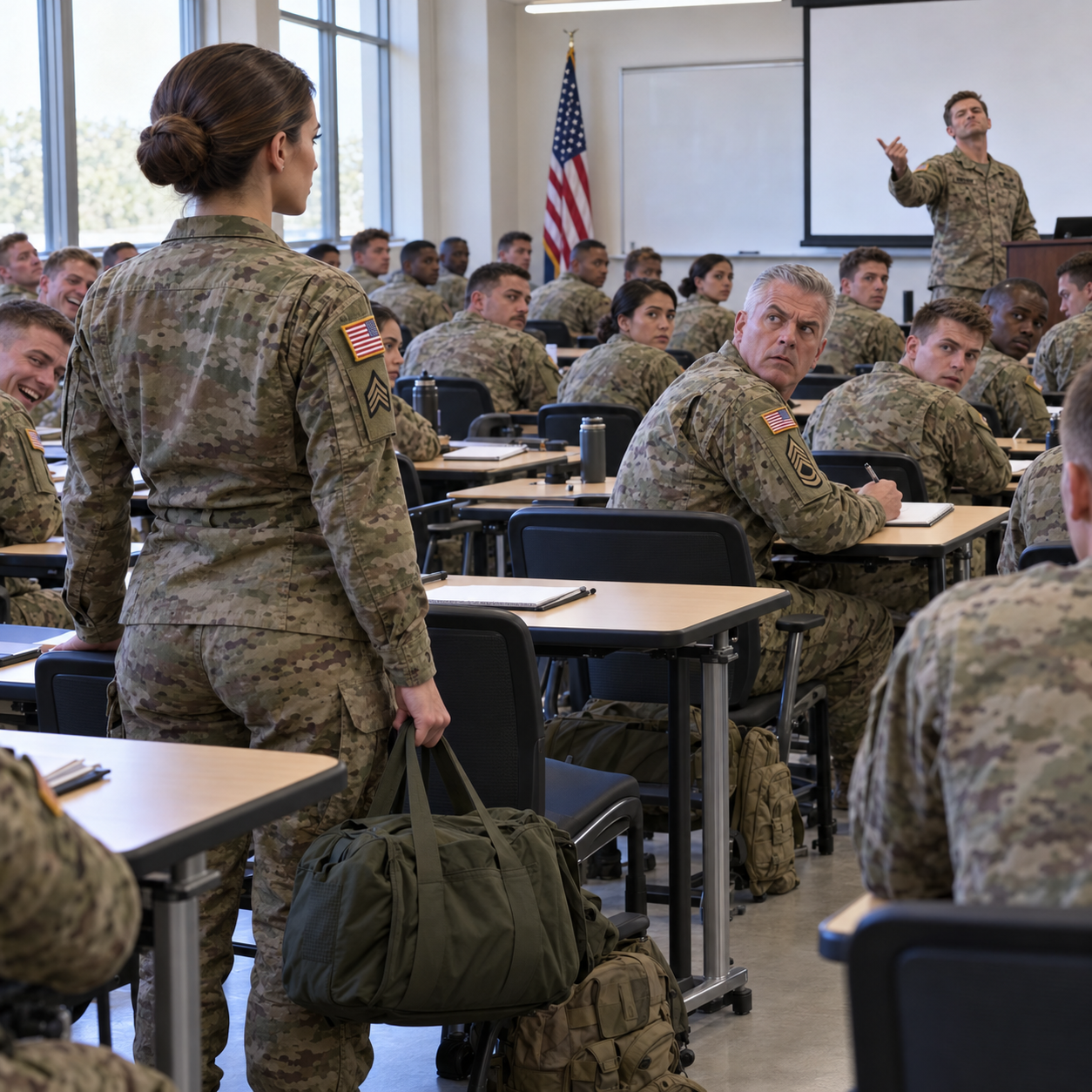
“Back Row, Sergeant. I Don’t Carry Passengers.” Thirty Soldiers Laughed. I Picked Up My Bag And Moved. Then The Gray-Haired Master Sergeant In Row One Turned Around, Saw My Face, And His Pen Stopped. The Instructor Snapped His Fingers. “Eyes Up Front.” “Sergeant, You Need To Check Her File.”
The instructor read my age and job off a clipboard, looked me over, and sent me to the back row because he didn’t “carry passengers.” Thirty soldiers heard him call me dead weight, and most of them laughed while I quietly took the seat he chose for me. I planned to finish the course, collect my certification, and forget him. Then a master sergeant in the front row turned around, went pale, and whispered a place and date I hadn’t spoken aloud in fifteen years.
Part 1
Sergeant First Class Cole Danner read the roster like he was sorting equipment before a mission. “Ramirez, twenty-two, combat engineer. Front row. Patel, twenty-four, signal. Second row. Reeves, nineteen, engineer. Front row. Good. Young legs.” Each name was followed by the scrape of a folding chair on concrete inside a converted maintenance bay at Fort Bliss, Texas, where thirty soldiers had gathered for combat lifesaver recertification on the sixth day of mobilization.
The room smelled like old motor oil, burnt coffee, canvas, and the dust that slipped under the two closed roll-up doors. A projector sat on a dented metal cart, aimed at a pull-down screen that hung slightly crooked, and two orange rescue litters leaned against the wall beside a mannequin wearing a helmet held together with silver duct tape. I had been standing near the entrance for almost ten minutes with my duffel hanging from one shoulder when Danner finally reached my name.
“Natalie Mercer.”
“Here, Sergeant.”
His eyes moved down the clipboard. “Forty-three.”
He looked at me, then back at the paper. I watched his expression settle before he spoke again. “Eighty-eight Mike. Motor transport operator. National Guard.”
“Correct.”
Danner smiled, and that smile bothered me more than an insult would have. There was no anger in it, no cruelty he expected anyone to challenge, only the calm satisfaction of a man who believed he had correctly solved a simple problem. “Back row, Sergeant Mercer. I don’t carry passengers.”
The room laughed.
Some soldiers laughed because it was funny to them, some because Danner was the instructor, and a few because they looked relieved he had chosen somebody else. My driver, Specialist Daniel Tran, sat in the front row and immediately looked over his shoulder at me with an expression halfway between apology and outrage. Staff Sergeant Kesha Brooks, one of my squad leaders, twisted around from row three, but I gave her the smallest possible shake of my head.
I picked up my bag and walked to the chair against the back wall.
“Dead weight belongs in the back,” Danner said while making a note on his clipboard. “Nothing personal. Battlefield math.”
I placed my bag between my boots and rested both hands flat on my knees. Danner continued calling names, and the laughter faded as quickly as laughter usually does when the target refuses to feed it. By the time the projector came on, I could almost convince myself it had been nothing.
Almost.
Danner was good at teaching. That mattered. His voice carried cleanly in the concrete bay, his demonstrations were sharp, and he knew the lifesaving sequence without glancing at his notes. A bad instructor would have been easy to dismiss; Danner was more dangerous because he was competent enough to believe competence in one thing made his instincts reliable in everything.
“Out there,” he told us, clicking to the first slide, “you’re going to make decisions fast. You don’t get biographies. You don’t get twenty minutes to understand somebody. You see what’s in front of you, decide who can work, decide who needs work, and move.”
That was when the master sergeant in the front row turned around.
I hadn’t noticed him before because I had trained myself not to notice people unless they belonged to my platoon. He was broad-shouldered, maybe late thirties now, with gray beginning at both temples and an engineer patch on his sleeve. A notebook lay open across one knee, and his pen stopped halfway through a sentence.
He stared at me.
Not at the back row.
At me.
Something happened to his face that I had seen before in hospital corridors and beside aircraft. The muscles went still first, and then the color seemed to leave from underneath the skin. He turned farther in his chair until his whole body faced me.
Danner snapped his fingers. “Master Sergeant, eyes front.”
The man didn’t move.
“Master Sergeant Holloway?”
That name meant nothing to me at first.
Then he spoke. “Sergeant, you should check her file.”
Danner gave a short laugh. “I read her file. She drives trucks.”
A few people laughed again, but much less confidently.
Master Sergeant Marcus Holloway held my eyes for one more second before turning around. He placed his pen beside the notebook as carefully as if it might explode if dropped.
My hands started shaking.
I pressed them harder against my knees.
Nobody except me could have understood why his face frightened me. Fifteen years had added weight to his jaw, gray to his hair, and lines around his eyes, but memory does strange things with faces you once studied from eight inches away while they were bleeding beneath you. It strips away age. It pulls the old face through the new one until both exist at once.
Danner advanced the slide.
MASSIVE HEMORRHAGE.
Someone in row two yawned.
The class moved on.
For everyone else, nothing had happened.
For me, Fort Bliss disappeared for half a second and became a river valley in Afghanistan under a brutal August sun.
At 0820, Tran dragged his chair into the back row beside me after asking Danner whether he could sit with his platoon sergeant. “That was messed up,” he whispered while pretending to organize his notebook. “You want me to say something?”
“No.”
“He doesn’t know anything about you.”
“Exactly. Take notes.”
Tran frowned but obeyed. His handwriting looked like an EKG during an earthquake, and when he wrote massive hemorrhage, he underlined it twice.
At 0840, Danner clicked to a photograph of a helicopter hovering over rough terrain. “Hoist casualty packaging,” he said. “You probably won’t do this yourselves, but somebody may need to prepare a casualty for the aircraft. Do it wrong and you make the flight crew’s day worse.”
I looked at the oil stains on the floor.
One long stain curved through the concrete like a dark river.
I knew immediately which river my mind had chosen.
Across the room, Holloway still wasn’t writing. Every few minutes his head turned slightly toward me before returning to the screen.
Danner noticed.
“Master Sergeant Holloway, you with us?”
“I’m here.”
“Good. Stay here.”
Holloway’s eyes remained forward, but his jaw tightened.
The slide showed straps crossing a litter.
Danner explained the order.
He got one detail wrong.
Not dangerously wrong. In a classroom, it made almost no difference. Under a hovering helicopter with dust filling your teeth and bullets striking a mud wall nearby, it cost maybe eleven seconds.
I knew because I had once counted every one of them.
I said nothing.
At 1000, Danner called a ten-minute break. Chairs scraped, soldiers stretched, coffee poured, and the room filled with thirty conversations at once. Tran went outside to make a call, while Brooks started toward me before seeing my expression and changing direction.
I stayed seated.
Holloway rose from the front row.
He ignored the coffee.
He walked along the wall until he stood beside my chair.
For several seconds, neither of us spoke.
Then he said quietly, “Arghandab.”
My throat tightened.
“August.”
“I know,” I said.
His hand closed around the back of the chair in front of me.
“I looked for you.”
And just like that, fifteen years disappeared.
Part 2
August 18, 2011, began with heat already pressing down on Kandahar before breakfast. I was twenty-eight then, a staff sergeant and flight medic assigned to a medevac company operating from a forward site, and by 1400 the inside of my uniform felt permanently glued to my skin. Our call came twenty-three minutes later: urgent surgical casualty, engineer unit, blast injury in the Arghandab River Valley.
From the air, the valley looked impossible. Green vineyards spread along the river in a country of brown mountains and pale dust, divided by thick mud walls that turned every field into a maze. Those walls made landing dangerous, so our pilot, Chief Warrant Officer Evan Rourke, brought us into a hover above a narrow opening while gunfire cracked somewhere west of the pickup point.
“You have thirty seconds once you’re down,” Rourke said through my headset. His Georgia accent never changed, even when the aircraft shook. “After that I’m bringing you up with him or without him.”
“With him.”
The crew chief clipped me into the cable and tapped my shoulder. I swung my boots outside, leaned into empty air, and dropped beneath the helicopter.
People who have never been under rotor wash think of wind. It isn’t wind. It is pressure with dirt inside it, a force that enters your sleeves, your collar, your mouth, and every gap around your goggles. The aircraft noise becomes so complete that you stop hearing it as sound and start feeling it in your bones.
I landed hard between rows of grapevines.
Four engineers surrounded a young soldier lying beside a wall. They had already placed a tourniquet high on his thigh, but the injury sat above where the device could fully control the bleeding. He was conscious, sunburned, terrified, and staring at me as if looking away would kill him.
His name tape read HOLLOWAY.
I packed the wound, pressing gauze into the injury until my forearm burned. There is no graceful version of that work, no way to make it sound clean for people who prefer medicine to happen behind curtains. I used both hands, then my fist, and kept pressure while his friends helped me move him onto the litter.
“Stay with me,” I shouted.
“I’m trying.”
“You’re doing fine.”
“I don’t feel fine.”
“That’s because your standards are too high.”
He laughed once, or maybe coughed. I clipped us both to the hoist and positioned myself over him so I could keep pressure as the cable lifted us. The vineyards dropped away beneath our boots while we spun slowly beneath the aircraft.
Inside the cabin, I knelt beside him.
The flight to Kandahar took nineteen minutes.
Holloway talked through almost every one of them.
“Tell me something,” he yelled.
“About what?”
“Anything. Where are you from?”
“Midland, Texas.”
“What’s in Midland?”
“Oil. Dust. People pretending Odessa is worse.”
He smiled despite himself.
I leaned harder into the wound when the helicopter banked.
“Tell me something else.”
“The sunsets are ugly.”
“That’s terrible.”
“You haven’t seen enough Texas sunsets.”
“I’m going to?”
“You are now.”
He looked at me for a long second. “Promise?”
I had learned not to promise outcomes.
So I said, “You’re going to have to check for yourself.”
At Kandahar, a surgical team ran toward us before the helicopter fully settled. A nurse placed her hands over mine and said, “I have pressure. Let go.”
I didn’t.
“Sergeant, I’ve got him.”
My fingers refused to release.
She looked directly at me. “Let go.”
On the third instruction, I did.
Holloway disappeared through the hospital doors while I stood in rotor wash with blood drying from my wrist to my elbow. Rourke came around the nose of the aircraft, handed me a bottle of water, and stood beside me while I poured it over my arm.
Holloway lived.
I learned that two days later.
I didn’t visit him.
At the time I told myself we were too busy, and we were. We flew four more urgent missions that week, but that wasn’t the real reason. I had stopped learning too much about patients because the dead accumulated faster than my ability to carry them.
Two months later, a letter appeared in my box.
The envelope said only: TO THE FEMALE FLIGHT MEDIC, DUSTOFF, ARGHANDAB, AUGUST 18.
Some clerk had figured out where it belonged and attached a yellow sticky note.
THIS YOU?
I recognized the large slanted handwriting immediately.
I never opened it.
The decision made perfect sense to me then. Holloway could write because things had gone right, but there were soldiers whose families would never write because our work had failed, and accepting gratitude from the survivor felt like stealing something from the dead. I put the envelope in a boot box with spare socks, photographs, and an old multitool.
That box followed me home.
It moved between four houses.
The letter remained sealed.
Back at Fort Bliss, Holloway stood beside my chair during the break with one hand gripping the metal backrest. “I wrote to your unit for months,” he said. “Nobody would give me your name. I called the medevac association. I contacted people at Rucker. I described you to anybody who would listen.”
I looked down.
“Brown hair,” he continued. “Texas accent. Woman. Said Texas sunsets were ugly.”
That nearly made me smile.
“I asked them not to give my information out.”
“I figured that eventually.”
Around us, soldiers moved in and out of the bay without paying attention. Danner stood near the projector drinking coffee, laughing about something with another instructor. Holloway lowered his voice further.
“I tell my soldiers about you.”
My eyes came up.
“Every time some kid says he can’t finish a ruck or can’t survive another mile or thinks being scared means he doesn’t belong, I tell him about the medic who kept pressure on my wound for nineteen minutes while she looked just as scared as I felt.”
“I wasn’t—”
“You were.”
I stopped.
Holloway smiled faintly. “That’s why I remember.”
I looked at the training tourniquet in my lap.
He followed my gaze.
“Why are you sitting back here?”
The answer escaped before I could protect it.
“It’s where I was put.”
Something changed in his expression.
Holloway straightened.
He walked back to the front of the room.
For one hopeful second, I thought the conversation was over.
Then he folded his chair.
The metal legs snapped together with a loud clap.
Several soldiers turned.
Holloway lifted the chair in one hand and started walking toward me.
Part 3
There are moments that feel important while they are happening, and there are moments that become important only after you understand what they changed. Watching Marcus Holloway carry that folding chair through the center aisle felt embarrassing more than anything else. I wanted him to stop because I had spent twelve years building a life around not being noticed, and attention felt like a threat.
He passed the first row.
Then the second.
Then Brooks.
Then Tran, who had returned from break and was standing near the coffee urn.
Holloway reached the back wall, unfolded his chair beside mine, and sat down.
Danner turned from his laptop. “Master Sergeant, your seat’s up front.”
“I’m good here.”
“That’s the back row.”
Holloway opened his notebook. “I know.”
Danner laughed as if searching for the missing joke. “Your knees need room.”
“They’re fine.”
I leaned toward Holloway. “Don’t do this for me.”
He kept his eyes on his notebook. “I’m not.”
“Then what are you doing?”
“Correcting where I decided to sit.”
That sentence struck harder than it should have because I knew exactly what he meant.
Danner hadn’t truly sent me to the back row that morning.
He had only found me there.
The first time I went willingly happened in Afghanistan six months after Holloway’s rescue.
We were responding at night to a casualty on a ridge in Zabul Province, another hoist because the terrain wouldn’t support a landing. Fine dust covered everything, the kind that became a solid wall under rotor wash. Sergeant Lena Ortiz, our crew chief, clipped me to the cable while Chief Warrant Officer Silas Kerr tried to hold the aircraft steady above the slope.
I had the patient on the litter and was halfway back through the cabin door when the world disappeared.
Brownout.
No ground.
No horizon.
The aircraft drifted.
A skid struck rock.
What happened next exists in fragments: metal folding, Ortiz screaming, the sensation of being thrown sideways, and one impact across my back so hard it seemed to erase sound. When everything stopped moving, the helicopter lay on its side and stars were visible through what had become the upper doorway.
The patient was still attached to me.
My right wrist pointed in the wrong direction.
Ortiz crawled toward us. “Natalie, your arm.”
“Get his feet.”
“Your wrist is broken.”
“Lena, get his feet.”
We moved the patient first.
All of us survived: patient, pilots, Ortiz, me. That became the sentence people used afterward because it was true and because true sentences can still hide things. Everyone lived, but I fractured a vertebra in my lower spine and broke my wrist in two places badly enough to require plates.
I spent months rehabilitating.
Six months grounded became twelve.
Twelve became permanent.
The flight surgeon explained it carefully. I could walk, run short distances, lift within limits, and remain in uniform, but nobody could guarantee my spine would tolerate another hard landing. If it failed during a mission, I would become a second casualty in an aircraft that had launched for one.
That decision was fair.
What happened after it was not entirely fair, although for years I pretended it was.
Major Peter Halbrook called me into his office with my medical profile on his desk. He was organized, ambitious, and never intentionally unkind. “Staff Sergeant Mercer, I can’t put a liability on an aircraft.”
“I understand, sir.”
“We’ll move you to medical supply.”
“Yes, sir.”
“You’re still part of the mission.”
“Yes, sir.”
The supply cage stood at the far back of the hangar behind chain-link fencing. From my desk, I could see crews sprint toward aircraft when the alert horn sounded, then watch them return hours later covered in dust, sweat, and sometimes blood. New flight medics passed my cage on their way to training without anyone saying, “That woman has performed more than two hundred hoists. Ask her what she knows.”
Instead, they came to me for batteries.
Gauze.
Chest seals.
Aid bags.
I became the person who made them sign forms.
One afternoon, several months into that assignment, I was counting training tourniquets. I picked one up and automatically started placing it around my arm, an action my hands had performed thousands of times. When I reached for the windlass, my right hand trembled.
I froze.
The tremor wasn’t dramatic. Most people probably wouldn’t have noticed it.
I did.
I heard Halbrook’s word.
Liability.
I put the tourniquet down.
Something inside me followed it.
I never practiced again.
When I left active duty and later joined the Guard, I chose transportation. Trucks were mechanical, honest, predictable. I became excellent at knowing engines, tires, fuel loads, routes, convoy intervals, and the private lives of the soldiers I led.
I told nobody about being a flight medic.
When soldiers were injured during training, I called the medic.
I held flashlights.
I stepped aside.
Nobody kept me in the back of that hangar.
I stayed there myself.
At Fort Bliss, Danner resumed instruction after break. Holloway sat beside me, writing notes as if nothing unusual had happened. A staff sergeant from Holloway’s engineer battalion stood near the coffee urn and stared at us for several seconds.
His name, I later learned, was Lonnie Price.
He had heard Holloway’s Afghanistan story for years.
Price walked to row two.
He folded his chair.
Clap.
He carried it to the back.
Danner paused for half a second but continued talking.
Another engineer moved three minutes later.
Then another.
At 1015, every engineer assigned to Holloway had relocated.
The back row ran out of space.
Private Ramirez, one of the “young legs” Danner had placed front and center, started a second row behind us.
Nobody explained anything.
That made it worse.
At 1022, Brooks stood.
She knew nothing about Holloway, Arghandab, the helicopter, or the unopened letter.
She only knew me.
Brooks folded her chair and walked back.
I stared at her.
Her expression said I could yell at her later.
Then Tran moved.
Then the rest of my platoon.
Eleven soldiers carried their chairs away from the front of the classroom.
I had not ordered them.
I would never have ordered them.
But one by one, they chose.
Danner lowered the projector remote.
“What exactly is going on?”
Nobody answered.
Because by then, the answer had become bigger than me.
Part 4
Silence changes depending on how many people are participating in it. One person refusing to answer feels stubborn. Thirty people refusing together becomes physical, something you can feel pressing against the walls.
Danner stared at the growing crowd in the back of his classroom.
The engineers had moved first.
My soldiers followed.
Then two signal specialists from Ohio looked at each other, shrugged, and carried their chairs back even though neither knew my name beyond what they had heard during the roster.
That was when I understood how these things spread.
Not through information.
Through trust.
One soldier moved because his master sergeant moved. Another moved because her platoon sergeant’s soldiers moved. Another followed the team leader he trusted. By eleven o’clock, the back wall looked like somebody had overturned the classroom and let all the people slide downhill.
Four crooked rows had formed behind the original last row.
Some soldiers sat on the concrete because there weren’t enough places to fit chairs.
Danner kept teaching.
I gave him credit for that.
“Four-person litter carry,” he said louder than necessary. “Tallest personnel at the ends.”
Another chair scraped.
He stopped.
The projector fan hummed.
A truck shifted gears somewhere outside.
Three perfectly straight rows of empty chairs sat between Danner and the rest of us.
He set down the remote.
“Okay.”
Nobody moved.
“Somebody tell me what this is.”
His voice wasn’t angry anymore.
It was confused.
He looked at Holloway.
Holloway continued writing.
He looked at me.
I studied my hands.
Brooks finally answered from the second improvised row. She had turned her chair backward and rested her arms across the metal back. “Check her file, Sergeant.”
Danner’s jaw tightened.
“All of it,” Brooks added.
I closed my eyes.
“Kesha.”
She looked at me. “You can be mad later.”
Danner checked his watch. “Lunch. Back here at thirteen hundred. Outdoor litter lane.”
Soldiers stood slowly.
Conversation began in whispers.
Tran touched my shoulder on his way past. Holloway closed his notebook and said, “I’ll be outside.”
I remained seated until the room had nearly emptied.
That habit also came from the years after the crash. If I waited, I didn’t have to answer questions in hallways. I didn’t have to accept sympathy from people who knew only enough of the story to hurt me with it.
Danner walked to a tablet at the instructor table.
Every mobilizing soldier had a record in the system.
He typed my name.
I should have left.
Instead I watched his face.
The first change came quickly.
Primary specialty: 88M.
Prior specialty: 68W.
Additional skill: flight medic.
Danner leaned closer.
Assignments appeared next.
Medevac company.
Two combat deployments.
Then awards.
His mouth flattened.
Distinguished Flying Cross.
Air Medal with Valor.
Combat Medical Badge.
Then an old evaluation remark someone had copied into my personnel record years earlier.
211 operational hoists.
Danner scrolled up.
Then down.
Then up again.
He read it twice.
Finally, he sat back and placed both hands flat on the table.
For a second, he looked exactly the way I had at eight that morning.
Still.
Careful.
Trying not to reveal what his body was doing.
I left without speaking.
At lunch, pieces of the story traveled faster than I did.
When I crossed the dining facility, I heard “flight medic” behind me.
At another table somebody said “Afghanistan.”
Near the trash cans, a private whispered, “She saved that master sergeant.”
I wanted to turn around and correct them.
I had not saved Holloway alone.
His soldiers placed the first tourniquet.
The pilots held the hover.
The crew chief ran the hoist.
The surgical team repaired what I could only temporarily control.
Stories become cleaner as they travel, and clean stories are usually less true.
At 1258, Danner walked onto the litter lane behind the maintenance bay carrying his clipboard.
Thirty soldiers stood under the Texas sun in a loose semicircle. Gravel reflected heat through the soles of my boots, and the rescue mannequin lay beside an orange litter with its duct-taped helmet still tilted sideways. Nobody joked.
Danner looked across the group.
Then directly at me.
He picked up the litter.
He walked over.
“Sergeant Mercer.”
“Sergeant.”
He held the rolled litter in both hands.
“I teach hoist packaging from a slide.”
I waited.
“I’ve practiced it on this mannequin hundreds of times.”
Still I said nothing.
“I’ve never packaged a real casualty beneath an aircraft.”
Several soldiers looked at me.
Danner extended the litter.
“Will you teach it?”
The question hit somewhere I hadn’t armored.
I could have embarrassed him.
Part of me wanted to.
He had spent the morning reducing thirty people to age, occupation, and physical usefulness, then turned me into the example of what he believed didn’t matter. His own choice had caused the class to reject his seating system publicly.
But revenge and repair are not the same thing.
“No,” I said.
A few soldiers shifted.
Danner’s arms lowered slightly.
“I’m not a medic anymore.”
He didn’t argue.
“I drive trucks,” I continued. “You were right about that.”
Danner met my eyes. “I was right about your current job.”
“That’s the one I have.”
He nodded once.
Then he turned away.
Near the corner of the building stood Command Sergeant Major Denise Carver, Danner’s battalion senior enlisted leader.
I had never met her.
Someone must have called during lunch.
She stood with her arms folded, saying nothing.
Watching everything.
Danner had taken four steps when Tran spoke.
“Sergeant Mercer.”
I looked at him.
He swallowed.
“Please.”
The entire semicircle heard him.
Tran pointed toward the litter.
“If something happens on the road overseas, he won’t be there.” He nodded toward Danner. “You will. We will.”
“Daniel.”
“I don’t want to know it from a slide.”
My right hand began to tremble.
I curled my fingers.
Tran saw.
So did I.
For twelve years, that tremor had been evidence in a private trial I conducted against myself.
Liability.
Dead weight.
Passenger.
Then another thought arrived.
Not courage.
Not revelation.
Just irritation.
So what?
My hand shook.
So what?
I held it out.
“Give me the litter.”
Danner turned around.
He walked back.
And placed it in my hands.
Part 5
The gravel burned through the knees of my uniform when I knelt beside the mannequin. My right hand continued trembling until the moment I snapped the orange litter open. Then muscle memory took over, and the shaking disappeared inside the work.
“Tran, head.”
He moved immediately.
“Brooks, hips. Price, legs.”
Staff Sergeant Price stepped forward from Holloway’s engineers.
I looked at all three. “Nobody moves until the person controlling the head calls it. If you remember nothing else, remember that.”
Tran placed both hands beside the mannequin’s helmet.
“Ready.”
“On three.”
We rolled the mannequin.
I slid the litter underneath, checked alignment, and began feeding straps.
“Chest first.”
Danner stood three feet away.
His eyes dropped to my hands.
“Not the feet?”
“That’s how your slide shows it.”
His face tightened.
“It isn’t dangerous,” I said. “It’s slower.”
“How much?”
“About eleven seconds if everything goes badly.”
Someone behind me shifted.
I clipped the next buckle.
“Eleven seconds doesn’t matter here. Nobody is shooting at us, the helicopter isn’t burning fuel over a grape field, and this mannequin won’t die if we have to start over.”
I tightened the chest strap.
“Real casualties don’t give resets.”
The group became completely quiet.
I folded the litter’s sides around the mannequin and attached the lifting harness. My fingers checked each buckle without conscious thought, moving in the same sequence they had performed hundreds of times in another life.
“Tagline.”
Tran handed it to me.
I attached it.
“Why there?” Danner asked.
“So it won’t rotate the casualty into the aircraft during ascent.”
I demonstrated the angle.
“If you put it opposite, you can fight the spin, but you’re working against the geometry the whole way.”
Danner took a pen from behind his ear.
He wrote that down.
“Time,” I said.
He looked at his watch.
“Three minutes, forty-two seconds.”
Nobody reacted.
My hand trembled again when I stood.
This time I let everyone see it.
Command Sergeant Major Carver remained near the building.
Her eyes moved from my hand to Danner.
Then she unfolded her arms and walked away.
That scared Danner more than if she had shouted.
“Again,” he said.
I thought he meant me.
Instead he pointed at the class.
“Pair up. Do it the way Sergeant Mercer showed you.”
For the next three hours, I taught.
Not because Danner ordered me.
Because once I started, I remembered what knowledge feels like when it has somewhere to go.
Ramirez kept crossing the straps and getting angry at himself. I made him slow down until he learned the sequence correctly, then speed up only after his hands stopped searching. Private Angela Rios, who had been in the Guard for seven months, surprised everyone by understanding the harness faster than the senior NCO helping her.
Tran asked the most questions.
“What if the casualty’s unconscious?”
“What if we can’t get the litter flat?”
“What if there are two casualties?”
“What if we don’t have this kind of litter?”
I answered every one.
Danner ran the stopwatch.
Sometimes he interrupted with a technical point.
Sometimes I corrected him.
Once he corrected me.
That mattered too.
If the afternoon had become a ceremony about how secretly impressive I was, I would have hated it. What made it useful was that Danner remained good at his job, I remained rusty in places, and thirty soldiers watched two experienced people stop protecting their pride long enough to make the class better.
At 1630, we returned our equipment.
Danner signed certification cards at a folding table.
When mine reached him, he wrote his name, paused, and looked up.
“I’ll see you tomorrow.”
“Yes, Sergeant.”
No apology.
I was relieved.
Public apologies have their place, but I didn’t want thirty soldiers clapping while Danner performed remorse for his command sergeant major. If he had learned something, I wanted to see it when nobody was rewarding him.
Carver intercepted me outside the bay.
“Sergeant Mercer.”
“Command Sergeant Major.”
We stood near the roll-up door while soldiers headed toward the barracks.
“How long were you a flight medic?”
“Seven years.”
“How long have you been transportation?”
“Ten.”
She studied me.
“Why did my instructor know none of that before this morning?”
“Because he didn’t need to.”
Carver raised one eyebrow.
“For the course,” I clarified. “He needed to teach me combat lifesaver skills. He didn’t need my biography.”
“Yet you think the seating exercise was appropriate?”
“No.”
“Why?”
I looked through the open bay at the abandoned rows of chairs.
“Because triage tells you what someone needs right now. It doesn’t tell you what they’re worth.”
Carver nodded slowly.
“That sentence may end up in a briefing.”
“I’d rather my name didn’t.”
“That can be arranged.”
She glanced back toward Danner.
“This isn’t just about him.”
I waited.
“We’ve got instructors across the battalion using little motivational systems. Front rows for the fast people. Public pushups for low test scores. Nicknames. Competition. Most of it sounds harmless until somebody confuses humiliation with instruction.”
“That wasn’t my call.”
“No,” Carver said. “But his choice created a useful problem.”
She walked away.
There it was.
Danner’s mistake had consequences.
Not because I had secretly outranked him.
Not because I knew somebody powerful.
Because the people he had sorted into categories rejected the categories.
That evening, I sat on my bunk with my phone in my hand.
For almost fifteen minutes, I stared at a contact named Mrs. Evelyn Park, my seventy-six-year-old neighbor back in Midland.
Then I called.
“Natalie? Are you overseas already?”
“Not yet.”
“You sound strange.”
“I need a favor.”
“That sounds worse.”
I described the hall closet.
Top shelf.
Old brown boot box.
Masking tape across the lid with KANDAHAR written on it.
Mrs. Park found it while keeping me on speakerphone.
“I have it.”
My mouth went dry.
“There should be an envelope inside.”
Paper rustled.
“Yes.”
“Take a picture of the front.”
A minute later, the image appeared on my phone.
TO THE FEMALE FLIGHT MEDIC.
My hands started shaking again.
“Evelyn?”
“Yes?”
“Open it.”
Part 6
Mrs. Park opened Marcus Holloway’s letter fifteen years after he mailed it.
She photographed all three pages on her kitchen counter, one corner of her thumb appearing in every image. The handwriting was exactly as I remembered from the envelope: large, slanted, impatient, written by a young soldier who apparently believed ruled lines were only suggestions.
I zoomed in.
To the flight medic,
I still don’t know your name.
I know you’re from Texas and you said Midland sunsets are ugly. I saw a sunset from my hospital window in Germany three days after they flew me out. It was gray and orange and honestly pretty bad. I thought about you the whole time.
I stopped reading.
The barracks continued around me.
Somebody laughed near the showers.
A duffel zipper opened.
Boots crossed the floor.
I read again.
Holloway wrote about his mother crying when he called home, his younger brother trying to act tough on the phone, and a surgeon explaining that the wound packing before evacuation had probably bought him the time they needed. He wrote that someone had told him the medic responsible was a woman and that he considered this hilarious because half his platoon had spent the deployment arguing that women couldn’t handle “real Army stuff.”
Near the end, the tone changed.
I’m going to be a sergeant someday, he wrote.
If I get soldiers of my own, I’m going to tell them about you.
They don’t need your name.
I just need you to know somebody will remember.
I sat on the bunk until the screen dimmed.
Then I turned it back on.
For fifteen years, I had believed leaving that letter sealed was an act of humility.
It wasn’t.
It was punishment.
I had decided gratitude belonged to the version of me who could still fly, and because that woman no longer existed, I denied both of us the letter.
At 2140, I bought two coffees from a vending machine outside the barracks.
They tasted like hot cardboard and came in paper cups printed with playing cards. Brooks knew which building Holloway’s battalion occupied because Brooks somehow knew everything, so I texted her and received a room number followed by a thumbs-up.
Holloway was already outside when I arrived.
He sat on a curb beneath a security light.
I handed him one coffee.
“I opened your letter.”
He stared at me.
“When?”
“Forty minutes ago.”
He laughed.
It burst out of him so suddenly that I almost dropped my cup.
Then the laughter stopped, and he wiped his eyes with the heel of one hand.
“I’m sorry,” I said.
“For what?”
“Not answering.”
“You were busy.”
“No.”
He waited.
I looked across the parking lot at rows of military vehicles under yellow lights.
“I didn’t think I deserved it.”
Holloway frowned.
“I did my job,” I said. “Sometimes it worked. Sometimes it didn’t. The people it didn’t work on couldn’t write me letters. Reading yours felt unfair.”
“That makes absolutely no sense.”
“I know that now.”
“Do you?”
“Maybe forty percent.”
That made him smile.
I told him about the crash.
About Halbrook.
About the supply cage.
About the tremor.
I had never told the full sequence to anyone.
“When I saw my hand shake,” I said, “I thought that was proof he was right. So I stopped doing anything that could prove him right again.”
Holloway turned his cup slowly between both hands.
“You know what I tell soldiers about you?”
“You already told me.”
“No. I told you the short version.”
I looked over.
“I tell them you were scared.”
My first reaction was irritation.
“I was working.”
“You were terrified.”
“You were losing blood, Marcus.”
“I had eyes.”
I laughed once.
He continued. “That’s the part that mattered. Your face was scared. Your hands weren’t.”
I looked at my right hand resting on my knee.
It trembled slightly.
“I’ve been sitting in that back row for years,” I said.
Holloway nodded.
“Danner didn’t put me there.”
“No.”
“He just pointed out the chair.”
“Pretty much.”
I took a drink of awful coffee.
Holloway leaned back on his hands.
“Well, you’ve been very committed to being dead weight.”
The laugh hurt.
It came from somewhere in my chest I had kept locked for years.
We sat on that curb until nearly 2300, talking about nothing important after that because important things need somewhere ordinary to land.
The next morning, the classroom had changed.
There were no rows.
Danner had arranged all thirty chairs in a large uneven circle around the mannequin.
He stood beside the projector with his clipboard lowered.
“Sit wherever.”
Nobody moved at first.
Then Holloway sat.
Everyone followed.
Danner taught for four hours without assigning a single nickname.
He didn’t read anyone’s age.
He didn’t mention jobs except when the course material required it.
At one point, a nineteen-year-old private answered a question wrong.
Danner started to make a joke.
I saw the old reflex arrive.
Then he stopped himself.
“Walk me through how you got there,” he said instead.
The private explained.
Danner found the misunderstanding and corrected it.
Nobody laughed.
That afternoon, Carver’s office sent instructors a notice suspending subjective seating exercises across the training battalion pending curriculum review.
Danner’s embarrassment had become paperwork.
His paperwork became policy.
His policy mistake exposed something larger than one man’s attitude: a culture of instructors who believed pressure and humiliation were interchangeable because sometimes both produced effort.
On day ten, Danner found me in the dining facility.
He asked to sit.
We ate quietly for several minutes.
Then he pushed rice around his tray.
“Triage has been my whole adult life,” he said. “You look at somebody and decide fast. Who can move. Who needs help. Who probably won’t make it.”
“That’s the job.”
“I started thinking I was good at reading people.”
I waited.
He shook his head.
“Triage works on injuries.”
“Yes.”
“Not identities.”
I looked at him.
Danner gave a tired laugh.
“Took me seventeen years to figure that out.”
“No.”
He looked up.
“Took you one bad morning.”
That was as close to forgiveness as either of us needed.
Part 7
We left Fort Bliss before sunrise on day eleven.
Our company waited on the tarmac under floodlights, soldiers sitting on rucksacks while buses idled nearby. Jet fuel drifted through the darkness, mixing with diesel exhaust and cold desert air.
Danner found me at 0405.
He handed me a folded piece of lined notebook paper.
“Read it later.”
Then he offered his hand.
I shook it.
He left before I could answer.
I unfolded the note on the flight.
Sergeant Mercer,
I seated thirty soldiers based on what I thought I understood in thirty seconds. I called that assessment.
It wasn’t.
I changed the class.
No assigned seats. No age-based jokes. No “dead weight.” The hoist slide is corrected too.
I put a small note at the bottom saying the strap sequence came from an experienced flight medic who reminded me classrooms are not battlefields.
I left your name off.
You don’t have to write back.
—Danner
I folded the paper.
Then I read it again.
We landed in Kuwait near the end of October.
My platoon’s world became sand, gravel, diesel, truck inspections, convoy briefs, maintenance forms, and roads stretching toward places most of us knew only from map grids. I loved the work because trucks did not care who I used to be.
During my first week, I visited our company commander.
Captain Emily Shaw listened while I told her everything.
Not everything everything.
Enough.
“I used to be a flight medic,” I said.
“I know. I read your file.”
That almost made me laugh.
“I want to recertify as a combat lifesaver instructor.”
Shaw leaned back.
“What do you need?”
“Training tourniquets. Medical supplies. A mannequin if we can find one. One hour twice a week.”
She wrote it down.
“What else?”
“That’s it.”
“We probably can’t get the mannequin.”
“We’ll use Tran.”
Tran objected strongly when informed.
His objections changed nothing.
We held our first class on the tailgate of Truck Eleven, which leaked two pounds of air from the left rear tire every three days no matter how many maintenance requests I submitted. Soldiers sat on gravel while I demonstrated tourniquets in the late afternoon.
The first time I wrapped one around my arm, my hand shook.
Everyone noticed.
Nobody cared.
That surprised me more than anything.
Brooks sat in the front and interrupted constantly.
“Sergeant Mercer, are we getting tested?”
“Yes.”
“Is there prize money?”
“No.”
“Then I reject the legitimacy of this test.”
“Ten pushups for insubordination.”
“You’re abusing positional authority.”
“Fifteen.”
She grinned.
Private Rios became the fastest tourniquet operator in the platoon.
Fourteen seconds.
The first time she did it cleanly, she jumped up and yelled loudly enough that the mechanics across the motor pool looked over.
“My mom is never going to believe this.”
“Do not tell your mother you’re excited about cutting off circulation to people.”
Rios called her mother that evening and told her anyway.
Her mother apparently told half their church.
By December, training had become routine.
Then a truck from another company rolled on a curve outside camp.
The accident wasn’t catastrophic.
Nobody died.
But a broken side window opened a deep cut along the driver’s forearm, and my convoy reached the scene first.
Tran was out of his vehicle before mine fully stopped.
I came around the wrecked truck expecting to take over.
He already had the tourniquet high on the driver’s arm.
Windlass tight.
Clip locked.
The bleeding controlled.
Tran looked up.
Not like the twenty-one-year-old kid who had looked for my approval in Danner’s classroom.
Like a soldier doing his job.
“Time it, Sergeant. I placed it at 1406.”
“Mark it.”
He wrote the time.
“Call the nine-line.”
He grabbed the radio.
I stood behind him.
For a strange second, I remembered all the times after my crash when I had called for a medic and stepped away. I had convinced myself that staying outside the circle was responsible.
This time, I stayed close.
I didn’t take over.
I didn’t need to.
Training had done what training was supposed to do.
Someone else’s hands were ready.
That evening, I walked beyond the motor pool toward the perimeter berm.
The sun was setting through a haze of dust.
Gray.
Orange.
Flat.
Honestly, not impressive.
Almost ugly.
I took a picture.
I sent it to Holloway, whose engineer battalion was operating from another camp farther north.
No caption.
He responded less than a minute later.
Ugly.
Then another message appeared.
Beautiful.
I laughed.
Two weeks later, I finally wrote back to Danner.
I sat outside a maintenance tent with sand blowing across my notebook and a headlamp strapped around my forehead. I told him the incorrect strap order on his slide probably would never have killed anybody.
Then I wrote:
But classrooms lie if we let them.
Everything is clean there.
Nobody is shooting.
Nobody is screaming.
You can repeat the drill.
Real life doesn’t repeat.
That is why humility matters more than looking certain.
I paused.
Then I added the sentence I had needed fifteen years to understand.
You didn’t put me in the back row.
You only found me sitting there.
That doesn’t excuse what you did.
It just means not all of that weight belongs to you.
I signed my name.
Underneath, I wrote one more word.
Passenger.
Then I laughed at myself and mailed it.
Part 8
Danner answered in January.
Three words.
Circle still there.
I kept the note taped inside the green notebook I carried during convoys.
By then, Sergeant Major Carver’s curriculum review had become permanent guidance for the training battalion. Instructors could still use competition, timed exercises, and pressure scenarios, but they could not publicly rank soldiers by age, body type, job, or assumptions about usefulness.
Danner remained an instructor.
I was glad.
Punishing him out of the job would have made a cleaner story.
It would also have wasted what he learned.
People sometimes wanted me to say he was a bully who got what he deserved. I never saw him that simply. He had been careless with authority, and carelessness matters because rank gives ordinary opinions unusual weight.
His mistake embarrassed him.
Then it made him better.
That was enough.
My relationship with myself took longer.
The tremor never disappeared.
Some mornings my right hand still shakes when I hold coffee.
Cold makes it worse.
So does exhaustion.
For years, I treated that movement like a confession.
Now it is simply a hand that shakes.
It also works.
Near the end of deployment, Captain Shaw asked me to run a formal combat lifesaver refresher for the entire company. I stood in front of almost eighty soldiers with a training tourniquet in one hand and felt the familiar vibration in my wrist.
Nobody laughed.
Nobody stared.
Or maybe they did.
I stopped checking.
I demonstrated the technique.
Then I handed the tourniquet to the nearest private.
“Your turn.”
That mattered more than demonstrating it perfectly.
Knowledge held too tightly becomes another kind of hiding.
Holloway and I stayed in contact after deployment.
Not constantly.
We were not transformed into inseparable friends by one dramatic morning.
Real life rarely works that way.
Sometimes he sent photographs of terrible sunsets.
Sometimes I sent worse ones.
Once, he mailed me a photocopy of the original letter because Mrs. Park had returned the real one to my boot box.
I finally framed that original.
Not the medals.
Not the flight photograph.
The letter.
I hung it in the hallway where I had to see it every morning on my way to the kitchen.
My name isn’t on it.
That is part of why I like it.
TO THE FLIGHT MEDIC.
For fifteen years, I thought those words belonged to someone who had died without actually dying.
The woman who flew hoists.
The woman whose hands didn’t shake.
The woman before the crash.
I had divided my life into before and after as neatly as an instructor dividing a classroom into front and back.
Useful.
Liability.
Medic.
Truck driver.
Carrier.
Passenger.
It took a folding chair to show me how ridiculous that was.
A year after Fort Bliss, I attended a training conference in Texas.
Danner was there.
He was teaching a block on casualty movement.
I stood outside the classroom for a moment before he saw me.
Thirty chairs formed a circle.
No front.
No back.
The mannequin lay in the center.
Danner caught my eye.
He didn’t announce me.
Didn’t tell the class my awards.
Didn’t turn me into a lesson.
He simply pointed at an empty chair.
“Room if you want it.”
I sat.
Halfway through the class, one of the soldiers asked about hoist packaging.
Danner answered, then looked toward me.
“Sergeant Mercer, anything you’d add?”
I thought about the old version of me.
She would have said no.
She would have hidden behind professionalism and called it humility.
I leaned forward.
“One thing.”
Thirty faces turned toward me.
My hand shook slightly where it rested on my knee.
I let it.
“When you’re learning casualty care,” I said, “people will give you sequences, checklists, numbers, and rules. Learn them. Practice them until your hands can perform them when your brain is scared.”
The room stayed quiet.
“But don’t confuse being scared with being incapable.”
Danner looked down for a moment.
I continued.
“And don’t make that mistake about the person beside you either.”
After class, we walked outside.
Danner carried the mannequin.
I carried one of the orange litters.
“You know,” he said, “that first morning, I really did think I was motivating people.”
“I know.”
“That somehow makes it worse.”
“It makes it common.”
He laughed quietly.
We reached the equipment cage.
Danner set the mannequin down.
“Did you ever forgive the officer who called you a liability?”
I thought about Major Halbrook.
I had not spoken to him in years.
For a long time, I blamed him.
Then I blamed myself.
Eventually, I understood the division was too easy.
“He made a bad choice of words,” I said. “I built a house inside them.”
Danner nodded.
“That’s not the same as forgiving him.”
“No.”
I looked toward the parking lot.
“It’s better.”
“How?”
“I don’t need anything from him anymore.”
That was the truth.
No apology.
No acknowledgment.
No late explanation that would somehow repair twelve lost years.
Halbrook had continued with his career.
So had I.
The difference was that I was finally choosing mine again.
Before leaving Fort Bliss that afternoon, I walked back through the maintenance bay where the first class had been held.
The room had been renovated.
New lights.
Fresh paint.
The oil stains were mostly gone.
I found the wall where the back row used to sit.
There was nothing special about it.
Just concrete.
For years, I had imagined that distance as enormous.
Front of the hangar to supply cage.
Aircraft door to desk.
Medic to driver.
Useful to useless.
It had always been a few dozen feet.
That was the trick.
The farther distance existed inside me.
I stood there for a minute.
Then I pulled one folding chair away from the wall.
The metal legs scraped across the floor.
I carried it toward the center of the room.
My right hand shook on the top rail.
I did not change hands.
I did not hide it.
I carried the chair anyway.
That is what I wish somebody had told me when I was twenty-nine and counting tourniquets behind a chain-link cage.
Someone may decide you are finished before you are.
A commander.
A boss.
A spouse.
A parent.
An instructor with a clipboard who looks at your age, your job, your injury, your mistake, your silence, and thinks they understand the whole person.
What they do can hurt you.
It can cost you years.
It can become a voice you carry long after the person who said the words has forgotten them.
But there is another danger.
Eventually, you may start doing their work for them.
You may move yourself to the back before anyone asks.
You may refuse the letter.
You may stop using the hand because it shakes.
You may call hiding discipline because discipline sounds better.
Marcus Holloway carried one chair across a classroom and sat beside me.
Then his soldiers moved.
Then mine.
Then people who knew nothing about me moved because somebody they trusted had moved first.
By lunch, the front rows were empty.
I will always remember that sight.
But the most important chair wasn’t Marcus’s.
It wasn’t Brooks’s.
It wasn’t Tran’s.
It was the one I finally learned to carry myself.
My hands still shake.
I carry it anyway.
THE END!
Disclaimer: Our stories are inspired by real-life events but are carefully rewritten for entertainment. Any resemblance to actual people or situations is purely coincidental.

