
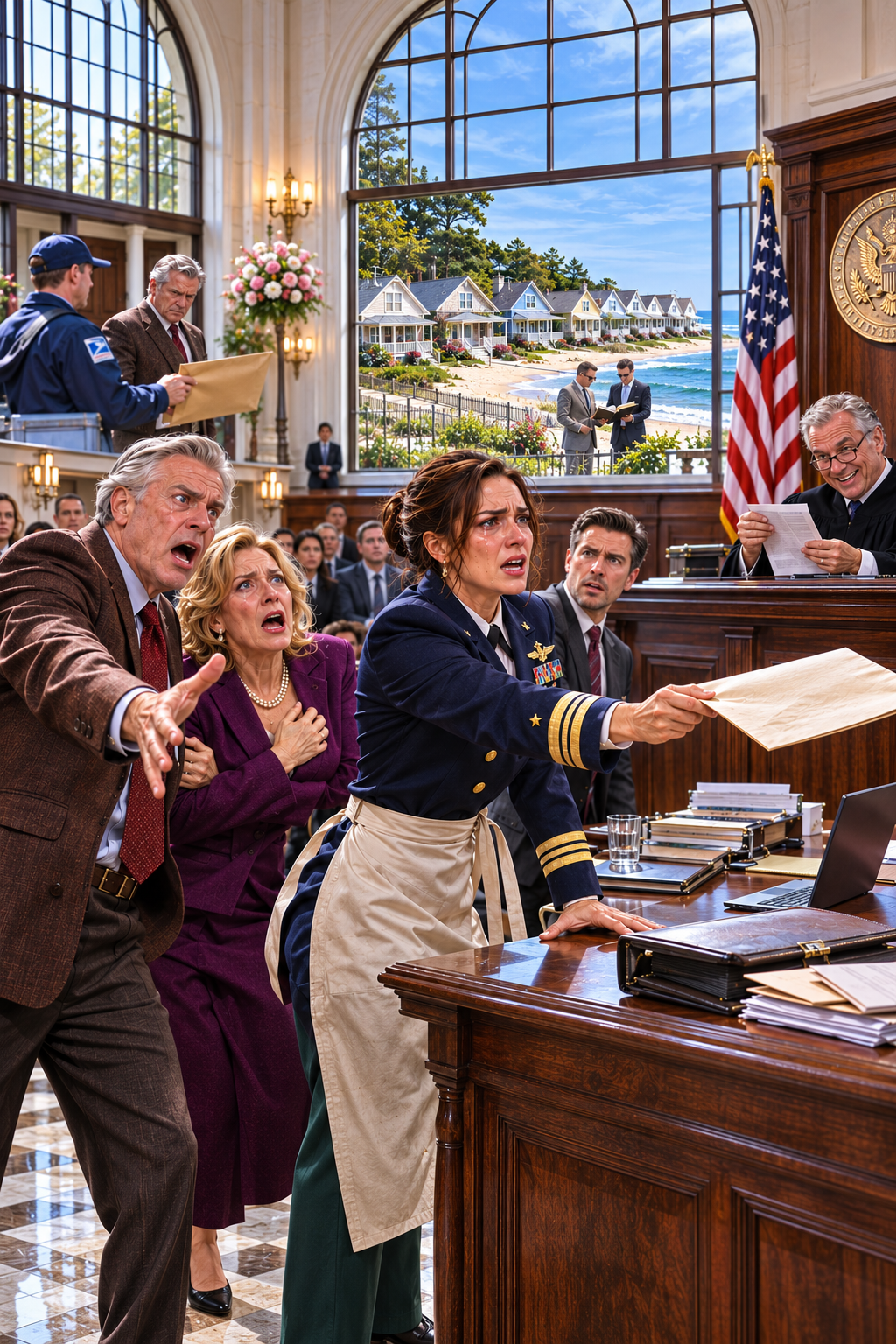
My father stood in court and declared, “There was no will.” Mom added, “Claire has a stable Navy career. She doesn’t need these properties.” They were already lining up a buyer for Grandma’s seven beachfront cottages. I handed the judge an envelope containing her unsigned draft, witnesses’ statements, and a notary’s log proving she’d signed a final will. Then he unfolded the delivery record and chuckled. The certified estate documents had been accepted days before Grandma died—by my own father.
### Part 1
The first sound I remember from the courtroom was paper unfolding.
Judge Daniel Mercer pulled one page from the envelope I had handed him, adjusted his glasses, and read it twice. Then, in a room so quiet I could hear the old wall clock ticking, he gave a short, surprised chuckle.
“Well…” he said, looking directly at my parents. “This is interesting.”
My father’s face tightened. My mother stopped smiling.
Three months earlier, neither of them had looked worried at all.
My name is Claire Bennett, and I was a Navy logistics officer when I learned my grandmother, Evelyn, had died while I was returning from deployment. Pastor Thomas called me as I stood outside Naval Air Station Key West with my sea bag beside my boots and jet fuel still hanging in the humid air.
“She went peacefully, Claire,” he told me.
That should have comforted me. Instead, all I could think was, I wasn’t there.
Grandma Evelyn had been more of a parent to me than my actual parents, Richard and Susan. When they forgot school events, she showed up. When they treated my problems like inconvenient background noise, she sat at her kitchen table and listened until I had nothing left to say.
Her world was a coral-colored house on the Florida Keys and seven modest vacation cottages stretching along the shoreline behind it.
She had named every one.
Pelican House. Sand Dollar. Blue Heron. Sea Glass. Turtle Cove. Coral Rest. Sunset Key.
They weren’t luxury rentals. Their porches creaked, their roofs rattled during storms, and Grandma repaired half the furniture herself. But veterans, widows, retirees, and working families returned year after year because Grandma kept the rents reasonable.
Whenever I complained about repainting shutters as a teenager, she would hand me iced tea and say, “Take care of these places, sweetheart. Someday they’ll take care of you.”
I never realized she meant it.
The morning after her death, I went to my parents’ house.
Dad had folders stacked neatly on the dining table. Mom sat beside him wearing perfect lipstick despite claiming she had been crying all night.
“We’ve handled everything,” Dad said. “Funeral arrangements, accounts, the cottages.”
“What did Grandma’s will say?”
Mom exchanged a glance with him.
“There is no will.”
I laughed because the idea was ridiculous. My grandmother labeled spice jars by expiration date.
“She told me she updated it.”
“You misunderstood her,” Mom replied.
Dad leaned back. “The properties belong to us now. You have your Navy career. You don’t need seven cottages.”
That sentence bothered me more than anything else.
Not Grandma left them to us.
Not this is what she wanted.
You don’t need them.
I drove to Grandma’s house afterward. The moment I opened the door, lavender soap and lemon cleaner hit me so strongly that my knees almost gave out.
Her coffee mug still sat upside down beside the sink. Fifty cheap souvenir magnets covered the refrigerator. I automatically straightened the crooked pelican magnet she always complained about.
My phone buzzed.
My older brother, Mason, had sent one message.
Stop causing trouble. Mom and Dad know what Grandma wanted.
I deleted it.
That afternoon, I walked among the cottages until Frank Holloway, a retired Coast Guard chief who rented Blue Heron every winter, called me over.
“Your grandmother worried about your parents selling these places,” he said. “She told me she wanted you running them.”
“Did she ever mention a will?”
Frank’s expression changed.
“She said she had finally made everything official.”
A week later, another tenant, Mrs. Rivera, approached me carrying an unmarked envelope.
“Your grandmother told me to give you this if something happened,” she whispered. “And she specifically said not to give it to your parents.”
Inside was a single handwritten sentence.
If anything happens to me, check the safe. You’ll understand.
I knew Grandma had no safe inside the house.
But she did have a safe-deposit box.
And suddenly, I understood why my parents wanted me to stop asking questions.
### Part 2
Box 428 opened with a metallic scrape that seemed painfully loud inside the bank’s private room.
Inside were three binders and one cream envelope.
The binders contained twenty years of rental records, repairs, tax receipts, tenant notes, and property documents, all organized in Grandma’s familiar blue handwriting. The envelope contained something far more important.
LAST WILL AND TESTAMENT OF EVELYN MARIE BENNETT.
My heart began hammering.
I found the section concerning the cottages and read it twice.
Grandma named me as steward of all seven properties, with instructions that they remain reasonably priced and continue serving veterans, retirees, widows, and families who could not afford the increasingly expensive resorts around the Keys.
For several seconds, I simply stared at my name.
Then I reached the final page.
No signature.
No witnesses.
No notary seal.
I sat back so hard the metal chair scraped the floor.
The document proved Grandma’s intention, but an unsigned draft was not the victory I had imagined. My parents could still argue she had changed her mind.
Yet something made no sense.
Grandma never left important work unfinished.
I contacted attorney Rachel Monroe, a sharp probate lawyer with the unnerving habit of going silent whenever she suspected someone was lying.
“This draft matters,” she told me. “But what we need is evidence that she executed a final version.”
So I started asking questions.
At Grandma’s church, six women immediately remembered her talking about “finally signing everything.” One of them even remembered who had notarized it.
Arthur Collins.
A retired local notary who lived two streets away.
His faded blue front door had a wooden sign reading WELCOME, PROBABLY, which was exactly the sort of thing Grandma would have found hilarious.
Arthur answered using a cane and recognized me before I introduced myself.
“Evelyn’s Navy granddaughter.”
My pulse jumped. “Did you notarize her will?”
He nodded.
“At her kitchen table.”
I forgot how to breathe.
“She signed it?”
“Every page that required a signature. Two neighbors witnessed it. I stamped it and entered it into my log.”
He disappeared into another room and returned carrying a thick leather book.
There it was.
Evelyn Marie Bennett.
Last Will and Testament.
Date, time, witness names, notary information.
Arthur tapped the entry.
“Your grandmother was relieved afterward. Told me she could finally stop worrying about certain people getting greedy.”
I called Rachel from my car.
After I explained everything, she went silent.
Finally she said, “Claire, your grandmother executed a valid will.”
“But the actual document is gone.”
“Yes. Which means we now have a different question.”
“Where did it go?”
“And who benefited from its disappearance?”
My father’s confident voice flashed through my head.
There is no will.
That evening, Pastor Thomas called.
“I found something Evelyn left here.”
He gave me a large envelope stored in a locked cabinet inside his office.
Inside were letters between Grandma and an attorney, years of tenant notes, and one handwritten letter addressed to me.
My dear Claire,
These cottages are not just property. People have come here when they were grieving, rebuilding, retiring, or simply trying to breathe.
You understand that better than anyone.
I have put my wishes in writing. If those words ever disappear, remember my voice.
Protect what I built.
Be careful around people who value the price of something more than its purpose.
Love always,
Grandma
I cried over that page until the ink blurred through my tears.
Then I noticed something tucked behind the letter.
A copy of a receipt.
Grandma had paid for certified estate documents to be delivered personally just days before she died.
And according to the signature line, someone in my family had accepted them.
### Part 3
The signature on the delivery receipt was difficult to read, but Rachel noticed something immediately.
“It begins with an R.”
My father’s name was Richard.
That alone proved nothing, but the pressure on my parents changed almost overnight.
Dad began appearing around the cottages with a coastal real estate agent. The first time I saw them together, the agent was photographing rooflines while Dad pointed toward the waterfront.
I walked across the gravel.
“What are you doing?”
Dad dismissed the agent before answering me.
“Exploring possibilities.”
“You mean selling them.”
“These properties are worth more together than your grandmother ever earned renting them.”
“There’s a court dispute.”
“There wouldn’t be if you stopped creating one.”
The salty breeze carried the smell of boat fuel from the marina. I watched the muscle jump beside his jaw.
“Did you receive documents for Grandma the week before she died?”
His eyes shifted for half a second.
That was all I needed to see.
“I received plenty of things for her.”
“A certified envelope?”
“Claire, stop pretending you’re some investigator.”
“Then answer me.”
He stepped closer, lowering his voice.
“You always thought Grandma loved you more than everyone else.”
That hurt because it was designed to.
Before I could respond, he added, “You walked away. You joined the Navy. We were here.”
I almost laughed.
“You visited when you needed something.”
His face went red.
“Drop the lawsuit.”
“No.”
“You’ll lose this family.”
I looked at him for several seconds.
The strangest thing was realizing that threat no longer frightened me.
“What family?”
He walked away without another word.
Mason arrived two nights later.
He slammed his truck door and marched toward me while I locked Coral Rest.
“You need to stop.”
“Why?”
“Because Mom and Dad already have a buyer.”
There it was.
The truth slipped out before he realized what he had said.
“A buyer?”
His face changed.
“Mason.”
He looked toward the water.
“How long have they had one?”
“Forget it.”
I grabbed his arm before he could walk away, then immediately released him.
“Did Dad get Grandma’s signed will?”
“I don’t know.”
“You know something.”
He shook his head.
“I know they said selling everything would solve a lot of problems.”
“What problems?”
He refused to answer.
But before leaving, he said something that followed me all the way back to Grandma’s house.
“Dad thought you’d stay overseas long enough for everything to be finished.”
Two days before court, Rachel gathered affidavits from Arthur, both witnesses, Pastor Thomas, and three longtime tenants. She included Grandma’s draft, attorney correspondence, notary records, and the certified delivery receipt.
Then she placed one additional page into the envelope.
“What’s that?”
“A declaration from the delivery company.”
I read it.
The driver remembered delivering the estate envelope to Grandma’s home because a man identifying himself as her son-in-law had accepted it and signed.
My father.
I sat completely still.
Rachel watched me.
“If your father accepted a document package connected to the final will, and then later told probate court no will existed, the judge is going to have questions.”
I wanted to feel triumphant.
Instead, I felt sick.
Dad had spent weeks looking me in the eye.
Mom had watched him do it.
Mason might have known.
That night I slept in Grandma’s bedroom beneath the slow ceiling fan, listening to wind chimes outside.
I finally understood something Grandma had tried to teach me for years.
Protecting yourself from strangers is easy.
The dangerous betrayals are the ones committed by people who already know where you keep your heart.
### Part 4
My parents arrived at court dressed as if appearance could settle the case for them.
Dad wore a gray suit. Mom carried an expensive handbag and gave me the same strained smile she used whenever strangers were watching.
Mason sat in the back row and avoided my eyes.
When Judge Mercer called the case, my father stood first.
“There was no will,” he said. “My wife inherited these properties through her mother. Our daughter is emotionally attached to the cottages and refuses to accept reality.”
Mom added, “Claire has a stable Navy career. She doesn’t need these properties.”
There it was again.
Need.
As though Grandma’s wishes were a prize awarded to whichever relative had the emptiest bank account.
Rachel said very little at first.
Then the judge asked for our evidence.
I carried the envelope forward myself.
He opened it.
The courtroom became silent.
He read Grandma’s draft. Arthur’s notarization log. The witnesses’ affidavits. Pastor Thomas’s statement. The correspondence with her attorney.
Then he reached the delivery declaration.
His eyebrows rose.
He reread it.
And laughed once under his breath.
“Well…” Judge Mercer said, “this is interesting.”
My mother went completely still.
Dad stared straight ahead.
The judge held up the page.
“Mr. Bennett, a sworn declaration states that you personally accepted a certified package associated with the decedent’s estate documents several days before her death.”
Dad swallowed.
“I accepted mail sometimes.”
“You subsequently represented that no will existed.”
“I never saw one.”
Judge Mercer looked unimpressed.
“Convenient.”
Mom suddenly whispered something to Dad.
He ignored her.
The judge continued reviewing the evidence before turning toward me.
“Lieutenant Bennett, what are you asking this court to do?”
I could have asked for revenge.
Instead, I remembered Grandma’s kitchen, the chipped countertops, the smell of coffee, and her handwritten notes beside tenants who needed help.
“I want the cottages protected,” I said. “I want them managed the way she intended. I don’t want them sold before the truth is established.”
The judge nodded.
He immediately froze all sales, transfers, and financing connected to the seven properties. Temporary management authority went to me while the court ordered further investigation into the missing executed will.
My father finally lost his calm.
“This is ridiculous.”
Judge Mercer looked directly at him.
“No, Mr. Bennett. What is troubling is that an elderly woman carefully documented nearly every part of her estate, executed a will before witnesses, arranged delivery of estate paperwork, and somehow the single document unfavorable to you disappeared.”
Dad said nothing after that.
The final resolution came months later.
Using witness testimony, notary records, attorney files, delivery documentation, and Grandma’s surviving draft, the court accepted the contents of her lost will. The seven cottages were placed under a trust exactly as she had intended, with me serving as trustee and manager.
My parents received other portions of her estate.
They did not receive the cottages.
Mom called afterward.
“We should put this behind us,” she said. “Families forgive.”
“No,” I replied.
She went silent.
“I can stop being angry someday. That doesn’t mean I have to trust you again.”
Dad never apologized.
Mason eventually admitted he had known they planned to sell everything quickly, though he claimed he never knew where the will had gone. I believed part of that.
It didn’t change my decision.
I stopped chasing a family that only wanted me when silence benefited them.
A year later, I stood outside Pelican House repainting the shutters while a retired Navy couple unloaded suitcases nearby. The afternoon smelled like salt, sunscreen, and fresh paint.
I could almost hear Grandma behind me.
Take care of these places, sweetheart.
I smiled and dragged the brush along the weathered wood.
“I am, Grandma.”
The cottages never made me rich.
They gave me something better.
A life built around people who understood that inheritance is not simply what someone leaves you.
Sometimes it is what they trusted you not to destroy.
THE END!
Disclaimer: Our stories are inspired by real-life events but are carefully rewritten for entertainment. Any resemblance to actual people or situations is purely coincidental.


