
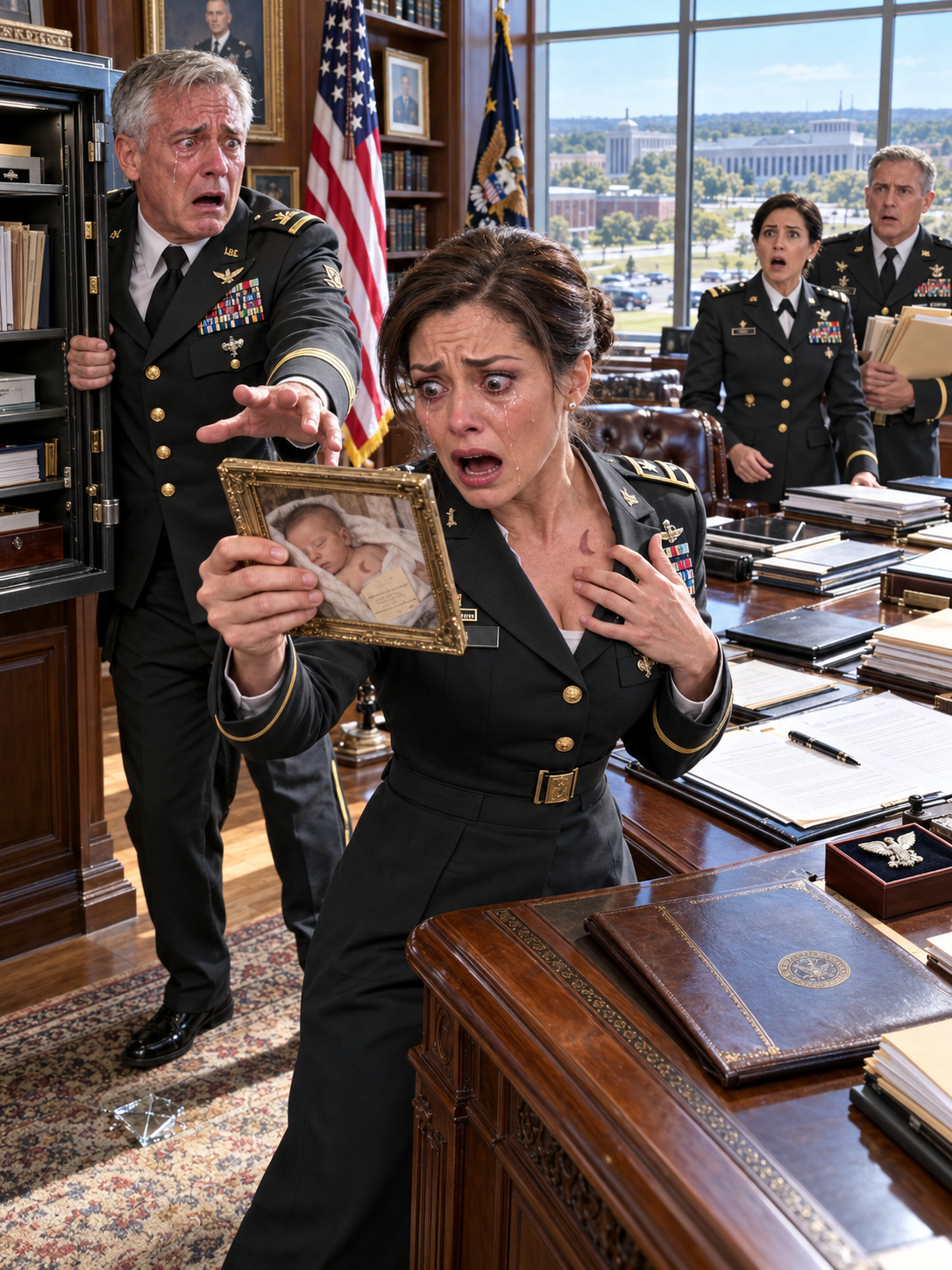
I thought the hardest thing I would do at Fort Belvoir was end a decorated colonel’s thirty-year career over a multimillion-dollar theft. I was wrong. Hours after I signed the order relieving Colonel Caleb Rowan of command, a brass frame slipped from his private safe and shattered my certainty. The baby in the photograph had my birth date, my crescent-shaped birthmark, and a name I had never heard. By sunrise, I was no longer sure whether I had exposed a criminal—or destroyed the only family I had ever had.
### Part 1
When I signed the order relieving Colonel Caleb Rowan of command, my hand did not shake. Eleven years as an investigative auditor for the Department of Defense had trained that out of me, along with the instinct to soften bad news because somebody had medals on his chest. The conference room smelled faintly of burnt coffee and dry-erase marker, rain streaked the glass wall behind him, and the red tabs in my evidence binder marked more than $4.8 million in missing equipment. Every suspicious requisition carried Rowan’s authorization code.
I had grown up believing numbers were safer than people. At Ridgeway Children’s Home in Virginia, adults changed shifts, social workers changed cases, and foster placements changed their minds, but numbers stayed where you put them: a birthday on a form, a bed assignment, a school ID, a balance in a savings account. By thirty-four, I had built an entire career around that certainty. If a ledger was wrong, there was a reason; if money disappeared, someone had taken it; if a signature appeared on a fraudulent document, the owner of that signature had explaining to do.
Fort Belvoir’s logistics division had been bleeding high-value vehicle components, communications hardware, and specialized field equipment for at least eighteen months. The thefts were elegant enough to survive routine inspection: damaged goods were marked destroyed, shipment weights were altered by a few hundred pounds, and replacement orders were approved before anyone asked where the originals had gone. I spent six days rebuilding manifests from archived gate scans and fuel receipts, and the pattern tightened until one name sat at the center. Colonel Caleb Rowan, thirty years in uniform, combat decorations, spotless evaluations, and personal approval on nearly every compromised movement.
He entered the inquiry room exactly on time, broad-shouldered, silver at his temples, uniform so precise it looked pressed onto him. I expected indignation when I slid the first packet across the table, but he read each page in silence while the wall clock clicked loud enough to irritate me. “These authorizations came from your credential,” I said. He looked up and answered, “Then they are my responsibility until you prove otherwise.”
That answer sounded noble for about three seconds, then it sounded evasive. I showed him cloned shipping records, destroyed-in-transit reports, and gate releases that had moved equipment after midnight; still, he did not blame a clerk, a contractor, or his deputy. When I asked whether anyone else had access to his digital token, his eyes shifted—not toward me, but toward the mirrored glass separating us from the observation room. “Access is never as simple as the policy manual says it is,” he said, and then he refused to elaborate.
Major Evan Kessler, Rowan’s deputy, had been sitting behind that glass. He met me afterward near the vending machines, jaw tight with the exhausted expression of an officer who had spent months cleaning up somebody else’s mess. “Sir has always protected his people,” Kessler said, rubbing the bridge of his nose. “Sometimes too much. If he tells you this belongs on him, I’d believe him.” He even handed me a printed access report showing Rowan’s credential active on three disputed nights, a helpful gesture I accepted without question. It was the first time anyone had spoken against Rowan, and the comment fit the evidence so neatly that I failed to notice how carefully it had been placed.
At 1600, I returned with the administrative relief order and a legal officer from headquarters. The order removed Rowan from command, suspended his access, froze discretionary authority, and referred the case for formal court-martial review; it did not literally erase thirty years of service in one stroke, but everyone in that room knew what it meant. Rowan read the final page, signed where I indicated, and handed me the pen. “Do your duty, Ms. Bennett,” he said quietly. “Justice is useless if it bends for the person standing in front of it.”
For the first time, something in me recoiled, not because he sounded innocent but because he sounded resigned. Two military police officers escorted him to his office while I supervised the inventory, separating government property from personal effects before the locks were changed. His shelves held field manuals, unit photographs, commendation boxes, and an old ceramic mug with a chipped handle; nothing about the room felt extravagant or secretive. Behind a wood panel, however, we found a private safe that had not appeared on the property sheet.
The safe contained sealed notebooks, personal letters, old ribbons, and a green felt lockbox. One MP lifted the box to check beneath it, and a tarnished brass frame slid free, struck the floor, and spun once before stopping at my boot. I bent to pick it up, already reaching for the inventory tag, then saw the photograph behind the scratched glass. A baby wrapped in a pale yellow blanket smiled at someone outside the frame, one tiny shoulder exposed.
Just below the left collarbone was a raised crescent-shaped mark. My thumb went instinctively to the same place beneath my blouse, to the mark I had seen in every mirror since childhood. Beneath the frame was a faded hospital band stamped with a date I knew as well as my own name: October 7, 1992. On the back of the photograph, in Rowan’s precise handwriting, were six words: “Elena Mae. I will find you.”
I had never heard the name Elena Mae in my life. Yet as the rain tapped against the office windows and the MPs waited for me to finish logging the item, the room seemed to tilt around a fact I could not explain. For the first time in my career, the numbers did not feel like evidence. They felt like a warning.
### Part 2
I logged the brass frame as personal property, then requested a temporary evidence hold because the hospital band might be relevant to identity fraud connected to the investigation. That explanation was technically defensible and emotionally dishonest, which made me hate it. I carried the frame and the green lockbox down to the archive room, where fluorescent lights hummed over rows of gray cabinets and the air smelled like paper dust and cold metal. At 9:17 p.m., I opened Rowan’s oldest notebook.
The first pages were not about logistics at all. They were lists of counties, social-service offices, adoption attorneys, private investigators, and case numbers written across more than three decades, with dates stretching back to 1993. A name appeared again and again: Elena Mae Rowan, infant daughter, missing from lawful custody while father deployed overseas. Beside some entries he had written one word—closed, sealed, transferred, denied—until the handwriting became harder and more angular with each passing year.
I told myself that birthmarks were not fingerprints and birthdays were not proof. Virginia had thousands of babies born on October 7, 1992, and I had spent my childhood in a system where paperwork was often incomplete or rewritten after transfers. Then I found a photocopy of a state intake page with most identifying details blacked out. At the bottom was a case number beginning with VJ-4427, the same number printed on the corner of every foster record I still kept in a folder at home.
My stomach tightened so sharply I had to sit down. I pulled up my encrypted personnel file and found the scanned intake document from Ridgeway, a page I had seen dozens of times without understanding what was missing from it. The original-name field was blank, but the case number matched, the birth date matched, and an old medical note described “crescent nevus, left upper chest.” I stared at the screen until the words blurred, then forced myself to do the only thing I knew how to do when my life stopped making sense: I audited it.
I rebuilt the logistics case from zero. Instead of starting with shipment manifests, I pulled raw authentication logs from the backend security server, the level of data most auditors ignored because it was ugly, repetitive, and usually useless. Rowan’s credential had approved the fraudulent shipments, yes, but the physical security token associated with those approvals had not been pinging from his office. It had been mirrored through a maintenance proxy inside the logistics operations annex.
The annex belonged administratively to Major Evan Kessler. I checked Kessler’s access and found nothing obvious at first, which was exactly what a competent thief would want me to find. Then I compared proxy activity with building climate-control records, badge swipes, and network maintenance tickets. On eleven nights when Rowan’s credential authorized phantom shipments, Kessler’s office registered occupancy after 2300 even though his official time sheets showed him off base.
That was not enough to clear Rowan, but it was enough to make my pulse hammer. I dug deeper and found deleted maintenance requests restored from backup: repeated complaints from Rowan’s office about unexplained token resets, ghost login alerts, and discrepancies in warehouse destruction certificates. The complaints had been closed by Kessler as “resolved user error.” Three weeks before my arrival, Rowan had also submitted a sealed request for an outside audit through the Inspector General channel.
I sat back so fast my chair struck a filing cabinet. Rowan had not been waiting to be caught; he had been trying to bring someone in. If that were true, his silence in the inquiry room made less sense, not more. He could have shown me the complaint, named Kessler, and saved himself from removal. Then I noticed the routing history: the sealed request had been opened twice by an administrative relay account before it reached Washington, both times from the annex network. Somebody inside the base had known an outside auditor was coming before my travel orders were even issued.
At 2:40 a.m., I found the reason hidden in a scanned memo attached to the IG request. Rowan wrote that prior internal inquiries had been compromised within hours, that warehouse staff were being pressured to alter statements, and that he suspected someone with access to senior administrative traffic. He requested an auditor “unknown to local command relationships” and warned that any premature accusation could cause the theft ring to wipe its digital trail. I had been sent because of that request, and nobody had told me.
A new thought hit me harder than the family records. Rowan had looked at me across that conference table and chosen not to defend himself because he did not know whether I was part of the compromised chain. His glance toward the mirrored glass had not been guilt. It had been fear of whoever was listening on the other side.
I checked the live system map one more time before leaving. At 3:12 a.m., a privileged administrator account connected to the annex proxy and attempted to purge old token-cloning logs. The account belonged to Kessler, and the login originated from a terminal inside his locked office. Kessler had told me he was home for the night.
I closed the laptop and looked at the brass frame beside me. Somewhere above my head, the man I had ruined was sleeping under guard, and the man who might have framed him had just realized the past was still alive on the server. I had two investigations now, and one of them could destroy my career if I handled it wrong.
### Part 3
By sunrise, I decided not to confront Kessler. A frightened thief destroys evidence; a confident thief keeps moving, and I needed him to keep moving long enough for me to see where the missing equipment went. I called my supervisor in Washington, gave her only the cyber findings, and requested authority for a covert preservation order. She approved it with one warning: “If Rowan is still dirty, this becomes your mistake as well as his.”
I spent the morning in Warehouse Four wearing a reflective vest over my uniform and pretending the audit was winding down. Forklifts beeped between steel racks, diesel fumes drifted in each time the loading doors opened, and clerks avoided my eyes because everyone knew I had just removed their commander. A nineteen-year-old civilian inventory assistant named Tessa Cole finally cornered me beside a pallet of radios. “Colonel Rowan wasn’t stealing,” she whispered. “He was checking seal numbers himself because somebody kept changing them after midnight.”
Tessa gave me the name of a civilian hauler, Grayline Transit, whose drivers collected loads marked for disposal. That looked like the break I needed until I learned Grayline’s owner had been Rowan’s friend for twenty years, which seemed to drag the evidence right back toward him. I drove to the company yard expecting to find stolen military hardware stacked behind a fence. Instead, I found three empty trailers, a furious owner, and copies of emails showing Kessler’s office repeatedly rerouting Grayline trucks after they left the depot.
Every answer produced another contradiction. Rowan’s name sat on the approvals, Kessler’s office controlled the reroutes, and Grayline had complained twice about sealed manifests being swapped after pickup. When I checked surveillance retention, the camera footage for those exact nights had been deleted under a routine schedule change authorized by a systems administrator named Paul Danner. Danner worked in the annex and reported directly to Kessler. One surviving thumbnail from a camera backup showed a truck entering after midnight with its civilian plate taped over, while a uniformed figure stood beside the gate kiosk holding a clipboard. The image was too grainy for a face, but the height and build were close enough to Kessler to make my skin prickle.
At noon, I asked for permission to interview Rowan at the transient officers’ quarters. He was sitting alone in a small common room with a paper cup of coffee, no insignia on his shoulders, looking older than he had the day before. I placed the brass frame on the table between us and watched his entire body go still. “Where did you get that?” he asked, and for the first time his voice lost its military calm.
“Your safe.” I did not show him my birthmark or tell him what I had found in the state files; I needed facts before emotion contaminated the conversation. I asked who Elena Mae Rowan was, and he looked past me toward the rain-dark window before saying, “My daughter. She was eight months old when I left on an overseas deployment. By the time I came home, my sister-in-law claimed my wife had vanished, the child had been surrendered, and the records were sealed.”
He told me his wife had died shortly before his deployment after a sudden illness, leaving temporary guardianship with relatives he trusted. Months later, letters reached him saying the baby had been moved through state custody after a disputed guardianship petition; when he returned, the relatives had disappeared, the address was empty, and the court file contained documents he later believed were forged. He had spent thirty-two years hiring investigators, petitioning judges, and searching databases that never quite opened. “I stopped expecting to find her,” he said. “I never stopped looking.”
I asked why he had let me sign the relief order when he had already requested an external audit. His jaw tightened. “Because the last time I challenged a false manifest, the clerk who helped me was threatened before sunrise. Someone knew what I said in a closed office. When I saw Kessler behind that glass, I knew he wanted me to accuse him without proof.” Rowan held my gaze. “And I did not know you yet.”
The words hurt because they were reasonable. I had walked into the base convinced detachment made me incorruptible, but detachment had also made me predictable; Kessler had fed me clean-looking evidence and watched me follow it exactly where he wanted. I stood to leave, then stopped at the door. “If Elena were alive,” I asked, “what would you want from her?”
His answer came without hesitation. “Nothing she didn’t choose to give.” That was the first moment I let myself believe he might be telling the truth about more than the thefts.
That afternoon I built a controlled shipment: six crates of decommissioned communications modules tagged as damaged beyond repair, each fitted with hidden trackers and silent inventory seals. I entered the disposal order into the system using a fake approval route visible only to the annex. Within forty minutes, Kessler’s office amended the pickup time and reassigned the load to a subcontractor I had never heard of.
At 11:08 p.m., the truck rolled out of Fort Belvoir under a perfectly valid gate release bearing Rowan’s cloned credential. I watched its tracker from an unmarked vehicle with two military investigators while the truck ignored the registered disposal site and headed south toward an abandoned commercial storage complex. When the signal stopped behind Unit 18, the steel door opened from inside.
Major Evan Kessler stepped into the loading bay wearing civilian clothes. He looked at the driver, then at the crates, and smiled like a man who believed the dangerous part was already over.
### Part 4
We did not move immediately. The investigators needed the handoff, the accomplices, and proof that the crates were being incorporated into the same pipeline as the previous thefts, so we watched through long-lens cameras from across the service road. Two men cut the military seals, scanned the serial numbers, and rolled the crates beside pallets of vehicle optics and encrypted radios that matched items listed as destroyed months earlier. When Kessler opened a laptop and connected a hardware key, our cyber team captured the same cloned certificate used against Rowan.
The raid began at 11:26 p.m. Floodlights snapped on, military police blocked both exits, and federal agents entered from the rear while Kessler froze beside the open crates. He ran exactly three steps before an investigator ordered him to the ground; there was no dramatic fight, only the sudden collapse of a man who had spent eighteen months believing paperwork made him untouchable. Paul Danner was arrested in the office above the bay, along with two civilian contractors and a procurement specialist from another installation.
I expected Kessler to deny everything. Instead, once he realized the warehouse had been recorded, his face hardened into something almost resentful. “Rowan made it easy,” he said while an agent secured his wrists. “He signs too much, trusts too much, and thinks taking responsibility is the same thing as leadership.”
I told him he had cloned a senior officer’s credentials and stolen millions in military property. He gave a short, bitter laugh. “And you fired him for me. That was the best part.” The sentence landed harder than I wanted it to because it was true; Kessler had not defeated Rowan with technology alone. He had used my certainty as a weapon.
Before dawn, I sent an emergency suspension notice stopping Rowan’s court-martial referral and attached the forensic evidence linking Kessler to the proxy network. By 0600, headquarters authorized Rowan’s immediate release from restriction and opened a formal exoneration review. I should have felt relief, but the family file still sat in my briefcase like a second verdict waiting to be read. Clearing Rowan as a commander did not prove he was my father.
I requested access to the old Virginia custody archive under identity-fraud authority and drove to Richmond after three hours of sleep. A records officer led me into a basement room where microfilm cabinets lined the wall and an ancient scanner clicked like an insect. Buried in a sealed transfer packet was the document Rowan had spent decades trying to reach: infant Elena Mae Rowan had been moved under emergency protective custody, then assigned a new administrative identity after a disputed guardianship case collapsed.
The receiving case number was VJ-4427. Attached to the intake note was a description of the same crescent-shaped mark on the left upper chest and a photocopy of a hospital band bearing October 7, 1992. A later placement summary listed the child under the name Nora Bennett, the name I still carried because a county social worker had given it to me before I was old enough to remember anything else. In the margin, a clerk had scribbled “father contesting placement—location overseas,” then crossed it out in blue ink. That one careless note told me Rowan had not abandoned me; someone had known he was trying to come back.
I sat alone in that basement with my hands flat on the table. I had spent my life thinking “Bennett” was the closest thing I had to a family history, only to learn it had been typed into a box by someone trying to make a file easier to process. The truth was stranger and crueler: I had a father who had been alive the entire time, and twenty-four hours earlier I had treated him as a thief.
I returned to Fort Belvoir near sunset and found Rowan sitting on the wooden steps outside the transient quarters, watching mist gather over the parade field. I carried his restored access badge in one hand and the brass frame in the other. When he saw the frame, he stood slowly, as if sudden movement might make me disappear.
“The theft case is clear,” I said. “Kessler used your credentials. You’re being formally reinstated while the exoneration is processed.” Rowan nodded once, but his eyes stayed on the photograph. I unbuttoned the top clasp of my uniform shirt just enough to pull the fabric aside and show the crescent mark beneath my left collarbone.
His face changed so completely that I almost looked away. The commander vanished first, then the accused officer, until there was only an exhausted man staring at something he had imagined for thirty-two years. “Nora,” he whispered, and his hands began to tremble.
“My foster case was VJ-4427,” I said. “The sealed transfer file says I entered the system as Elena Mae Rowan.” I swallowed hard before adding the words that frightened me more than any investigation ever had. “I think I’m your daughter.”
He did not step forward until I nodded. Then he hugged me carefully, almost formally, as if I were something both precious and breakable, and I felt his breath hitch against my hair. We agreed that night to confirm everything with a legal DNA test, because after a lifetime built on evidence, neither of us wanted our first act as family to be pretending certainty where proof was available.
Three days later, the laboratory report arrived in a sealed envelope. I read the probability of paternity twice before I could make myself breathe: 99.99 percent. The man I had fired was my father, and for once the truth in front of me was bigger than anything a ledger could hold.
### Part 5
The Inspector General’s investigation moved faster once Kessler’s warehouse was in custody. Agents recovered more than six million dollars in stolen equipment, traced payments through shell companies, and tied the theft ring to three contracting firms and two insiders beyond Fort Belvoir. Kessler eventually entered a guilty plea on multiple federal counts rather than face the full stack of evidence at trial; I attended the proceeding, listened to him describe the scheme in a flat voice, and felt no need to forgive him for using Rowan’s honor and my judgment against us.
Colonel Caleb Rowan’s record was formally cleared. His command authority, retirement eligibility, decorations, and benefits were restored, and headquarters issued a written acknowledgment that the evidence against him had been deliberately manufactured through credential theft. He read the letter once, folded it, and put it in a drawer. “Paper can give a reputation back,” he told me, “but it can’t return the day you lost.”
That sentence stayed with me because neither of us tried to pretend the reunion erased thirty-four years. Our first breakfasts were awkward, full of pauses and practical questions about coffee, allergies, and whether I had always hated raisins. He showed me photographs of my mother, Leah, laughing on a dock in North Carolina and holding me under a maple tree; I showed him the few pictures Ridgeway had kept from school events. He also gave me a sealed box of letters he had written to “Elena” every year on my birthday and never mailed because he had nowhere to send them. I read only three at first, then put the box in my closet until I was ready; some nights we talked for hours, and some nights I went home because being someone’s daughter was more exhausting than I had expected.
The hardest conversation came when I apologized for relieving him. I had rehearsed it like testimony, complete with facts, chronology, and a clean statement of failure, but he stopped me halfway through. “You made the best decision you could with evidence that had been built to deceive you,” he said. “Your mistake wasn’t doing your job. Your mistake was thinking people who look guilty stop deserving questions.”
I did not let myself off that easily. I reviewed every major case I had handled in the previous five years, looking for places where procedure had become a substitute for curiosity. Nothing comparable surfaced, but I changed how I worked: I began requiring source-level authentication checks before recommending career-ending action and started training younger auditors to treat digital signatures as claims, not truth. My reputation for precision survived; what changed was the arrogance hiding inside it.
Rowan retired six months later by choice. He said he had spent enough years letting the Army decide where he slept, and he bought a small house near Fredericksburg with a porch wide enough for two rocking chairs he insisted he did not need. I visited on Sundays when work allowed, and he learned not to ask whether I was coming every week. The first time I missed two Sundays because of travel, he sent one text—“Coffee will keep”—and nothing more; that restraint meant more to me than any grand speech could have. I learned that family could be offered without becoming a debt.
In the spring, I received orders to report to a promotion ceremony at Fort Belvoir. The auditorium smelled of floor polish and fresh flowers, dress uniforms filled the rows, and an American flag hung behind the stage under bright white lights. When the commanding general announced my promotion to major, I felt the old instinct to stand perfectly still and feel nothing.
Then the general asked me to choose who would pin on my oak leaves. I had already submitted the name weeks earlier, but hearing it called across the hall still tightened my throat. “Colonel Caleb Rowan, United States Army, retired,” the announcer said, and my father stepped onto the stage in full dress uniform with every restored ribbon in place.
His hands were steady when he removed the old insignia and fixed the gold oak leaves to my shoulders. He leaned close enough that only I could hear him say, “I knew I’d find you.” I laughed once, embarrassingly close to tears, and answered, “You took the long route.”
The audience applauded, but the moment that mattered came afterward in the quiet hallway. He handed me the brass frame, newly repaired, with the cracked glass replaced but the tarnish left untouched. On the back, beneath his old handwriting, he had added a second line: “Found October 2026.”
I kept it on my desk after that. Not because I needed a reminder that mistakes can be corrected—some can’t—but because it reminded me how close I came to letting a perfect paper trail become a perfect lie. Kessler had counted on my certainty, Rowan had survived because he refused to sacrifice innocent people to save himself, and I had learned that evidence only becomes truth when someone is brave enough to keep asking what does not fit.
For most of my life, I thought safety meant needing no one. I had built a career, a home, and an identity out of that belief, and I was proud of every piece of it. I still was.
But on Sunday mornings, when I pulled into my father’s driveway and saw him waiting on the porch with two cups of coffee, I understood something the child at Ridgeway never had the chance to learn. Being independent was not the same as being alone, and finding family did not erase the life I had built without it. It simply gave that life one more place to come home to.
THE END!
Disclaimer: Our stories are inspired by real-life events but are carefully rewritten for entertainment. Any resemblance to actual people or situations is purely coincidental.


