
My Sister Died Alone While I Called—At Her Funeral, Her Letter Exposed the Truth
I called my parents 14 times while doctors fought to save my 19-year-old sister. They never answered. At four in the morning, a surgeon said Lily was dead, and I collapsed against the wall clutching her backpack. Inside, I found four handwritten pages and one instruction: “If they act innocent, read this out loud.” A week later, at Lily’s funeral, my mother prepared to praise our perfect family. I opened my purse, unfolded her letter, and walked toward the microphone.
### Part 1: Fourteen Unanswered Calls Left Me Alone With My Dying Sister
At 1:47 in the morning, my younger sister, Lily, was curled on the kitchen floor of my apartment with both arms wrapped around her stomach. I had been asleep when I heard something fall, followed by a weak knock against my bedroom door. When I found her, her face was gray beneath the warm kitchen light, sweat had soaked the collar of her old college T-shirt, and there were tiny half-moon marks in her palms where her fingernails had dug into the skin. “Maya,” she whispered, “something is really wrong.” I didn’t call a rideshare or wait to see whether the pain passed. I pulled on jeans, grabbed my keys, and helped her into my car. Every pothole made her gasp. Every red light felt personal. By the time we reached the emergency entrance, she could barely straighten her legs.
The hospital smelled like disinfectant, burnt coffee, and that strange cold air hospitals always have after midnight. A television mounted over the waiting room was showing an infomercial nobody watched. Somewhere behind a set of swinging doors, a baby cried. A nurse rushed Lily away while I stood at the registration desk answering questions about her birthday, insurance, allergies, and emergency contacts. My hands were shaking so badly I typed our mother’s number incorrectly twice. Once Lily disappeared down the hallway, I called Mom. No answer. I called Dad. Voicemail. I called them again, then tried a video call, then sent a message to our family group chat: “Call me now.” Five minutes passed. Then ten. Nothing.
A young doctor eventually came out and asked whether I was Lily’s sister. His expression told me not to expect good news. He explained that they strongly suspected her appendix had ruptured and infection was spreading through her body. Surgery needed to happen immediately. “Are her parents coming?” he asked. I looked at my phone showing six unanswered calls and said, “They’re on their way.” It was the last lie I ever told to protect my parents. They let me see Lily for less than two minutes before taking her upstairs. Her dark hair stuck to her forehead. A thin oxygen tube rested beneath her nose, and the monitor beside her made steady electronic chirps that seemed much too calm for what was happening. She reached for my wrist. “Did they answer?” she whispered. I swallowed. “No. But I’m here.” She stared at me for several seconds, almost as if my answer confirmed something she already knew. Then she said, “My backpack. Side pocket.” Before I could ask why, the nurse told me they needed to go.
I sat outside surgery calling until my call history looked ridiculous. Eighth call. Tenth. Twelfth. Fourteenth. Finally I left a voicemail. “Mom, Dad, this isn’t drama. Lily is in surgery. Call me now.” My voice sounded flat and unfamiliar. Around four in the morning, the surgeon walked toward me with tired eyes above his mask. I stood before he said anything. He explained that Lily’s appendix had ruptured before we arrived, the infection had progressed rapidly, and her body had not responded the way they had hoped. They had tried everything. I remember placing one hand against the wall because the floor seemed to tilt. I remember a janitor quietly steering his mop around my shoes. I remember realizing the vending machine had run out of the sports drink Lily always bought. I remember everything except the exact moment the doctor said my sister was dead.
Her backpack was still beside my chair. Inside the side pocket, beneath a charger and a crumpled receipt, was a folded envelope with my name written across the front. “For Maya.” There were four pages inside, written in Lily’s neat handwriting. I read the first paragraph, stopped, and pressed the pages against my chest because I suddenly couldn’t breathe. She wrote that she was tired of carrying secrets for people who cared more about appearing happy than actually being decent. She wrote about Mom. She wrote about Dad. And near the bottom of the final page, pressed so hard into the paper that the pen had almost torn through it, Lily had written one sentence larger than everything else.
“If they act innocent, read this out loud.”
At 7:06 that morning, my mother finally called.
### Part 2: My Parents Built Their Perfect Story While Lily Left Evidence
I answered without saying hello. Wind and waves hissed through the phone before my mother’s bright voice said, “Maya? Honey, I saw all your calls. We were down by the coast and reception was terrible. What happened?” She used the same soft voice she used when greeting people after church, polished and concerned without ever sounding truly afraid. “Lily died,” I said. Silence lasted maybe two seconds. Then came a scream. My father took the phone almost immediately and started asking questions as if we were reviewing a damaged insurance claim. Which hospital? What happened? Who authorized surgery? Had I contacted a funeral home? When could they release her? I listened until he paused, then asked, “Why were you at the coast?” There was a small delay before he said, “Your mother and I needed a night away.”
That sentence changed something inside me. Our parents had spent our entire childhood presenting themselves as the kind of people who would abandon anything for family. Our home in a quiet Houston suburb had matching porch furniture, family portraits in the hallway, seasonal wreaths, and enough smiling photographs online to convince strangers we never argued. Dad, Daniel, owned a small construction consulting company. Mom, Meredith, organized charity drives and church dinners. Lily had always been the cheerful one between them, the daughter who cracked jokes whenever Dad went silent for days and distracted Mom whenever she started criticizing everyone in the room. I had escaped to nursing school at eighteen. Lily had been thirteen. For years, I told myself she was fine because she always sounded fine. Reading her letter in that hospital taught me how badly I had misunderstood her.
The next several days became a blur of paperwork, flower arrangements, casseroles, phone calls, and people saying, “She was such a light.” My parents moved quickly to control the story. Lily’s death became a “sudden medical tragedy.” Mom repeated that phrase so often I started hearing it in my sleep. Nobody mentioned fourteen unanswered calls. Nobody mentioned that Lily had asked for them before surgery. Nobody mentioned that when their youngest daughter was dying, they had been drinking wine at a rented beach house. I stayed quiet because I wanted to understand everything Lily had written before I decided what to do with it.
Her letter described the final six months of her life at home. Mom had become obsessed with photographs, appearances, and keeping anyone from noticing tension in the marriage. Dad spent more nights away, claimed business dinners, and dismissed Lily whenever she asked questions. Then she mentioned a man named Grant Mercer, Dad’s business partner and one of the church’s biggest donors. I had known Grant most of my life. He was the man who shook everyone’s hand with both of his, brought expensive bottles of wine to holiday dinners, and always called Mom “Meredith, sweetheart” in a way I had once thought was harmless. Lily wrote that she had seen them kissing near the pantry late one evening. Weeks later she heard them arguing in the garage. Grant had told Mom that if Dad ever exposed them publicly, he would ruin their business and embarrass the entire family.
The part that hurt worse came afterward. Lily had told Dad. According to her letter, she expected anger, maybe confrontation, maybe finally an explanation for why home had become so tense. Instead, Dad looked at her and said, “Stay out of grown people’s mess.” He already knew. He had known for months and had chosen silence because Grant’s money was tied to the company, church projects, and several investments. Lily wrote, “They made me feel like knowing the truth was the bad thing, not what they were doing.” I read that sentence so many times the paper became soft beneath my thumb.
I showed the letter to my friend Renee, who worked as a paralegal for a probate attorney. We sat in a small coffee shop two days before the funeral, the windows fogged from rain outside. Renee read all four pages twice. “This doesn’t sound impulsive,” she said. “She dated things. She described conversations. She named people.” I stared at Lily’s handwriting. “So what is it?” Renee slid the pages back toward me. “It’s your sister making sure nobody rewrites her life after she’s gone.”
That night Mom called and told me she had written a short family statement to read at the funeral. “We need everyone focused on Lily,” she said. “Not rumors. Not confusion. Not private family matters.”
I looked at the envelope beside me and finally understood why Lily had told me to read it aloud.
Mom thought she was planning Lily’s funeral.
Lily had already planned the truth.
### Part 3: I Read Lily’s Letter Before Everyone My Parents Had Fooled
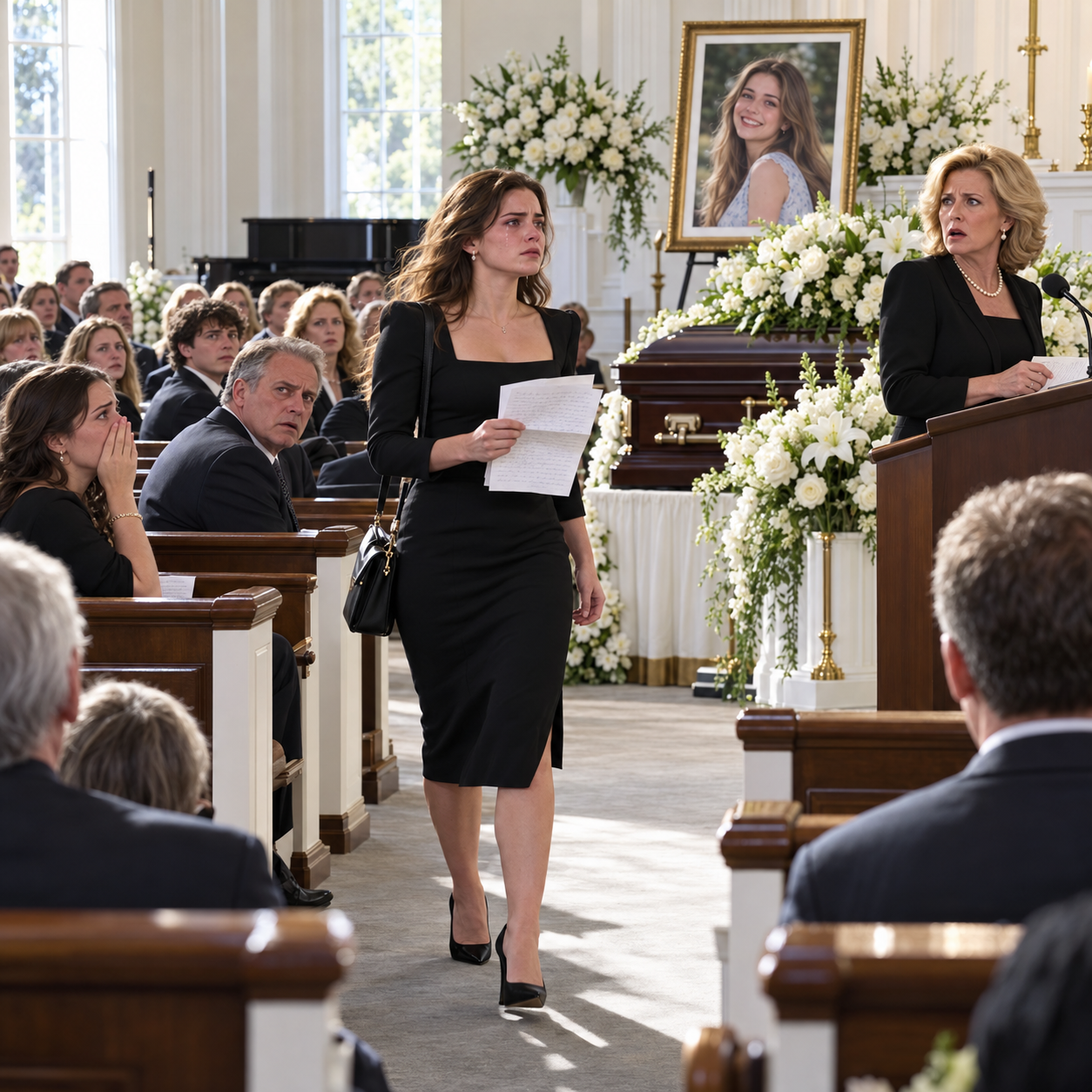
The church was full by ten Saturday morning. Gray dresses, dark suits, whispering relatives, the smell of lilies mixed with perfume and coffee drifting from the fellowship hall. At the front stood a large photograph from Lily’s high school graduation. She was laughing in it, not posing, which was why I had chosen it. Mom wanted a more formal photograph. For once, she didn’t get what she wanted. I sat between my parents in the front pew with Lily’s folded letter hidden inside my purse. Mom kept dabbing her eyes, but I noticed she also kept looking over her shoulder to see who had come. Dad stared straight ahead with his jaw clenched. Grant Mercer sat three rows behind us beside his wife, Elaine.
The pastor spoke about Lily’s kindness, her humor, and the way she had volunteered with younger kids during summer programs. I almost managed to forget what I intended to do until he invited family members to share memories. Mom placed both hands on the pew as if preparing to stand. I stood first. “Maya,” she whispered sharply. I ignored her and walked toward the microphone. My legs felt strangely steady. I looked at Lily’s photograph, then at the rows of people who believed they knew our family. “I didn’t prepare a speech,” I said. “Lily prepared something instead.” Behind me, I heard my father shift in his seat.
I unfolded the letter. The first paragraphs were about Lily herself: how tired she was of mediating arguments, how often she felt responsible for keeping peace, how strange it was to live in a house where everyone knew something was wrong but nobody was permitted to say it. People listened quietly. Then I reached the part about Mom. “Maya,” my mother said, louder this time. “Stop.” I continued. Lily described seeing Meredith and Grant together, the garage argument, Dad admitting he knew, and the warning to stay out of adult problems. The room seemed to shrink with every sentence. When I finally read, “Mom thinks nobody sees what she’s doing with Grant Mercer, but I saw enough, and Dad knows enough,” someone gasped behind me.
Grant’s wife stood so abruptly her purse fell to the floor. I looked directly at him before reading his name again. Grant’s face had gone colorless. Mom rose from the front pew. “That is a lie!” she shouted. Several people turned toward her. Dad came toward the pulpit and reached for my arm. I stepped back. “Don’t touch me.” The pastor moved uncertainly between us, but I kept reading. Lily’s final paragraphs weren’t about revenge. They were worse for my parents because they were painfully calm. “I’m tired of being the wall holding up everybody else’s house,” she had written. “If something happens to me, don’t let them make me into another pretty picture and pretend we were perfect.”
Elaine Mercer walked into the aisle and stared at her husband. “Tell me she’s lying.” Grant opened his mouth but nothing came out. Elaine asked again, louder. This time Mom shouted, “This is not the place!” Elaine turned toward her. “Apparently it was the place when you were sitting beside me every Sunday.” The church erupted into overlapping whispers. Dad hissed at me that I was destroying Lily’s funeral. I looked straight at him. “No. You destroyed her trust while she was alive. I’m just refusing to bury that too.”
Renee had come prepared. After I finished reading, I gave copies of the letter to the pastor, Elaine, a member of the church board, and Renee. I kept the original. Mom cornered me outside near the stone walkway while people clustered in the parking lot pretending not to stare. Her mascara had run beneath one eye. “You humiliated me at my daughter’s funeral.” I felt strangely calm. “You humiliated yourself long before today.” Dad came up behind her, face red. “There are things you don’t understand.” “I understand that I called fourteen times,” I said. “I understand Lily asked for you. And I understand you both trained her to believe your secrets mattered more than her pain.”
He flinched. It was the first honest reaction I saw from him all week.
Then Elaine came through the church doors holding her copy of Lily’s letter. She walked directly toward Dad instead of Grant. “What exactly were you three protecting?” she asked.
Dad’s face changed.
Until then, I thought Lily’s letter had exposed an affair.
I was about to learn the affair was only the first secret.
### Part 4: Lily’s Final Truth Destroyed Their Image But Freed My Life
Three days after the funeral, Dad called and asked me to meet him alone. I refused. If he had something to say, Renee would be there. We met in her office after hours, beneath fluorescent lights that reminded me too much of the hospital. Dad looked ten years older than he had at the funeral. He admitted Grant had been moving money through questionable company expenses for months. Dad discovered it while reviewing accounts and confronted him. Grant reminded Dad that exposing those transactions could damage the company, trigger audits, and reveal that Dad had signed documents without properly reviewing them. Around the same time, Dad discovered the affair. Instead of exposing Grant or leaving Mom, he chose to contain everything. Keep the business alive. Keep the marriage looking normal. Keep church gossip quiet. And when Lily discovered pieces of the truth, he told a nineteen-year-old girl to carry the burden silently.
“Why didn’t you answer the phone?” I asked. Dad stared at the carpet. He said he and Mom had gone away because their marriage was collapsing and both had agreed to turn off their phones for the evening. “We didn’t know,” he whispered. “You knew you had daughters,” I said. “That was enough.” He started crying then. Maybe the tears were real. Maybe they weren’t. It didn’t matter anymore. There are apologies that arrive after the damage has become permanent. Hearing them doesn’t repair anything. It only confirms the person could have understood all along.
The weeks afterward dismantled the life my parents had spent decades polishing. The church board removed Grant from its finance committee while reviewing donations and expenses connected to him. His wife filed for separation. Dad’s company suspended its partnership with Grant after an accountant identified irregular transactions requiring further investigation. Mom stopped attending church after people stopped treating her like the grieving mother at the center of a tragedy and started asking questions she could not control. She sent me pages of messages. Some blamed Dad. Some blamed Grant. Several blamed me. Then came apologies wrapped in excuses: “I made terrible choices, but I loved Lily.” “You don’t understand what I was going through.” “God teaches forgiveness.”
I read every message once and answered none of them.
Dad tried a different approach. He left quiet voicemails saying he missed me and wished he could change that night. One evening he said, “I know I don’t deserve forgiveness, but I hope someday you can give it.” I deleted the message. Forgiveness, at least the version my parents wanted, meant access. It meant letting them return to my life so they could feel less guilty. I had spent too many years confusing love with obligation. I wasn’t going to do it anymore. Maybe someday I would stop being angry. Maybe someday I could remember them without my chest tightening. But peace did not require reconciliation.
Renee helped me establish a small scholarship in Lily’s name for students entering nursing programs. I contributed what I could, and several people who had known Lily donated after hearing about it. Months later, I received an anonymous contribution from someone at the hospital. I never tried to discover who it was. I liked believing that somewhere in those terrible final hours, somebody besides me had remembered her as more than a patient number.
I moved to a different apartment the following spring because my old kitchen still carried the memory of finding Lily on the floor. On moving day, I discovered one of her hoodies behind a storage bin. It still smelled faintly of the cheap vanilla body spray she loved. I sat on the carpet holding it and cried harder than I had at the funeral. Grief turned out to be strange that way. The biggest moments didn’t always break me. Sometimes it was a hoodie. Sometimes a song in the grocery store. Sometimes seeing two sisters arguing affectionately over which cereal to buy.
My parents still live in the same brick house. The family photos disappeared from social media. The elaborate holiday decorations stopped. Dad eventually sold his share of the company and Mom found another church across town. I know these things because relatives occasionally try to update me. I usually stop them. Their lives are no longer my responsibility.
On the first anniversary of Lily’s death, I went alone to her grave with her original letter. I didn’t leave it there. That belonged to me. I sat in the grass and told her about the scholarship, my new apartment, and the fact that I had finally stopped checking my phone expecting Mom to call. Before leaving, I unfolded the letter one last time and traced the sentence she had pressed so deeply into the paper.
“If they act innocent, read this out loud.”
“I did,” I whispered.
For most of my life, I thought being a good daughter meant protecting my family from embarrassment. Lily taught me something different in four handwritten pages: love that depends on silence isn’t love, and keeping somebody else’s secrets can become a prison.
My sister died without hearing our parents’ voices.
But she did not die without being heard.
And I will never again become the wall that holds up somebody else’s lies.
THE END!
Disclaimer: Our stories are inspired by real-life events but are carefully rewritten for entertainment. Any resemblance to actual people or situations is purely coincidental.

