I bought a quiet ranch outside Meadow Ridge, nowhere near its HOA boundaries. Then its president, Janice Holloway, began sending fake violation notices: $500 for my fence, my barn, even my goats. When I refused, someone cut my fencing and ripped out my mailbox. At 3:07 a.m., my camera caught Janice creeping around my gate. I thought that footage would stop her. Instead, she called 911 and reported an armed trespasser on my property. Deputies arrived—and put me in handcuffs.
Part 1
When I signed the closing papers, the realtor shook my hand like he was sending me off to war.
“You’ll sleep better out there,” he said. “It’s quiet. You’ll hear your own thoughts again.”
That was the whole point. I’d spent eight years living in a city apartment where every night came with sirens, stomping upstairs neighbors, and someone’s bass line bleeding through thin walls. I wanted land. I wanted sky. I wanted silence big enough to stand inside.
My ranch wasn’t some sprawling movie set with white fences and horses galloping through morning fog. It was honest land: a small, sun-faded house with a porch that leaned a little, a red barn with a roof that needed patching, and acres of pasture stitched together by old wire fencing. There was a creek in the back that sounded like whispered conversation if you sat long enough. Out front was a gravel driveway that crunched under tires like applause.
The first morning I woke up there, I didn’t hear traffic. I didn’t hear anything. No neighbors arguing, no distant horns, no construction.
Just wind.
I made coffee and sat on the porch steps, watching a hawk circle like it owned the world. My life felt simple for the first time in years. Like I’d stepped out of a crowded room and shut the door behind me.
Across the road sat the only house within sight: a large two-story with a paved driveway and landscaping that looked professionally manicured, like a photo from a magazine. The flowerbeds were arranged with military discipline. Even the hedges looked like they’d been threatened into shape.
On my second day, I was unloading a feed bag from the back of my truck when a white SUV rolled up to the edge of my driveway and stopped. The driver’s window slid down like a verdict.
A woman in her late forties leaned out. Perfect hair. Sunglasses that hid her eyes. Lipstick that didn’t smudge. She looked like she’d been sculpted from the concept of authority.
“Hi,” she said, with a smile that didn’t reach anywhere deep. “You must be the new owner.”
“That’s me,” I said. “I’m Daniel.”
“Janice,” she replied. “Janice Holloway. HOA president for Meadow Ridge.”
I paused, still holding the feed bag, and let the words roll around in my head. Meadow Ridge was the subdivision a mile down the road, the one with matching mailboxes and identical fences. I’d driven past it and thought, Not for me.
“Nice to meet you,” I said. “But I’m not in Meadow Ridge.”
“Oh, I know.” She smiled wider. “Your property sits right next to it, though. We like to keep the neighborhood consistent.”
Consistent. The way she said it made it sound like an oath. Like inconsistency was a sickness.
“Well,” I said, polite but firm, “my place isn’t part of any HOA.”
Janice’s head tilted slightly, like a bird considering whether you were worth pecking. “Technically, yes. But things change. Standards help everyone.”
“Standards are great,” I said. “But this is my land.”
She held the smile. It didn’t waver. “Of course. Just… if you ever need guidance on property values, aesthetics, community expectations, I’m your girl.”
Then she waved with two fingers, rolled up her window, and drove away as if she’d completed a check-in.
I didn’t think much of it. People are territorial. I figured she was one of those women who treated a neighborhood like a kingdom.
I was wrong.
The first note appeared three days later. It was tucked inside my mailbox like a secret. Printed on crisp paper with an HOA letterhead at the top, it listed a “Violation.”
Unapproved fencing material.
I laughed out loud, standing in the gravel with the paper in my hand. My fence was old wire and wooden posts, the kind that had been there since before Janice Holloway learned the word consistent.
I turned the page over, expecting a signature. Nothing. No name. No contact number. Just a block of text that ended with: Please correct within 10 days to avoid penalties.
I crumpled it and tossed it in the trash.
Two more letters arrived that week. Outbuilding not compliant with design aesthetics. Driveway gravel inconsistent with neighborhood standards. Unapproved livestock proximity to property line.
Livestock. I had two goats, both rescues, more curious than disruptive. They followed me around like dogs and chewed on anything that didn’t run away fast enough. One of them, Maple, loved to press her forehead into my leg like a cat asking to be held.
By the end of the week, the “violations” felt less funny and more like someone tapping on the glass of my peace, testing it.
I called the county office. A clerk with a tired voice confirmed what I already knew.
“Your parcel is outside Meadow Ridge’s HOA boundaries,” she said. “They can’t enforce anything on you.”
“So I can ignore it?”
“Yes, sir. If they keep harassing you, you can file a complaint. But legally, they have no jurisdiction.”
No jurisdiction. That should’ve been the end.
It wasn’t.
A notice of violation showed up taped to my gate like a warning poster. Bold red letters. An HOA seal stamped at the top as if it carried the weight of law. Fine: $500.
At the bottom, someone had added a handwritten line in blue ink:
Please cooperate. We don’t want to escalate.
I stood there staring at the paper while my goats bleated behind me. The wind pushed the notice, fluttering it against the metal like nervous wings.
Escalate.
That wasn’t a misunderstanding. That was a threat.
A day later, I caught a man in a reflective vest standing near my fence line taking photos of my barn. He didn’t have a county badge. He didn’t have any business on my land.
“Hey!” I shouted.
He startled, then tried to smile like he belonged. “Just documenting drainage concerns for the community.”
“This isn’t your community,” I said. “Get off my property.”
He backed away, hands up, still smiling as if my anger was a minor inconvenience. “No need to get hostile.”
“Off,” I repeated.
He left, but my stomach didn’t settle. There was a feeling that had nothing to do with fences and goats. It was the feeling of someone aiming a spotlight at your front door.
Two days later, I came home to find Janice on my porch.
Clipboard. Pen. Sunglasses even though the sun was fading. She stood there like the house had called her.
“Daniel,” she said, as if we were old friends. “We’ve had multiple complaints.”
“From who?” I asked.
She made a note. “About your livestock being too close to the property line.”
“My goats?” I said. “They’re on my land.”
“They’re disruptive,” she replied, tone flat, as if she were reporting weather.
That’s when my patience snapped clean. “Janice, you have no authority here. This isn’t HOA property. You can’t fine me. You can’t threaten me. And you definitely can’t come onto my land without permission.”
For a moment, the smile slipped. Just a fraction. In that gap, I saw something sharp.
She clicked her pen and looked at me like I’d disappointed her. “You’ll regret this attitude.”
Then she walked down my steps and across my yard like she owned the space between us.
I watched her go, trying to laugh it off, trying to shake the tension out of my shoulders.
But that night, I dreamed of my gate swinging open in the dark, of footsteps in my pasture, of a voice saying consistent over and over until it sounded like a curse.
Two days later, an orange sticker was slapped across my gate: Pending enforcement action.
And hammered into the dirt beside it was a sign that made my blood run cold.
Future Site of Residential Development. Pending HOA Review.
My ranch, my dream, my acres of quiet, reduced to a “site” on someone else’s plan.
I stared at it until my eyes burned. Then I yanked it out of the ground and threw it into the back of my truck like it was a dead animal.
That was the moment I understood: Janice wasn’t just nagging.
She was trying to erase me.
Part 2
I went to the sheriff’s department the next morning with the sign in my truck bed and a folder of letters under my arm. The waiting room smelled like old coffee and floor cleaner. A bored deputy behind the desk listened while I explained, his expression neutral in a way that felt practiced.
“So she’s leaving letters,” he said. “And posting signs.”
“And coming onto my property,” I added. “Sending people. Taking photos.”
He shrugged. “Unless you’ve got proof of trespassing or property damage, it’s mostly civil. HOA disputes get messy.”
“This isn’t an HOA dispute,” I said, trying to keep my voice level. “I’m not in their HOA.”
He glanced at my papers. “Then ignore it.”
Ignore it. Like ignoring a rattlesnake makes it harmless.
I drove home with my jaw clenched and the sense that I was alone in a fight I didn’t start. The sky looked bigger than usual, the clouds piled high like bruises. When I pulled into my driveway, Maple and Juniper trotted up to the fence line, tails wagging like dogs.
I tried to breathe with them. Tried to remember why I came here.
Then the weekend hit like a punch.
Saturday morning, my mailbox was ripped from the ground, the post snapped clean. The metal box lay in the ditch like a discarded helmet. That same day, I found my fence wire cut in two places, the clean slice of wire cutters obvious, deliberate.
Sunday, someone left a dead bouquet on my porch.
Not wilted flowers. Dead ones, brown and brittle, tied with a ribbon that had once been white. It felt theatrical, like something out of a bad movie. A message dressed up as decoration.
My stomach twisted as I carried the bouquet to the trash. The wind picked up, rattling the barn door. The pasture looked the same as it always had, but I felt like I was standing in a place that could be invaded at any moment.
That night, I installed cameras.
I wasn’t a paranoid person. I’d never lived my life expecting someone to target me. But Janice had turned my peace into a battlefield, and battlefields require surveillance.
I mounted one camera above the porch, another on the barn, and a third aimed at the gate. I set the motion alerts to my phone and tested them by walking in front of each lens until my phone buzzed like an anxious heartbeat.
The first time the police showed up, it was almost surreal.
I was inside repairing a kitchen cabinet when I saw flashing lights through the window. Blue and red splashed across my walls, turning my living room into a crime scene.
Two sheriff’s deputies walked up my driveway. One was tall and broad-shouldered, with a hand resting near his belt as if it belonged there. The other, shorter, looked younger, his eyes scanning the yard.
I stepped onto the porch, hands visible.
“Can I help you?” I asked.
The taller deputy spoke first. “Sir, we got a call about a squatter refusing to leave this property.”
I blinked. “A squatter.”
“Yes, sir. The caller said someone broke into a ranch house and is trespassing.”
I felt something cold slide down my spine. “I live here.”
“We’ll need ID,” he said.
I retrieved my wallet and handed over my license. Then I went inside and brought out my deed, my mail, my closing documents. Papers like shields. The younger deputy took them, his face shifting from suspicion to embarrassment.
“Dispatch said it came from the HOA president,” he muttered.
I stared at him. “Janice Holloway.”
The tall deputy exhaled slowly. “Sir, we have to check it out. Standard procedure.”
I wanted to scream. Instead, I stood there on my porch and watched them do a walk-around like I was the problem.
When they finally left, the younger deputy paused at the bottom of my steps. His voice lowered.
“You should document everything,” he said. “She’s been calling about you for weeks.”
“About what?” I asked.
He shook his head, not quite meeting my eyes. “Noise. Livestock. ‘Suspicious activity.’ Stuff like that. It’s… a lot.”
Then he climbed into the cruiser and drove away, leaving me with the fading echo of sirens and a ranch that felt less like a refuge and more like a target.
That night, I barely slept. Every creak of the house sounded like a footstep. Every gust of wind sounded like someone breathing outside my window.
At 3:07 a.m., my phone buzzed.
Motion alert: Gate camera.
My heart slammed against my ribs as I opened the feed. Grainy night vision, the world painted in pale greens and blacks. Then headlights swept across the frame, and a white SUV rolled to a stop by my gate.
Janice’s car.
She stepped out, clipboard tucked under her arm even at three in the morning, as if she couldn’t stop being herself long enough to be human. She walked to the gate, lifted her phone, and took pictures. Then she moved to the sign post area where she’d planted that development sign and bent down, adjusting something.
She was staging my nightmare.
My hands shook as I recorded the screen on my phone. I watched her stand there in the dark, a woman who believed a clipboard could rewrite reality.
When she finally drove away, I sat on my couch staring at the wall as if it might explain why someone would do this. Why someone would wake up at three in the morning to manufacture evidence against a man who just wanted to drink coffee on a porch.
In the morning, I printed the footage.
I took it to the county office first. The clerk I spoke to this time was less tired and more alarmed.
“She can’t do that,” the clerk said, eyes widening. “That’s harassment.”
“Can you stop her?” I asked.
The clerk sighed. “We can file a report. But you need legal pressure.”
So I hired a lawyer.
Her name was Maya Chen, and she had the kind of calm that made you feel foolish for panicking. She listened without interrupting, flipping through my stack of letters, watching the footage, asking sharp questions that cut straight through the noise.
“Has she ever stated why she’s doing this?” Maya asked.
I hesitated. “She said… the community should match.”
Maya’s eyes narrowed. “Match what?”
“Her standards,” I said. “She wants my land for her son. She hinted at it the first time we met.”
Maya leaned back in her chair, fingers steepled. “Then this isn’t about fences or goats. It’s about control.”
Within days, Maya sent a cease and desist letter to Janice and to Meadow Ridge’s HOA board. It outlined the harassment, the trespass, the fraudulent fines. It demanded an immediate stop.
Janice’s response came, predictably, in the form of escalation.
She filed a complaint against me, claiming I was harassing her.
The absurdity would’ve been funny if it hadn’t been terrifying. She was setting the stage to paint me as the aggressor. If she could convince enough people of her story, the truth wouldn’t matter.
Maya didn’t blink.
“We’re going to build a record so thick it crushes her,” she said.
We gathered everything. Every letter with the HOA seal. Every timestamped camera clip. Photos of my broken mailbox, my cut fence. I logged every incident in a notebook, dates and times written in ink like a prayer against being dismissed.
Then Maya dug into the HOA’s finances.
That’s when she found the rot.
Janice had been using HOA funds to print violation letters directed at me, a non-member, and to pay for “inspectors” to trespass onto my land. She was spending community money on her personal vendetta.
Fraud.
When Maya presented the evidence to the HOA board, chaos erupted.
Half the board resigned within a week. The rest scheduled an emergency meeting. Neighbors who’d never spoken to me suddenly called, their voices shaky with shock.
“Did you know she was doing this?” one man asked.
“No,” I said. “But I knew she was capable of something.”
Janice refused to step down. Of course she did.
Instead, she doubled down, acting like the meeting itself was an inconvenience. Like the evidence was just paperwork, not reality.
And then, as if the universe wanted to test the limits of my nerves, she made her most dangerous move yet.
She called 911 again.
This time, she told dispatch there was an armed trespasser on her family’s ranch.
My ranch.
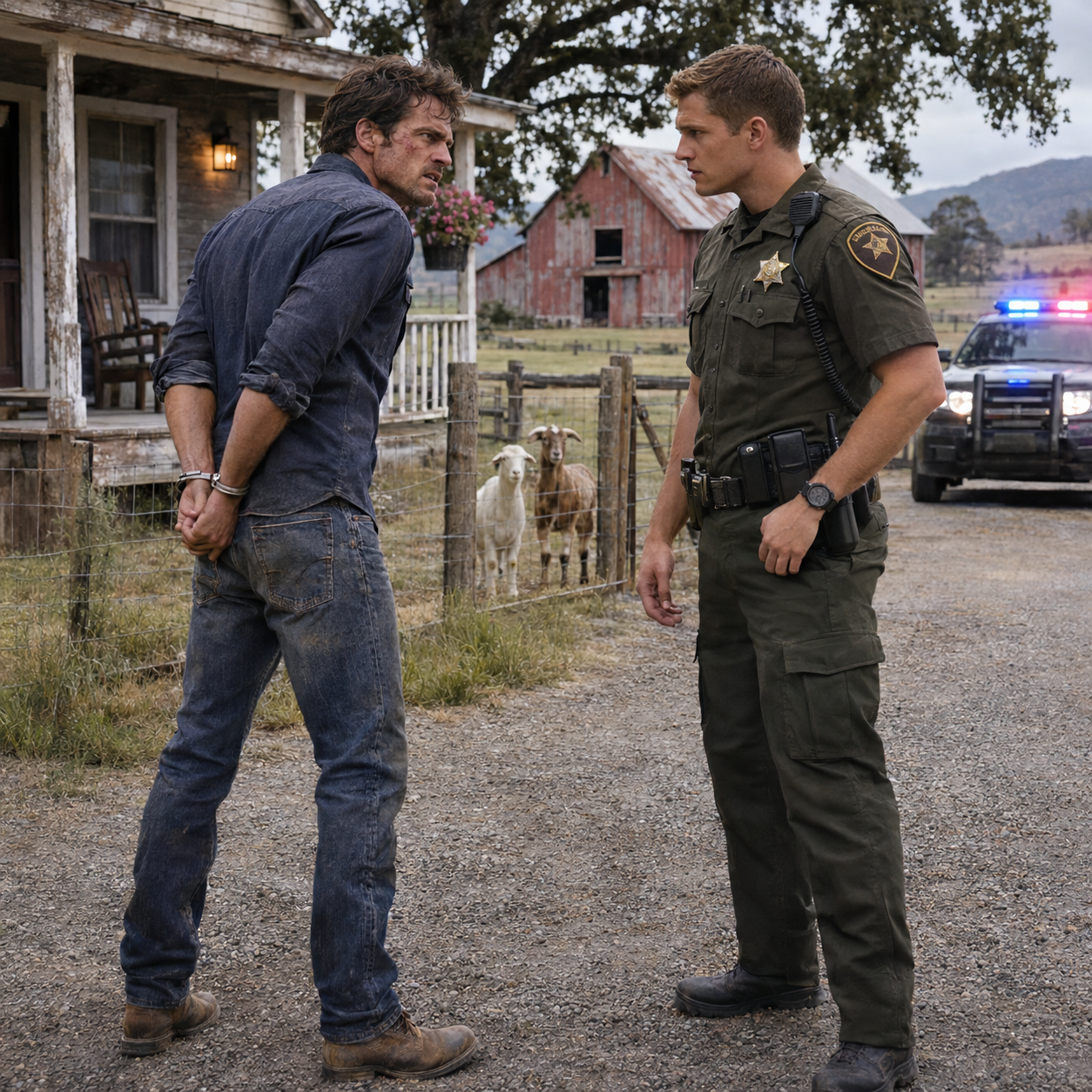
The police arrived with lights and sirens. I was detained on my own driveway, hands behind my back, while my goats bleated in panic and my heart hammered with rage so intense I tasted metal.
In the back of my mind, one thought burned brighter than everything else:
She’s trying to get me killed.
Part 3
The officer who cuffed me was doing his job, but his eyes flicked over me like he was searching for the monster Janice had described. I stood in the gravel with my wrists tight behind my back, trying not to make sudden movements, trying not to give anyone an excuse to misunderstand my body language.
“What’s your name?” one officer asked.
“Daniel Harper,” I said, voice strained. “I own this property.”
“We got a call,” he replied, not unkindly. “Armed trespasser. Possible threats.”
“Do you see a weapon?” I asked.
He looked at my empty hands, then at the porch behind me, then at the barn. “No.”
“Because there isn’t one,” I said. “This is harassment. You’ve been here before.”
A second officer approached, older, with tired eyes that looked like they’d seen too many lies in too many forms. He studied me for a long moment.
“Take the cuffs off,” he said quietly.
The younger officer hesitated. “Lieutenant—”
“I said take them off.”
The cuffs clicked open, and my wrists throbbed with relief. The lieutenant stepped closer, lowering his voice.
“Mr. Harper,” he said, “we’re sorry. We have to respond when someone calls. But I’m telling you right now, this is getting out of hand.”
“No,” I said, the word shaking. “It’s already out of hand.”
They asked a few questions, took my statement, and left again, their lights disappearing down my driveway like the last trace of sanity.
When the quiet returned, it wasn’t comforting. It felt like the pause before another strike.
Maya was furious when I told her.
“This is dangerous,” she said. “False reporting with claims of weapons can get someone hurt. We’re not just suing for harassment now. We’re going for defamation, emotional distress, false police reports, trespassing, and fraud.”
The word suing sounded heavy. Like dragging a boulder up a hill. But I was past the point of hoping she’d stop. I needed a boundary stronger than my fence.
Maya filed the lawsuit.
Janice responded the way I’d come to expect: not with remorse, not with fear, but with arrogance. She posted online about “protecting property values” and “keeping out riffraff.” She implied I was a criminal hiding behind paperwork. She whispered to neighbors, spun stories, built a narrative where she was the hero and I was the threat.
But Maya had built our case like a fortress. Every lie Janice told met a timestamped video. Every accusation collided with a deed.
The court date arrived on a gray morning that smelled like rain. The courthouse felt too small for the weight of what had happened. People filled the benches, neighbors from Meadow Ridge and beyond, drawn by curiosity or outrage or both. I recognized faces I’d never met but had seen driving slowly past my driveway.
Janice sat across the aisle, chin lifted, arms crossed. Her son Ethan sat beside her, younger than I expected, maybe mid-twenties, with a face that looked both resentful and uncertain. He avoided my eyes.
Janice wore a blazer like armor. She looked ready to argue with gravity.
When the judge entered, the room stood. The air shifted, the way it does when power enters. I sat back down with my hands clasped, feeling my pulse in my fingertips.
Maya rose first. She spoke clearly, confidently, her voice cutting through the room like a blade.
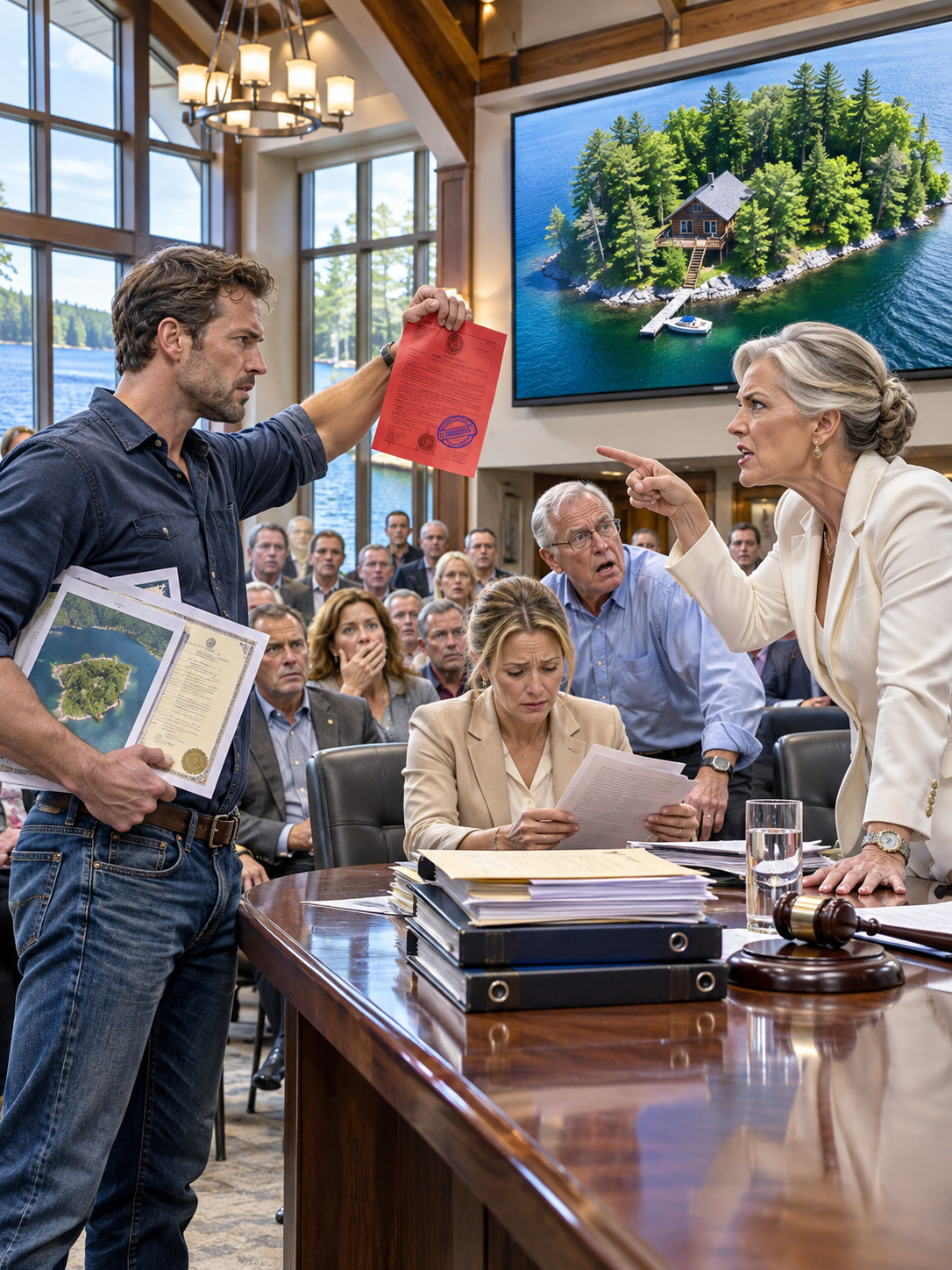
“This case is not about an HOA,” she said. “It’s about harassment and abuse of perceived authority. My client purchased his ranch legally. The defendant, Ms. Holloway, attempted to force him out through fraudulent fines, trespass, vandalism, and repeated false police reports. She escalated to life-threatening accusations.”
Janice’s attorney tried to frame it as a misunderstanding, a boundary dispute, an overzealous attempt at “maintaining standards.” But every time he leaned on that, Maya leaned harder on evidence.
The letters were displayed. The HOA seal. The made-up fines. The footage of Janice at my gate at 3 a.m. The broken mailbox photos. The cut fence.
Then came the 911 recordings.
Hearing my own life described as a crime, hearing Janice’s voice on the speaker, calm and confident as she lied about me, made my stomach churn. She sounded like she believed she was telling the truth. Or worse, like she believed truth was something she could rewrite if she said it clearly enough.
The judge listened without interruption, expression unreadable.
When it was Janice’s turn to speak, she stood with a practiced posture, smoothing her blazer. She looked at the judge like she was speaking to an employee.
“I did what I had to do,” she said. “That land is adjacent to our community, and it affects everyone. His property doesn’t fit. It lowers the standard.”
The judge’s eyebrows rose slightly. “Ms. Holloway,” he said, “are you claiming you have authority over property outside your HOA boundaries?”
Janice didn’t hesitate. “I’m claiming the community should match. That ranch… it doesn’t align with the neighborhood.”
The courtroom murmured. I heard someone whisper, “Did she really just say that?”
The judge leaned forward, his voice quiet but sharp enough to slice.
“That’s not how ownership works.”
Janice’s smile faltered. The first real crack.
The judge asked questions, direct and unforgiving. Why did she send violation letters to a non-member? Why did she authorize inspectors on private land? Why did she call 911 multiple times? Why did she claim there was an armed trespasser?
Janice’s answers tangled. She blamed “concerned neighbors.” She claimed she felt threatened. She insisted she was protecting her community. But the evidence didn’t bend to her narrative.
When the judge finally spoke his ruling, the room went still.
He granted a restraining order against Janice. He ordered damages for harassment and emotional distress. He required a public retraction and apology. He referred the fraud findings to the county for further investigation.
Janice’s face went pale, the lipstick suddenly too bright against her skin. Ethan stared at the floor like it had opened beneath him.
Outside the courthouse, reporters waited. Cameras. Microphones. The kind of attention Janice loved, except now it wasn’t admiration. It was exposure.
Maya touched my arm. “You did it,” she said softly.
I didn’t feel triumphant. I felt like someone had finally removed a boot from my chest.
Janice stood on the courthouse steps, surrounded by microphones, and for the first time, she looked small. Not powerless, but reduced. Forced to exist inside rules she couldn’t charm her way out of.
As I walked past, she turned her head slightly, as if she wanted to say something. Her mouth opened, then closed again.
I didn’t stop.
On the drive back to my ranch, the fields rolled by, green and gold beneath a clearing sky. The world looked the same, but I felt different. Like I’d survived something that could’ve swallowed me whole.
Still, one thought haunted me as I turned onto my gravel driveway:
How many people never make it to court? How many people get crushed by someone like Janice because they don’t have cameras, or a lawyer, or the stubbornness to fight?
I parked, stepped out, and listened.
The wind moved through the pasture, steady and indifferent. Maple and Juniper trotted over, pressing close, their warm bodies grounding me.
For the first time in months, my shoulders lowered. The quiet didn’t feel like a pause before another siren.
It felt like mine again.
THE END!
Disclaimer: Our stories are inspired by real-life events but are carefully rewritten for entertainment. Any resemblance to actual people or situations is purely coincidental.