
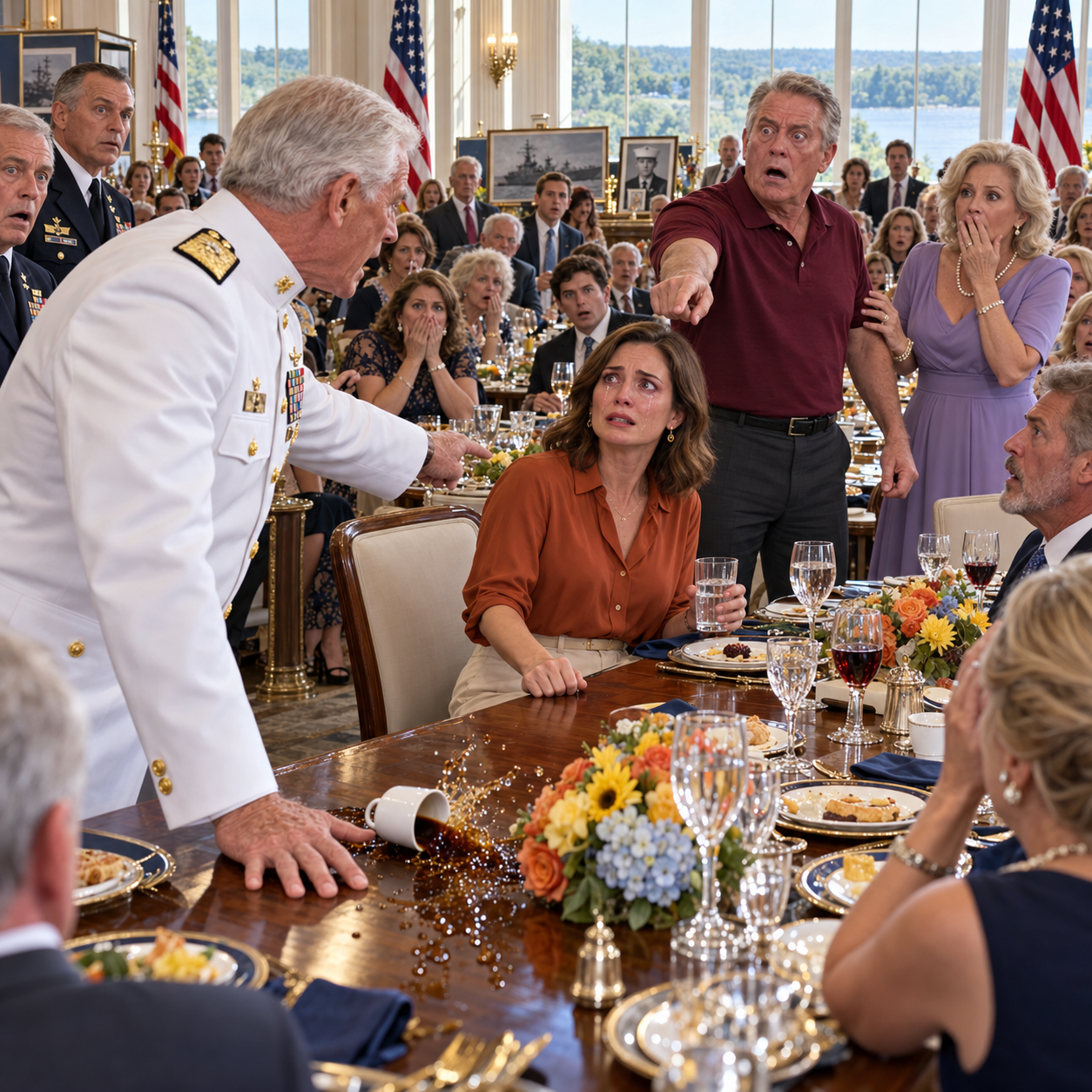
“Lazy Since The Navy Cut Her Loose,” Dad Told The Whole Reunion. “Admiral, Straighten Her Out!” Everyone Laughed. The Admiral Turned Toward Dad, Who Was Still Grinning. But The Admiral’s Response Left Him Speechless: “You Don’t Know Your Daughter…”
At thirty-six, I drove my father to a Navy reunion. He thanked me by calling me lazy into a microphone while more than two hundred sailors laughed. When he asked his favorite admiral to straighten me out, I stayed silent. The admiral looked at me, stood, and said three words that ended the laughter. Weeks later, a rejected application arrived bearing my father’s signature.
Part 1
My father believed work should leave evidence. Sawdust on a shirt, grease beneath a fingernail, a limp at the end of a shift: those things counted. If the evidence was invisible, he distrusted it. That distinction shaped our house in Chesapeake, Virginia, long before I understood what it would cost me.
Senior Chief Elliot Ward spent twenty-seven years in the Navy, most of them making sure heavy things stayed where sailors needed them. When he came home, his boots landed on the mat in perfect alignment, and the kitchen filled with the smell of salt, diesel, and the peppermint gum he chewed instead of smoking. My mother, Iris, could identify his mood from how firmly he closed the storm door.
There was one story Dad told without needing to be asked. In February 1998, his destroyer, the USS Bracken, had been caught in a North Atlantic storm while trying to recover a damaged towline. Six sailors fought the line on a deck disappearing beneath waves, and their commanding officer came down from the bridge to pull beside them. Captain Julian Harrow worked for hours with a torn glove and never asked anyone to notice.
“That,” Dad would say, tapping two fingers against the table, “is what a real leader looks like.” He described Harrow as if the man had invented endurance, which made the framed photograph in our den feel less like a picture of a ship than a religious painting. Beneath it Dad installed a brass plate engraved with the words EARN YOUR PLACE. I memorized every feature of that photograph, hoping someday he might tell a story about me with the same expression.
He taught me to swim when I was seven, the summer after the storm. The Great Bridge YMCA pool smelled of chlorine and wet towels, and I remember the rough edge of his thumb beneath my shoulder blade as he held me on my back. “The water won’t do the work for you, Tessa,” he told me. “But it will hold you if you stop fighting it.” On the ninth attempt, he took his hand away and I floated without knowing it.
For three seconds, he smiled at me without checking my form or looking for a correction. I spent much of the next decade trying to earn those three seconds again. Dad liked that I exercised, though he never understood why anyone would spend hours moving through water without arriving anywhere.
Owen was easier for him to understand. My brother played football, rebuilt a dirt bike, and took a job hauling lumber before he finished high school. At dinner Dad admired Owen’s calluses while I quietly rubbed lotion into the chlorine cracks between my fingers. Mom would sometimes catch my eye over the mashed potatoes, but she rarely interrupted the conversation.
When I was sixteen, a swimmer collapsed in the deep end during my lifeguard shift. I brought him to the surface, kept his face above water, and helped the paramedics carry him out through the side gate. That night I told Dad the man was alive, and he nodded while looking for a wrench in the garage. “Good,” he said. “That’s why the city pays you.” I knew he meant it as praise, but it never became one of his stories.
Two years later, a Navy recruiter watched me at a swim meet and mentioned aviation rescue swimming. I went home with a brochure showing a helicopter above whitecaps and a swimmer suspended beneath it on a cable. I wanted work with a purpose I could feel, even if nobody could see it on my hands afterward.
Dad read the brochure at the kitchen counter, his glasses low on his nose. “If you’re going to wear the uniform, learn a trade with a future,” he said. “Deck operations, navigation, something that gets you promoted instead of injured.” I told him I had already started the application, and he handed the brochure back as though it belonged to a stranger. “Your choice. Don’t expect me to pretend it’s a smart one.”
Mom drove me to the processing station in the predawn rain because Dad had taken an early shift at the marine supply yard. At the door, she fixed the collar of my jacket and said he was proud of me in his own way. She had been translating his silence for so long that I almost believed her.
I carried Dad’s swimming lesson with me through boot camp and the aircrew training pipeline. When my classmates complained about aching shoulders, I thought of that first moment he had let go of my back. I did not yet realize that learning to float was different from learning to wait for a person who might never reach for you. The distinction would become clear in water much colder than the YMCA pool.
Part 2
Rescue swimmer school in Pensacola taught me that panic had its own weight. Instructors grabbed us underwater, tangled our legs, and made us repeat procedures when our lungs wanted anything but another attempt. Thirty trainees began my class; twelve finished. I was one of two women at the start and the only one left when we received our certificates.
I called Dad from the parking lot, squinting into the Florida sun. “I graduated,” I said, still wet from the final exercise. He asked if I could transfer into something less risky before I got stuck doing it. I watched my classmates embrace their families beside the gate and told him I had to go. For the first time, ending the call felt easier than defending myself.
The work itself never disappointed me. I flew from Norfolk aboard MH-60 Seahawks, learned the difference between waves that looked bad and waves that could roll a person under a hull, and trusted my crewmates to perform their duties. Some nights we brought a fisherman or an exhausted sailor home alive.
I married a fellow aircrew member, Evan Kline, in 2013 and used his surname at work. Dad liked Evan’s practical jokes and his ability to rebuild an engine, which meant our Sunday dinners briefly became comfortable. But Evan and I spent long stretches deployed in different places, and the marriage developed the tired politeness of roommates passing in a hallway.
On March 9, 2017, our helicopter was sent toward a second aircraft that had gone into the Norwegian Sea during a snow squall. Its crew was transferring a senior passenger between ships when an engine problem and sudden crosswinds forced it down. Two pilots reached a raft; a crew chief and the passenger were separated in heavy seas. The water was just above freezing, and daylight was disappearing behind thick, moving cloud.
The crew chief was conscious when I reached him, shouting directions nobody could use over the rotor noise. I secured him in the rescue sling and watched our hoist lift him toward the cabin. The passenger drifted farther away, a dark figure in a flotation coat, his face exposed to the snow. I swam after him because there wasn’t another reasonable choice.
He was older, with close-cropped silver hair and eyes that kept losing their focus. I slid an arm beneath his shoulders, turned us away from the worst of the chop, and told him my name was Petty Officer Kline. “Look at me when you can,” I said. “We breathe together.” I began counting slowly, the rhythm Dad had taught me at seven.
When I signaled for the cable, nothing came down. A mechanical problem had jammed the hoist after the first recovery, and the helicopter had to pull away while the crew worked the emergency plan. Through my headset someone told me a ship’s boat was launching and another aircraft was diverting. Then the radio crackled, and the man beside me sagged in my arms.
I could not make the boat move faster, and I could not lift him onto a helicopter that wasn’t above us anymore. I could keep his face out of the water, turn our backs to the worst waves, and remind him to breathe. “In for two,” I said into his ear. “Out for three.” He began mouthing the numbers, so I said them again.
I thought about the numbness spreading through my hands, the way his head kept slipping, and a loose strap that slapped my neck every time a wave rose. Fear was present, but it had no useful instructions. Counting did, and I held on to those five beats until I heard an engine pushing through the darkness.
The rescue boat arrived after forty-one minutes. The crew reached for him as a swell lifted the boat, then another wave knocked its steel side toward us with terrible speed. I turned my body between the hull and his head because I was closer to the impact. Something cracked in my back, sharp enough to empty my lungs, and for a moment the sky seemed to tilt sideways.
Hands dragged us over the gunwale. I remember wet nonskid under my cheek and someone cutting through my suit while another sailor called for the medical officer. The passenger lay a few feet away, shivering violently but breathing, and an officer bent over him with a face almost as white as the snow. “Admiral Harrow,” the officer kept saying. “Sir, can you hear me?”
I had listened to my father worship that name for nineteen years. Now the man from our kitchen-table storm story was lying beside me while I couldn’t move my legs without pain. I tried to ask if he would live, but the corpsman was already securing my neck. The last thing I heard before they moved me below was that the admiral had opened his eyes.
Part 3
The hospital ceiling in Portsmouth was made of white acoustic tiles, almost identical to the ones above the pool where Dad had taught me to float. I stared at them after the doctor explained the fractures and the likelihood of surgery. My commanding officer visited and told me the admiral was recovering.
Mom knew I had been hurt during a flight operation, but I had given her so few details that she assumed it was a training accident. Dad called while she was away getting clean clothes. “Heard you hurt your back,” he said, and before I could explain, added, “I warned you this job would do that. You should’ve picked a rate you could grow old in.” I lay there with a brace holding my spine still and answered, “I heard you.”
I had planned to tell him everything. But the familiar satisfaction in his voice made the words feel like an audition I no longer wanted to give. If the admiral’s name was the only thing capable of making my injury worthwhile to him, I did not want to say it.
Seven months later, my squadron held a small ceremony in a hangar with folding chairs arranged between tool cabinets. I received the Navy and Marine Corps Medal for the rescue, and the commander read a citation I barely recognized as my own life. My family wasn’t there because I hadn’t invited them, a choice that felt like control at the time and grew heavier as the years passed.
Admiral Harrow sent three letters during my rehabilitation. They were addressed to Petty Officer First Class Tessa Kline and written on thick cream paper, each one shorter and more careful than the last. He remembered a woman counting above the sound of the sea, he wrote, and he wanted to thank her face-to-face. I read every letter, then placed them with my medal in a shoebox beneath an old sweater.
My body recovered unevenly. Two operations stabilized my spine but did not end the pain. Evan and I divorced with more sadness than anger, and I went back to Ward. In 2021, I left the Navy on medical retirement and rented a small apartment where the shower had a grab bar and the stairs were somebody else’s problem.
Some mornings I could stand at the stove without thinking about my back; on others, tying my shoes took a quarter of an hour. I began teaching adaptive swimming at the Great Bridge YMCA, helping people recovering from injuries discover what the water could support. I was good at it, which felt natural.
One student, Cal Dorsey, was a retired boatswain’s mate who could barely walk across the locker room without resting. He had stopped meeting friends because of his injury. In the pool he laughed the first time he moved from wall to wall without a cane.
Iris mentioned my classes at Sunday dinner once, but Dad waved away her explanation. “So the Navy pays her to sleep in, and the Y pays her to splash around,” he said. Owen laughed before he noticed I wasn’t smiling. I carried the plates into the kitchen rather than argue.
In 2024, the YMCA director asked me to help prepare a grant request for a local fleet veterans foundation. Eighteen thousand dollars would cover accessible transportation and pool time for veterans on a waiting list. The application came back marked ineligible without a hearing, and our director, Monica Reyes, said we’d try another source.
We stretched donated equipment, shortened sessions, and asked volunteers to drive students who couldn’t reach the pool. Every Thursday I checked the waiting list, where names sat beside addresses beyond the public bus route. Some men called every few weeks to ask whether we had space. We had empty water, but no reliable way to bring them to it.
Dad kept making jokes about my “permanent vacation,” especially when Owen brought home another dealership bonus. I shortened my visits until family dinner became a monthly obligation.
Then Dad needed a knee replacement. He was president of the USS Bracken reunion committee that year, and his doctor wouldn’t let him drive to the October banquet at the Virginia Beach oceanfront. Mom caught a respiratory infection a week before the event and called asking if I could take him. When I agreed, Dad got on the phone sounding younger than he had in years: “Harrow’s finally coming. First reunion he’s attended since retirement.”
I sat down on the edge of my bed after we hung up. The shoebox was four feet away in my closet. I could have refused, but Dad needed a ride and I was tired of arranging my life around a secret. I told myself a ballroom full of old sailors was large enough for one woman to disappear inside.
Part 4
The banquet hall had wine-red carpeting, brass chandeliers, and windows that reflected the guests instead of the black Atlantic beyond them. Two hundred twelve former sailors had registered, along with spouses and a scattering of adult children. I wore a navy dress and flat shoes, prepared to leave by ten if my back allowed it.
Dad entered on his cane and immediately belonged to the room. Men crossed aisles to embrace him, trading old nicknames and arguments about storms nobody else remembered accurately. He introduced me as his chauffeur, then sent me to the buffet while he visited the head table. I brought his plate back untouched and took a seat near the service doors.
The admiral arrived just before seven-thirty with his wife, Beatrice. I recognized him despite the silver hair and the slight care in his walk, the way a cold-weather injury can stay in a person’s joints. He shook hands with Dad for a long time.
Dinner passed with familiar Navy speeches, rubbery chicken, and the reading of names of shipmates who had died that year. I liked the quiet when the bell sounded for each name; nobody turned grief into a competition. For a while, I thought the evening would pass without my being noticed. Then Dad stepped behind the microphone and told the storm story.
His voice strengthened with every familiar detail: the severed towline, the steep deck, the captain coming down from the bridge to work alongside the sailors. He pointed to the old photograph and called Admiral Harrow the hardest-working officer he’d ever known. The room applauded, and the admiral gave a modest, uncomfortable nod. I kept my eyes on the exit sign above the service doors.
Dad could have sat down after that. Instead, he looked across the tables until he found me and announced that his daughter had been kind enough to drive him. “She’s got nothing but time since the Navy retired her,” he said, drawing scattered chuckles. “These days her biggest job is telling people not to drown in the YMCA pool.”
Dad leaned closer to the microphone and smiled toward the head table. “Admiral, you want to show my girl what hard work looks like? Maybe she’ll listen to you.” Beside me, a retired machinist named Roy Ellison stopped smiling.
“Want me to say something?” Roy whispered. I put a hand on his sleeve and shook my head because I still believed I could get through the next fifteen minutes without anyone knowing. Every instinct told me to walk out, but Dad’s cane leaned against the podium, and I was the person who had promised to drive him home. Even then, I was calculating what he needed before asking what I deserved.
The admiral turned in his chair, searching the back of the room for the daughter Dad had offered him as a punch line. He gripped the edge of the table, stood carefully, and walked between the chairs without speaking. The laughter dissolved in pieces as he passed each row. By the time he reached me, I could hear someone at the far wall setting a coffee cup onto its saucer. The admiral looked at the scar near my jaw, then at my eyes, and finally closed his own when I said, “Good evening, sir.”
He turned toward the stage. “Elliot,” he said, his voice steady enough to reach the microphone without one. “She saved me.” Dad’s mouth remained open, the joke unfinished. The admiral looked back at me, and for an instant I could smell cold seawater instead of hotel coffee.
Dad stared. “In the Norwegian Sea?” he asked. The admiral nodded. “Petty Officer Tessa Kline. Your daughter. She held my head above water for forty-one minutes and broke her back protecting me from the rescue boat.” No one laughed now, and I realized I didn’t want their new attention any more than I’d wanted their old amusement.
I walked out through the service doors and into the corridor behind the ballroom. Outside, on a covered loading dock, I set both hands against cold concrete and breathed in for two, out for three. The count still worked, even eight years later.
The admiral found me there. He had removed his tie, and his hands shook slightly as he said he’d written three times. “I know,” I replied. “I kept the letters, but I couldn’t answer.” He told me he’d searched for Tessa Kline at Navy events and never connected the name to Elliot Ward’s daughter, then asked whether I would let him thank me without an audience.
“You stayed,” he said, his voice roughening. “When the cable failed, when the boat wasn’t there, you stayed.” Through the loading dock window, I saw Dad standing in the hallway with his cane, staring at us. For the first time I can remember, he looked frightened of what an ordinary conversation might reveal.
Part 5
Dad said nothing during the twenty-five-mile drive home. At the house, he stared at the porch light while the engine idled and finally asked why I had let him talk about me that way. The question was so perfectly backwards that I laughed once, without humor. “I didn’t give you a script,” I said. “You wrote every word.”
He turned the handle of his cane between his palms. “Why didn’t you tell me who you saved?” I thought of the hospital bed and the steady confidence with which he’d diagnosed my entire career as a mistake. “You called while I was in a brace,” I said. “Before I could tell you anything, you told me you’d been right about me.” His gaze dropped, and I drove away before he offered an explanation.
At eight the next morning he called with a plan. The reunion newsletter could run a correction, he said, and the association would recognize me at its monthly breakfast. Dad would introduce me; maybe the admiral would come back to present the medal everyone had somehow missed. He spoke briskly, the way he did when arranging repairs at the marine yard.
“Don’t put my name in that newsletter,” I told him. “And don’t ask anyone to stage an award ceremony.” He insisted he was trying to make things right. “You don’t get to turn my life into another story you tell about yourself,” I said. Dad replied that I’d humiliated him in front of his shipmates, then hung up.
By Tuesday, strangers were emailing the YMCA asking to meet the famous rescue swimmer. The room had been full of people with phones and strong opinions. Monica pulled me into her office, shut the door, and asked whether I wanted my schedule moved away from the lobby. I thanked her, then asked her to keep the students’ names out of any conversation with reporters.
“There’s something you should see before your father talks to the foundation,” she said. She took out the 2024 grant application and a stack of correspondence she had requested after the banquet. The fleet veterans foundation wasn’t run by the reunion committee, but several senior association members helped screen local grants. Its community programs chair that year had been Elliot Ward.
The form I remembered as a bland rejection had a handwritten note on the back: NOT REHABILITATION. RECREATION FOR PEOPLE WHO NEED TO GET BACK TO WORK. Beneath it was Dad’s signature, forwarding the application for summary rejection instead of full review. The director had been told the request failed eligibility screening; the eligibility guidelines, printed in the same folder, specifically included adaptive physical activity for disabled veterans.
“We could have appealed,” Monica said, her voice strained. “But I believed what they told us about the guidelines.” I pictured Cal laughing at the pool wall and other veterans unable to reach it. The harm had never been restricted to what Dad said about me at Thanksgiving. He had been deciding what counted as effort for people whose pain he couldn’t see, and his judgments had traveled on official letterhead.
The foundation board invited me to speak privately, not about the rescue but about the waiting list. I brought attendance logs, referrals, and a transportation budget. A board member asked how many students had missed sessions. I answered with numbers because I didn’t trust myself to answer with names.
Dad attended that meeting too. He claimed he hadn’t realized I worked on the proposal. I believed him for about ten minutes, until the foundation secretary brought out the email trail. Attached to the application was my staff biography, which Monica had submitted with my qualifications, and the cover message identified me by name as the program’s lead instructor.
I asked Dad whether he had read it. He looked at the committee members, then at the table, and said that he’d skimmed the packet. The secretary turned to the next page, a reply Dad had sent to another reviewer: “I know whose program this is. We can’t keep pretending pool time is a career.” The room became very still, although this silence felt different from the one at the reunion. There was nothing mysterious left in it.
Dad had not known I’d saved Harrow. He had known I was helping injured veterans and had decided it was unworthy of support anyway. When the chair asked whether he wanted to explain the screening decision, Dad said the foundation had limited funds and difficult choices. Nobody disputed that, but the board voted to reopen the application and review the screening process. Dad left before the meeting ended.
That night Mom called and asked me to consider what he was going through. “He’s ashamed,” she said. “He’s been sitting in the garage with your medal citation open on his workbench.” I asked whether she had known about the grant. She admitted she’d asked him to help but hadn’t challenged his refusal. I told her I wouldn’t spend the rest of my life making his shame easier to carry.
Part 6
The foundation reviewed the rejected requests from the period Dad had chaired community programs. Two more had been screened out without a full vote, both involving support for veterans with long-term injuries. The board changed its review procedures, restored the YMCA proposal to consideration, and asked Dad to resign from his volunteer screening role. He did, though he told Mom the committee had turned against him because of one unfortunate speech.
The renewed grant wasn’t rushed, and I appreciated the careful questions. They approved it in December with public reporting requirements. We added morning sessions and transportation.
I thought a check would make the wrong years feel smaller, but it didn’t. What changed was more ordinary: people who had been absent appeared at the shallow end. One man arrived without swim clothes; Monica found him a spare pair of trunks. He gripped the railing and apologized for needing help on the steps. “That’s what we’re here for,” I said, and meant it without resentment.
Dad appeared outside my apartment carrying a framed copy of my medal citation, but I didn’t invite him in. Later he left a voicemail saying he’d taken down the brass plaque in his den. He admitted he’d mistaken stubbornness for strength, which was more accurate than any story he’d told about me.
I wrote him a letter rather than call. I told him I believed he regretted what had happened in front of Harrow, but the application showed he had made similar judgments when no one important was watching. I explained that I would no longer attend dinners where my work or injury could become entertainment. I didn’t ask him to suffer forever; I asked him to leave me out of his attempts to repair his standing.
Owen visited before Christmas and admitted he’d laughed at Dad’s jokes rather than defend me. He said being Dad’s favorite had made it easy to overlook the harm. I accepted his apology without pretending our relationship was suddenly repaired, and we ate grilled cheese sandwiches while his daughter’s school play came up in conversation.
I told Mom I wouldn’t visit for Christmas, and she didn’t argue. I ate cinnamon rolls with my neighbor, watched rain move across my windows, and fell asleep during a movie. Rest still hurt sometimes, but I no longer confused it with failure.
I finally answered the admiral’s letters in January. My reply was only two pages, and much of it concerned the swimming program rather than the rescue. He wrote back from his home in Annapolis, mentioning his grandchildren and how one of them had started lessons after hearing about the woman who’d taught him to breathe in the sea. He asked permission to contribute to the YMCA scholarship fund without attaching my name. I said that would be welcome.
In the spring, Dad mailed a handwritten apology. He did not mention Harrow, his career, or the embarrassment of the reunion, and for once he didn’t ask me to be proud of him for saying something difficult. He wrote about the afternoon I rescued a man at sixteen and the moment he’d reduced it to a paycheck. He remembered my face when he said it, he admitted, but had never wanted to think about why I’d gone quiet.
I read the letter twice before placing it beside the shoebox. It mattered that he had finally looked at the ordinary moments, not only the spectacular one in the Norwegian Sea. It did not give him a right to the life I’d built after them. I thanked him in a short note and told him I still needed distance; he did not call to negotiate.
The following October, the reunion committee offered me a seat at the head table. I declined; I was teaching that evening. Roy later said Dad spoke briefly and made no jokes about his children. I was glad he’d changed his behavior, but I didn’t need to witness it.
On the anniversary of the reunion, Cal completed a full length of the pool without touching the wall rail. He reached the far side red-faced and laughing, then asked me how many strokes he’d taken. I told him twenty-eight, because I’d counted every one. Outside, traffic hummed along Battlefield Boulevard, and somewhere beyond the buildings the Atlantic kept moving whether anyone noticed or not.
I still have the shoebox, but it no longer lives beneath a sweater. The medal hangs in my office beside photographs of swimmers who agreed to be pictured, and the admiral’s letters rest in a drawer where I can read them without hiding. My father taught me that water would hold me if I stopped fighting it. What I learned without him was that I didn’t have to keep holding up everyone who refused to see me.
THE END!
Disclaimer: Our stories are inspired by real-life events but are carefully rewritten for entertainment. Any resemblance to actual people or situations is purely coincidental.


