“May Emily’s imaginary fiancé finally become real,” Dad toasted at my engagement party. My mother laughed, and my sister Brooke had bet I’d cry. Then a helicopter landed on the country club lawn. Nathan Reed stepped out, kissed my hand, and watched Dad turn pale. My family didn’t know my fiancé owned the aviation company Dad desperately wanted as a client. But that night, Nathan showed me an email Dad had sent him—and what it said about me changed everything.
### Part 1
My engagement party smelled like white roses, grilled steak, expensive perfume, and humiliation. Willow Creek Country Club had strung paper lanterns over the terrace, a small jazz trio played near the open doors, and nearly every relative I had spent my childhood trying to impress was there, balancing plates and whispering about the empty chair beside mine. My mother, Marlene Carter, wore pearl earrings and the pleased little smile she always used when cruelty could be disguised as concern. My father, Thomas, had already finished two glasses of bourbon. My younger sister, Brooke, looked radiant in champagne silk, her engagement ring flashing whenever she lifted her hand. She had always been the beautiful daughter, the promising daughter, the daughter whose victories became family holidays. I was simply Emily, the dependable one who remembered birthdays, carried bags, fixed mistakes, and learned early that wanting attention only made everyone tired.
Three weeks earlier, I had mailed invitations announcing my engagement to Nathan Reed. My mother called the same afternoon. “Emily, sweetheart, this is getting embarrassing. Who exactly are you engaged to?” When I repeated Nathan’s name, Brooke laughed in the background and asked whether I had stolen it from a business magazine. My father became strangely quiet before saying, “If this man exists, bring him.” I told them Nathan would attend. What I did not tell them was that Nathan ran Reed Air, a national medical aviation company my father’s commercial development firm had been trying to approach for almost a year. I also did not know then that Dad had met Nathan before. All I knew was that every time I mentioned my fiancé, my family reacted as if an ordinary woman like me claiming an extraordinary man was evidence of dishonesty.
Nathan and I had met on the roof of St. Catherine’s Medical Center, where my architecture firm was coordinating a trauma-wing expansion. I had been wrestling rolled blueprints against October wind when his helicopter landed. While every executive rushed toward him, Nathan walked past them and asked why I was the only person holding the revised plans. He listened when I spoke, remembered my name, later emailed my boss praising a coordination problem I had caught, then asked me for coffee without acting as though I should feel lucky. We fell in love slowly: takeout on my apartment floor, burned garlic in his kitchen, quiet Sundays, long conversations in parked cars. He never made me audition for affection. That alone felt revolutionary.
At the party, however, Nathan was late because of an airspace delay, and my family could smell blood. Brooke leaned toward me and murmured, “If he doesn’t show, we can tell everyone he got food poisoning.” My mother laughed. Then my father stood and struck a spoon against his glass. “I’d like to toast Emily, our lifelong dreamer.” Conversations died around us. He lifted his drink toward me. “May the imaginary fiancé finally become real someday.” Laughter spread across the terrace. Mom nearly spilled her wine. Brooke covered her mouth, shoulders shaking. My face burned, but I refused to move. Inside my purse were the final copies of the prenuptial agreement Nathan and I had reviewed with our attorneys, along with our venue paperwork. I touched the edge of the folder and checked my watch.
Then the music disappeared beneath a deep rhythmic pounding overhead.
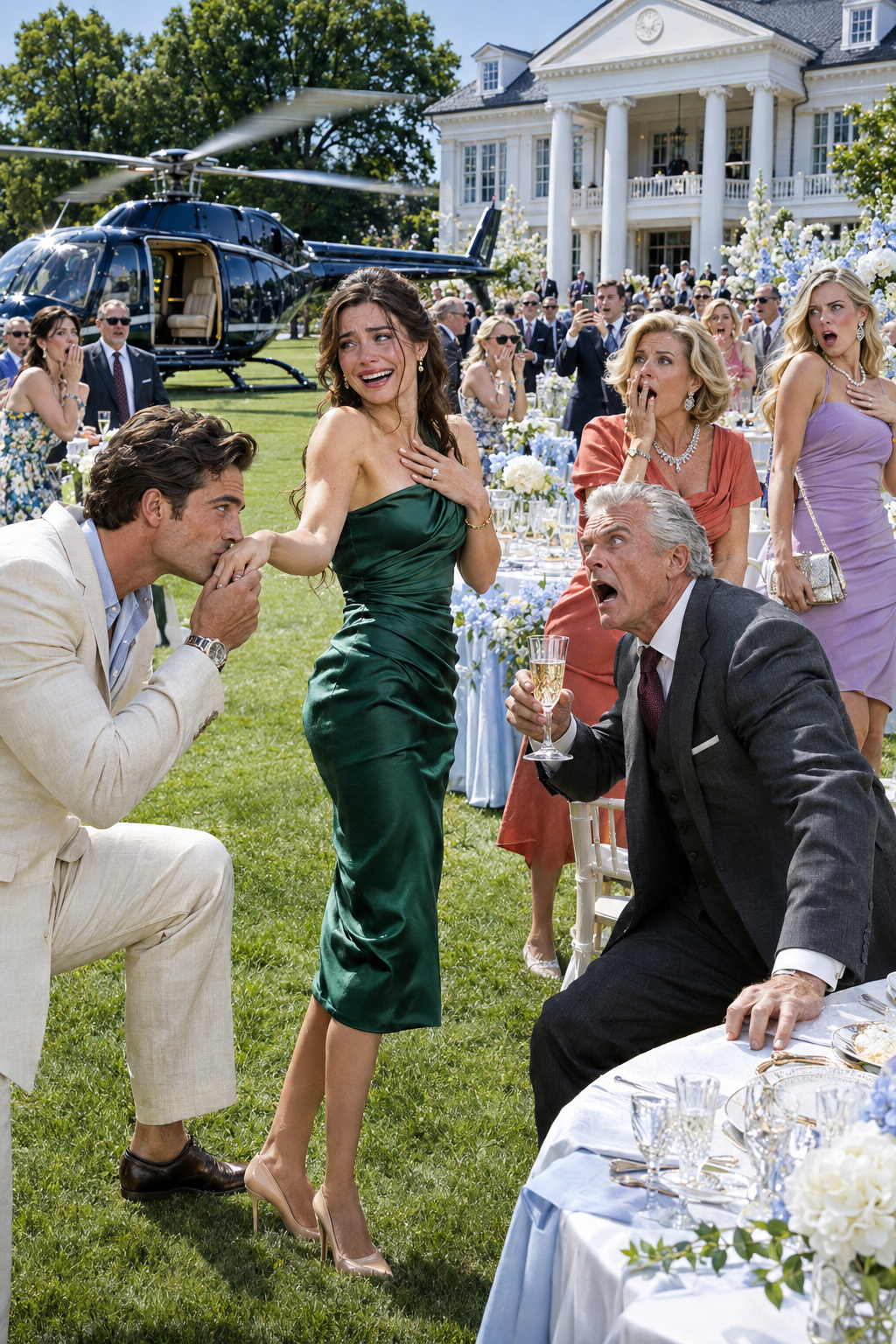
Guests looked up. Lanterns trembled. Napkins lifted from tables as rotor wash swept across the lawn beyond the terrace. A dark helicopter descended onto the club’s approved landing field, and suddenly nobody was laughing. The doors opened several minutes later, and Nathan walked toward us in a black suit, his hair windblown, carrying the calm expression of a man who did not know he had just become the answer to fifty cruel jokes. His eyes found mine immediately. He crossed the terrace, took my hand, kissed my knuckles, and said, “Sorry I’m late, sweetheart. Traffic in the sky was awful.”
The silence was magnificent.
My mother stood so abruptly her chair scraped stone. Brooke’s smile vanished. My father went gray. “Reed?” he whispered.
Nathan turned toward him. “Thomas.”
That single word told me they knew each other.
My father recovered first, forcing a laugh and extending his hand. “Mr. Reed. This is certainly unexpected.” Nathan looked at the hand before shaking it. “I imagine it is.” Mom instantly transformed. She began calling Nathan her “future son-in-law,” although twenty minutes earlier she had been laughing about his supposed nonexistence. Brooke tried to joke about his dramatic entrance, but Nathan merely said, “I was invited.” Watching their faces change taught me something I should have understood years earlier: they were not ashamed because they had humiliated me. They were terrified because they had humiliated me in front of someone they wanted.
Later, while people pretended dinner had restored normalcy, my Aunt Susan slipped her phone beneath the tablecloth into my lap. A family group chat filled the screen. Its title was Emily’s Mystery Night. Brooke had bet I would cry in the restroom. Dad had written that if my relationship was a fantasy, tonight should end it. Mom had told him to make his toast early. Another relative joked that at worst they would get dinner and a funny story.
I handed the phone back without speaking.
Nathan saw my expression. “What happened?”
“Later,” I whispered.
Before dessert, Dad rose for another speech. I stood first. “I think we’ve heard enough speeches.”
Every face turned toward me.
“Some of you came here to celebrate us,” I said. “Some of you came because you expected to watch me be humiliated.”
My father frowned. “Emily, don’t be dramatic.”
I looked straight at him. “You made entertainment out of your daughter’s humiliation. Don’t complain because the ending disappointed you.”
Mom’s first response was not an apology.
“Who showed you?”
That question finally broke something inside me.
Nathan took my hand, and we walked out together. Only when we reached his car did he say, “There’s something else you need to know.”
The garage lights beneath his townhouse buzzed faintly as he handed me his phone.
“My father?” I asked.
Nathan nodded.
“He emailed me three weeks ago.”
And what Thomas Carter had written about his own daughter made the laughter at the party look almost harmless.
### Part 2
My father’s email was written with the calm professionalism of a man warning a business associate about defective equipment. He told Nathan that I had always been “imaginative” and “emotionally fragile.” He suggested that if I had exaggerated a professional acquaintance into a romantic relationship, Nathan should avoid encouraging my fantasy. For my sake, Dad wrote. And yours. I read those lines until my fingers went numb. My father had not merely doubted me privately. He had deliberately tried to discredit me with the man I loved before Nathan could contradict the story my family preferred.
Nathan sat beside me on the bottom stair after we went inside. “I didn’t respond,” he said. “I wanted you to decide what relationship you wanted with them.” That night I cried harder than I had at the party. Nathan did not tell me they meant well or remind me that life was short. He simply stayed. The next morning my phone filled with calls from Mom, Dad, and Brooke. Brooke texted, Can we please not turn this into a whole thing? Mom is devastated. By afternoon, my mother had invited Nathan and me to brunch because they “owed us an apology.” I almost refused. Then I decided I wanted to see whether they were capable of apologizing when there was nothing left to gain from pretending.
The answer came before coffee was finished. Mom said they had been “caught off guard.” Dad blamed the group chat mostly on Brooke. Brooke insisted everyone had been joking. When I mentioned the email, Dad changed tactics. He turned toward Nathan and explained that they had lacked “context.” Had they known I was actually involved with Nathan Reed, he said, none of the humiliation would have happened. Nathan’s expression barely moved. “That is not the comforting statement you think it is.” Then Brooke’s fiancé, Derek, accidentally revealed why everyone was suddenly so eager for peace. He mentioned that my father’s firm was positioning itself for logistics work connected to Reed Air’s planned regional expansion. Mom immediately began talking about family announcements, society photographs, and presenting our engagements together. Their cruelty had transformed into opportunity management.
“You didn’t invite us here because you’re sorry,” I said. “You invited us because you want access.”
Dad’s jaw hardened. “That’s unfair.”
“No. It’s accurate.”
Nathan placed his phone on the table with Dad’s email open. Nobody touched it. Dad insisted he had been protecting me. “You were protecting your version of me,” I told him. Then we left while Mom cried and Brooke accused me of making everything intense. At the door Mom called after me, “You’re going to let one terrible night define your entire family?” I turned around. “No. I’m finally admitting how many years defined it before that night.”
That afternoon, my former high school art teacher, Mrs. Hale, contacted me. She had heard about the engagement party through Aunt Susan and wanted to tell me something she had carried unknowingly for years. During senior year, I had applied to a prestigious summer art residency in Chicago. I remembered every detail. I had worked on my portfolio until charcoal lived permanently beneath my fingernails. Then no acceptance ever arrived, and Mom gently told me programs like that usually wanted more polished students. That same month Brooke qualified for a national dance competition, and our house filled with flowers, costumes, travel schedules, and celebration.
Mrs. Hale’s voice became careful. “Emily, you weren’t rejected.”
I stopped breathing.
“You received a full scholarship.”
She had been copied on the acceptance because she was my faculty reference. When I never responded, she assumed I had changed my mind. Months later, she mentioned it to my mother, who claimed there must have been a mailing problem. Mrs. Hale also remembered Brooke joking that if I went away to Chicago, there would be nobody home to help Mom during dance season.
After I hung up, every old memory seemed to rotate into a different position.
I drove to my parents’ house alone. Mom tried to block the doorway when I said I needed to look for something, which told me she knew exactly what I meant. I went straight to the kitchen junk drawer where I had once found a handmade bracelet I gave her at thirteen, discarded beneath batteries and coupons. The drawer still jammed halfway. The bracelet was still there, faded blue and green thread buried beneath charging cables.
In the drawer below it, behind old menus, I found a thick cream envelope.
My handwriting was on the front.
The seal had been sliced open.
Inside were the acceptance letter, scholarship forms, housing information, and a handwritten note from the residency director saying my work had stood out immediately.
Mom whispered, “We meant to tell you.”
Dad appeared from his office and began explaining that Brooke had nationals, Mom had been overwhelmed, Chicago was impractical, and somebody had needed to stay home. Then Brooke arrived, saw the letter, and rolled her eyes.
“I was seventeen,” she said. “Maybe I forgot to give it to you.”
“You forgot the one letter I waited months for?”
Her expression hardened. “Honestly? You would’ve gone away and come back unbearable. Mom needed help. Not everything was about you.”
I looked at my parents.
Neither denied it.
That was the moment forgiveness died. Not when they mocked Nathan. Not when Dad called me unstable. Not even when I saw the group chat.
They had seen exactly what I wanted, opened the door to my future, and closed it because Brooke’s life was considered more important.
I left carrying the letter and the bracelet. Three days later, Mom mailed the bracelet back to me in white tissue with a card.
Families make mistakes. Remember the love, not only the hurt.
There was still no apology.
Then Dad called from an unknown number and told me my mother was “unwell.”
“Is she in the hospital?”
“No, but she’s devastated.”
“Then she isn’t unwell,” I said. “She’s upset.”
His voice went cold. “You’re being cruel.”
For the first time in my life, I did not shrink.
“No,” I told him. “I’m being new.”
### Part 3
My father could tolerate anger better than boundaries. Anger could be dismissed as emotion; boundaries changed logistics. When I told him he and Mom would not be invited to our wedding, he laughed because the idea of me excluding him seemed physically impossible. “People are already talking,” he warned. “We can still repair the optics.” There it was again: optics. Not love. Not remorse. Not even fear of losing a daughter. Reputation.
“I mean it,” I said.
“Emily, you cannot possibly—”
I hung up.
Brooke messaged two days later accusing me of using Nathan to punish the family. Then Nathan showed me what she had sent him privately. She told him I had “a flair for victimhood,” offered to give him the honest version of our family, and several lines later mentioned that Derek was searching for investors in aviation technology. I laughed until tears came. Even after everything, Brooke still believed access to Nathan was the prize and that I was merely standing inconveniently in front of it. The clarity was painful, but it was clean.
The week before our wedding, Nathan and I finalized the guest list. We chose a rooftop garden downtown instead of the enormous society event my mother would have demanded. Jenna, my closest friend, would stand beside me. Nathan’s sister and brother-in-law were coming. Mrs. Hale was invited. So was Aunt Susan because courage arriving late was still courage. My parents, Brooke, and Derek were not invited. For the first time, I built a room around people who actually wanted me in it.
The night before the ceremony, the venue manager called. “Someone claiming to be your mother requested tomorrow’s access code. We didn’t provide it.”
I closed my eyes.
Nathan came in from the terrace and immediately noticed my face. When I told him, he crouched in front of me and took both my hands. “They do not get to force their way into your joy.”
I barely slept. Just before dawn a blocked-number voicemail appeared on my phone. I never listened to it. By morning, I already knew they would come.
The rooftop garden was bright beneath a clear spring sky. White roses wound around the railings, and glass lanterns moved gently in the breeze. I was in the bridal suite while Jenna pinned my hair when the venue manager knocked. “There are three people downstairs requesting entry. Your parents and your sister.”
Jenna muttered something deeply unladylike.
Nathan appeared moments later in his tuxedo. “Do you want me to handle it?”
The old version of me would have said yes. She had spent her whole life hoping somebody bigger, louder, richer, stronger, or more loved would finally stand between her and her family.
But I was tired of needing rescue from people who had taught me not to trust my own voice.
“No,” I said. “I’ll do it.”
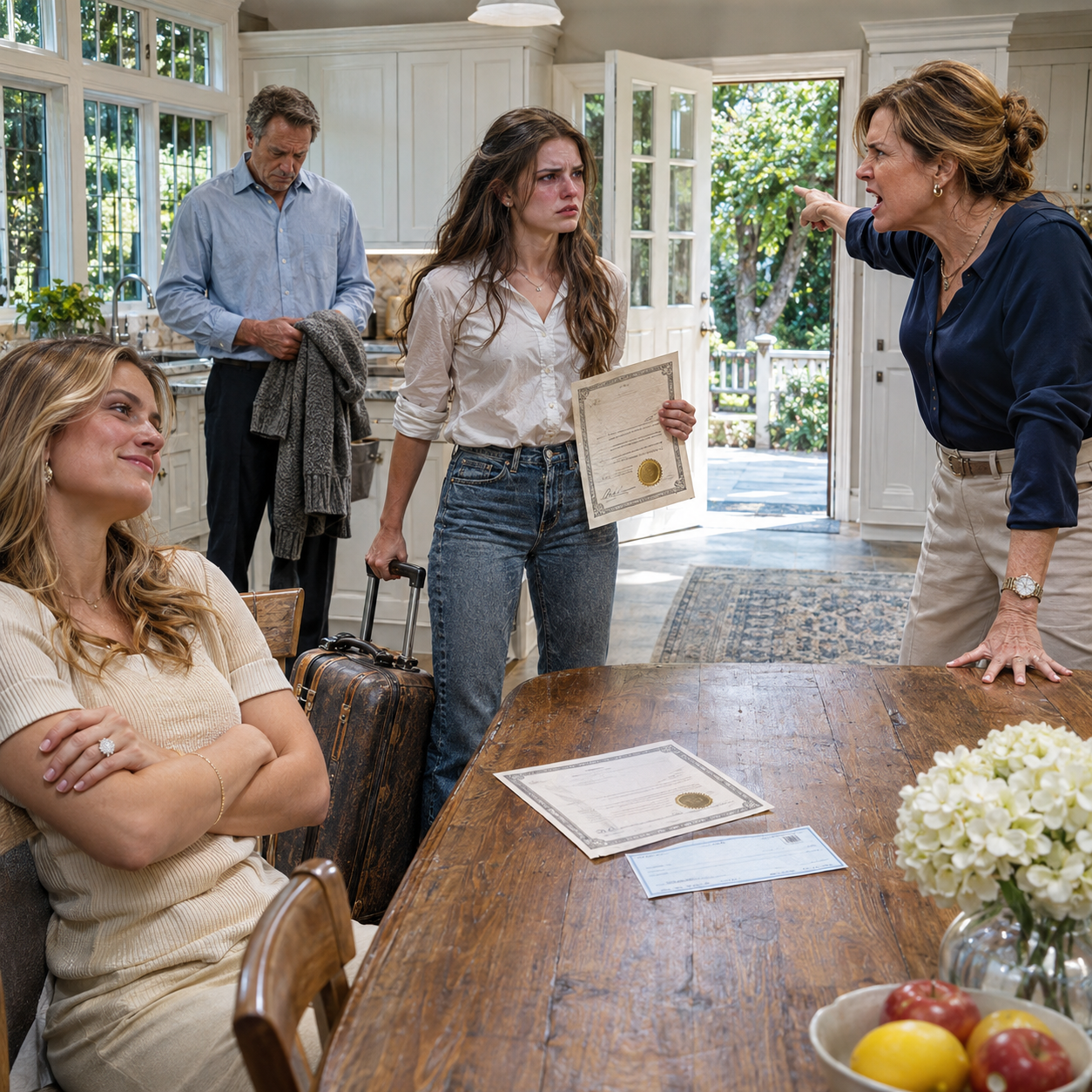
Nathan rode the elevator down beside me without taking over. The hotel lobby smelled like polished stone and orchids. Mom waited near the reception desk in navy silk and pearls. Dad wore a dark suit and the tie I had bought him years ago. Brooke had chosen blush, as if even arriving uninvited at my wedding required competing with the bride.
Mom’s face crumpled. “Emily.”
“You cannot be here.”
Dad stepped forward. “This has gone far enough. We are your family.”
I studied him: the man who introduced me for years as “the quiet one,” who warned my fiancé that I was unstable, who considered my stolen scholarship reasonable collateral for Brooke’s convenience.
“No,” I said. “You’re my relatives.”
Mom pressed her fingers against her mouth. “Please don’t do this on your wedding day.”
“You mean set a boundary? I should’ve started sooner.”
Brooke folded her arms. “You’re addicted to making yourself the tragic heroine. Mom’s been crying for weeks.”
I turned toward her. “You stole an opportunity that could have changed my life, admitted why you did it, and still never apologized. If you speak to me after today, it will be because you deliberately ignored my request not to.”
For once, Brooke had nothing to say.
Dad tried the only argument he had left. “Whatever happened years ago can be discussed privately, but if people see us being turned away—”
I almost smiled.
Still the optics.
“You think I’m doing this to embarrass you,” I said. “I’m not. I’m doing it because I finally believe what you’ve shown me.”
Mom stepped toward me. Her mascara had begun to smear. “We loved you.”
Maybe she believed that. Maybe she even had loved me in whatever limited form she was capable of.
“You loved the version of me that never inconvenienced Brooke.”
I reached into my satin bag and removed the old bracelet. I had brought it for a reason I had not fully understood until then. Thirteen-year-old me had braided those threads because she believed if she made love beautiful enough, her mother might keep it.
I placed it on the reception desk.
“You can keep the symbol,” I said. “I’m done carrying the story.”
Dad’s face hardened. “If you walk away from this family today, don’t expect to come back.”
For most of my life, that sentence would have terrified me.
Now it sounded like freedom.
“That,” I told him, “is the first honest offer you’ve ever made me.”
I turned toward the elevator. Security handled the shouting that followed.
When the doors closed, Nathan finally asked, “How do you feel?”
My cheeks were wet. My hands were shaking. My chest hurt.
But somewhere underneath all of it, something bright had opened.
“Free,” I said.
The elevator rose.
Above us, the music began.
And for the first time in my life, I was walking toward a future without anyone standing in front of me deciding whether I deserved it.
### Part 4
I walked down the aisle alone by choice. That distinction mattered. I was not an abandoned daughter marching toward marriage because nobody wanted to claim me; I was a grown woman who had finally stopped treating being claimed as proof of worth. The white runner lifted slightly in the rooftop breeze. Jenna cried openly in the front row. Aunt Susan clutched a handkerchief with both hands, and Mrs. Hale smiled at me with the same expression she had worn years earlier when I showed her artwork I had been too frightened to submit. Nathan waited beneath an arch of white roses, his face completely unguarded. He had first seen me carrying blueprints in uncomfortable shoes on a windy hospital roof, and somehow he had kept seeing me clearly even when my own family insisted their version of me was more believable.
Our vows were simple. I promised I would never again disappear inside silence just to keep a room comfortable. Nathan promised he would never ask me to earn the right to be loved. When we kissed, there was no helicopter, no shocked audience, no dramatic reversal. It was warm and certain and almost ordinary, which made it more meaningful than every spectacular gesture that had come before it.
During the reception, I stood alone near the rooftop railing for a few minutes. The city stretched below me in glass and steel. Jazz drifted from behind me, mixed with laughter and the clink of champagne glasses. I looked at my wedding ring and expected to feel haunted by the three people who had been removed from the lobby.
Instead, I felt quiet.
Nathan joined me and wrapped one arm around my waist. “Any regrets?”
“Only that it took me this long.”
He kissed my temple. “Late still counts.”
My parents tried to contact me afterward. Mom mailed a long handwritten letter full of phrases like “difficult season,” “misunderstandings,” and “a mother’s broken heart.” She never wrote, I hid your acceptance letter. She never wrote, I laughed while everyone humiliated you. She never wrote, I chose your sister’s convenience over your future. Dad sent a message six weeks later saying, When you’re ready to behave like an adult, we can discuss moving forward.
I deleted it.
Brooke’s final attempt was almost impressive.
Hope married life is good. If Nathan ever wants to discuss investments, Derek is moving into a new sector.
I stared at the message, laughed, blocked her number, and went for ice cream with Jenna.
People imagine refusing forgiveness must feel angry. Mine did not. It felt like opening a window after living for years in a room where something had spoiled behind the walls. The air was suddenly cold and clean. I understood that forgiveness and access were not the same thing anyway. I could stop waking up furious without letting the people who hurt me walk back through my front door.
Months passed. Nathan and I built a life that would have looked boring to my younger self and miraculous to the woman I had become. Grocery lists appeared on the refrigerator. We argued about lamps. We forgot laundry in the washer. Sometimes he cooked too late, and sometimes I worked at the kitchen table while he answered emails beside me. There were no audiences. No competitions. No one keeping score.
I began drawing again.
At first I could barely tolerate looking at my old work. Every charcoal line seemed connected to the seventeen-year-old girl whose scholarship had been hidden from her. Then Mrs. Hale reminded me that an opportunity stolen once did not have to become permission to steal every opportunity that came afterward.
So I applied for a competitive design fellowship.
The morning the acceptance email arrived, I stared at the screen for nearly a minute before screaming so loudly Nathan came running from the other room.
“What happened?”
I turned the laptop toward him.
He read the email, looked at me, and grinned. “You got it.”
“I got it.”
There was no mother telling me not to overshadow Brooke. No father describing it as “good too.” Nobody needed me to shrink the news until it fit comfortably around somebody else’s celebration.
Nathan opened a bottle of sparkling wine at ten in the morning.
We celebrated anyway.
One Saturday that fall, while looking for stamps in my desk, I found the bracelet. I thought I had left it on the hotel reception desk, but Aunt Susan had apparently picked it up after my family was escorted away and slipped it into a box of wedding belongings sent to us later.
I held the faded blue and green threads in my palm.
For years, I had thought the bracelet represented my mother throwing away my love.
That suddenly felt unfair to the girl who had made it.
She had been thirteen. She had sat somewhere with embroidery thread tangled around her fingers and carefully chosen her mother’s favorite colors. She had believed affection could be made by hand. She had kept trying in a house where one daughter sparkled and the other carried things.
That girl was not pathetic.
She deserved better.
I wrapped the bracelet in bright yellow tissue paper, put it into an envelope, addressed it to myself at our home, and mailed it.
Two days later Nathan brought the package inside.
“You mailed yourself something?”
“Yes.”
“What is it?”
I opened the envelope and smiled.
“Proof.”
“Of what?”
I lifted the bracelet from the yellow paper.
“That something handmade can survive being put in the wrong drawer.”
I kept it.
Not because I forgave my mother.
Not because my father eventually understood.
Not because Brooke apologized.
None of those things happened.
I did not invite them back. I did not trade my peace for their comfort, and I did not let regret arrive years too late and rename itself love.
I married the man who saw me.
I returned to the work I loved.
I chose a life that actually fit.
And months later, when the distant sound of helicopter blades rolled across the afternoon sky, I looked up through the window, smiled for a moment, and returned to my drawing.
For once, I had absolutely nothing left to prove.
THE END!
Disclaimer: Our stories are inspired by real-life events but are carefully rewritten for entertainment. Any resemblance to actual people or situations is purely coincidental.