
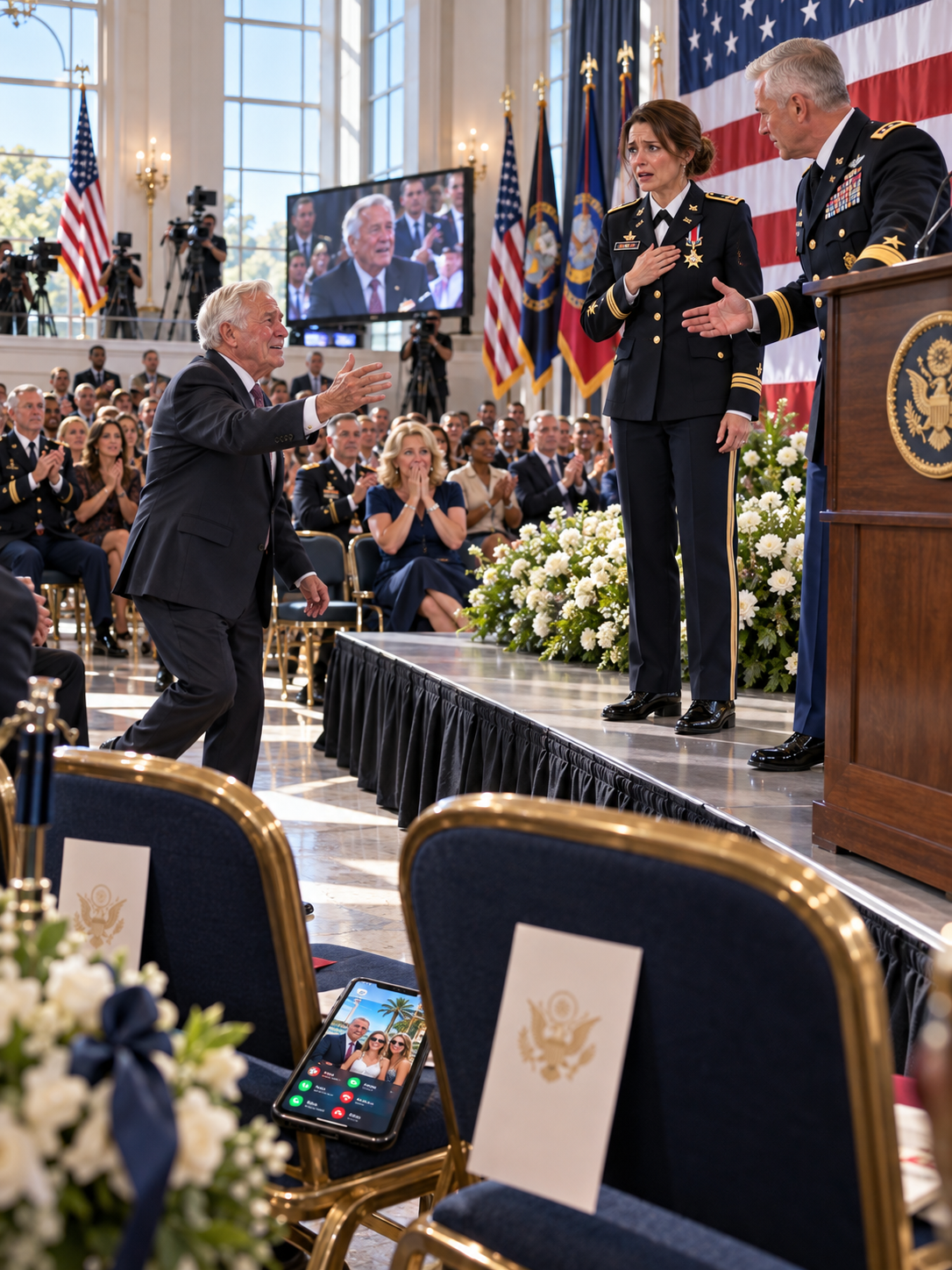
40 minutes before I received the Bronze Star Medal, my stepfather told me never to wear my uniform in his house again because I had “chosen strangers over family.” My mother skipped my ceremony for my stepsister’s Miami launch party, leaving two front-row seats empty. I thought I had finally stopped caring. Then the commander called someone else from my family onto the stage, cameras kept rolling, and ninety minutes later my phone showed thirty-seven missed calls from people who suddenly remembered I existed.
### Part 1
The first call came while I was still wearing my dress uniform in the parking lot, sitting behind the wheel of my truck with both hands resting at ten and two like I was waiting for somebody to grade my driving. The September night outside Fort Belvoir had turned cold enough to fog the lower edge of the windshield, and every few seconds my phone rattled against the passenger seat, stopped, then started again. Thirty-seven missed calls in ninety minutes, most from the same three people who had barely managed thirty-seven meaningful conversations with me in the previous six years.
I turned the phone facedown and watched my own reflection in the glass. The medal pinned over my left breast caught a stripe of parking-lot light whenever I moved, and I should have been thinking about the ceremony, the applause, or Colonel Nathan Caldwell reading the citation while three hundred people stood quietly beneath white auditorium lights. Instead, I kept hearing my stepfather’s voice from that morning: “You made your choice, Morgan. Don’t ever wear that uniform in my house again.”
My name is Morgan Ellis, I was twenty-eight years old, and by then I had served six years as an Army combat medic. People who have never done that job tend to imagine helicopters, dramatic rescues, and somebody shouting for a medic while patriotic music plays in the background, but most of what I remember is smaller and less cinematic: grit caught behind my teeth, diesel fumes settling into my hair, instant coffee cooling beside boxes of gauze, and the strange silence that comes after a medical tent has been loud for hours. I learned very early that panic is a luxury you schedule for later.
I grew up outside Richmond with my mother, Linda Ellis, after my biological father disappeared before I was old enough to remember much beyond the smell of his aftershave. When I was nine, Mom married Dale Mercer, a salesman who wore pressed polo shirts on Saturdays and treated politeness like a weapon; two years later, my half sister Kayla was born, and the entire temperature of our house changed. Nobody announced that I had become less important, because families rarely announce those things, but I could feel it in who got the bigger bedroom, whose school events went on the refrigerator, and whose disappointment could rearrange everybody else’s weekend.
Dale never hit me or screamed at me when I was little. He was more efficient than that. He would look at me across the dinner table like I was an extra place setting, then turn to Kayla and ask about dance practice while my mother followed his attention as naturally as a sunflower follows light; by thirteen, I had learned that being useful earned more peace than asking to be noticed.
I babysat Kayla, packed her lunches when Mom worked late, drove her to cheer practice after I got my license, and learned to say, “It’s fine,” before anybody finished asking whether something bothered me. When I graduated high school, Dale spent most of my party telling relatives about Kayla’s middle-school talent show, and that night I lay awake staring at the glow-in-the-dark stars still stuck to my ceiling from childhood and realized I could either spend my life competing for scraps or leave. I enlisted seven days after my nineteenth birthday.
Basic training was the hardest physical thing I had ever done and one of the cleanest emotional experiences of my life. Nobody cared that Dale thought Kayla was special, nobody cared that my mother forgot to mail the care package she promised, and nobody cared that I had spent years trying to become easier to love; if I carried my weight, learned fast, and showed up when it hurt, I belonged. Becoming a medic felt almost inevitable because I understood instinctively what it meant to be needed when somebody was terrified.
The money problem started during my first deployment. Mom called one evening and said Kayla needed orthodontic work sooner than expected, their insurance was complicated, and could I send a few hundred dollars until Dale’s next commission check cleared; I did it within ten minutes. Two months later it was a car repair, then a school trip, then a laptop Kayla “absolutely needed,” and each time my mother ended the request with some version of, “You know we’d do the same for you.”
I wanted to believe that sentence so badly I never tested it. By my second deployment, Dale had persuaded me to split part of my direct deposit into an old joint account my mother could access because, according to him, “You’re overseas. Somebody responsible should be able to handle emergencies.” What counted as an emergency gradually expanded until it included Kayla’s phone upgrades, salon appointments, a leased apartment she barely used, and equipment for what she called her “brand.”
Kayla was twenty-three by then and convinced she was one viral post away from becoming a fashion entrepreneur. She had around forty thousand followers, filmed outfit clips in rented spaces, and had begun designing a small swimwear line using manufacturers she found online; I did not dislike her ambition, and I never blamed her for wanting something of her own. What I eventually blamed her for was knowing exactly where the money came from and deciding that my silence meant permission.
The moment something inside me finally started breaking happened after a brutal day overseas. We had spent hours treating casualties from an attack near a checkpoint, and when I finally got a few minutes to sit down, the skin around my wrists was irritated from gloves, my shoulders felt like concrete, and my coffee tasted faintly like dust. I called home because I wanted to hear my mother say my name in a voice that meant I was her daughter, not her bank account.
She answered on the second ring. “Morgan, thank God. The transfer limit is blocking me again, and Kayla has a studio deposit due tonight.”
I stared at the plywood wall in front of me. Somewhere behind it, a generator coughed and settled into its steady metallic hum. “Hi, Mom.”
“Yes, hi, sweetheart, but listen, I need you to open your banking app.”
I waited for the question that never came. How are you? Are you safe? Did you eat? Anything. Instead, she kept explaining the studio contract until finally I unlocked the app with hands that still smelled like antiseptic and raised the transfer limit.
After I hung up, one of the younger soldiers I had treated earlier asked whether somebody from home had called. I looked at him, then at the dark screen of my phone, and said, “Something like that.”
I wish I could tell you I changed everything that night. I didn’t. People imagine boundaries arrive like thunder, but mine came like a crack in glass, almost invisible at first; I kept sending money because the nine-year-old version of me was still convinced there had to be a price I could finally pay that would make somebody choose me.
The price just kept getting higher.
Then, one Tuesday morning almost a year before my medal ceremony, Dale called me himself.
And by the time that call ended, I finally understood that he had never considered my service a sacrifice at all.
He considered it income.
### Part 2
That Tuesday began before sunrise with an explosion far enough away not to hit our aid station but close enough to shake powder from the seams of the plywood ceiling. By breakfast, a patrol had come in with several wounded soldiers, and for nearly two hours my world narrowed to clipped instructions, monitor tones, boot soles squeaking against the floor, and the face of a twenty-year-old corporal named Marcus Bell trying very hard not to look scared. We stabilized him for evacuation just after noon, and when the helicopter finally lifted, I sat on an overturned supply crate outside with my elbows on my knees and waited for my hands to stop trembling.
My phone buzzed in my pocket. Seeing Dale’s name was strange enough that I almost assumed something had happened to Mom, because in nineteen years he had called me directly maybe four times. Instead, the moment I answered, he said, “Kayla’s Miami launch is next month. We need eighteen hundred for the booth and photographer, and your reenlistment money should’ve cleared.”
For several seconds I genuinely thought exhaustion had made me misunderstand him. Wind pushed hot dust across my boots, somebody rolled a metal cart behind me, and on the landing pad in the distance the helicopter carrying Marcus became a shrinking dark shape against the pale sky. “Dale, I just spent almost two hours trying to keep a twenty-year-old soldier alive.”
His answer came without hesitation. “And?”
I straightened slowly. “And I’m not talking about a swimsuit launch right now.”
“This is Kayla’s career, Morgan. You’re over there playing soldier, but she’s trying to build something real.” His voice had that flat, managerial tone he used whenever he wanted disagreement to sound immature. “Besides, what do you even spend money on over there?”
I remember looking at my hands and noticing a thin brown line of dried antiseptic along one thumb. For years I had imagined that if Dale ever said the quiet part aloud, it would crush me; instead, hearing it made everything suddenly simple. “No.”
The silence was immediate.
Then I heard movement on his end, and my mother’s voice replaced his. “Excuse me?”
“I said no.”
“Morgan, don’t start this today. Your sister has contracts signed.”
“A soldier I treated this morning is on his way to surgery, Mom.”
“And we’re grateful you have a job you care about, but family doesn’t stop existing because you’re busy.”
I laughed once, not because anything was funny. “That is an incredible sentence.”
“What is that supposed to mean?”
“It means I’m not sending the money.”
My mother inhaled sharply, and I knew the script that was coming before she started: everything they had sacrificed for me, the roof Dale had “put over my head,” the food they had “provided,” the years they had “supported” my decisions. She talked about my childhood like I had taken out a loan at nine years old and finally become delinquent. I let her speak for maybe thirty seconds, then ended the call without defending myself.
The strangest part was what happened afterward. Nothing exploded. Nobody from command walked over to accuse me of being selfish, the sky did not change color, and the earth kept rotating while I sat there realizing I had just said no to my mother and survived it. That realization frightened me more than the argument.
Three weeks later, during a rare quiet evening, I was scrolling through my phone when Kayla’s newest post appeared. She was leaning against a brand-new white luxury SUV in Mom and Dale’s driveway, one heel lifted behind her, sunglasses pushed into her hair, and beneath the photo was a caption about “manifesting the life you deserve.” I stared at it long enough for the screen to dim.
The monthly lease alone was more than my first apartment had cost. I zoomed in, noticed the temporary dealer plate, and felt something colder than anger settle into me because I already knew where at least part of the down payment had come from. I checked the joint account.
There were withdrawals I did not recognize, transfers in round numbers, and one payment to an auto dealer that made my stomach drop.
For the first time, I did not call home.
I opened a new account at a different bank, moved every dollar I legally controlled, changed my pay elections so my salary went entirely into my name, reset every password, and contacted finance to make sure no old authorization remained attached to my records. I went methodically, one screen at a time, while the air conditioner in the barracks rattled over my head and the smell of somebody’s reheated noodles drifted down the hall. When I finished, I stared at the confirmation page for several minutes before closing the laptop.
Dale noticed within seventy-two hours.
His first voicemail said there had obviously been a banking error. His second said I needed to stop “playing games.” By the sixth, I was apparently ungrateful, unstable, selfish, manipulated by military people who “didn’t understand family,” and deliberately sabotaging Kayla’s future out of jealousy.
Mom’s messages were softer and worse. “Morgan, honey, nobody is saying your money belongs to us. We’re saying families share. I don’t recognize you anymore.”
That sentence almost got me. I listened to it three times in the dim barracks hallway, feeling the old reflex rise in me, the need to call, explain, apologize, and make everybody comfortable again. Then Staff Sergeant Leah Torres walked by carrying a laundry bag, saw my face, and asked, “Bad news?”
“Family.”
She nodded once. “Sometimes that is the bad news.”
I laughed so unexpectedly I nearly cried.
I finished the deployment without answering any of their calls. When I returned stateside, I requested assignment in Virginia but did not move home; I rented a modest one-bedroom apartment forty minutes from base, furnished it with a secondhand couch and a kitchen table I assembled badly enough that one leg needed cardboard underneath. The first night there, I ate takeout noodles on the floor with no television, no curtains, and no one asking me for anything.
I had never experienced silence that felt so expensive and so good.
There was one person from Dale’s family I refused to lose. His mother, Evelyn Mercer, was seventy-one, lived alone in a small house in North Carolina, and had somehow managed to treat me like a granddaughter from the day Dale married Mom even when Dale himself never treated me like a daughter. Evelyn mailed handwritten letters during every deployment, remembered every promotion, and once sent me a birthday card three weeks early because, as she wrote inside, “The mail is unpredictable, but loving you shouldn’t be.”
When I came home, I began visiting her every other weekend. I replaced a loose porch board, carried groceries, cleaned gutters, and sat at her kitchen table drinking coffee from cups that never matched; she never once asked what happened between me and Dale until the afternoon I finally told her.
She listened without interrupting.
Then she took off her glasses, folded them carefully on the table, and said, “Your stepfather has always confused being needed with being obeyed.”
I looked at her. “You knew?”
“I knew enough.”
“What did he tell you?”
Her expression changed just slightly.
And that was when I learned Dale had been telling the family a completely different story about me.
### Part 3
According to Dale, I had come home from deployment arrogant, cut everybody off because I thought my uniform made me better than them, and abandoned my mother financially after years of depending on his generosity. The version reaching relatives left out the split direct deposit, the launch expenses, the SUV payment, and every phone call from overseas; in Dale’s story, I was a difficult stepdaughter who had finally revealed her true personality. Evelyn told me all of this while sunlight moved slowly across her kitchen linoleum and a wall clock ticked so loudly I could hear each second between her sentences.
“Your aunt asked me why you were punishing Linda,” she said.
“What did you tell her?”
“That if she wanted an answer, she could ask you.”
I rubbed both hands over my face. “Thank you.”
Evelyn shrugged. “Truth does not need me to decorate it.”
That was how she lived. She had spent most of her adult life working in a county records office, raised three children after her husband died young, and had developed the unnerving habit of waiting silently until other people filled the space with their own dishonesty. Dale called that trait “difficult”; I called it the reason I trusted her.
Over the next several months, my life stabilized. I worked long shifts at Fort Belvoir, started sleeping through the night more often, and learned ordinary pleasures I had never noticed before, like buying groceries without mentally calculating what portion of my paycheck might disappear before I got home. I kept an emergency savings account, paid off the last small debt attached to my name, and even bought a used pickup in cash; it was seven years old, dark blue, and smelled faintly of the previous owner’s pine air freshener, but the title had only my name on it.
Mom tried reaching me through relatives. One cousin sent a message saying, “Your mother is devastated,” followed three minutes later by, “Also, did you really cut off Kayla’s business money?” That told me exactly which part of the devastation everybody had been discussing.
Kayla contacted me once. Her message read, “Whatever issue you have with Mom and Dad isn’t my fault. I’ve got vendors depending on me.”
I stared at those words longer than I should have. Finally I answered, “Were you told the SUV payment came from my account?”
The typing bubble appeared, vanished, appeared again, then disappeared completely.
She never replied.
That silence was more useful than an argument.
About eleven months after I moved into my apartment, my battalion commander asked me to report to his office. I spent the walk there mentally reviewing every report I had filed that week, wondering whether I had missed a signature, but when I entered, he stood and offered his hand. “Sergeant Ellis, congratulations.”
I must have looked confused because the first sergeant smiled. On the desk between them sat a folder with my name on it.
I had been approved to receive the Bronze Star Medal with a valor device for actions during my last deployment, including the Tuesday operation involving Marcus Bell and two later incidents where evacuation delays had forced our medical team to improvise treatment under dangerous conditions. I knew recommendations had been submitted, but those things can disappear into paperwork for months, and I had deliberately stopped asking. Hearing the award was real made the room seem strangely small.
The ceremony would be held six weeks later as part of a larger installation program honoring combat medical personnel. Several service members were being recognized, local media had been invited, and the public affairs office planned to stream the event; family seating would be reserved near the front.
“Who should we list as your guests?” the administrative sergeant asked.
I said my mother’s name before I had time to stop myself.
That embarrassed me later.
After everything, some stubborn piece of me still imagined Mom seeing me on a stage, hearing the citation read aloud, and finally understanding that those years away had not been a game. I added Dale because excluding him felt like admitting I wanted to hurt him, and at that point I was still measuring my morality by how little discomfort I caused people who had caused me plenty.
I mailed them invitations myself.
For almost a week I heard nothing.
Then Mom called from a number I did not recognize. I answered because I thought it might be work.
“Morgan?”
My stomach tightened immediately. “How did you get this number?”
“Evelyn gave it to me because she understands families should communicate.”
I closed my eyes. I knew Evelyn well enough to suspect Mom had probably framed it as an emergency, but I did not want to drag her into the middle. “Why are you calling?”
Mom’s tone brightened artificially. “We got your invitation. This is wonderful. Really, it is. We’re proud of you.”
I waited.
Sure enough, she continued. “There’s just one little scheduling conflict.”
Kayla’s Miami launch.
Not a small pop-up anymore, according to Mom. Apparently several online personalities might attend, a photographer from a local lifestyle magazine had expressed interest, and Dale had already booked flights. The event fell on the same Saturday as my ceremony.
“We promised her months ago,” Mom said. “You understand.”
I looked out the window of my apartment at rain sliding down the glass. “You’re choosing a swimsuit launch over my Bronze Star ceremony.”
“Don’t make it ugly.”
“I repeated what you said.”
“You’ll have other Army ceremonies, Morgan. Kayla gets one first major launch.”
I almost laughed at the absurdity of hearing my mother describe a military decoration as something that came around every summer. “It’s a Bronze Star, Mom.”
“I know what it is.”
“No, you don’t.”
Her voice sharpened. “I’m not going to be guilted because you scheduled something the same weekend.”
I did not bother explaining that the United States Army had not coordinated its ceremony around Kayla’s fashion calendar.
Instead I said, “Okay.”
She paused, clearly expecting resistance. “Okay?”
“Go to Miami.”
There was silence.
For years my anger had been useful to them because anger meant engagement. The first thing that truly frightened my mother was my calm.
After we hung up, I called Evelyn.
“Grandma, are you busy on September nineteenth?”
She immediately said, “No.”
“You don’t even know what I’m asking.”
“I know enough.”
When I invited her, she started crying so quietly that at first I thought the connection had dropped. She apologized, sniffed, and said, “I would be honored, sweetheart.”
I bought her plane ticket that evening and booked a hotel near the base. A week later, the public affairs office asked whether any of my guests had been unusually important during my deployments because the program included a short section about family support. I gave them Evelyn’s name and mentioned her letters, nothing more.
At least, I thought it was nothing more.
Three days before the ceremony, Captain Wallace from public affairs stopped me in a hallway and asked an odd question.
“Sergeant Ellis, has Mrs. Mercer received any calls from a family support organization recently?”
I frowned. “Not that I know of. Why?”
He smiled too quickly. “Just checking something.”
Then he walked away.
And for the first time, I wondered whether the empty chair beside Evelyn was about to become important for a reason nobody in my family saw coming.
### Part 4
Evelyn arrived in Virginia Friday afternoon wearing a navy coat and carrying one small suitcase that looked older than I was. I met her at the airport, and she hugged me so tightly that the side of her glasses pressed into my cheek; on the drive to her hotel she asked fifteen questions about the ceremony, none of them involving what she should wear on camera, where she would sit, or whether anyone important would be there. She wanted to know if I was nervous, whether my unit friends would attend, and whether I had eaten lunch.
That alone almost broke me.
We had dinner at a quiet diner near the hotel where the coffee came in thick white mugs and the vinyl booth cracked when we shifted our weight. Evelyn ordered meatloaf, looked at me over her glasses, and said, “Your mother called this morning.”
I put down my fork. “About what?”
“She wanted to know whether I was really coming.”
“What did you say?”
“I said yes.”
“And?”
“She told me I was encouraging your resentment.”
I leaned back. “Of course she did.”
Evelyn spread butter across a dinner roll with calm precision. “Then Dale took the phone and told me this was a private matter between your household and theirs.”
“Your household?”
“He was upset.”
I watched her face. “Did he tell you not to come?”
“He suggested it.”
“And you?”
“I suggested he enjoy Miami.”
I nearly inhaled my coffee.
The next morning I woke at five even though the ceremony did not begin until ten. My dress uniform hung from the closet door, perfectly pressed, and for several minutes I stood barefoot on the carpet looking at it while the apartment was still dark; medals and ribbons are small objects until you understand how much exhaustion, fear, paperwork, luck, and loss can fit inside a few inches of metal. I showered, dressed slowly, checked everything twice, then drove to pick up Evelyn.
She came out of the hotel wearing a soft blue cardigan over a gray dress and carrying the small leather purse she used for church. When she saw me standing beside the truck in uniform, she stopped completely.
“Oh, Morgan.”
I smiled. “Too much?”
She walked over, placed one hand against my cheek, and shook her head. “Exactly enough.”
We were twenty minutes from the base when my phone rang through the truck speakers.
Dale.
I almost ignored it, but Evelyn glanced at the display and said, “Answer if you want. Don’t answer for me.”
I pressed the button.
Dale did not say hello. “I heard you brought my mother up there.”
“She’s sitting beside me.”
There was a short pause. “Put me on speaker.”
“You already are.”
“Mom, you don’t need to be involved in this.”
Evelyn stared straight ahead through the windshield. “Good morning, Dale.”
“This thing between Morgan and Linda has gotten ridiculous.”
“This thing has a name. It’s called consequences.”
His breathing changed. “You’ve always done this. You always take the other person’s side.”
“No. I take the side I can sleep with.”
I gripped the steering wheel harder to keep from smiling.
Then Dale turned his attention to me. “Morgan, you’re doing this to humiliate your mother.”
“I invited Grandma because she supported me.”
“We supported you.”
“With what?”
“Don’t you dare.”
The temperature inside the truck seemed to change. Evelyn reached over and rested her hand lightly on my forearm, not to stop me, just to remind me I was not alone.
Dale continued, voice low and controlled. “You ran away, cut your mother off, and turned my own mother against me because we asked you to help your sister.”
“You took money from my account for a vehicle without asking.”
“That money was sitting there.”
“It was mine.”
“You were living overseas at government expense.”
I actually laughed. “There it is again.”
“What?”
“The part where you think my deployment made my paycheck yours.”
His patience finally snapped. “You will never wear that uniform in my house again. Do you understand me? You made your choice when you chose those people over us.”
I looked through the windshield at the morning traffic, then at Evelyn’s hand still resting on my sleeve. Something that would once have felt like rejection landed with almost no weight.
“That’s fine,” I said. “I wasn’t planning to wear it there.”
I ended the call.
For about a mile, neither of us spoke.
Then Evelyn said quietly, “He always thinks closing a door is punishment.”
I glanced at her.
“He never notices when somebody is relieved to be outside.”
Forty minutes later, I stood backstage with four other service members waiting to walk into the auditorium. I could hear people settling into seats beyond the curtains, programs rustling, children being hushed, and the low hum of conversation under the public address system; one of the sergeants beside me kept flexing his fingers, while another whispered that his mother had brought twenty relatives and might somehow start cheering before anybody’s name was called.
When we walked out, the lights were brighter than I expected.
I saw Evelyn immediately in the front row.
Beside her were two reserved seats that should have held Mom and Dale.
For half a second, the sight still hurt.
Then Evelyn caught my eye and lifted her chin in the smallest, proudest nod I had ever seen.
The ceremony moved through introductions, recognition of several medical teams, and finally the individual decorations. When Colonel Caldwell called my name, I stepped forward, came to attention, and listened while he read the citation; the formal language described decisions I remembered making in sweat, dust, confusion, and fear, turning ugly hours into polished sentences about courage and devotion to duty.
When he pinned the medal to my uniform, the applause seemed to arrive from very far away.
I looked at Evelyn.
She was crying openly.
I almost did too.
But the ceremony was not finished.
Colonel Caldwell returned to the microphone and said, “Before we close today’s program, we have one additional recognition connected to Sergeant Ellis’s story.”
I felt my forehead crease.
Captain Wallace stood near the curtain, watching me with a suspiciously satisfied expression.
Then Colonel Caldwell looked directly toward the front row.
“Mrs. Evelyn Mercer, would you please join us?”
Evelyn went completely still.
So did I.
And somewhere hundreds of miles away, my mother and Dale had no idea the livestream was still running.
### Part 5
Evelyn looked at me as if I had secretly arranged a marching band behind her. I shook my head because I honestly had no idea what was happening, and the woman seated beside her gently touched her elbow until Evelyn finally stood; she walked toward the stage carefully, one hand gripping the strap of her purse, while the entire auditorium watched. Colonel Caldwell stepped aside as a woman from a regional military family support foundation approached the microphone.
Her name was Denise Harper, and I recognized the organization only vaguely. Months earlier, I had mentioned it to Evelyn after she told me she worried about other grandparents and parents supporting deployed family members without knowing where to find resources; apparently she had filled out paperwork, written letters, and helped connect two other military families in her county with assistance. What I did not know was that somebody from one of those families had nominated Evelyn for the foundation’s annual Homefront Service Award.
Denise described letters mailed every month for years, rides Evelyn had given to another military grandmother who no longer drove, meals she had prepared when a Marine nephew’s wife had surgery, and the way she quietly kept track of birthdays and deployment dates across three branches of service. Evelyn stood under the stage lights with her hands pressed against her mouth, shaking her head slightly as if every sentence must be about somebody else.
Then Denise said, “This year, our regional partners wanted the award to mean something practical.”
A photograph of Evelyn’s small North Carolina house appeared on the screen behind them.
My stomach dropped.
Her roof had been patched twice in four years. The plumbing beneath the kitchen sink leaked whenever temperatures fell below freezing, the upstairs bathroom floor had begun to warp, and the front steps were difficult for her knees; Evelyn had saved money for repairs, but every estimate seemed to uncover another problem.
Denise smiled at her. “Mrs. Mercer, through donations from our partner contractors and veteran-support organizations, your home has been selected for a fully funded renovation. That includes a new roof, necessary plumbing work, safer entry access, and accessibility improvements throughout the main floor.”
The room erupted.
Evelyn’s knees visibly buckled, and I moved before I realized I was moving, stepping down to steady her arm. She turned to me with tears streaming down her face.
“Did you do this?”
“No.”
“Morgan.”
“I swear.”
Denise laughed softly into the microphone. “Sergeant Ellis knew about the support program, but she was not informed about today’s selection.”
That was when I started crying.
I had kept my face dry while hearing my own award citation, but watching Evelyn stand there after spending decades being treated by Dale like an inconvenient old woman who asked too many questions did something to me. The applause lasted long enough that she had to wipe her eyes twice before accepting the plaque.
The livestream continued through the announcement.
That mattered.
Afterward, people crowded around Evelyn in the lobby. Soldiers I barely knew hugged her, one colonel’s wife asked about her letter-writing habit, and a young private told her his grandmother did the same thing; Evelyn looked overwhelmed but radiant, her blue cardigan slightly crooked from all the embraces.
My phone started vibrating during the reception.
Mom.
I let it ring.
Thirty seconds later, Dale.
Then Mom again.
I put the phone into my pocket.
Evelyn noticed. “Them?”
“Probably.”
“You can answer.”
“I know.”
I didn’t.
We went to dinner with Leah and two members of my medical unit, and for almost an hour I managed to forget the phone existed. Evelyn told embarrassing stories about me trying to bake biscuits at fourteen, Leah described the first time she saw me argue with a physician twice my rank, and I ate a cheeseburger while feeling something unfamiliar settle over the table.
Peace.
Not victory.
Not revenge.
Just peace.
I drove Evelyn back to her hotel shortly after seven. She carried the award plaque against her chest the whole ride as if somebody might take it back if she set it down; when we reached the entrance, she hugged me and whispered, “Today should have been about you.”
“It was.”
“No, sweetheart.”
I stepped back. “Watching you get something good did not take anything from me.”
Her eyes filled again.
That sentence surprised me because I realized I meant it.
After she went inside, I returned to my truck and finally looked at my phone.
Thirty-seven missed calls.
Fourteen from Mom.
Eleven from Dale.
Seven from Kayla.
The rest from two relatives I had barely spoken to in years.
There were seventeen voicemails and more text messages than I cared to count.
The first message from Mom said, Call me immediately.
The second said, What did you tell those people?
The third said, This has gone too far.
Dale’s messages were stranger. Did you nominate her? Call me. Mom does not need strangers tearing up her house. We need to discuss what happens with that money.
That last line made me stop.
What money?
The renovation was not a cash prize.
I opened his voicemail.
His voice came through tight and hurried. “Morgan, you need to call me before your grandmother signs anything. She doesn’t understand these programs. If there’s grant money attached, there are family considerations. Kayla’s business is in a really difficult period, and your mother and I have expenses you don’t know about.”
I sat motionless.
There it was.
Not pride in Evelyn.
Not relief that his seventy-one-year-old mother would have a safe roof.
He had heard “award” and immediately started calculating whether some part could be redirected toward himself.
I played Mom’s longest voicemail next.
“Morgan, I don’t understand why Evelyn was singled out. Your father—Dale—is extremely hurt. We supported you too, and somehow you managed to make this entire ceremony a statement against us. People have already sent us the video. Do you understand how humiliating that is?”
I whispered to the empty truck, “You weren’t even there.”
Then I played Kayla’s voicemail.
Her tone was annoyed rather than angry. “Hey, did Grandma actually get a free house renovation? Dad’s being weird and Mom’s crying. Also, do you know if the livestream showed anything from Miami? A reporter was supposed to come to my launch, but I haven’t seen coverage.”
I stared at the dashboard.
That was the exact moment something final happened inside me.
For years I had wondered whether there was a version of the truth I could explain clearly enough to make them understand me.
Sitting there with thirty-seven missed calls, I finally understood the problem was not that they misunderstood.
They understood perfectly.
They just preferred the arrangement where I paid.
I turned off my phone.
What I did not know yet was that Dale had a much bigger reason to be panicking than Evelyn’s renovation.
Within two weeks, a letter would arrive at my apartment that explained why losing access to my paycheck had terrified him from the beginning.
And this time, the problem had my name on it.
### Part 6
The letter came on a Wednesday in a plain white envelope from a financial institution I recognized but had not used in years. I almost threw it into the pile of advertising mail on my kitchen counter until I noticed my full legal name printed beneath a reference number; when I opened it, the first paragraph said they were updating contact information on an old account associated with a line of credit. I read that sentence three times.
I did not have a line of credit there.
I called the number printed on the letter, verified my identity, and learned the account had once listed me as an authorized secondary party when I was barely twenty. It had been opened during my first deployment, when Dale convinced me to sign several documents “in case the family needed emergency access while you’re overseas”; technically, the account balance was now zero and closed, but archived statements showed transfers tied to household expenses.
I felt sick.
The representative emailed historical records after confirming what she legally could, and by midnight my kitchen table was covered with printed pages. Most of the transactions were old and small enough to be irritating rather than catastrophic, but they revealed something I had never understood: Dale had not simply received the portion of pay I voluntarily split into the family account.
He had built their monthly budget around it.
Insurance premiums, vehicle payments, Kayla’s rent, furniture financing, even vacation deposits had been timed around the dates my military pay arrived.
I was not helping with emergencies.
I had been functioning like a second income earner in a household where I did not live.
The paperwork did not show a crime I could prove from the documents alone, and I had no interest in turning my life into years of legal fighting over old authorizations I had foolishly signed. What it did show was why their finances had begun collapsing so quickly once I cut off access.
I called Evelyn.
She listened while I explained.
When I finished, she was silent for a long time. “Your mother knew?”
“I don’t know how much.”
“That was not my question.”
I closed my eyes. “Yes. I think she knew enough.”
Evelyn sighed. “I’m sorry.”
“So am I.”
“No, Morgan. I mean I’m sorry I raised a son who learned to call dependence responsibility.”
I looked down at the statements. “That isn’t yours to carry.”
“Neither was this yours.”
That sentence stayed with me.
Over the following month, consequences began arriving without any help from me. A cousin named Rachel, who still occasionally spoke to everybody, told me Kayla’s Miami launch had been a disappointment; fewer people attended than expected, the lifestyle reporter never showed, and several vendors demanded payment within thirty days. Her swimwear line had generated attention online but very little actual profit.
I felt no satisfaction hearing that.
I also did not offer money.
Then the luxury SUV disappeared from Mom and Dale’s driveway. Rachel told me it had been surrendered after missed lease payments, and Dale blamed Kayla for choosing something too expensive; Kayla blamed Mom for promising they could afford it, while Mom blamed Dale for “moving money around” without telling her.
For the first time, their arguments were aimed sideways instead of at me.
Evelyn’s renovation began in October. I took leave for the first weekend of demolition and drove down to North Carolina, where contractor trucks lined her narrow driveway and stacks of shingles sat beneath blue tarps; Evelyn spent the morning trying to feed workers cinnamon rolls until the site supervisor laughingly told her she could either let them fix the house or put them all into a sugar coma.
We stood in the kitchen while one wall was opened to replace old plumbing. The room smelled like sawdust and coffee, and sunlight poured through an uncovered window where the curtains had been removed.
“I like the sage,” she said, holding two paint samples against the cabinet.
“The lighter one.”
“I knew you’d say that.”
“Then why ask?”
“Because being right is more satisfying with witnesses.”
I laughed.
Half an hour later, a familiar sedan stopped at the curb.
My body went still before my mind caught up.
Dale got out.
Evelyn looked through the window and sighed. “I told him not to come.”
He walked toward the porch with shoulders stiff, ignored the contractor carrying lumber past him, and entered after Evelyn opened the door. His eyes moved across the stripped kitchen before landing on me.
“Of course you’re here.”
I put down the paint sample. “Hello, Dale.”
“This is ridiculous.”
Evelyn folded her arms. “My leaking roof?”
“These people are tearing apart your house.”
“They’re fixing it.”
“You don’t know what strings are attached.”
The site supervisor glanced toward us from the hallway, clearly deciding whether he needed to intervene.
Evelyn remained calm. “There are no strings.”
Dale turned to me. “You’re enjoying this, aren’t you?”
“No.”
“You made me look like some kind of monster on that livestream.”
“I didn’t mention you once.”
“You didn’t have to. Empty chairs. My mother sitting there. Then this grand announcement.”
“You were invited.”
His jaw tightened.
I stepped closer, lowering my voice. “You chose Miami.”
He looked away for half a second.
It was the first time I had ever seen him do that.
Then he said something I did not expect. “Your mother didn’t know everything.”
The room seemed to narrow.
“What does that mean?”
He rubbed a hand across his mouth. “About the accounts.”
Evelyn stared at him.
I felt my heartbeat slow instead of speed up, the way it used to before a difficult procedure. “What didn’t she know?”
Dale looked from me to his mother and back again.
Then, finally, he said, “I moved more of your money than Linda realized.”
Nobody spoke.
Behind us, a hammer struck wood in slow, steady blows.
And just like that, the family story changed again.
### Part 7
Dale admitted it in pieces because people like him rarely confess in complete sentences. He had increased transfers when Kayla’s expenses rose, used one old authorization to shift money between linked accounts, and told Mom I had agreed because, in his words, “Morgan always helped.” He insisted he intended to replace some of it after commissions improved, but commissions never improved enough, and once their lifestyle expanded around my income there was always another reason not to stop.
Evelyn stood beside the unfinished kitchen wall looking at her son like she had never seen him before. “How much?”
Dale’s eyes hardened. “Mom.”
“How much of her money?”
“I don’t have a number.”
“That means you do.”
He turned toward me. “I’m trying to be honest now.”
I almost smiled. “No. You came here because your finances are collapsing, and you’re scared Grandma might know something you can’t control.”
“That’s not fair.”
“Fair?”
I did not raise my voice. That seemed to bother him more.
“I treated wounded soldiers while you used my deployment money to pay for a luxury car and Kayla’s apartment. You called me selfish when I stopped. Then the morning of my Bronze Star ceremony, you told me I chose strangers over family because your mother agreed to sit in the chair you refused to fill.”
Dale glanced at the workers, embarrassed they might hear.
That told me everything.
He still cared more about being seen as wrong than being wrong.
“I said I handled it badly,” he muttered.
“No, you didn’t.”
His face flushed. “What do you want from me, Morgan?”
For years I had imagined that question with a hundred answers: an apology, repayment, acknowledgment, a father who acted like a father, a mother who chose me once without checking Kayla’s calendar. Standing there, I discovered the answer had become almost embarrassingly simple.
“Nothing.”
He frowned.
“I don’t want anything from you.”
“That’s not realistic.”
“It’s the most realistic thing I’ve ever said.”
He stared at me, and for the first time I understood that my need for his approval had been part of his power. Anger he knew how to fight. Requests he knew how to negotiate. But indifference gave him nothing to push against.
Evelyn opened the front door. “You should go.”
“Mom.”
“You heard me.”
“This is exactly what she wanted.”
Evelyn’s expression sharpened. “Do not insult me by pretending Morgan controls my mind because you lost control of her money.”
Dale looked genuinely stunned.
Then he left.
I watched his sedan pull away through the open doorway and felt no rush of victory, only fatigue. My hands shook slightly after the adrenaline passed, and Evelyn noticed.
“Sit down.”
“I’m fine.”
“You can be fine sitting.”
We sat on two folding chairs in what remained of her kitchen while contractors worked around us. She poured coffee from a thermos into paper cups and handed one to me.
“I should have stopped him years ago,” she said.
“You couldn’t.”
“I could have asked more questions.”
“So could I.”
She shook her head. “You were trying to belong.”
The words hit harder than Dale’s confession.
That evening, I called Mom.
It was the first time I had called her in more than a year.
She answered before the first ring finished. “Morgan?”
“We need to talk.”
Her breath caught. “I’ve been waiting for this.”
That sentence almost made me hang up, but I continued. “Dale told me he moved money without telling you the full amount.”
Silence.
Then, “He told me you agreed to help.”
“I agreed to a split deposit for household emergencies.”
“He said you didn’t need the rest.”
I closed my eyes.
“Did you ever ask me?”
She started crying.
I hated that tears still triggered the old instinct to comfort her.
“Morgan, I knew we were using some money, but I didn’t understand how much. Dale handled the banking.”
“You knew enough to call me when transfers failed.”
“That’s not fair.”
There it was again.
“Did you know the SUV payment came from my account?”
Her silence answered.
“Mom.”
“It was supposed to be temporary.”
I looked through Evelyn’s front window at workers loading debris into a trailer.
“You knew.”
“I knew about that one payment.”
“And Kayla’s studio?”
“She needed help.”
“And the Miami booth?”
“She was trying to build a future!”
“So was I.”
Mom stopped crying for a moment.
I continued. “That is the part none of you ever understood. Every dollar you took was from my future too.”
“We’re your family.”
“No. You were people I kept paying because I thought one day payment would turn into love.”
She inhaled sharply.
I did not enjoy hurting her, but I also did not soften it.
“I’m sorry,” she whispered.
I waited.
Then she added, “Maybe we could start over.”
That was the sentence I had once spent years hoping to hear.
Instead, I thought about an empty seat at my ceremony, Kayla’s Miami launch, Dale calling my service “playing soldier,” and seventeen voicemails that began only after Evelyn received something valuable.
“I forgive enough of this that I don’t want to carry it every day,” I said. “But starting over would require me to pretend I don’t know who you are when choosing costs you something.”
She cried harder.
I felt sad.
But sadness was not the same thing as changing my mind.
“I hope you’re okay,” I said. “I’m just not going back.”
I ended the call.
Three months later, Mom and Dale lost the house.
And that was when every relative who once told me “family is family” suddenly remembered my phone number.
### Part 8
The foreclosure was not dramatic from my side. There were no moving trucks outside my apartment, no courtroom confrontation, no final speech; I heard about it from Rachel over coffee when she visited Virginia for work. Dale had refinanced the house more than once, the SUV had been tied indirectly to debt secured through their home equity, Kayla’s business expenses had continued long after my paycheck disappeared, and eventually there was nothing left to shuffle.
“They’re moving into a two-bedroom rental,” Rachel said carefully. “Kayla too.”
I stirred cream into my coffee. “Okay.”
She studied me. “That’s it?”
“What do you want me to do?”
“I don’t know. I guess everyone assumed you’d help.”
I looked at her.
Rachel winced. “I know.”
“No, say it.”
“They assumed because you have savings now.”
I laughed softly. “They know I have savings because I stopped giving it to them.”
“That’s basically what I told Aunt Denise.”
I appreciated Rachel because she could deliver ugly information without wrapping it in righteousness. Before leaving, she asked whether I ever planned to see Mom again.
“Maybe someday.”
“Dale?”
“No.”
“Kayla?”
I thought about that longer.
Kayla had sent one message after the foreclosure notice. It was the first thing she had ever written to me that contained something resembling accountability: I know you probably hate me. I knew some of my stuff came from your money. I told myself Mom and Dad had it handled because it was easier than asking questions. I’m sorry.
I replied the next day.
I don’t hate you. But I’m not financing, fixing, or rescuing anything anymore. What happens next is yours.
She answered, I understand.
Whether she truly did was no longer my responsibility.
The months after that moved quietly. I extended my Army contract and was accepted into a specialized combat medic instructor course in Texas, which meant trading the familiar gray Virginia winters for sun-bleached training ranges and dry heat that settled over the pavement before breakfast. My students were young enough to remind me of Marcus Bell, and on the first day I told them, “The moment somebody is depending on your hands is not the moment to discover you skipped the boring part of training.”
They laughed.
Then I made them repeat the drill.
Teaching changed something in me. Overseas, success had often meant preventing the worst thing from happening for one more hour; in Texas, I got to watch inexperienced medics become competent before anybody’s life depended on them. I began measuring my days by what I passed forward instead of what I survived.
My rented house was small, with a narrow patio facing a strip of dry grass and a fence somebody had painted badly. In the evenings I sat outside with iced tea, boots off, listening to sprinklers click across neighboring yards; sometimes I still reached for my phone expecting a crisis from home, then remembered that other people’s financial emergencies were no longer automatically mine.
Evelyn’s renovation finished just before winter.
I flew back to North Carolina for the final walkthrough.
She had chosen sage green for the kitchen.
“I told you,” she said when I walked in.
The cabinets were repaired, the plumbing no longer leaked, a sturdy handrail ran beside the front steps, and the new roof looked almost too clean against the weathered brick. Evelyn stood behind the new kitchen counter cutting slices from a pound cake while sunlight filled the room.
“You know what the contractor told me?” she asked.
“That you fed them too much?”
“That too. He said this roof should outlast me.”
I frowned. “That is a terrible sales pitch.”
She laughed so hard she had to put down the knife.
We carried cake and coffee to the table. On the wall near the pantry, she had framed a photograph from my ceremony: me standing onstage after receiving the medal, Evelyn in the front row looking up, two empty chairs beside her.
At first I hated that the empty chairs were visible.
Then I realized they belonged in the picture.
They told the truth without controlling the memory.
Evelyn followed my gaze. “I can move that.”
“No.”
“You sure?”
“I’m sure.”
She nodded.
After a moment, she said, “Dale still calls.”
“Do you answer?”
“Not anymore.”
I looked at her.
“He doesn’t call to ask how I am,” she said. “He calls because he wants me to make him feel less guilty. I am seventy-one years old. I finally decided I’m too busy.”
We sat quietly for a while.
I thought about the dusty aid station years earlier, my hands shaking after Marcus’s evacuation, and Dale demanding money for Kayla’s launch. At the time, I thought saying no was the hardest part.
It wasn’t.
The hardest part was accepting that people can love the role you play in their lives without truly loving you.
My family loved my usefulness.
Evelyn loved me.
There was a difference.
Mom sent a birthday card that year with no request inside. She wrote that she was working again, that the rental apartment was smaller but manageable, and that she hoped someday we might have coffee. I read it twice, placed it in a drawer, and did not answer.
I was not angry.
That was the part I never expected.
For most of my life I thought freedom would feel like finally winning an argument. Instead, it felt like no longer needing the argument at all.
A few weeks later, Marcus Bell found me through a veterans network. The soldier whose evacuation had started the Tuesday everything changed was walking, working, married, and training to become a physical therapist; he sent me a short message saying he had recently learned about the Bronze Star citation and wanted me to know he remembered my voice telling him to stay awake on that table.
I sat on my patio reading his message with tears running down my face.
Not because he praised me.
Because he was alive.
That was what the money, medals, uniforms, and arguments had obscured for years.
My life had meaning long before my family decided whether it did.
The Bronze Star now sits inside a plain wooden display box in my living room. I do not stare at it every day, and I do not need strangers to ask about it, but sometimes when morning light catches the metal, I remember that ceremony and the thirty-seven missed calls waiting afterward.
For years I would have interpreted those calls as proof that they finally cared.
Now I know better.
They called because something had changed that they could no longer control.
I never returned most of those calls.
I never rescued Kayla’s business.
I never paid Mom and Dale’s overdue mortgage.
I never apologized for inviting Evelyn.
And I never wore my uniform in Dale’s house again.
Not because he forbade it.
Because I never entered that house again.
The last time I visited Evelyn, she stood on her repaired porch waving as I pulled away, sunlight bright against her sage-green kitchen through the window behind her. I drove toward the airport with the radio low and my phone silent in the cupholder, and I realized I had finally become the person I spent my whole childhood waiting for someone else to be.
The person who showed up for me.
Sometimes family is blood.
Sometimes family is the grandmother in the blue cardigan who occupies the chair everybody else abandoned.
And sometimes the most important choice you make is understanding that walking away from people who only value what you provide is not betrayal.
It is the first honest step toward your own life.
THE END!
Disclaimer: Our stories are inspired by real-life events but are carefully rewritten for entertainment. Any resemblance to actual people or situations is purely coincidental.


